
Next Century Challenges for Computer Science and Electrical

- Slides: 37
Next Century Challenges for Computer Science and Electrical Engineering Professor Randy H. Katz United Microelectronics Corporation Distinguished Professor CS Division, EECS Department University of California, Berkeley, CA 94720 -1776 USA
Agenda • • • The Information Age EECS Department at Berkeley Student Enrollment Pressures Random Thoughts and Recommendations Summary and Conclusions
Agenda • • • The Information Age EECS Department at Berkeley Student Enrollment Pressures Random Thoughts and Recommendations Summary and Conclusions
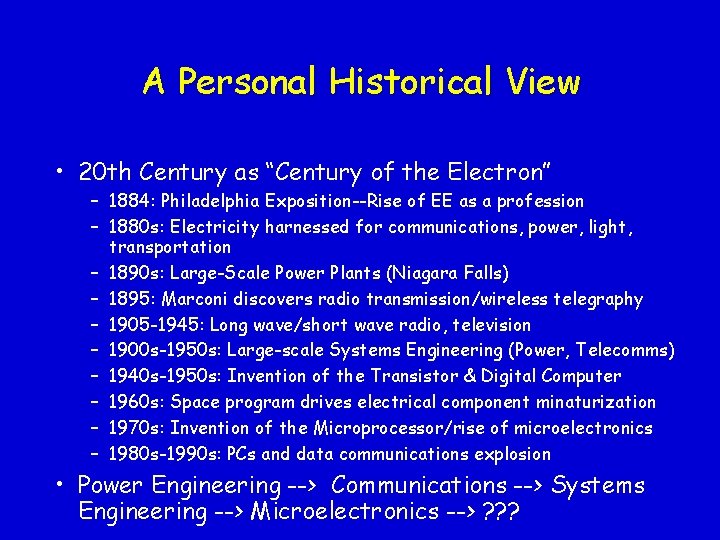
A Personal Historical View • 20 th Century as “Century of the Electron” – 1884: Philadelphia Exposition--Rise of EE as a profession – 1880 s: Electricity harnessed for communications, power, light, transportation – 1890 s: Large-Scale Power Plants (Niagara Falls) – 1895: Marconi discovers radio transmission/wireless telegraphy – 1905 -1945: Long wave/short wave radio, television – 1900 s-1950 s: Large-scale Systems Engineering (Power, Telecomms) – 1940 s-1950 s: Invention of the Transistor & Digital Computer – 1960 s: Space program drives electrical component minaturization – 1970 s: Invention of the Microprocessor/rise of microelectronics – 1980 s-1990 s: PCs and data communications explosion • Power Engineering --> Communications --> Systems Engineering --> Microelectronics --> ? ? ?
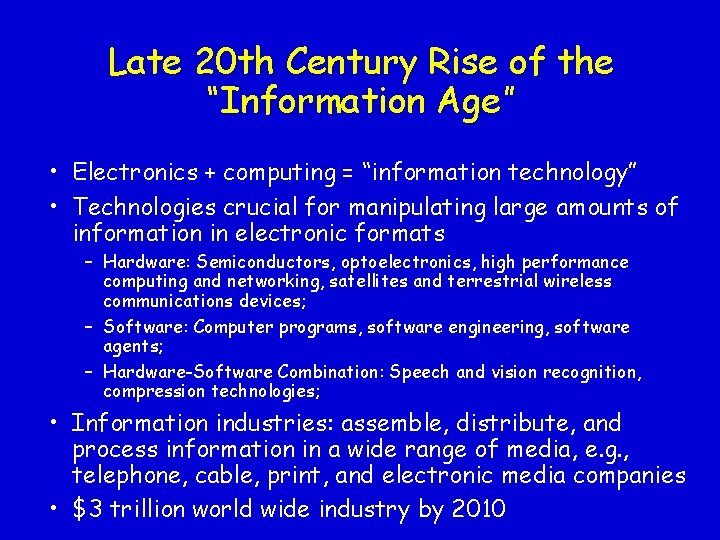
Late 20 th Century Rise of the “Information Age” • Electronics + computing = “information technology” • Technologies crucial for manipulating large amounts of information in electronic formats – Hardware: Semiconductors, optoelectronics, high performance computing and networking, satellites and terrestrial wireless communications devices; – Software: Computer programs, software engineering, software agents; – Hardware-Software Combination: Speech and vision recognition, compression technologies; • Information industries: assemble, distribute, and process information in a wide range of media, e. g. , telephone, cable, print, and electronic media companies • $3 trillion world wide industry by 2010
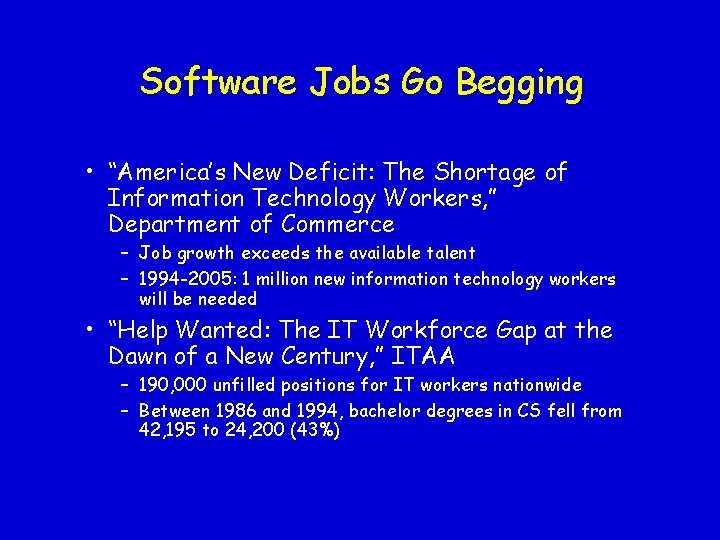
Software Jobs Go Begging • “America’s New Deficit: The Shortage of Information Technology Workers, ” Department of Commerce – Job growth exceeds the available talent – 1994 -2005: 1 million new information technology workers will be needed • “Help Wanted: The IT Workforce Gap at the Dawn of a New Century, ” ITAA – 190, 000 unfilled positions for IT workers nationwide – Between 1986 and 1994, bachelor degrees in CS fell from 42, 195 to 24, 200 (43%)
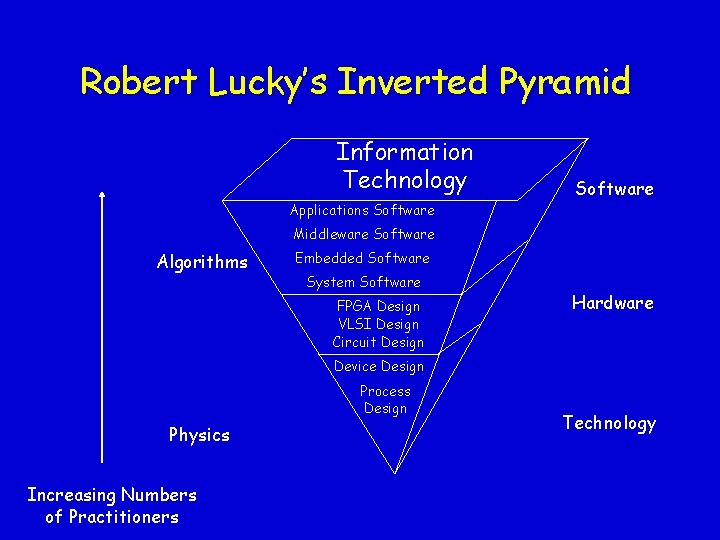
Robert Lucky’s Inverted Pyramid Information Technology Applications Software Middleware Software Algorithms Embedded Software System Software FPGA Design VLSI Design Circuit Design Hardware Device Design Process Design Physics Increasing Numbers of Practitioners Technology
Agenda • • • The Information Age EECS Department at Berkeley Student Enrollment Pressures Random Thoughts and Recommendations Summary and Conclusions
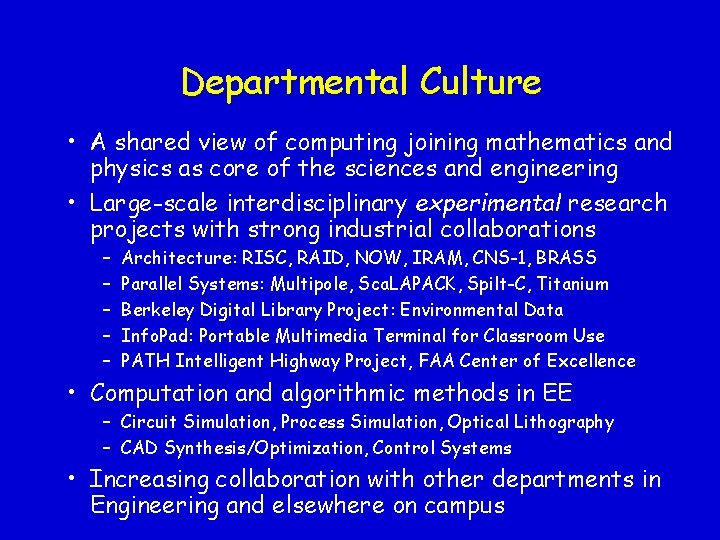
Departmental Culture • A shared view of computing joining mathematics and physics as core of the sciences and engineering • Large-scale interdisciplinary experimental research projects with strong industrial collaborations – – – Architecture: RISC, RAID, NOW, IRAM, CNS-1, BRASS Parallel Systems: Multipole, Sca. LAPACK, Spilt-C, Titanium Berkeley Digital Library Project: Environmental Data Info. Pad: Portable Multimedia Terminal for Classroom Use PATH Intelligent Highway Project, FAA Center of Excellence • Computation and algorithmic methods in EE – Circuit Simulation, Process Simulation, Optical Lithography – CAD Synthesis/Optimization, Control Systems • Increasing collaboration with other departments in Engineering and elsewhere on campus
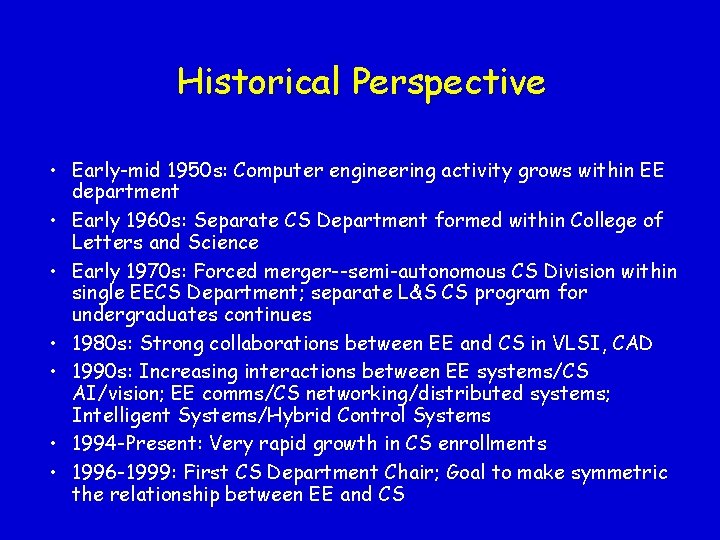
Historical Perspective • Early-mid 1950 s: Computer engineering activity grows within EE department • Early 1960 s: Separate CS Department formed within College of Letters and Science • Early 1970 s: Forced merger--semi-autonomous CS Division within single EECS Department; separate L&S CS program for undergraduates continues • 1980 s: Strong collaborations between EE and CS in VLSI, CAD • 1990 s: Increasing interactions between EE systems/CS AI/vision; EE comms/CS networking/distributed systems; Intelligent Systems/Hybrid Control Systems • 1994 -Present: Very rapid growth in CS enrollments • 1996 -1999: First CS Department Chair; Goal to make symmetric the relationship between EE and CS
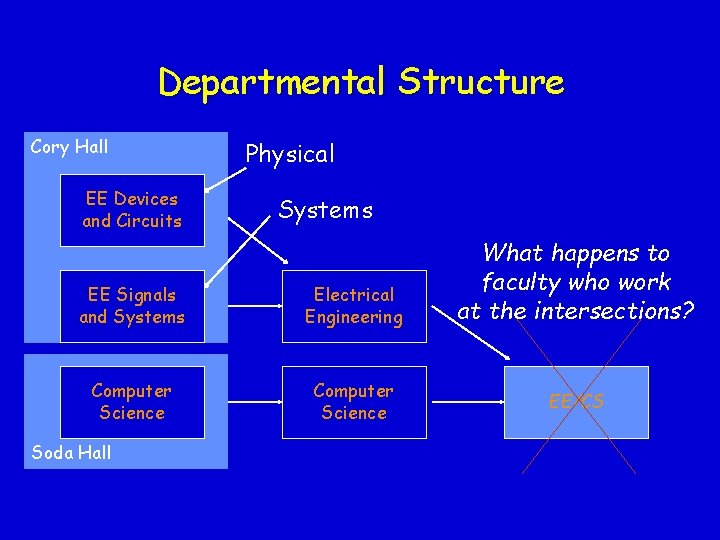
Departmental Structure Cory Hall EE Devices and Circuits Physical Systems EE Signals and Systems Electrical Engineering Computer Science Soda Hall What happens to faculty who work at the intersections? EE/CS
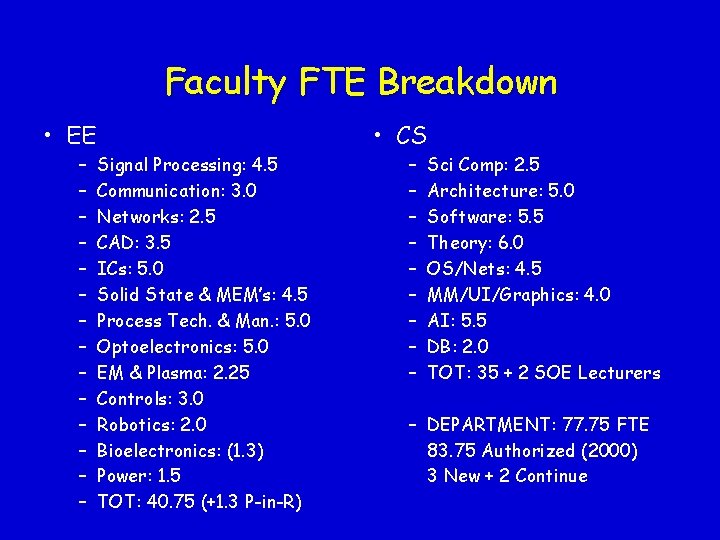
Faculty FTE Breakdown • EE – – – – • CS Signal Processing: 4. 5 Communication: 3. 0 Networks: 2. 5 CAD: 3. 5 ICs: 5. 0 Solid State & MEM’s: 4. 5 Process Tech. & Man. : 5. 0 Optoelectronics: 5. 0 EM & Plasma: 2. 25 Controls: 3. 0 Robotics: 2. 0 Bioelectronics: (1. 3) Power: 1. 5 TOT: 40. 75 (+1. 3 P-in-R) – – – – – Sci Comp: 2. 5 Architecture: 5. 0 Software: 5. 5 Theory: 6. 0 OS/Nets: 4. 5 MM/UI/Graphics: 4. 0 AI: 5. 5 DB: 2. 0 TOT: 35 + 2 SOE Lecturers – DEPARTMENT: 77. 75 FTE 83. 75 Authorized (2000) 3 New + 2 Continue
Agenda • • • The Information Age EECS Department at Berkeley Student Enrollment Pressures Random Thoughts and Recommendations Summary and Conclusions
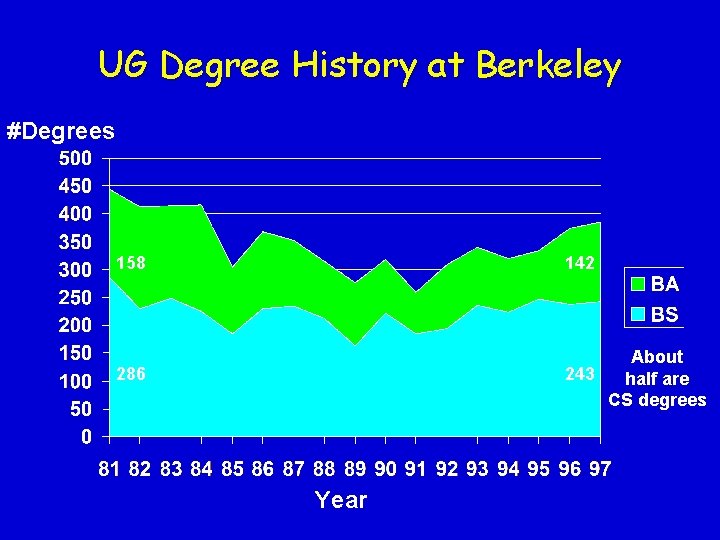
UG Degree History at Berkeley #Degrees 158 142 286 About 243 half are CS degrees Year
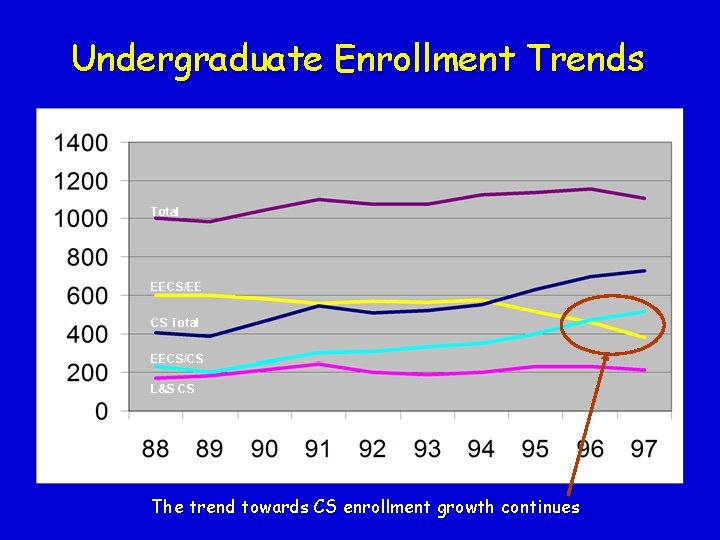
Undergraduate Enrollment Trends Total EECS/EE CS Total EECS/CS L&S CS The trend towards CS enrollment growth continues
A New Vision for EECS “If we want everything to stay as it is, it will be necessary for everything to change. ” Giuseppe Tomasi Di Lampedusa (1896 -1957)
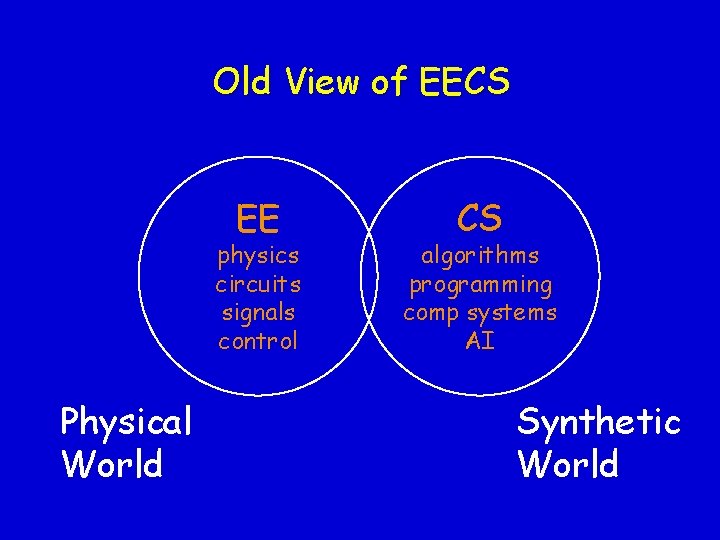
Old View of EECS EE physics circuits signals control Physical World CS algorithms programming comp systems AI Synthetic World
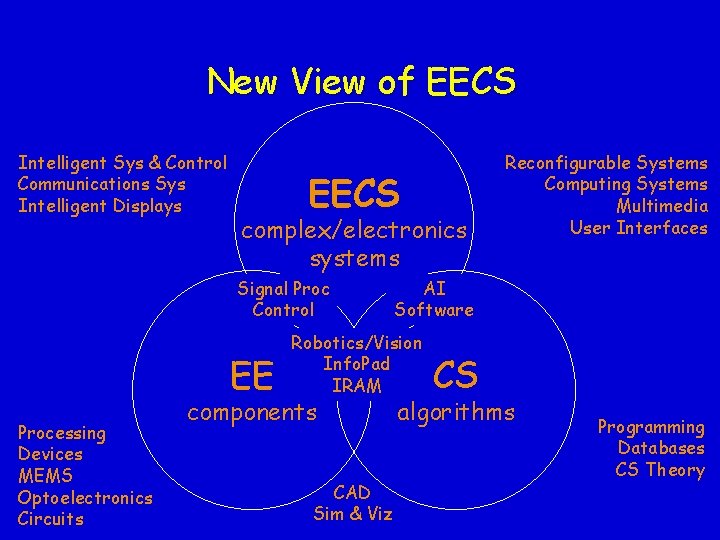
New View of EECS Intelligent Sys & Control Communications Sys Intelligent Displays EECS complex/electronics systems Signal Proc Control EE Processing Devices MEMS Optoelectronics Circuits AI Software Robotics/Vision Info. Pad IRAM components CAD Sim & Viz Reconfigurable Systems Computing Systems Multimedia User Interfaces CS algorithms Programming Databases CS Theory
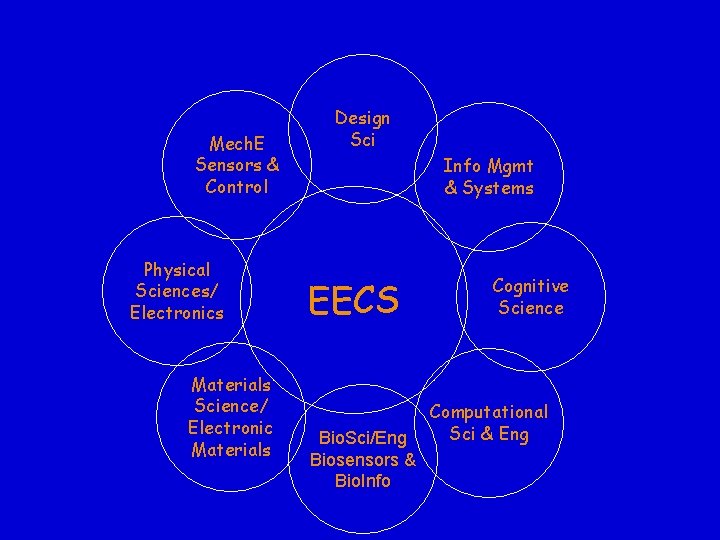
Mech. E Sensors & Control Physical Sciences/ Electronics Materials Science/ Electronic Materials Design Sci Info Mgmt & Systems EECS Bio. Sci/Eng Biosensors & Bio. Info Cognitive Science Computational Sci & Eng
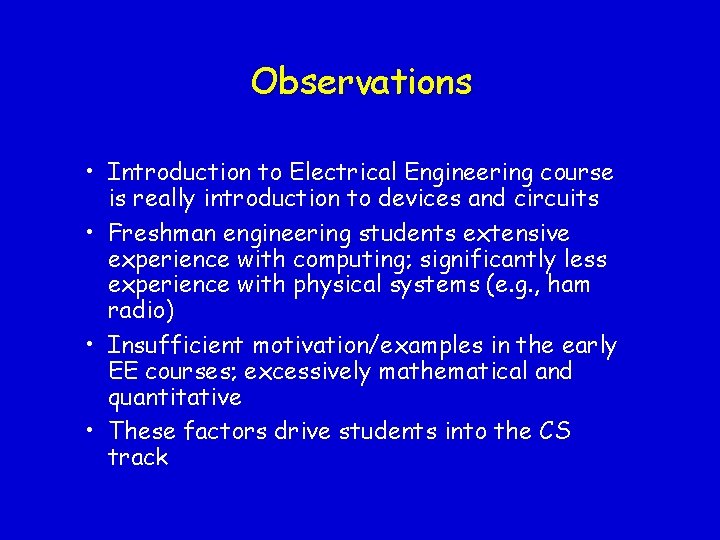
Observations • Introduction to Electrical Engineering course is really introduction to devices and circuits • Freshman engineering students extensive experience with computing; significantly less experience with physical systems (e. g. , ham radio) • Insufficient motivation/examples in the early EE courses; excessively mathematical and quantitative • These factors drive students into the CS track
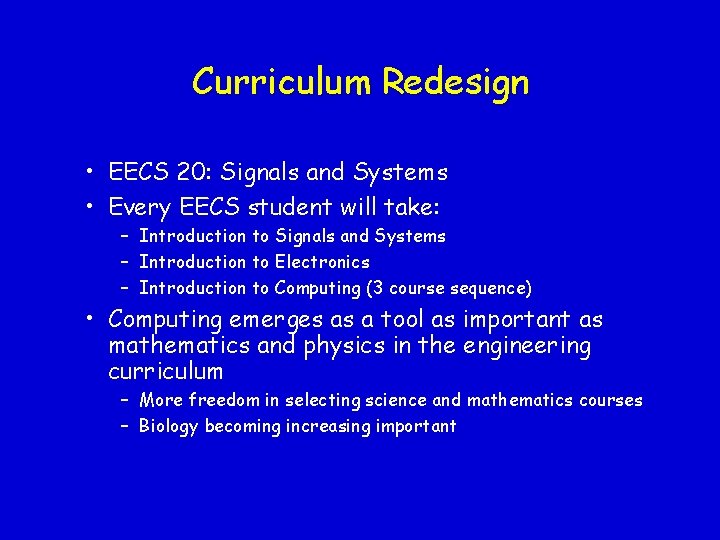
Curriculum Redesign • EECS 20: Signals and Systems • Every EECS student will take: – Introduction to Signals and Systems – Introduction to Electronics – Introduction to Computing (3 course sequence) • Computing emerges as a tool as important as mathematics and physics in the engineering curriculum – More freedom in selecting science and mathematics courses – Biology becoming increasing important
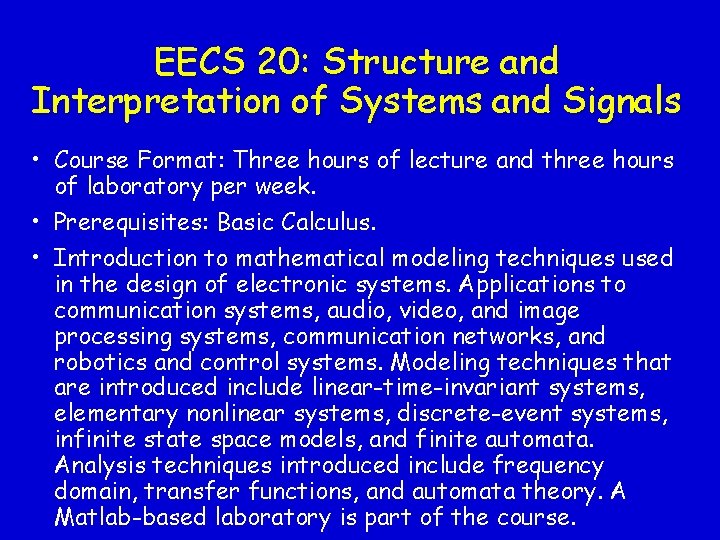
EECS 20: Structure and Interpretation of Systems and Signals • Course Format: Three hours of lecture and three hours of laboratory per week. • Prerequisites: Basic Calculus. • Introduction to mathematical modeling techniques used in the design of electronic systems. Applications to communication systems, audio, video, and image processing systems, communication networks, and robotics and control systems. Modeling techniques that are introduced include linear-time-invariant systems, elementary nonlinear systems, discrete-event systems, infinite state space models, and finite automata. Analysis techniques introduced include frequency domain, transfer functions, and automata theory. A Matlab-based laboratory is part of the course.
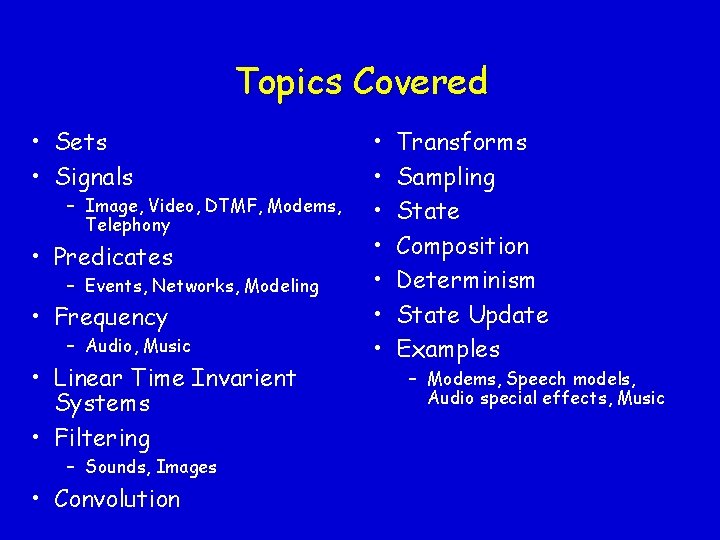
Topics Covered • Sets • Signals – Image, Video, DTMF, Modems, Telephony • Predicates – Events, Networks, Modeling • Frequency – Audio, Music • Linear Time Invarient Systems • Filtering – Sounds, Images • Convolution • • Transforms Sampling State Composition Determinism State Update Examples – Modems, Speech models, Audio special effects, Music
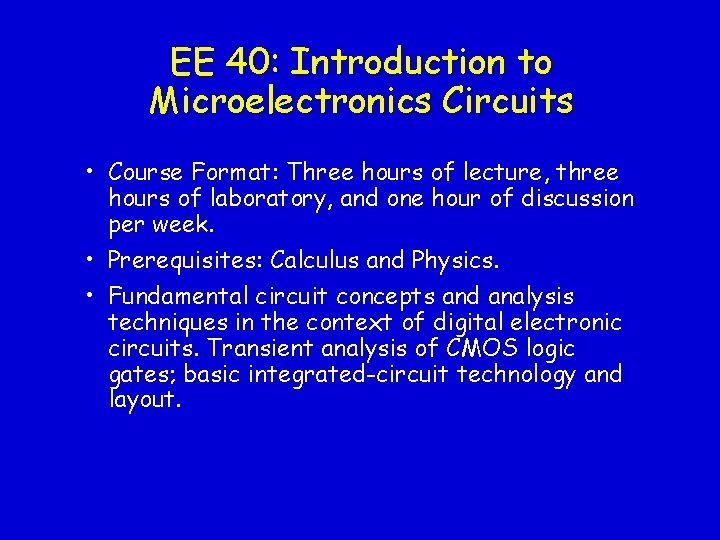
EE 40: Introduction to Microelectronics Circuits • Course Format: Three hours of lecture, three hours of laboratory, and one hour of discussion per week. • Prerequisites: Calculus and Physics. • Fundamental circuit concepts and analysis techniques in the context of digital electronic circuits. Transient analysis of CMOS logic gates; basic integrated-circuit technology and layout.
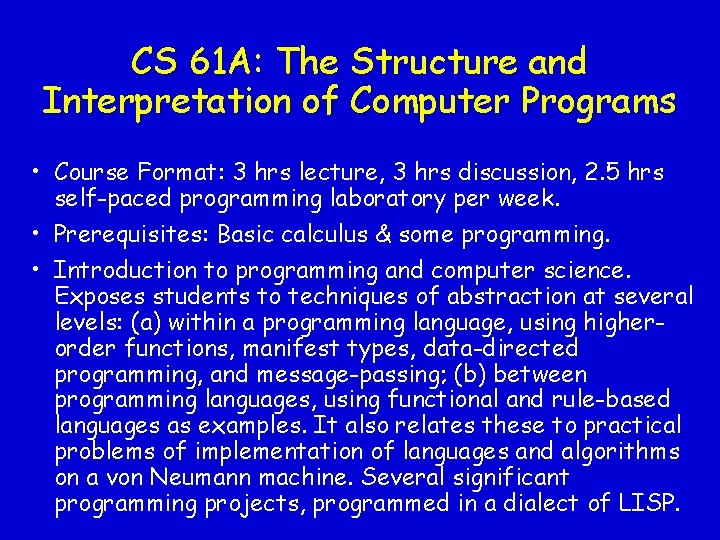
CS 61 A: The Structure and Interpretation of Computer Programs • Course Format: 3 hrs lecture, 3 hrs discussion, 2. 5 hrs self-paced programming laboratory per week. • Prerequisites: Basic calculus & some programming. • Introduction to programming and computer science. Exposes students to techniques of abstraction at several levels: (a) within a programming language, using higherorder functions, manifest types, data-directed programming, and message-passing; (b) between programming languages, using functional and rule-based languages as examples. It also relates these to practical problems of implementation of languages and algorithms on a von Neumann machine. Several significant programming projects, programmed in a dialect of LISP.
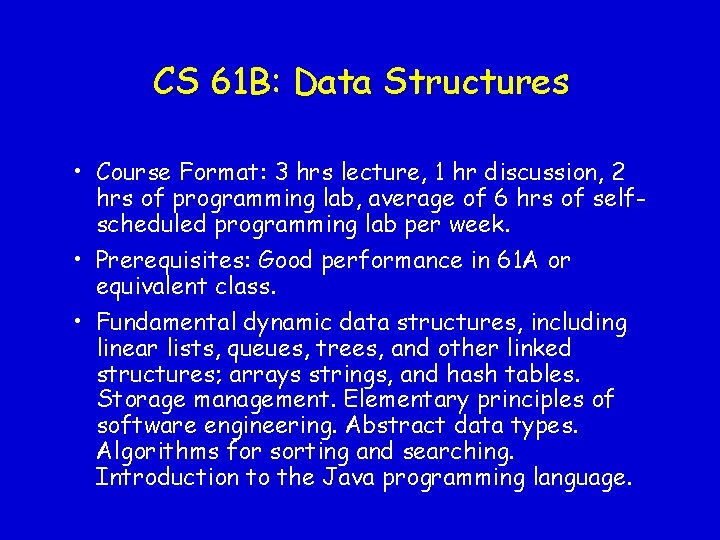
CS 61 B: Data Structures • Course Format: 3 hrs lecture, 1 hr discussion, 2 hrs of programming lab, average of 6 hrs of selfscheduled programming lab per week. • Prerequisites: Good performance in 61 A or equivalent class. • Fundamental dynamic data structures, including linear lists, queues, trees, and other linked structures; arrays strings, and hash tables. Storage management. Elementary principles of software engineering. Abstract data types. Algorithms for sorting and searching. Introduction to the Java programming language.
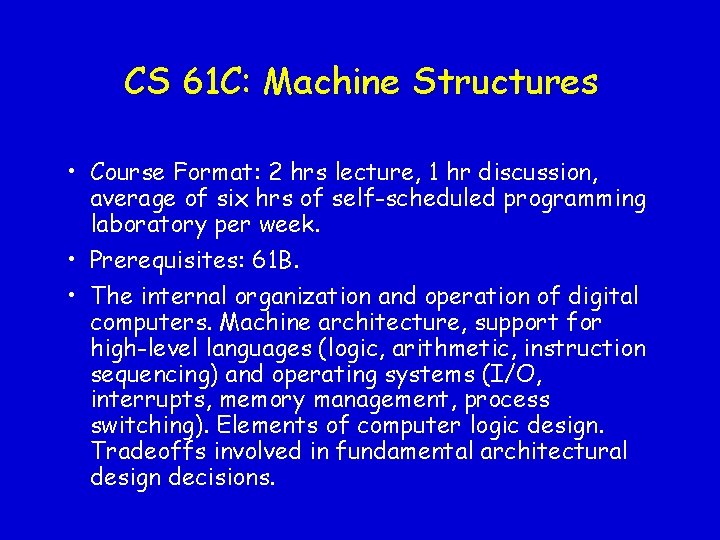
CS 61 C: Machine Structures • Course Format: 2 hrs lecture, 1 hr discussion, average of six hrs of self-scheduled programming laboratory per week. • Prerequisites: 61 B. • The internal organization and operation of digital computers. Machine architecture, support for high-level languages (logic, arithmetic, instruction sequencing) and operating systems (I/O, interrupts, memory management, process switching). Elements of computer logic design. Tradeoffs involved in fundamental architectural design decisions.
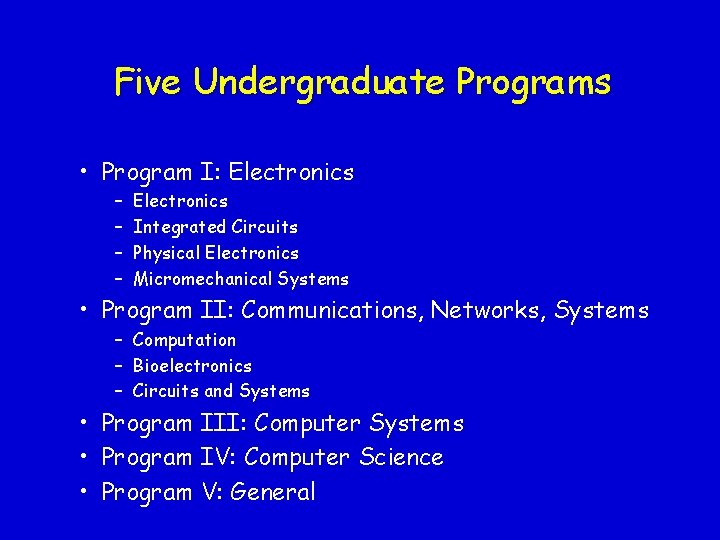
Five Undergraduate Programs • Program I: Electronics – – Electronics Integrated Circuits Physical Electronics Micromechanical Systems • Program II: Communications, Networks, Systems – Computation – Bioelectronics – Circuits and Systems • Program III: Computer Systems • Program IV: Computer Science • Program V: General
Agenda • • • The Information Age EECS Department at Berkeley Student Enrollment Pressures Random Thoughts and Recommendations Summary and Conclusions
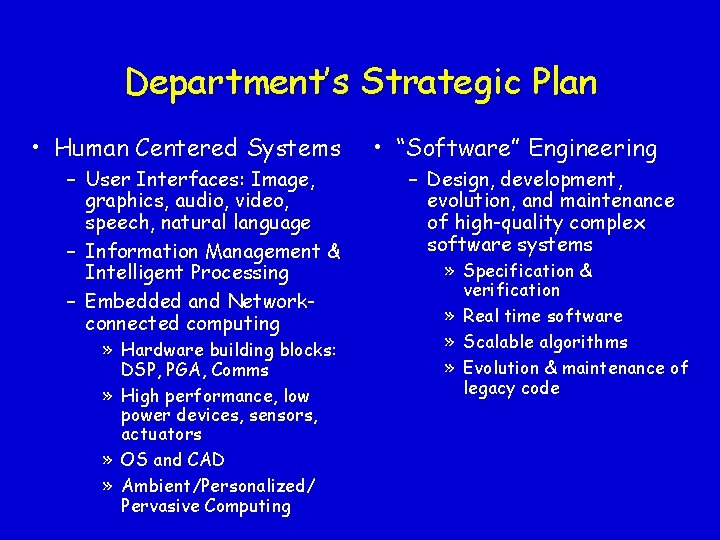
Department’s Strategic Plan • Human Centered Systems – User Interfaces: Image, graphics, audio, video, speech, natural language – Information Management & Intelligent Processing – Embedded and Networkconnected computing » Hardware building blocks: DSP, PGA, Comms » High performance, low power devices, sensors, actuators » OS and CAD » Ambient/Personalized/ Pervasive Computing • “Software” Engineering – Design, development, evolution, and maintenance of high-quality complex software systems » Specification & verification » Real time software » Scalable algorithms » Evolution & maintenance of legacy code
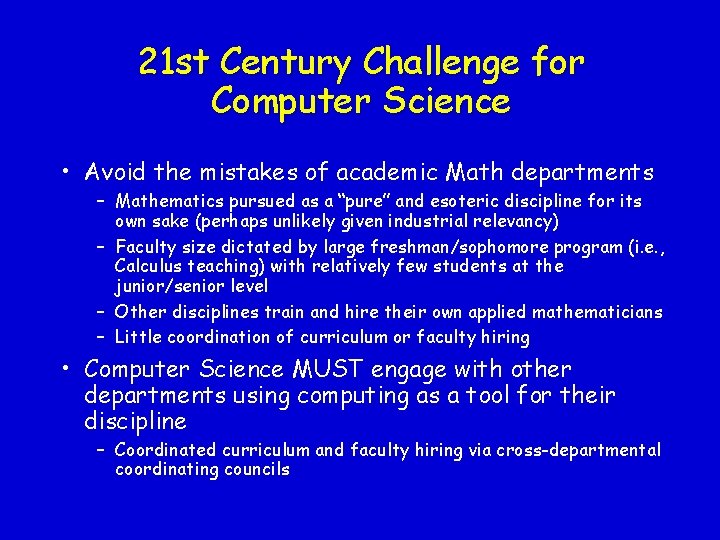
21 st Century Challenge for Computer Science • Avoid the mistakes of academic Math departments – Mathematics pursued as a “pure” and esoteric discipline for its own sake (perhaps unlikely given industrial relevancy) – Faculty size dictated by large freshman/sophomore program (i. e. , Calculus teaching) with relatively few students at the junior/senior level – Other disciplines train and hire their own applied mathematicians – Little coordination of curriculum or faculty hiring • Computer Science MUST engage with other departments using computing as a tool for their discipline – Coordinated curriculum and faculty hiring via cross-departmental coordinating councils
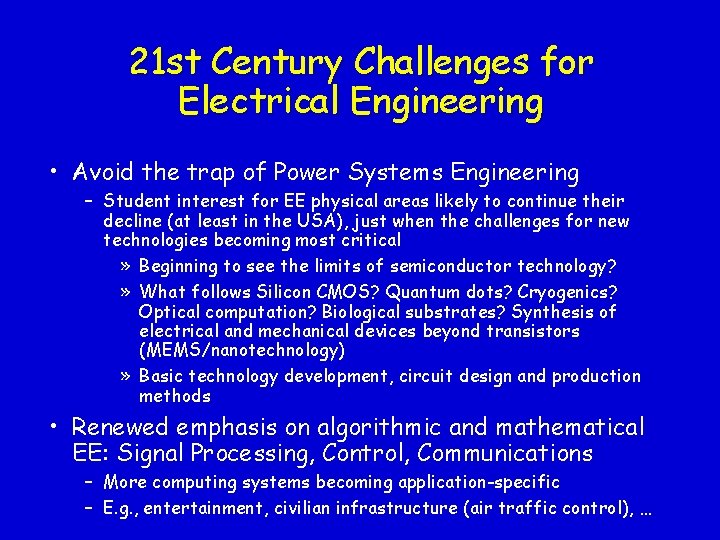
21 st Century Challenges for Electrical Engineering • Avoid the trap of Power Systems Engineering – Student interest for EE physical areas likely to continue their decline (at least in the USA), just when the challenges for new technologies becoming most critical » Beginning to see the limits of semiconductor technology? » What follows Silicon CMOS? Quantum dots? Cryogenics? Optical computation? Biological substrates? Synthesis of electrical and mechanical devices beyond transistors (MEMS/nanotechnology) » Basic technology development, circuit design and production methods • Renewed emphasis on algorithmic and mathematical EE: Signal Processing, Control, Communications – More computing systems becoming application-specific – E. g. , entertainment, civilian infrastructure (air traffic control), …
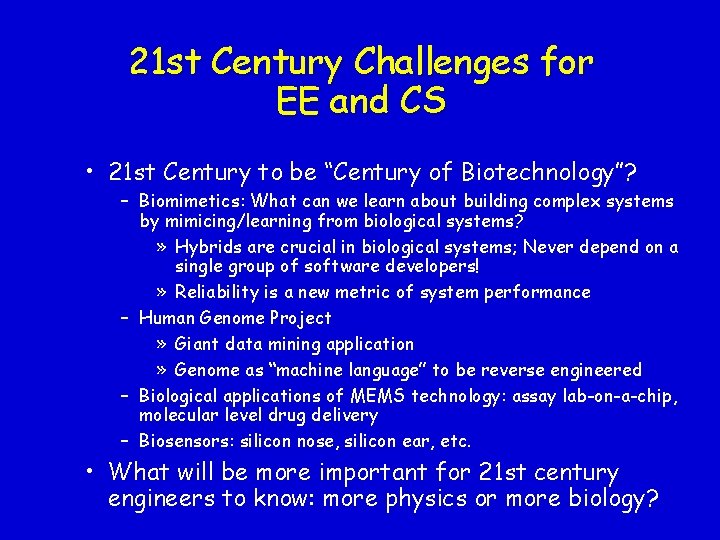
21 st Century Challenges for EE and CS • 21 st Century to be “Century of Biotechnology”? – Biomimetics: What can we learn about building complex systems by mimicing/learning from biological systems? » Hybrids are crucial in biological systems; Never depend on a single group of software developers! » Reliability is a new metric of system performance – Human Genome Project » Giant data mining application » Genome as “machine language” to be reverse engineered – Biological applications of MEMS technology: assay lab-on-a-chip, molecular level drug delivery – Biosensors: silicon nose, silicon ear, etc. • What will be more important for 21 st century engineers to know: more physics or more biology?
Example: Affymetrix www. affymetrix. com • Develops chips used in the acquisition, analysis, & management of genetic information for biomedical research, genomics, & clinical diagnostics • Gene. Chip system: disposable DNA probe arrays containing specific gene sequences, instruments to process the arrays, & bioinformatics software • IC company? Software company? Bioengineering company? Biotech company?
Should EE and CS Be Separate Departments? • EEs need extensive computing: will spawn competing Computer Engineering activity anyway • Much productive collaborative at intersection of EE and CS: CAD, Architecture, Signal Processing, Control/Intelligent Systems, Comms/Networking • But all quantitative fields are becoming as computational as EE; e. g. , transportation systems in Civil. Eng • Will natural center of gravity of CS move towards cognitive science, linguistics, economics, biology?
Agenda • • • The Information Age EECS Department at Berkeley Student Enrollment Pressures Random Thoughts and Recommendations Summary and Conclusions
Summary and Conclusions • Fantastic time for the IT fields of EE and CS – As we approach 2001, we are in the Information Age, not the Space Age! – BUT, strong shift in student interest from the physical side of EE towards the algorithmic side of CS • Challenge for CS – Avoid mistakes of math as an academic discipline – Coordinate with other fields as they add computing expertise to their faculties • Challenge for EE – What will be the key information system implementation technology of 21 st century? • Challenge for EE and CS – How to contribute to the Biotech revolution of the next century