
Newtons Laws of Motion Chapter 4 Forces A

- Slides: 15
Newton’s Laws of Motion Chapter 4
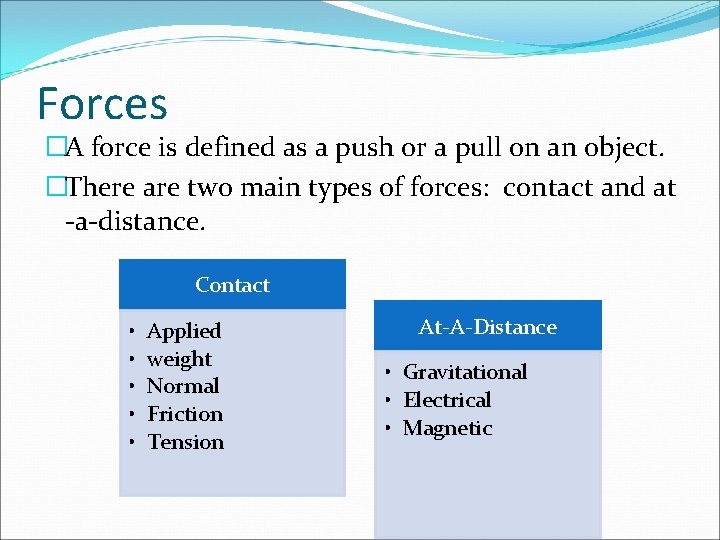
Forces �A force is defined as a push or a pull on an object. �There are two main types of forces: contact and at -a-distance. Contact • • • Applied weight Normal Friction Tension At-A-Distance • Gravitational • Electrical • Magnetic
Forces �Applied: any force directly applied to an object by a person or thing �Weight: the product of mass x gravity, measured in Newtons �Normal: the force exerted on an object from a surface. Will always act perpendicular to the surface. �Tension: forces extended through ropes, wires, or cables. �Friction: force created when surfaces are in contact with one another.
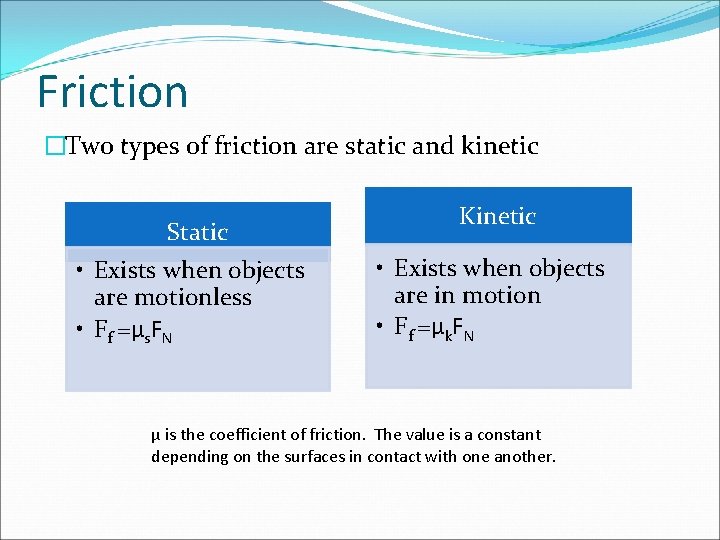
Friction �Two types of friction are static and kinetic Static • Exists when objects are motionless • Ff =μs. FN Kinetic • Exists when objects are in motion • Ff =μk. FN μ is the coefficient of friction. The value is a constant depending on the surfaces in contact with one another.
Gravity �All objects with mass possess a gravitational attraction to all other objects with mass. �Gravity is an at-a-distance force. �On earth, the force of gravity is a fairly constant value of 9. 8 N. �In other words, the Earth will accelerate a 1 kg object at a rate of 9. 8 m/s 2
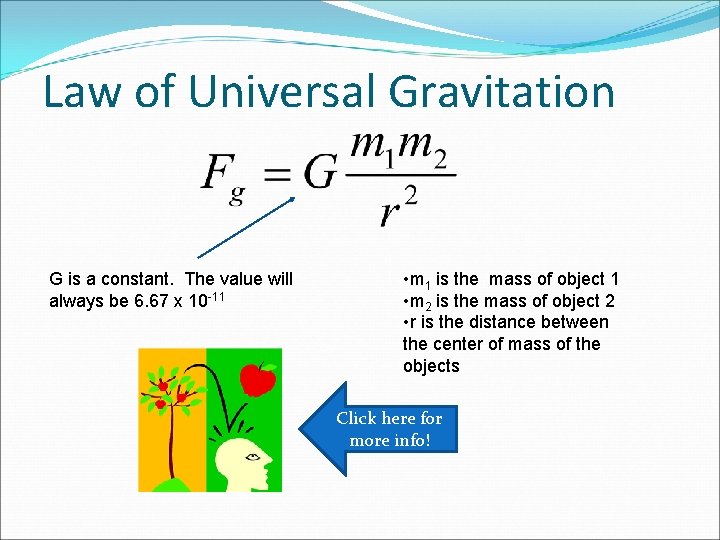
Law of Universal Gravitation G is a constant. The value will always be 6. 67 x 10 -11 • m 1 is the mass of object 1 • m 2 is the mass of object 2 • r is the distance between the center of mass of the objects Click here for more info!
Forces �All forces have the SI unit of Newtons (N) �Forces cause objects to move, change motion, or stop moving. �Forces causes objects with mass to accelerate. �Inertia is NOT a force. �More than one force can act on an object at any given time.
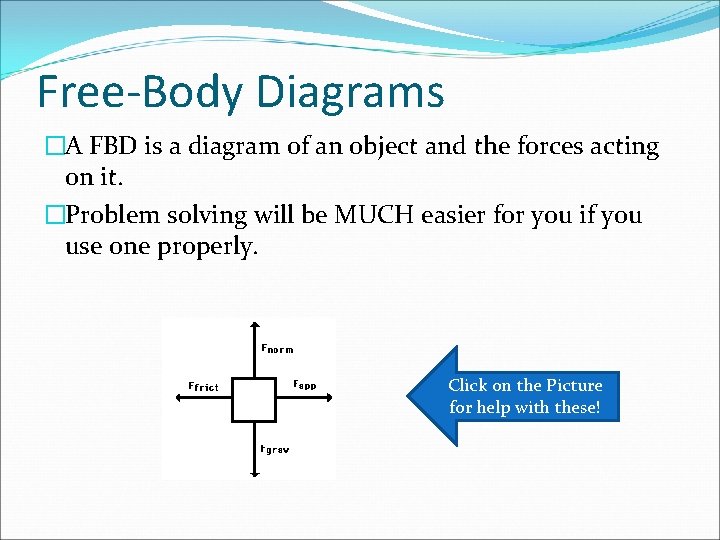
Free-Body Diagrams �A FBD is a diagram of an object and the forces acting on it. �Problem solving will be MUCH easier for you if you use one properly. Click on the Picture for help with these!
Newton’s st 1 Law of Motion �Objects in motion tend to stay in motion, objects at rest tend to stay at rest until acted on by an unbalanced force. �Also called the “Law of Inertia. ” �Inertia is: �A property of matter that depends on the mass of an object. �A resistance to change in motion (or lack thereof)
Newton’s nd 2 Law of Motion �The net force acting on a mass is directly proportional to the acceleration. �Net force is the vector sum of all forces acting on an object. �When supplied a constant force, the acceleration and mass of an object are inversely proportional.
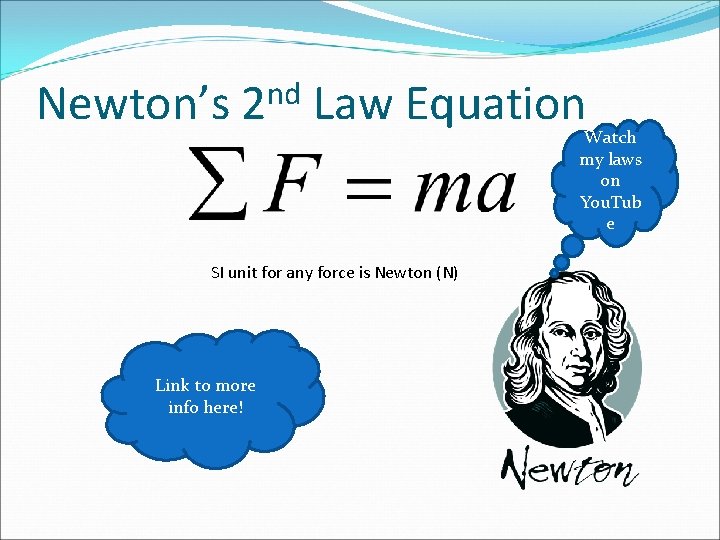
Newton’s nd 2 Law Equation SI unit for any force is Newton (N) Link to more info here! Watch my laws on You. Tub e
ΣF �The sum of the forces acting on an object is the VECTOR sum of all forces. �Free body diagrams help identify the forces. �Analyze forces using x- and y- components. �Recombine x- and y- components after solving for both directions first. �Finally, plug vector sum into Newton’s 2 nd Law equation.
Try One � A pack of five Arctic wolves are exerting five different forces upon the carcass of a 500 -kg dead polar bear. A top view showing the magnitude and direction of each of the five individual forces is shown in the diagram at the right. The counterclockwise convention is used to indicate the direction of each force vector. Remember that this is a top view of the situation and as such does not depict the gravitational and normal forces (since they would be perpendicular to the plane of your computer monitor); it can be assumed that the gravitational and normal forces balance each other. Use a scaled vector diagram to determine the net force acting upon the polar bear. Then compute the acceleration of the polar bear (both magnitude and direction). When finished, check your answer by clicking the button and then view the solution to the problem by analyzing the diagrams shown below.
Newton’s rd 3 Law of Motion �For every action, there is an equal and opposite reaction. �For every force, there is an equal and opposite force. �Forces are never applied to an object without the object applying a force back! This shou video ld he lp!