
Newtons Laws kinematics the describing of HOW things
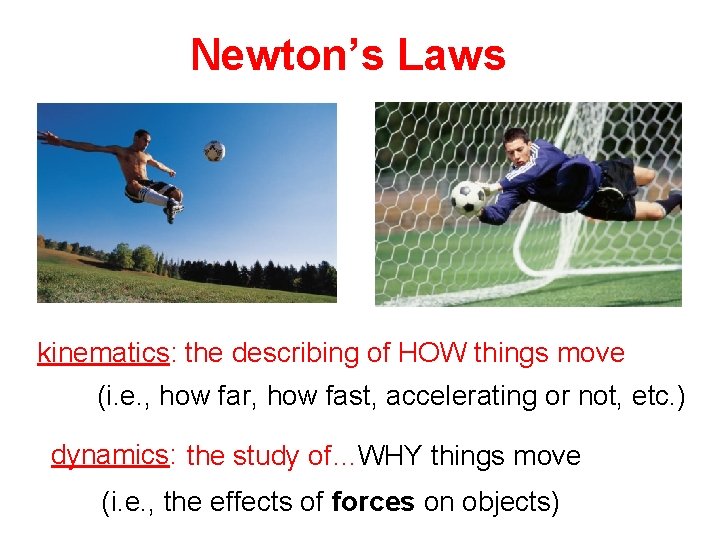
Newton’s Laws kinematics: the describing of HOW things move (i. e. , how far, how fast, accelerating or not, etc. ) dynamics: the study of…WHY things move (i. e. , the effects of forces on objects)
The Beginnings of Dynamics Aristotle (384– 322 B. C. E. ) didn’t experiment, but claimed: -- heavier things fall faster -- forces arise from matter…seeking to return to its “natural” place e. g. , smoke drifting upward, rivers flowing to the sea, boulders rolling down a mountain
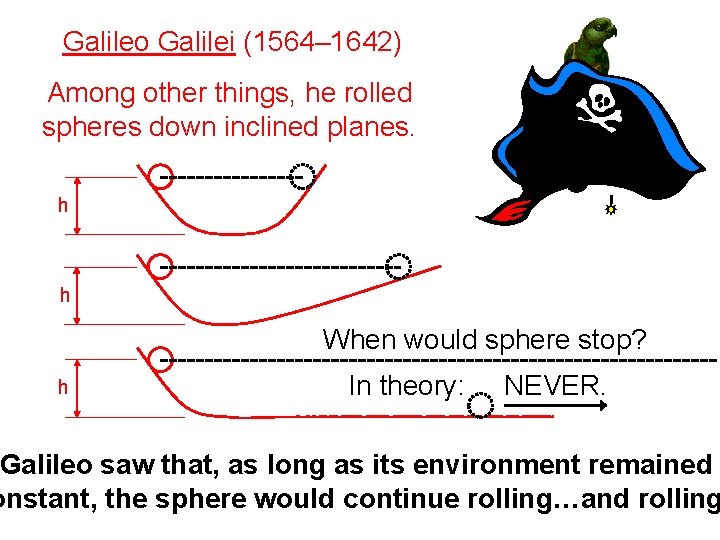
Galileo Galilei (1564– 1642) Among other things, he rolled spheres down inclined planes. h h When would sphere stop? h In theory: NEVER. Galileo saw that, as long as its environment remained onstant, the sphere would continue rolling…and rolling
Newton’s First Law of Motion (Law of Inertia) An object at rest tends to stay at rest – and an object in motion tends to stay in motion at constant velocity – unless the object is acted upon by an unbalanced, external force. The Law of Inertia is universal: It applies to all objects, moving and nonmoving, massive or not.
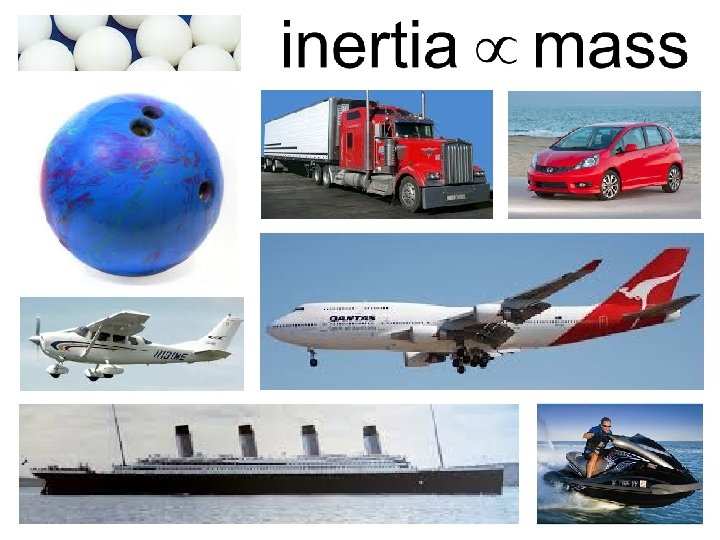
FINAL THOUGHTS: Introduction to Dynamics 1. Kinematics deals with motion’s “whats”: Dd, v, a, Dt. Dynamics deals with the WHY of motion: forces. Of course, forces influence the whats of kinematics. 2. Aristotle said that forces in nature were the result of things seeking their natural place. 3. Galileo realized that continually-applied forces were not necessary to keep an object in motion. 4. Newton’s Law of Inertia says that objects tend to maintain their state of motion. The more inertia they have (due to their mass), the more they “want” to maintain that state of motion. www. teachnlearnchem. com
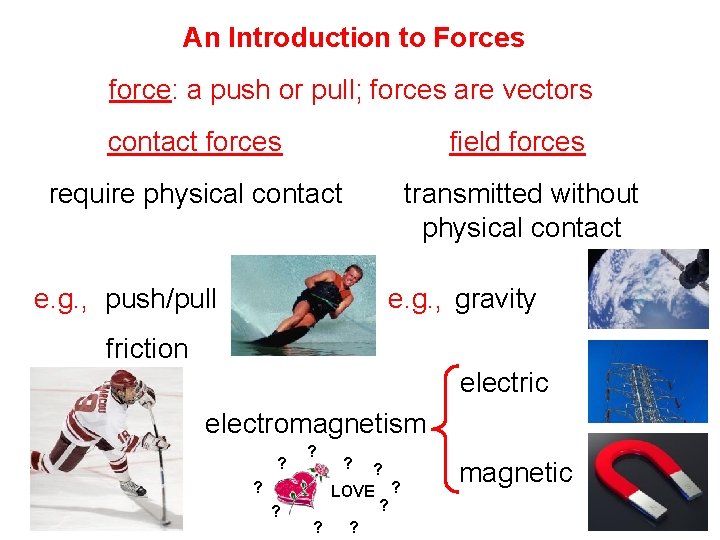
An Introduction to Forces force: a push or pull; forces are vectors contact forces field forces require physical contact transmitted without physical contact e. g. , push/pull e. g. , gravity friction electric electromagnetism ? ? ? ? LOVE ? ? magnetic
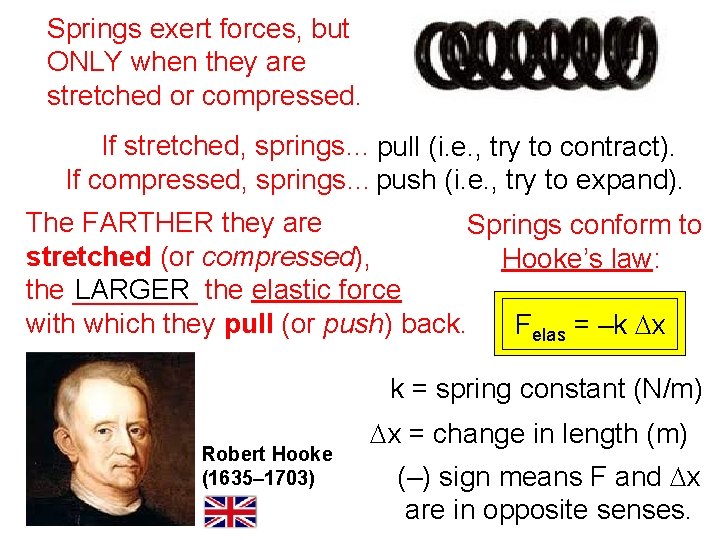
Springs exert forces, but ONLY when they are stretched or compressed. If stretched, springs… pull (i. e. , try to contract). If compressed, springs… push (i. e. , try to expand). The FARTHER they are Springs conform to stretched (or compressed), Hooke’s law: LARGER the elastic force the ____ with which they pull (or push) back. Felas = –k Dx k = spring constant (N/m) Robert Hooke (1635– 1703) Dx = change in length (m) (–) sign means F and Dx are in opposite senses.
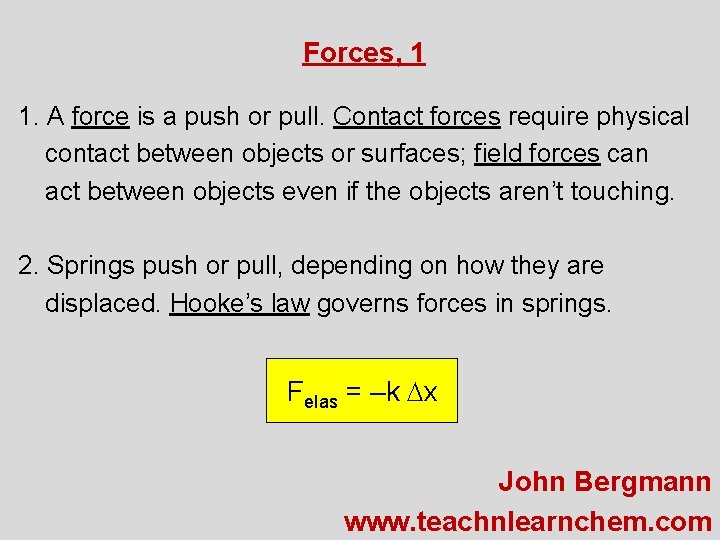
Forces, 1 1. A force is a push or pull. Contact forces require physical contact between objects or surfaces; field forces can act between objects even if the objects aren’t touching. 2. Springs push or pull, depending on how they are displaced. Hooke’s law governs forces in springs. Felas = –k Dx John Bergmann www. teachnlearnchem. com
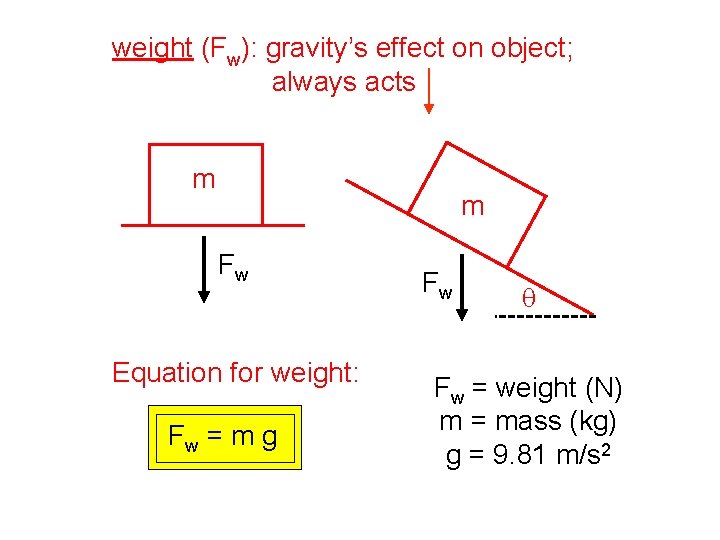
weight (Fw): gravity’s effect on object; always acts m m Fw Equation for weight: Fw = m g Fw q Fw = weight (N) m = mass (kg) g = 9. 81 m/s 2
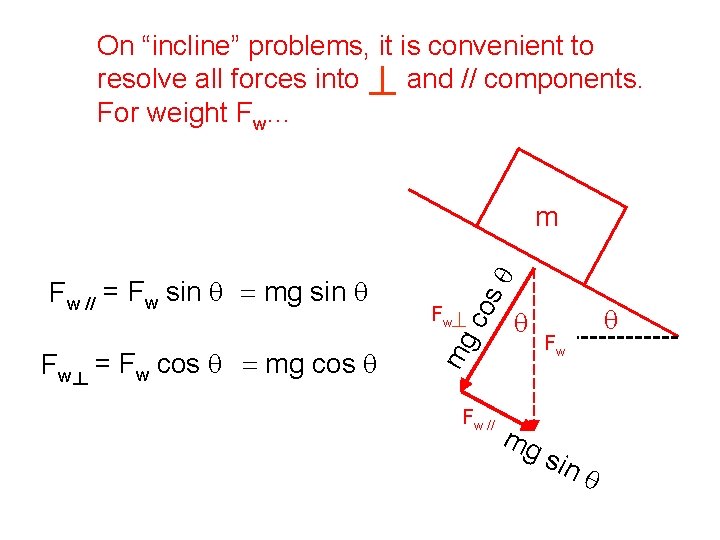
On “incline” problems, it is convenient to resolve all forces into and // components. For weight Fw… Fw = Fw cos q = mg cos q Fw mg Fw // = Fw sin q = mg sin q co sq m Fw // q Fw mg s in q q
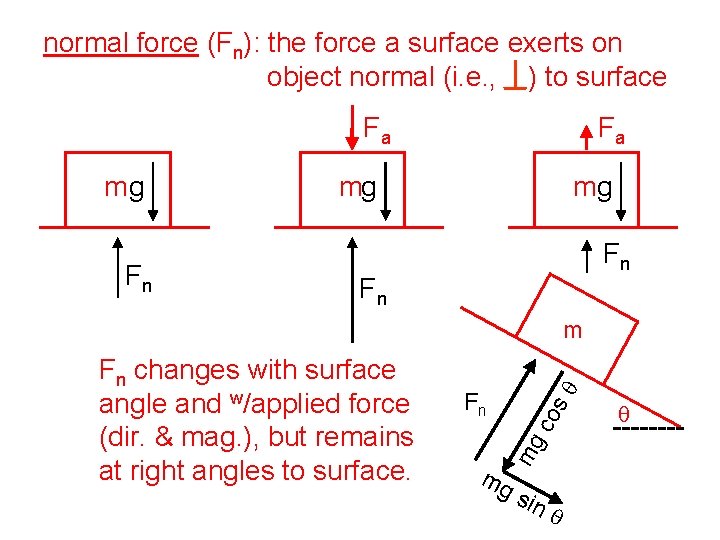
normal force (Fn): the force a surface exerts on object normal (i. e. , ) to surface Fa mg Fn Fa mg mg Fn Fn co Fn mg Fn changes with surface angle and w/applied force (dir. & mag. ), but remains at right angles to surface. sq m mg sin q q
Forces, 2 Weight is the gravitational pull on an object. It always acts straight downward, but can be resolved into components for ease of use in solving certain problems. Fw = m g The normal force is one force a surface exerts on an object. It is always perpendicular to a surface, no matter the orientation of the surface. John Bergmann www. teachnlearnchem. com
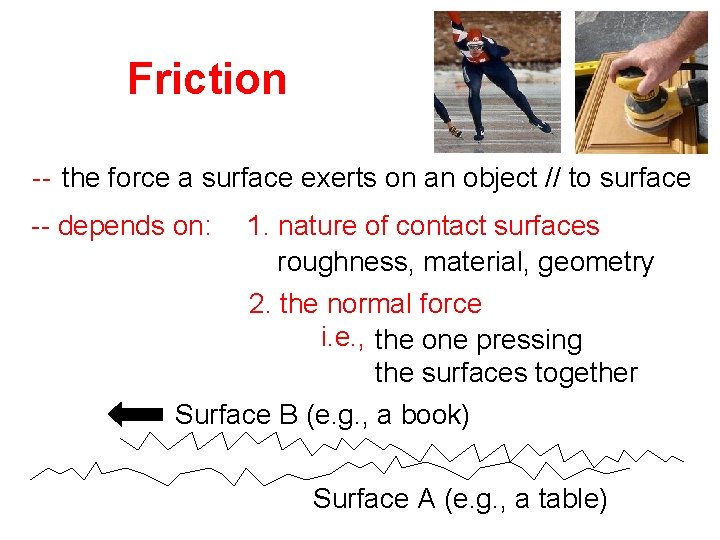
Friction -- the force a surface exerts on an object // to surface -- depends on: 1. nature of contact surfaces roughness, material, geometry 2. the normal force i. e. , the one pressing the surfaces together Surface B (e. g. , a book) Surface A (e. g. , a table)
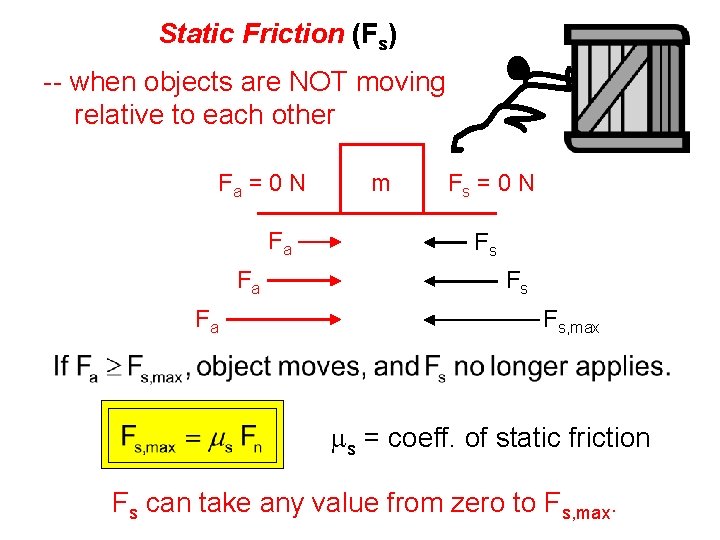
Static Friction (Fs) -- when objects are NOT moving relative to each other Fa = 0 N Fa Fa Fa m Fs = 0 N Fs Fs Fs, max ms = coeff. of static friction Fs can take any value from zero to Fs, max.
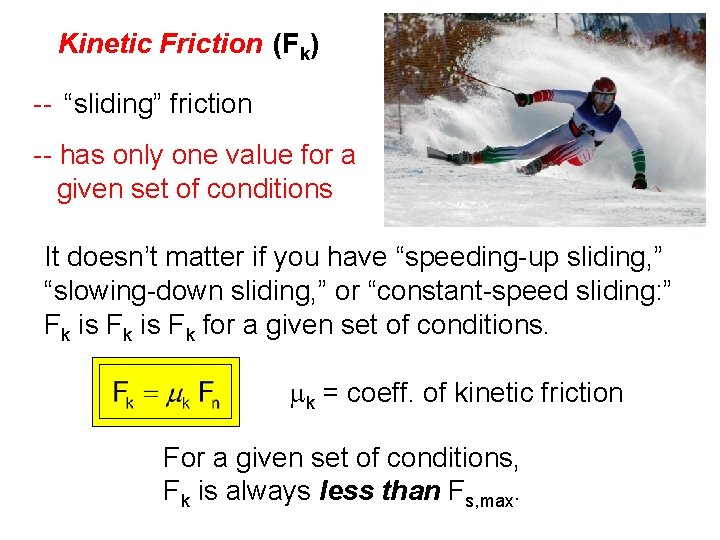
Kinetic Friction (Fk) -- “sliding” friction -- has only one value for a given set of conditions It doesn’t matter if you have “speeding-up sliding, ” “slowing-down sliding, ” or “constant-speed sliding: ” Fk is Fk for a given set of conditions. mk = coeff. of kinetic friction For a given set of conditions, Fk is always less than Fs, max.
FINAL THOUGHTS: Forces, 3 1. While a normal force is the force exerted by a surface on an object perpendicular to the surface, friction acts on the object PARALLEL to the surface. No matter the orientation of the surface, normal and friction forces are at right angles to each other. 2. With static friction, there is no relative motion btwn surface and object, despite sideways forces acting. 3. Kinetic friction is sliding friction. 4. A coefficient of friction is a number that accounts for the nature of the two contact surfaces. Bigger coeffs of friction mean “stickier” surfaces.
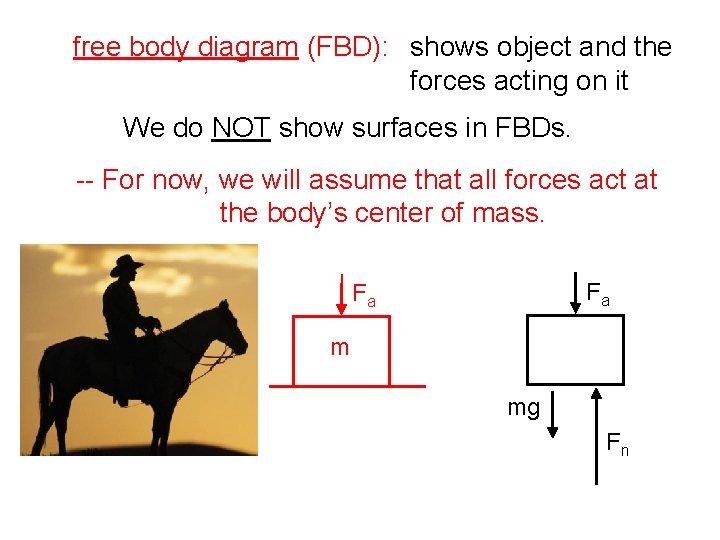
free body diagram (FBD): shows object and the forces acting on it We do NOT show surfaces in FBDs. -- For now, we will assume that all forces act at the body’s center of mass. Fa Fa m mg Fn
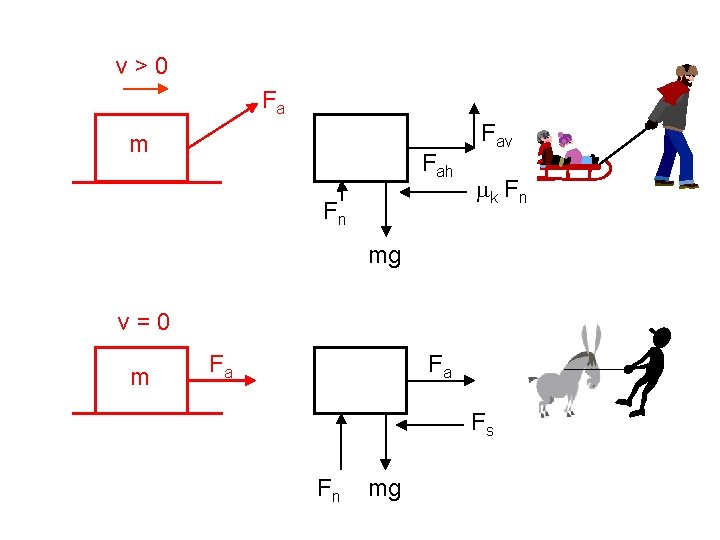
v>0 Fa m Fah Fn Fav mk F n mg v=0 m Fa Fa Fs Fn mg
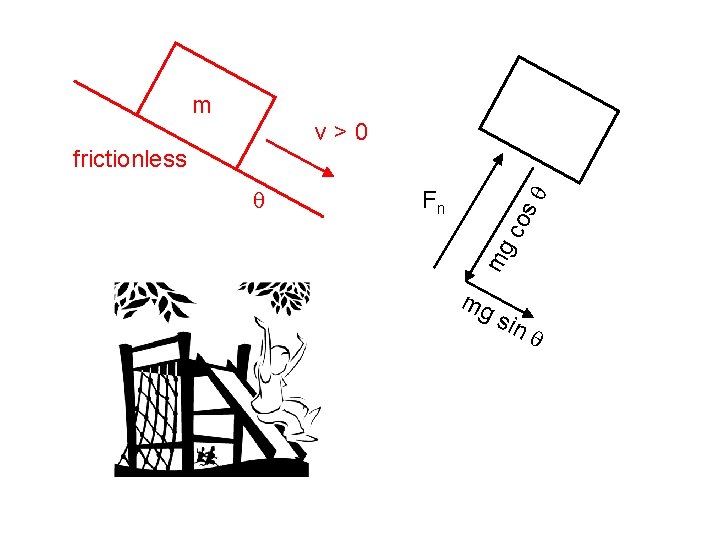
m v>0 frictionless co sq Fn mg q mg sin q
SUMMARY: Free Body Diagrams 1. A free body diagram (FBD) is a simple picture that models an object and shows all the forces acting on the object. Resist the initial urge to draw surfaces in an FBD, but PLEASE DO draw in the force(s) that a surface exerts on the object. 2. It is usually most convenient to resolve all forces into two mutually perpendicular directions. If there is a surface, the two directions should be parallel to and perpendicular to the surface.
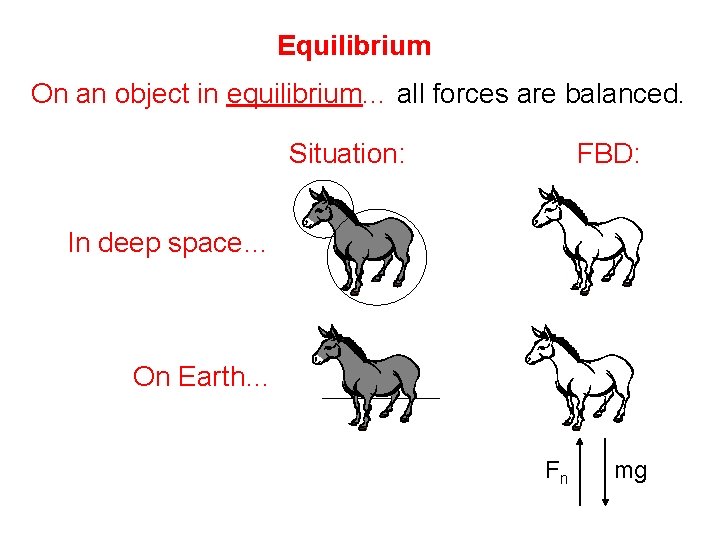
Equilibrium On an object in equilibrium. . . all forces are balanced. Situation: FBD: In deep space… On Earth… Fn mg
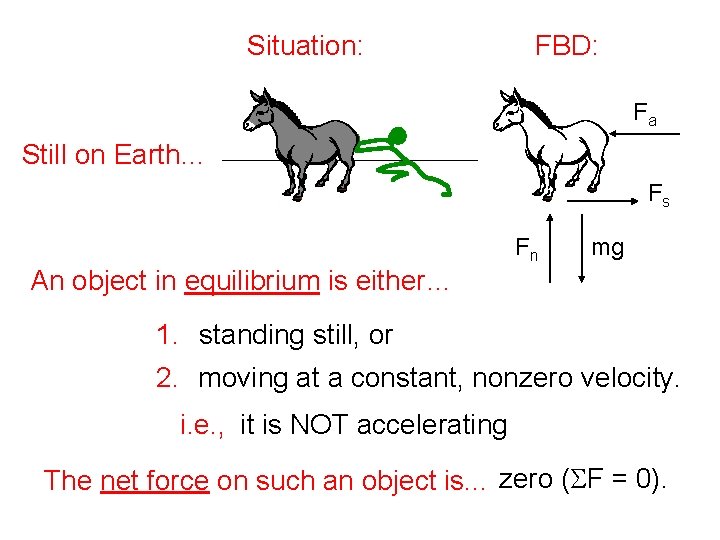
Situation: FBD: Fa Still on Earth… Fs Fn mg An object in equilibrium is either… 1. standing still, or 2. moving at a constant, nonzero velocity. i. e. , it is NOT accelerating The net force on such an object is. . . zero (SF = 0).
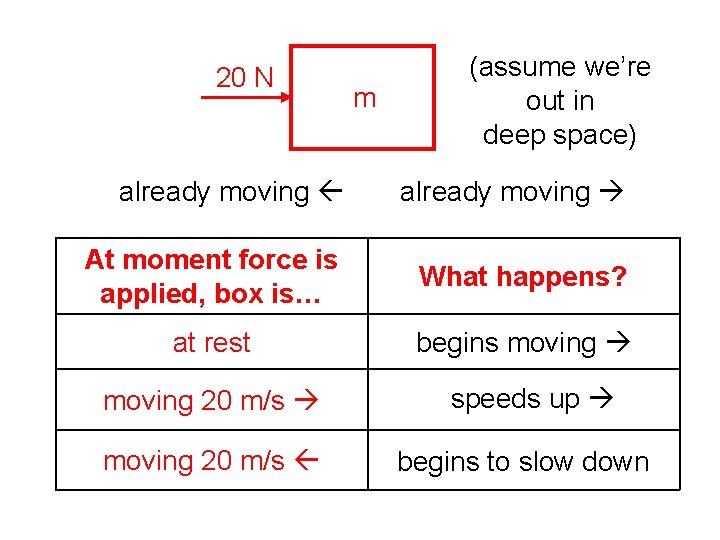
20 N m (assume we’re out in deep space) already moving At moment force is applied, box is… What happens? at rest begins moving 20 m/s speeds up begins to slow down
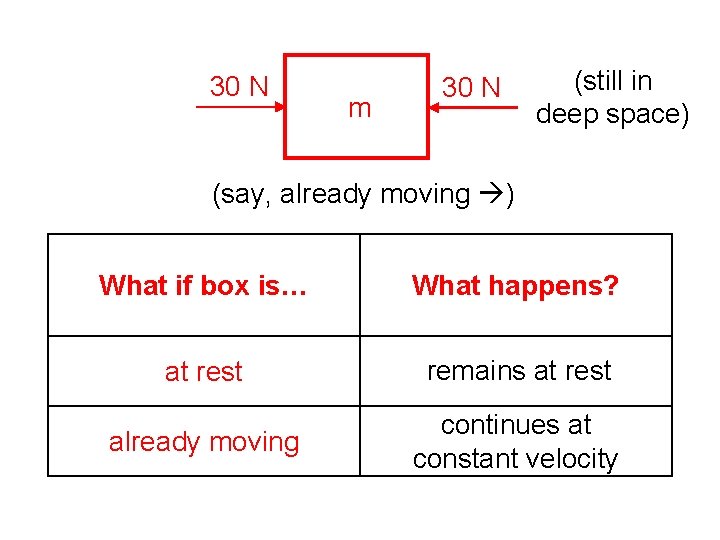
30 N m 30 N (still in deep space) (say, already moving ) What if box is… What happens? at rest remains at rest already moving continues at constant velocity
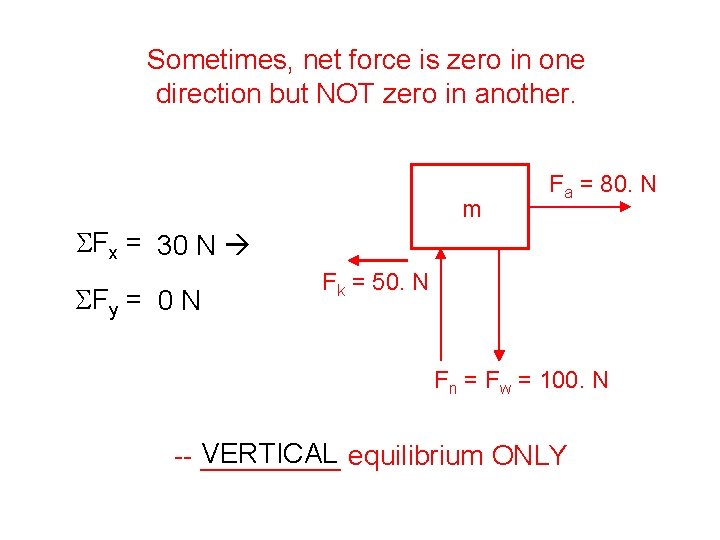
Sometimes, net force is zero in one direction but NOT zero in another. m Fa = 80. N SFx = 30 N SFy = 0 N Fk = 50. N Fn = Fw = 100. N VERTICAL equilibrium ONLY -- _____
FINAL THOUGHTS: Equilibrium 1. For now, an object is in equilibrium if there is zero net force acting on it. An object in equilibrium could have many forces acting on it, but they would cancel to yield a net of ZERO. For any given direction, we must assign a (+) and a (–) sense so we know when to add forces and when to subtract them. 2. It is a common misconception that a moving object must have a net force acting on it. If the object is moving at constant velocity (and that includes a velocity of zero), it is in equilibrium, and the net force on it is…ZERO.
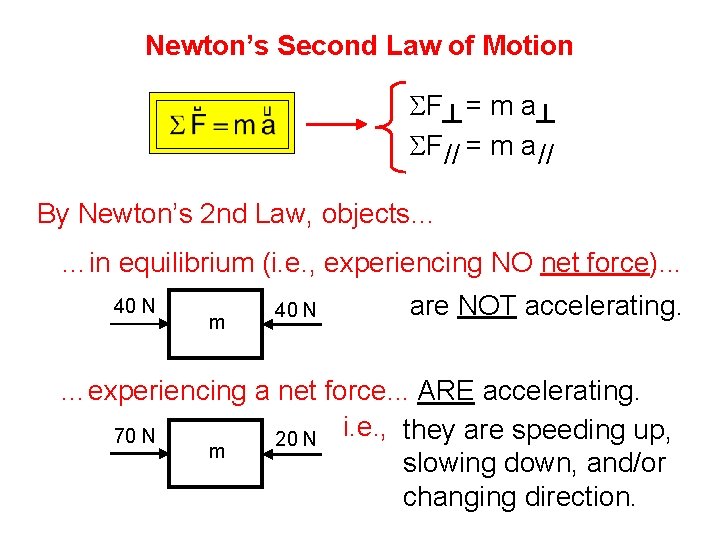
Newton’s Second Law of Motion SF = m a SF // = m a // By Newton’s 2 nd Law, objects… …in equilibrium (i. e. , experiencing NO net force). . . 40 N m 40 N are NOT accelerating. …experiencing a net force. . . ARE accelerating. 70 N 20 N i. e. , they are speeding up, m slowing down, and/or changing direction.
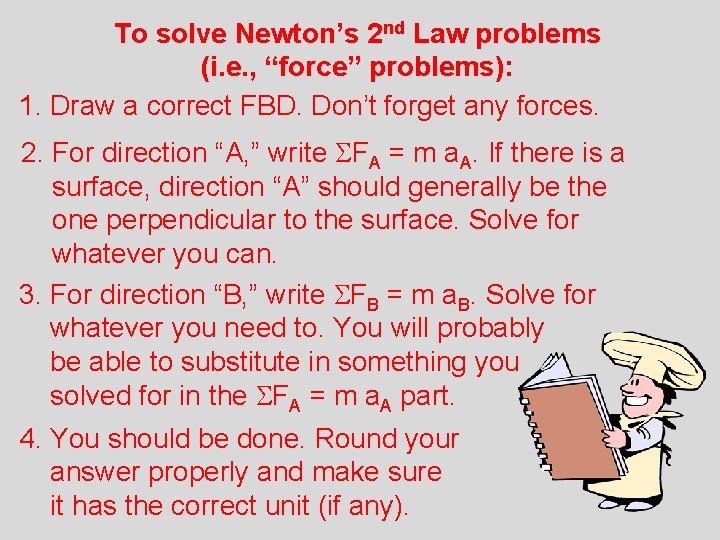
To solve Newton’s 2 nd Law problems (i. e. , “force” problems): 1. Draw a correct FBD. Don’t forget any forces. 2. For direction “A, ” write SFA = m a. A. If there is a surface, direction “A” should generally be the one perpendicular to the surface. Solve for whatever you can. 3. For direction “B, ” write SFB = m a. B. Solve for whatever you need to. You will probably be able to substitute in something you solved for in the SFA = m a. A part. 4. You should be done. Round your answer properly and make sure it has the correct unit (if any).
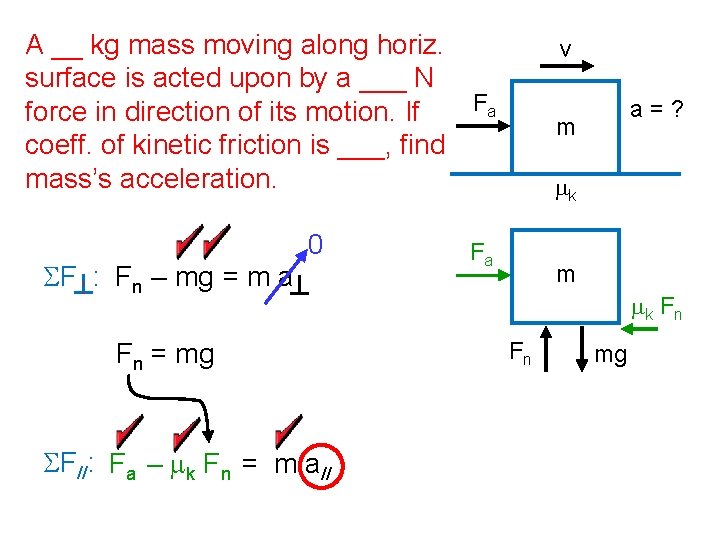
A __ kg mass moving along horiz. surface is acted upon by a ___ N Fa force in direction of its motion. If coeff. of kinetic friction is ___, find mass’s acceleration. SF : Fn – mg = m a 0 Fn = mg SF//: Fa – mk Fn = m a// v a=? m mk Fa m mk F n Fn mg
To solve Newton’s 2 nd Law problems (i. e. , “force” problems): 1. Draw a correct FBD. Don’t forget any forces. 2. For direction “A, ” write SFA = m a. A. If there is a surface, direction “A” should generally be the one perpendicular to the surface. Solve for whatever you can. 3. For direction “B, ” write SFB = m a. B. Solve for whatever you need to. You will probably be able to substitute in something you solved for in the SFA = m a. A part. 4. You should be done. Round your answer properly and make sure it has the correct unit (if any).
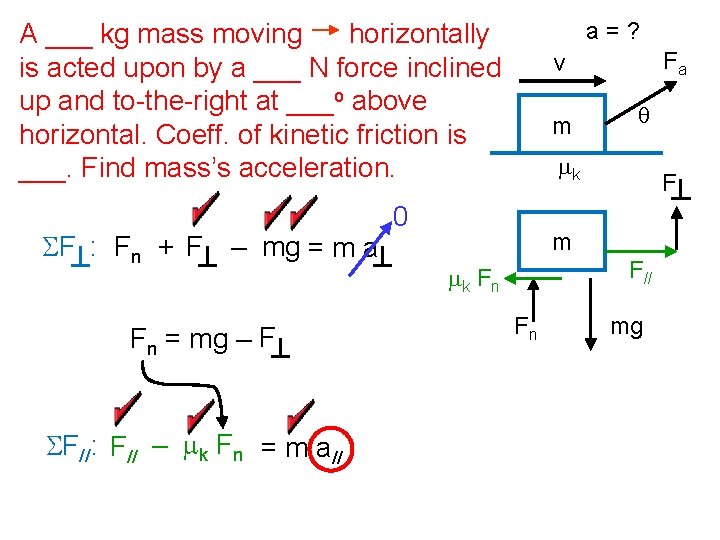
a=? A ___ kg mass moving horizontally is acted upon by a ___ N force inclined up and to-the-right at ___o above horizontal. Coeff. of kinetic friction is ___. Find mass’s acceleration. SF : Fn + F – mg = m a Fn = mg – F SF//: F// – mk Fn = m a// Fa v m q mk 0 F m F// mk F n Fn mg
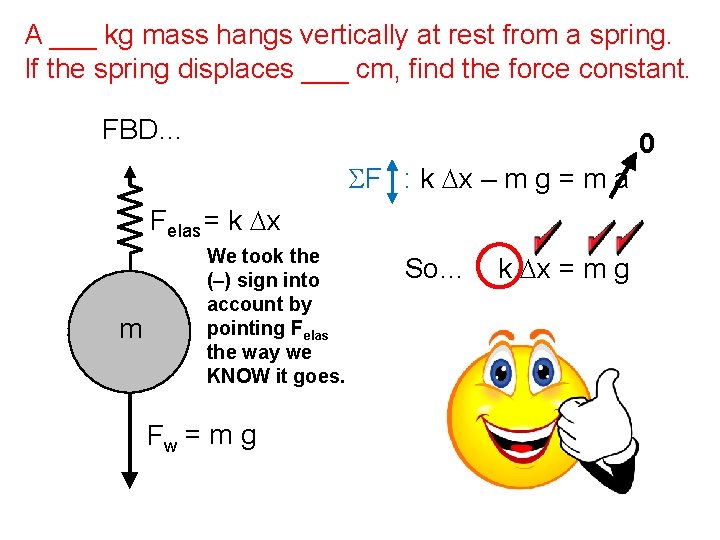
A ___ kg mass hangs vertically at rest from a spring. If the spring displaces ___ cm, find the force constant. FBD… 0 SF : k Dx – m g = m a Felas = k Dx m We took the (–) sign into account by pointing Felas the way we KNOW it goes. Fw = m g So… k Dx = m g
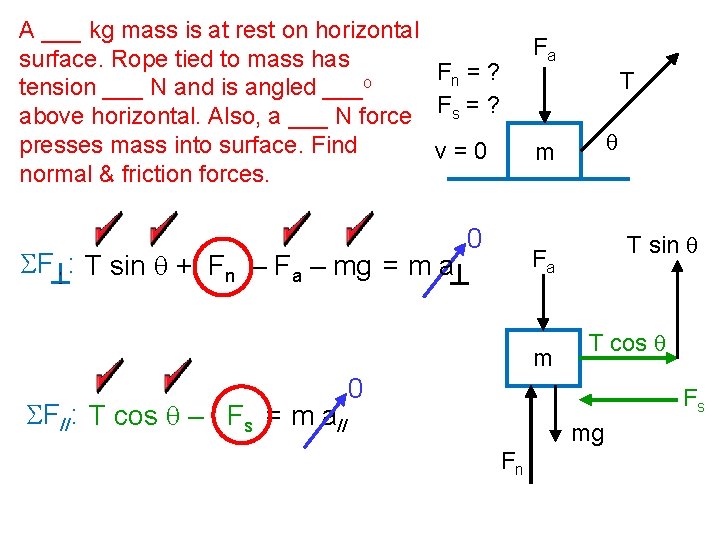
A ___ kg mass is at rest on horizontal surface. Rope tied to mass has Fn = ? tension ___ N and is angled ___o above horizontal. Also, a ___ N force Fs = ? presses mass into surface. Find v=0 normal & friction forces. SF : T sin q + Fn – Fa – mg = m a Fa T 0 T sin q Fa m SF//: T cos q – Fs = m a// q m T cos q 0 Fs mg Fn
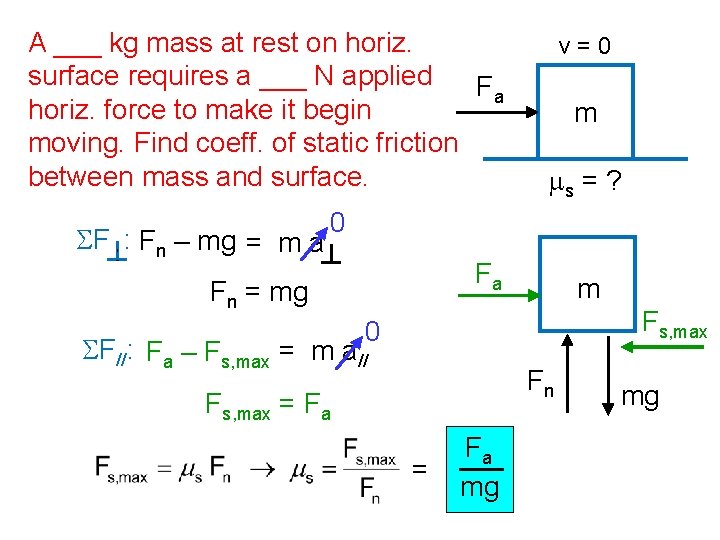
A ___ kg mass at rest on horiz. surface requires a ___ N applied Fa horiz. force to make it begin moving. Find coeff. of static friction between mass and surface. SF : Fn – mg = m a v=0 m ms = ? 0 Fa Fn = mg m Fs, max 0 SF//: Fa – Fs, max = m a// Fn Fs, max = Fa mg mg
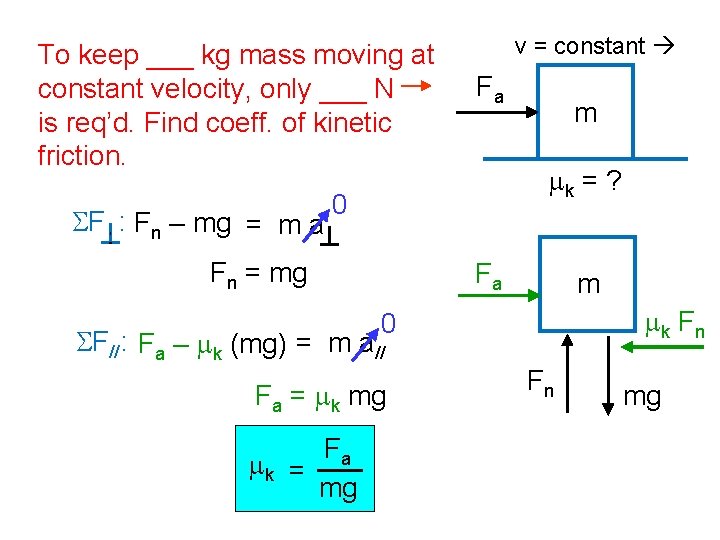
To keep ___ kg mass moving at constant velocity, only ___ N is req’d. Find coeff. of kinetic friction. SF : Fn – mg = m a v = constant Fa mk = ? 0 Fn = mg m Fa m mk F n 0 SF//: Fa – mk (mg) = m a// Fa = mk mg Fa mk = mg Fn mg
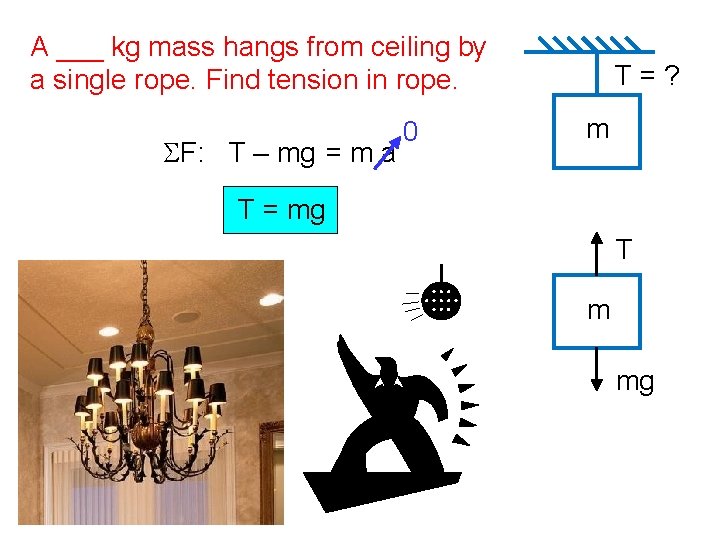
A ___ kg mass hangs from ceiling by a single rope. Find tension in rope. SF: T – mg = m a 0 T=? m T = mg T m mg
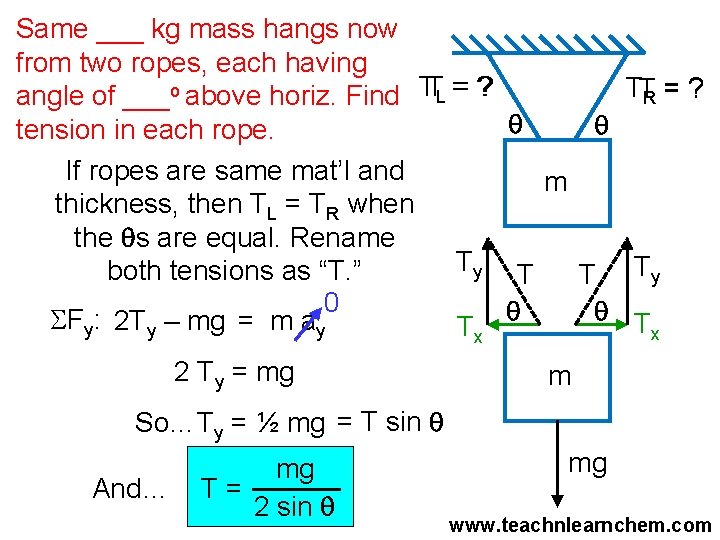
Same ___ kg mass hangs now from two ropes, each having TTR = ? angle of ___o above horiz. Find TTL = ? q q tension in each rope. If ropes are same mat’l and m thickness, then TL = TR when the qs are equal. Rename Ty T both tensions as “T. ” T Ty 0 q q T SFy: 2 Ty – mg = m ay Tx x 2 Ty = mg m So…Ty = ½ mg = T sin q And… mg T= 2 sin q mg www. teachnlearnchem. com
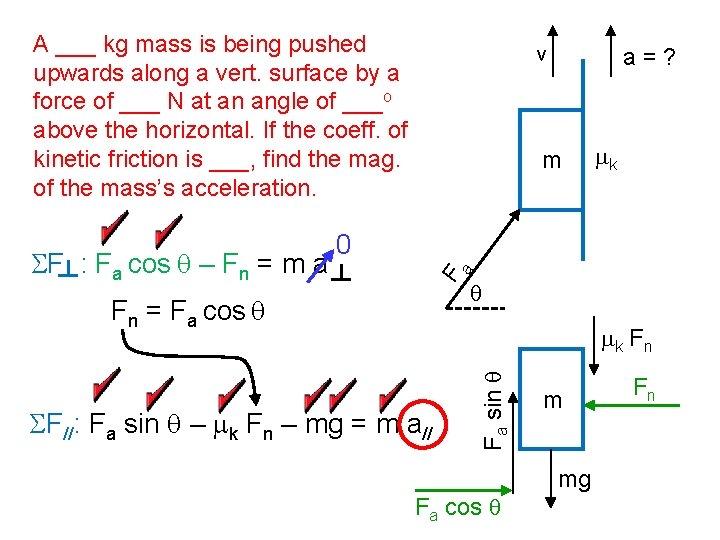
A ___ kg mass is being pushed upwards along a vert. surface by a force of ___ N at an angle of ___o above the horizontal. If the coeff. of kinetic friction is ___, find the mag. of the mass’s acceleration. a=? m mk a 0 F Fn = Fa cos q q mk F n SF//: Fa sin q – mk Fn – mg = m a// Fa sin q SF : Fa cos q – Fn = m a v Fa cos q m mg Fn
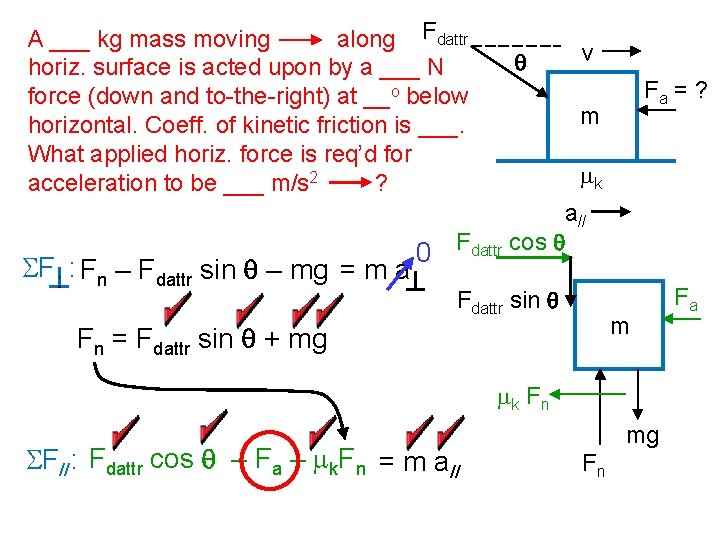
A ___ kg mass moving along Fdattr horiz. surface is acted upon by a ___ N force (down and to-the-right) at __o below horizontal. Coeff. of kinetic friction is ___. What applied horiz. force is req’d for acceleration to be ___ m/s 2 ? SF : Fn – Fdattr sin q – mg = m a 0 q v Fa = ? m mk a// Fdattr cos q Fdattr sin q m Fn = Fdattr sin q + mg mk F n SF//: Fdattr cos q – Fa – mk. Fn = m a// mg Fn Fa
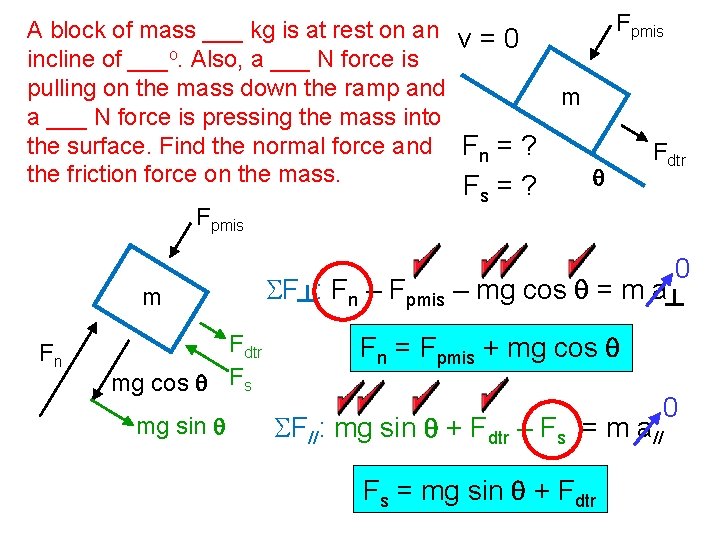
Fpmis A block of mass ___ kg is at rest on an v = 0 incline of ___o. Also, a ___ N force is pulling on the mass down the ramp and m a ___ N force is pressing the mass into the surface. Find the normal force and Fn = ? Fdtr the friction force on the mass. q F =? Fpmis m Fn Fdtr mg cos q Fs mg sin q s SF : Fn – Fpmis – mg cos q = m a 0 Fn = Fpmis + mg cos q 0 SF//: mg sin q + Fdtr – Fs = m a// Fs = mg sin q + Fdtr
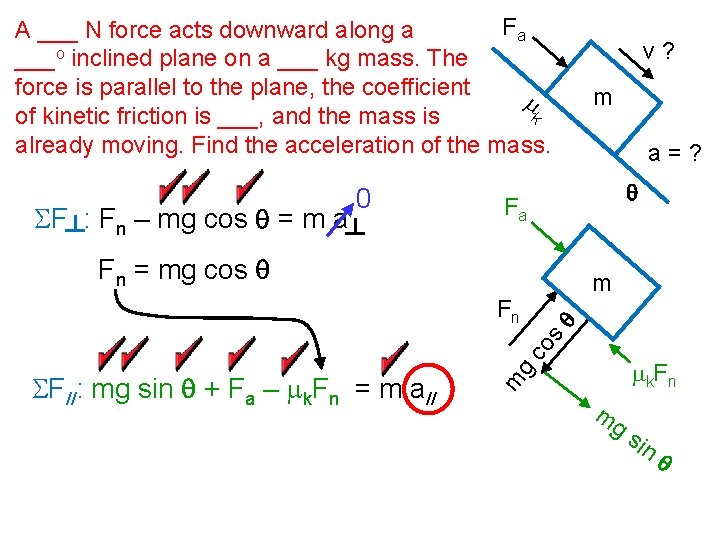
Fa A ___ N force acts downward along a ___o inclined plane on a ___ kg mass. The force is parallel to the plane, the coefficient m k of kinetic friction is ___, and the mass is already moving. Find the acceleration of the mass. SF : Fn – mg cos q = m a 0 v? m a=? q Fa Fn = mg cos q q co s Fn m g m SF//: mg sin q + Fa – mk. Fn = m a// m k. F n m g sin q
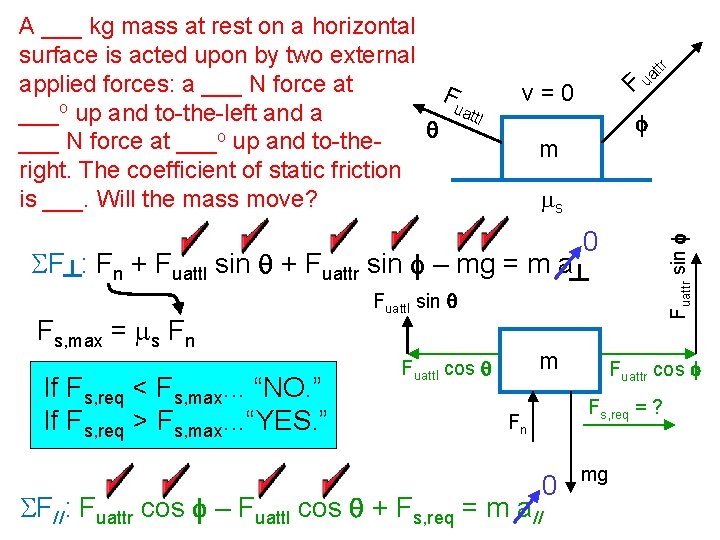
If Fs, req < Fs, max. . . “NO. ” If Fs, req > Fs, max. . . “YES. ” f m ms SF : Fn + Fuattl sin q + Fuattr sin f – mg = m a Fs, max = ms Fn F v=0 ttr a u 0 Fuattr sin f A ___ kg mass at rest on a horizontal surface is acted upon by two external applied forces: a ___ N force at Fu o attl ___ up and to-the-left and a q ___ N force at ___o up and to-theright. The coefficient of static friction is ___. Will the mass move? Fuattl sin q m Fuattl cos q Fuattr cos f Fs, req = ? Fn 0 SF//: Fuattr cos f – Fuattl cos q + Fs, req = m a// mg
To solve Newton’s 2 nd Law problems (i. e. , “force” problems): 1. Draw a correct FBD. Don’t forget any forces. 2. For direction “A, ” write SFA = m a. A. If there is a surface, direction “A” should generally be the one perpendicular to the surface. Solve for whatever you can. 3. For direction “B, ” write SFB = m a. B. Solve for whatever you need to. You will probably be able to substitute in something you solved for in the SFA = m a. A part. 4. You should be done. Round your answer properly and make sure it has the correct unit (if any).
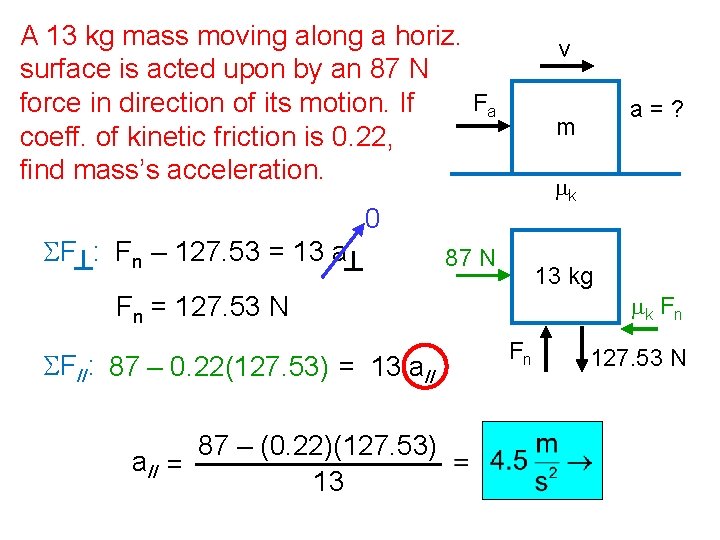
A 13 kg mass moving along a horiz. surface is acted upon by an 87 N Fa force in direction of its motion. If coeff. of kinetic friction is 0. 22, find mass’s acceleration. SF : Fn – 127. 53 = 13 a v m mk 0 87 N 13 kg mk F n Fn = 127. 53 N SF//: 87 – 0. 22(127. 53) = 13 a// 87 – (0. 22)(127. 53) a// = 13 a=? Fn 127. 53 N
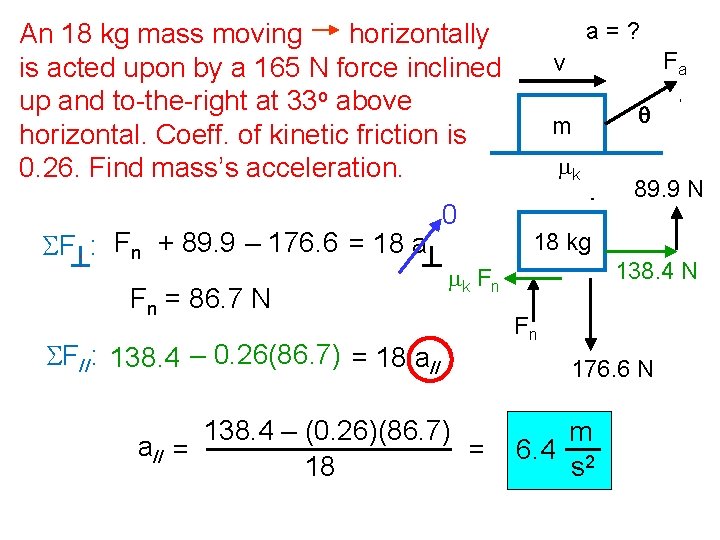
a=? An 18 kg mass moving horizontally is acted upon by a 165 N force inclined up and to-the-right at 33 o above horizontal. Coeff. of kinetic friction is 0. 26. Find mass’s acceleration. SF : Fn + 89. 9 – 176. 6 = 18 a Fn = 86. 7 N 0 Fa v m mk 138. 4 – (0. 26)(86. 7) a// = = 18 89. 9 N 18 kg 138. 4 N mk F n SF//: 138. 4 – 0. 26(86. 7) = 18 a// q Fn 176. 6 N m 6. 4 2 s
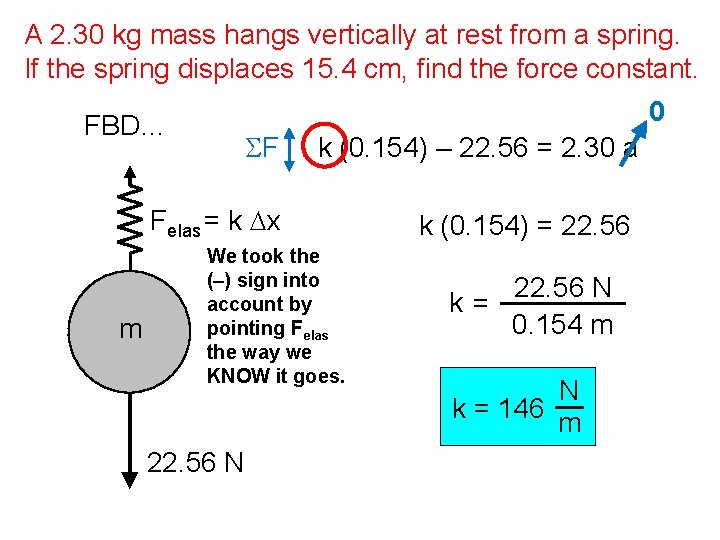
A 2. 30 kg mass hangs vertically at rest from a spring. If the spring displaces 15. 4 cm, find the force constant. 0 FBD… SF : k (0. 154) – 22. 56 = 2. 30 a Felas = k Dx m We took the (–) sign into account by pointing Felas the way we KNOW it goes. 22. 56 N k (0. 154) = 22. 56 k= 22. 56 N 0. 154 m N k = 146 m
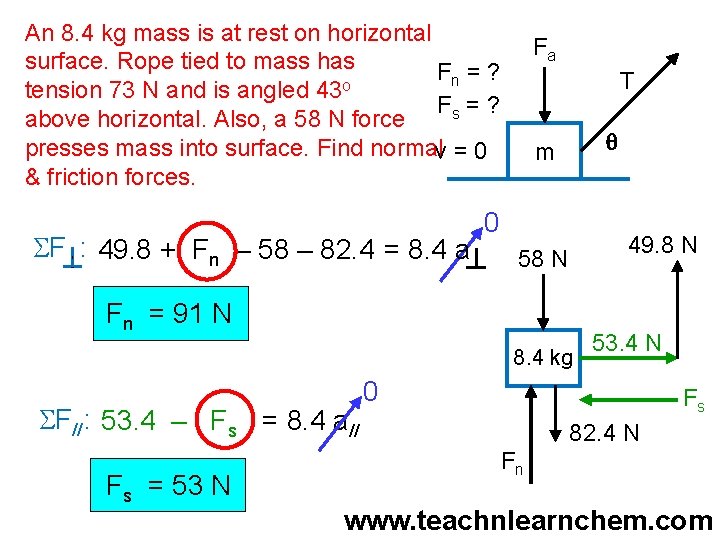
An 8. 4 kg mass is at rest on horizontal surface. Rope tied to mass has Fn = ? o tension 73 N and is angled 43 Fs = ? above horizontal. Also, a 58 N force presses mass into surface. Find normalv = 0 & friction forces. SF : 49. 8 + Fn – 58 – 82. 4 = 8. 4 a Fa T q m 0 49. 8 N 58 N Fn = 91 N 8. 4 kg SF//: 53. 4 – Fs = 8. 4 a// Fs = 53 N 53. 4 N 0 Fs 82. 4 N Fn www. teachnlearnchem. com
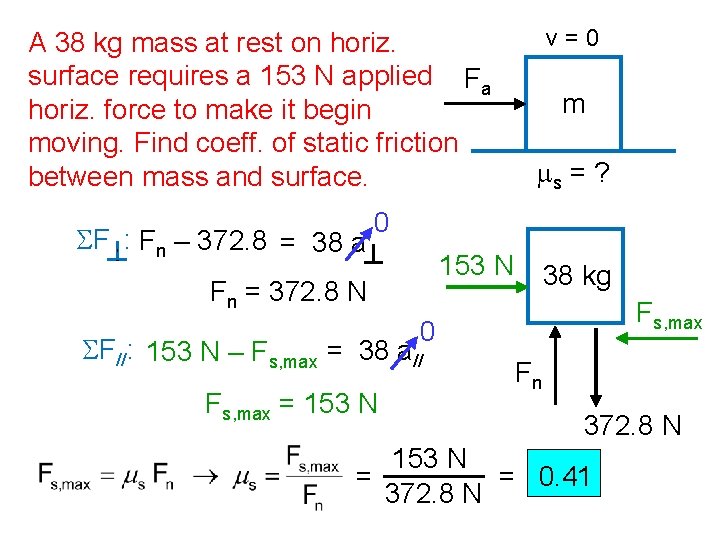
A 38 kg mass at rest on horiz. surface requires a 153 N applied Fa horiz. force to make it begin moving. Find coeff. of static friction between mass and surface. SF : Fn – 372. 8 = 38 a v=0 m ms = ? 0 153 N Fn = 372. 8 N 38 kg Fs, max 0 SF//: 153 N – Fs, max = 38 a// Fs, max = 153 N Fn 372. 8 N 153 N = 0. 41 = 372. 8 N
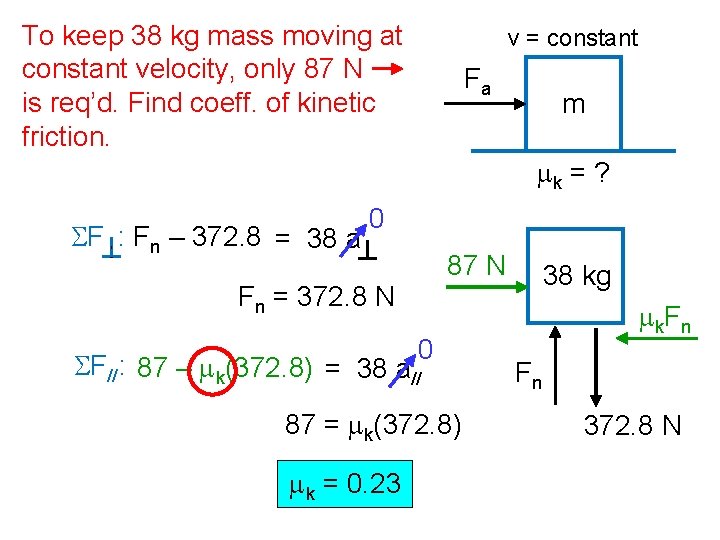
To keep 38 kg mass moving at constant velocity, only 87 N is req’d. Find coeff. of kinetic friction. v = constant Fa m mk = ? SF : Fn – 372. 8 = 38 a 0 87 N 38 kg Fn = 372. 8 N 0 SF//: 87 – mk(372. 8) = 38 a// 87 = mk(372. 8) mk = 0. 23 mk. Fn Fn 372. 8 N
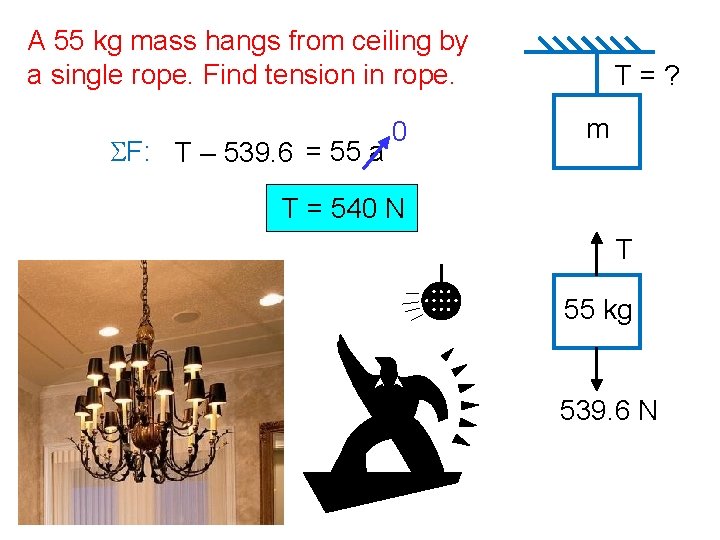
A 55 kg mass hangs from ceiling by a single rope. Find tension in rope. SF: T – 539. 6 = 55 a 0 T=? m T = 540 N T 55 kg 539. 6 N
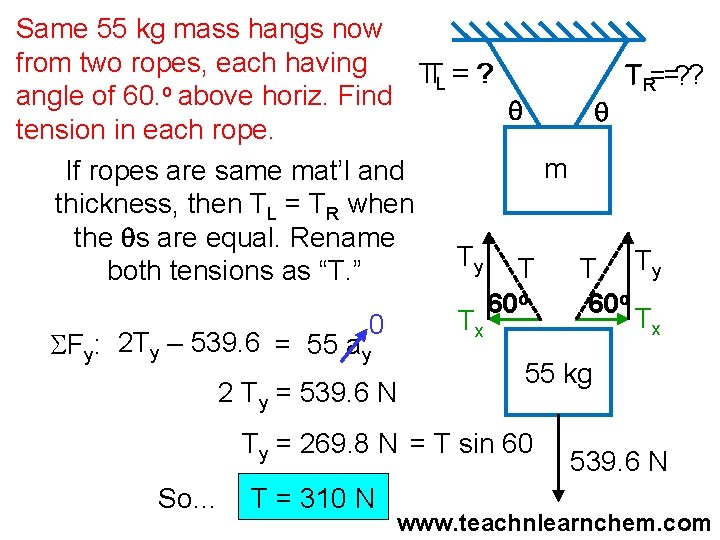
Same 55 kg mass hangs now from two ropes, each having TTL = ? TR==? ? o angle of 60. above horiz. Find q q tension in each rope. m If ropes are same mat’l and thickness, then TL = TR when the qs are equal. Rename Ty T T Ty both tensions as “T. ” 60 o Tx Tx 0 SFy: 2 Ty – 539. 6 = 55 ay 55 kg 2 Ty = 539. 6 N Ty = 269. 8 N = T sin 60 So… T = 310 N 539. 6 N www. teachnlearnchem. com
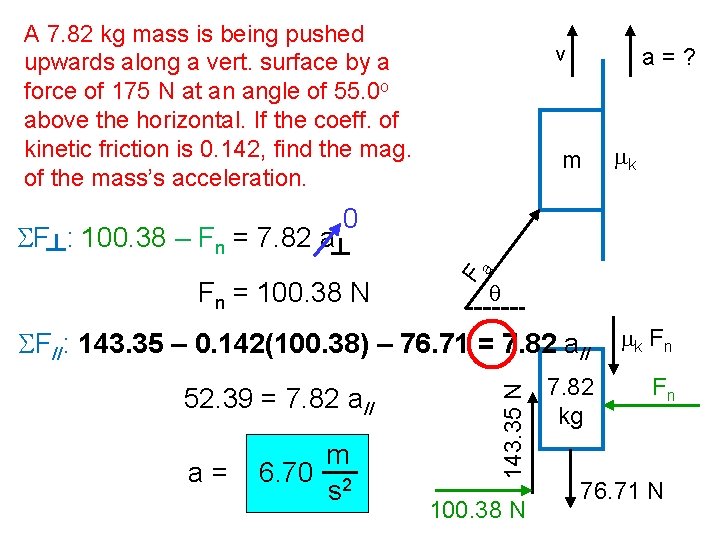
A 7. 82 kg mass is being pushed upwards along a vert. surface by a force of 175 N at an angle of 55. 0 o above the horizontal. If the coeff. of kinetic friction is 0. 142, find the mag. of the mass’s acceleration. a=? m mk 0 Fn = 100. 38 N F a SF : 100. 38 – Fn = 7. 82 a v q mk F n 7. 82 kg Fn 52. 39 = 7. 82 a// a= m 6. 70 2 s 143. 35 N SF//: 143. 35 – 0. 142(100. 38) – 76. 71 = 7. 82 a// 100. 38 N 76. 71 N
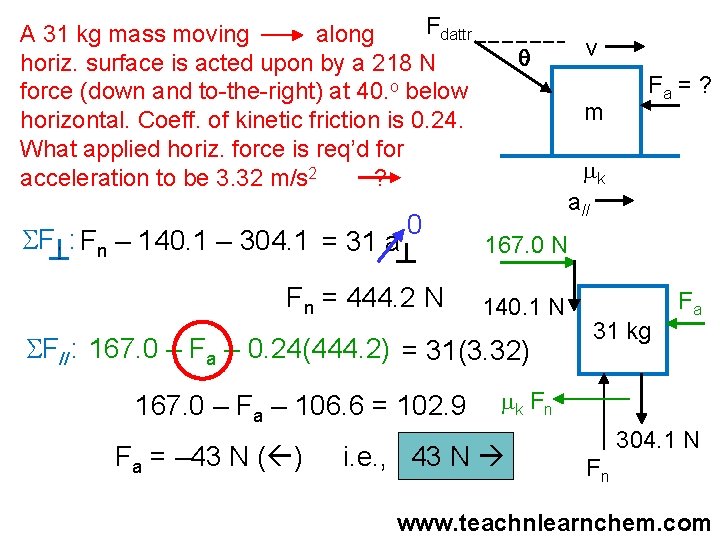
Fdattr A 31 kg mass moving along horiz. surface is acted upon by a 218 N force (down and to-the-right) at 40. o below horizontal. Coeff. of kinetic friction is 0. 24. What applied horiz. force is req’d for acceleration to be 3. 32 m/s 2 ? SF : Fn – 140. 1 – 304. 1 = 31 a 0 Fn = 444. 2 N q m Fa = – 43 N ( ) Fa = ? mk a// 167. 0 N 140. 1 N SF//: 167. 0 – Fa – 0. 24(444. 2) = 31(3. 32) 167. 0 – Fa – 106. 6 = 102. 9 v 31 kg Fa mk F n i. e. , 43 N 304. 1 N Fn www. teachnlearnchem. com
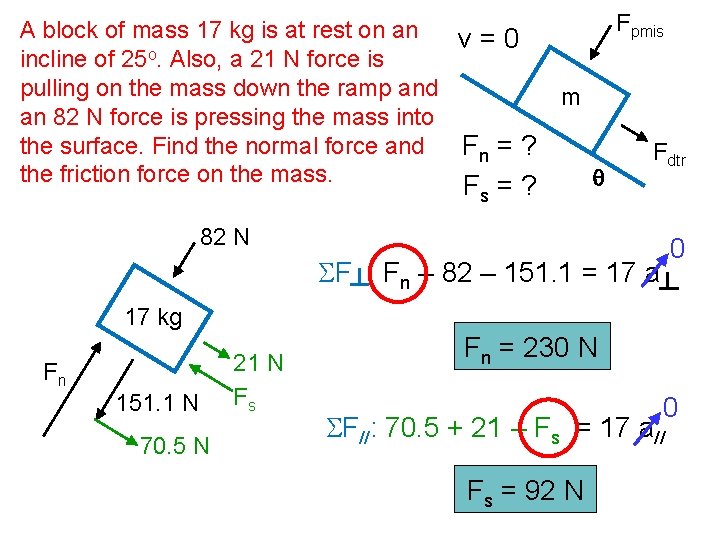
Fpmis A block of mass 17 kg is at rest on an v=0 o incline of 25. Also, a 21 N force is pulling on the mass down the ramp and m an 82 N force is pressing the mass into the surface. Find the normal force and Fn = ? Fdtr the friction force on the mass. q F =? s 82 N 0 SF : Fn – 82 – 151. 1 = 17 a 17 kg Fn 151. 1 N 70. 5 N 21 N Fs Fn = 230 N 0 SF//: 70. 5 + 21 – Fs = 17 a// Fs = 92 N
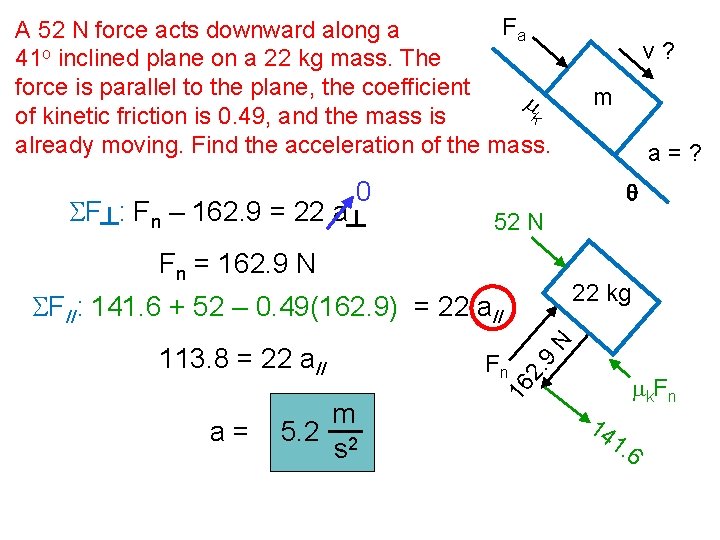
Fa A 52 N force acts downward along a 41 o inclined plane on a 22 kg mass. The force is parallel to the plane, the coefficient m k of kinetic friction is 0. 49, and the mass is already moving. Find the acceleration of the mass. SF : Fn – 162. 9 = 22 a m a=? 0 q 52 N Fn = 162. 9 N 22 kg m 5. 2 2 s 9 2. Fn m k. F n 16 113. 8 = 22 a// N SF//: 141. 6 + 52 – 0. 49(162. 9) = 22 a// a= v? 14 1. 6
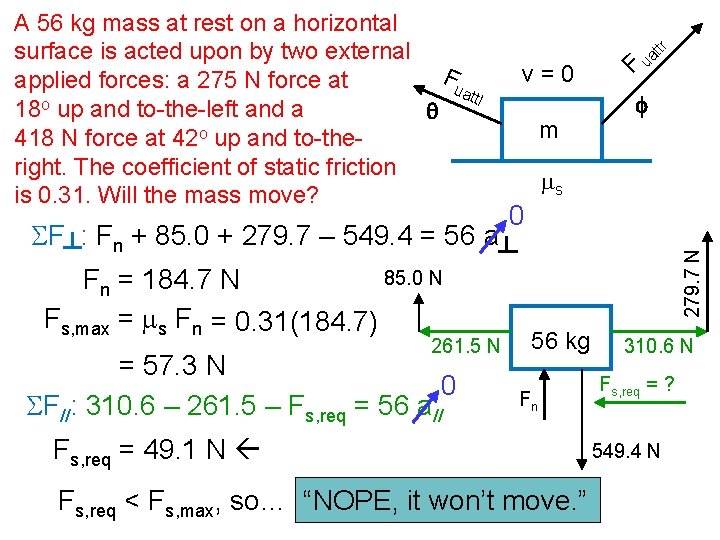
SF : Fn + 85. 0 + 279. 7 – 549. 4 = 56 a 85. 0 N Fn = 184. 7 N Fs, max = ms Fn = 0. 31(184. 7) 261. 5 N = 57. 3 N 0 SF//: 310. 6 – 261. 5 – Fs, req = 56 a// v=0 m F ttr a u f ms 0 279. 7 N A 56 kg mass at rest on a horizontal surface is acted upon by two external Fu applied forces: a 275 N force at attl o 18 up and to-the-left and a q 418 N force at 42 o up and to-theright. The coefficient of static friction is 0. 31. Will the mass move? 56 kg Fn Fs, req = 49. 1 N Fs, req < Fs, max, so… “NOPE, it won’t move. ” 310. 6 N Fs, req = ? 549. 4 N
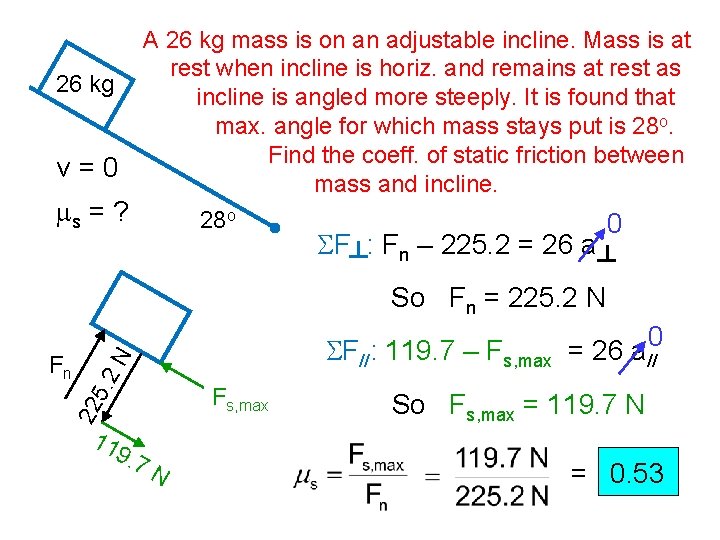
26 kg v=0 ms = ? A 26 kg mass is on an adjustable incline. Mass is at rest when incline is horiz. and remains at rest as incline is angled more steeply. It is found that max. angle for which mass stays put is 28 o. Find the coeff. of static friction between mass and incline. 28 o SF : Fn – 225. 2 = 26 a 0 So Fn = 225. 2 N SF//: 119. 7 – Fs, max = 26 a// Fs, max 22 Fn 0 11 9. 7 N So Fs, max = 119. 7 N = 0. 53
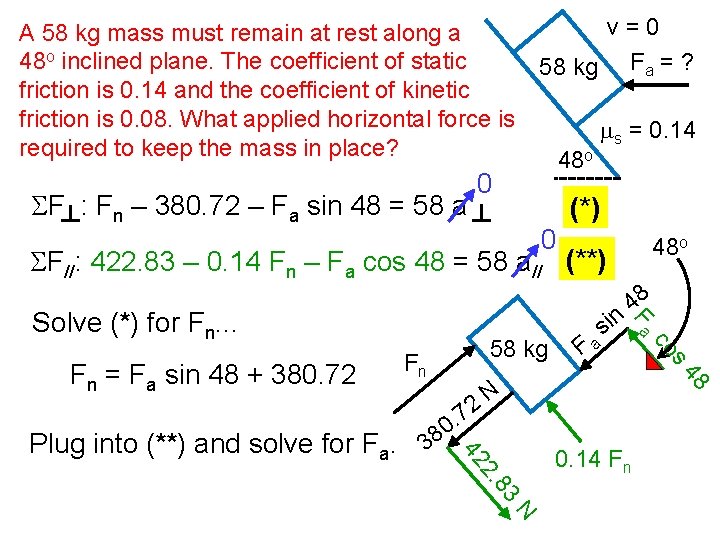
A 58 kg mass must remain at rest along a 48 o inclined plane. The coefficient of static friction is 0. 14 and the coefficient of kinetic friction is 0. 08. What applied horizontal force is required to keep the mass in place? SF : Fn – 380. 72 – Fa sin 48 = 58 a v=0 58 kg Fa = ? 48 o 0 0 ms = 0. 14 (*) SF//: 422. 83 – 0. 14 Fn – Fa cos 48 = 58 a// (**) . 0 38 48 72 N 83 2. 42 Plug into (**) and solve for Fa. Fn Fa s co Fn = Fa sin 48 + 380. 72 58 kg sin 48 Fa Solve (*) for Fn. . . 48 o 0. 14 Fn N
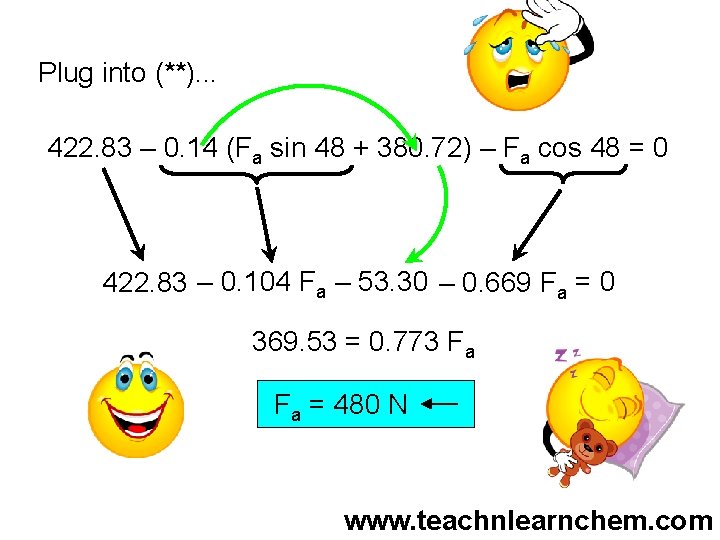
Plug into (**). . . 422. 83 – 0. 14 (Fa sin 48 + 380. 72) – Fa cos 48 = 0 422. 83 – 0. 104 Fa – 53. 30 – 0. 669 Fa = 0 369. 53 = 0. 773 Fa Fa = 480 N www. teachnlearnchem. com
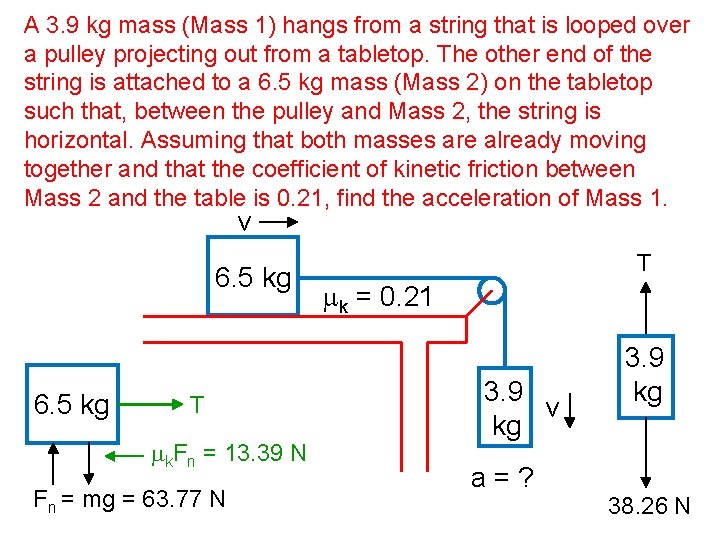
A 3. 9 kg mass (Mass 1) hangs from a string that is looped over a pulley projecting out from a tabletop. The other end of the string is attached to a 6. 5 kg mass (Mass 2) on the tabletop such that, between the pulley and Mass 2, the string is horizontal. Assuming that both masses are already moving together and that the coefficient of kinetic friction between Mass 2 and the table is 0. 21, find the acceleration of Mass 1. v 6. 5 kg T mk. Fn = 13. 39 N Fn = mg = 63. 77 N T mk = 0. 21 3. 9 v kg a=? 3. 9 kg 38. 26 N
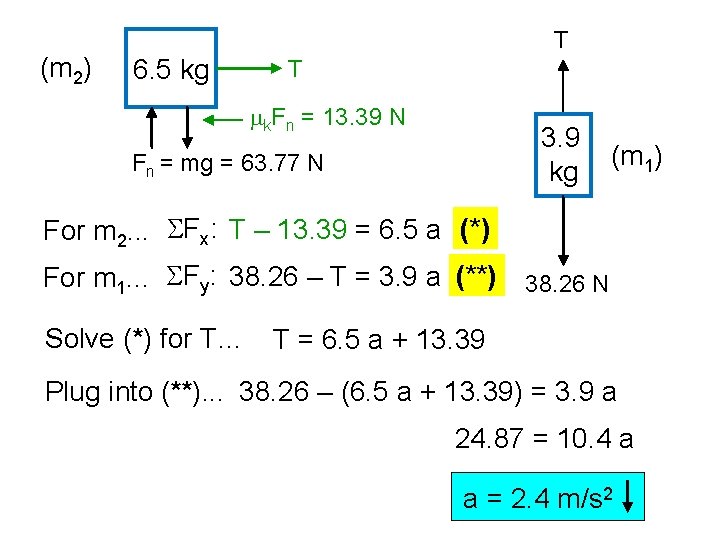
(m 2) 6. 5 kg T T mk. Fn = 13. 39 N 3. 9 kg Fn = mg = 63. 77 N (m 1) For m 2. . . SFx: T – 13. 39 = 6. 5 a (*) For m 1. . . SFy: 38. 26 – T = 3. 9 a (**) 38. 26 N Solve (*) for T… T = 6. 5 a + 13. 39 Plug into (**). . . 38. 26 – (6. 5 a + 13. 39) = 3. 9 a 24. 87 = 10. 4 a a = 2. 4 m/s 2
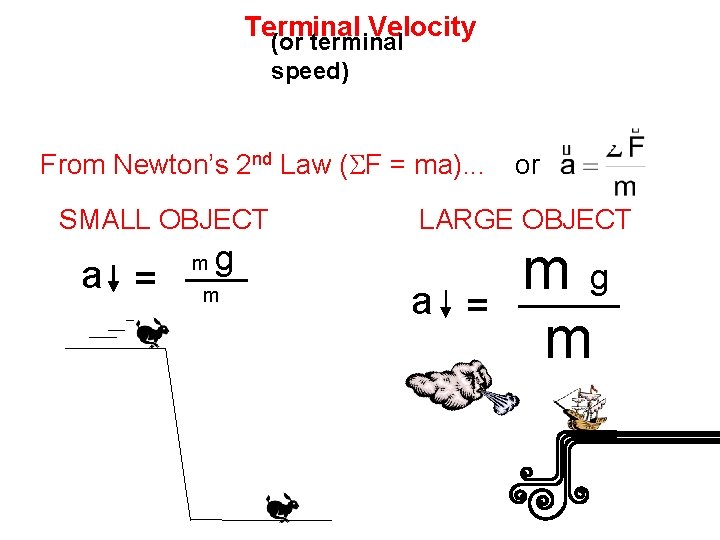
Terminal Velocity (or terminal speed) Why do objects fall at the same rate, in the absence of air resistance? From Newton’s 2 nd Law (SF = ma). . . or SMALL OBJECT a = m LARGE OBJECT g m a = mg m
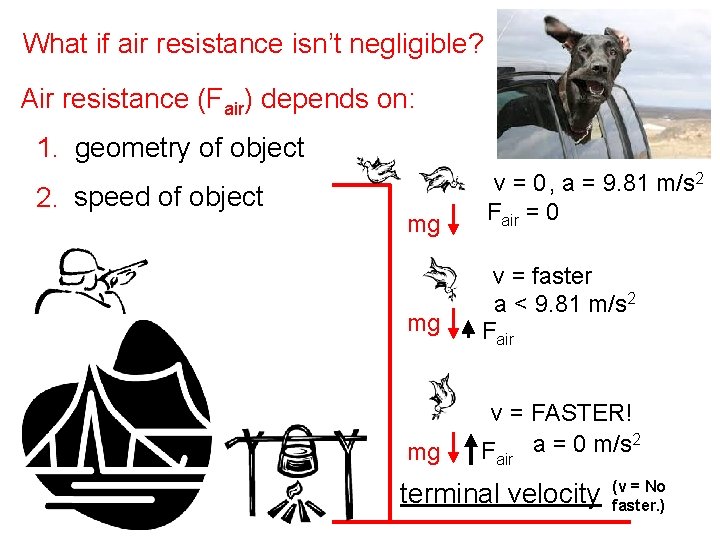
What if air resistance isn’t negligible? Air resistance (Fair) depends on: 1. geometry of object 2. speed of object mg mg mg v = 0 , a = 9. 81 m/s 2 Fair = 0 v = faster a < 9. 81 m/s 2 Fair v = FASTER! a = 0 m/s 2 F air terminal velocity (v = No faster. )
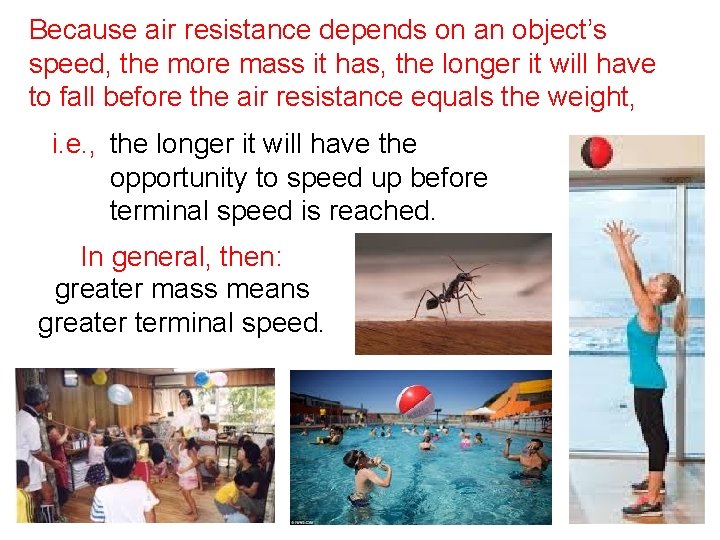
Because air resistance depends on an object’s speed, the more mass it has, the longer it will have to fall before the air resistance equals the weight, i. e. , the longer it will have the opportunity to speed up before terminal speed is reached. In general, then: greater mass means greater terminal speed.
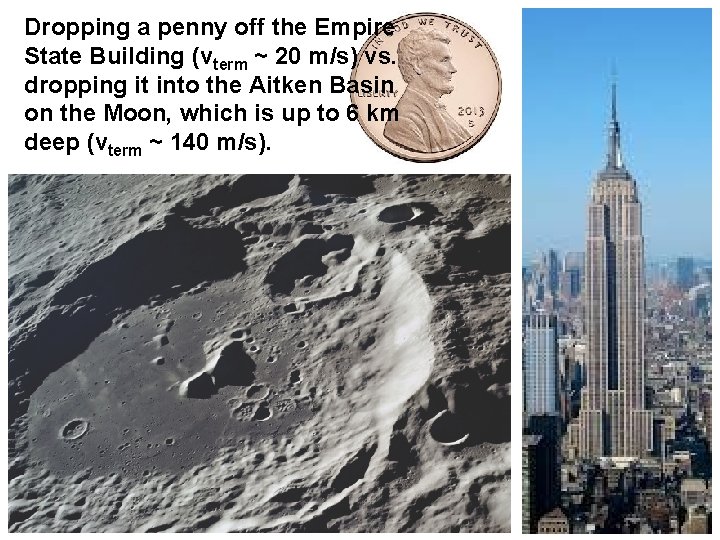
Dropping a penny off the Empire State Building (vterm ~ 20 m/s) vs. dropping it into the Aitken Basin on the Moon, which is up to 6 km deep (vterm ~ 140 m/s).
FINAL THOUGHTS: Terminal Velocity Terminal velocity occurs whenever an object is falling and there is resistance from the air or some other fluid. As a falling object accelerates due to gravity (i. e. , its weight), it speeds up, which means the fluid resistance on it increases. At some point, the fluid resistance equals (and, of course, opposes) the object’s weight, and the object no longer picks up speed: It falls at ‘cruise control. ’
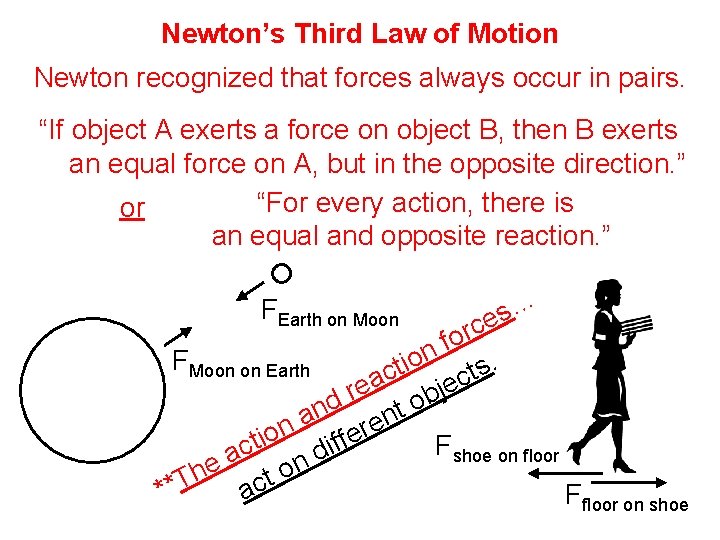
Newton’s Third Law of Motion Newton recognized that forces always occur in pairs. “If object A exerts a force on object B, then B exerts an equal force on A, but in the opposite direction. ” “For every action, there is or an equal and opposite reaction. ” … s e orc f n o FMoon on Earth. i t s t c c a e e j r d ob n t a n e n r e io f t f Fshoe on floor i c d a n e o h t **T ac F FEarth on Moon floor on shoe
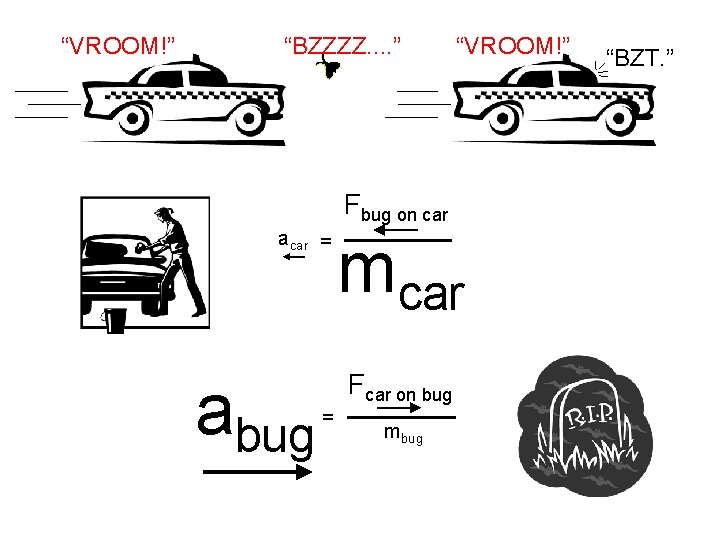
“VROOM!” “BZZZZ. . ” “VROOM!” Fbug on car acar = abug mcar Fcar on bug = mbug “BZT. ”
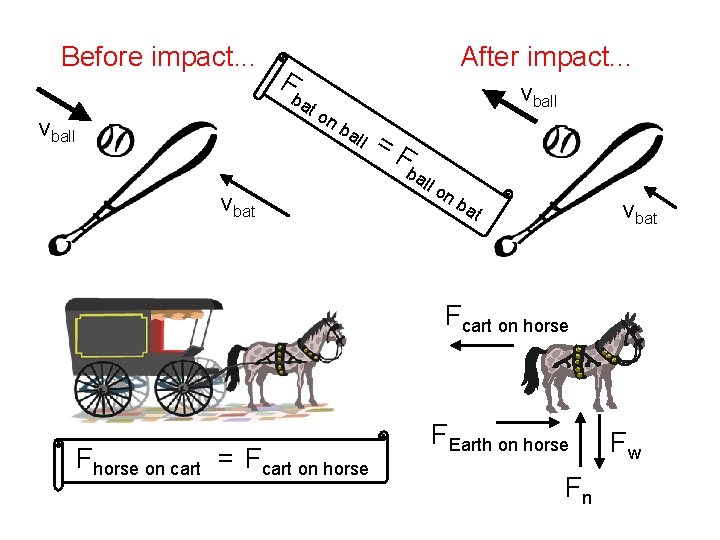
Before impact. . . After impact. . . F ba to vball nb all vbat =F ba ll o nb vbat at Fcart on horse Fhorse on cart = Fcart on horse FEarth on horse Fn Fw
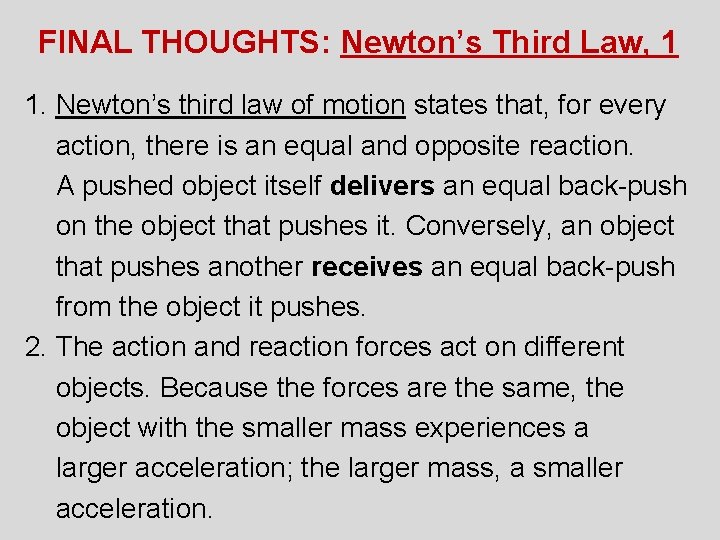
FINAL THOUGHTS: Newton’s Third Law, 1 1. Newton’s third law of motion states that, for every action, there is an equal and opposite reaction. A pushed object itself delivers an equal back-push on the object that pushes it. Conversely, an object that pushes another receives an equal back-push from the object it pushes. 2. The action and reaction forces act on different objects. Because the forces are the same, the object with the smaller mass experiences a larger acceleration; the larger mass, a smaller acceleration.
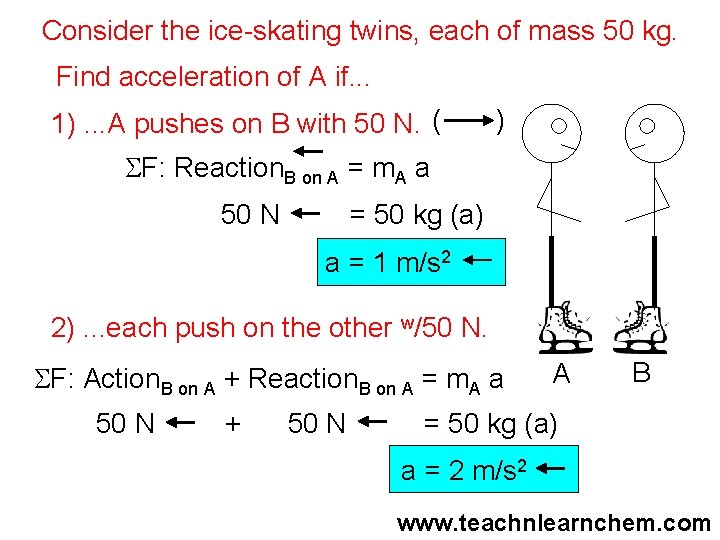
Consider the ice-skating twins, each of mass 50 kg. Find acceleration of A if. . . 1). . . A pushes on B with 50 N. ( ) SF: Reaction. B on A = m. A a 50 N = 50 kg (a) a = 1 m/s 2 2). . . each push on the other w/50 N. SF: Action. B on A + Reaction. B on A = m. A a 50 N + 50 N A B = 50 kg (a) a = 2 m/s 2 www. teachnlearnchem. com
- Slides: 72