
NEWTONS LAWS INERTIA Force push or a pull




- Slides: 93
NEWTON’S LAWS
INERTIA
• Force push or a pull • Contact Force physical contact • Field Forces No contact: gravity, magnetic force, etc.
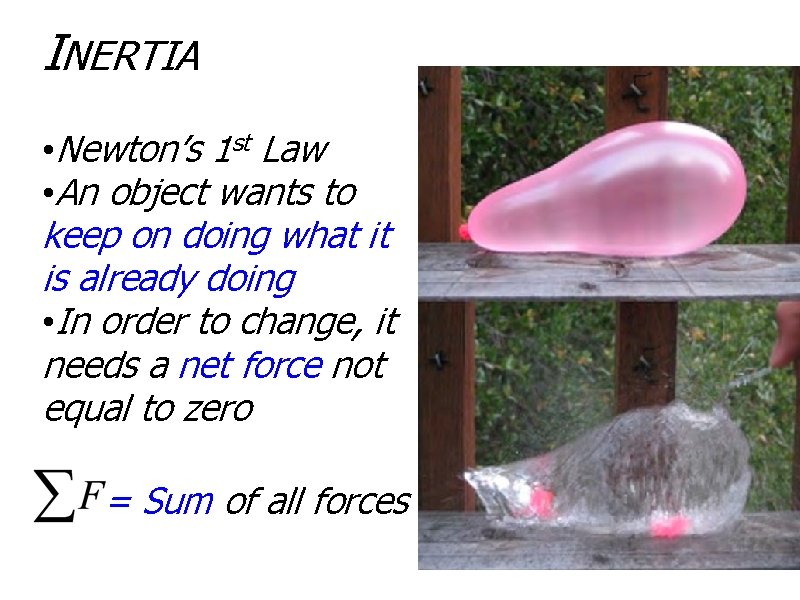
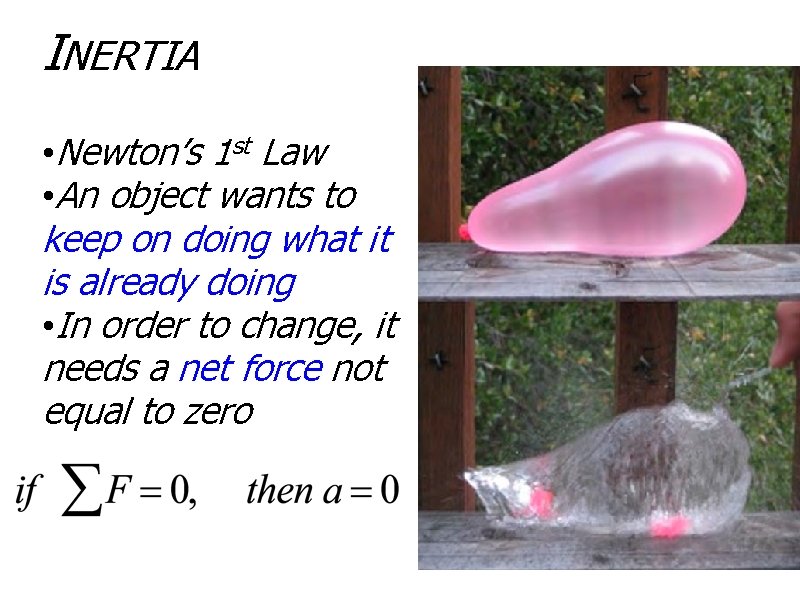
INERTIA • Newton’s 1 st Law • An object wants to keep on doing what it is already doing • In order to change, it needs a net force not equal to zero = Sum of all forces
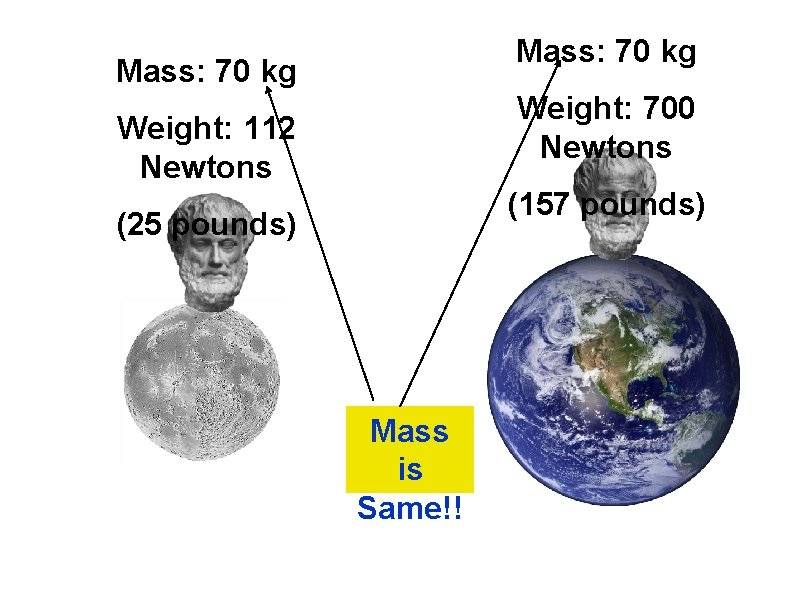
MASS IS NOT WEIGHT • Weight is a common force • Weight is the force exerted by gravity on an objects mass • Weight can change if gravity changes
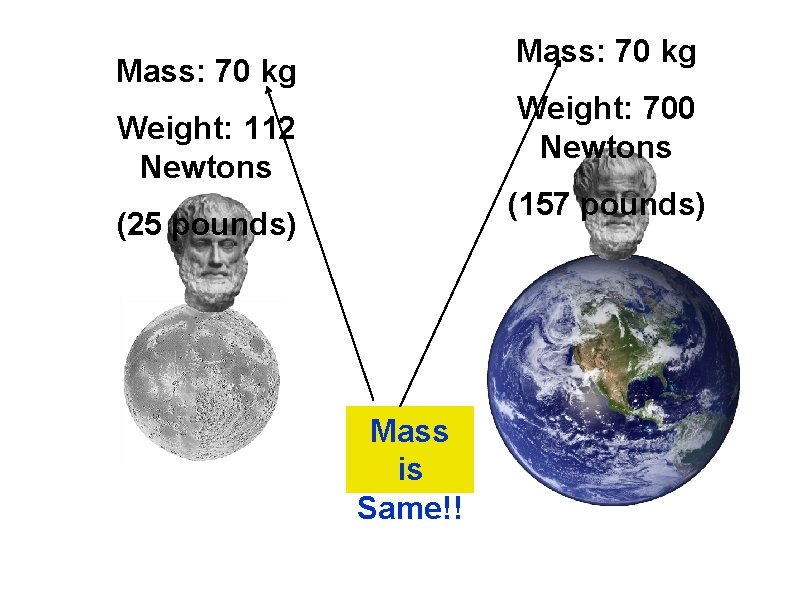
Mass: 70 kg Weight: 700 Newtons Weight: 112 Newtons (157 pounds) (25 pounds) Mass is Same!!
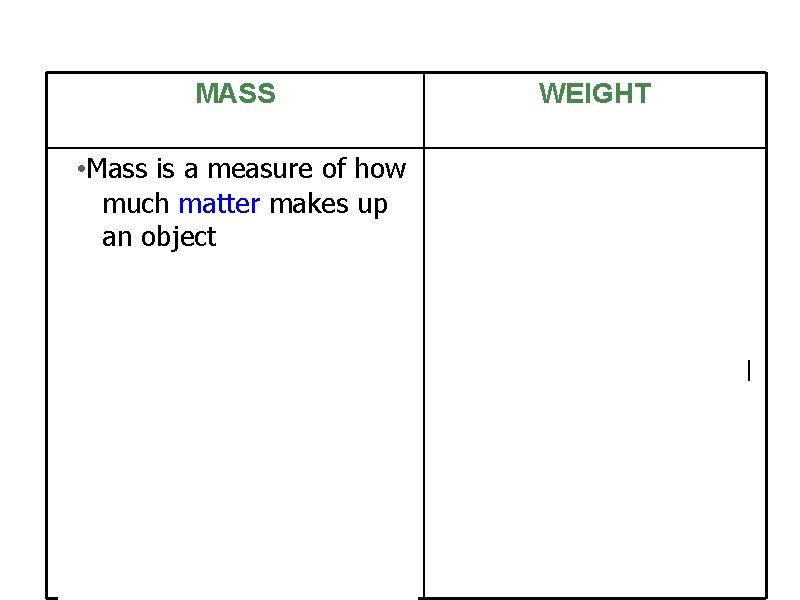
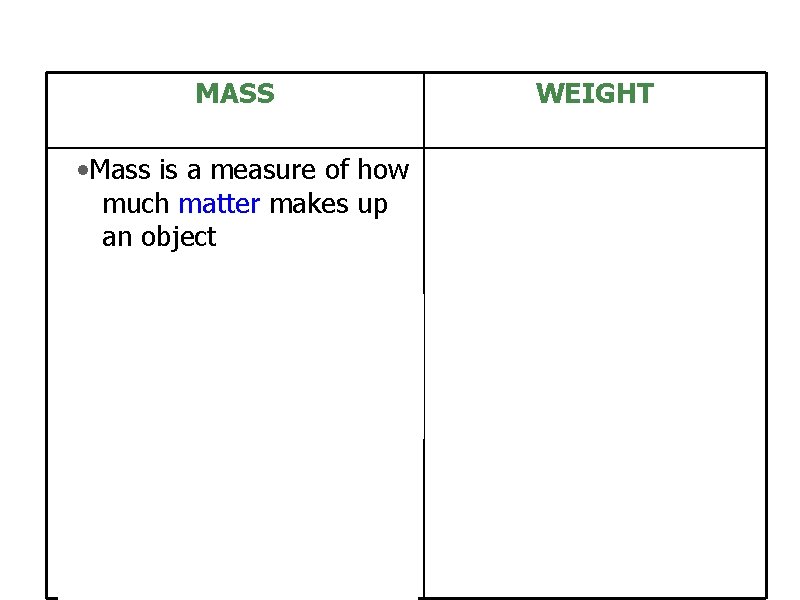
MASS WEIGHT • Mass is a measure of how much matter makes up an object • Weight is a Force • Depends on object itself – NEVER CHANGES • Mass Is a measure of inertia • Mass is measured in: grams, Kilograms • Depends on gravity • Weight is measured in: Newtons (N) or pounds (lbs)
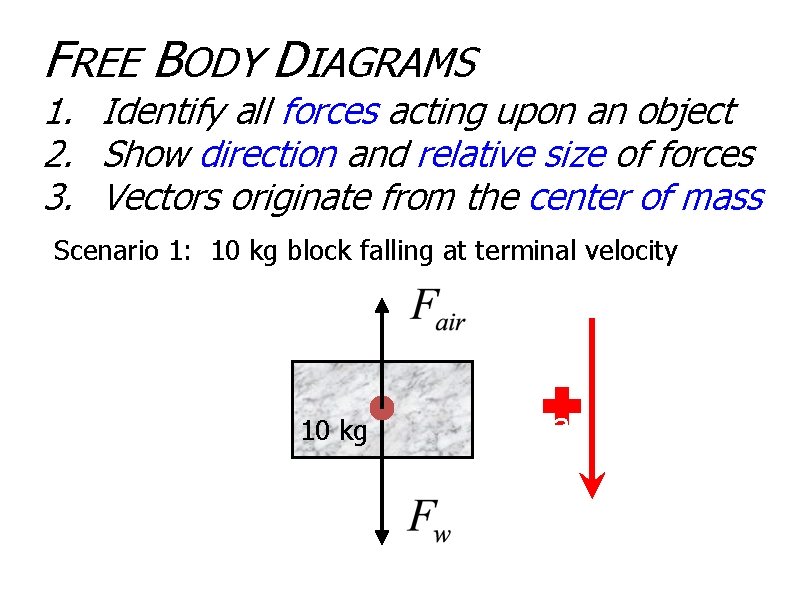
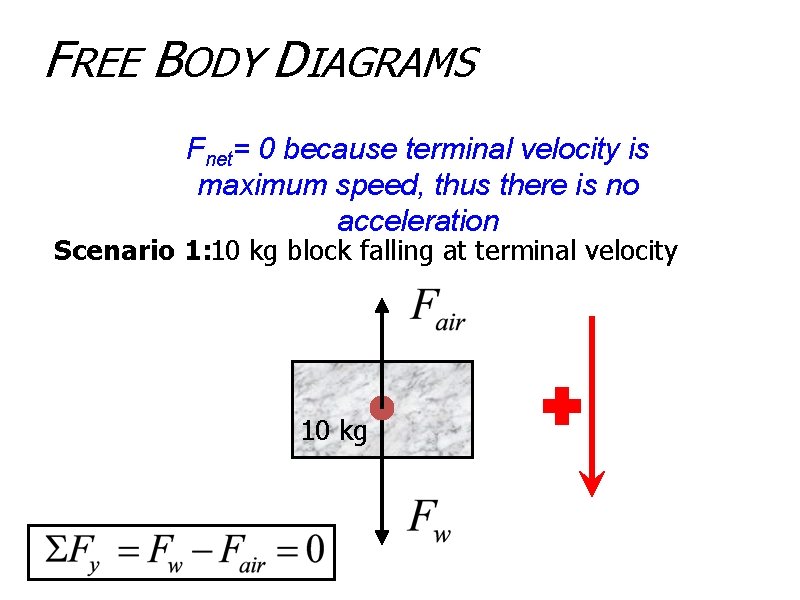
FREE BODY DIAGRAMS 1. Identify all forces acting upon an object 2. Show direction and relative size of forces 3. Vectors originate from the center of mass Scenario 1: 10 kg block falling at terminal velocity 10 kg a
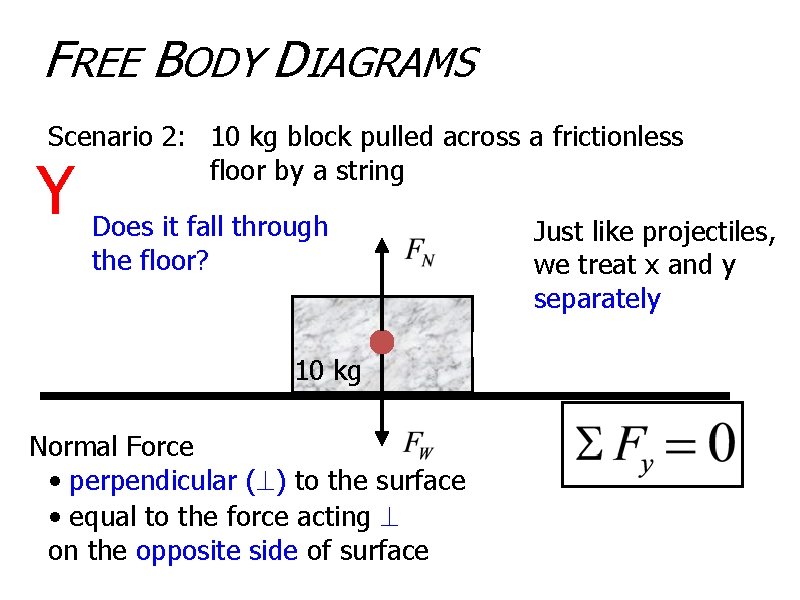
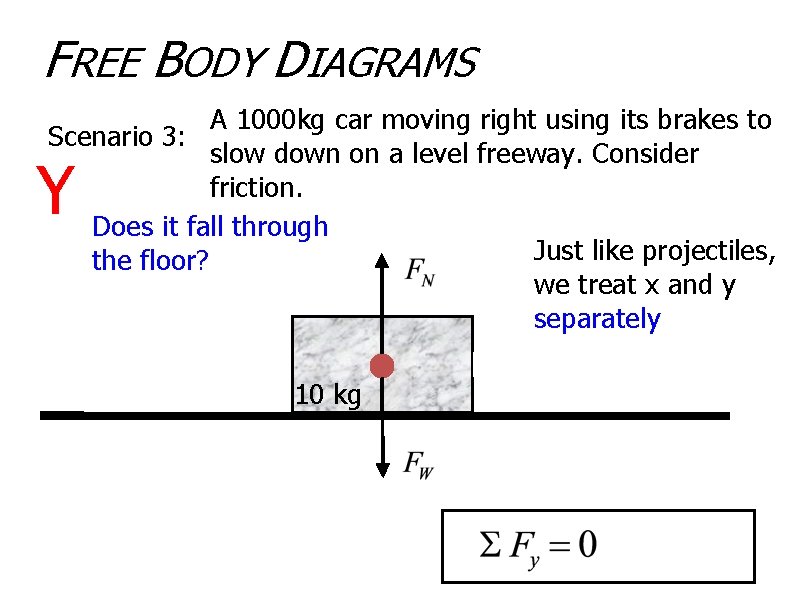
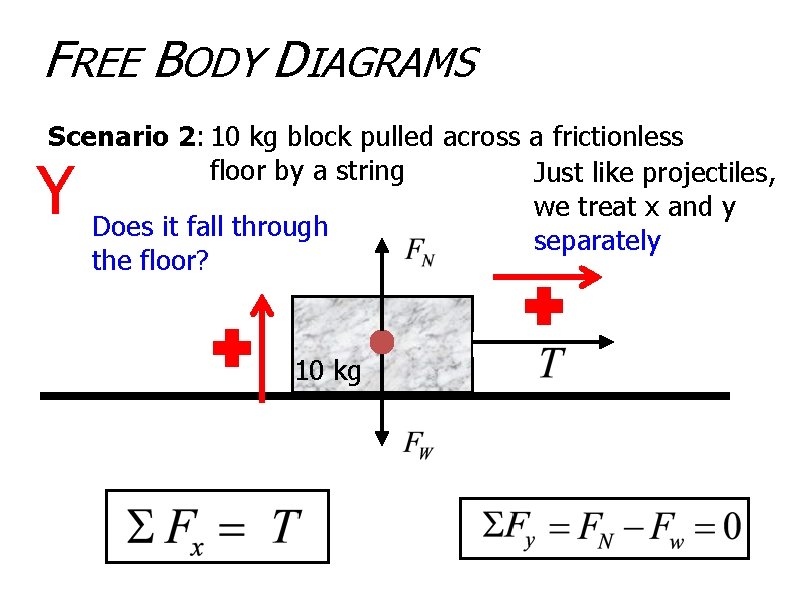
FREE BODY DIAGRAMS Scenario 2: 10 kg block pulled across a frictionless floor by a string Y Does it fall through the floor? 10 kg Normal Force • perpendicular ( ) to the surface • equal to the force acting on the opposite side of surface Just like projectiles, we treat x and y separately
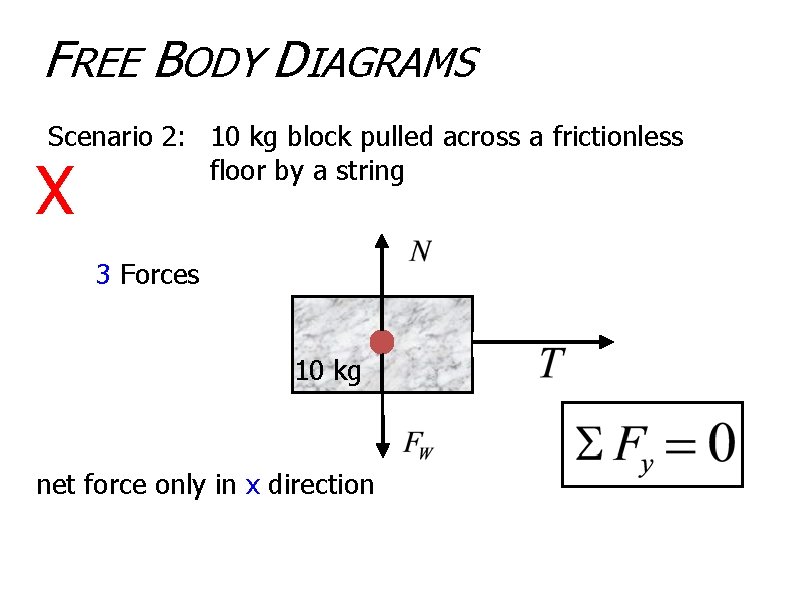
FREE BODY DIAGRAMS Scenario 2: 10 kg block pulled across a frictionless floor by a string X 3 Forces 10 kg net force only in x direction
FREE BODY DIAGRAMS A 1000 kg car moving right using its brakes to Scenario 3: slow down on a level freeway. Consider friction. Does it fall through Just like projectiles, the floor? we treat x and y separately Y 10 kg
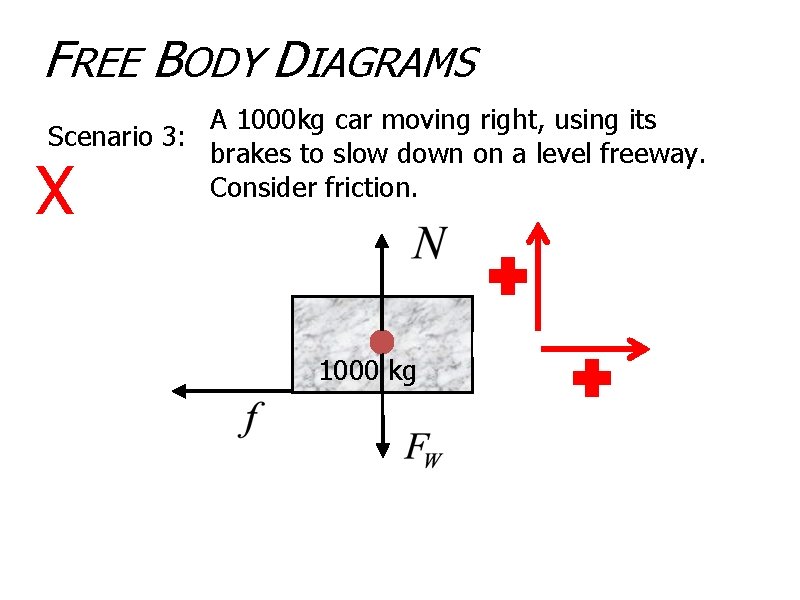
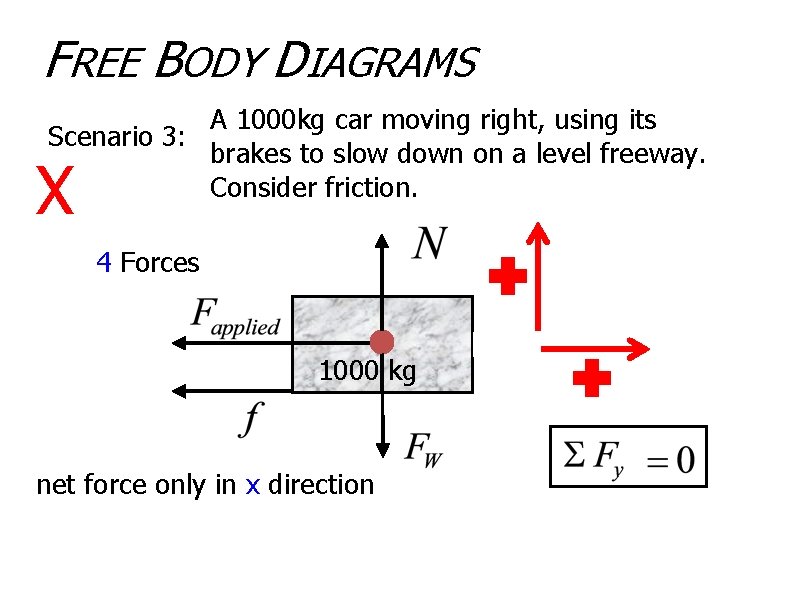
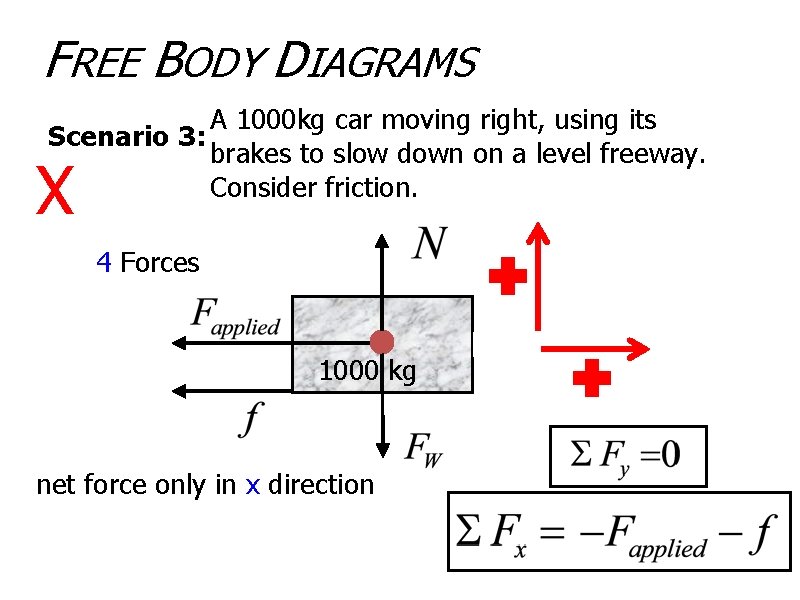
FREE BODY DIAGRAMS A 1000 kg car moving right, using its Scenario 3: brakes to slow down on a level freeway. Consider friction. X 1000 kg
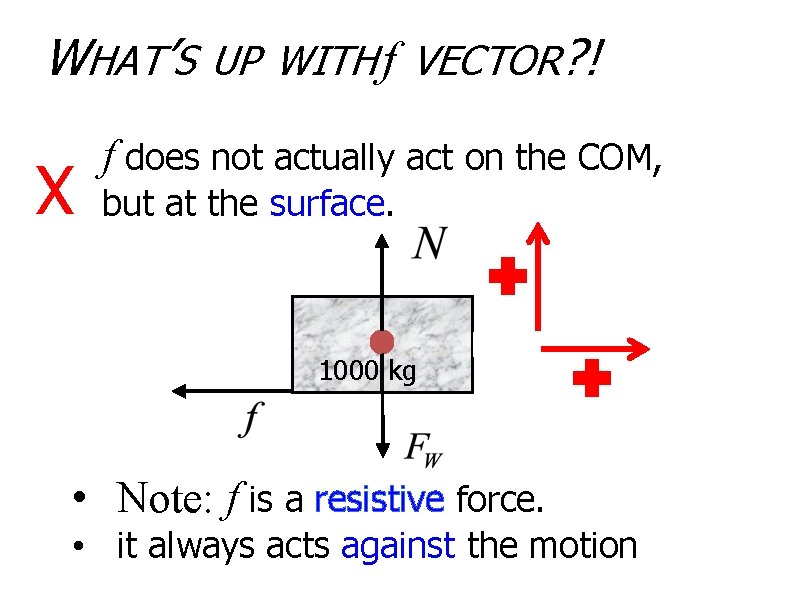
WHAT’S UP WITH f VECTOR? ! X f does not actually act on the COM, but at the surface. 1000 kg • Note: f is a resistive force. • it always acts against the motion
FREE BODY DIAGRAMS A 1000 kg car moving right, using its Scenario 3: brakes to slow down on a level freeway. Consider friction. X 4 Forces 1000 kg net force only in x direction
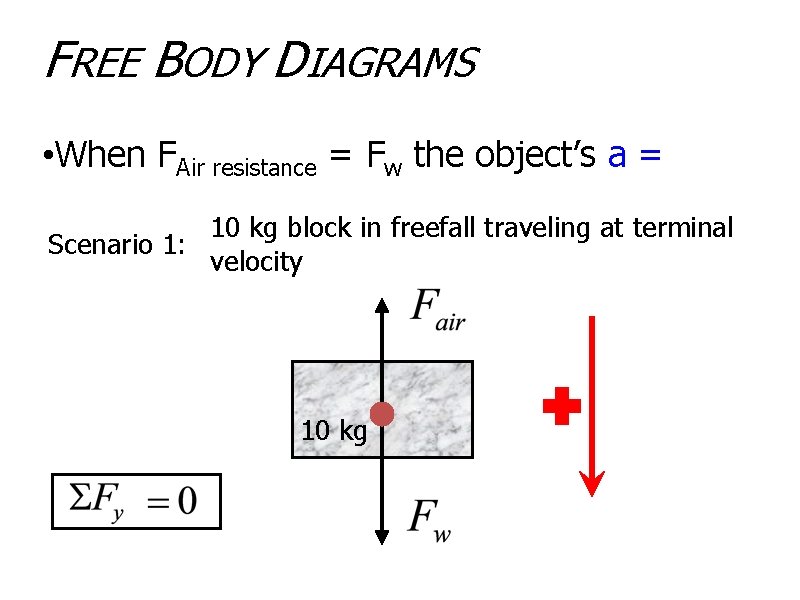
FREE BODY DIAGRAMS Fnet= 0 because terminal velocity is maximum speed, thus there is no acceleration Scenario 1: 10 kg block falling at terminal velocity 10 kg
FREE BODY DIAGRAMS Scenario 2: 10 kg block pulled across a frictionless floor by a string Just like projectiles, we treat x and y Does it fall through separately the floor? Y 10 kg
FREE BODY DIAGRAMS A 1000 kg car moving right, using its Scenario 3: brakes to slow down on a level freeway. Consider friction. X 4 Forces 1000 kg net force only in x direction
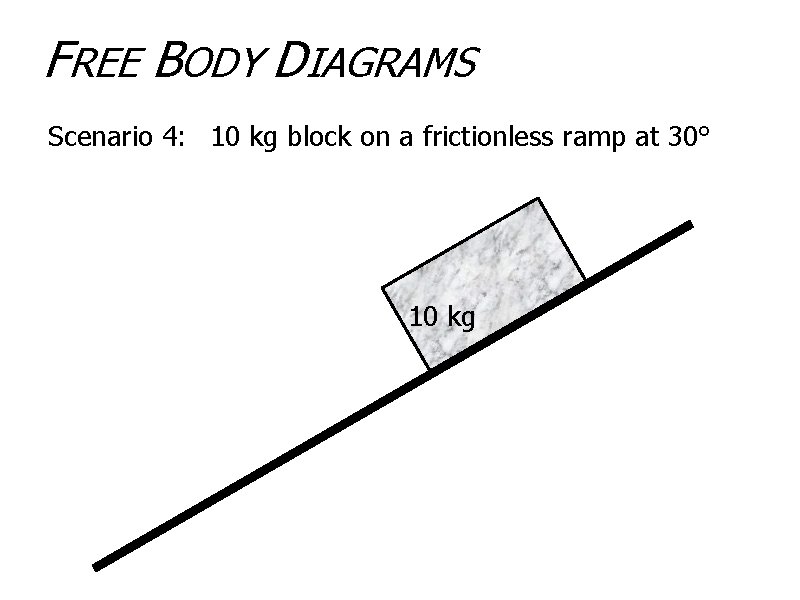
FREE BODY DIAGRAMS Scenario 4: 10 kg block on a frictionless ramp at 30° 10 kg
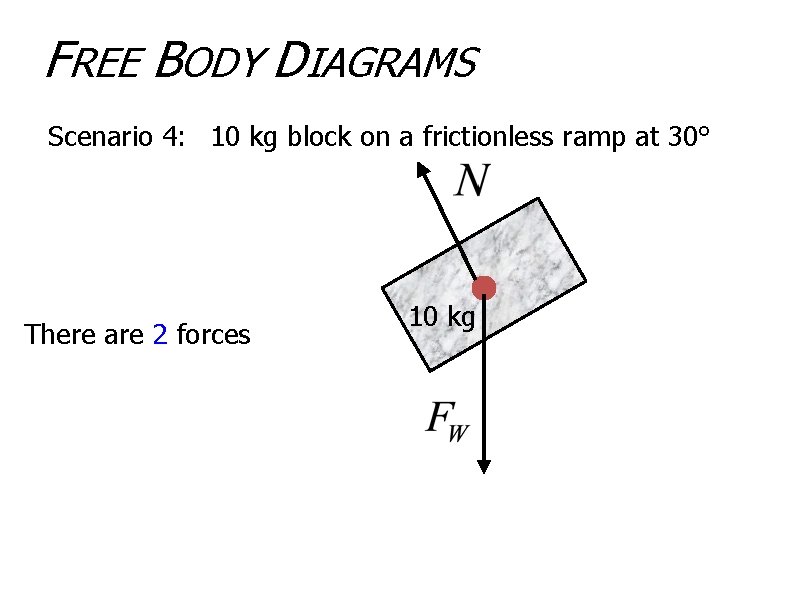
FREE BODY DIAGRAMS Scenario 4: 10 kg block on a frictionless ramp at 30° There are 2 forces 10 kg
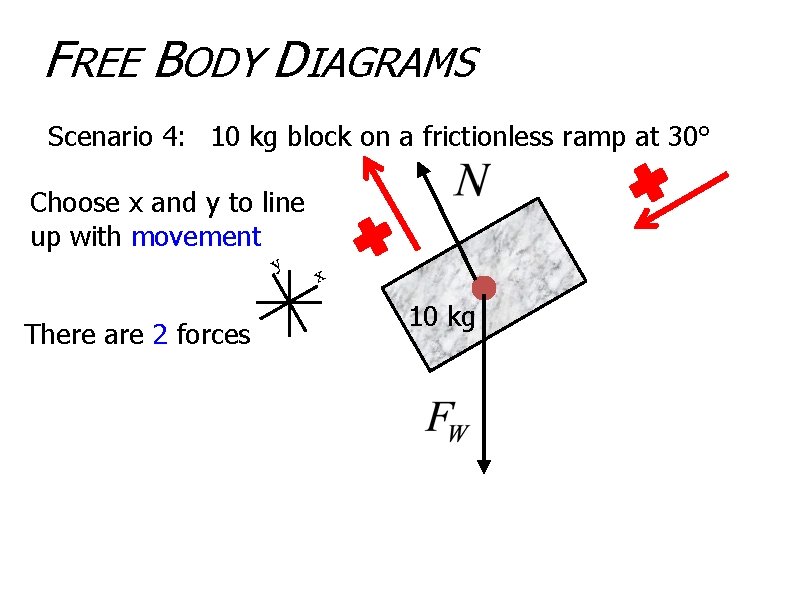
FREE BODY DIAGRAMS Scenario 4: 10 kg block on a frictionless ramp at 30° Choose x and y to line up with movement y There are 2 forces x 10 kg
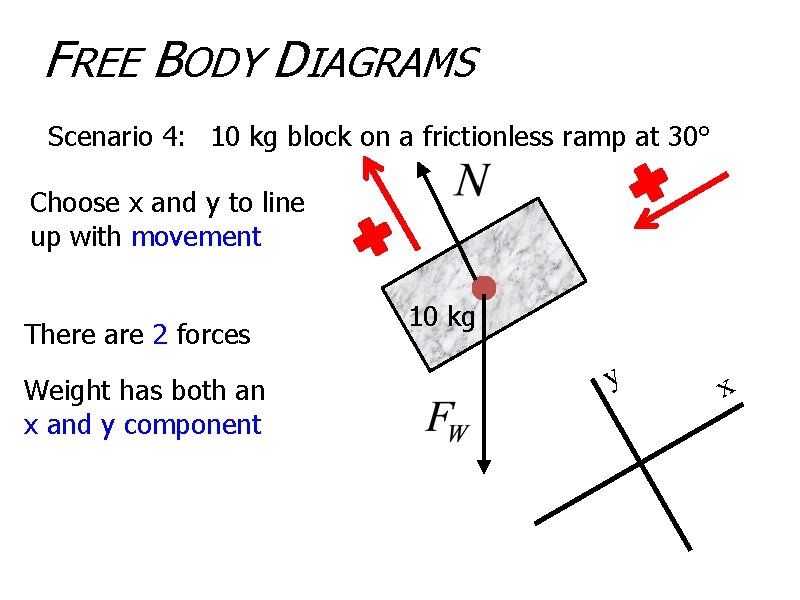
FREE BODY DIAGRAMS Scenario 4: 10 kg block on a frictionless ramp at 30° Choose x and y to line up with movement There are 2 forces Weight has both an x and y component 10 kg y x
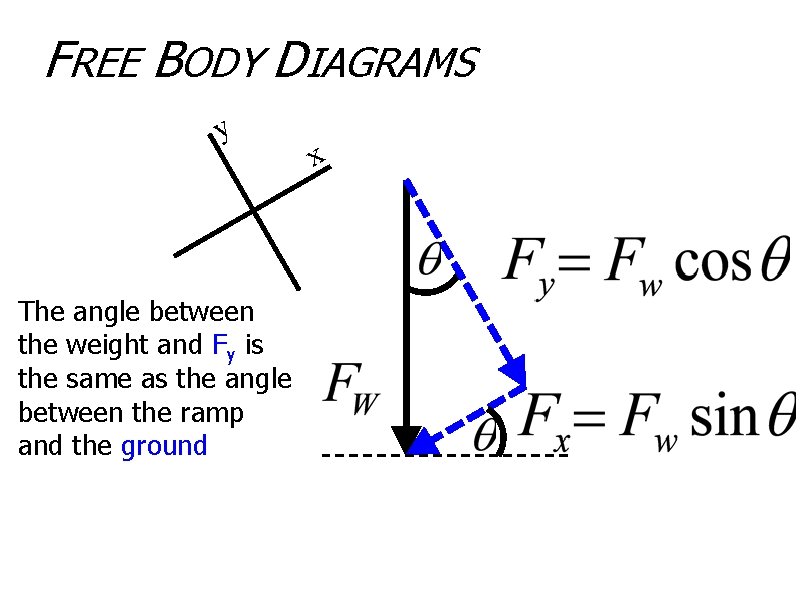
FREE BODY DIAGRAMS y The angle between the weight and Fy is the same as the angle between the ramp and the ground x
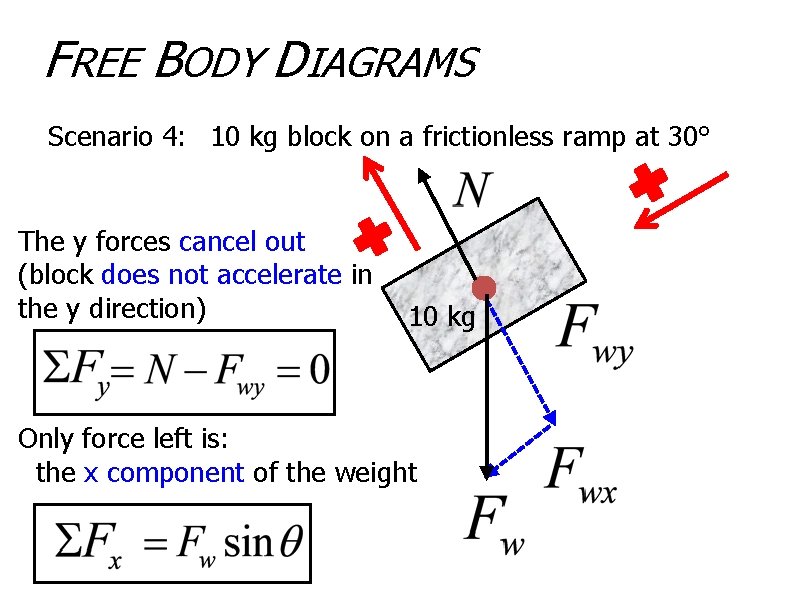
FREE BODY DIAGRAMS Scenario 4: 10 kg block on a frictionless ramp at 30° The y forces cancel out (block does not accelerate in the y direction) 10 kg Only force left is: the x component of the weight
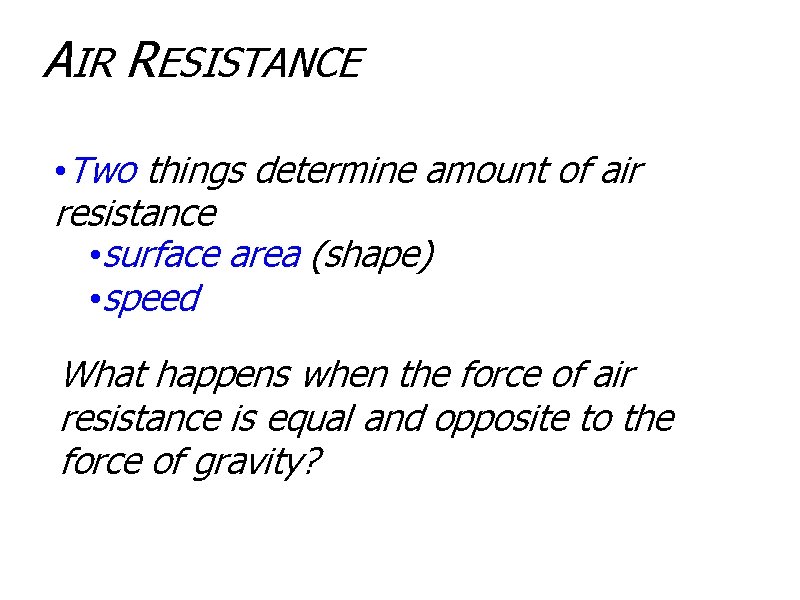
AIR RESISTANCE • Two things determine amount of air resistance • surface area (shape) • speed What happens when the force of air resistance is equal and opposite to the force of gravity?
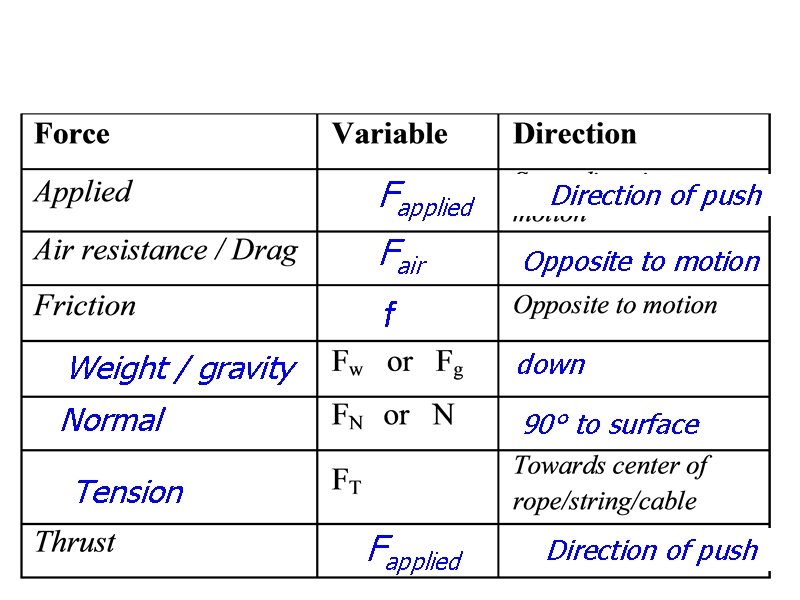
Fapplied Fair Direction of push Opposite to motion f Weight / gravity down Normal 90° to surface Tension Fapplied Direction of push
Review Test & HW Check & Correct your Free Body Diagrams HW Answer sheet in front Ftake a photo if you need to
PRACTICE! Go to pg. 310
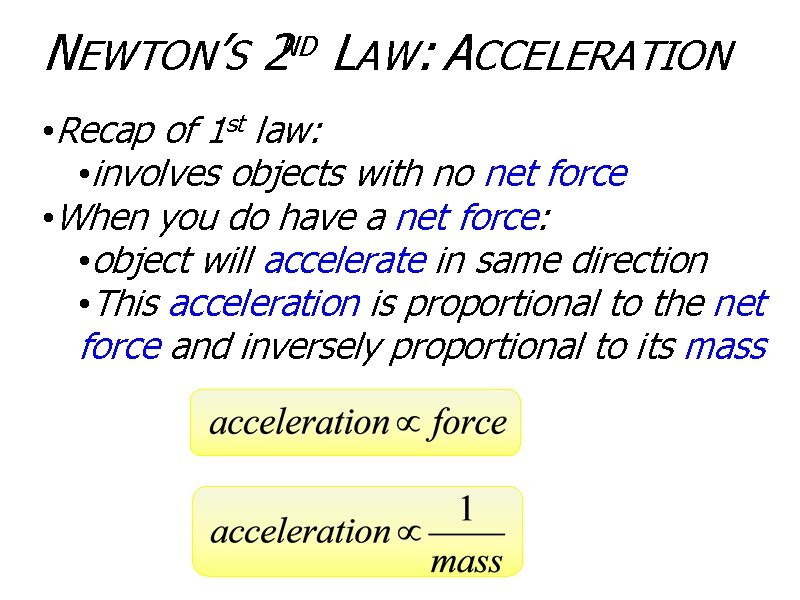
NEWTON’S 2 LAW: ACCELERATION ND • Recap of 1 st law: • involves objects with no net force • When you do have a net force: • object will accelerate in same direction • This acceleration is proportional to the net force and inversely proportional to its mass
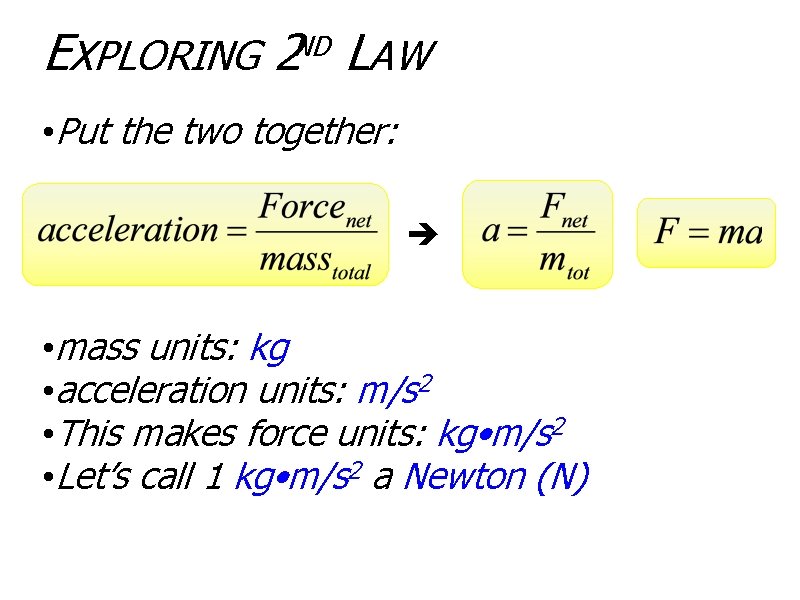
EXPLORING 2 LAW ND • Put the two together: • mass units: kg • acceleration units: m/s 2 • This makes force units: kg • m/s 2 • Let’s call 1 kg • m/s 2 a Newton (N)
Lab Go to pg. 359
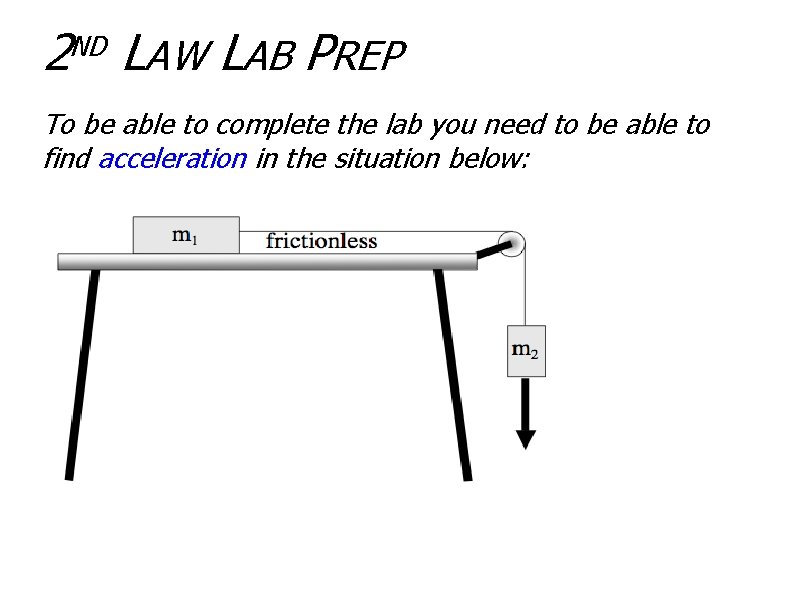
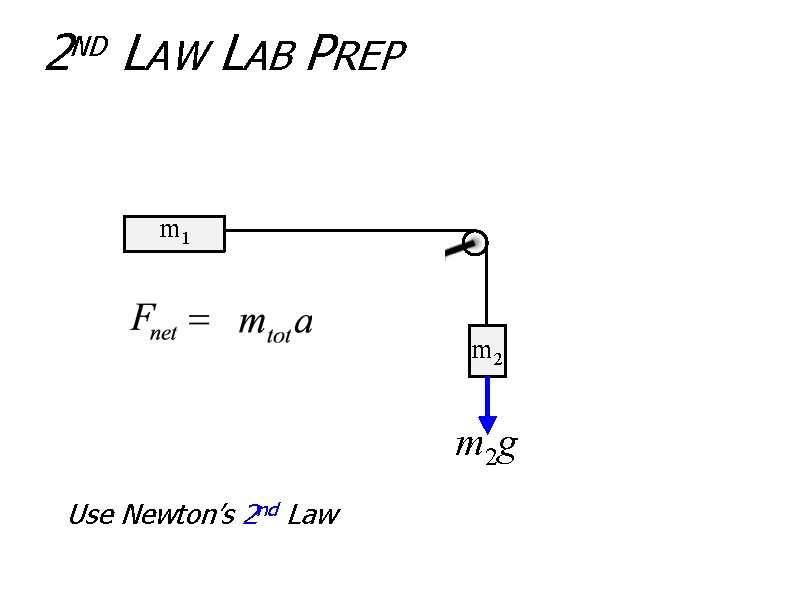
2 LAW LAB PREP ND To be able to complete the lab you need to be able to find acceleration in the situation below:
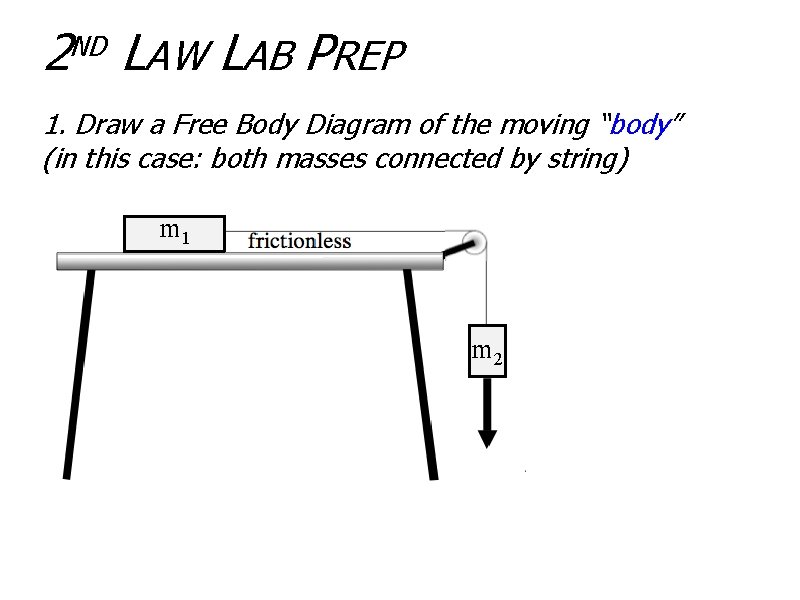
2 LAW LAB PREP ND 1. Draw a Free Body Diagram of the moving “body” (in this case: both masses connected by string) m 1 m 2
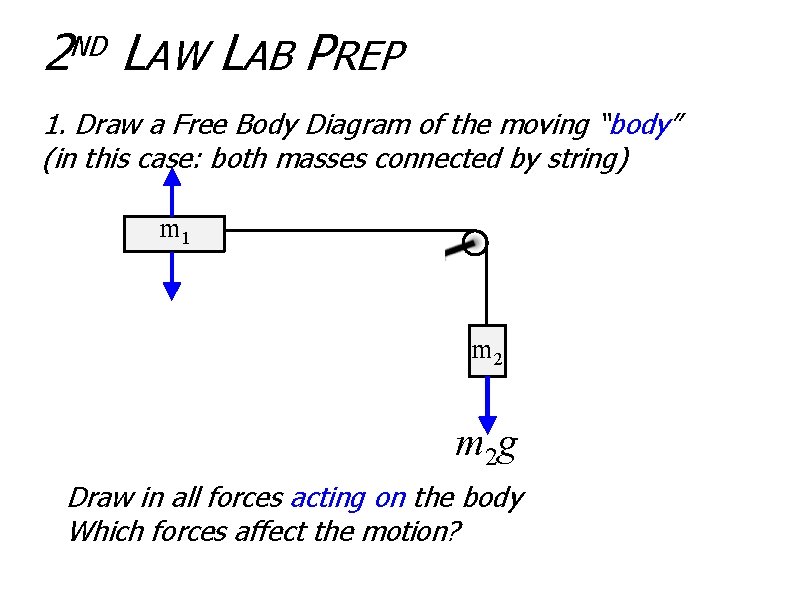
2 LAW LAB PREP ND 1. Draw a Free Body Diagram of the moving “body” (in this case: both masses connected by string) m 1 m 2 g Draw in all forces acting on the body Which forces affect the motion?
2 LAW LAB PREP ND m 1 m 2 g Use Newton’s 2 nd Law
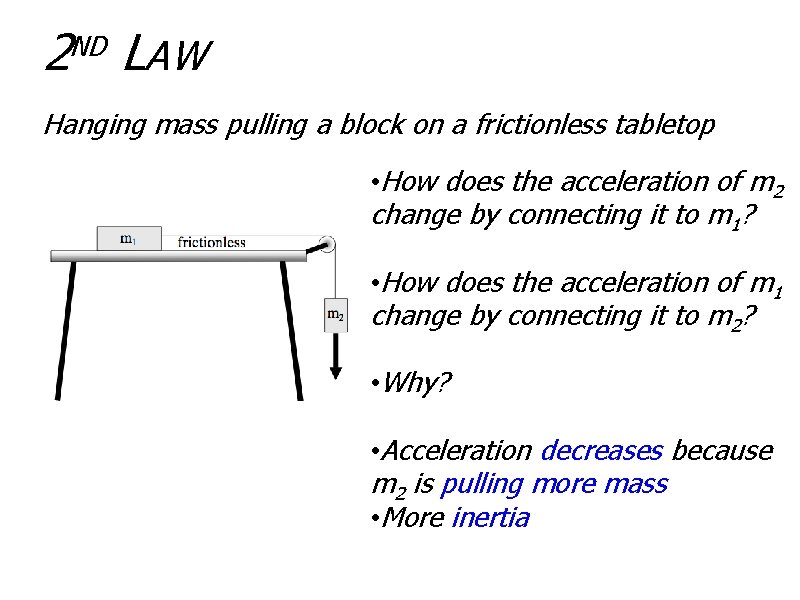
2 LAW ND Hanging mass pulling a block on a frictionless tabletop • How does the acceleration of m 2 change by connecting it to m 1? • How does the acceleration of m 1 change by connecting it to m 2? • Why? • Acceleration decreases because m 2 is pulling more mass • More inertia
Start Lab Go to pg. 316 -319
Assembly Procedure 1. Screw in pulley 2. Screw in photogate and plug it in 3. Make sure the photogate “sees” the pulley – when the pulley spins the red light should blink
Assembly Procedure 1. Put your cart on the rail 2. If the cart moves forward or backwards level the rail by turning the screws until the cart stays still 3. Record the mass of your cart and block 4. Record the mass of your mass hanger and masses 5. Plug sensors in & open the correct file
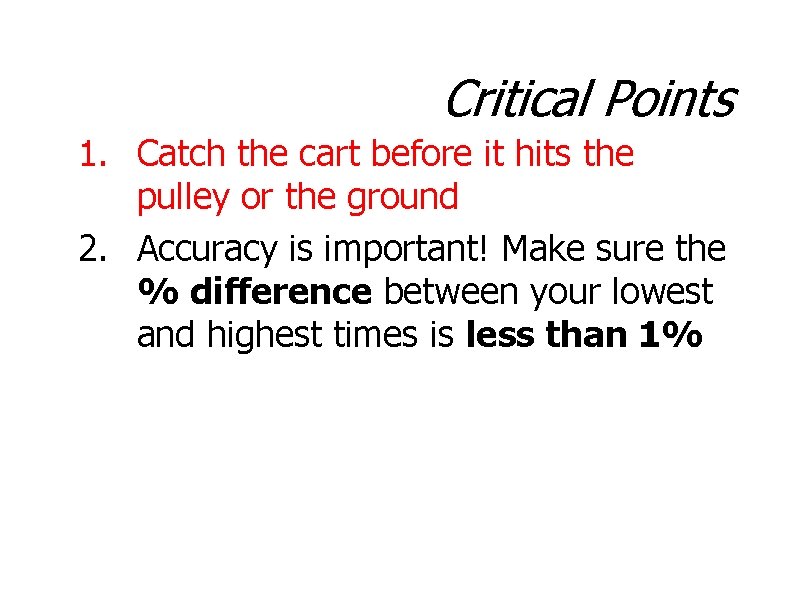
Critical Points 1. Catch the cart before it hits the pulley or the ground 2. Accuracy is important! Make sure the % difference between your lowest and highest times is less than 1%
Corrections to text #3 pg 317 FTap mode and select Pulley (10 spoke) enter data collection 4 after 50 events #3 pg 322 FHow much time would it take for the block to fall 30 cm if the 125 gram…
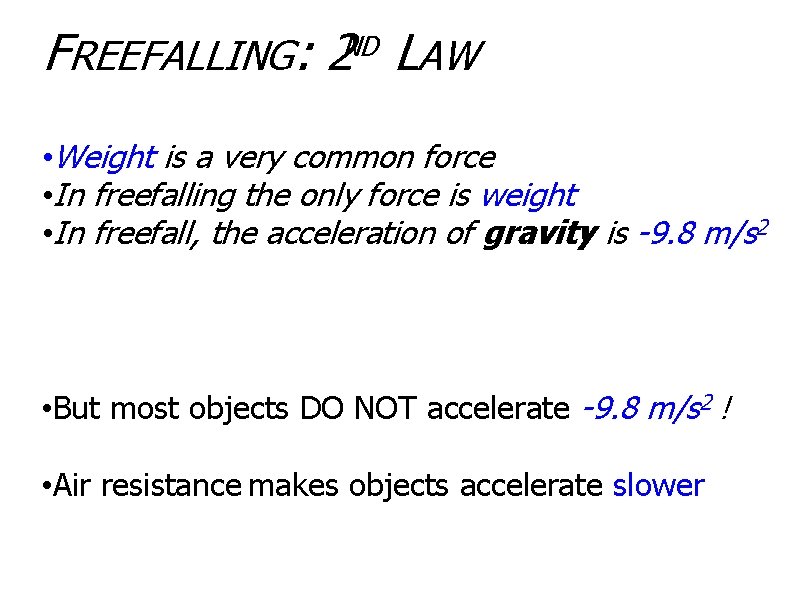
FREEFALLING: 2 LAW ND • Weight is a very common force • In freefalling the only force is weight • In freefall, the acceleration of gravity is -9. 8 m/s 2 • But most objects DO NOT accelerate -9. 8 m/s 2 ! • Air resistance makes objects accelerate slower
FREE BODY DIAGRAMS • When FAir resistance = Fw the object’s a = zero 10 kg block in freefall traveling at terminal Scenario 1: velocity 10 kg
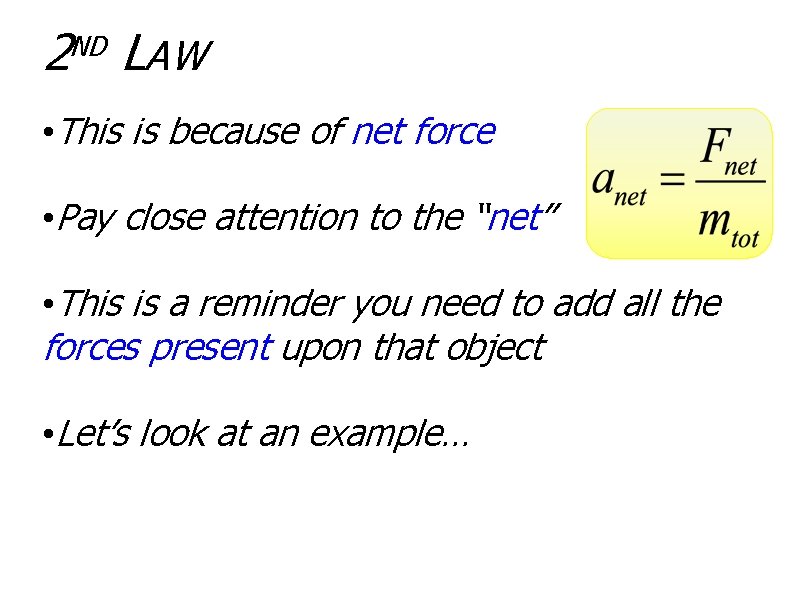
2 LAW ND • This is because of net force • Pay close attention to the “net” • This is a reminder you need to add all the forces present upon that object • Let’s look at an example…
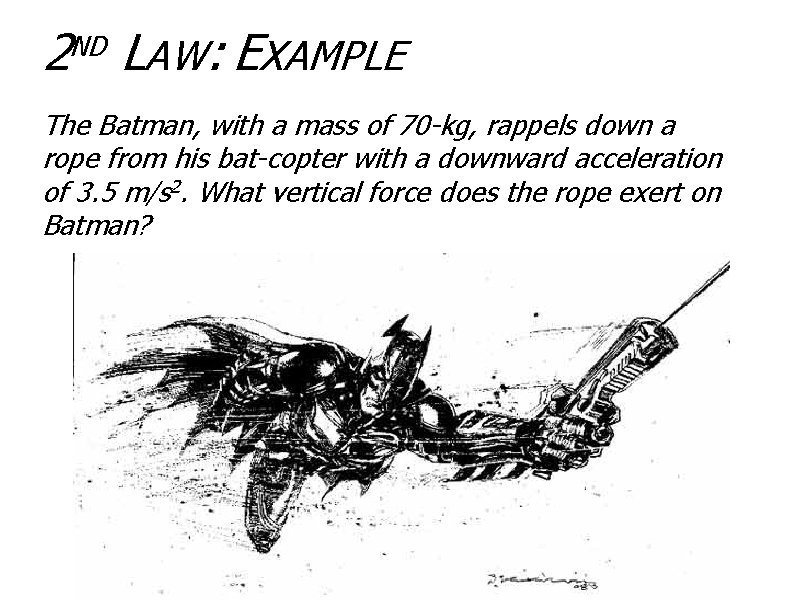
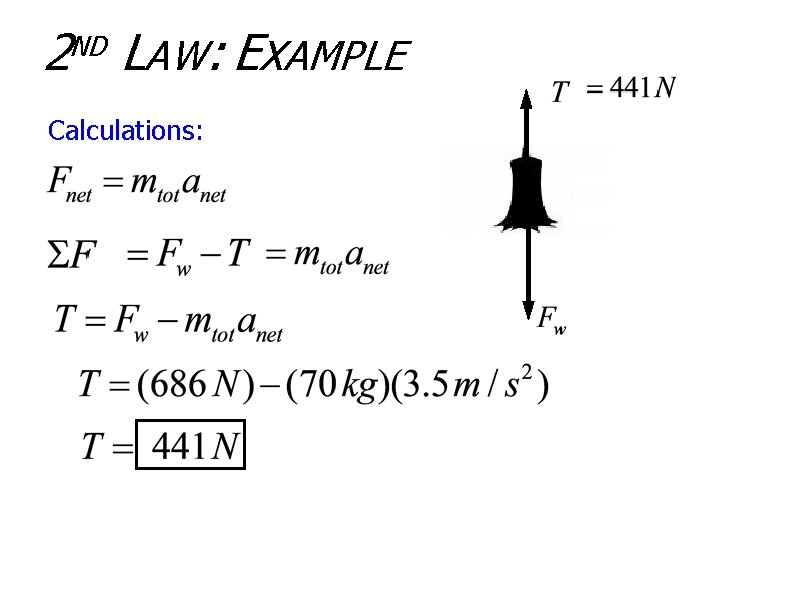
2 LAW: EXAMPLE ND The Batman, with a mass of 70 -kg, rappels down a rope from his bat-copter with a downward acceleration of 3. 5 m/s 2. What vertical force does the rope exert on Batman?
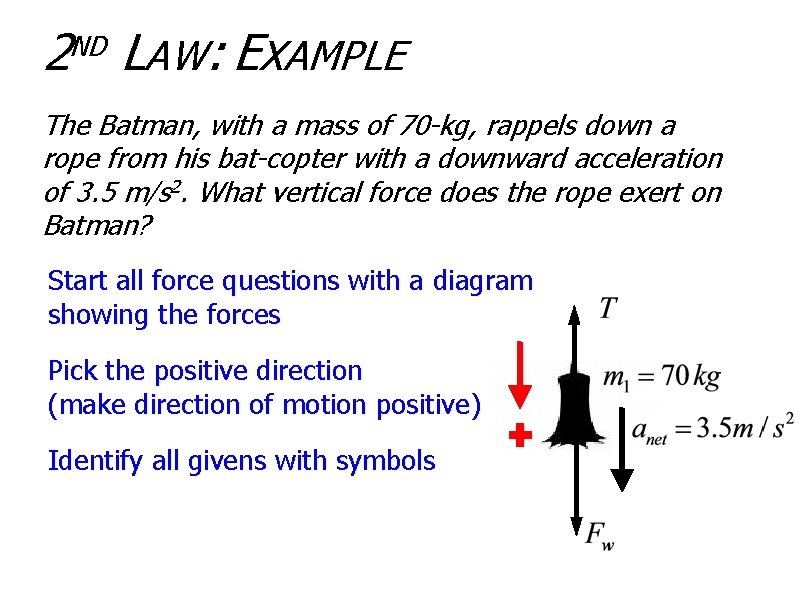
2 LAW: EXAMPLE ND The Batman, with a mass of 70 -kg, rappels down a rope from his bat-copter with a downward acceleration of 3. 5 m/s 2. What vertical force does the rope exert on Batman? Start all force questions with a diagram showing the forces Pick the positive direction (make direction of motion positive) Identify all givens with symbols
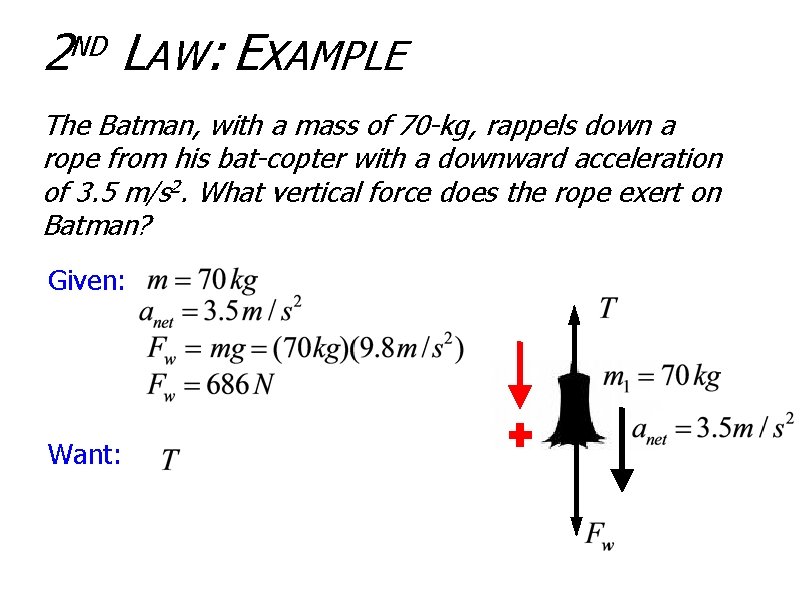
2 LAW: EXAMPLE ND The Batman, with a mass of 70 -kg, rappels down a rope from his bat-copter with a downward acceleration of 3. 5 m/s 2. What vertical force does the rope exert on Batman? Given: Want:
2 LAW: EXAMPLE ND Calculations:
TIME TO PRACTICE Start your homework Turn to pg. 405
Atwood Machine Video http: //www. youtube. com/watch ? v=i 2 b. GTC 27 OJU
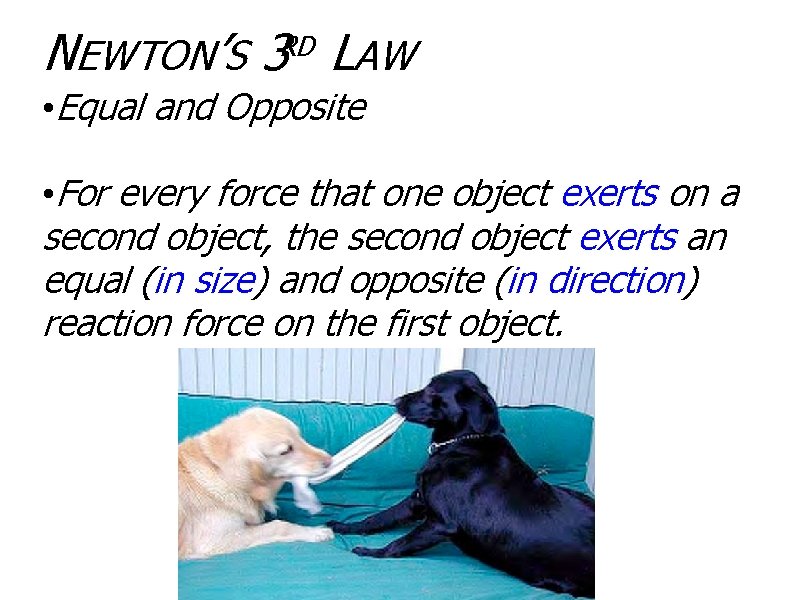
NEWTON’S 3 LAW RD • Equal and Opposite • For every force that one object exerts on a second object, the second object exerts an equal (in size) and opposite (in direction) reaction force on the first object.
NEWTON’S 3 LAW SUBTLETIES RD • Forces only come in pairs (you cannot create a single force) • Does action cancel out reaction? • NO! Each force acts on a different object. • Each force has different effect on their object! (ex. gun and bullet)
TIME TO PRACTICE Turn to pg. 337
Fhttp: //www. youtube. com/watch? v=8 b. Td. M m. NZm 2 M 1. Why does the moon go around the earth? 2. Does the moon put a gravitational pull on the earth? 3. How does that force compare to the force the earth puts on the moon?
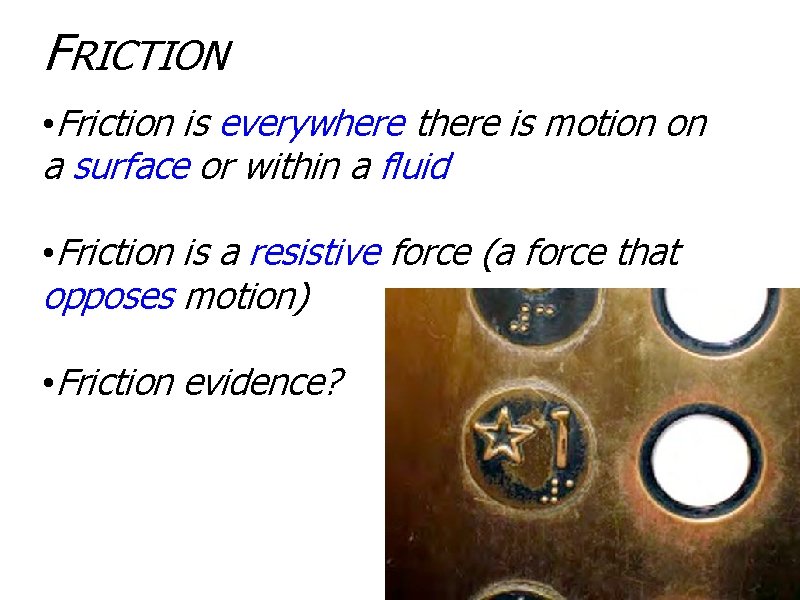
FRICTION • Friction is everywhere there is motion on a surface or within a fluid • Friction is a resistive force (a force that opposes motion) • Friction evidence?
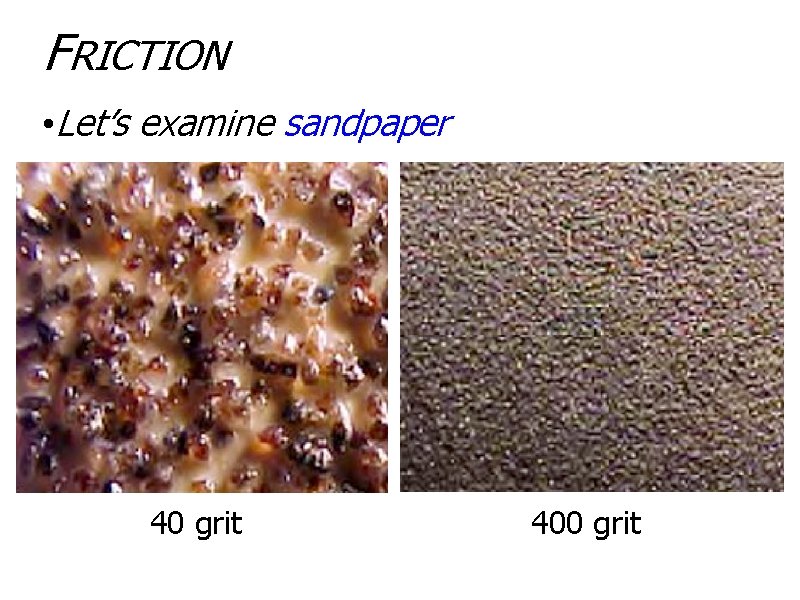
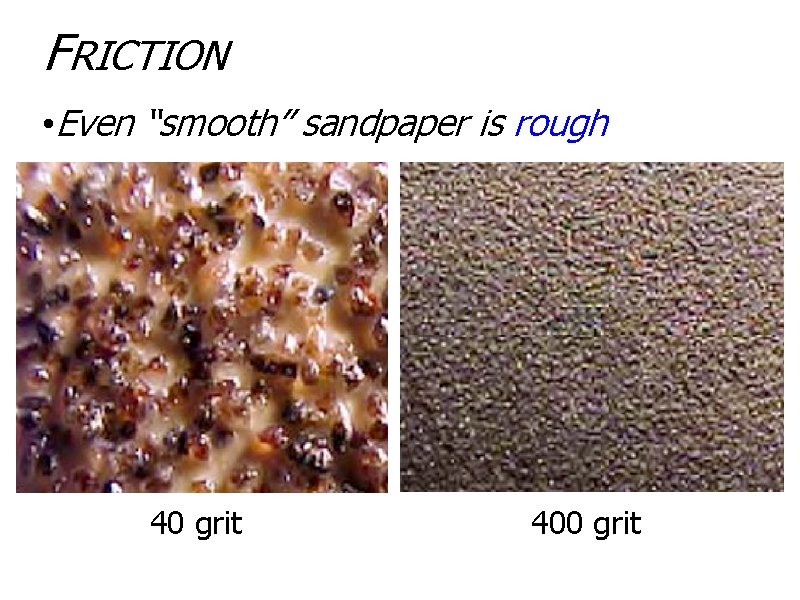
FRICTION • Let’s examine sandpaper 40 grit 400 grit
FRICTION • Even “smooth” sandpaper is rough 40 grit 400 grit
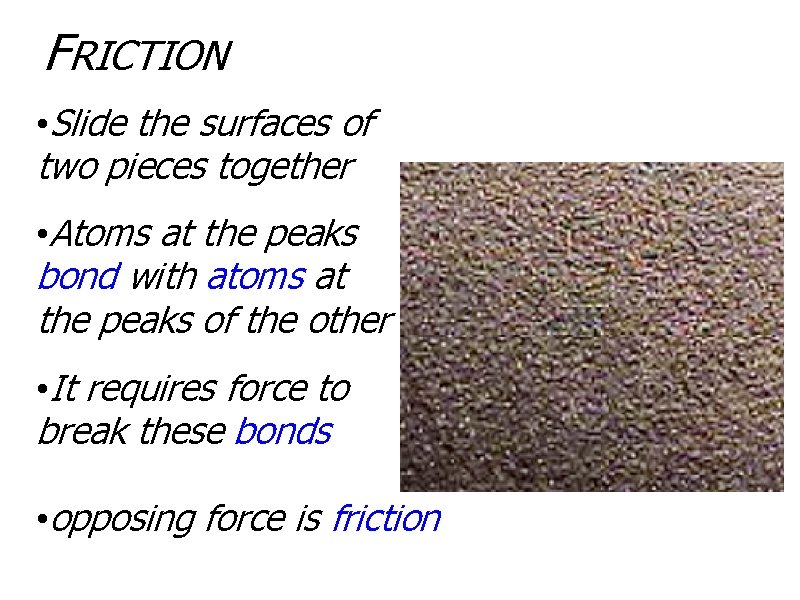
FRICTION • Slide the surfaces of two pieces together • Atoms at the peaks bond with atoms at the peaks of the other • It requires force to break these bonds • opposing force is friction
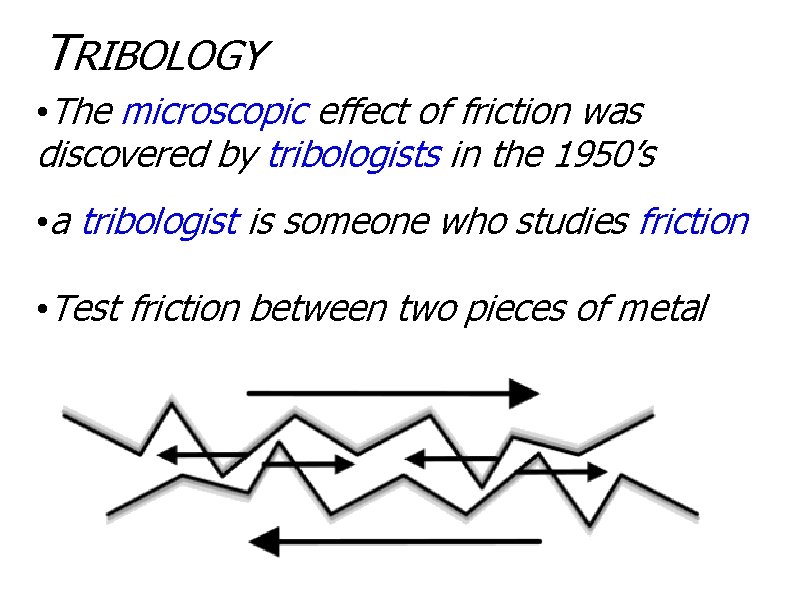
TRIBOLOGY • The microscopic effect of friction was discovered by tribologists in the 1950’s • a tribologist is someone who studies friction • Test friction between two pieces of metal
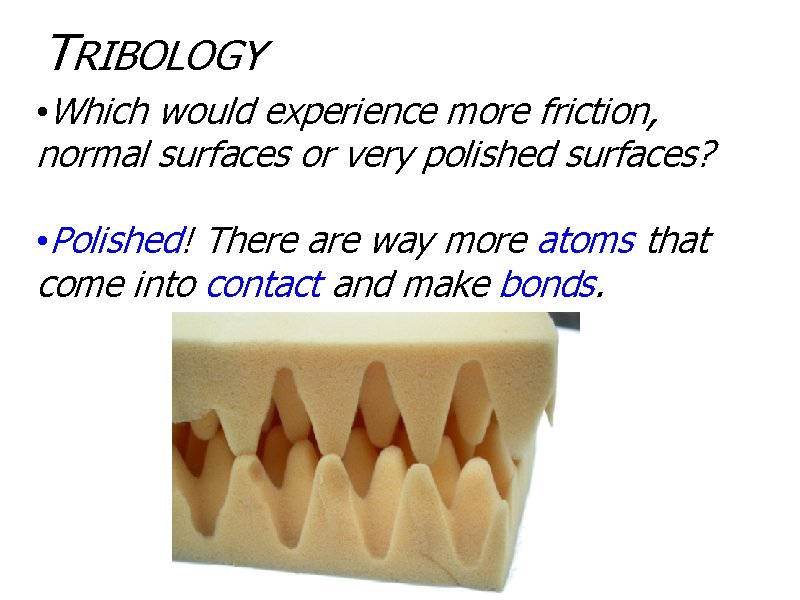
TRIBOLOGY • Which would experience more friction, normal surfaces or very polished surfaces? • Polished! There are way more atoms that come into contact and make bonds.
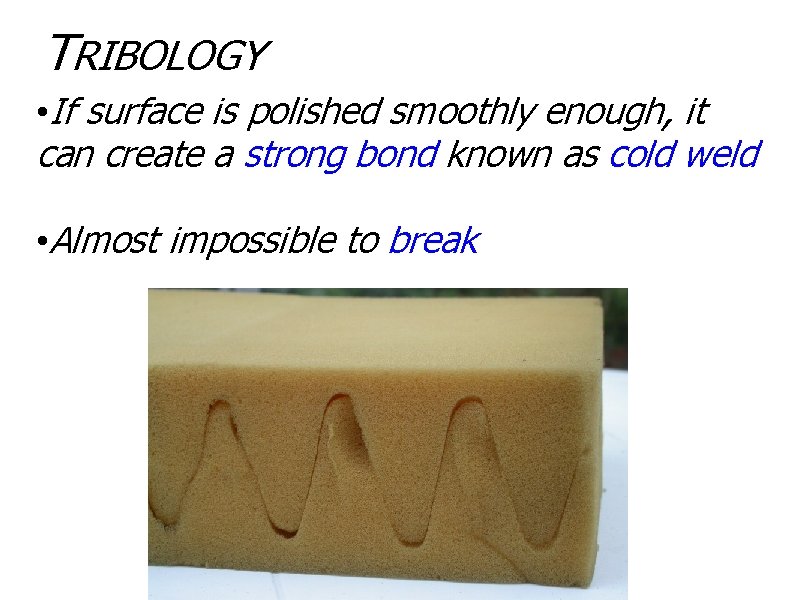
TRIBOLOGY • If surface is polished smoothly enough, it can create a strong bond known as cold weld • Almost impossible to break
FORCE OF FRICTION • Friction between solid surfaces depends on: 1. The perpendicular (Normal) force between the surfaces in contact 2. The nature of the surfaces in contact • together, these create a net frictional force
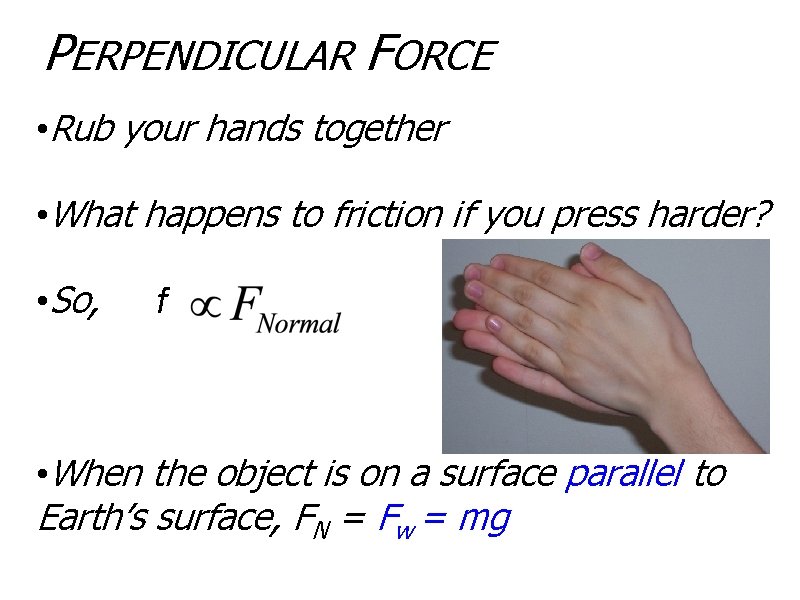
PERPENDICULAR FORCE • Rub your hands together • What happens to friction if you press harder? • So, f • When the object is on a surface parallel to Earth’s surface, FN = Fw = mg
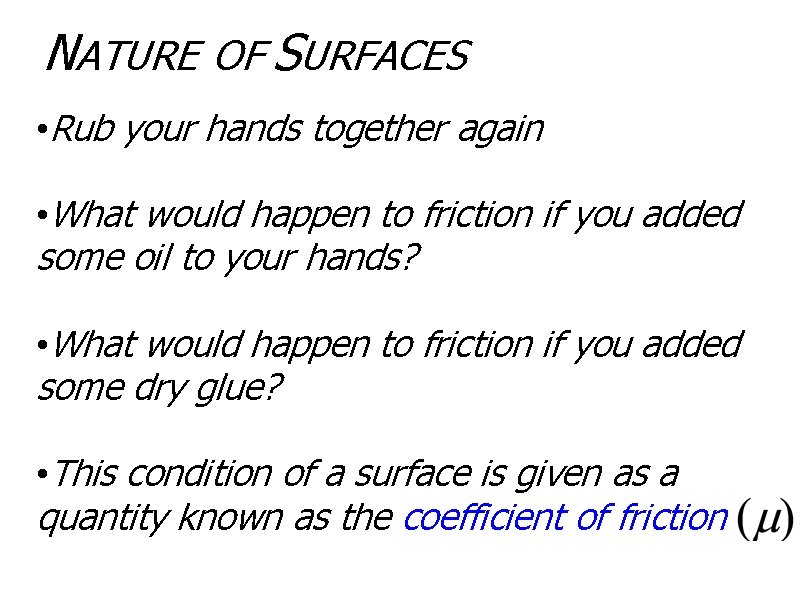
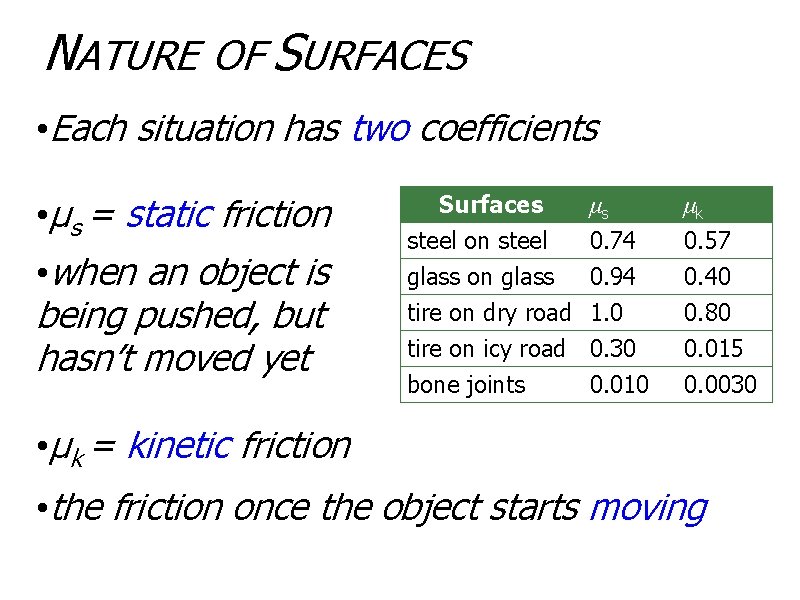
NATURE OF SURFACES • Rub your hands together again • What would happen to friction if you added some oil to your hands? • What would happen to friction if you added some dry glue? • This condition of a surface is given as a quantity known as the coefficient of friction
NATURE OF SURFACES • Each situation has two coefficients • μs = static friction • when an object is being pushed, but hasn’t moved yet Surfaces steel on steel glass on glass tire on dry road μs μk 0. 74 0. 94 1. 0 0. 57 0. 40 0. 80 tire on icy road 0. 30 bone joints 0. 010 0. 015 0. 0030 • μk = kinetic friction • the friction once the object starts moving
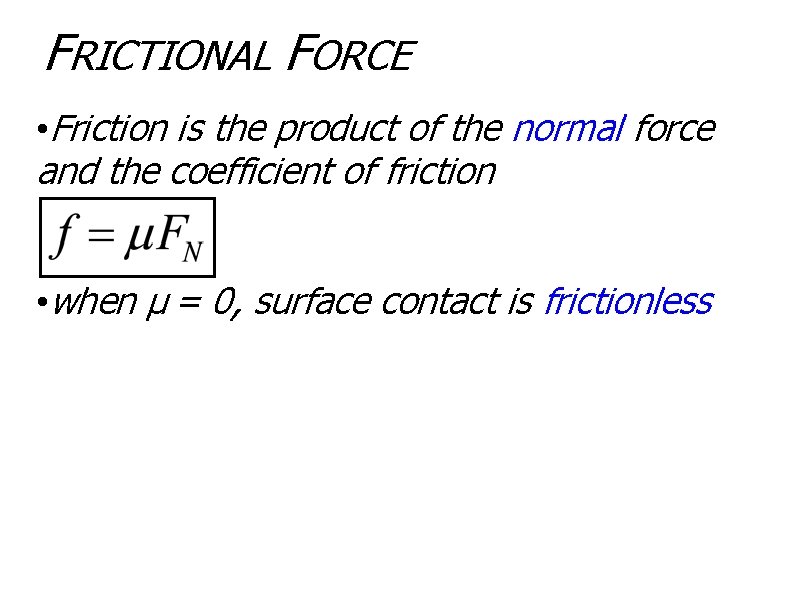
FRICTIONAL FORCE • Friction is the product of the normal force and the coefficient of friction • when μ = 0, surface contact is frictionless
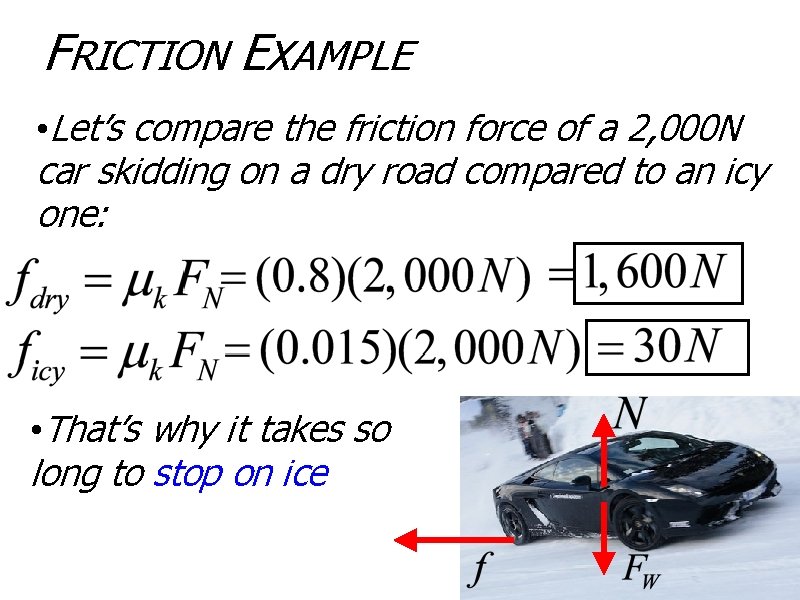
FRICTION EXAMPLE • Let’s compare the friction force of a 2, 000 N car skidding on a dry road compared to an icy one: • That’s why it takes so long to stop on ice
Time to practice Turn to pg. 346 Remember mass ≠ Fweight
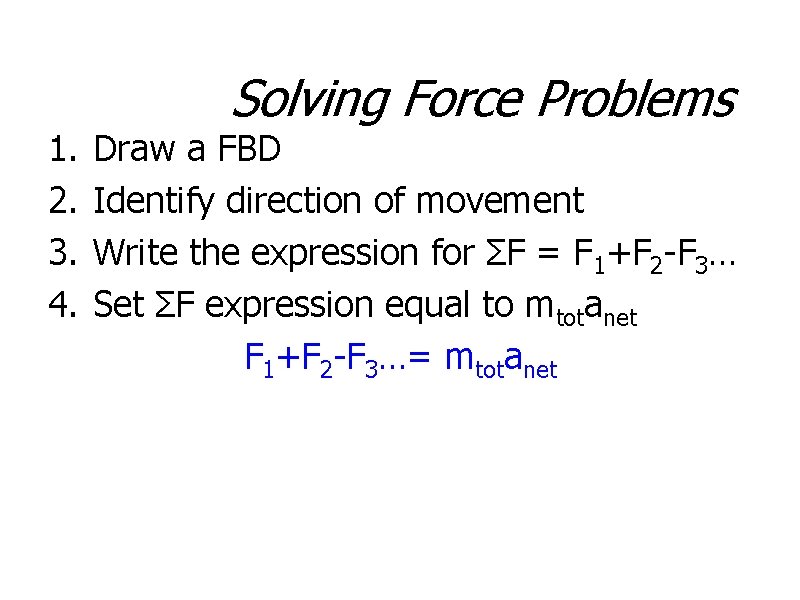
1. 2. 3. 4. Solving Force Problems Draw a FBD Identify direction of movement Write the expression for ΣF = F 1+F 2 -F 3… Set ΣF expression equal to mtotanet F 1+F 2 -F 3…= mtotanet
INERTIA • Newton’s 1 st Law • An object wants to keep on doing what it is already doing • In order to change, it needs a net force not equal to zero
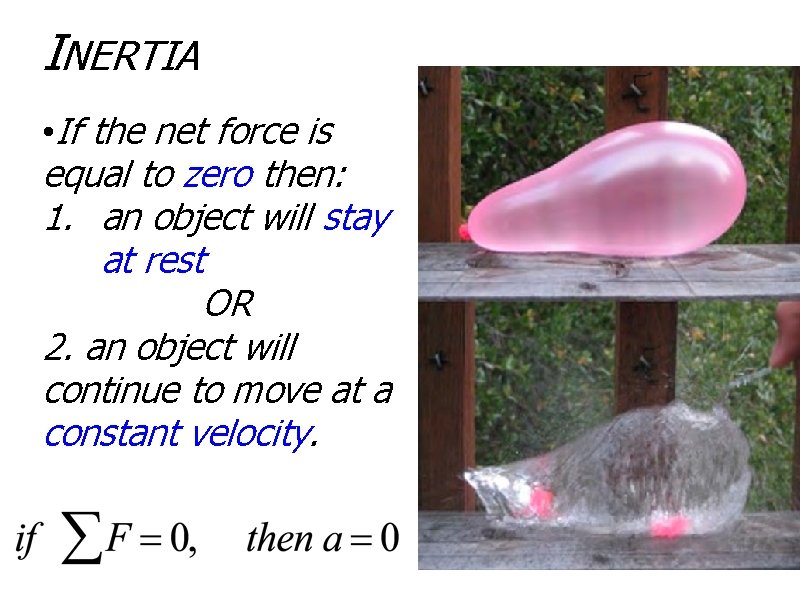
INERTIA • If the net force is equal to zero then: 1. an object will stay at rest OR 2. an object will continue to move at a constant velocity.
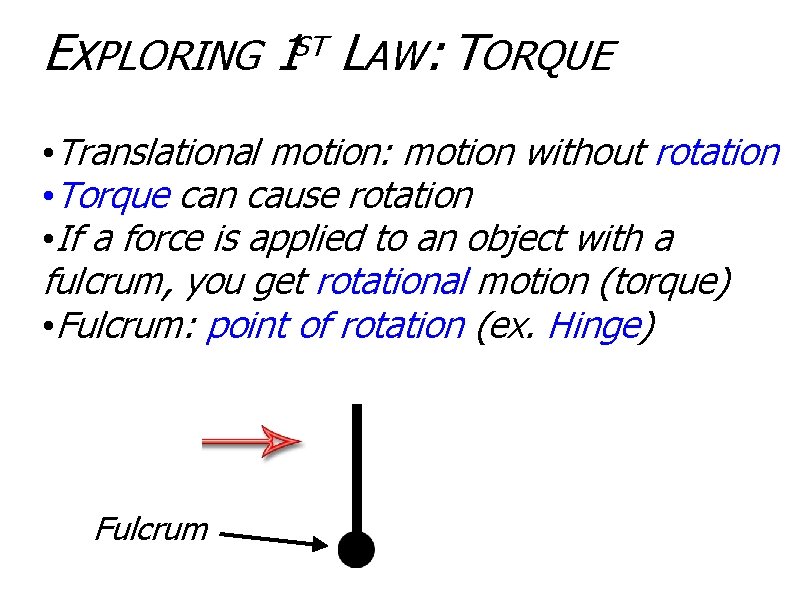
EXPLORING 1 LAW: TORQUE ST • Translational motion: motion without rotation • Torque can cause rotation • If a force is applied to an object with a fulcrum, you get rotational motion (torque) • Fulcrum: point of rotation (ex. Hinge) Fulcrum
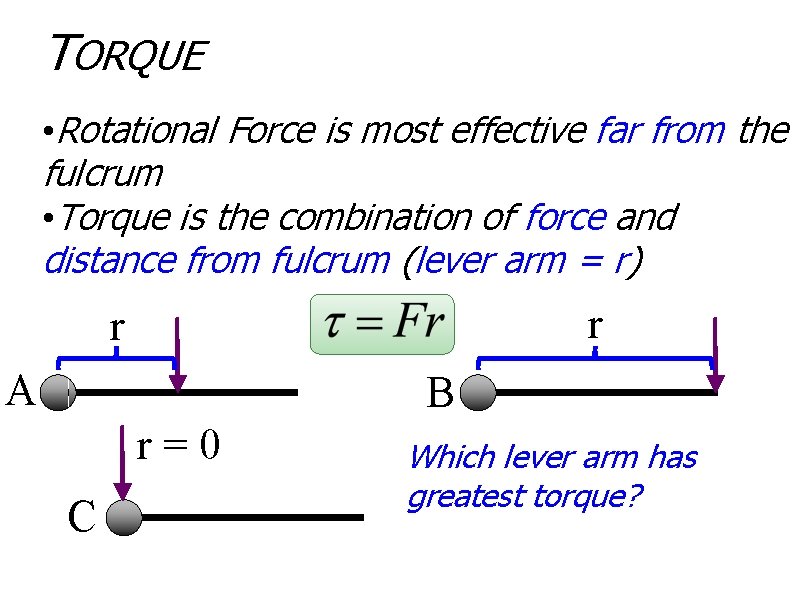
TORQUE • Rotational Force is most effective far from the fulcrum • Torque is the combination of force and distance from fulcrum (lever arm = r) r r A B r=0 C Which lever arm has greatest torque?
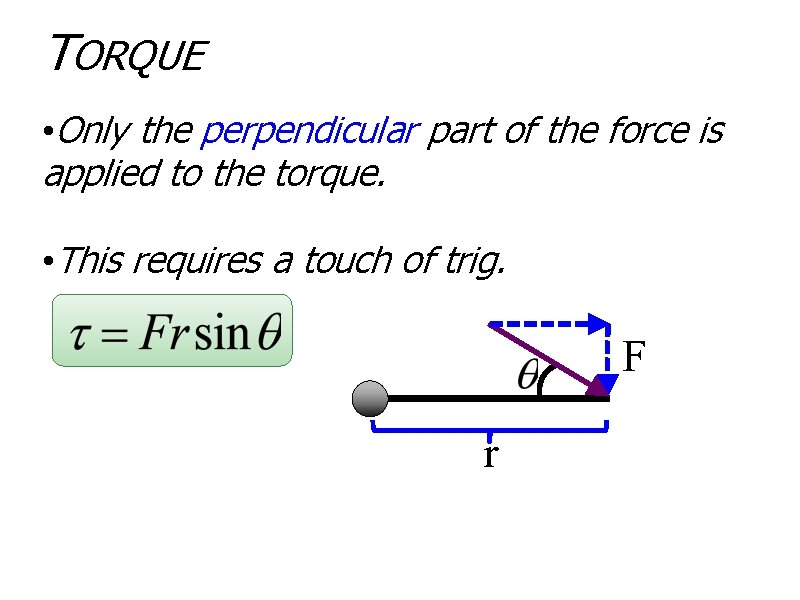
TORQUE • Only the perpendicular part of the force is applied to the torque. • This requires a touch of trig. F r
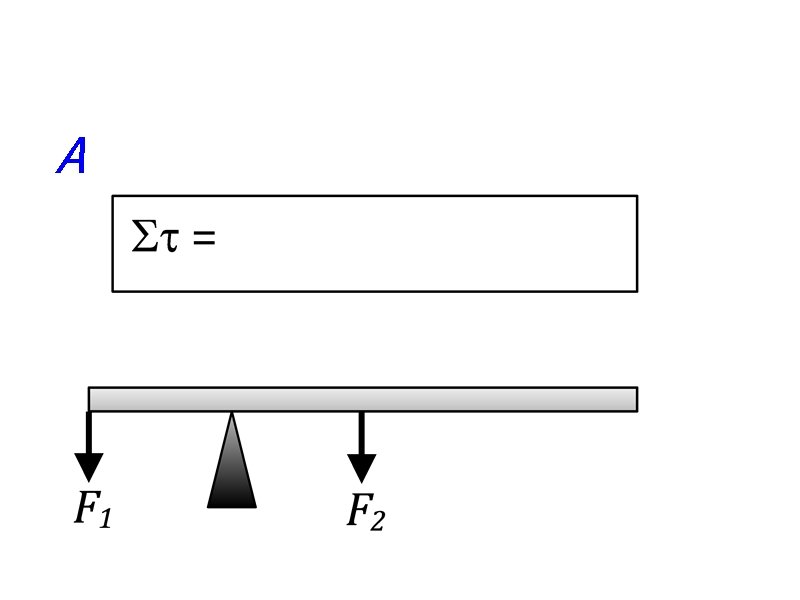
A
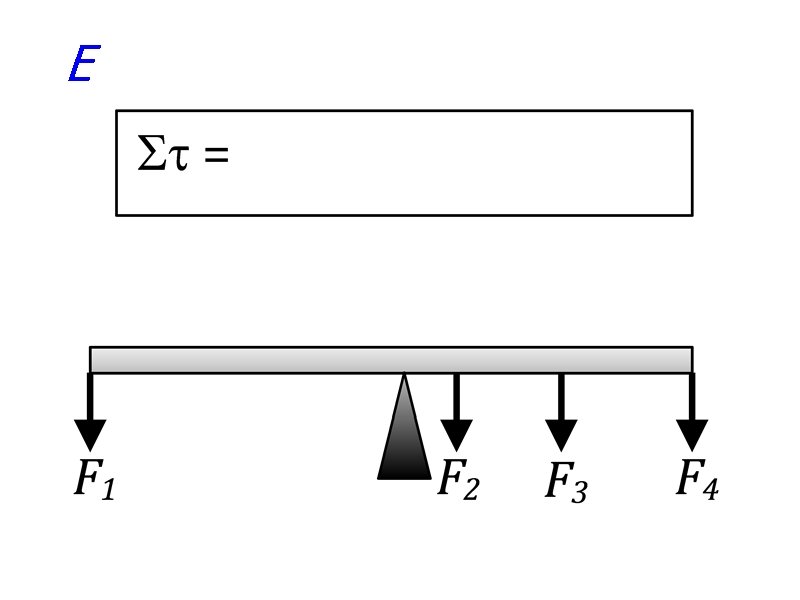
E
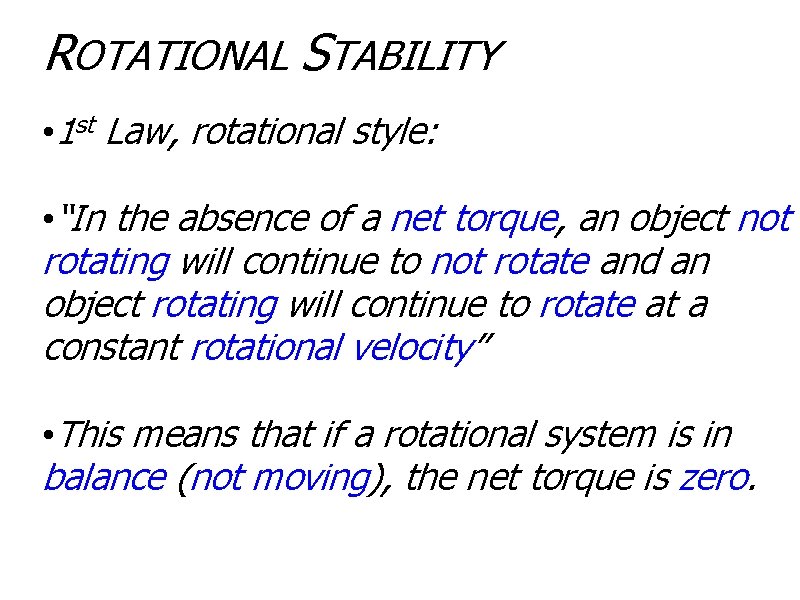
ROTATIONAL STABILITY • 1 st Law, rotational style: • “In the absence of a net torque, an object not rotating will continue to not rotate and an object rotating will continue to rotate at a constant rotational velocity” • This means that if a rotational system is in balance (not moving), the net torque is zero.
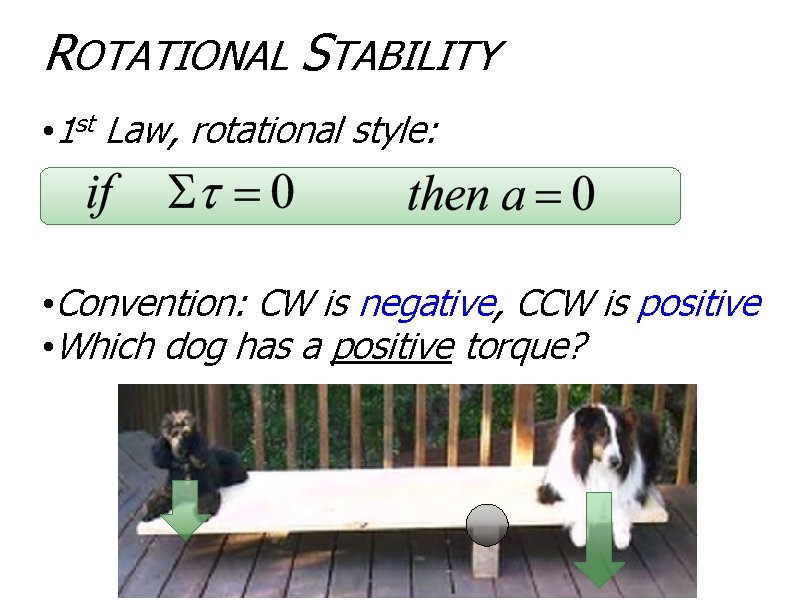
ROTATIONAL STABILITY • 1 st Law, rotational style: • Convention: CW is negative, CCW is positive • Which dog has a positive torque?
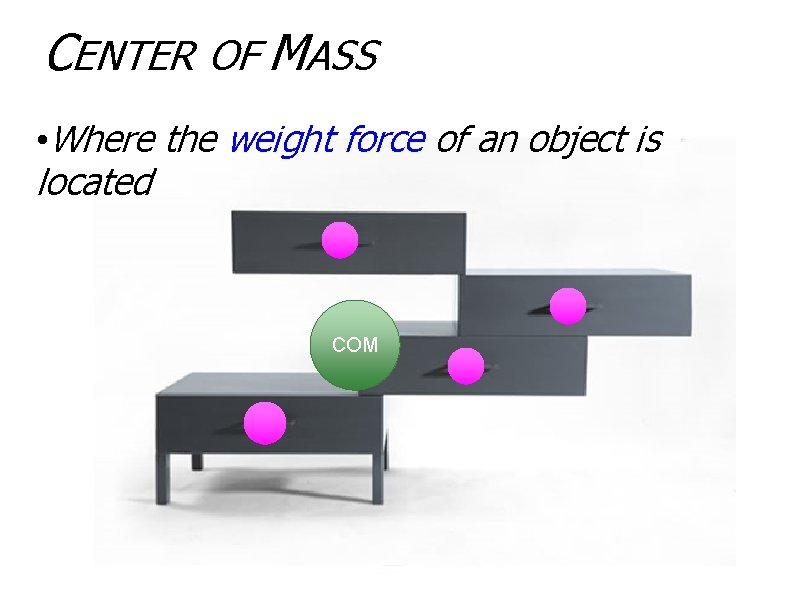
CENTER OF MASS • Where the weight force of an object is located COM
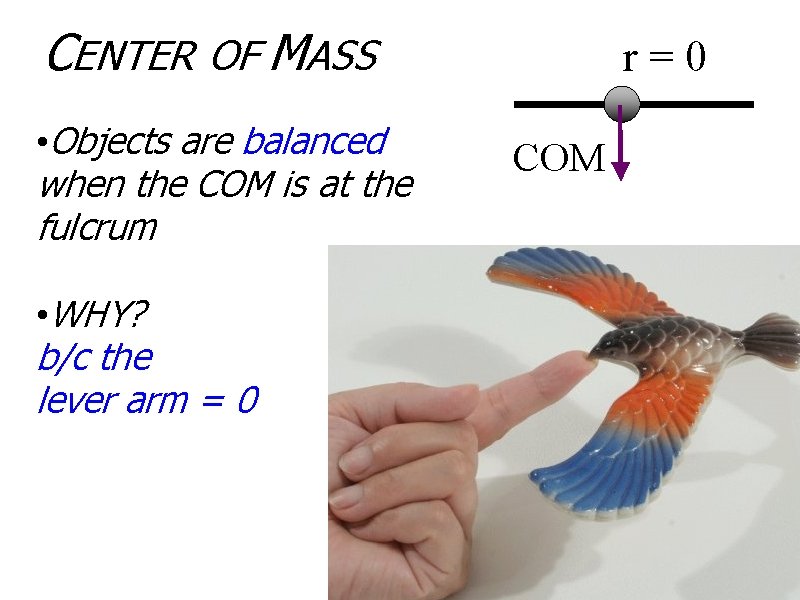
CENTER OF MASS • Objects are balanced when the COM is at the fulcrum • WHY? b/c the lever arm = 0 r=0 COM
Dr Carlson's Science Theatre
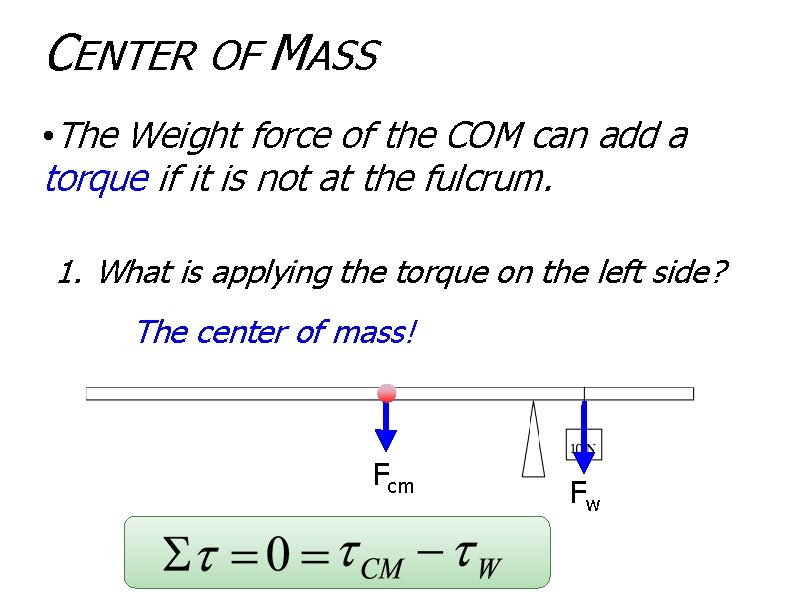
CENTER OF MASS • The Weight force of the COM can add a torque if it is not at the fulcrum. 1. What is applying the torque on the left side? The center of mass! Fcm Fw
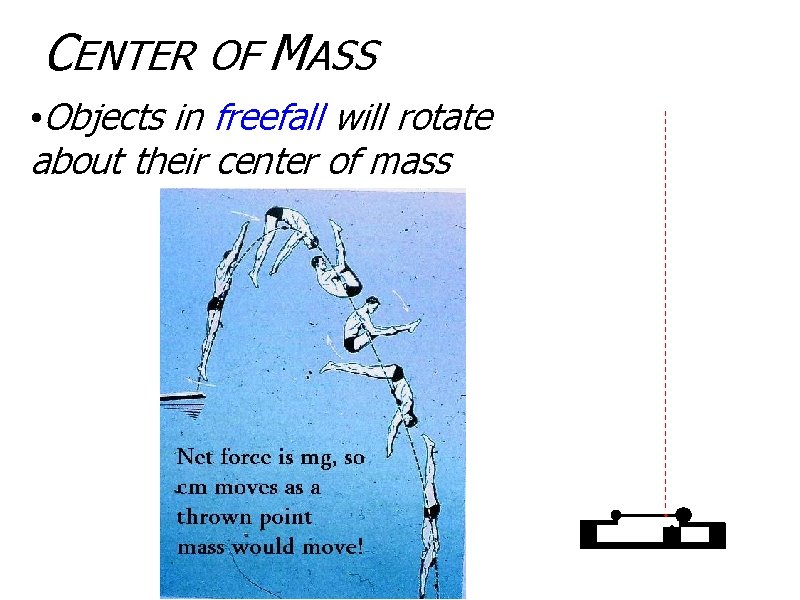
CENTER OF MASS • Objects in freefall will rotate about their center of mass
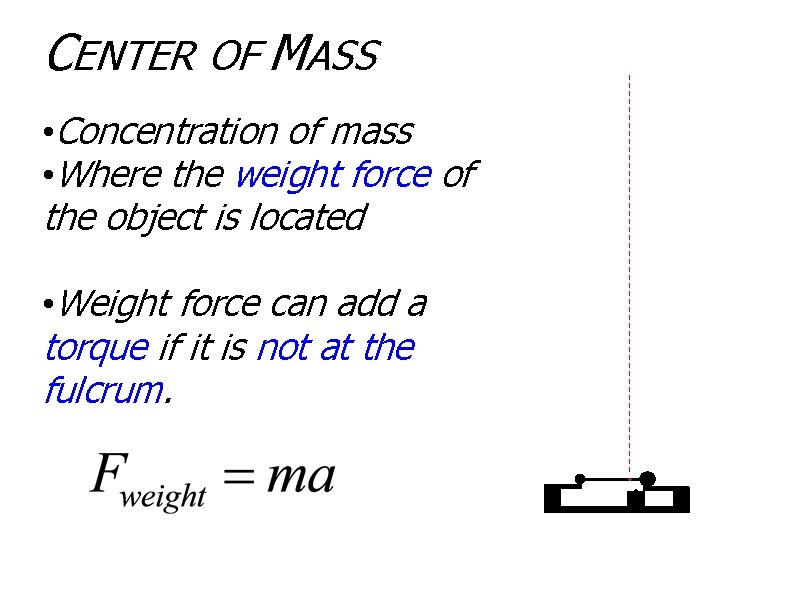
CENTER OF MASS • Concentration of mass • Where the weight force of the object is located • Weight force can add a torque if it is not at the fulcrum.
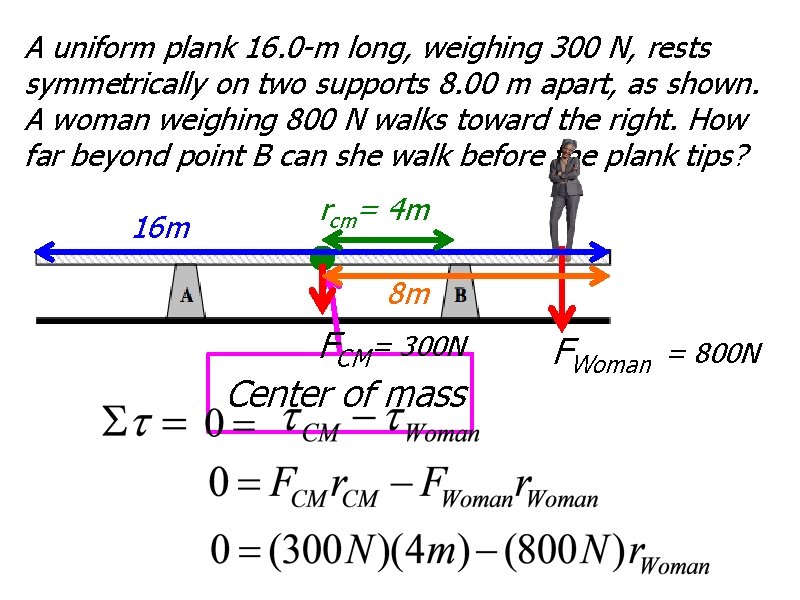
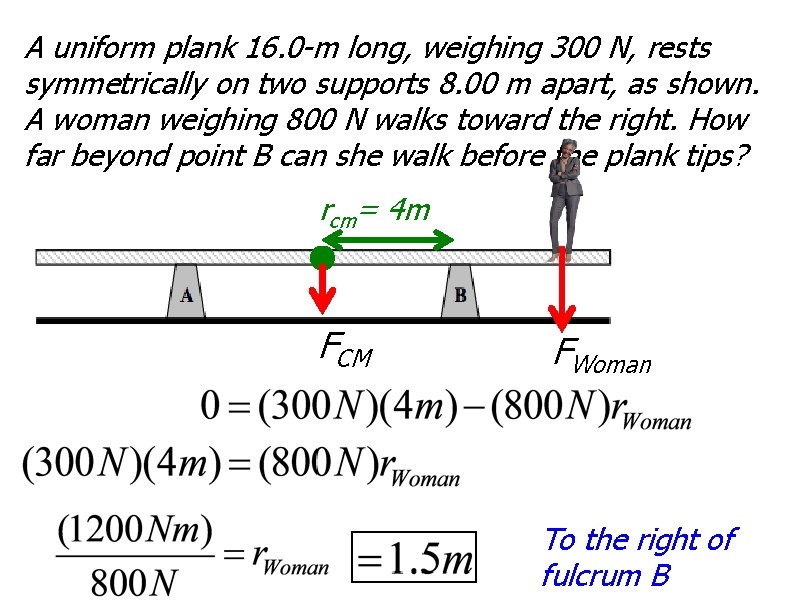
A uniform plank 16. 0 -m long, weighing 300 N, rests symmetrically on two supports 8. 00 m apart, as shown. A woman weighing 800 N walks toward the right. How far beyond point B can she walk before the plank tips? 16 m rcm= 4 m 8 m FCM = 300 N Center of mass FWoman = 800 N
A uniform plank 16. 0 -m long, weighing 300 N, rests symmetrically on two supports 8. 00 m apart, as shown. A woman weighing 800 N walks toward the right. How far beyond point B can she walk before the plank tips? rcm= 4 m FCM FWoman To the right of fulcrum B
MASS WEIGHT • Mass is a measure of how much matter makes up an object • Weight is a Force • Depends on object itself – NEVER CHANGES • Mass is a measure of inertia • Mass is measured in: grams, Kilograms • Depends on object’s location • Weight is measured in: Newtons (N) or pounds (lbs)
Mass: 70 kg Weight: 700 Newtons Weight: 112 Newtons (157 pounds) (25 pounds) Mass is Same!!
Lab: pg 375 -377 FWrite givens and equations FBox answers & include units FMass needs in kg Fr (distance to fulcrum) in m
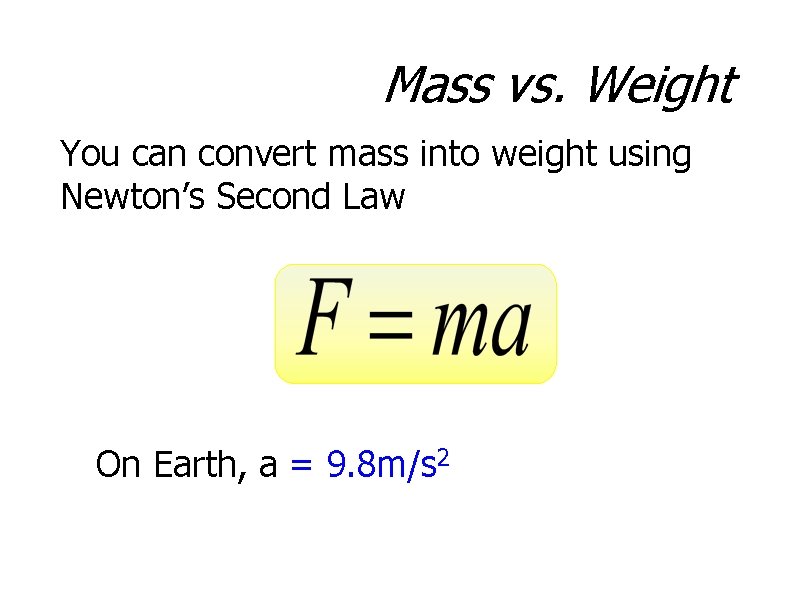
Mass vs. Weight You can convert mass into weight using Newton’s Second Law On Earth, a = 9. 8 m/s 2
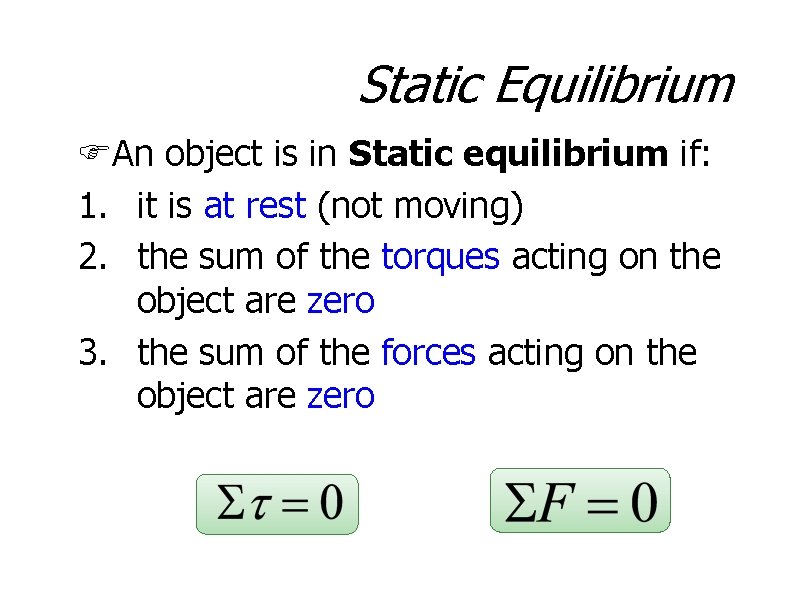
Static Equilibrium FAn object is in Static equilibrium if: 1. it is at rest (not moving) 2. the sum of the torques acting on the object are zero 3. the sum of the forces acting on the object are zero
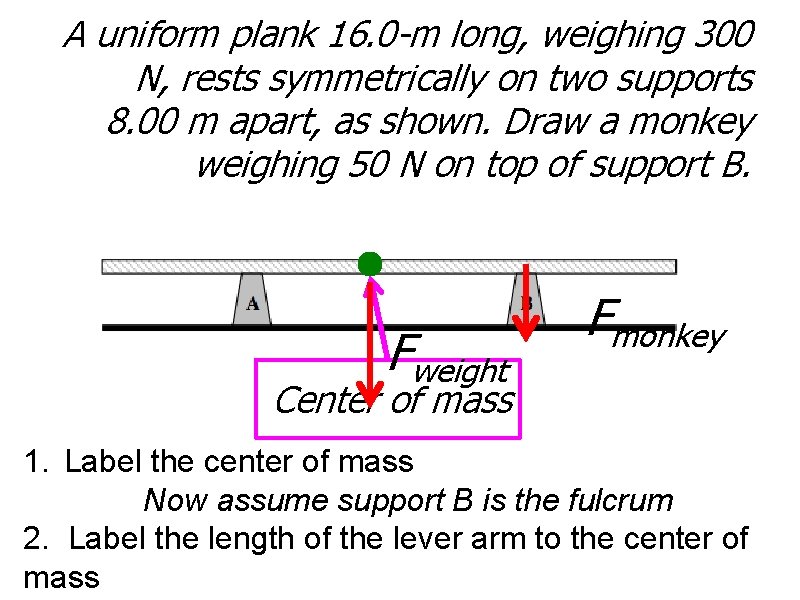
A uniform plank 16. 0 -m long, weighing 300 N, rests symmetrically on two supports 8. 00 m apart, as shown. Draw a monkey weighing 50 N on top of support B. Fweight Fmonkey Center of mass 1. Label the center of mass Now assume support B is the fulcrum 2. Label the length of the lever arm to the center of mass
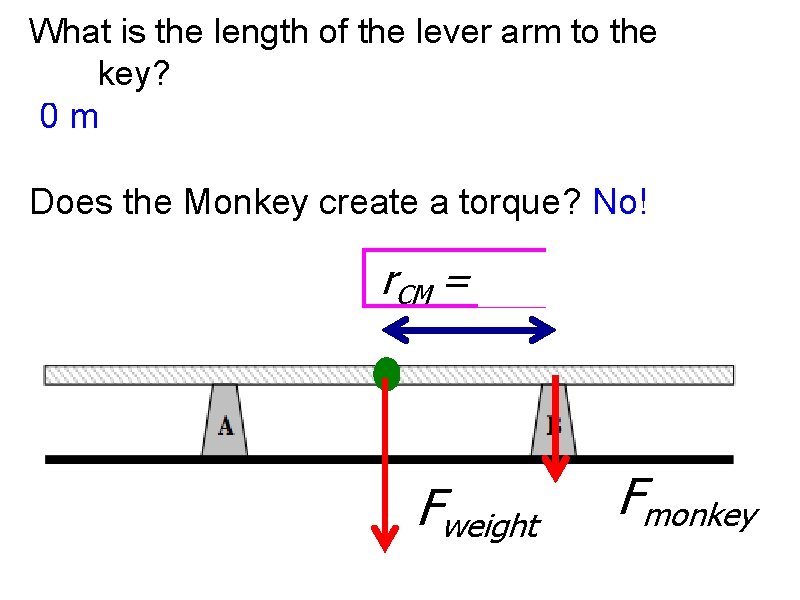
What is the length of the lever arm to the monkey? 0 m Does the Monkey create a torque? No! r. CM = 4 m Fweight Fmonkey
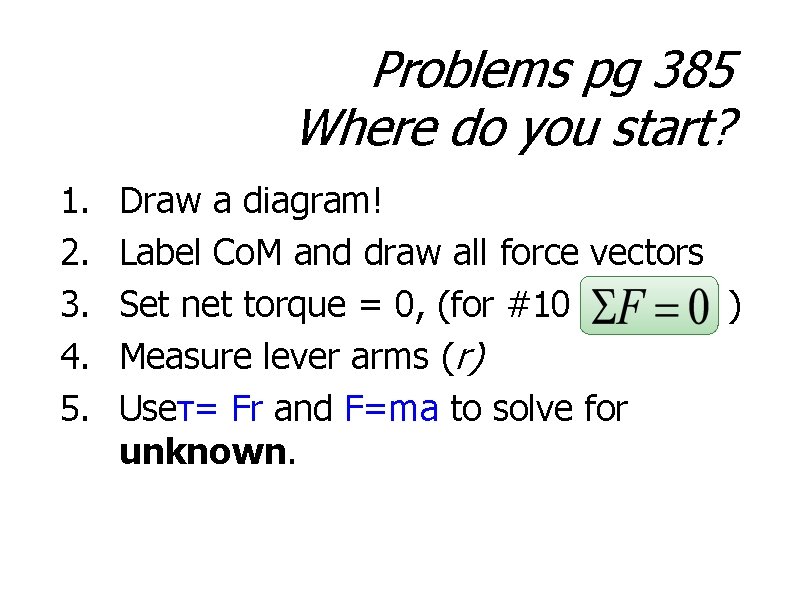
Problems pg 385 Where do you start? 1. 2. 3. 4. 5. Draw a diagram! Label Co. M and draw all force vectors Set net torque = 0, (for #10 ) Measure lever arms (r) Useτ= Fr and F=ma to solve for unknown.