
Newtons Laws DYNAMICS 4 1 Aristotle on Motion
- Slides: 49
Newton’s Laws DYNAMICS
4. 1 Aristotle on Motion Force causing motion goes back to the 4 th century. Aristotle studied motion and came up with 2 kinds: natural and violent.
Natural motion was thought to be either straight up or down. Objects would seek their natural resting places, such as smoke up high, and boulders down low. The orbits (circles) of the heavens were also thought to be natural, since they were not thought to be forced.
Imposed motion was violent motion. Things needed to be pushed or pulled. Violent motion needed an external cause.
4. 2 Copernicus and the Moving Earth Copernicus came up with the idea of a moving earth, and didn’t release his ideas until he was on his deathbed to avoid persecution. This went against all of Aristotle’s ideas.
4. 3 Galileo on Motion Galileo was a supporter of Copernicus and he proved that force was not need to keep an object moving. A force is a push or pull. Friction is the name that is given to the force that acts between materials that are touching as they move past each other. Without friction, objects need no force to remain in motion.
Galileo argued that only when friction is present are forces needed to keep objects in motion.
The tendency of an object to keep moving is natural and every body resists change to its state of motion, this is called inertia. Galileo was concerned with how things move, and really pushed the idea of experimentation. Galileo thus opened the door for Isaac Newton to come up with a new model of the universe.
4. 4 Newton’s Law of Inertia Newton has developed his laws of motion before his 24 th birthday. Newton’s first law is the law of inertia. It is a restatement of Galileo’s ideas of motion.
Every object continues in a state of rest, or of motion in a straight line at constant speed unless it is compelled to change that state by forces exerted upon it.
With the absence of forces, a moving object tends to move in a straight line indefinitely. Air hockey tables are an example of this.
4. 5 Mass- A Measure of Inertia The amount of inertia an object has depends on its mass. the more mass an object has, the greater its inertia is, and the more force it takes to change its state of motion.
Mass is a measure of the inertia of an object.
Mass and volume are not the same. Volume measures space and is measured in liters, cubed meters, cm, or mm. Mass is measured in kilograms. Objects can have the same volumes, but completely different masses. Think of a bed pillow vs. a car battery.
Mass and weight are not the same. Weight is the measure of gravitational force on an object. Mass is the amount of material in an object. Weight can vary by location, and mass cannot.
Mass and weight do have a proportional relationship though. Objects with little mass have little weight, and objects with a lot of weight have a lot of mass. However, the numbers are not equal. If you double the mass, the weight will double. This shows a relationship, but again, they are not the same.
The SI unit of force is the Newton. One Newton is equal to just less than ¼ of a pound. The Newton is written with a capitol N. If you want to move between kilograms and Newton’s, you simply need to multiply the number of kilograms by 9. 8, or if you know Newton’s divide by 9. 8. Weight= mass x g
4. 6 Net Force In the absence of net force, objects do not change their state of motion. If you push with equal, yet opposite forces on an object, the object will not move, it will stay at rest. The combination of all forces on an object is its net force.
4. 7 Equilibrium – When Net Force Equals Zero What forces are acting on you in your chair? Not only gravity is acting upon you because then you would be in freefall. The support force of the desk is acting upon you, too. This is sometimes called the normal force. When objects are at rest, they are in a state of equilibrium.
If you hang from a trapeze, what happens to the atoms in the rope? A tension force is established. How much tension? Equal to the amount of your weight. Gravity pulls you down, and the rope pulls you up. A spring scale can also measure tension.
4. 8 Vector Addition of Forces Recall our learning of velocity vectors. We use the same technique force vectors. As angles increase, tension in the vectors increases. Is it easier to hang from a vertical clothesline or a horizontal clothesline?
For any pair of scales, ropes or wires supporting a load, the greater the angle from the vertical, the larger the tension force must be.
4. 9 The Moving Earth Again A bird sits in a tree and sees a worm on the ground. It swoops down to snag it. Why does the earth not move past the bird in the second that it takes to swoop down to the worm? Our notions of motion are very different from our ancestors.
Newton’s Second Law: Force and Acceleration
Force causes acceleration Acceleration rates depend on the net force
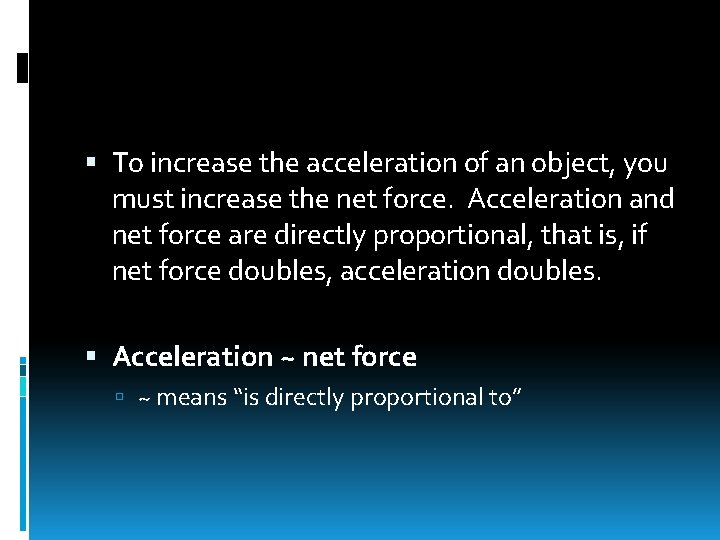
To increase the acceleration of an object, you must increase the net force. Acceleration and net force are directly proportional, that is, if net force doubles, acceleration doubles. Acceleration ~ net force ~ means “is directly proportional to”
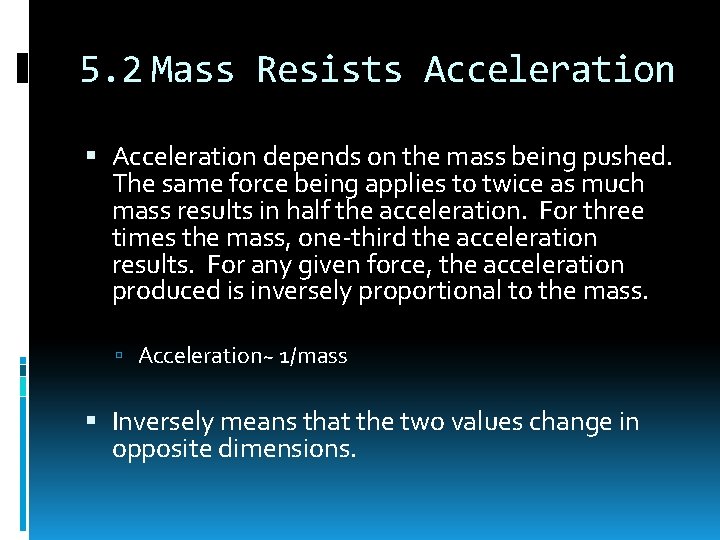
5. 2 Mass Resists Acceleration depends on the mass being pushed. The same force being applies to twice as much mass results in half the acceleration. For three times the mass, one-third the acceleration results. For any given force, the acceleration produced is inversely proportional to the mass. Acceleration~ 1/mass Inversely means that the two values change in opposite dimensions.
5. 3 Newton’s Second Law Newton was one of the first to notice that the acceleration produced when something depends not only on the force applied, but also on the objects mass.
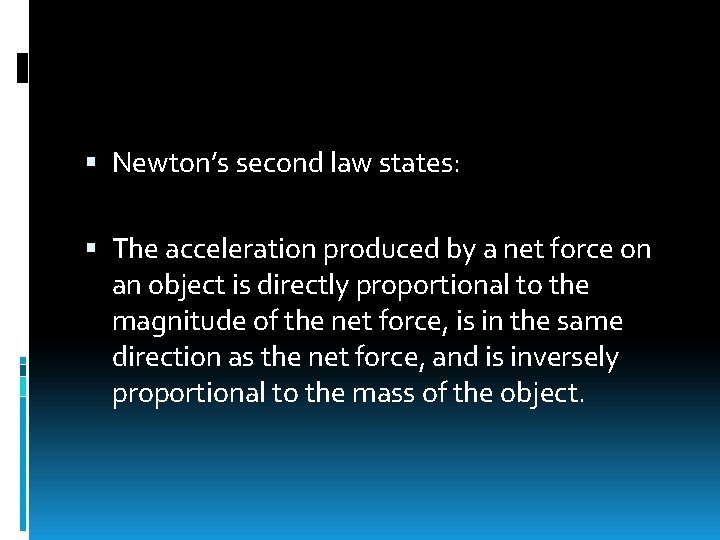
Newton’s second law states: The acceleration produced by a net force on an object is directly proportional to the magnitude of the net force, is in the same direction as the net force, and is inversely proportional to the mass of the object.
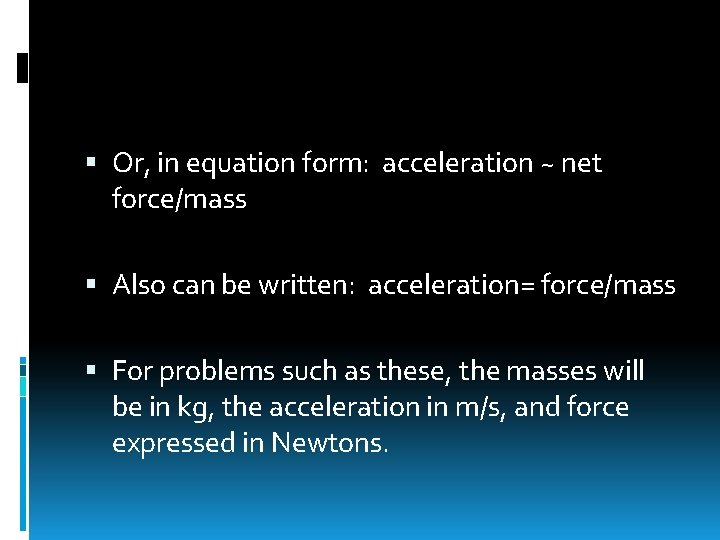
Or, in equation form: acceleration ~ net force/mass Also can be written: acceleration= force/mass For problems such as these, the masses will be in kg, the acceleration in m/s, and force expressed in Newtons.
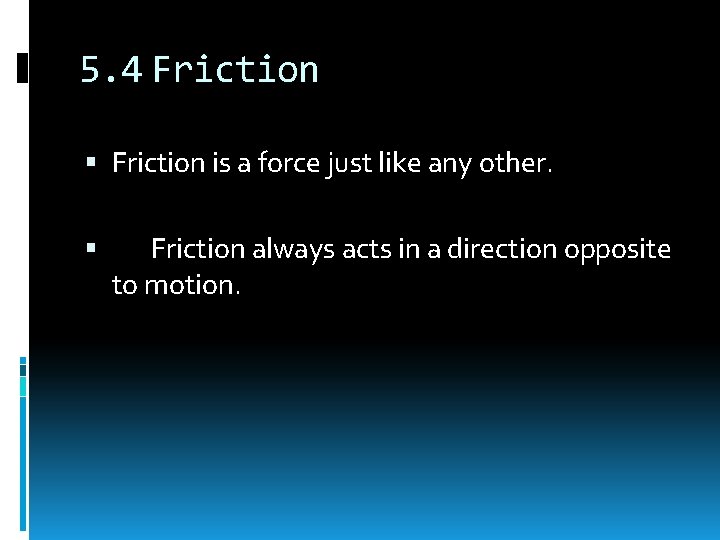
5. 4 Friction is a force just like any other. Friction always acts in a direction opposite to motion.
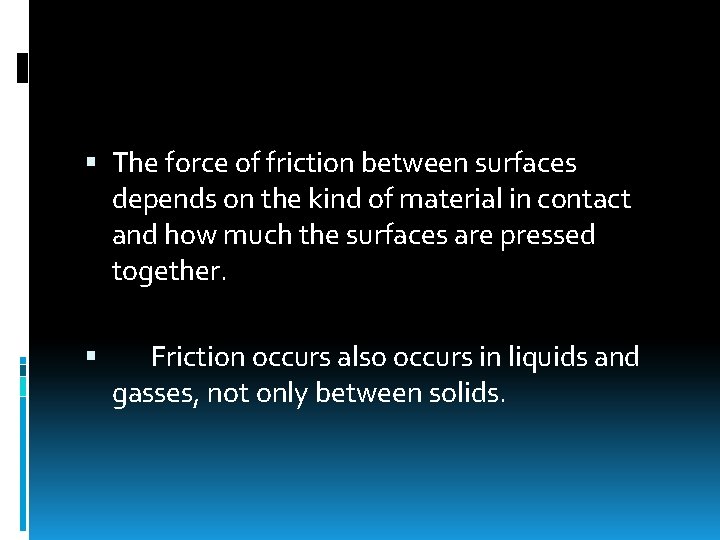
The force of friction between surfaces depends on the kind of material in contact and how much the surfaces are pressed together. Friction occurs also occurs in liquids and gasses, not only between solids.
5. 5 Applying Force The amount of force per unit of area is called pressure. Balance a book on your palm lying down, and then balance it upright. The upright book presses into your hand with more pressure.
Pressure is different from force, and is measured in Pascals (Pa). The smaller the area supporting a given force, the greater the pressure on the surface.
5. 6 Free Fall Explained Recall that mass and weight are proportional. So, a 10 kg cannonball experiences 10 times the gravitational force as a 1 kg stone, right?
However, when something is falling we need to consider Newton’s second law, not just gravity. This means considering the mass of an object.
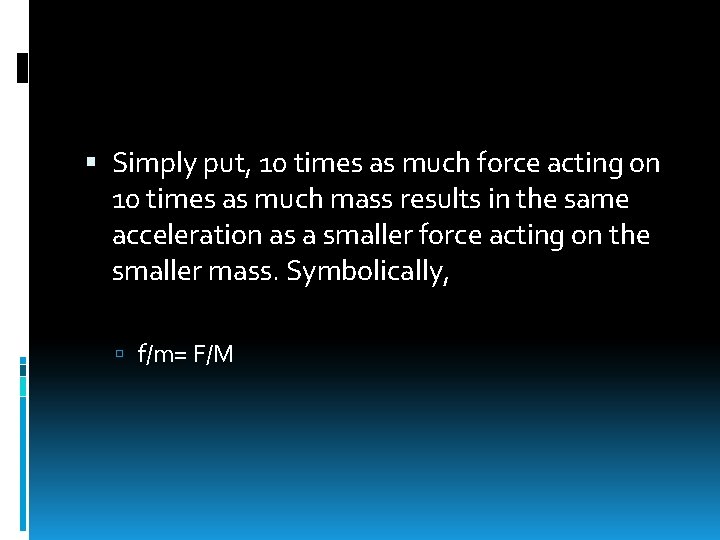
Simply put, 10 times as much force acting on 10 times as much mass results in the same acceleration as a smaller force acting on the smaller mass. Symbolically, f/m= F/M
5. 7 Falling and Air Resistance Air resistance diminishes the net forces acting on objects. When acceleration terminates because of air resistance, an object reaches its terminal speed (velocity).
Terminal speed is an important factor for skydivers. Bodies spread out reach their terminal velocities faster than bodies that are not spread out.
Parachutes work on this concept, and slow to a terminal speed of close to 15 -25 km/h and make it safe to land. Air resistance is more noticeable at high speeds than at low speeds.
Newton’s Third Law of Motion: Action and Reaction
6. 1 Forces and Interactions Newton states that a force is not a thing in itself but part of a mutual action, an interaction. For every force there is an opposing force.
6. 2 Newton’s Third Law Whenever one object exerts a force on a second object, the second object exerts an equal and opposite force on the first object.
One force is the action force, and the other is the reaction force. These forces are equal in strength and opposite in direction. The third law is often stated “for every action there is an equal and opposite reaction. ”
Forces always occur in pairs. The interactions of the pairs depend on friction. Without friction, the forces may not work, like a person trying to walk on the ice.
6. 3 Identifying Action and Reaction It is simple to identify action and reaction forces. Simply label the interacting objects A and B. If the action is A on B, the reaction is B on A.
6. 4 Action and Reaction on Different Masses Action and reaction forces work on all items, but then why does the cannon not travel as far as the cannonball? Remember Newton’s second law. Objects with more mass will need more force to accelerate than objects with less mass. This is why the cannonball goes far, while the cannon remains relatively stationary.
6. 5 Do Action and Reaction Forces Cancel? Since action/reaction forces are equal and opposite, why don’t they cancel to zero? They must be internal to their own system to completely cancel each other and provide no acceleration to a system. Action/reaction forces do not cancel each other when either is external to the system being considered.
6. 7 Action Equals Reaction For interactions between things, there is always a pair of oppositely directed forces that are equal in strength. You can’t hit a piece of paper flying through the air with a force of 50 lbs, because the paper can’t react with that much force.