
Newtons First Law of Motion Kinematics How objects
Newton’s First Law of Motion
• Kinematics: How objects move • Dynamics: Why objects move • First studied by Isaac Newton

Isaac Newton Sir Isaac Newton at 46 in Godfrey Kneller's 1689 portrait Born 4 January [O. S. 25 December 1642] 1643 Woolsthorpe-by-Colsterworth, Lincolnshire, England Died 31 March [O. S. 20 March] 1727 Kensington, London Residence England Nationality English Field Mathematics, physics, astronomy, alchemy, and natural philosophy Institution University of Cambridge Alma Mater University of Cambridge Doctoral Advisor Isaac Barrow Known for Gravitation, optics, calculus, mechanics Societies President of the Royal Society, Master of the Royal Mint Prizes Knighthood Religion Prophetic Unitarianism, Church of England

Force • is a push or a pull

• An object at rest • A moving object needs a force to get it moving. change its velocity.
• Can be a field force: gravity, magnetism Does not involve physical contact, invisible! • Or it can be a contact force like • friction, Normal • Does involve physical contact!

4 Main forces: 1. Gravitational force 2. Electromagnetic force 3. Strong force 4. Weak force
Gravitational Force: • attractive force that exists between all objects that have mass, • Gravity is the weakest of all forces • Yet, it is the force that holds the universe together
2. Electromagnetic Force: • result of electric charge, • gives materials their physical characteristics, • strength, ability to bend, squeeze, stretch, shatter, malleability • Greater than gravity
3. Strong Nuclear Force: • holds particles of nucleus together • strongest force • but only over a very, very small distance
4. Weak nuclear force: • involved in radioactive decay of some nuclei, • may be a form of electromagnetic force
Types of Forces: 1. Weight is a Force. (Fg=W=mg) Mass is a property of an object Mass is the measure of inertia of an object. In the SI system, mass is measured in kilograms.
Inertia: is NOT a force • Inertia is the tendency of a body or object to resist a change in its motion • The more mass a body has, the more inertia it has
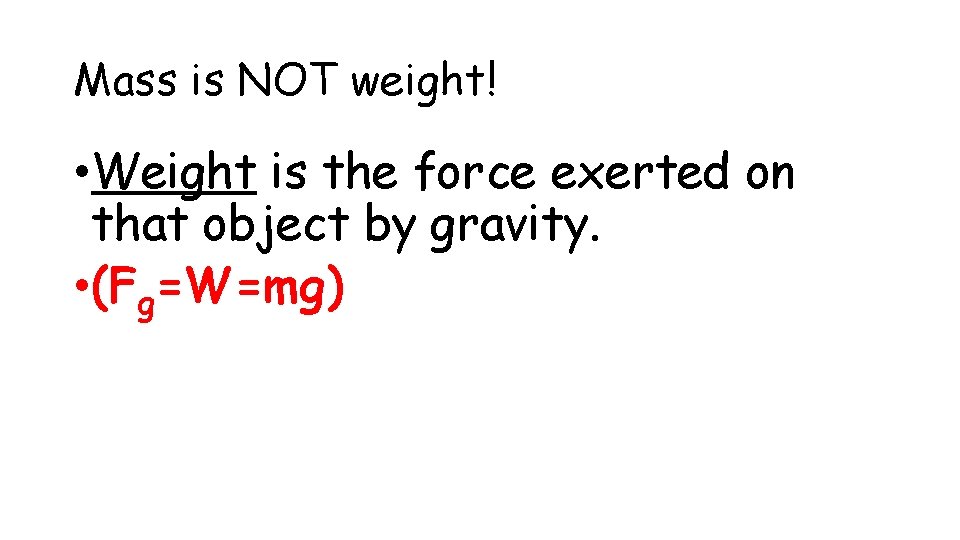
Mass is NOT weight! • Weight is the force exerted on that object by gravity. • (Fg=W=mg)
• If you go to the moon, whose gravitational acceleration is 1/6 th of the Earth’s, you will weigh much less. • Your mass however, will be the SAME!

Mass: • Gravitational mass and inertial mass have the same numerical value • Gravitational mass is a quantity that determines the gravitational force on an object, • Gravitational mass – found on a scale or balance
• Inertial mass is a quantity that determines the acceleration of an object. Inertial mass – calculated using Newton’s 2 nd law of motion
2. The Normal Forcea force exerted by one object (usually a surface) on another in a direction perpendicular to the surface of contact (FN, N)
Normal Force: • It is the force supplied by the surface supporting the object • It is a contact force • Usually due to weight of the object • The object pushes down • The surface pushes up
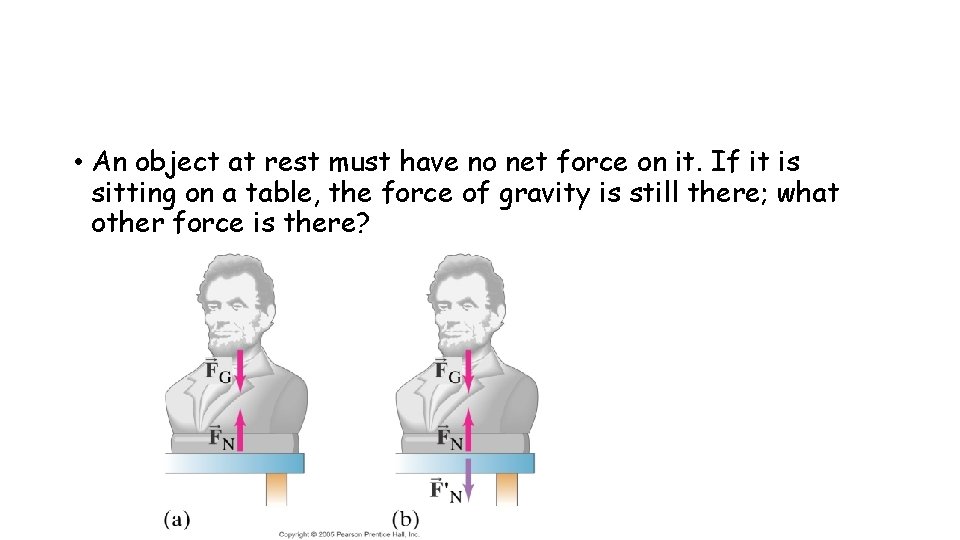
• An object at rest must have no net force on it. If it is sitting on a table, the force of gravity is still there; what other force is there?

• The force exerted perpendicular to a surface is called the normal force. It is exactly as large as needed to balance the force from the object (if the required force gets too big, something breaks!)

3. Kinetic friction(sliding friction)-the resistive force that opposes the relative motion of two contacting surfaces that are moving past one another. F k = k. F N
μ: • Is the coefficient of friction and is different for every pair of surfaces.

4. Static friction The resistive force that opposes the relative motion of two contacting surfaces that are at rest with respect to one another. (Fs) Fs= s. FN
5. Air Resistance is a friction force: (FR)-As an object falls its velocity increases, air resistance also increases. When the upward force of air resistance balances the downward force of gravity, the net force on the object is zero and the object continues to move downward with a constant maximum velocity, called terminal velocity.
6. Tension (T=FT)-a force due to the pulling on a string or stretched object. 7. Motion-(Fa)-a force exerted by pushing or pulling on an object, sometimes labeled Fp.
Free Body Diagram: (FBD) To Sketch a free body diagram (FBD) 1. Isolate the object 2. And draw the forces acting on it, straight lines, with barbs, They are vectors!
Newton’s 1 st Law of Motion: N 1 L st 1 • Newton’s Law of Motion: an object with no outside force (no unbalanced) acting on it will move at a constant velocity in a straight line or remain at rest, forever…….

• https: //www. youtube. com/watch? v=08 BFCZJDn 9 w • https: //www. youtube. com/watch? v=1 XSyyjc. EHo 0

Demo: • Ballistic Car
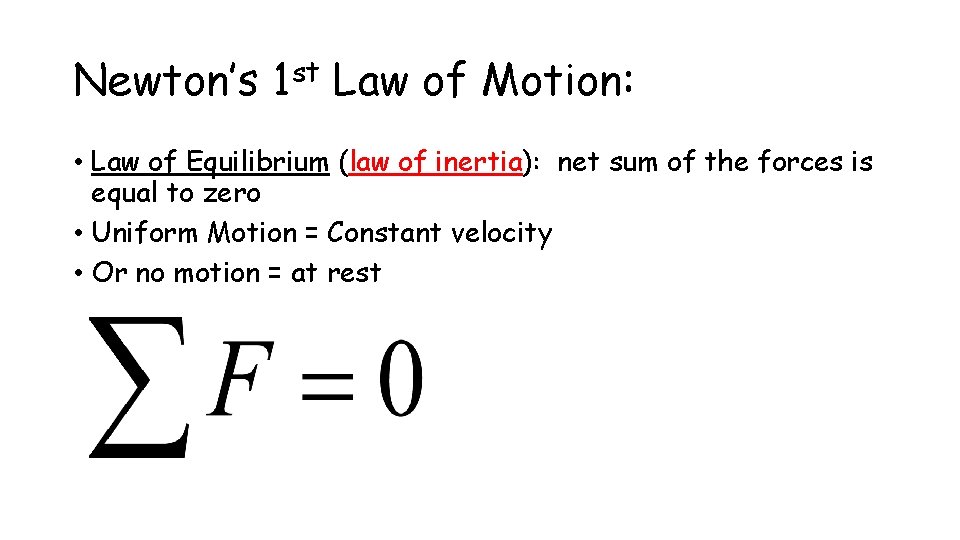
Newton’s 1 st Law of Motion: • Law of Equilibrium (law of inertia): net sum of the forces is equal to zero • Uniform Motion = Constant velocity • Or no motion = at rest
Newton’s 1 st Law of Motion = Law of Inertia • An object at rest needs a force to get it moving; • a moving object needs a force to change its velocity. • An object in motion remains in motion and an object at rest remains at rest, until a net external force acts on it.
Free Body Diagrams: • All vectors are drawn at the center of mass • Draw a free body diagram (FBD) of a box moving at constant velocity across the floor with friction • What does Net Force mean?
- Slides: 33