
Newtons First Law of Motion An object remains
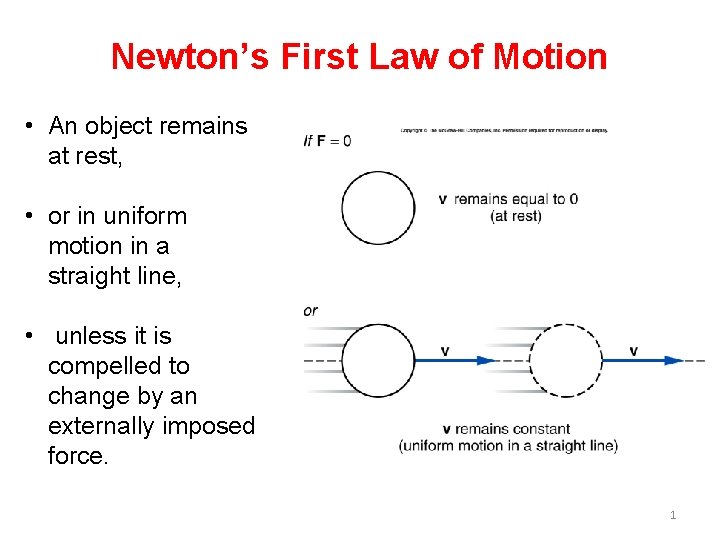
Newton’s First Law of Motion • An object remains at rest, • or in uniform motion in a straight line, • unless it is compelled to change by an externally imposed force. 1
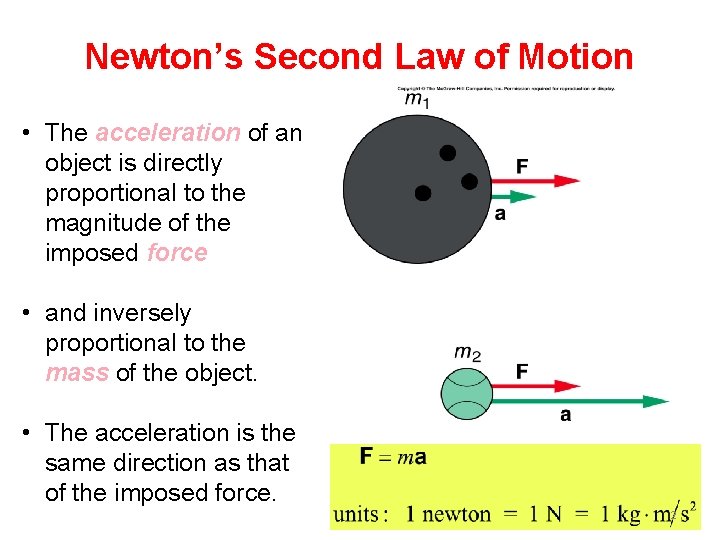
Newton’s Second Law of Motion • The acceleration of an object is directly proportional to the magnitude of the imposed force • and inversely proportional to the mass of the object. • The acceleration is the same direction as that of the imposed force. 2
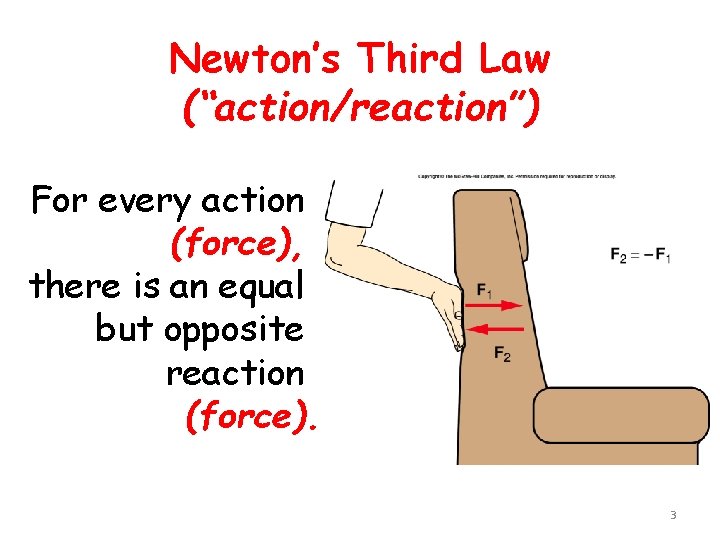
Newton’s Third Law (“action/reaction”) For every action (force), there is an equal but opposite reaction (force). 3
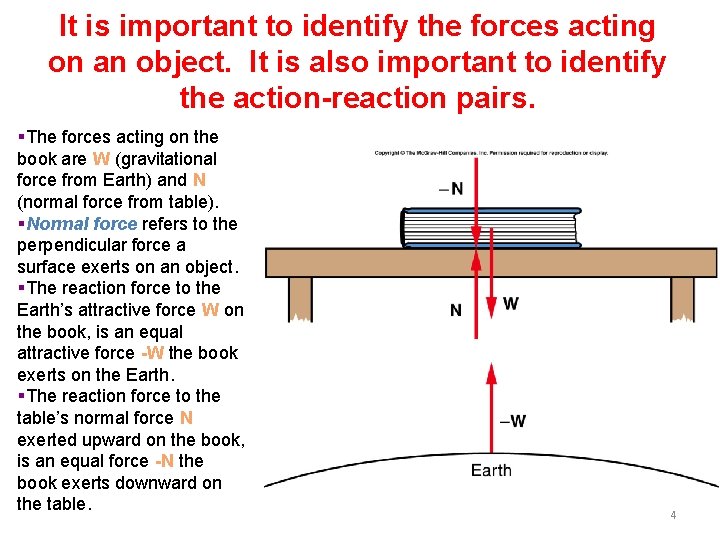
It is important to identify the forces acting on an object. It is also important to identify the action-reaction pairs. §The forces acting on the book are W (gravitational force from Earth) and N (normal force from table). §Normal force refers to the perpendicular force a surface exerts on an object. §The reaction force to the Earth’s attractive force W on the book, is an equal attractive force -W the book exerts on the Earth. §The reaction force to the table’s normal force N exerted upward on the book, is an equal force -N the book exerts downward on the table. 4
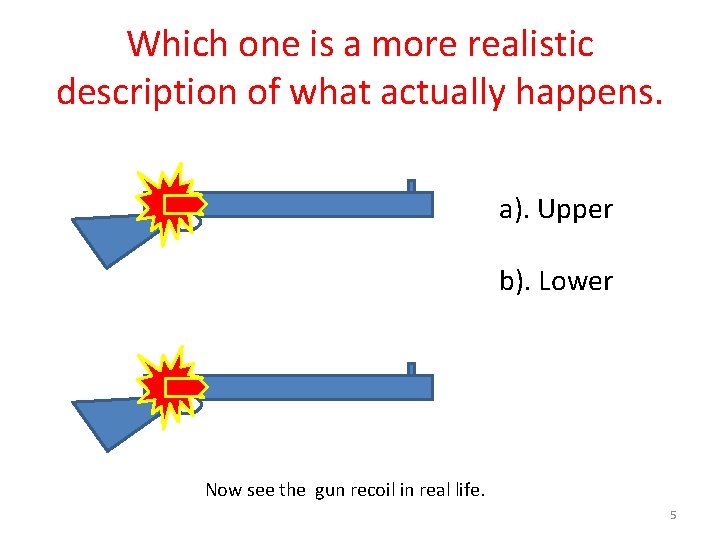
Which one is a more realistic description of what actually happens. a). Upper b). Lower Now see the gun recoil in real life. 5

Gun Recoil 6
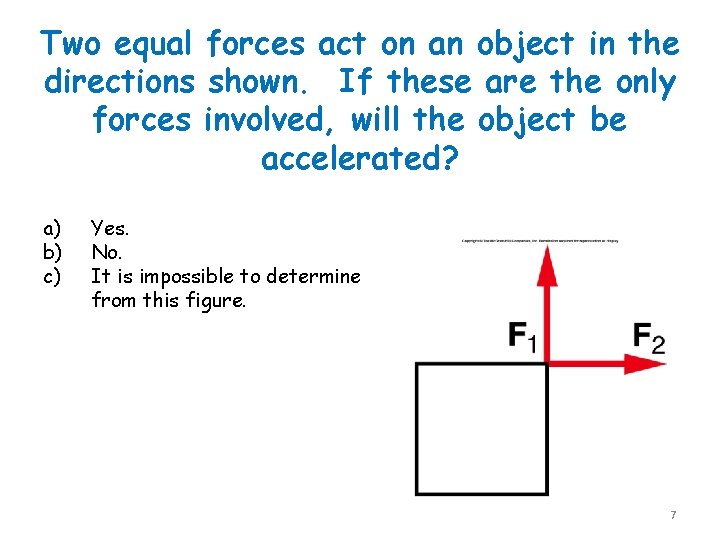
Two equal forces act on an object in the directions shown. If these are the only forces involved, will the object be accelerated? a) b) c) Yes. No. It is impossible to determine from this figure. 7
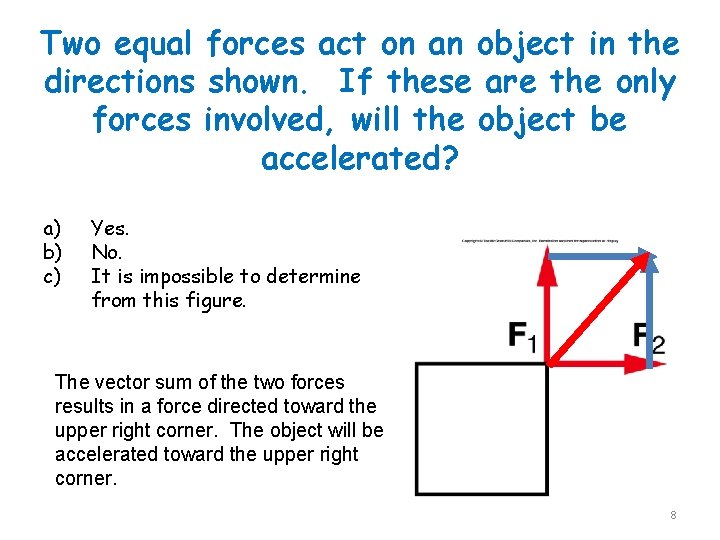
Two equal forces act on an object in the directions shown. If these are the only forces involved, will the object be accelerated? a) b) c) Yes. No. It is impossible to determine from this figure. The vector sum of the two forces results in a force directed toward the upper right corner. The object will be accelerated toward the upper right corner. 8
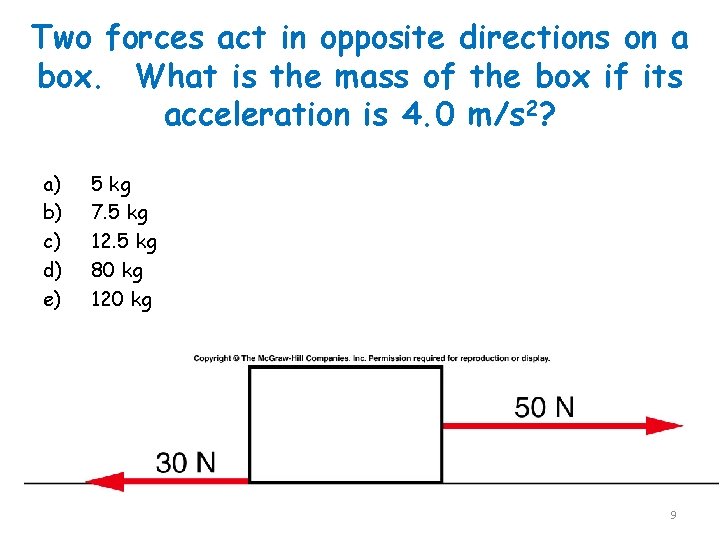
Two forces act in opposite directions on a box. What is the mass of the box if its acceleration is 4. 0 m/s 2? a) b) c) d) e) 5 kg 7. 5 kg 12. 5 kg 80 kg 120 kg 9
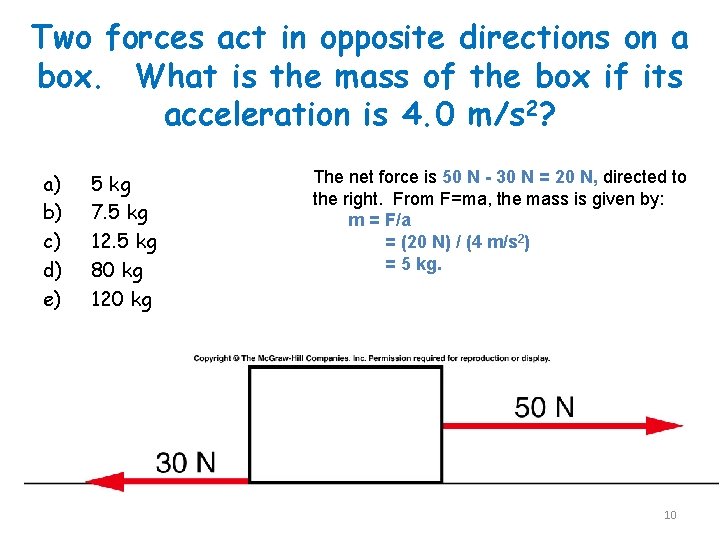
Two forces act in opposite directions on a box. What is the mass of the box if its acceleration is 4. 0 m/s 2? a) b) c) d) e) 5 kg 7. 5 kg 12. 5 kg 80 kg 120 kg The net force is 50 N - 30 N = 20 N, directed to the right. From F=ma, the mass is given by: m = F/a = (20 N) / (4 m/s 2) = 5 kg. 10
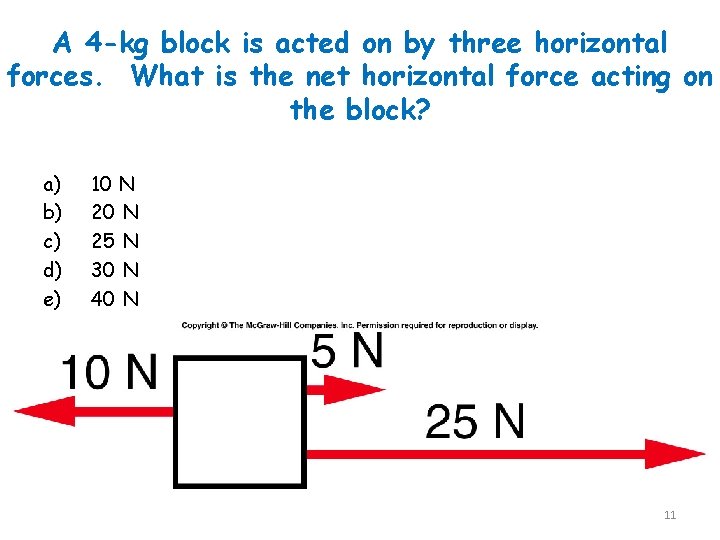
A 4 -kg block is acted on by three horizontal forces. What is the net horizontal force acting on the block? a) b) c) d) e) 10 N 25 N 30 N 40 N 11
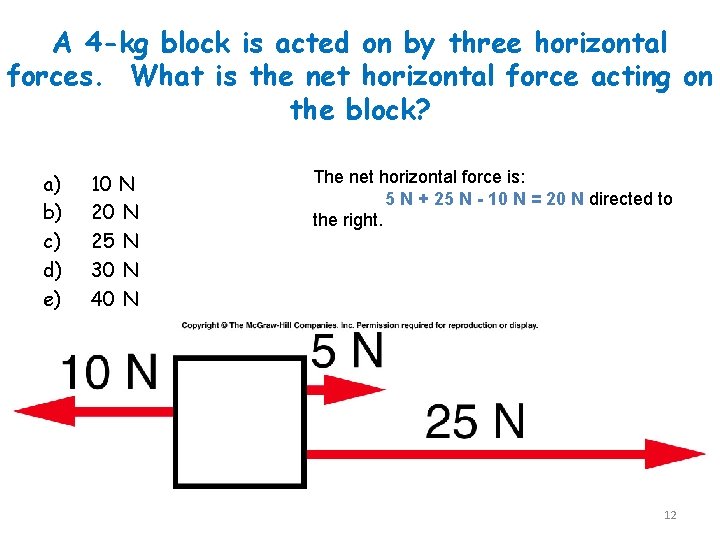
A 4 -kg block is acted on by three horizontal forces. What is the net horizontal force acting on the block? a) b) c) d) e) 10 N 25 N 30 N 40 N The net horizontal force is: 5 N + 25 N - 10 N = 20 N directed to the right. 12
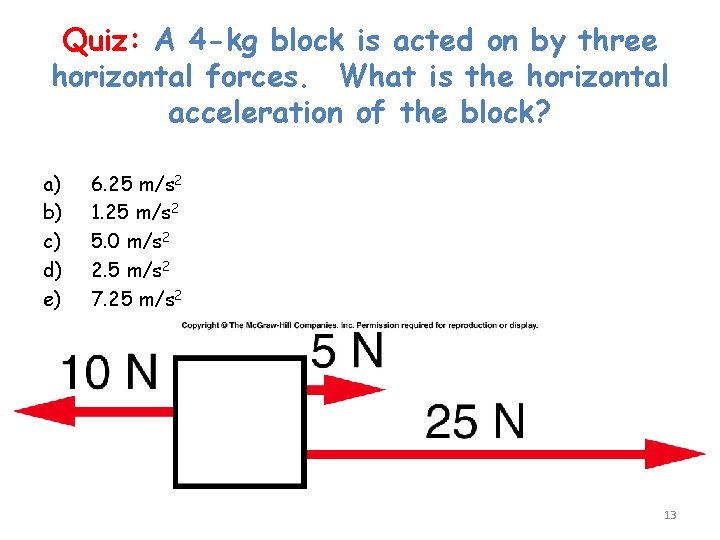
Quiz: A 4 -kg block is acted on by three horizontal forces. What is the horizontal acceleration of the block? a) b) c) d) e) 6. 25 m/s 2 1. 25 m/s 2 5. 0 m/s 2 2. 5 m/s 2 7. 25 m/s 2 13
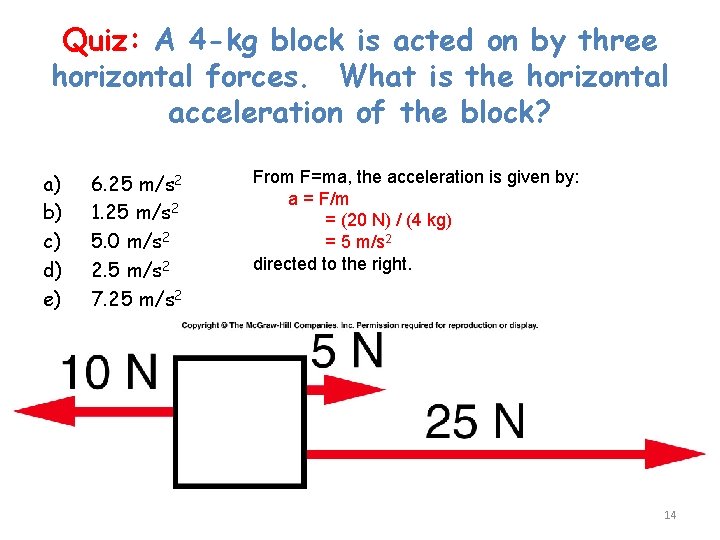
Quiz: A 4 -kg block is acted on by three horizontal forces. What is the horizontal acceleration of the block? a) b) c) d) e) 6. 25 m/s 2 1. 25 m/s 2 5. 0 m/s 2 2. 5 m/s 2 7. 25 m/s 2 From F=ma, the acceleration is given by: a = F/m = (20 N) / (4 kg) = 5 m/s 2 directed to the right. 14
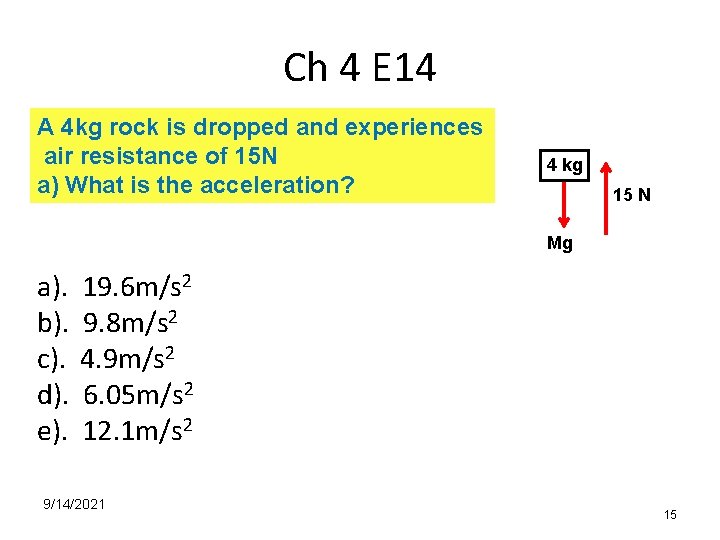
Ch 4 E 14 A 4 kg rock is dropped and experiences air resistance of 15 N a) What is the acceleration? 4 kg 15 N Mg a). b). c). d). e). 19. 6 m/s 2 9. 8 m/s 2 4. 9 m/s 2 6. 05 m/s 2 12. 1 m/s 2 9/14/2021 15
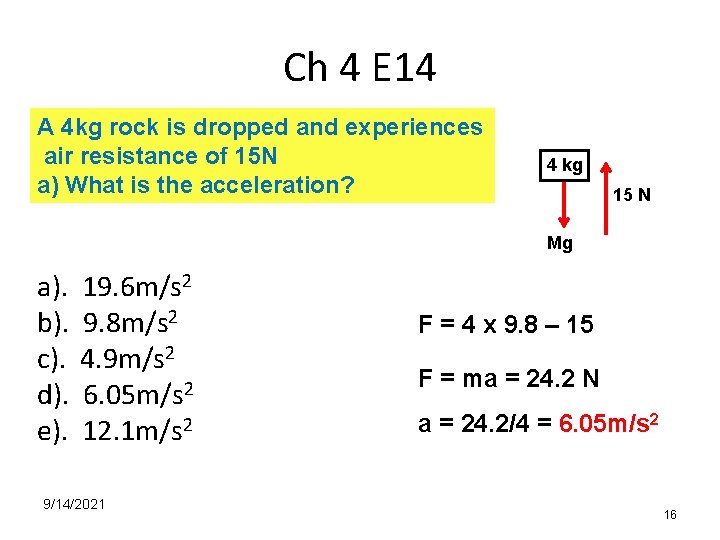
Ch 4 E 14 A 4 kg rock is dropped and experiences air resistance of 15 N a) What is the acceleration? 4 kg 15 N Mg a). b). c). d). e). 19. 6 m/s 2 9. 8 m/s 2 4. 9 m/s 2 6. 05 m/s 2 12. 1 m/s 2 9/14/2021 F = 4 x 9. 8 – 15 F = ma = 24. 2 N a = 24. 2/4 = 6. 05 m/s 2 16
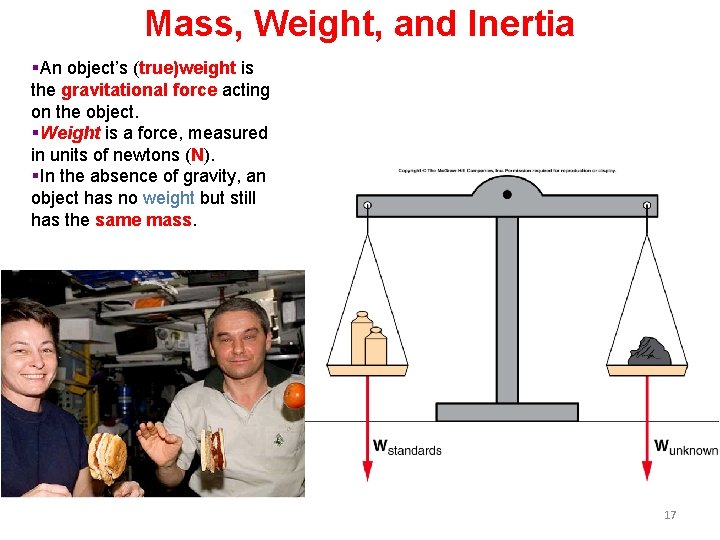
Mass, Weight, and Inertia §An object’s (true)weight is the gravitational force acting on the object. §Weight is a force, measured in units of newtons (N). §In the absence of gravity, an object has no weight but still has the same mass. 17
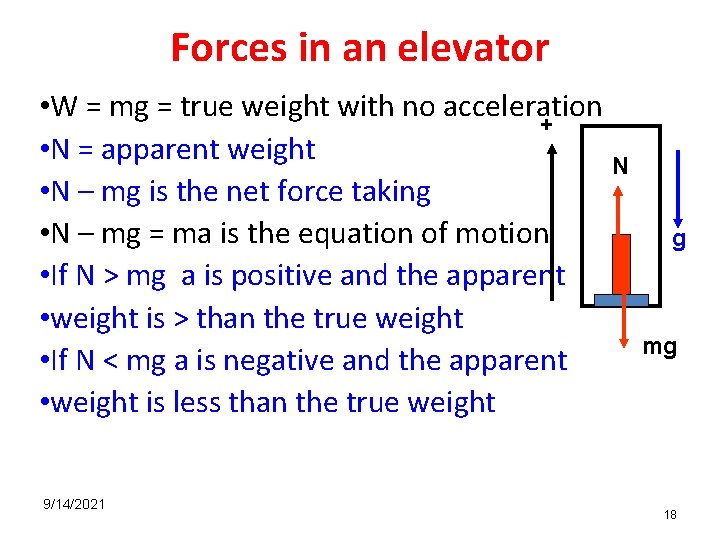
Forces in an elevator • W = mg = true weight with no acceleration + • N = apparent weight N • N – mg is the net force taking • N – mg = ma is the equation of motion • If N > mg a is positive and the apparent • weight is > than the true weight • If N < mg a is negative and the apparent • weight is less than the true weight 9/14/2021 g mg 18
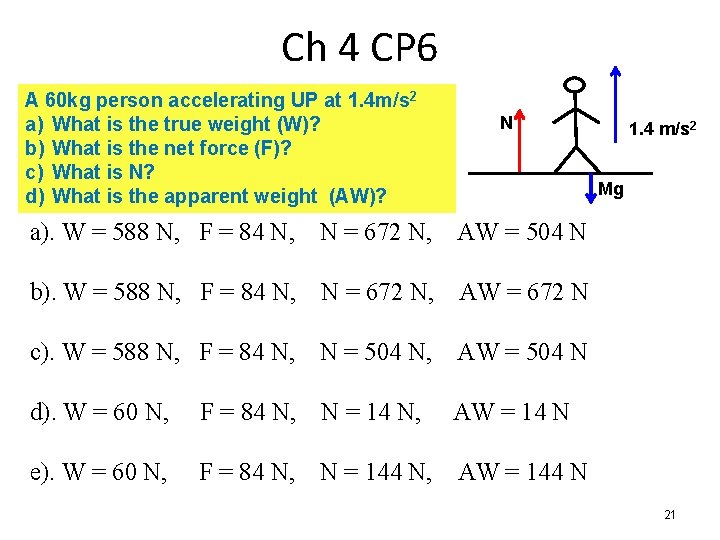
Ch 4 CP 6 A 60 kg person accelerating UP at 1. 4 m/s 2 a) What is the true weight (W)? b) What is the net force (F)? c) What is N? d) What is the apparent weight (AW)? N 1. 4 m/s 2 Mg a). W = 588 N, F = 84 N, N = 672 N, AW = 504 N b). W = 588 N, F = 84 N, N = 672 N, AW = 672 N c). W = 588 N, F = 84 N, N = 504 N, AW = 504 N d). W = 60 N, F = 84 N, N = 14 N, AW = 14 N e). W = 60 N, F = 84 N, N = 144 N, AW = 144 N 21
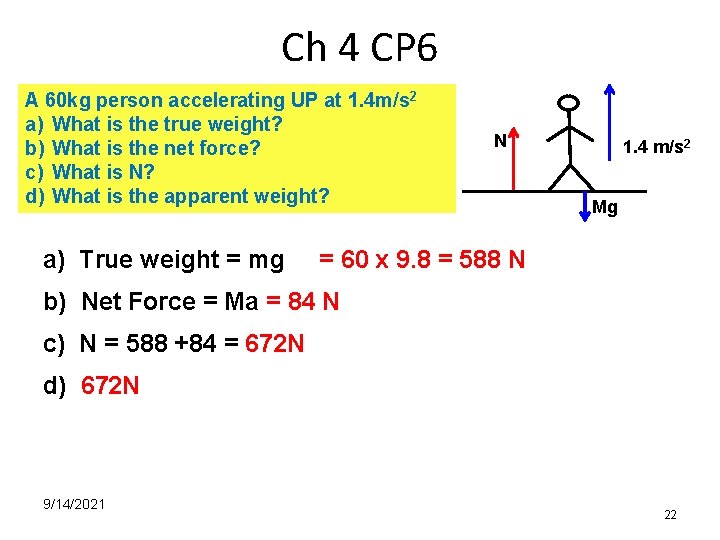
Ch 4 CP 6 A 60 kg person accelerating UP at 1. 4 m/s 2 a) What is the true weight? b) What is the net force? c) What is N? d) What is the apparent weight? a) True weight = mg N 1. 4 m/s 2 Mg = 60 x 9. 8 = 588 N b) Net Force = Ma = 84 N c) N = 588 +84 = 672 N d) 672 N 9/14/2021 22
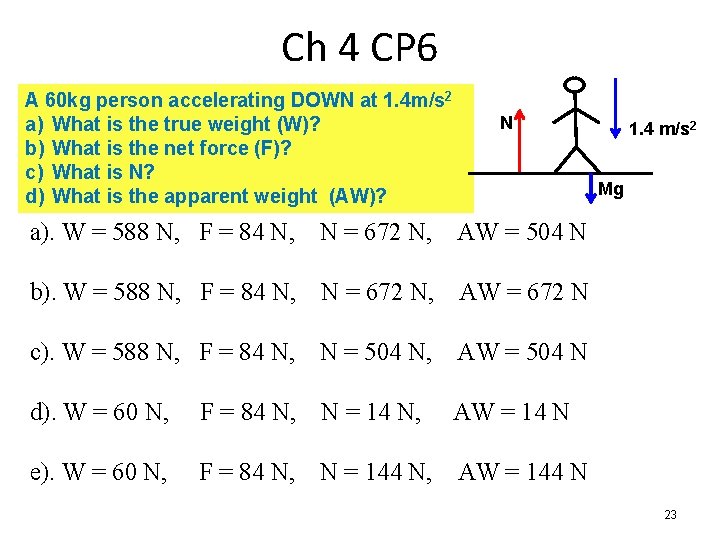
Ch 4 CP 6 A 60 kg person accelerating DOWN at 1. 4 m/s 2 a) What is the true weight (W)? b) What is the net force (F)? c) What is N? d) What is the apparent weight (AW)? N 1. 4 m/s 2 Mg a). W = 588 N, F = 84 N, N = 672 N, AW = 504 N b). W = 588 N, F = 84 N, N = 672 N, AW = 672 N c). W = 588 N, F = 84 N, N = 504 N, AW = 504 N d). W = 60 N, F = 84 N, N = 14 N, AW = 14 N e). W = 60 N, F = 84 N, N = 144 N, AW = 144 N 23
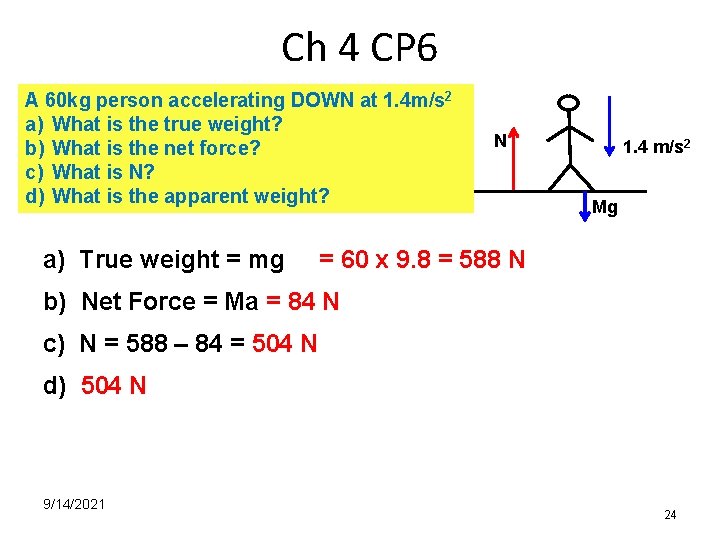
Ch 4 CP 6 A 60 kg person accelerating DOWN at 1. 4 m/s 2 a) What is the true weight? b) What is the net force? c) What is N? d) What is the apparent weight? a) True weight = mg N 1. 4 m/s 2 Mg = 60 x 9. 8 = 588 N b) Net Force = Ma = 84 N c) N = 588 – 84 = 504 N d) 504 N 9/14/2021 24
- Slides: 22