
Newtons First Law Mathematical Statement of Newtons 1

- Slides: 14
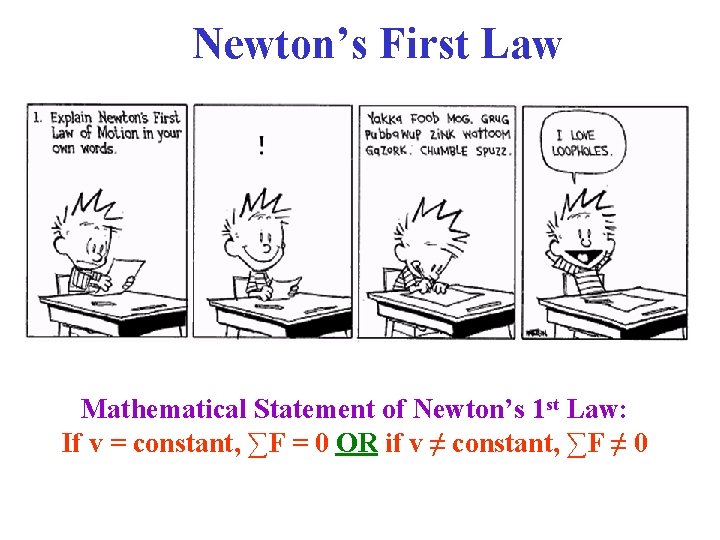
Newton’s First Law Mathematical Statement of Newton’s 1 st Law: If v = constant, ∑F = 0 OR if v ≠ constant, ∑F ≠ 0
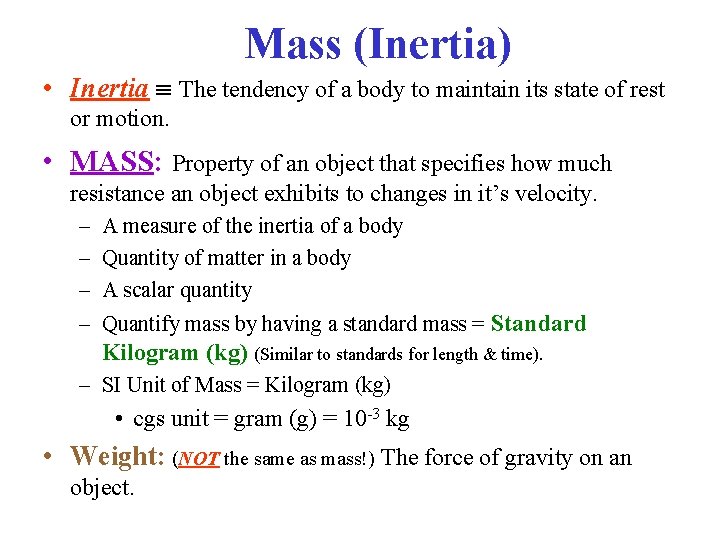
Mass (Inertia) • Inertia The tendency of a body to maintain its state of rest or motion. • MASS: Property of an object that specifies how much resistance an object exhibits to changes in it’s velocity. – A measure of the inertia of a body – Quantity of matter in a body – A scalar quantity – Quantify mass by having a standard mass = Standard Kilogram (kg) (Similar to standards for length & time). – SI Unit of Mass = Kilogram (kg) • cgs unit = gram (g) = 10 -3 kg • Weight: (NOT the same as mass!) The force of gravity on an object.
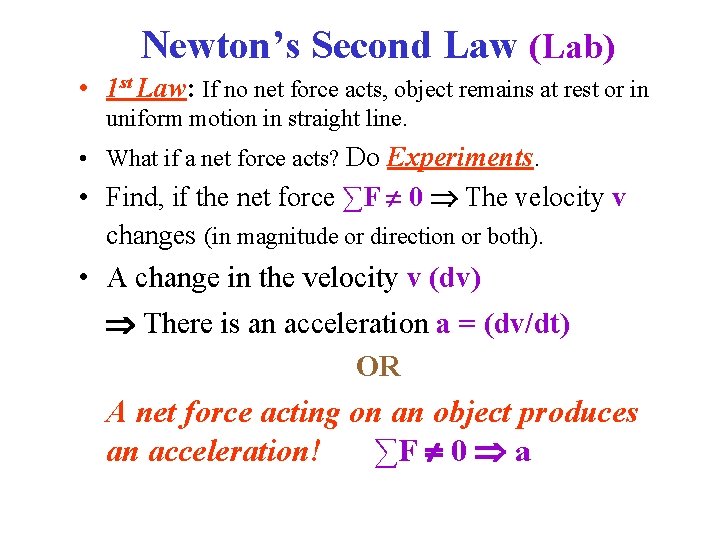
Newton’s Second Law (Lab) • 1 st Law: If no net force acts, object remains at rest or in uniform motion in straight line. • What if a net force acts? Do Experiments. • Find, if the net force ∑F 0 The velocity v changes (in magnitude or direction or both). • A change in the velocity v (dv) There is an acceleration a = (dv/dt) OR A net force acting on an object produces an acceleration! ∑F 0 a
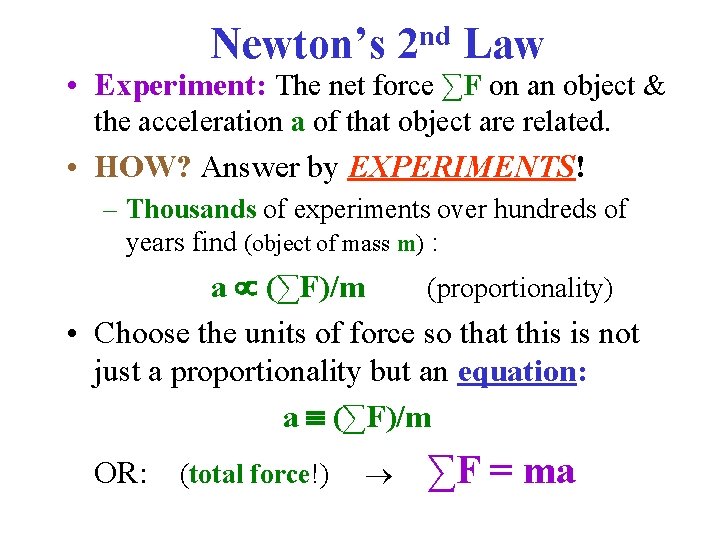
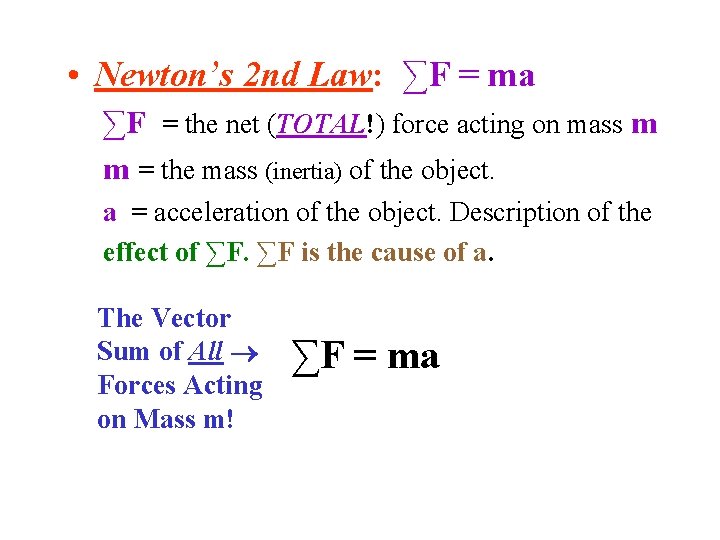
Newton’s 2 nd Law • Experiment: The net force ∑F on an object & the acceleration a of that object are related. • HOW? Answer by EXPERIMENTS! – Thousands of experiments over hundreds of years find (object of mass m) : a (∑F)/m (proportionality) • Choose the units of force so that this is not just a proportionality but an equation: a (∑F)/m OR: (total force!) ∑F = ma
• Newton’s 2 nd Law: ∑F = ma ∑F = the net (TOTAL!) force acting on mass m m = the mass (inertia) of the object. a = acceleration of the object. Description of the effect of ∑F. ∑F is the cause of a. The Vector Sum of All Forces Acting on Mass m! ∑F = ma
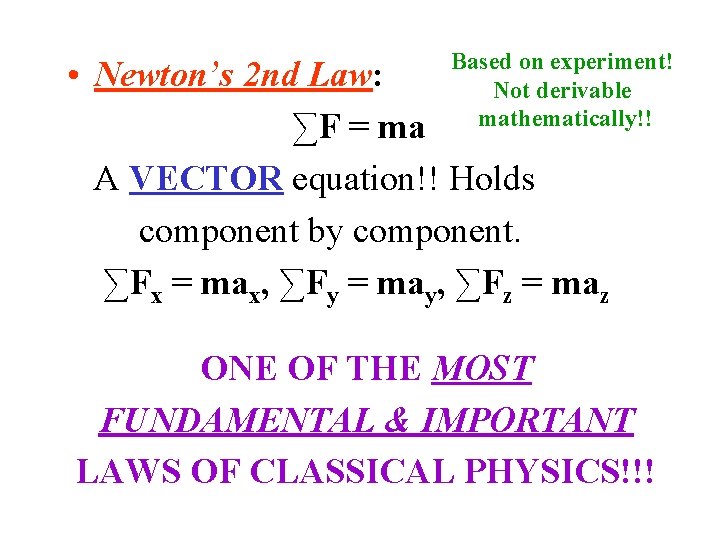
Based on experiment! Not derivable mathematically!! • Newton’s 2 nd Law: ∑F = ma A VECTOR equation!! Holds component by component. ∑Fx = max, ∑Fy = may, ∑Fz = maz ONE OF THE MOST FUNDAMENTAL & IMPORTANT LAWS OF CLASSICAL PHYSICS!!!
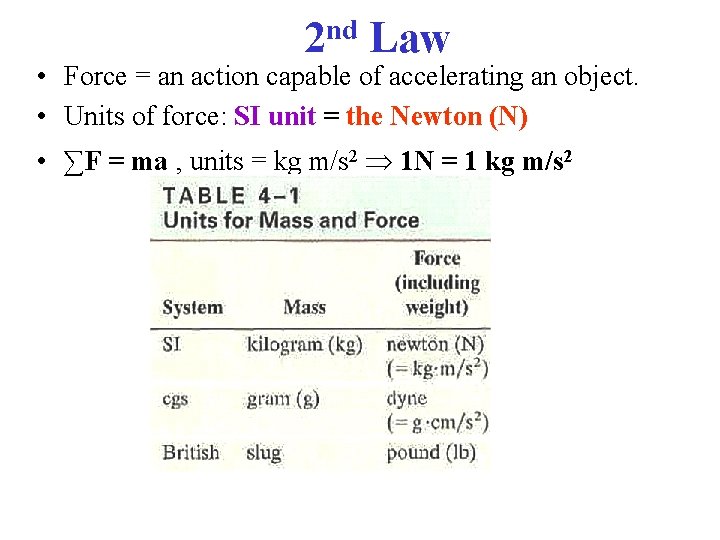
nd 2 Law • Force = an action capable of accelerating an object. • Units of force: SI unit = the Newton (N) • ∑F = ma , units = kg m/s 2 1 N = 1 kg m/s 2
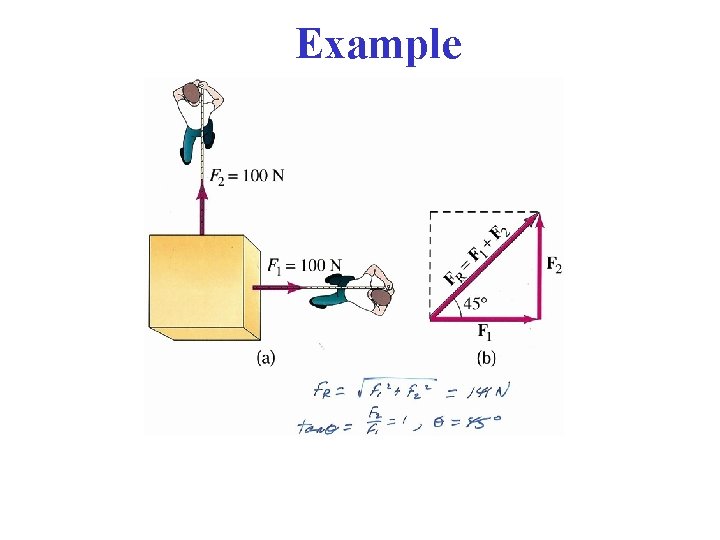
Example 5. 1: Accelerating Hockey Puck See Figure: A hockey puck, mass m = 0. 3 kg, slides on the horizontal, frictionless surface of an ice rink. Two hockey sticks strike the puck simultaneously, exerting forces F 1 & F 2 on it. Calculate the magnitude & direction of the acceleration. Steps to Solve the Problem 1. Sketch the force diagram (“Free Body Diagram”). 2. Choose a coordinate system. 3. Resolve Forces (find components) along x & y axes. 4. Write Newton’s 2 nd Law equations x & y directions. 5. Use Newton’s 2 nd Law equations & algebra to solve for unknowns in the problem. x & y directions.
Example
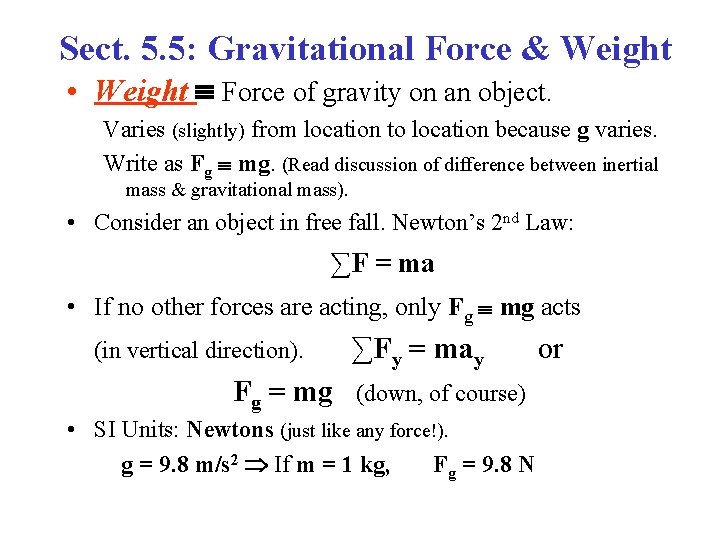
Sect. 5. 5: Gravitational Force & Weight • Weight Force of gravity on an object. Varies (slightly) from location to location because g varies. Write as Fg mg. (Read discussion of difference between inertial mass & gravitational mass). • Consider an object in free fall. Newton’s 2 nd Law: ∑F = ma • If no other forces are acting, only Fg mg acts (in vertical direction). Fg = mg ∑Fy = may (down, of course) • SI Units: Newtons (just like any force!). g = 9. 8 m/s 2 If m = 1 kg, Fg = 9. 8 N or
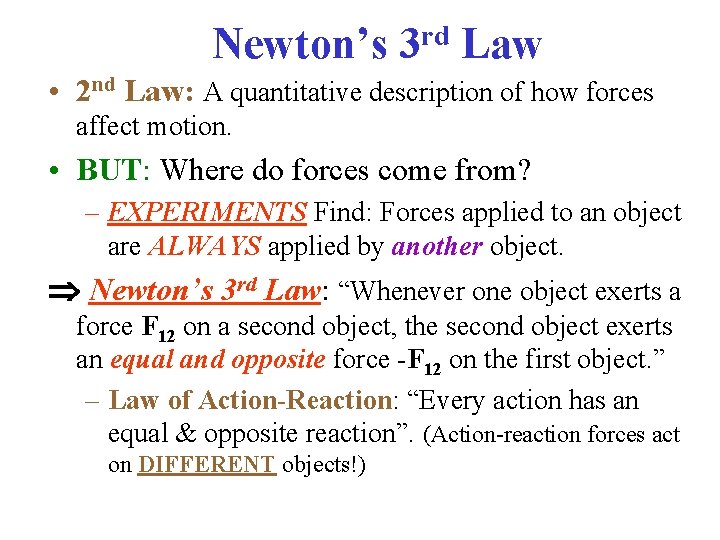
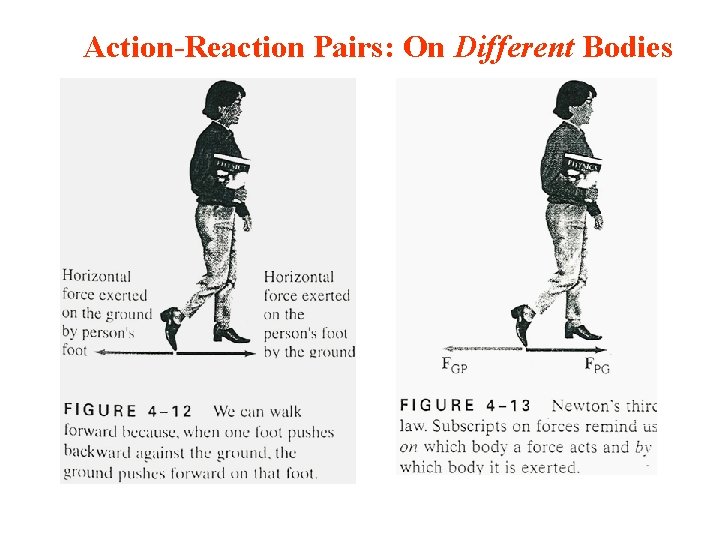
Newton’s 3 rd Law • 2 nd Law: A quantitative description of how forces affect motion. • BUT: Where do forces come from? – EXPERIMENTS Find: Forces applied to an object are ALWAYS applied by another object. Newton’s 3 rd Law: “Whenever one object exerts a force F 12 on a second object, the second object exerts an equal and opposite force -F 12 on the first object. ” – Law of Action-Reaction: “Every action has an equal & opposite reaction”. (Action-reaction forces act on DIFFERENT objects!)
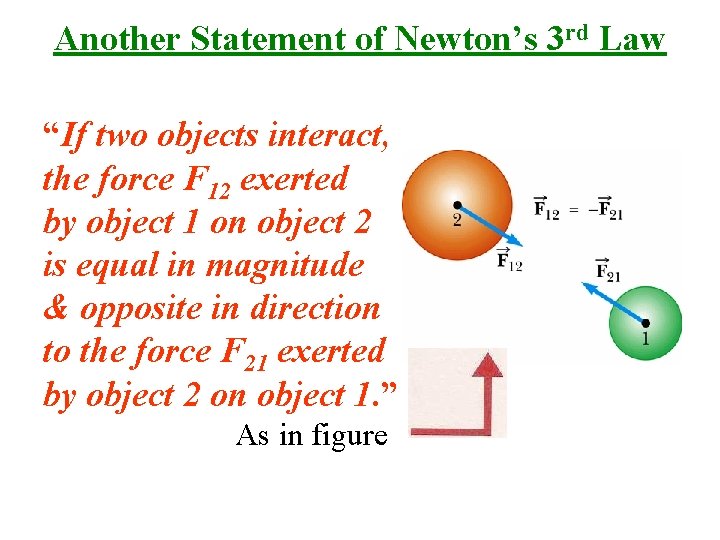
Another Statement of Newton’s 3 rd Law “If two objects interact, the force F 12 exerted by object 1 on object 2 is equal in magnitude & opposite in direction to the force F 21 exerted by object 2 on object 1. ” As in figure
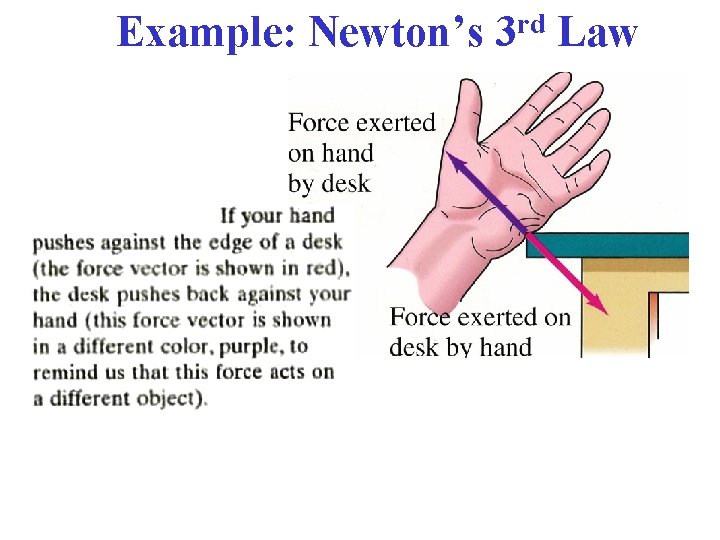
Example: Newton’s 3 rd Law
Action-Reaction Pairs: On Different Bodies