
Newtonian Program Analysis via Tensor Product Thomas Reps

- Slides: 33
Newtonian Program Analysis via Tensor Product Thomas Reps Emma Turetsky Prathmesh Prabhu Univ. of Wisconsin Gramma. Tech Google and Gramma. Tech
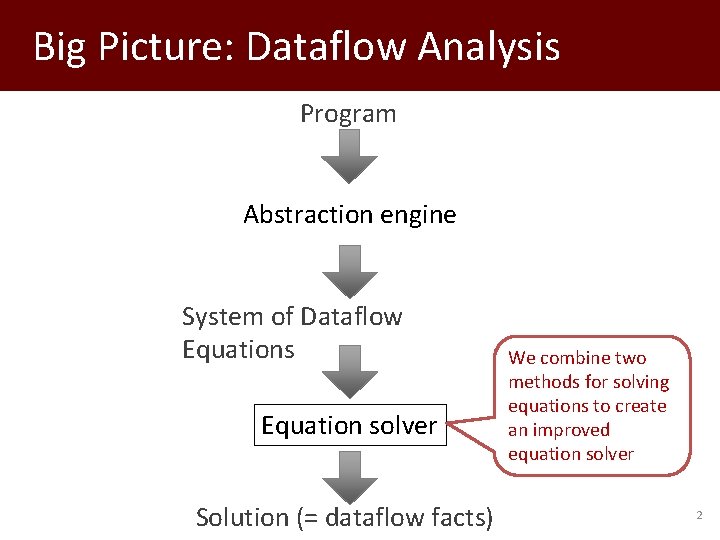
Big Picture: Dataflow Analysis Program Abstraction engine System of Dataflow Equations Equation solver Solution (= dataflow facts) We combine two methods for solving equations to create an improved equation solver 2
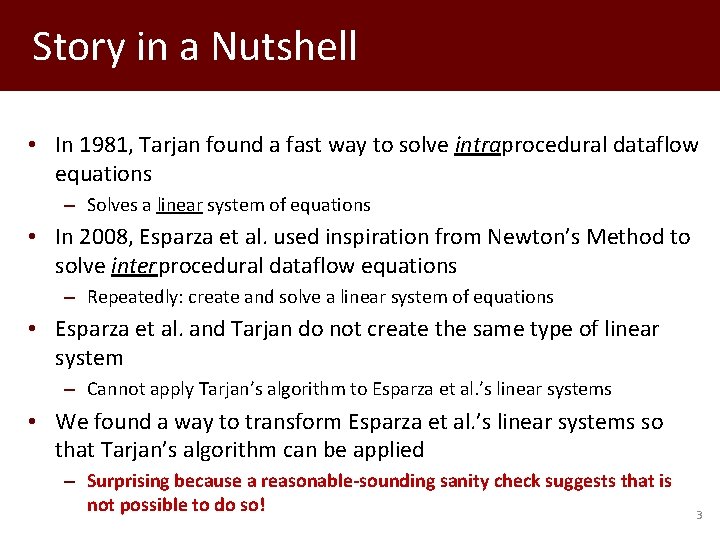
Story in a Nutshell • In 1981, Tarjan found a fast way to solve intraprocedural dataflow equations – Solves a linear system of equations • In 2008, Esparza et al. used inspiration from Newton’s Method to solve interprocedural dataflow equations – Repeatedly: create and solve a linear system of equations • Esparza et al. and Tarjan do not create the same type of linear system – Cannot apply Tarjan’s algorithm to Esparza et al. ’s linear systems • We found a way to transform Esparza et al. ’s linear systems so that Tarjan’s algorithm can be applied – Surprising because a reasonable-sounding sanity check suggests that is not possible to do so! 3
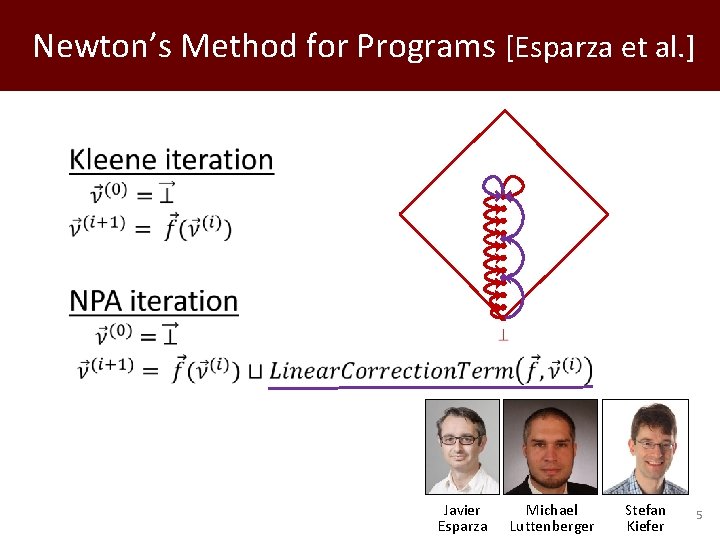
Newton’s Method for Programs [Esparza et al. ] Javier Esparza Michael Luttenberger Stefan Kiefer 5
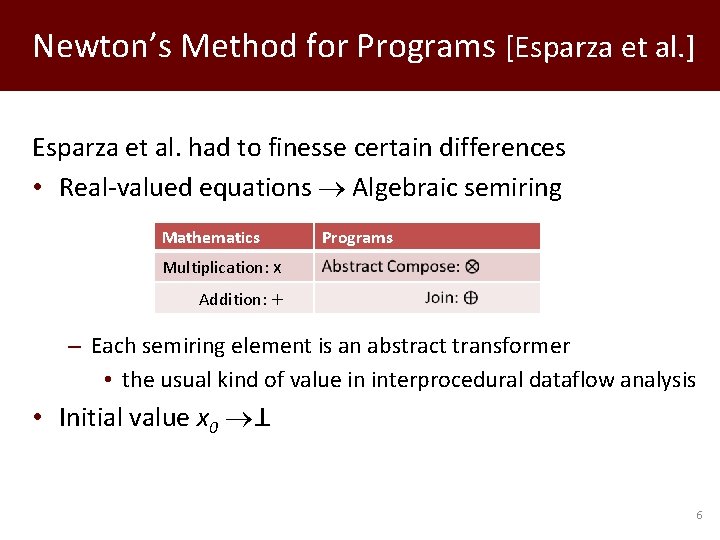
Newton’s Method for Programs [Esparza et al. ] Esparza et al. had to finesse certain differences • Real-valued equations Algebraic semiring Mathematics Programs Multiplication: x Addition: + – Each semiring element is an abstract transformer • the usual kind of value in interprocedural dataflow analysis • Initial value x 0 ⊥ 6
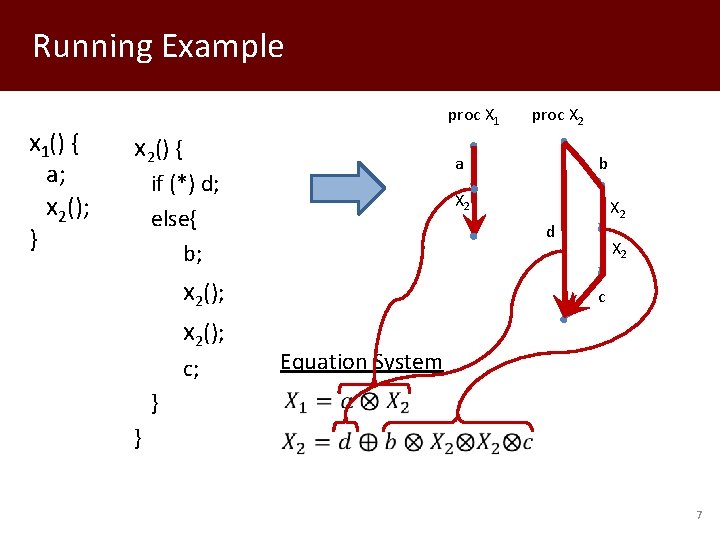
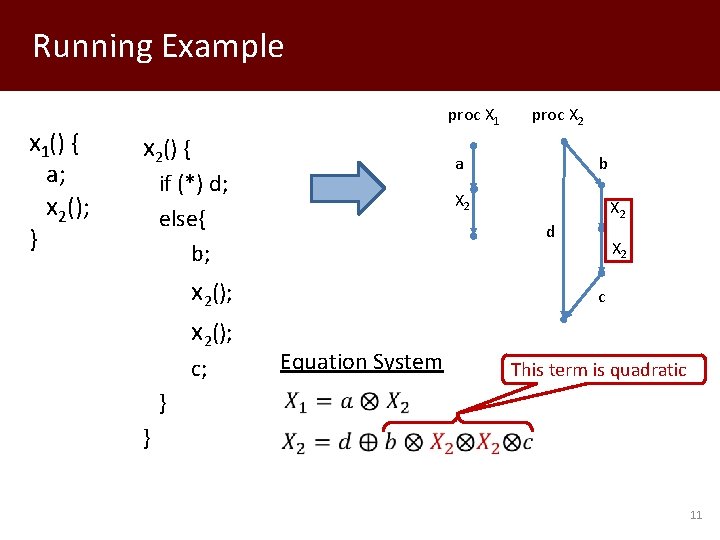
Running Example x 1() { a; x 2(); } proc X 1 x 2() { b a if (*) d; else{ b; X 2 d x 2(); c; } } proc X 2 c Equation System 7
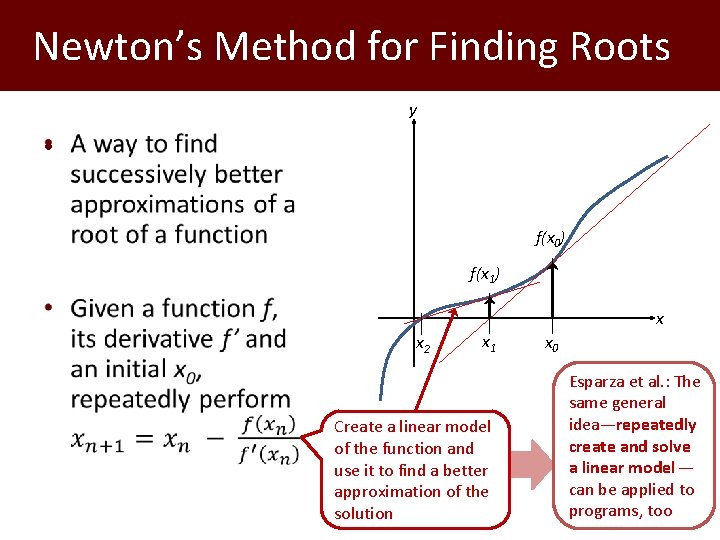
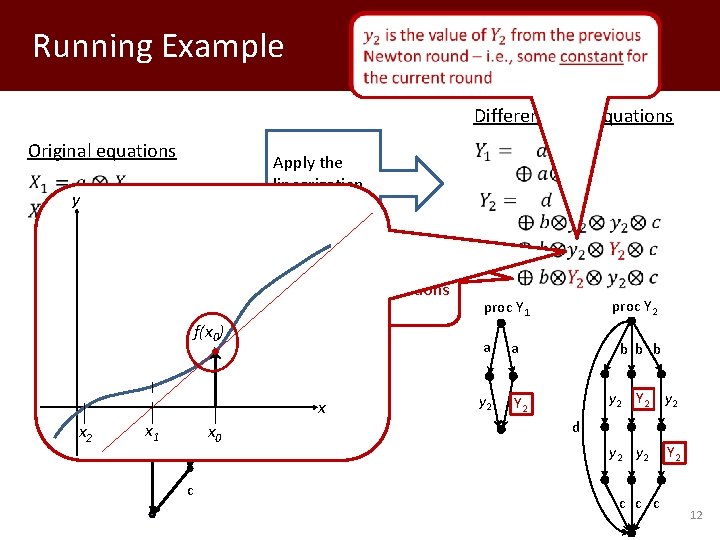
Newton’s Method for Finding Roots y • f(x 0) f(x 1) x x 2 x 1 Create a linear model of the function and use it to find a better approximation of the solution x 0 Esparza et al. : The same general idea—repeatedly create and solve a linear model — can be applied to Isaac programs, too 8 Newton
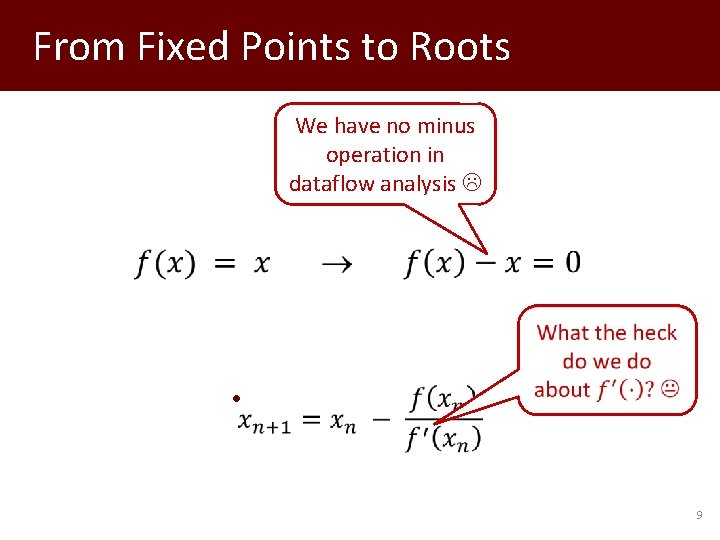
From Fixed Points to Roots We have no minus operation in dataflow analysis • 9
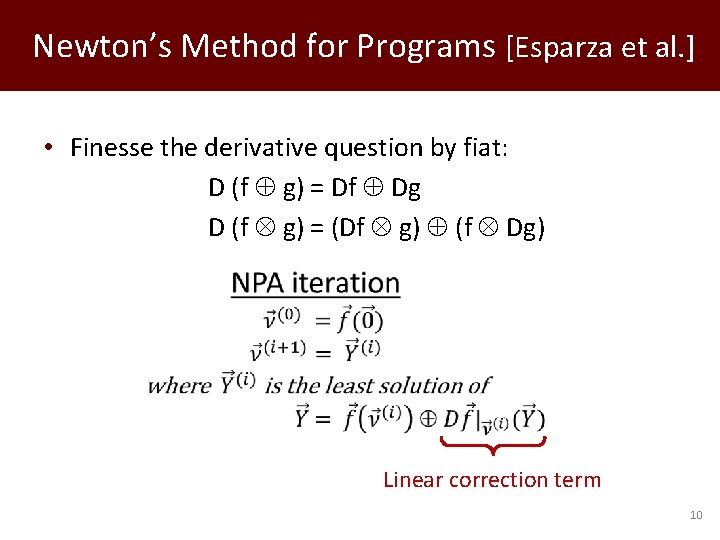
Newton’s Method for Programs [Esparza et al. ] • Finesse the derivative question by fiat: D (f g) = Df Dg D (f g) = (Df g) (f Dg) Linear correction term 10
Running Example x 1() { a; x 2(); } proc X 1 x 2() { b a if (*) d; else{ b; X 2 d x 2(); c; } } proc X 2 c Equation System This term is quadratic 11
Running Example Differentiated Equations Original equations Apply the linearization operator y proc X 1 Each summand now only has one variable; this system of equations is now linear! f(x 0) proc X 2 b a X 2 x 2 dx x 1 X 2 0 c x proc Y 2 proc Y 1 a a y 2 Y 2 bb b y 2 Y 2 y 2 d y 2 c c c Y 2 12
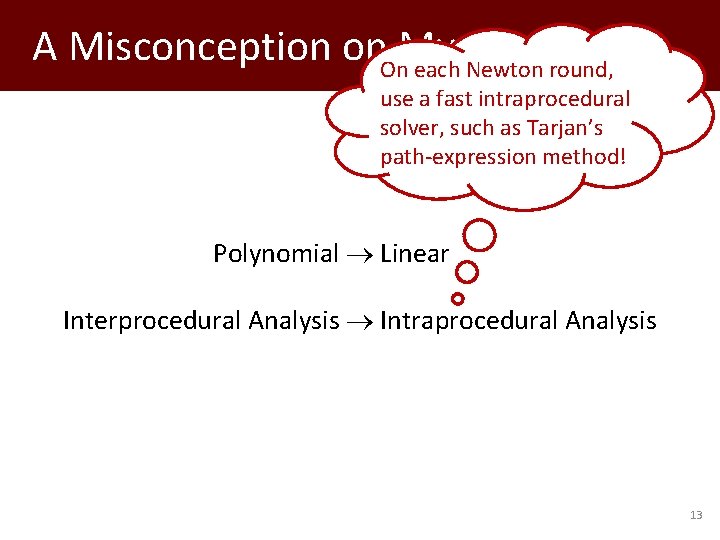
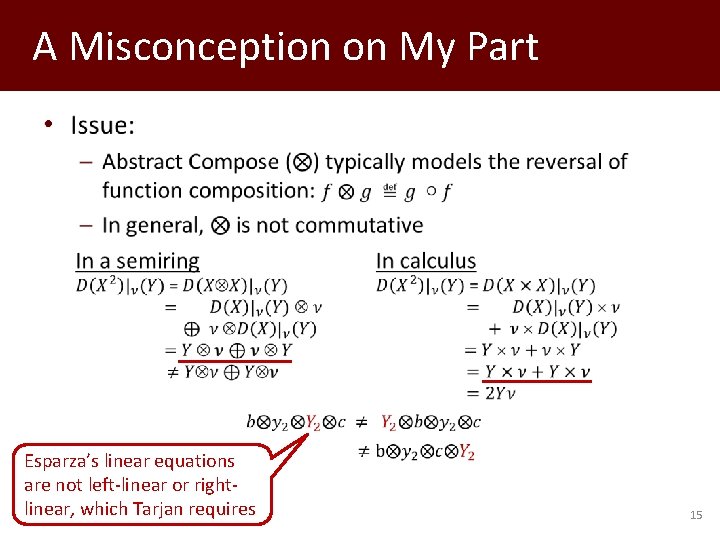
A Misconception on My Part On each Newton round, use a fast intraprocedural solver, such as Tarjan’s path-expression method! Polynomial Linear Interprocedural Analysis Intraprocedural Analysis 13
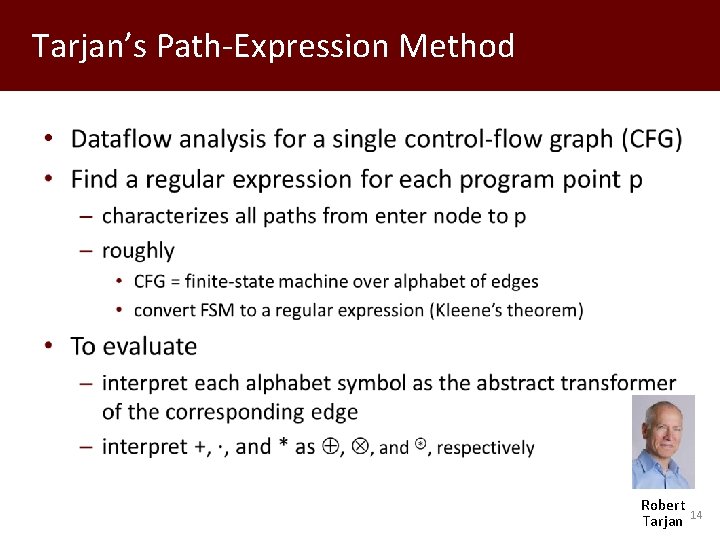
Tarjan’s Path-Expression Method • Robert Tarjan 14
A Misconception on My Part • Esparza’s linear equations are not left-linear or rightlinear, which Tarjan requires 15
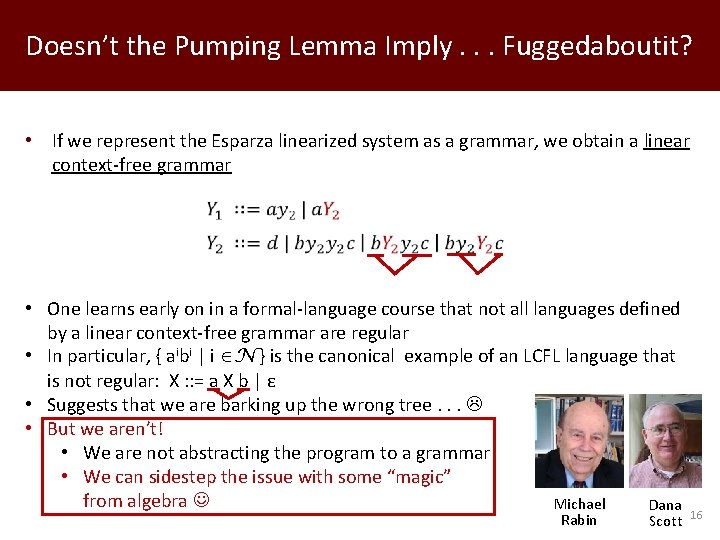
Doesn’t the Pumping Lemma Imply. . . Fuggedaboutit? • If we represent the Esparza linearized system as a grammar, we obtain a linear context-free grammar • One learns early on in a formal-language course that not all languages defined by a linear context-free grammar are regular • In particular, { aibi | i N } is the canonical example of an LCFL language that is not regular: X : : = a X b | ε • Suggests that we are barking up the wrong tree. . . • But we aren’t! • We are not abstracting the program to a grammar • We can sidestep the issue with some “magic” from algebra Michael Dana Rabin Scott 16
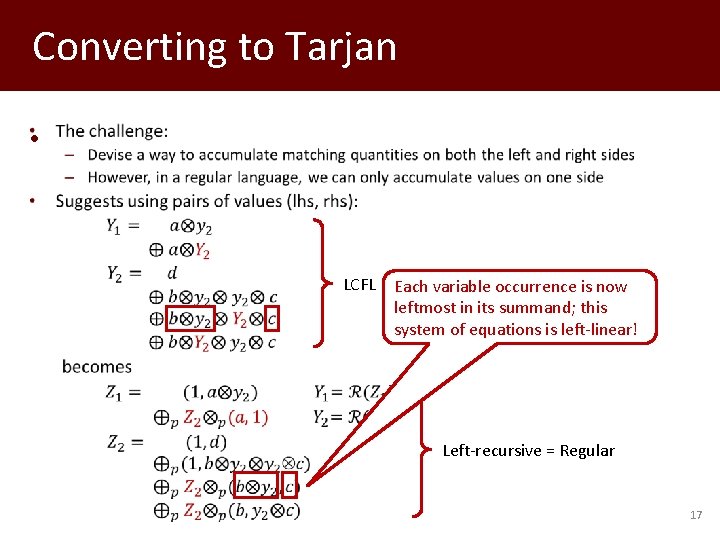
Converting to Tarjan • LCFL Each variable occurrence is now leftmost in its summand; this system of equations is left-linear! Left-recursive = Regular 17
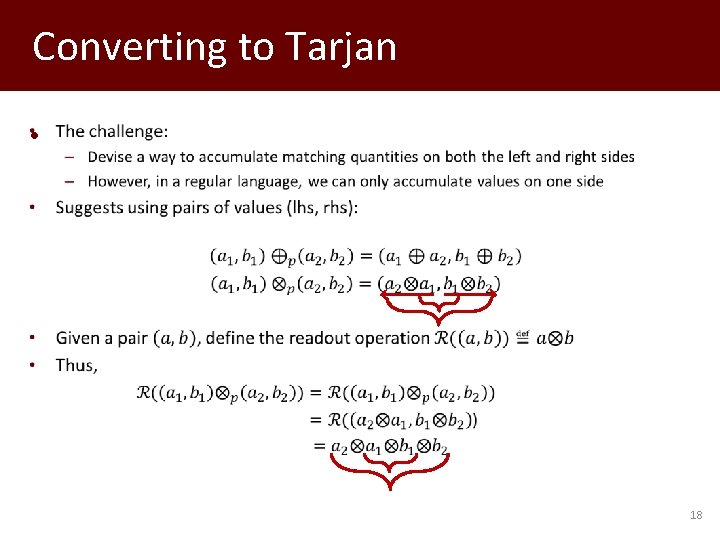
Converting to Tarjan • 18
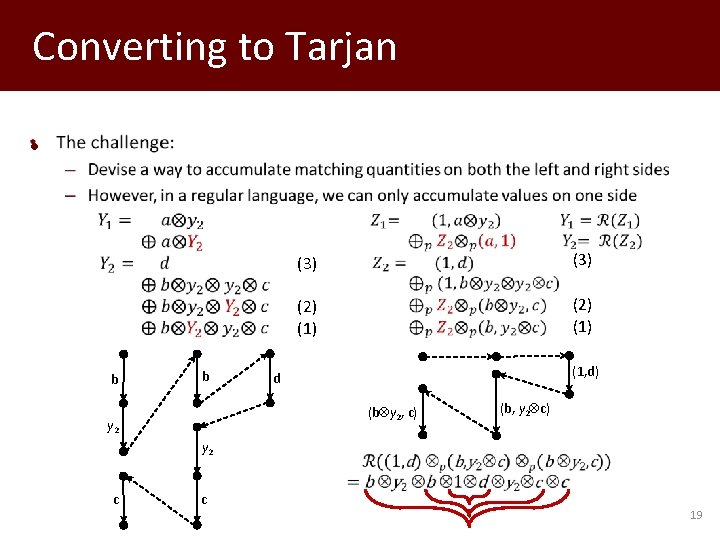
Converting to Tarjan • b b (3) (2) (1) (1, d) d (b y 2, c) y 2 c c (b, y 2 c) 19
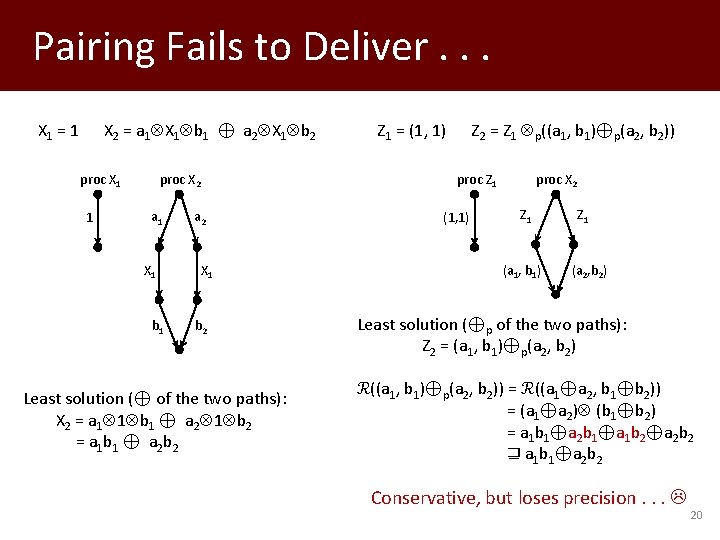
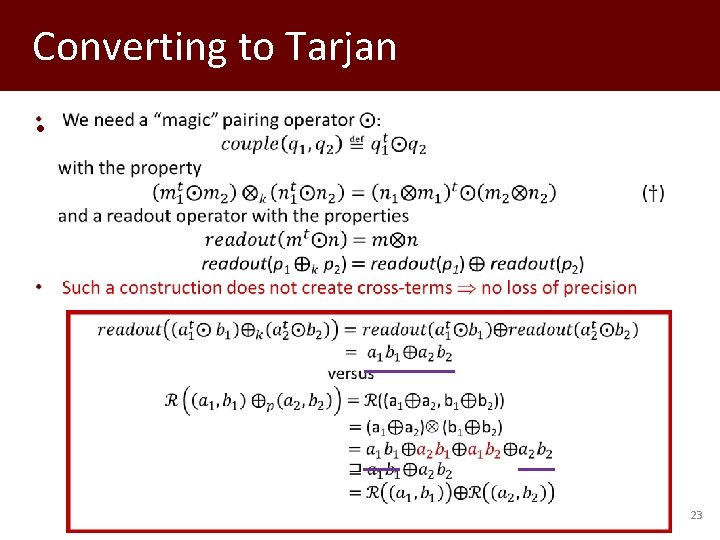
Pairing Fails to Deliver. . . X 1 = 1 X 2 = a 1 X 1 b 1 ⊕ a 2 X 1 b 2 proc X 1 1 proc X 2 a 1 X 1 b 1 Z 1 = (1, 1) Z 2 = Z 1 p((a 1, b 1)⊕p(a 2, b 2)) proc X 2 proc Z 1 a 2 X 1 b 2 Least solution (⊕ of the two paths): X 2 = a 1 1 b 1 ⊕ a 2 1 b 2 = a 1 b 1 ⊕ a 2 b 2 (1, 1) Z 1 (a 1, b 1) Z 1 (a 2, b 2) Least solution (⊕p of the two paths): Z 2 = (a 1, b 1)⊕p(a 2, b 2) ℛ((a 1, b 1)⊕p(a 2, b 2)) = ℛ((a 1⊕a 2, b 1⊕b 2)) = (a 1⊕a 2) (b 1⊕b 2) = a 1 b 1⊕a 2 b 1⊕a 1 b 2⊕a 2 b 2 ⊒ a 1 b 1⊕a 2 b 2 Conservative, but loses precision. . . 20
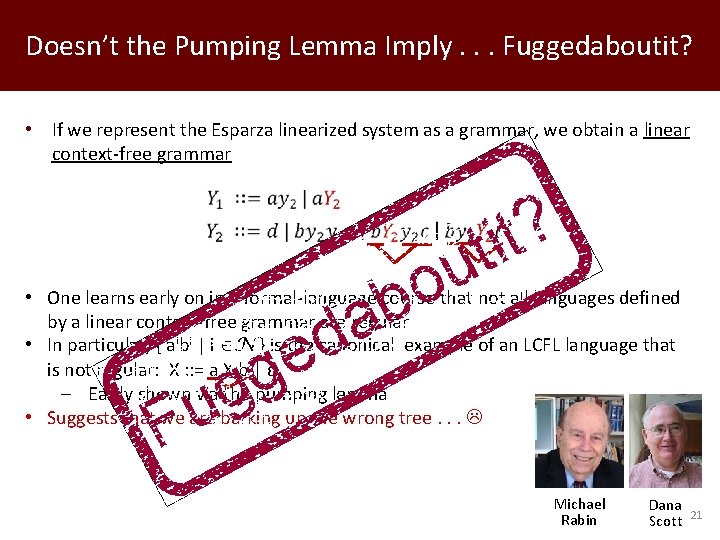
Doesn’t the Pumping Lemma Imply. . . Fuggedaboutit? • If we represent the Esparza linearized system as a grammar, we obtain a linear context-free grammar ? t ti b a u o • One learns early on in a formal-language course that not all languages defined by a linear context-free grammar are regular • In particular, { aibi | i N } is the canonical example of an LCFL language that is not regular: X : : = a X b | ε – Easily shown via the pumping lemma • Suggests that we are barking up the wrong tree. . . d e g g u F Michael Rabin Dana Scott 21
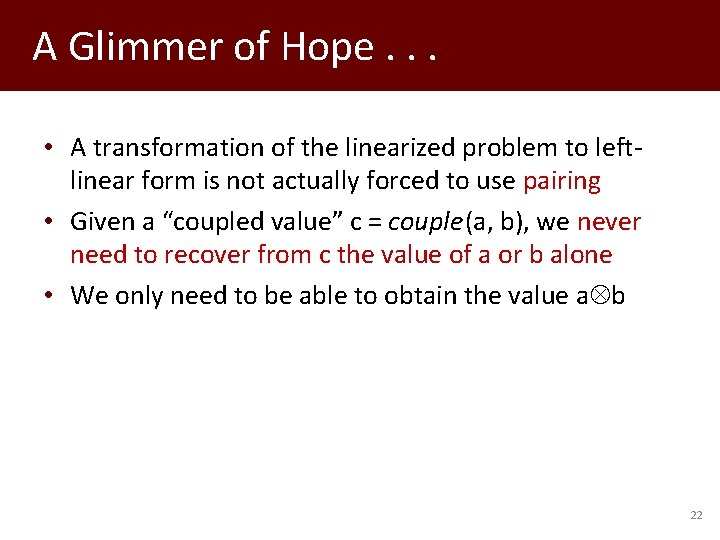
A Glimmer of Hope. . . • A transformation of the linearized problem to leftlinear form is not actually forced to use pairing • Given a “coupled value” c = couple(a, b), we never need to recover from c the value of a or b alone • We only need to be able to obtain the value a b 22
Converting to Tarjan • Akash Lal Tayssir Touili Nick Kidd Thomas Reps 23
Converting to Tarjan • 24
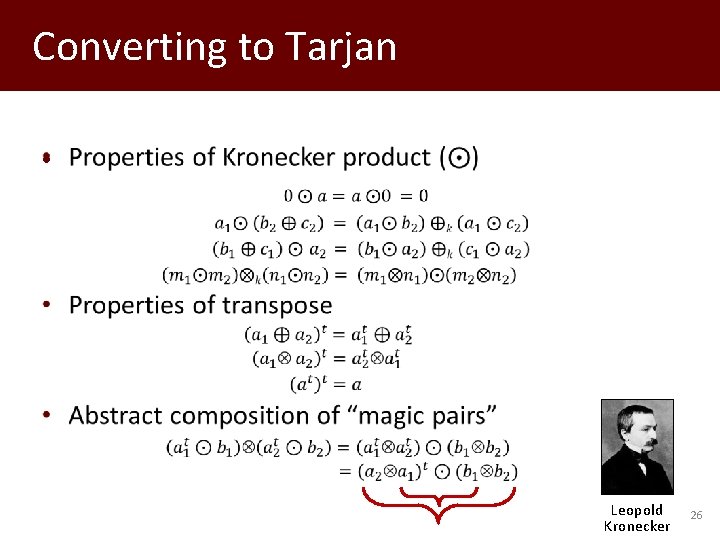
Some Intuition About Kronecker Product Leopold Kronecker 25
Converting to Tarjan • Leopold Kronecker 26
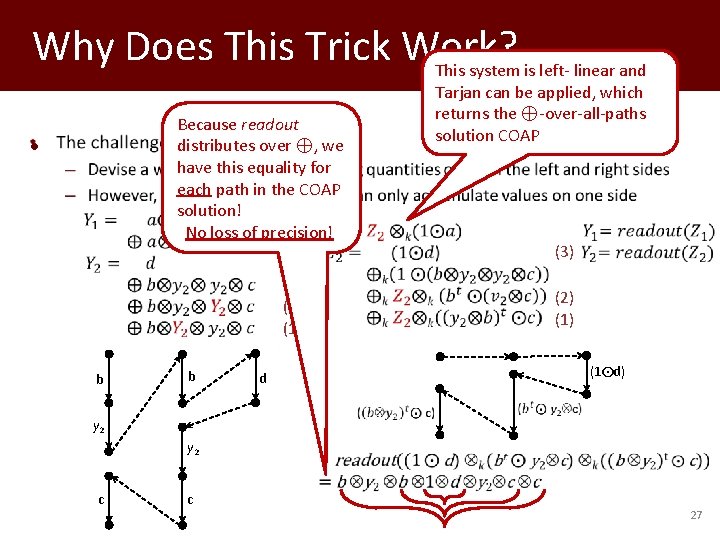
Why Does This Trick Work? This system is left- linear and Tarjan can be applied, which returns the ⊕-over-all-paths solution COAP Because readout distributes over ⊕, we have this equality for each path in the COAP solution! No loss of precision! • (3) (2) (1) b b (1⨀d) d y 2 c c 27
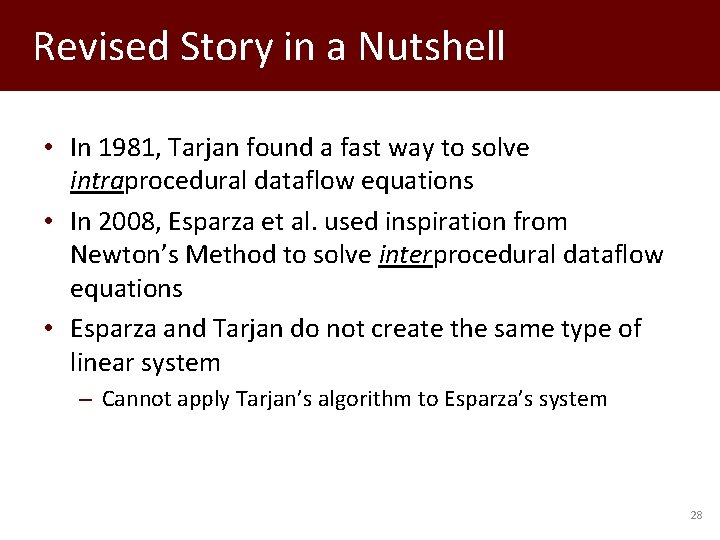
Revised Story in a Nutshell • In 1981, Tarjan found a fast way to solve intraprocedural dataflow equations • In 2008, Esparza et al. used inspiration from Newton’s Method to solve interprocedural dataflow equations • Esparza and Tarjan do not create the same type of linear system – Cannot apply Tarjan’s algorithm to Esparza’s system 28
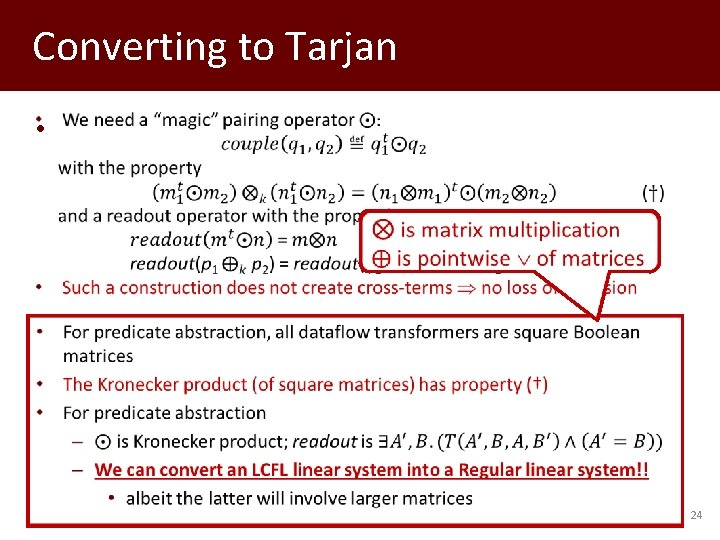
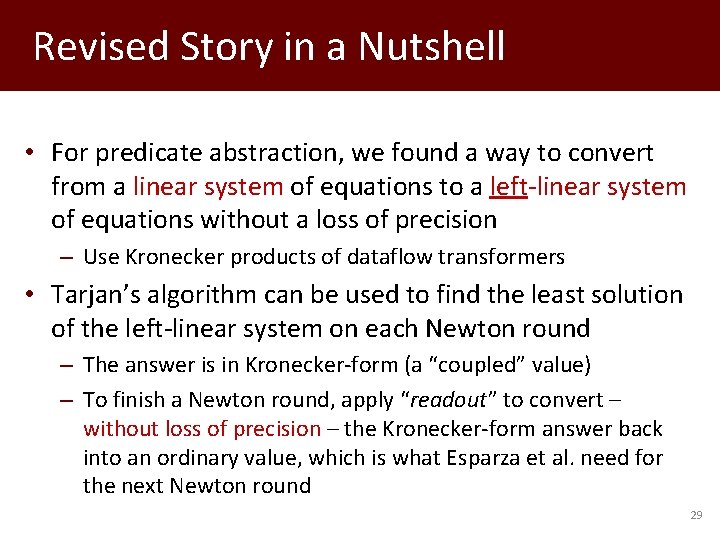
Revised Story in a Nutshell • For predicate abstraction, we found a way to convert from a linear system of equations to a left-linear system of equations without a loss of precision – Use Kronecker products of dataflow transformers • Tarjan’s algorithm can be used to find the least solution of the left-linear system on each Newton round – The answer is in Kronecker-form (a “coupled” value) – To finish a Newton round, apply “readout” to convert – without loss of precision – the Kronecker-form answer back into an ordinary value, which is what Esparza et al. need for the next Newton round 29
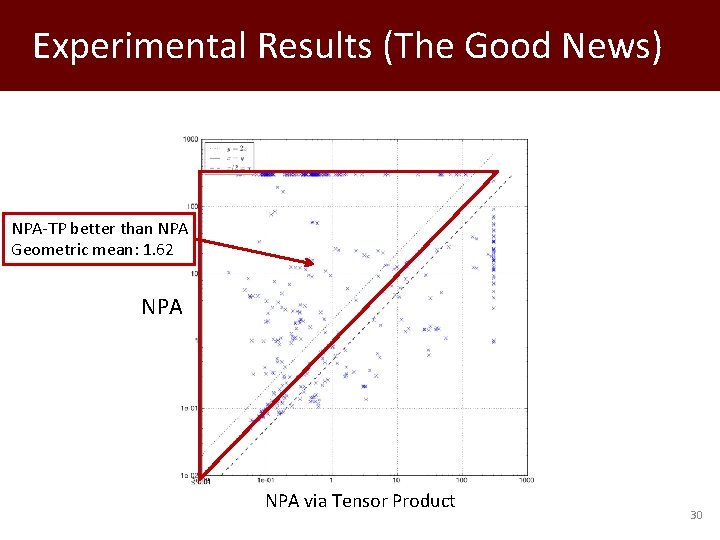
Experimental Results (The Good News) NPA-TP better than NPA Geometric mean: 1. 62 NPA via Tensor Product 30
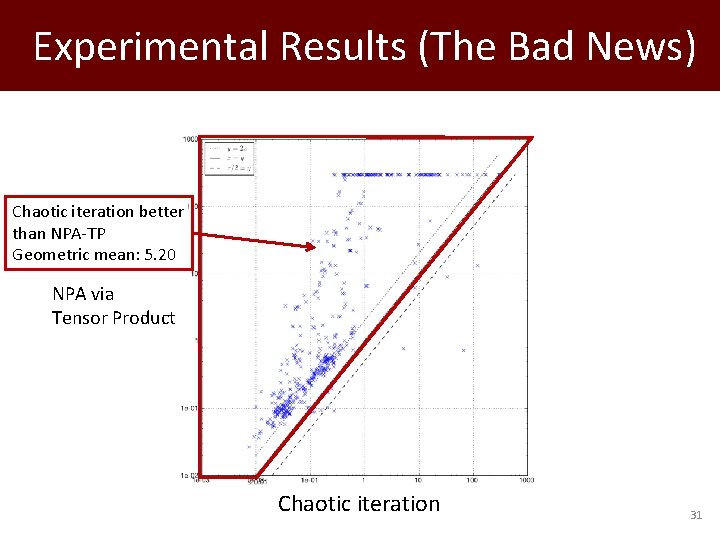
Experimental Results (The Bad News) Chaotic iteration better than NPA-TP Geometric mean: 5. 20 NPA via Tensor Product Chaotic iteration 31
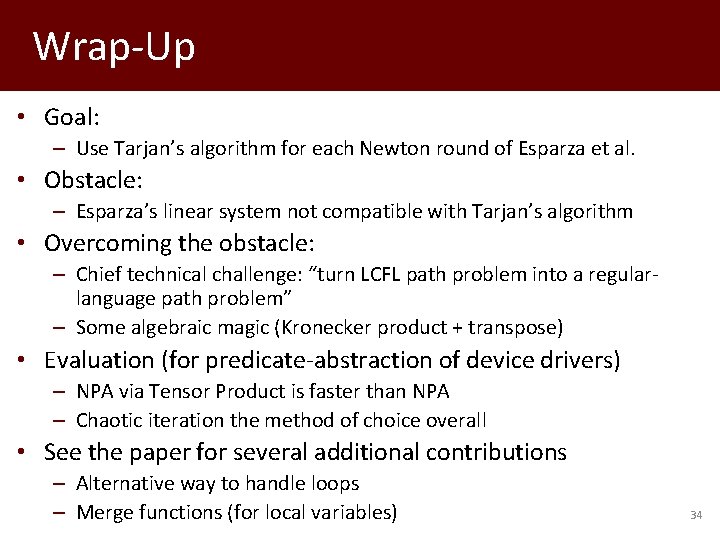
Wrap-Up • Goal: – Use Tarjan’s algorithm for each Newton round of Esparza et al. • Obstacle: – Esparza’s linear system not compatible with Tarjan’s algorithm • Overcoming the obstacle: – Chief technical challenge: “turn LCFL path problem into a regularlanguage path problem” – Some algebraic magic (Kronecker product + transpose) • Evaluation (for predicate-abstraction of device drivers) – NPA via Tensor Product is faster than NPA – Chaotic iteration the method of choice overall • See the paper for several additional contributions – Alternative way to handle loops – Merge functions (for local variables) 34
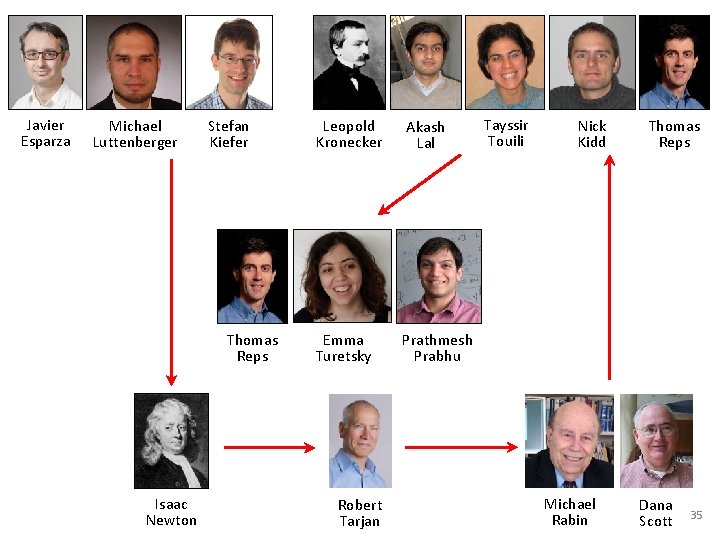
Javier Esparza Michael Luttenberger Stefan Kiefer Thomas Reps Isaac Newton Leopold Kronecker Akash Lal Emma Turetsky Prathmesh Prabhu Robert Tarjan Tayssir Touili Nick Kidd Michael Rabin Thomas Reps Dana Scott 35
36