
Newtonian Models of Human Behavior 20 th Century
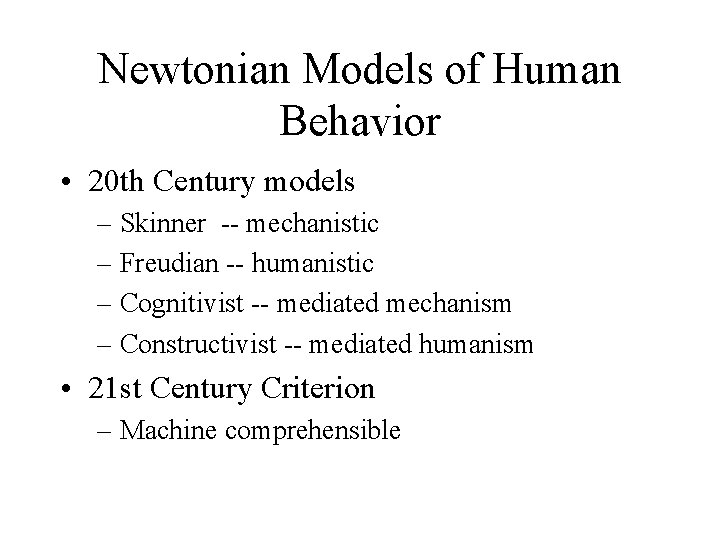
Newtonian Models of Human Behavior • 20 th Century models – Skinner -- mechanistic – Freudian -- humanistic – Cognitivist -- mediated mechanism – Constructivist -- mediated humanism • 21 st Century Criterion – Machine comprehensible
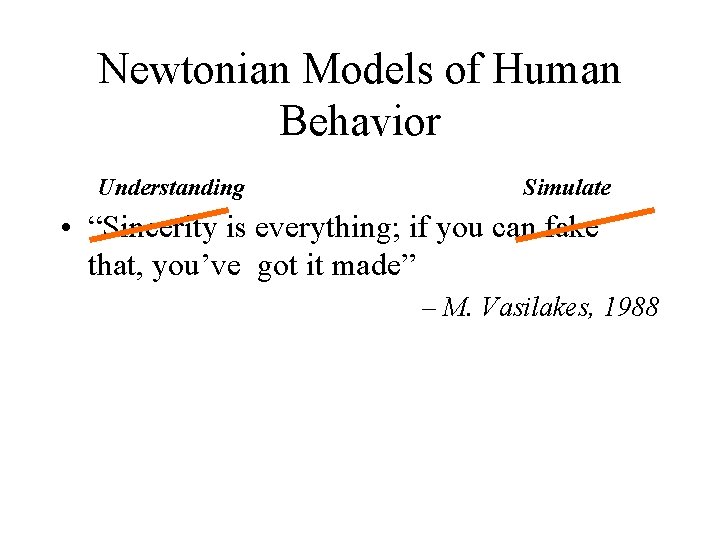
Newtonian Models of Human Behavior Understanding Simulate • “Sincerity is everything; if you can fake that, you’ve got it made” – M. Vasilakes, 1988
Machine “Readable” • Joint with Prof. Ragnar Nordlie of Oslo University College. • Students – Insuk Oh – Ying Sun • Can a machine apply the model of human behavior?
Just how smart are computers? • Computers can “accumulate” “compare” and “branch”. This supports complex operations of arithmetic (like computing logarithms) -- but it only supports simple things like recognizing your boss’s face if we can reduce that recognition to some sequence of accumulations and comparisons.
Searching Behavior • When a human helps, or even observes another human searching, it is not hard to form some mental model of the person’s thought process. – I usually leave my glasses in the kitchen – Maybe I took them upstairs last night – That failed. Let’s try the kitchen again.
Machine perplexity – That failed. Let’s try the kitchen again. • This step makes no sense whatsoever to a computer. But it is very human. • We look for models that accommodate this kind of “peculiar” behavior. • What these models are not.
People are not random, but they are unpredictable • Failed Markov Models (“FMM”). • Postulate that a person is in a “search state” – One state corresponding to each action – Moves to the next state according to a fixed stochastic law – e. g. After seeing a document: 70% chance to look at another one; 30% chance to quit. – Implies chance to look at n documents in a row is 0. 3(0. 7)n
People are interactive • Generate complex search patterns as they respond in simple ways to the responses of the systems that they use. • H. Simon. The ant at the beach. Complex path because the beach is hilly. – Not because the ant has a rich situated inner metaphysical and emotional life. – Not because the ant tosses a coin to decide what to do.
Newtonian Searching • First Law: A searcher persists in each selected pattern of action until events make it desirable to change. • Second Law: The nature of the change will be substantially influenced by (a) the history up to that point and (b) the nature of the event forcing change.
Can this be studied? • • Yes. Set model tasks. Observe and log the search sessions Review the log, with a time-elastic think aloud process. • Identify types of persistence and types of change event.
What can be found? • By analysis of logs: – aaaaaaaxbbbbbyaaaaaaaxbbbbbzc. . . – This pattern shows persistent “a” behavior until event of type “x”, after which “b” behavior persists until an event of type “y”. This moves the searcher back to type “a” behavior. Another “x” pushes him to type “b”. Finally a “z” event pushes him to type “c” behavior, and so on.
The inner human accumulator • But also, it may be that the tendency to change to “c” behavior is governed by some kind of internal accumulator. • E. g. If “a” is “look at a page and not stay long” it may be that the longer we do this, the more likely we are to just quit, no matter what we see. • If a particular approach fails some number of times, we are more prone to abandon it.
The goal: • To provide models that can predict, more often that mere chance, what the searcher will do next -- • and • To base that prediction on simple events and actions that the computer can observe and accumulate. • Then the computer can fake sincerity.
- Slides: 13