
Newtonian Mechanics Review Classical Mechanics The science of
- Slides: 21
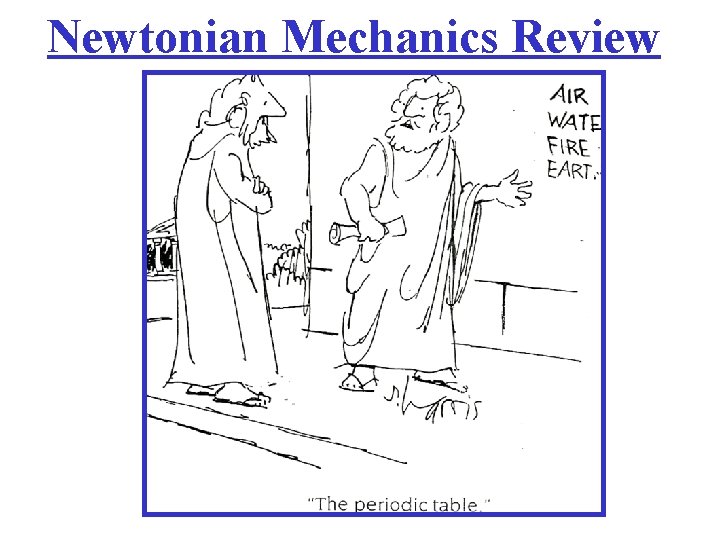
Newtonian Mechanics Review
Classical Mechanics • The science of objects at rest or in motion + conditions of rest or motion, when the objects are under the influence of forces. • HOW objects move, usually not WHY • Other than the fact that forces can cause motion. • The Sources of Forces? (Usually) Outside the scope of mechanics.
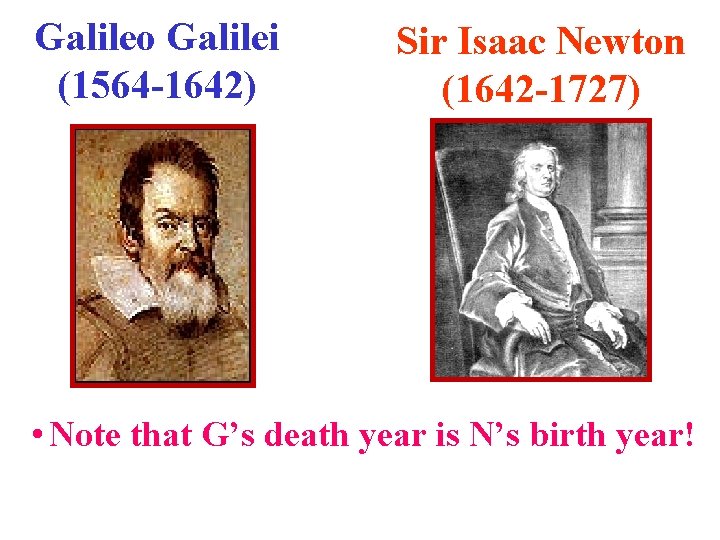
Galileo Galilei (1564 -1642) Sir Isaac Newton (1642 -1727) • Note that G’s death year is N’s birth year!
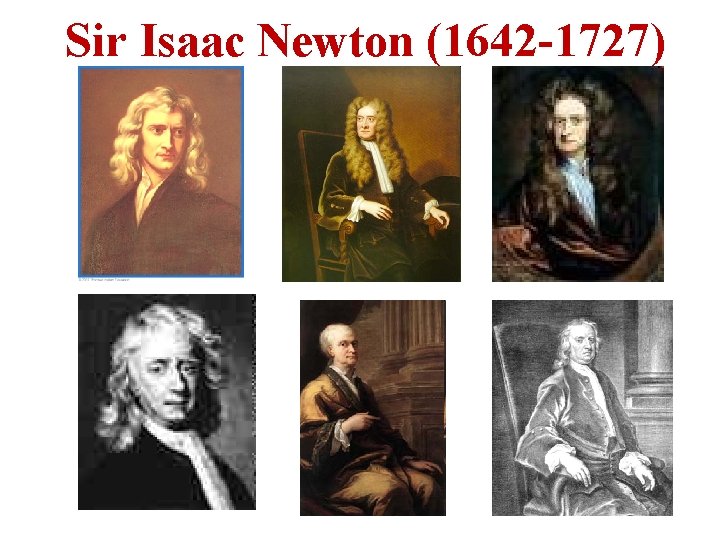
Sir Isaac Newton (1642 -1727)
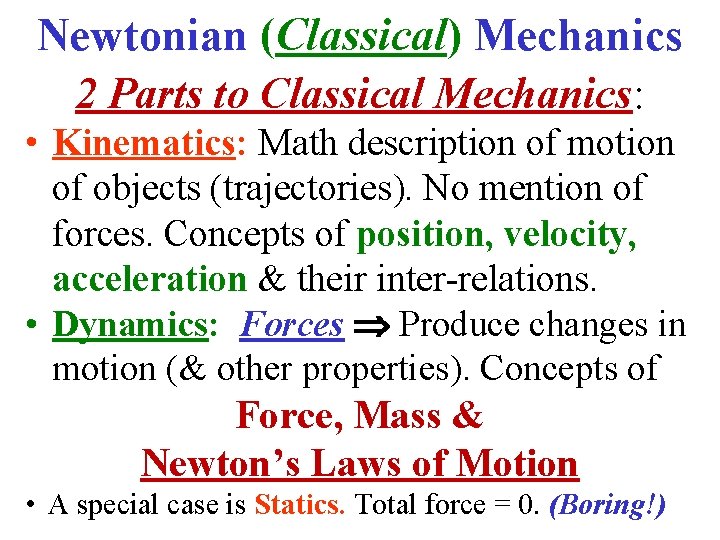
Newtonian (Classical) Mechanics 2 Parts to Classical Mechanics: • Kinematics: Math description of motion of objects (trajectories). No mention of forces. Concepts of position, velocity, acceleration & their inter-relations. • Dynamics: Forces Produce changes in motion (& other properties). Concepts of Force, Mass & Newton’s Laws of Motion • A special case is Statics. Total force = 0. (Boring!)
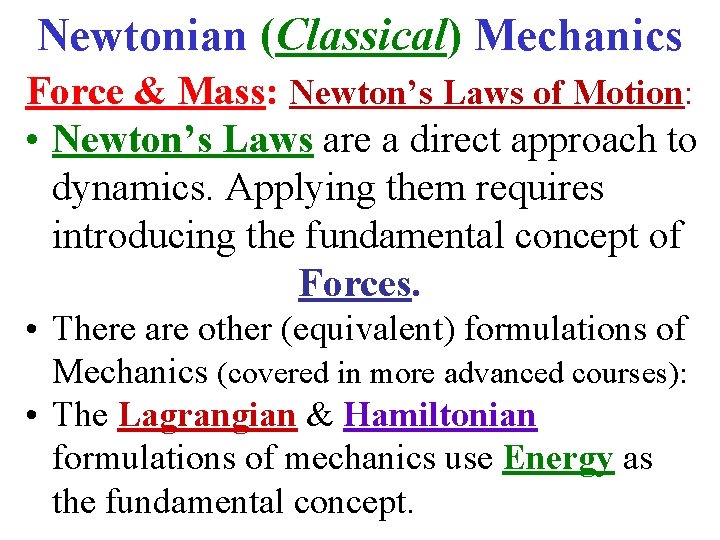
Newtonian (Classical) Mechanics Force & Mass: Newton’s Laws of Motion: • Newton’s Laws are a direct approach to dynamics. Applying them requires introducing the fundamental concept of Forces. • There are other (equivalent) formulations of Mechanics (covered in more advanced courses): • The Lagrangian & Hamiltonian formulations of mechanics use Energy as the fundamental concept.
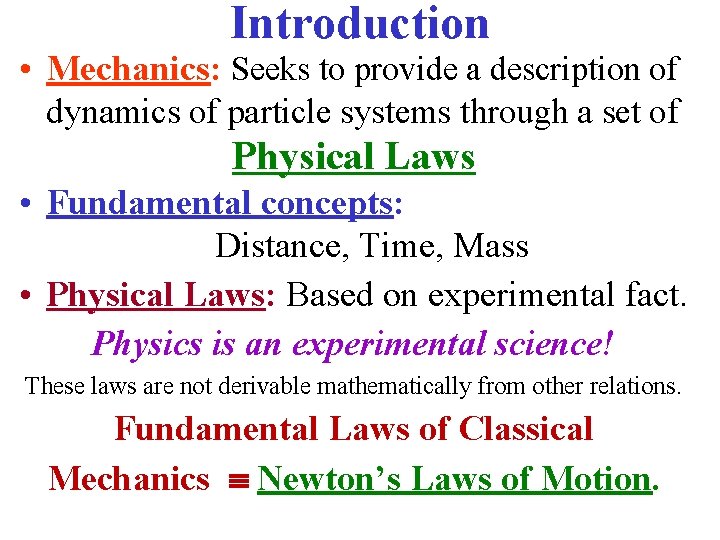
Introduction • Mechanics: Seeks to provide a description of dynamics of particle systems through a set of Physical Laws • Fundamental concepts: Distance, Time, Mass • Physical Laws: Based on experimental fact. Physics is an experimental science! These laws are not derivable mathematically from other relations. Fundamental Laws of Classical Mechanics Newton’s Laws of Motion.
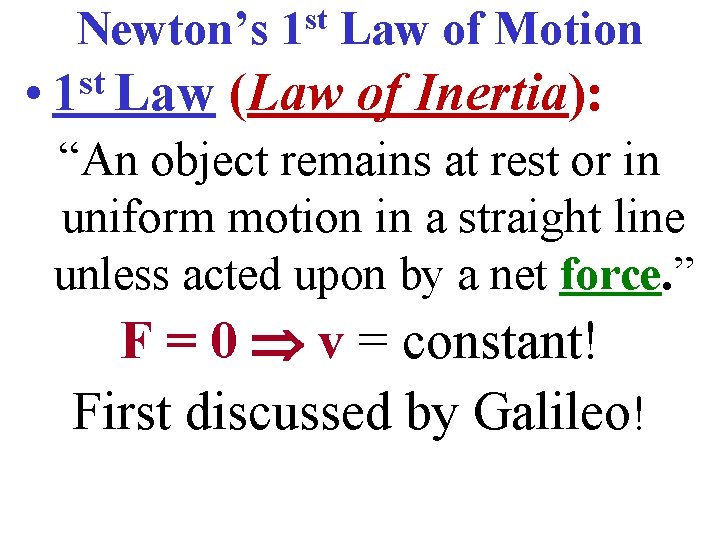
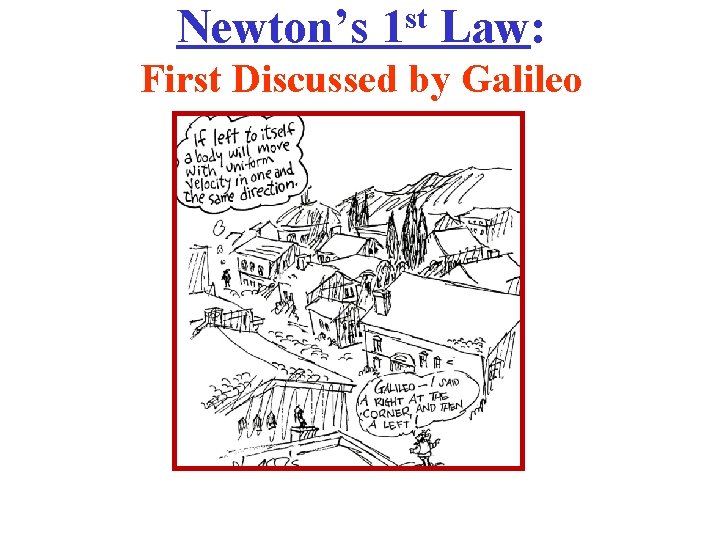
Newton’s 1 st Law of Motion st • 1 Law (Law of Inertia): “An object remains at rest or in uniform motion in a straight line unless acted upon by a net force. ” F = 0 v = constant! First discussed by Galileo!
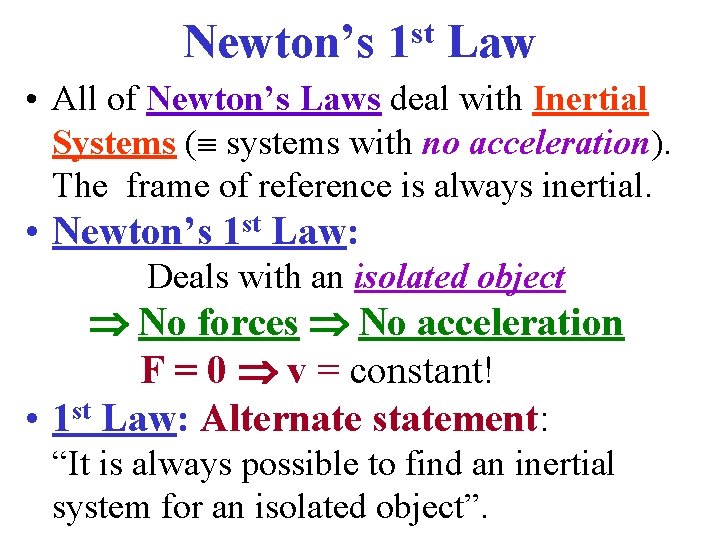
Newton’s st 1 Law • All of Newton’s Laws deal with Inertial Systems ( systems with no acceleration). The frame of reference is always inertial. • Newton’s 1 st Law: Deals with an isolated object No forces No acceleration F = 0 v = constant! • 1 st Law: Alternate statement: “It is always possible to find an inertial system for an isolated object”.
Newton’s st 1 Law: First Discussed by Galileo
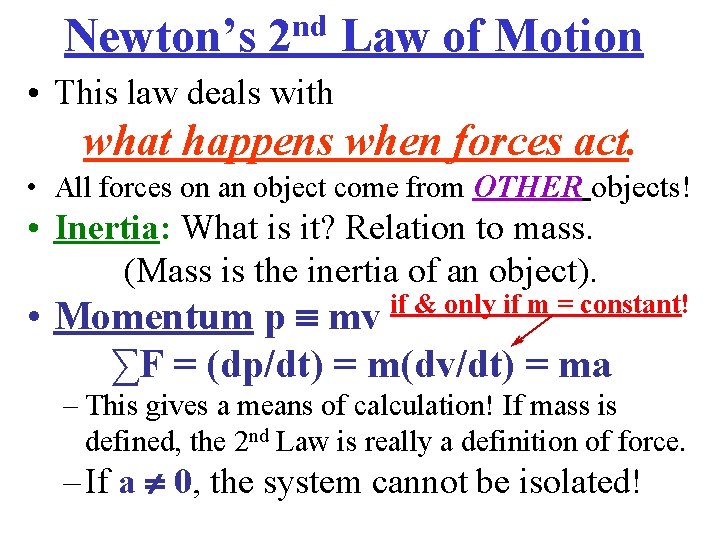
Newton’s 2 nd Law of Motion • This law deals with what happens when forces act. • All forces on an object come from OTHER objects! • Inertia: What is it? Relation to mass. (Mass is the inertia of an object). if & only if m = constant! • Momentum p mv ∑F = (dp/dt) = m(dv/dt) = ma – This gives a means of calculation! If mass is defined, the 2 nd Law is really a definition of force. – If a 0, the system cannot be isolated!
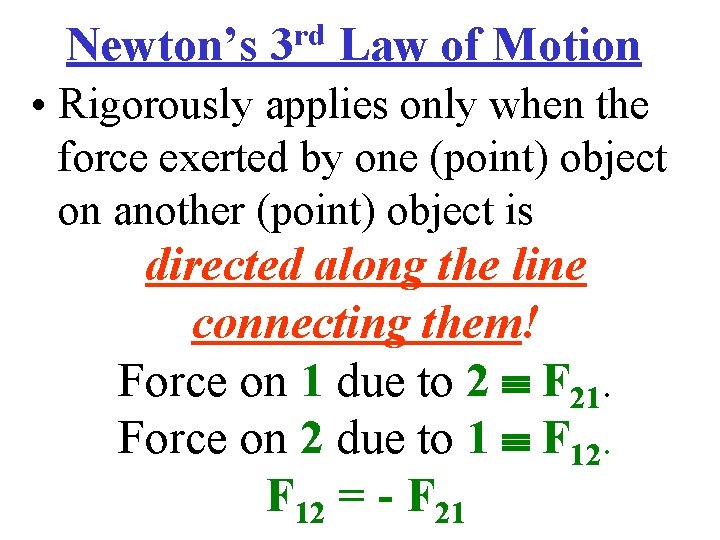
Newton’s 3 rd Law of Motion • Rigorously applies only when the force exerted by one (point) object on another (point) object is directed along the line connecting them! Force on 1 due to 2 F 21. Force on 2 due to 1 F 12 = - F 21
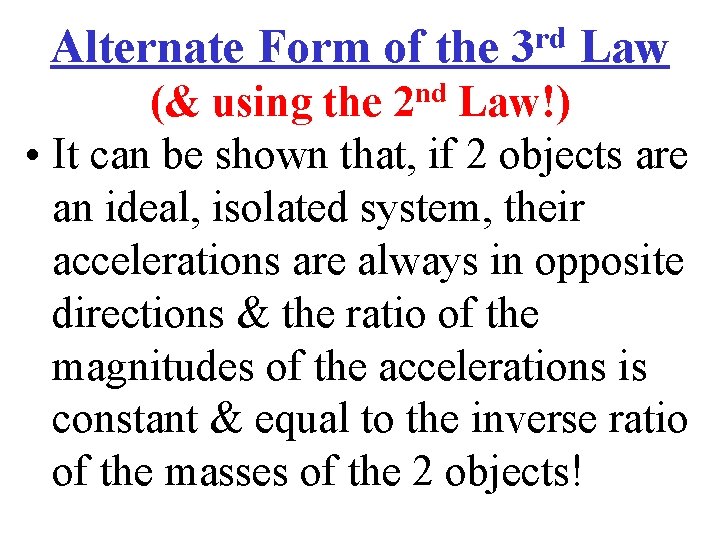
Alternate Form of the rd 3 Law (& using the 2 nd Law!) • It can be shown that, if 2 objects are an ideal, isolated system, their accelerations are always in opposite directions & the ratio of the magnitudes of the accelerations is constant & equal to the inverse ratio of the masses of the 2 objects!
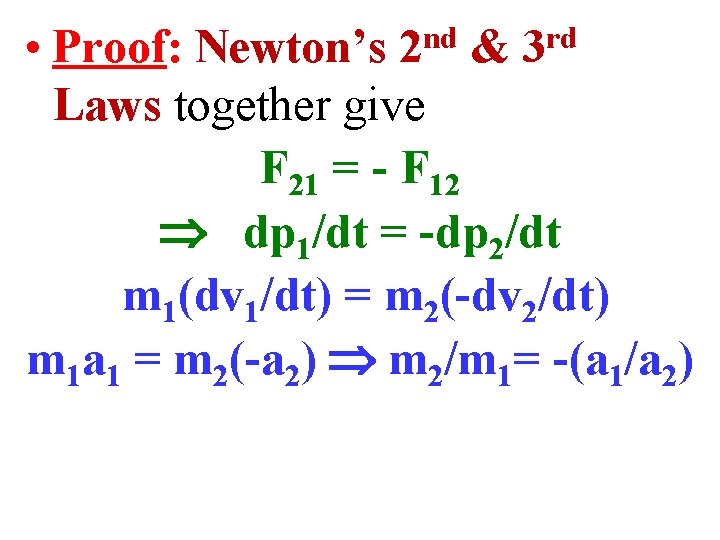
• Proof: Newton’s & Laws together give F 21 = - F 12 dp 1/dt = -dp 2/dt m 1(dv 1/dt) = m 2(-dv 2/dt) m 1 a 1 = m 2(-a 2) m 2/m 1= -(a 1/a 2) nd 2 rd 3
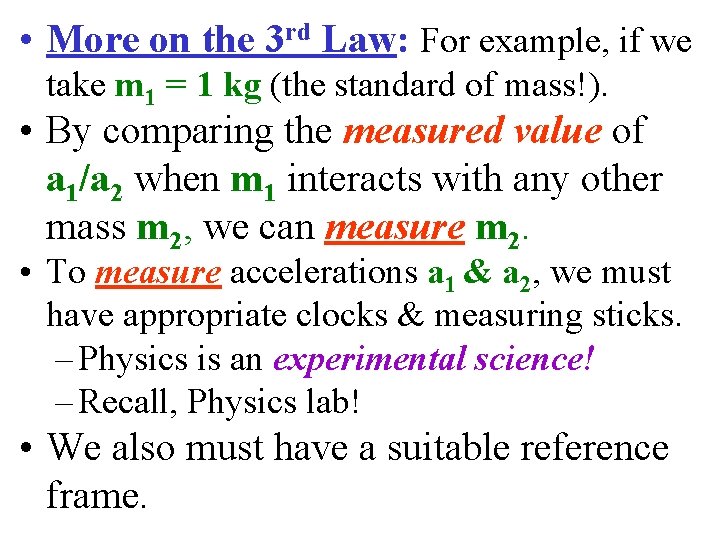
• More on the 3 rd Law: For example, if we take m 1 = 1 kg (the standard of mass!). • By comparing the measured value of a 1/a 2 when m 1 interacts with any other mass m 2, we can measure m 2. • To measure accelerations a 1 & a 2, we must have appropriate clocks & measuring sticks. – Physics is an experimental science! – Recall, Physics lab! • We also must have a suitable reference frame.
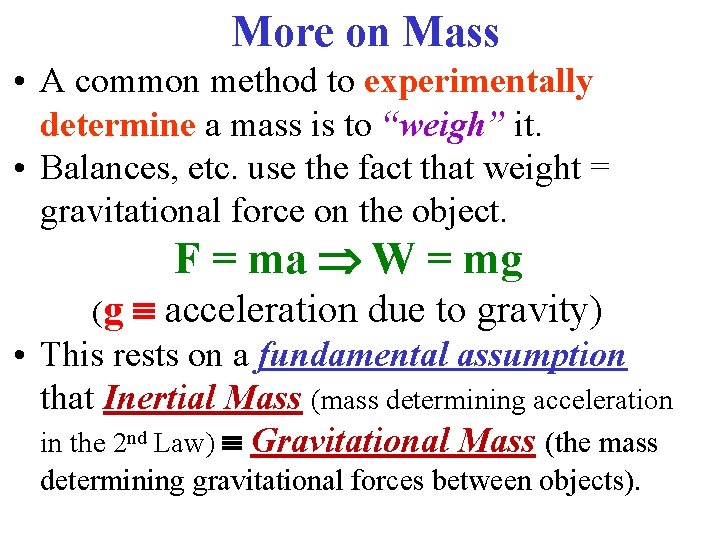
More on Mass • A common method to experimentally determine a mass is to “weigh” it. • Balances, etc. use the fact that weight = gravitational force on the object. F = ma W = mg (g acceleration due to gravity) • This rests on a fundamental assumption that Inertial Mass (mass determining acceleration in the 2 nd Law) Gravitational Mass (the mass determining gravitational forces between objects).
The Principle of Equivalence: From Einstein’s General Relativity! • The inertial & gravitational masses are equivalent experimentally! • Whether they are fundamentally different or not is a philosophical question (beyond scope of the course). • This equivalence principle is discussed in detail in Einstein’s Theory of General Relativity!
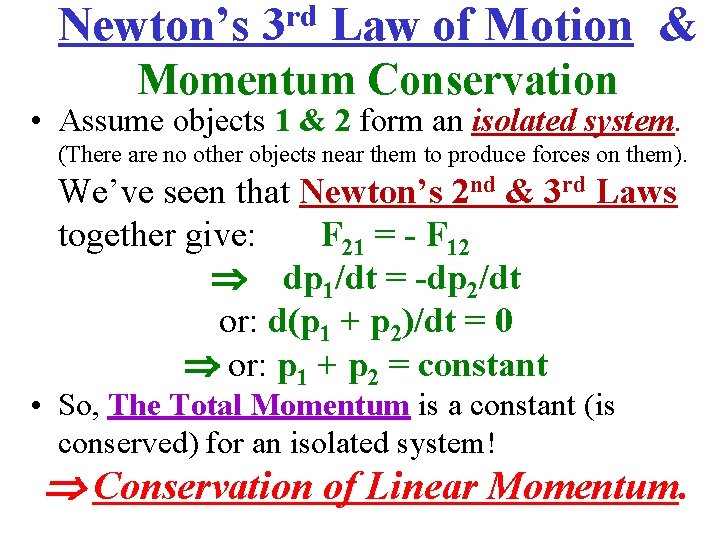
Newton’s rd 3 Law of Motion & Momentum Conservation • Assume objects 1 & 2 form an isolated system. (There are no other objects near them to produce forces on them). We’ve seen that Newton’s 2 nd & 3 rd Laws together give: F 21 = - F 12 dp 1/dt = -dp 2/dt or: d(p 1 + p 2)/dt = 0 or: p 1 + p 2 = constant • So, The Total Momentum is a constant (is conserved) for an isolated system! Conservation of Linear Momentum.
Frames of Reference • For Newton’s Laws of Motion to have meaning, the motion of objects must be measured relative to a Reference Frame. • We already said that Newton’s Laws of Motion are valid only in an Inertial Frame A reference frame where Newton’s Laws of Motion hold! • Inertial Frame A non-accelerating reference frame. By Newton’s 2 nd Law, this must be a frame which has no external force on it!
Newtonian/Galilean Relativity • If Newton’s Laws of Motion are valid in one (inertial) reference frame, they are also valid in any other reference frame in uniform (not accelerated) motion with respect to the first. • This is a result of the fact that Newton’s 2 nd Law: F = ma = m (d 2 r/dt 2) involves a 2 nd time derivative of r. A change of coordinates involving constant velocity will not change the 2 nd Law (or the 1 st Law or the 3 rd Law).
• Newton’s Laws of Motion are the same in all inertial frames Newtonian / Galilean Relativity. • Special Relativity: “Absolute rest” & “Absolute inertial frame” are meaningless. • Usually, we take the Newtonian “absolute” inertial frame as the “fixed stars”. NOTE! Rotating frames are non-inertial!!! • So, Newton’s Laws of Motion don’t hold in rotating frames unless we introduce “fictitious” forces!!