
News from the Laser Interferometer GravitationalWave Observatory LIGO
News from the Laser Interferometer Gravitational-Wave Observatory (LIGO) Dennis Ugolini, Trinity University for the LIGO Science Collaboration SMU Physics Seminar March 29, 2010 Document no. LIGO-G 100214 1
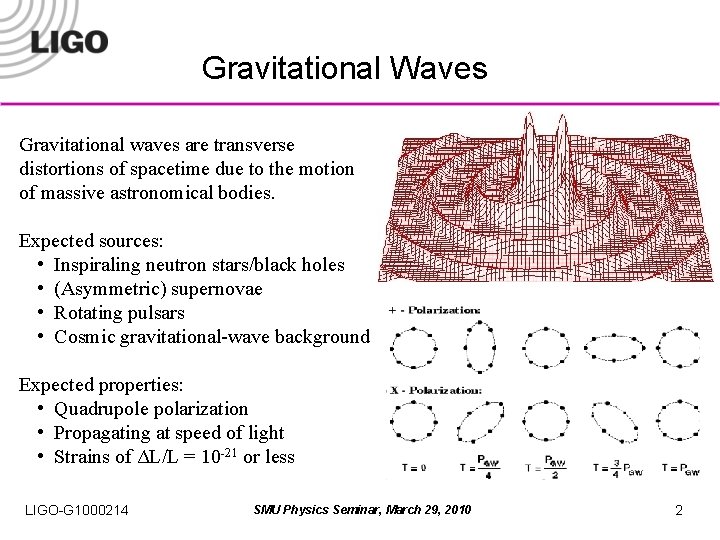
Gravitational Waves Gravitational waves are transverse distortions of spacetime due to the motion of massive astronomical bodies. Expected sources: • Inspiraling neutron stars/black holes • (Asymmetric) supernovae • Rotating pulsars • Cosmic gravitational-wave background Expected properties: • Quadrupole polarization • Propagating at speed of light • Strains of ΔL/L = 10 -21 or less LIGO-G 1000214 SMU Physics Seminar, March 29, 2010 2
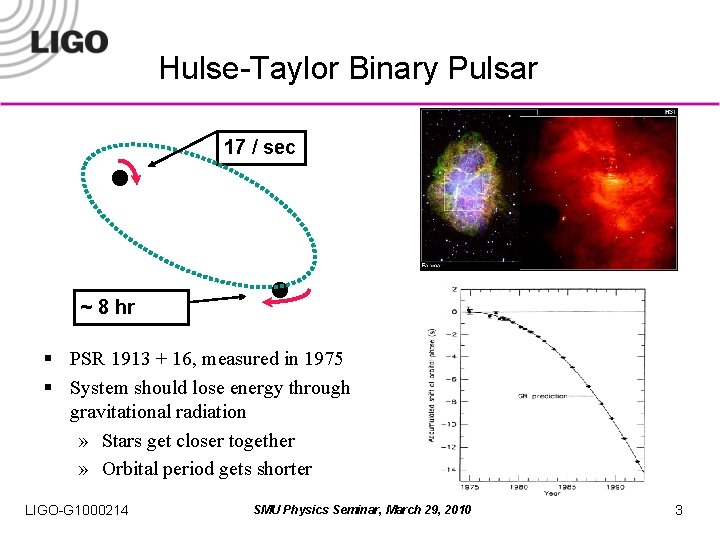
Hulse-Taylor Binary Pulsar · ~ 8 hr 17 / sec · § PSR 1913 + 16, measured in 1975 § System should lose energy through gravitational radiation » Stars get closer together » Orbital period gets shorter LIGO-G 1000214 SMU Physics Seminar, March 29, 2010 3
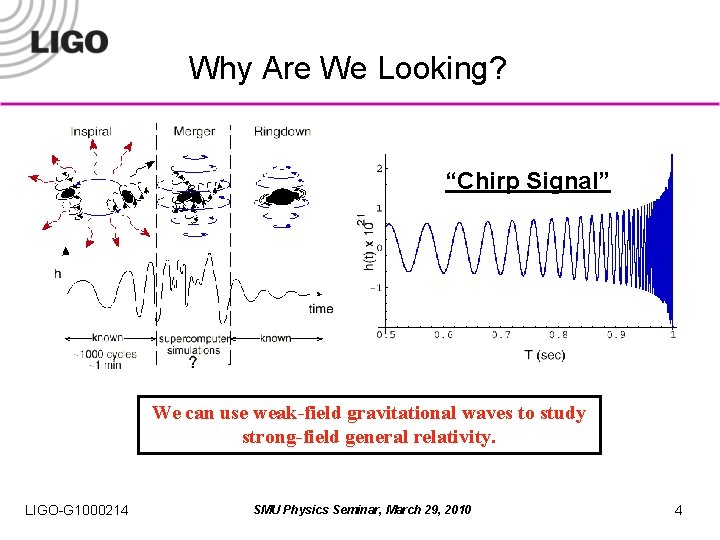
Why Are We Looking? “Chirp Signal” We can use weak-field gravitational waves to study strong-field general relativity. LIGO-G 1000214 SMU Physics Seminar, March 29, 2010 4
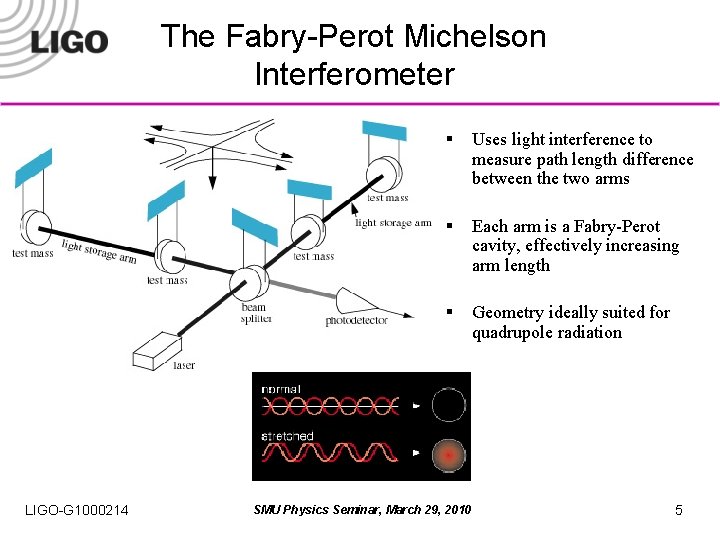
The Fabry-Perot Michelson Interferometer LIGO-G 1000214 § Uses light interference to measure path length difference between the two arms § Each arm is a Fabry-Perot cavity, effectively increasing arm length § Geometry ideally suited for quadrupole radiation SMU Physics Seminar, March 29, 2010 5
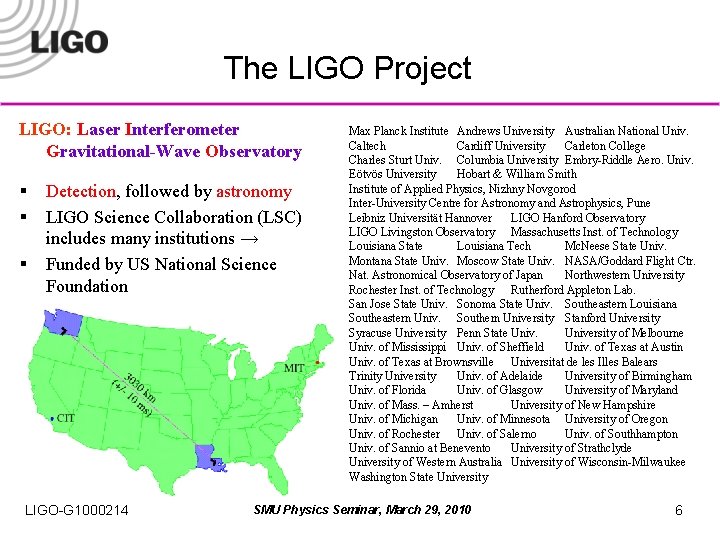
The LIGO Project LIGO: Laser Interferometer Gravitational-Wave Observatory § § § Detection, followed by astronomy LIGO Science Collaboration (LSC) includes many institutions → Funded by US National Science Foundation LIGO-G 1000214 Max Planck Institute Andrews University Australian National Univ. Caltech Cardiff University Carleton College Charles Sturt Univ. Columbia University Embry-Riddle Aero. Univ. Eӧtvӧs University Hobart & William Smith Institute of Applied Physics, Nizhny Novgorod Inter-University Centre for Astronomy and Astrophysics, Pune Leibniz Universität Hannover LIGO Hanford Observatory LIGO Livingston Observatory Massachusetts Inst. of Technology Louisiana State Louisiana Tech Mc. Neese State Univ. Montana State Univ. Moscow State Univ. NASA/Goddard Flight Ctr. Nat. Astronomical Observatory of Japan Northwestern University Rochester Inst. of Technology Rutherford Appleton Lab. San Jose State Univ. Sonoma State Univ. Southeastern Louisiana Southeastern Univ. Southern University Stanford University Syracuse University Penn State University of Melbourne Univ. of Mississippi Univ. of Sheffield Univ. of Texas at Austin Univ. of Texas at Brownsville Universitat de les Illes Balears Trinity University Univ. of Adelaide University of Birmingham Univ. of Florida Univ. of Glasgow University of Maryland Univ. of Mass. – Amherst University of New Hampshire Univ. of Michigan Univ. of Minnesota University of Oregon Univ. of Rochester Univ. of Salerno Univ. of Southhampton Univ. of Sannio at Benevento University of Strathclyde University of Western Australia University of Wisconsin-Milwaukee Washington State University SMU Physics Seminar, March 29, 2010 6
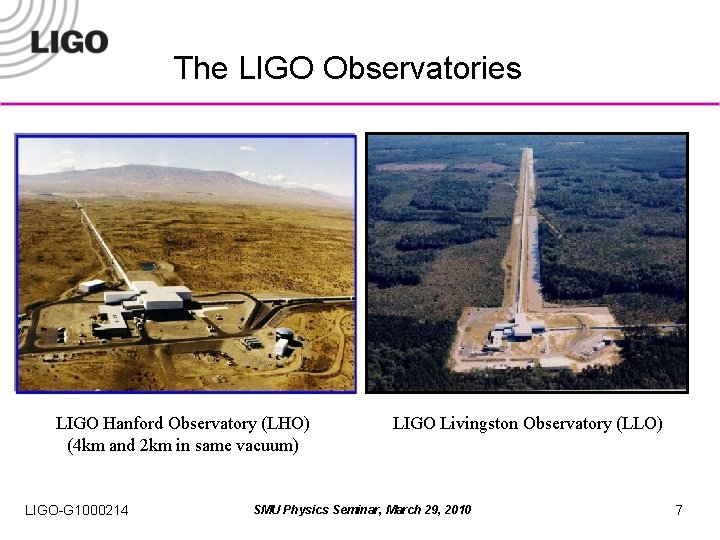
The LIGO Observatories LIGO Hanford Observatory (LHO) (4 km and 2 km in same vacuum) LIGO-G 1000214 LIGO Livingston Observatory (LLO) SMU Physics Seminar, March 29, 2010 7
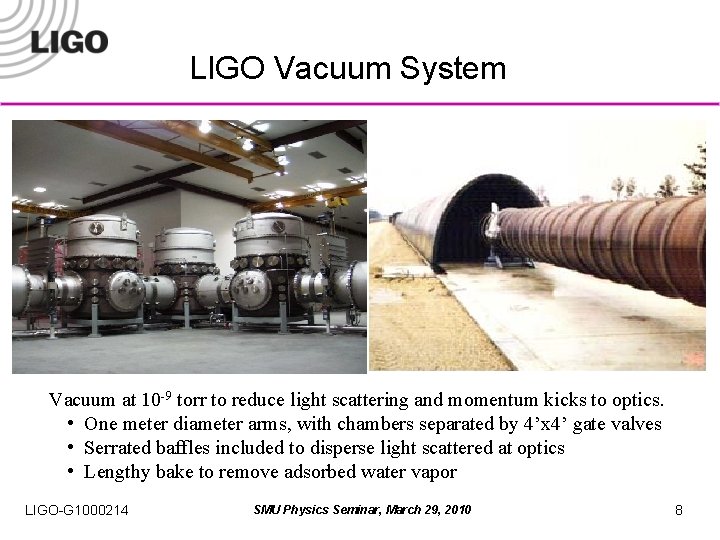
LIGO Vacuum System Vacuum at 10 -9 torr to reduce light scattering and momentum kicks to optics. • One meter diameter arms, with chambers separated by 4’x 4’ gate valves • Serrated baffles included to disperse light scattered at optics • Lengthy bake to remove adsorbed water vapor LIGO-G 1000214 SMU Physics Seminar, March 29, 2010 8
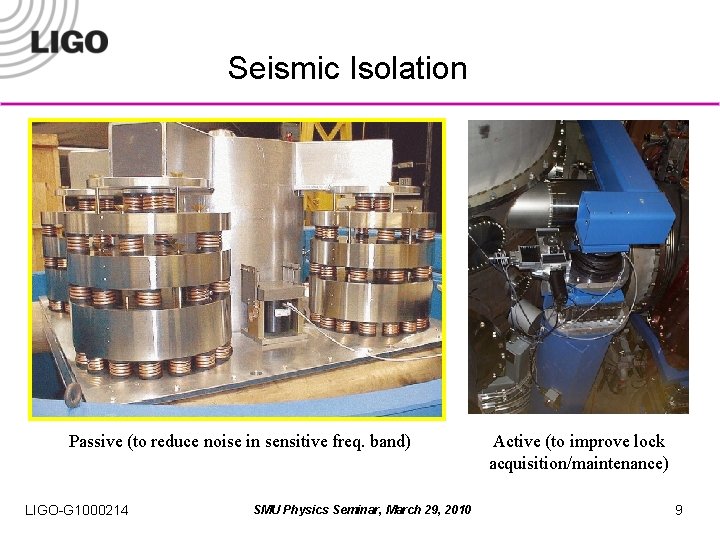
Seismic Isolation Passive (to reduce noise in sensitive freq. band) LIGO-G 1000214 SMU Physics Seminar, March 29, 2010 Active (to improve lock acquisition/maintenance) 9
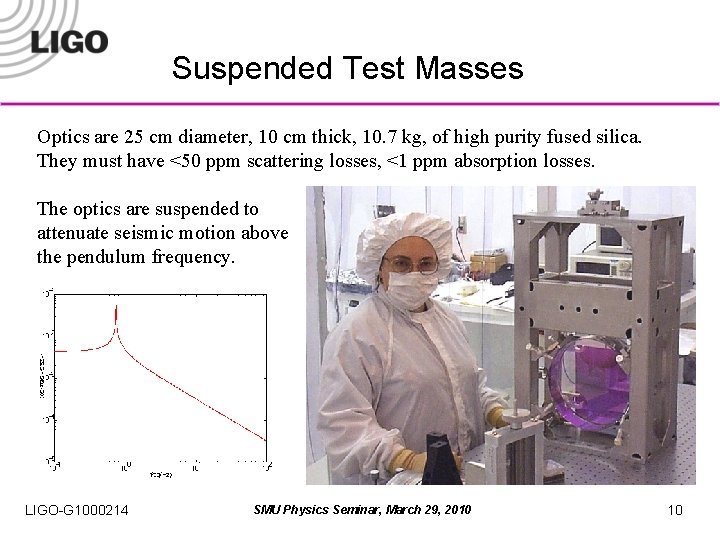
Suspended Test Masses Optics are 25 cm diameter, 10 cm thick, 10. 7 kg, of high purity fused silica. They must have <50 ppm scattering losses, <1 ppm absorption losses. The optics are suspended to attenuate seismic motion above the pendulum frequency. LIGO-G 1000214 SMU Physics Seminar, March 29, 2010 10
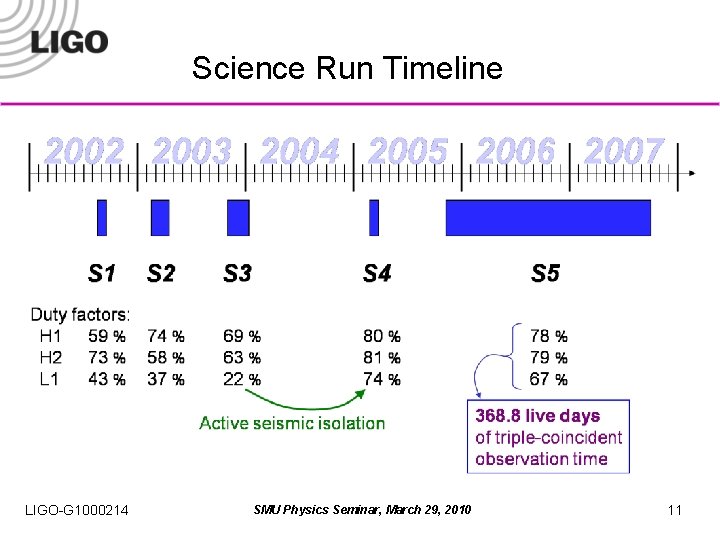
Science Run Timeline LIGO-G 1000214 SMU Physics Seminar, March 29, 2010 11
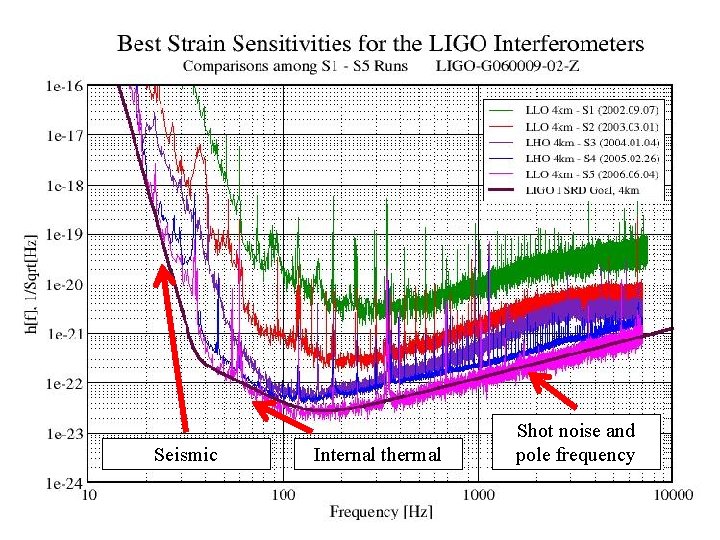
Seismic LIGO-G 1000214 Internal thermal SMU Physics Seminar, March 29, 2010 Shot noise and pole frequency 12
So Have We Detected Gravitational Waves? Nope. But the lack of detections puts interesting constraints on our universe: • The properties of certain astronomical objects • The populations of gravitational-wave sources • The total energy density of gravitational waves LIGO-G 1000214 SMU Physics Seminar, March 29, 2010 13
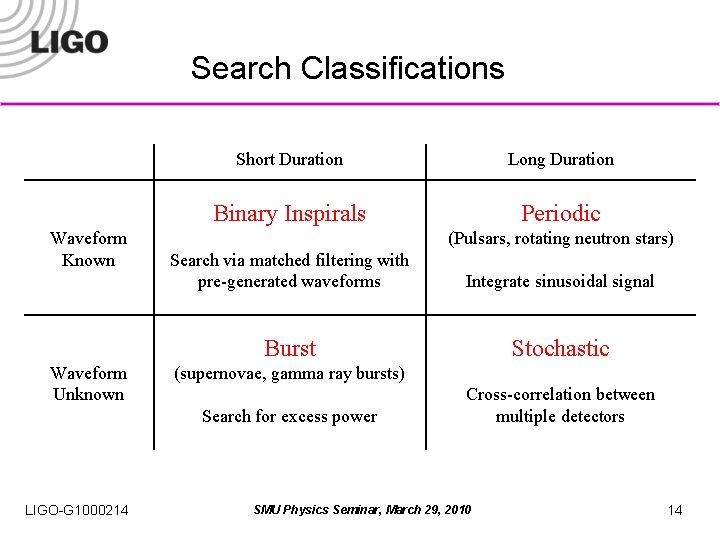
Search Classifications Waveform Known Waveform Unknown Short Duration Long Duration Binary Inspirals Periodic (Pulsars, rotating neutron stars) Search via matched filtering with pre-generated waveforms Integrate sinusoidal signal Burst Stochastic (supernovae, gamma ray bursts) Search for excess power LIGO-G 1000214 Cross-correlation between multiple detectors SMU Physics Seminar, March 29, 2010 14
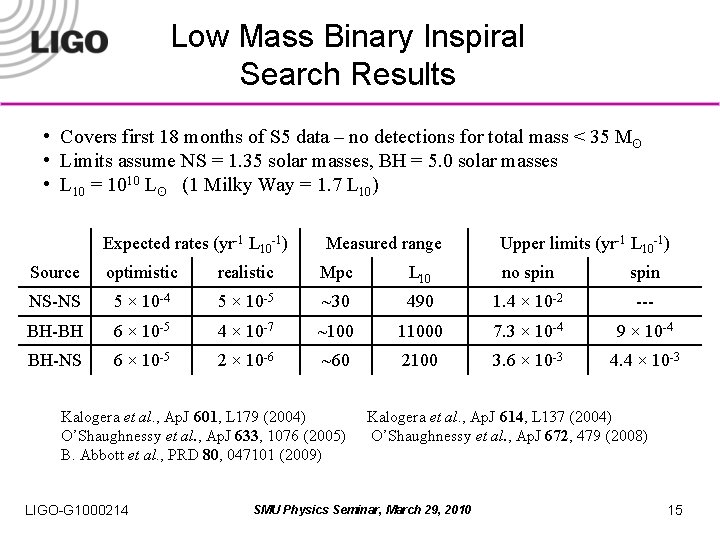
Low Mass Binary Inspiral Search Results • Covers first 18 months of S 5 data – no detections for total mass < 35 Mʘ • Limits assume NS = 1. 35 solar masses, BH = 5. 0 solar masses • L 10 = 1010 Lʘ (1 Milky Way = 1. 7 L 10) Expected rates (yr-1 L 10 -1) Measured range Upper limits (yr-1 L 10 -1) Source optimistic realistic Mpc L 10 no spin NS-NS 5 × 10 -4 5 × 10 -5 ~30 490 1. 4 × 10 -2 --- BH-BH 6 × 10 -5 4 × 10 -7 ~100 11000 7. 3 × 10 -4 9 × 10 -4 BH-NS 6 × 10 -5 2 × 10 -6 ~60 2100 3. 6 × 10 -3 4. 4 × 10 -3 Kalogera et al. , Ap. J 601, L 179 (2004) O’Shaughnessy et al. , Ap. J 633, 1076 (2005) B. Abbott et al. , PRD 80, 047101 (2009) LIGO-G 1000214 Kalogera et al. , Ap. J 614, L 137 (2004) O’Shaughnessy et al. , Ap. J 672, 479 (2008) SMU Physics Seminar, March 29, 2010 15
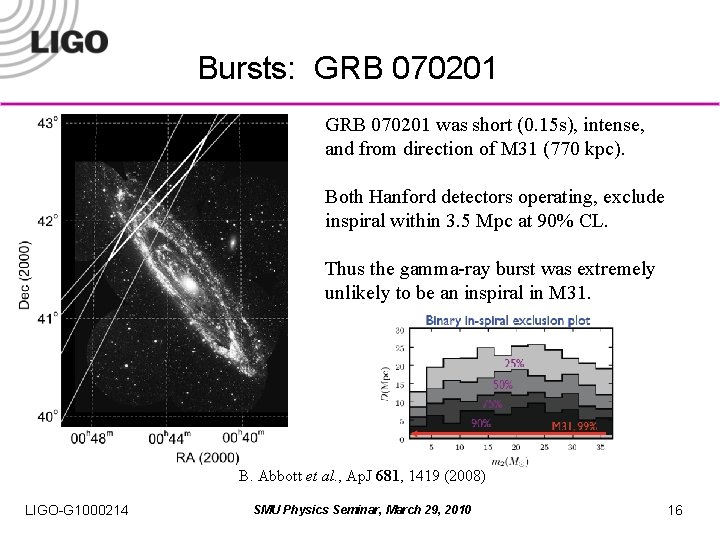
Bursts: GRB 070201 was short (0. 15 s), intense, and from direction of M 31 (770 kpc). Both Hanford detectors operating, exclude inspiral within 3. 5 Mpc at 90% CL. Thus the gamma-ray burst was extremely unlikely to be an inspiral in M 31. B. Abbott et al. , Ap. J 681, 1419 (2008) LIGO-G 1000214 SMU Physics Seminar, March 29, 2010 16
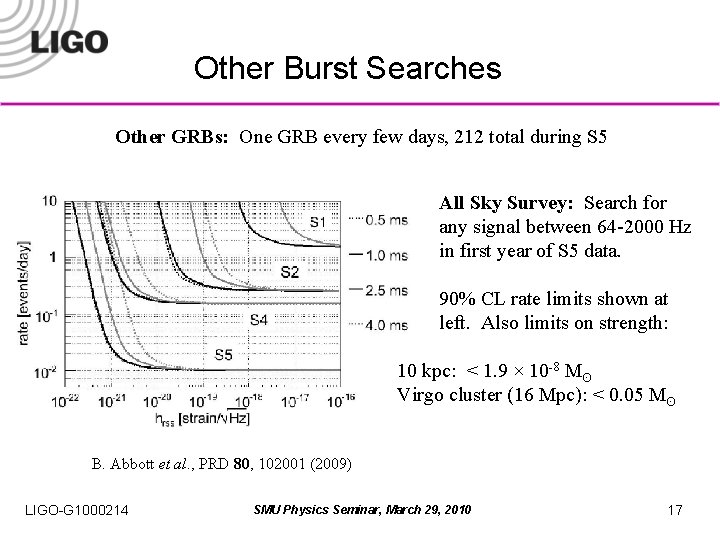
Other Burst Searches Other GRBs: One GRB every few days, 212 total during S 5 All Sky Survey: Search for any signal between 64 -2000 Hz in first year of S 5 data. 90% CL rate limits shown at left. Also limits on strength: 10 kpc: < 1. 9 × 10 -8 Mʘ Virgo cluster (16 Mpc): < 0. 05 Mʘ B. Abbott et al. , PRD 80, 102001 (2009) LIGO-G 1000214 SMU Physics Seminar, March 29, 2010 17
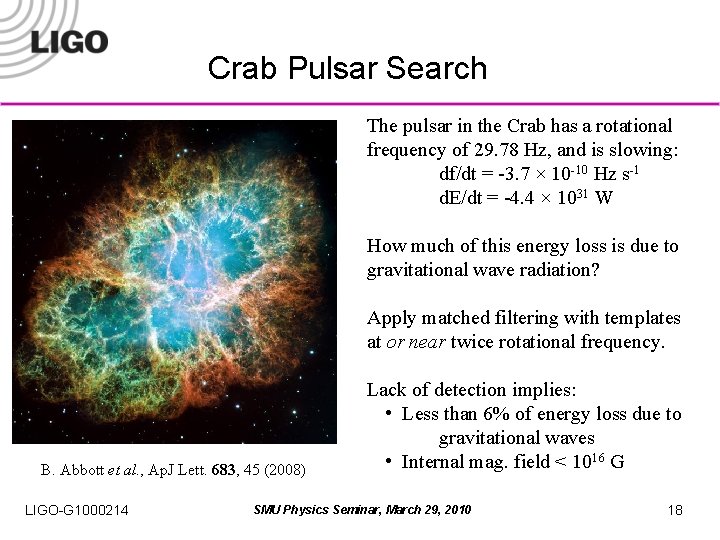
Crab Pulsar Search The pulsar in the Crab has a rotational frequency of 29. 78 Hz, and is slowing: df/dt = -3. 7 × 10 -10 Hz s-1 d. E/dt = -4. 4 × 1031 W How much of this energy loss is due to gravitational wave radiation? Apply matched filtering with templates at or near twice rotational frequency. B. Abbott et al. , Ap. J Lett. 683, 45 (2008) LIGO-G 1000214 Lack of detection implies: • Less than 6% of energy loss due to gravitational waves • Internal mag. field < 1016 G SMU Physics Seminar, March 29, 2010 18
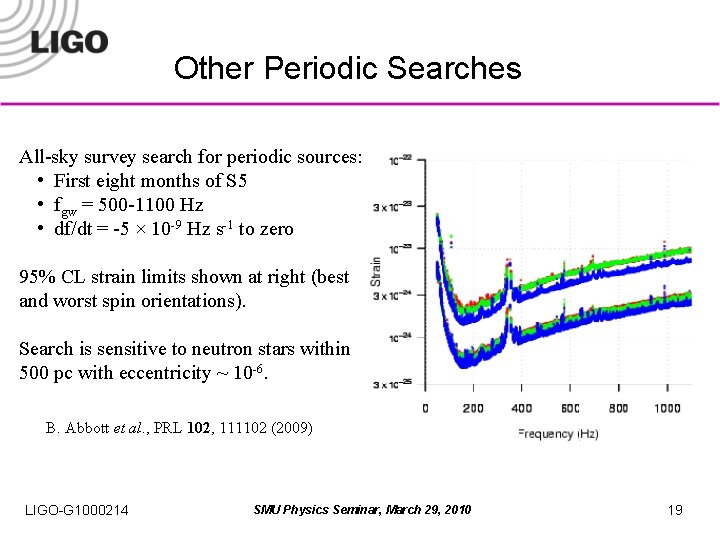
Other Periodic Searches All-sky survey search for periodic sources: • First eight months of S 5 • fgw = 500 -1100 Hz • df/dt = -5 × 10 -9 Hz s-1 to zero 95% CL strain limits shown at right (best and worst spin orientations). Search is sensitive to neutron stars within 500 pc with eccentricity ~ 10 -6. B. Abbott et al. , PRL 102, 111102 (2009) LIGO-G 1000214 SMU Physics Seminar, March 29, 2010 19
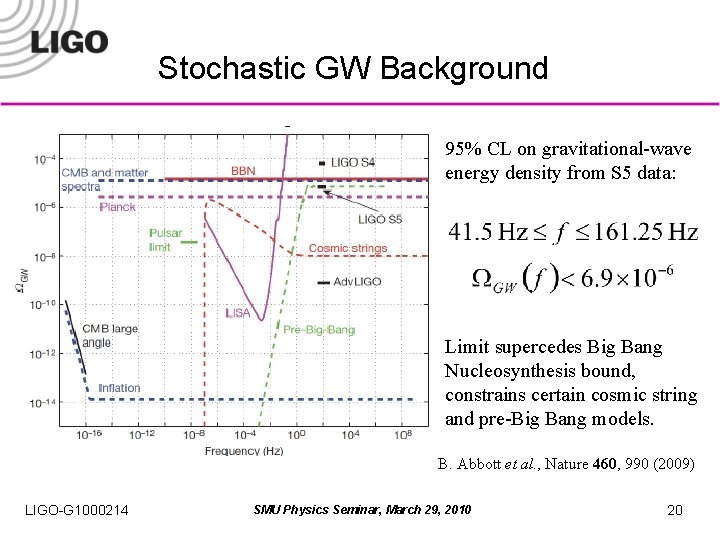
Stochastic GW Background 95% CL on gravitational-wave energy density from S 5 data: Limit supercedes Big Bang Nucleosynthesis bound, constrains certain cosmic string and pre-Big Bang models. B. Abbott et al. , Nature 460, 990 (2009) LIGO-G 1000214 SMU Physics Seminar, March 29, 2010 20
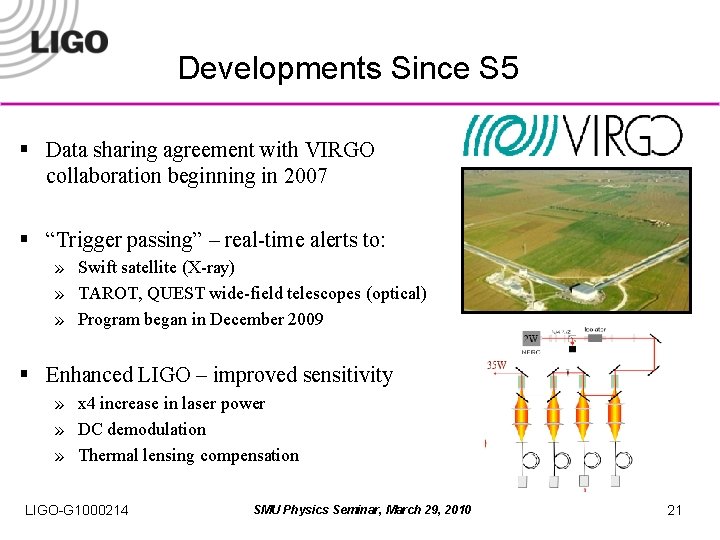
Developments Since S 5 § Data sharing agreement with VIRGO collaboration beginning in 2007 § “Trigger passing” – real-time alerts to: » Swift satellite (X-ray) » TAROT, QUEST wide-field telescopes (optical) » Program began in December 2009 § Enhanced LIGO – improved sensitivity » x 4 increase in laser power » DC demodulation » Thermal lensing compensation LIGO-G 1000214 SMU Physics Seminar, March 29, 2010 21
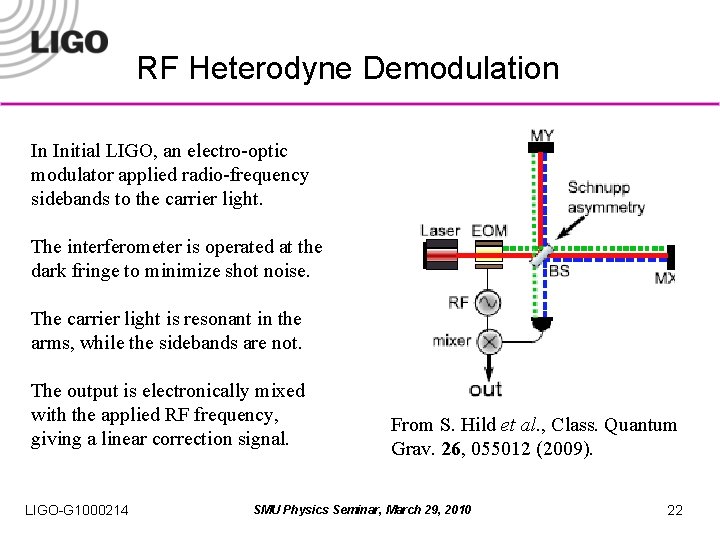
RF Heterodyne Demodulation In Initial LIGO, an electro-optic modulator applied radio-frequency sidebands to the carrier light. The interferometer is operated at the dark fringe to minimize shot noise. The carrier light is resonant in the arms, while the sidebands are not. The output is electronically mixed with the applied RF frequency, giving a linear correction signal. LIGO-G 1000214 From S. Hild et al. , Class. Quantum Grav. 26, 055012 (2009). SMU Physics Seminar, March 29, 2010 22
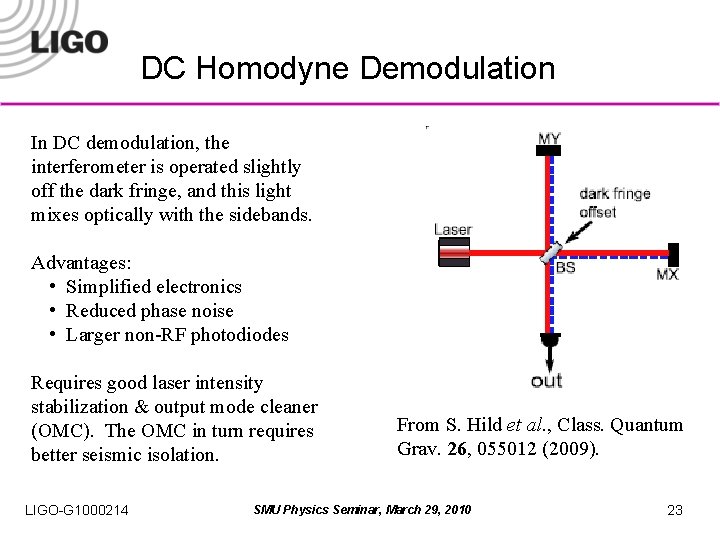
DC Homodyne Demodulation In DC demodulation, the interferometer is operated slightly off the dark fringe, and this light mixes optically with the sidebands. Advantages: • Simplified electronics • Reduced phase noise • Larger non-RF photodiodes Requires good laser intensity stabilization & output mode cleaner (OMC). The OMC in turn requires better seismic isolation. LIGO-G 1000214 From S. Hild et al. , Class. Quantum Grav. 26, 055012 (2009). SMU Physics Seminar, March 29, 2010 23
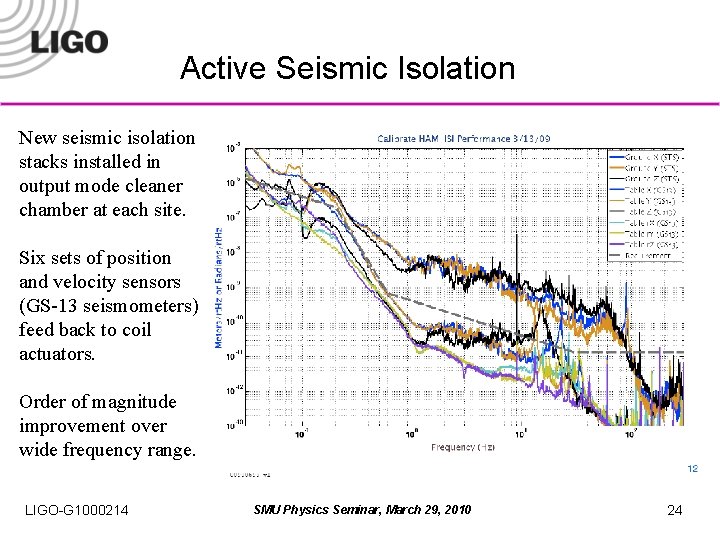
Active Seismic Isolation New seismic isolation stacks installed in output mode cleaner chamber at each site. Six sets of position and velocity sensors (GS-13 seismometers) feed back to coil actuators. Order of magnitude improvement over wide frequency range. LIGO-G 1000214 SMU Physics Seminar, March 29, 2010 24
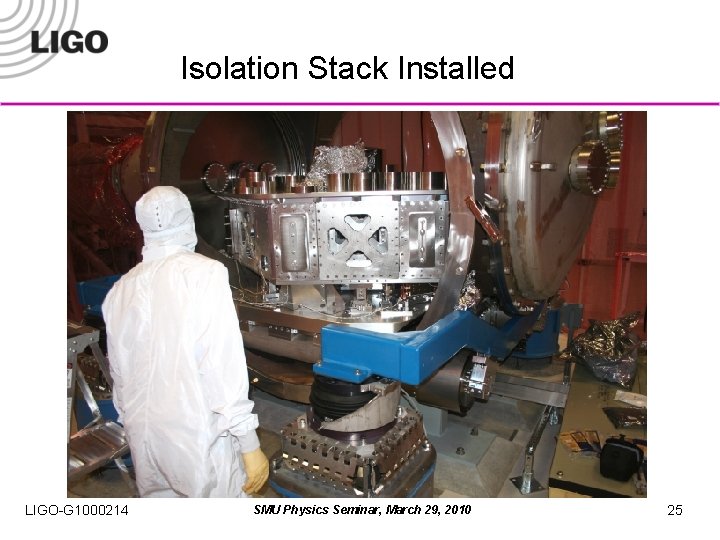
Isolation Stack Installed LIGO-G 1000214 SMU Physics Seminar, March 29, 2010 25
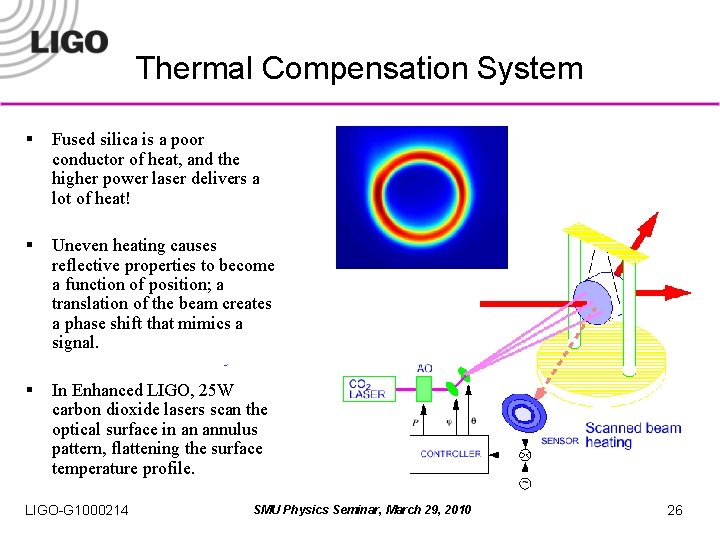
Thermal Compensation System § Fused silica is a poor conductor of heat, and the higher power laser delivers a lot of heat! § Uneven heating causes reflective properties to become a function of position; a translation of the beam creates a phase shift that mimics a signal. § In Enhanced LIGO, 25 W carbon dioxide lasers scan the optical surface in an annulus pattern, flattening the surface temperature profile. LIGO-G 1000214 SMU Physics Seminar, March 29, 2010 26
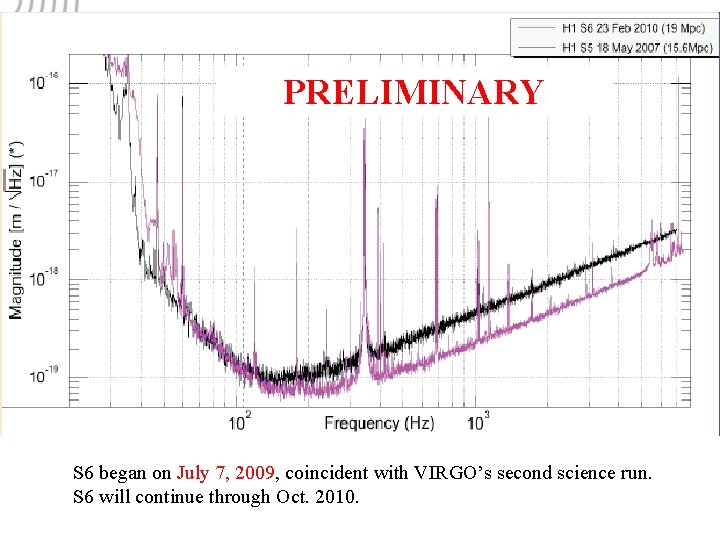
Sensitivity Improvement PRELIMINARY S 6 began on July 7, 2009, coincident with VIRGO’s second science run. S 6 will continue through Oct. 2010. LIGO-G 1000214 SMU Physics Seminar, March 29, 2010 27
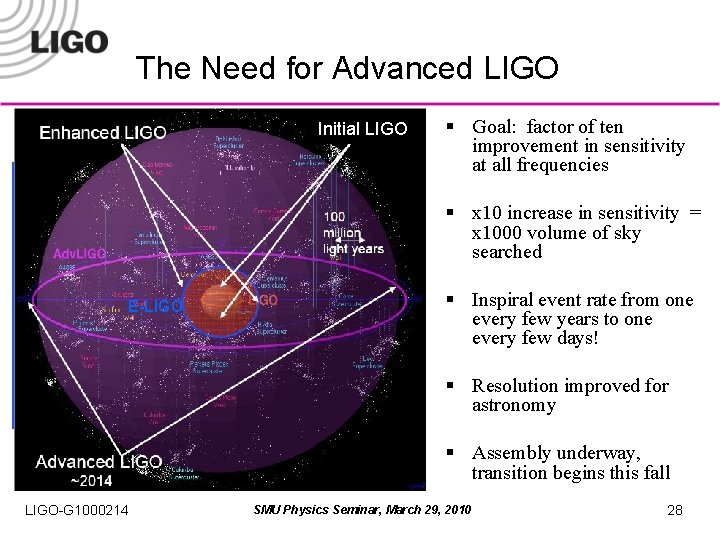
The Need for Advanced LIGO Initial LIGO § Goal: factor of ten improvement in sensitivity at all frequencies § x 10 increase in sensitivity = x 1000 volume of sky searched E-LIGO § Inspiral event rate from one every few years to one every few days! § Resolution improved for astronomy § Assembly underway, transition begins this fall LIGO-G 1000214 SMU Physics Seminar, March 29, 2010 28
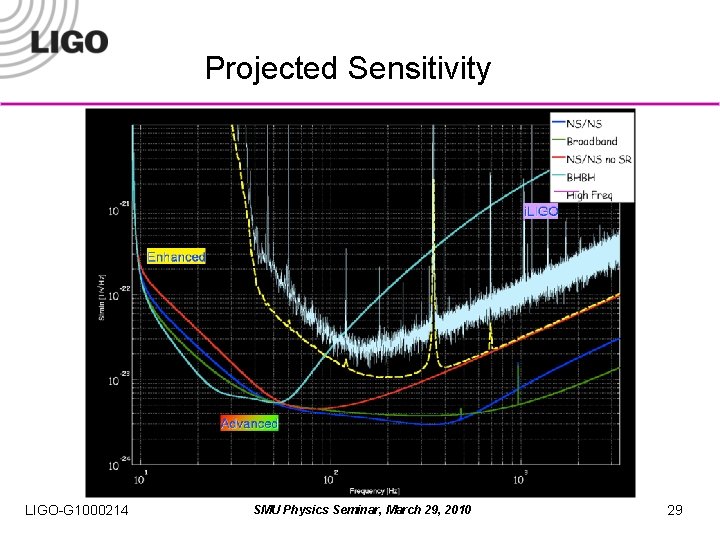
Projected Sensitivity LIGO-G 1000214 SMU Physics Seminar, March 29, 2010 29
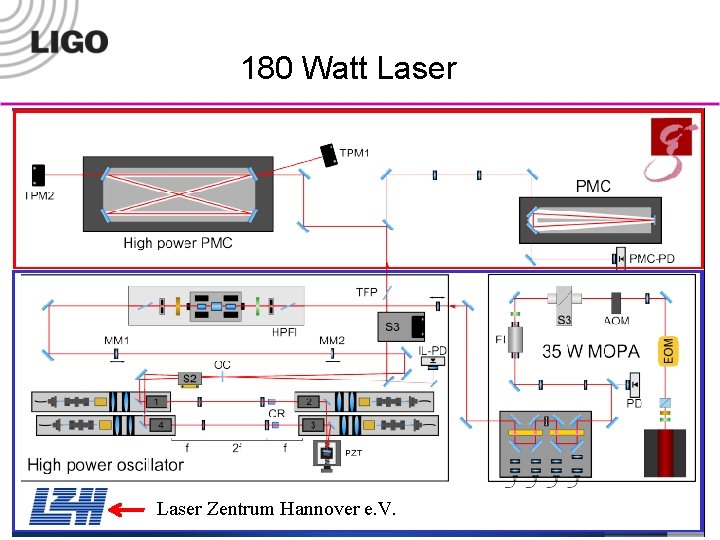
180 Watt Laser LIGO-G 1000214 SMU Hannover Physics Seminar, March 29, 2010 Laser Zentrum e. V. 30
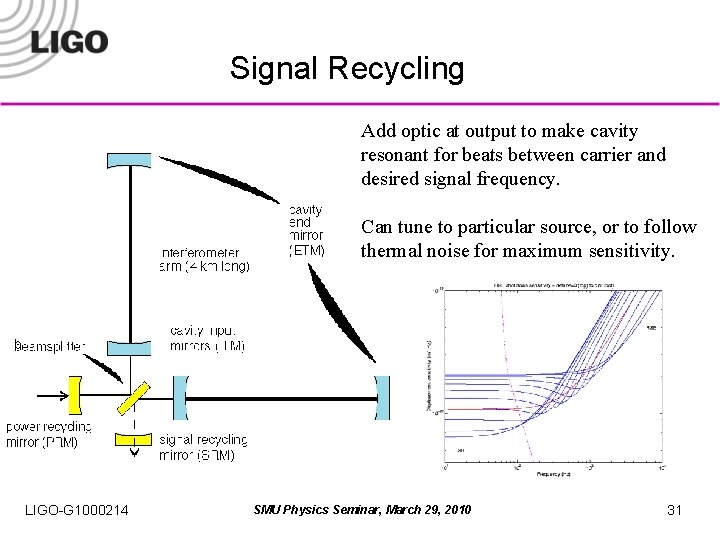
Signal Recycling Add optic at output to make cavity resonant for beats between carrier and desired signal frequency. Can tune to particular source, or to follow thermal noise for maximum sensitivity. LIGO-G 1000214 SMU Physics Seminar, March 29, 2010 31
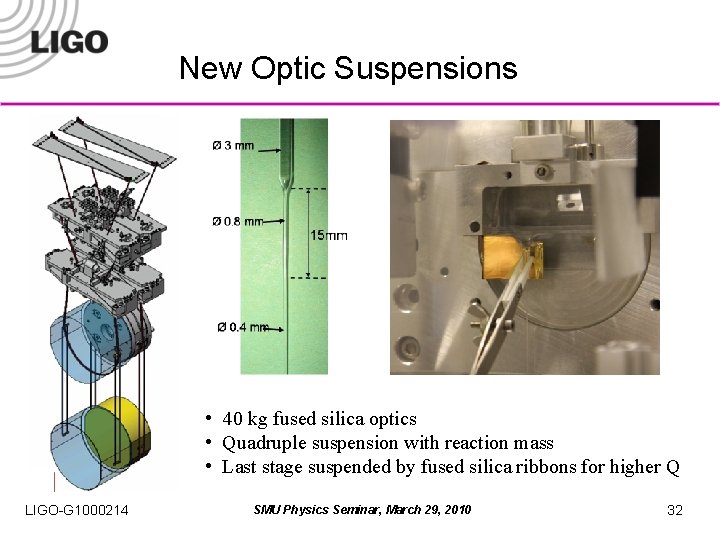
New Optic Suspensions • 40 kg fused silica optics • Quadruple suspension with reaction mass • Last stage suspended by fused silica ribbons for higher Q LIGO-G 1000214 SMU Physics Seminar, March 29, 2010 32
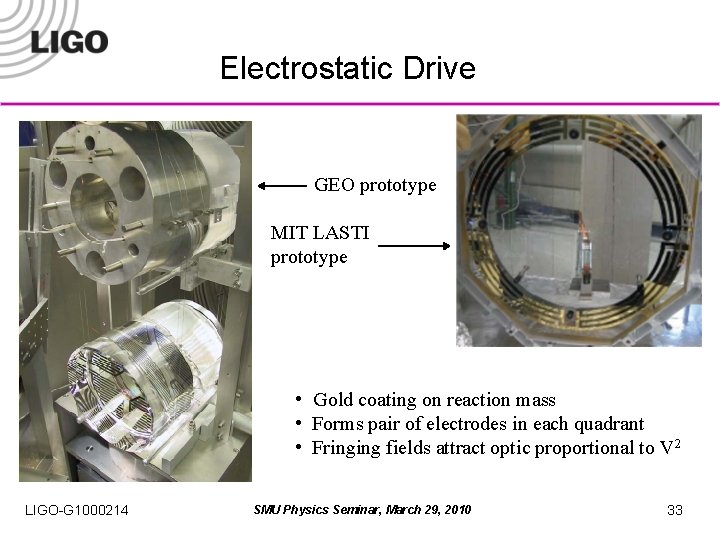
Electrostatic Drive GEO prototype MIT LASTI prototype • Gold coating on reaction mass • Forms pair of electrodes in each quadrant • Fringing fields attract optic proportional to V 2 LIGO-G 1000214 SMU Physics Seminar, March 29, 2010 33
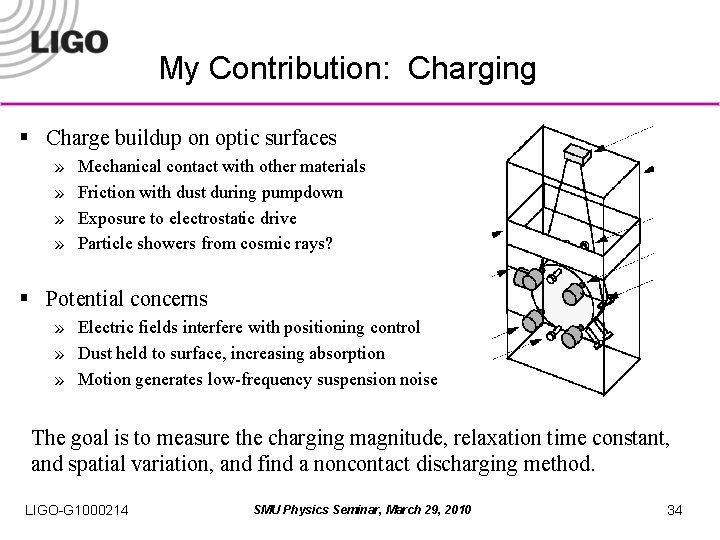
My Contribution: Charging § Charge buildup on optic surfaces » » Mechanical contact with other materials Friction with dust during pumpdown Exposure to electrostatic drive Particle showers from cosmic rays? § Potential concerns » Electric fields interfere with positioning control » Dust held to surface, increasing absorption » Motion generates low-frequency suspension noise The goal is to measure the charging magnitude, relaxation time constant, and spatial variation, and find a noncontact discharging method. LIGO-G 1000214 SMU Physics Seminar, March 29, 2010 34
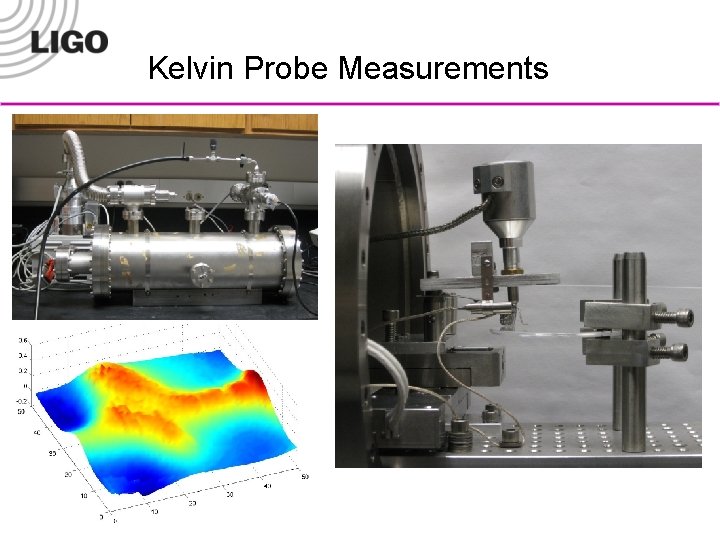
Kelvin Probe Measurements LIGO-G 1000214 SMU Physics Seminar, March 29, 2010 35
Summary § No detections yet, but results of S 5 science run have put interesting constraints on our nearest neighbors § Enhanced LIGO science run ongoing § Advanced LIGO construction already underway, aiming for sensitivity to detect GW sources with regularity by 2014 -5 LIGO-G 1000214 SMU Physics Seminar, March 29, 2010 36
- Slides: 36