
News Consumption UNDERSTANDING CONSUMER DIFFERENCES BASED ON QUANTITY
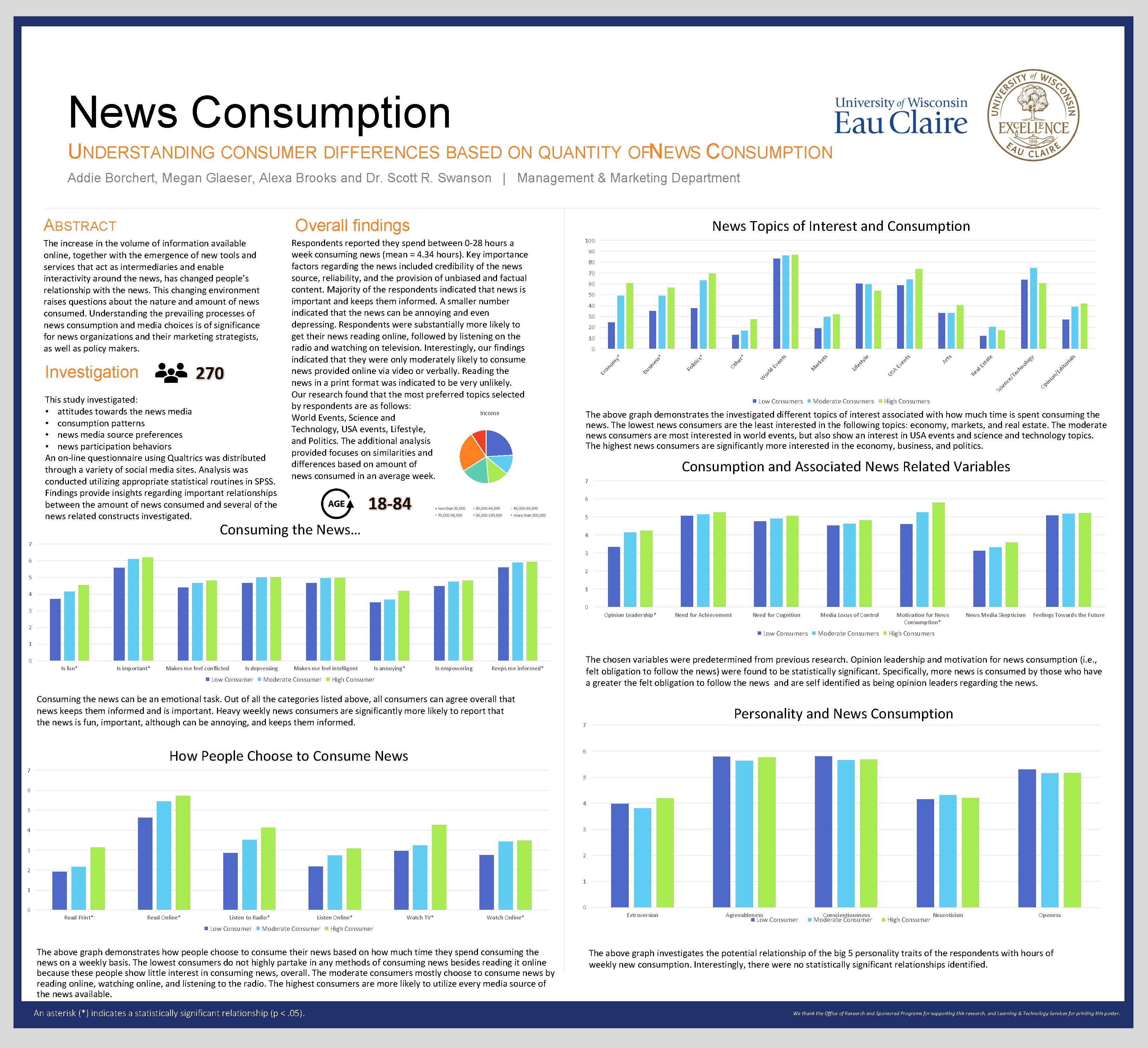
News Consumption UNDERSTANDING CONSUMER DIFFERENCES BASED ON QUANTITY OFNEWS CONSUMPTION Addie Borchert, Megan Glaeser, Alexa Brooks and Dr. Scott R. Swanson | Management & Marketing Department Overall findings This study investigated: • attitudes towards the news media • consumption patterns • news media source preferences • news participation behaviors An on-line questionnaire using Qualtrics was distributed through a variety of social media sites. Analysis was conducted utilizing appropriate statistical routines in SPSS. Findings provide insights regarding important relationships between the amount of news consumed and several of the news related constructs investigated. 18 -84 100 90 80 70 60 50 40 30 20 10 Low Consumers Moderate Consumers ls ria to di /E on in i Op Sc ie nc e/ Te c Re al hn Es ol ta og y te ts Ar en Ev US A W ts ty le Lif es ts ld M Ev ar ke en t s r* he or Po lit ics * * ss in e Bu s om y* 0 on 270 Investigation Respondents reported they spend between 0 -28 hours a week consuming news (mean = 4. 34 hours). Key importance factors regarding the news included credibility of the news source, reliability, and the provision of unbiased and factual content. Majority of the respondents indicated that news is important and keeps them informed. A smaller number indicated that the news can be annoying and even depressing. Respondents were substantially more likely to get their news reading online, followed by listening on the radio and watching on television. Interestingly, our findings indicated that they were only moderately likely to consume news provided online via video or verbally. Reading the news in a print format was indicated to be very unlikely. Our research found that the most preferred topics selected by respondents are as follows: Income World Events, Science and Technology, USA events, Lifestyle, and Politics. The additional analysis provided focuses on similarities and differences based on amount of news consumed in an average week. Ec The increase in the volume of information available online, together with the emergence of new tools and services that act as intermediaries and enable interactivity around the news, has changed people’s relationship with the news. This changing environment raises questions about the nature and amount of news consumed. Understanding the prevailing processes of news consumption and media choices is of significance for news organizations and their marketing strategists, as well as policy makers. News Topics of Interest and Consumption Ot ABSTRACT High Consumers The above graph demonstrates the investigated different topics of interest associated with how much time is spent consuming the news. The lowest news consumers are the least interested in the following topics: economy, markets, and real estate. The moderate news consumers are most interested in world events, but also show an interest in USA events and science and technology topics. The highest news consumers are significantly more interested in the economy, business, and politics. Consumption and Associated News Related Variables 7 6 less than 20, 000 -44, 999 45, 000 -69, 999 70, 000 -95, 999 96, 000 -199, 999 more than 200, 000 Consuming the News… 5 4 7 3 6 2 5 1 4 0 3 Opinion Leadership* Need for Achievement Need for Cognition 2 Low Consumers Media Locus of Control Moderate Consumers Motivation for News Consumption* News Media Skepticism Feelings Towards the Future High Consumers 1 0 Is fun* Is important* Makes me feel conflicted Is depressing Low Consumer Makes me feel intelligent Moderate Consumer Is annoying* Is empowering Keeps me informed* High Consumer Consuming the news can be an emotional task. Out of all the categories listed above, all consumers can agree overall that news keeps them informed and is important. Heavy weekly news consumers are significantly more likely to report that the news is fun, important, although can be annoying, and keeps them informed. How People Choose to Consume News The chosen variables were predetermined from previous research. Opinion leadership and motivation for news consumption (i. e. , felt obligation to follow the news) were found to be statistically significant. Specifically, more news is consumed by those who have a greater the felt obligation to follow the news and are self identified as being opinion leaders regarding the news. Personality and News Consumption 7 6 7 5 6 4 5 3 4 3 2 2 1 1 0 0 Read Print* Read Online* Listen to Radio* Low Consumer Listen Online* Moderate Consumer Watch TV* Watch Online* Agreeableness Low Consumer Conscientiousness Moderate Consumer High Consumer Neuroticism Openess High Consumer The above graph demonstrates how people choose to consume their news based on how much time they spend consuming the news on a weekly basis. The lowest consumers do not highly partake in any methods of consuming news besides reading it online because these people show little interest in consuming news, overall. The moderate consumers mostly choose to consume news by reading online, watching online, and listening to the radio. The highest consumers are more likely to utilize every media source of the news available. An asterisk (*) indicates a statistically significant relationship (p <. 05). Extroversion The above graph investigates the potential relationship of the big 5 personality traits of the respondents with hours of weekly new consumption. Interestingly, there were no statistically significant relationships identified. We thank the Office of Research and Sponsored Programs for supporting this research, and Learning & Technology Services for printing this poster.
- Slides: 1