
Newmarks Translation Theory of Semantic Communicative Translation q

- Slides: 6
Ø Newmark’s Translation Theory of Semantic & Communicative Translation q The present lecture will address the following questions: ü Who is Peter Newmark & what are his contribution(s) regarding the translation theory? ü What is Newmark’s concept of translation? ü What is communicative translation? ? ü What is semantic translation? ü Are there any criticisms leveled against Newmark’s theory?
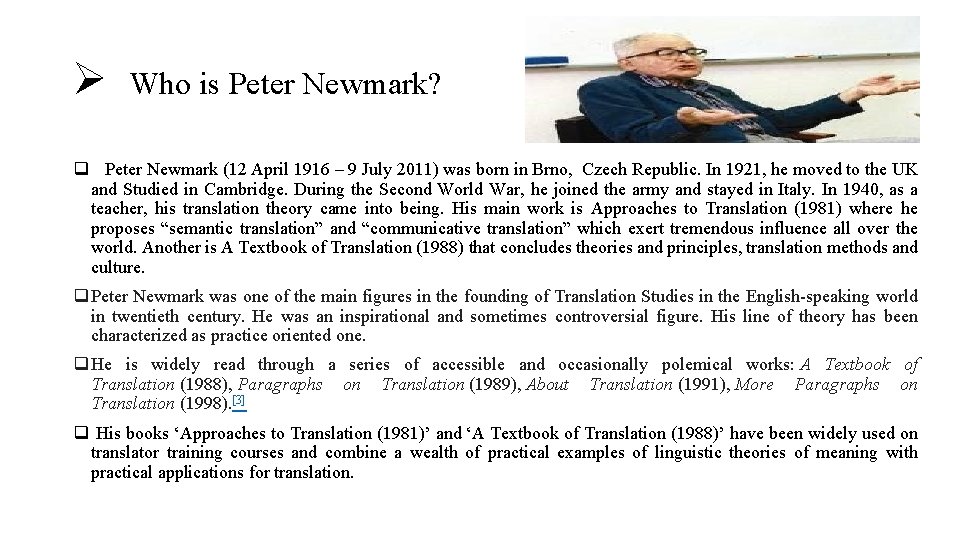
Ø Who is Peter Newmark? q Peter Newmark (12 April 1916 – 9 July 2011) was born in Brno, Czech Republic. In 1921, he moved to the UK and Studied in Cambridge. During the Second World War, he joined the army and stayed in Italy. In 1940, as a teacher, his translation theory came into being. His main work is Approaches to Translation (1981) where he proposes “semantic translation” and “communicative translation” which exert tremendous influence all over the world. Another is A Textbook of Translation (1988) that concludes theories and principles, translation methods and culture. q Peter Newmark was one of the main figures in the founding of Translation Studies in the English-speaking world in twentieth century. He was an inspirational and sometimes controversial figure. His line of theory has been characterized as practice oriented one. q He is widely read through a series of accessible and occasionally polemical works: A Textbook of Translation (1988), Paragraphs on Translation (1989), About Translation (1991), More Paragraphs on Translation (1998). [3] q His books ‘Approaches to Translation (1981)’ and ‘A Textbook of Translation (1988)’ have been widely used on translator training courses and combine a wealth of practical examples of linguistic theories of meaning with practical applications for translation.
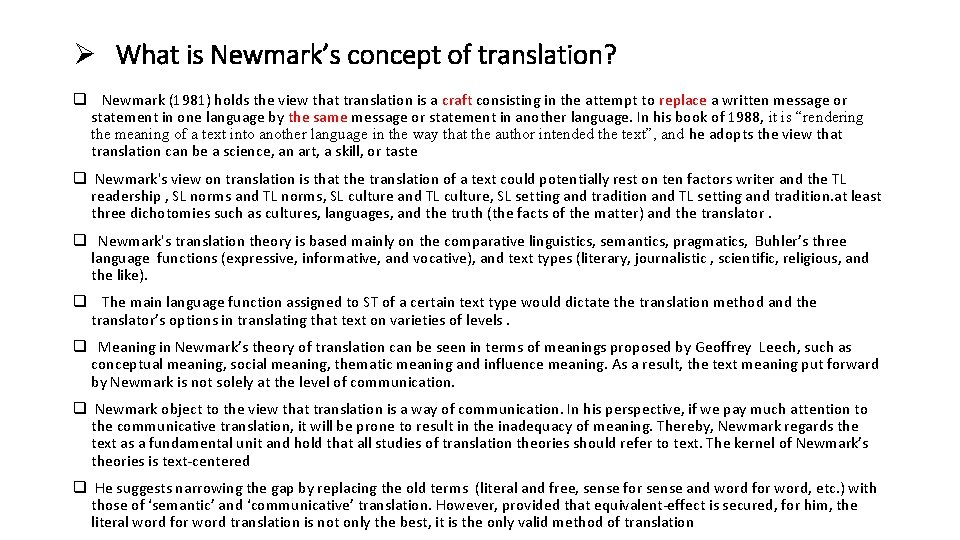
Ø What is Newmark’s concept of translation? q Newmark (1981) holds the view that translation is a craft consisting in the attempt to replace a written message or statement in one language by the same message or statement in another language. In his book of 1988, it is “rendering the meaning of a text into another language in the way that the author intended the text”, and he adopts the view that translation can be a science, an art, a skill, or taste q Newmark's view on translation is that the translation of a text could potentially rest on ten factors writer and the TL readership , SL norms and TL norms, SL culture and TL culture, SL setting and tradition and TL setting and tradition. at least three dichotomies such as cultures, languages, and the truth (the facts of the matter) and the translator. q Newmark's translation theory is based mainly on the comparative linguistics, semantics, pragmatics, Buhler’s three language functions (expressive, informative, and vocative), and text types (literary, journalistic , scientific, religious, and the like). q The main language function assigned to ST of a certain text type would dictate the translation method and the translator’s options in translating that text on varieties of levels. q Meaning in Newmark’s theory of translation can be seen in terms of meanings proposed by Geoffrey Leech, such as conceptual meaning, social meaning, thematic meaning and influence meaning. As a result, the text meaning put forward by Newmark is not solely at the level of communication. q Newmark object to the view that translation is a way of communication. In his perspective, if we pay much attention to the communicative translation, it will be prone to result in the inadequacy of meaning. Thereby, Newmark regards the text as a fundamental unit and hold that all studies of translation theories should refer to text. The kernel of Newmark’s theories is text-centered q He suggests narrowing the gap by replacing the old terms (literal and free, sense for sense and word for word, etc. ) with those of ‘semantic’ and ‘communicative’ translation. However, provided that equivalent-effect is secured, for him, the literal word for word translation is not only the best, it is the only valid method of translation
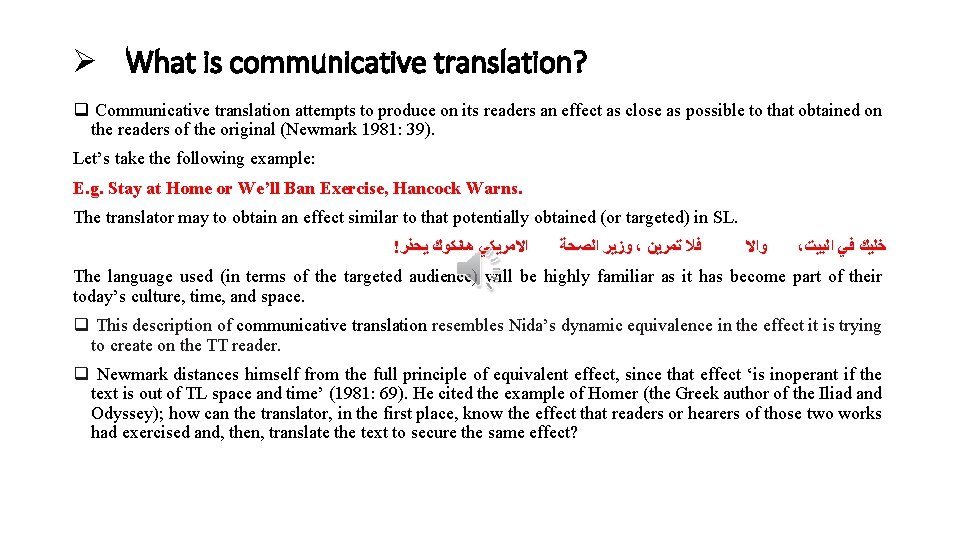
Ø What is communicative translation? q Communicative translation attempts to produce on its readers an effect as close as possible to that obtained on the readers of the original (Newmark 1981: 39). Let’s take the following example: E. g. Stay at Home or We’ll Ban Exercise, Hancock Warns. The translator may to obtain an effect similar to that potentially obtained (or targeted) in SL. ! ﺍﻻﻣﺮﻳﻜﻲ ﻫﺎﻧﻜﻮﻙ ﻳﺤﺬﺭ ﻭﺯﻳﺮ ﺍﻟﺼﺤﺔ ، ﻓﻼ ﺗﻤﺮﻳﻦ ﻭﺍﻻ ، ﺧﻠﻴﻚ ﻓﻲ ﺍﻟﺒﻴﺖ The language used (in terms of the targeted audience) will be highly familiar as it has become part of their today’s culture, time, and space. q This description of communicative translation resembles Nida’s dynamic equivalence in the effect it is trying to create on the TT reader. q Newmark distances himself from the full principle of equivalent effect, since that effect ‘is inoperant if the text is out of TL space and time’ (1981: 69). He cited the example of Homer (the Greek author of the Iliad and Odyssey); how can the translator, in the first place, know the effect that readers or hearers of those two works had exercised and, then, translate the text to secure the same effect?
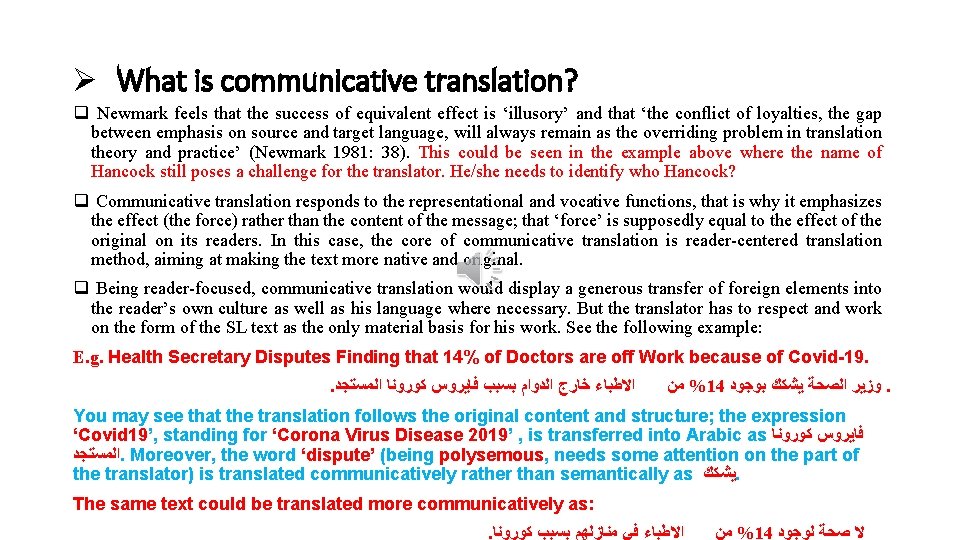
Ø What is communicative translation? q Newmark feels that the success of equivalent effect is ‘illusory’ and that ‘the conflict of loyalties, the gap between emphasis on source and target language, will always remain as the overriding problem in translation theory and practice’ (Newmark 1981: 38). This could be seen in the example above where the name of Hancock still poses a challenge for the translator. He/she needs to identify who Hancock? q Communicative translation responds to the representational and vocative functions, that is why it emphasizes the effect (the force) rather than the content of the message; that ‘force’ is supposedly equal to the effect of the original on its readers. In this case, the core of communicative translation is reader-centered translation method, aiming at making the text more native and original. q Being reader-focused, communicative translation would display a generous transfer of foreign elements into the reader’s own culture as well as his language where necessary. But the translator has to respect and work on the form of the SL text as the only material basis for his work. See the following example: E. g. Health Secretary Disputes Finding that 14% of Doctors are off Work because of Covid-19. . ﺍﻻﻃﺒﺎﺀ ﺧﺎﺭﺝ ﺍﻟﺪﻭﺍﻡ ﺑﺴﺒﺐ ﻓﺎﻳﺮﻭﺱ ﻛﻮﺭﻭﻧﺎ ﺍﻟﻤﺴﺘﺠﺪ ﻣﻦ %14 ﻭﺯﻳﺮ ﺍﻟﺼﺤﺔ ﻳﺸﻜﻚ ﺑﻮﺟﻮﺩ. You may see that the translation follows the original content and structure; the expression ‘Covid 19’, standing for ‘Corona Virus Disease 2019’ , is transferred into Arabic as ﻓﺎﻳﺮﻭﺱ ﻛﻮﺭﻭﻧﺎ ﺍﻟﻤﺴﺘﺠﺪ. Moreover, the word ‘dispute’ (being polysemous, needs some attention on the part of the translator) is translated communicatively rather than semantically as ﻳﺸﻜﻚ. The same text could be translated more communicatively as: . ﺍﻻﻃﺒﺎﺀ ﻓﻲ ﻣﻨﺎﺯﻟﻬﻢ ﺑﺴﺒﺐ ﻛﻮﺭﻭﻧﺎ ﻣﻦ %14 ﻻ ﺻﺤﺔ ﻟﻮﺟﻮﺩ
Thank You & Good Luck