
Newcomers and the settlement process Why Are People
- Slides: 15
Newcomers and the settlement process
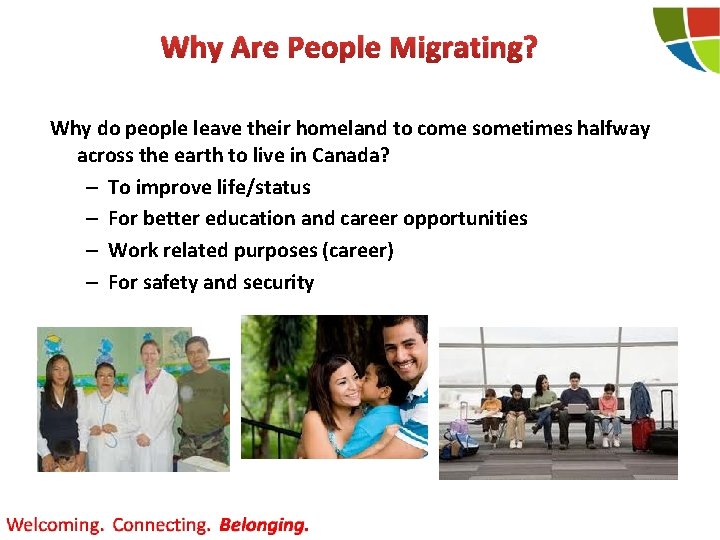
Why Are People Migrating? Why do people leave their homeland to come sometimes halfway across the earth to live in Canada? – To improve life/status – For better education and career opportunities – Work related purposes (career) – For safety and security
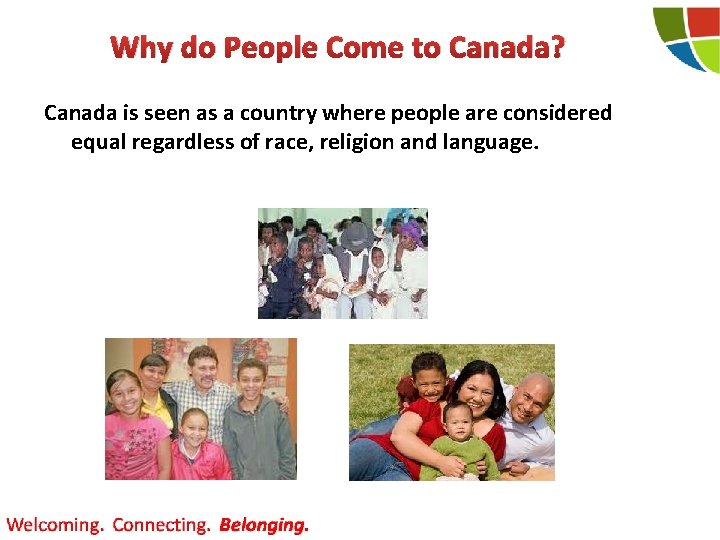
Why do People Come to Canada? Canada is seen as a country where people are considered equal regardless of race, religion and language.
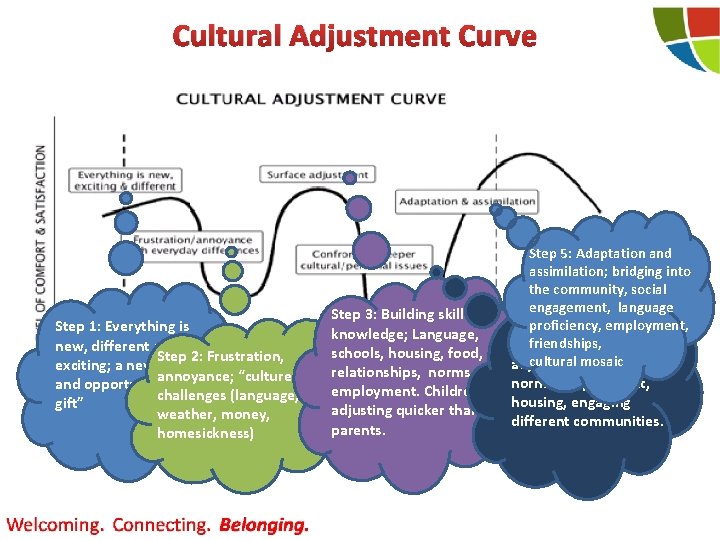
Cultural Adjustment Curve Step 5: Adaptation and assimilation; bridging into the community, social engagement, language Step 3: Building skills and proficiency, employment, knowledge; Language, friendships, Step 4: Cultural schools, housing, food, cultural mosaic adjustments, social Step 1: Everything is new, different and Step 2: Frustration, exciting; a new chance relationships, norms, annoyance; “culture shock”; norms, employment, and opportunity; “a challenges (language, food, employment. Children oftenhousing, engaging gift” adjusting quicker than weather, money, different communities. parents. homesickness)
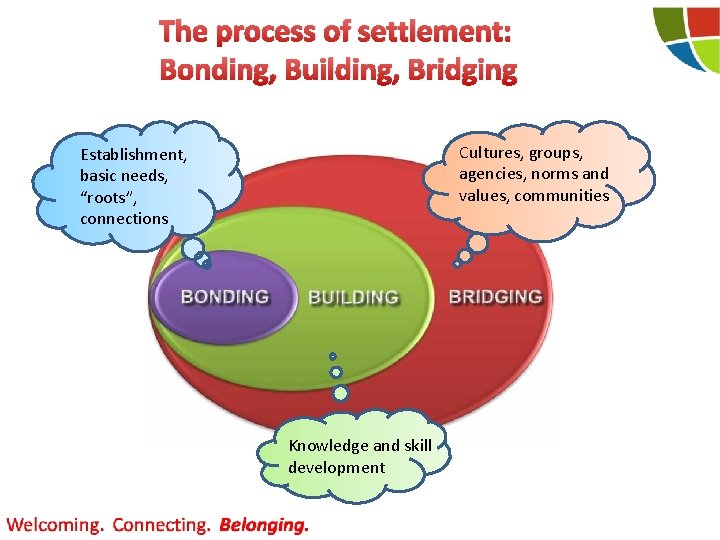
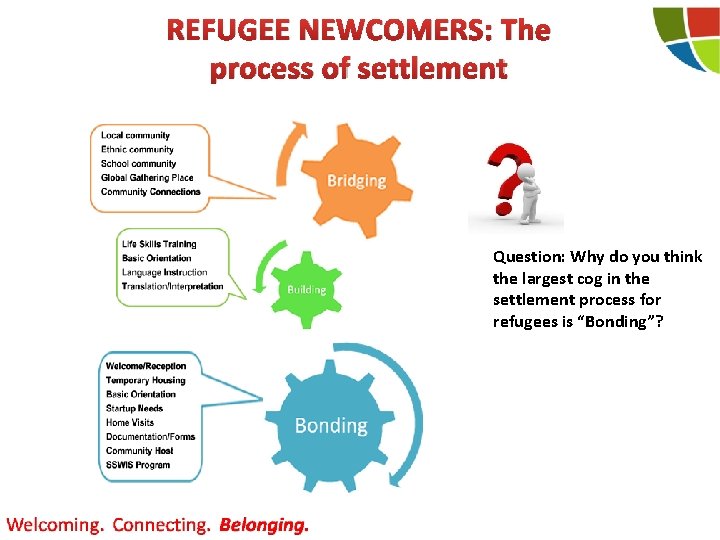
The process of settlement: Bonding, Building, Bridging Cultures, groups, agencies, norms and values, communities Establishment, basic needs, “roots”, connections Knowledge and skill development
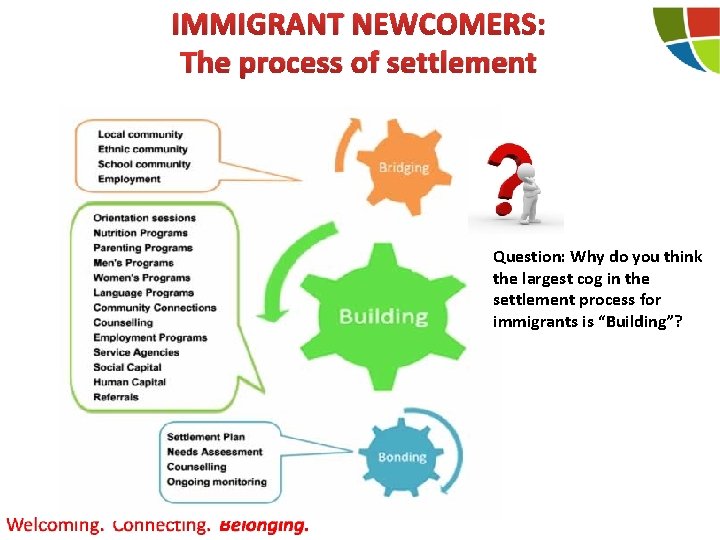
IMMIGRANT NEWCOMERS: The process of settlement Question: Why do you think the largest cog in the settlement process for immigrants is “Building”?
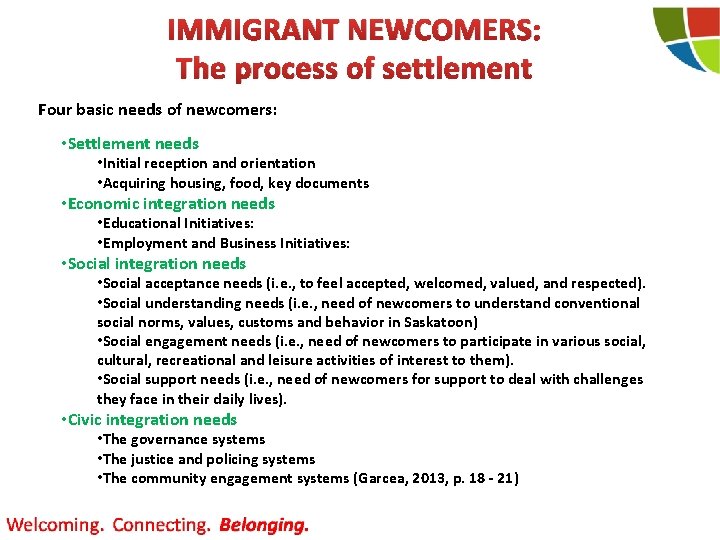
IMMIGRANT NEWCOMERS: The process of settlement Four basic needs of newcomers: • Settlement needs • Initial reception and orientation • Acquiring housing, food, key documents • Economic integration needs • Educational Initiatives: • Employment and Business Initiatives: • Social integration needs • Social acceptance needs (i. e. , to feel accepted, welcomed, valued, and respected). • Social understanding needs (i. e. , need of newcomers to understand conventional social norms, values, customs and behavior in Saskatoon) • Social engagement needs (i. e. , need of newcomers to participate in various social, cultural, recreational and leisure activities of interest to them). • Social support needs (i. e. , need of newcomers for support to deal with challenges they face in their daily lives). • Civic integration needs • The governance systems • The justice and policing systems • The community engagement systems (Garcea, 2013, p. 18 - 21)
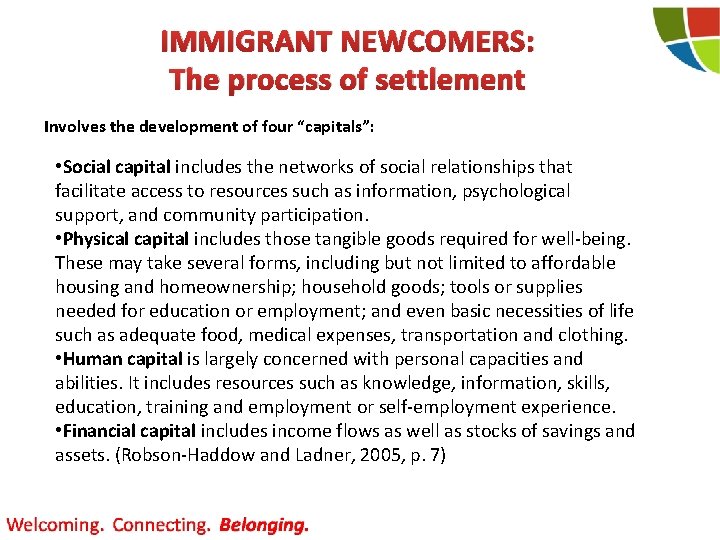
IMMIGRANT NEWCOMERS: The process of settlement Involves the development of four “capitals”: • Social capital includes the networks of social relationships that facilitate access to resources such as information, psychological support, and community participation. • Physical capital includes those tangible goods required for well-being. These may take several forms, including but not limited to affordable housing and homeownership; household goods; tools or supplies needed for education or employment; and even basic necessities of life such as adequate food, medical expenses, transportation and clothing. • Human capital is largely concerned with personal capacities and abilities. It includes resources such as knowledge, information, skills, education, training and employment or self-employment experience. • Financial capital includes income flows as well as stocks of savings and assets. (Robson-Haddow and Ladner, 2005, p. 7)
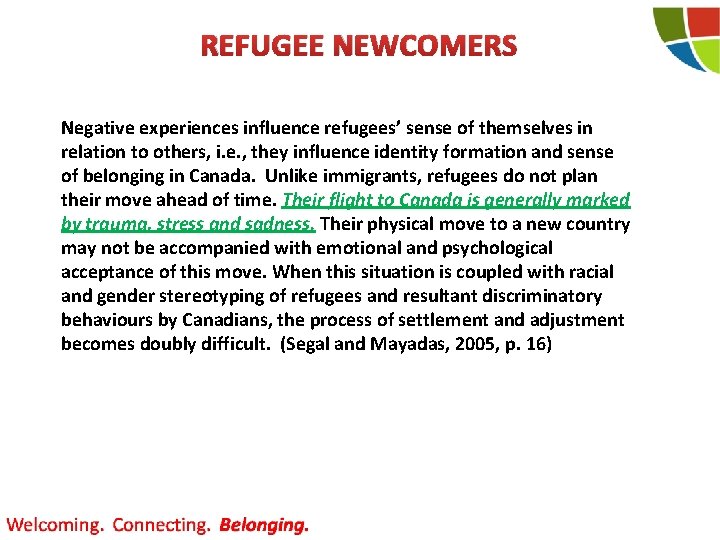
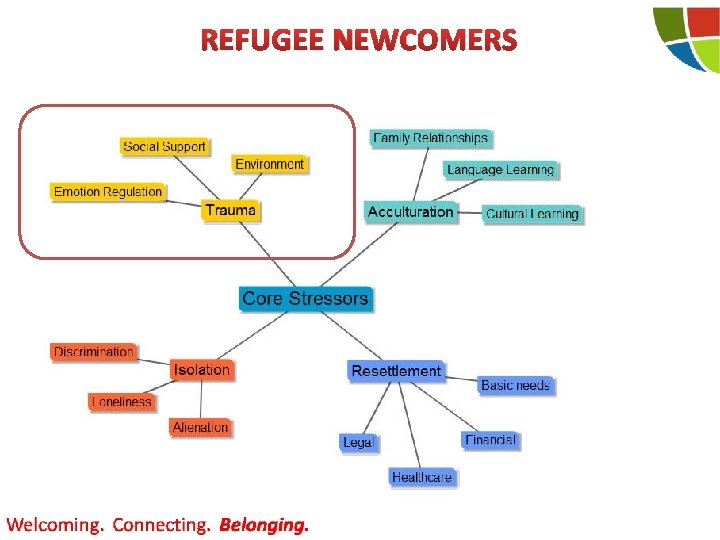
REFUGEE NEWCOMERS Negative experiences influence refugees’ sense of themselves in relation to others, i. e. , they influence identity formation and sense of belonging in Canada. Unlike immigrants, refugees do not plan their move ahead of time. Their flight to Canada is generally marked by trauma, stress and sadness. Their physical move to a new country may not be accompanied with emotional and psychological acceptance of this move. When this situation is coupled with racial and gender stereotyping of refugees and resultant discriminatory behaviours by Canadians, the process of settlement and adjustment becomes doubly difficult. (Segal and Mayadas, 2005, p. 16)
REFUGEE NEWCOMERS
REFUGEE NEWCOMERS: The process of settlement Question: Why do you think the largest cog in the settlement process for refugees is “Bonding”?
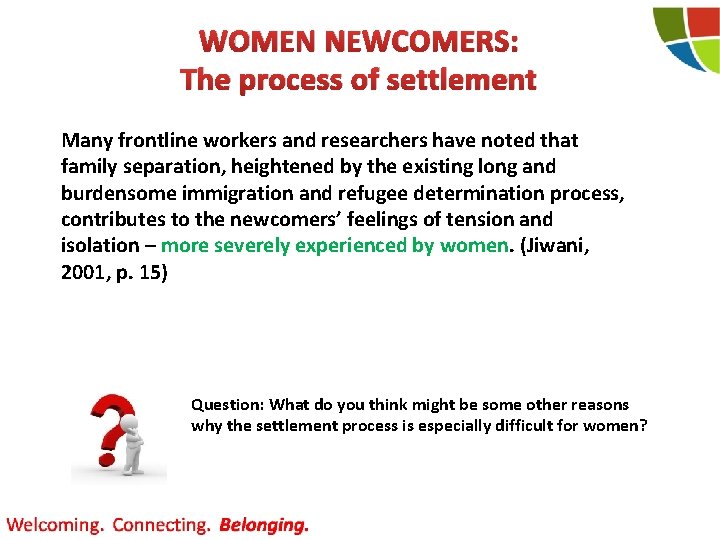
WOMEN NEWCOMERS: The process of settlement Many frontline workers and researchers have noted that family separation, heightened by the existing long and burdensome immigration and refugee determination process, contributes to the newcomers’ feelings of tension and isolation – more severely experienced by women. (Jiwani, 2001, p. 15) Question: What do you think might be some other reasons why the settlement process is especially difficult for women?
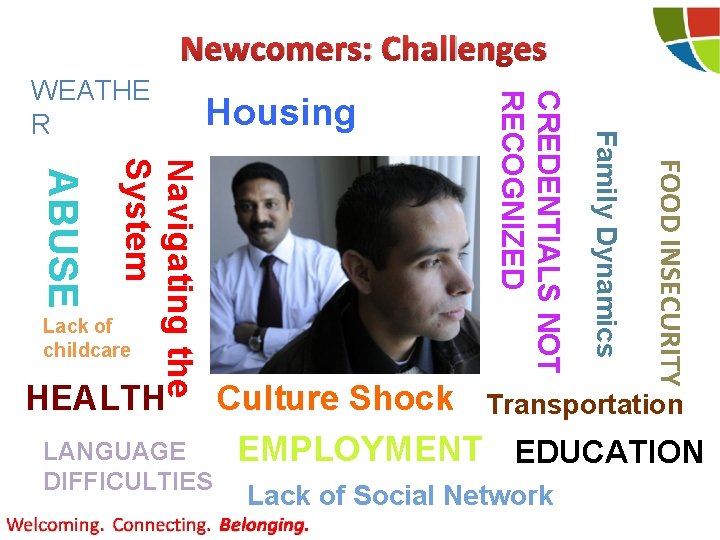
Newcomers: Challenges HEALTH LANGUAGE DIFFICULTIES FOOD INSECURITY Navigating the System ABUSE Lack of childcare Family Dynamics Housing CREDENTIALS NOT RECOGNIZED WEATHE R Culture Shock Transportation EMPLOYMENT EDUCATION Lack of Social Network
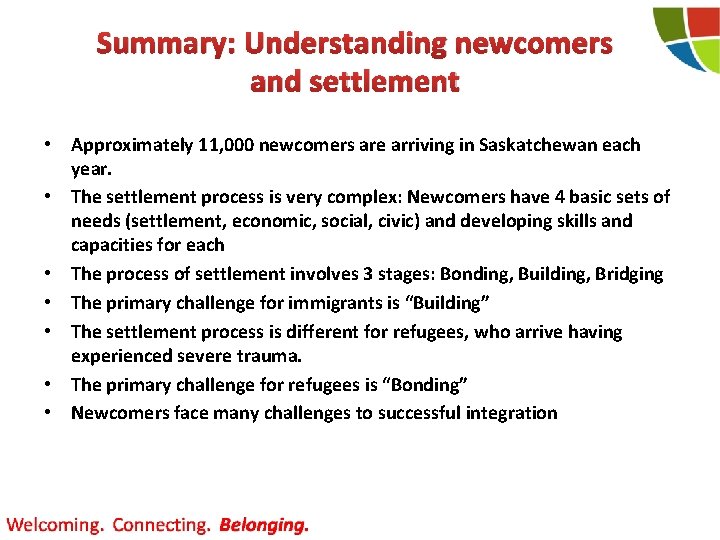
Summary: Understanding newcomers and settlement • Approximately 11, 000 newcomers are arriving in Saskatchewan each year. • The settlement process is very complex: Newcomers have 4 basic sets of needs (settlement, economic, social, civic) and developing skills and capacities for each • The process of settlement involves 3 stages: Bonding, Building, Bridging • The primary challenge for immigrants is “Building” • The settlement process is different for refugees, who arrive having experienced severe trauma. • The primary challenge for refugees is “Bonding” • Newcomers face many challenges to successful integration
Understanding Newcomers and Settlement: Questions/Comments § What have you learned about newcomers and settlement? § What was the biggest surprise? § What difference will understanding more about newcomers and settlement make in your work life? § What difference will understanding more about newcomers and settlement make in your relationships with other people? § What difference will understanding more about newcomers and settlement make in your relationships with newcomers?