
New Zealand Government Web Accessibility SelfAssessments Jason Kiss
New Zealand Government Web Accessibility Self-Assessments Jason Kiss Senior Advisor - Digital Engagement Dept. of Internal Affairs Jason. kiss@dia. govt. nz Department of Internal Affairs Twitter: @jkiss
Overview • • Background and context Goals Methodology Analysis Results Conclusions Future plans Department of Internal Affairs
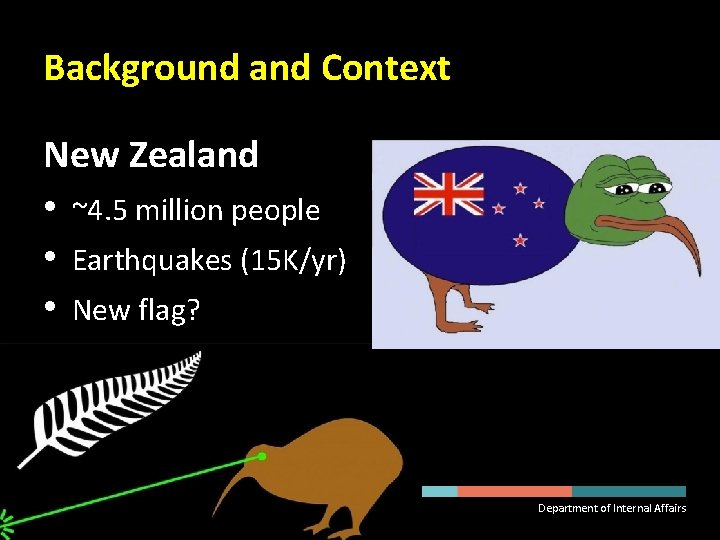
Background and Context New Zealand • ~4. 5 million people • Earthquakes (15 K/yr) • New flag? Department of Internal Affairs
Background and Context New Zealand • Relatively small government • ~500 central government websites • User-centred consolidation underway • Few accessibility experts and consultants Department of Internal Affairs
Background and Context 2003 NZ Government Web Guidelines • Cabinet mandate • All core government agencies ( currently ~33) • WCAG 1. 0 Department of Internal Affairs
Background and Context December 2008 Department of Internal Affairs
Background and Context March 2009 NZ Government Web Standards 2. 0 • WCAG 2. 0 AA + “New Zealand Layer” Department of Internal Affairs
Background and Context 2011 Self-Assessments • Very simple • Results not very useful • But, indicated significant variability in govt and vendor knowledge and skill Department of Internal Affairs
Background and Context 2012 -13 • Consultation on new Web Standards: – Govt agencies – Disability communities – Web design/development firms • Web Standards Working Group (WSWG) Department of Internal Affairs
Background and Context July 2013 NZ Govt Web Accessibility Standard • WCAG 2. 0 AA + some exceptions • 4 year implementation schedule • “High-stakes” vs. “core” content Department of Internal Affairs
Background and Context WCAG 2. 0 Exceptions • Complex visual maps • Full text alternatives over audio description • Captions: 10 day grace period except for “high -stakes” content • Live captions: only for “high-stakes” content Department of Internal Affairs
GOALS: 2014 Self-Assessments Not a compliance exercise! • Report on agency progress after 1 yr • Baseline for continual improvement • Raise awareness, knowledge and skill Department of Internal Affairs
GOALS: 2014 Self-Assessments How • Identify most common Web Standards issues • Assess risks and identify plans to address • Self-assessment workshops • Inform training and education for agencies and vendors Department of Internal Affairs
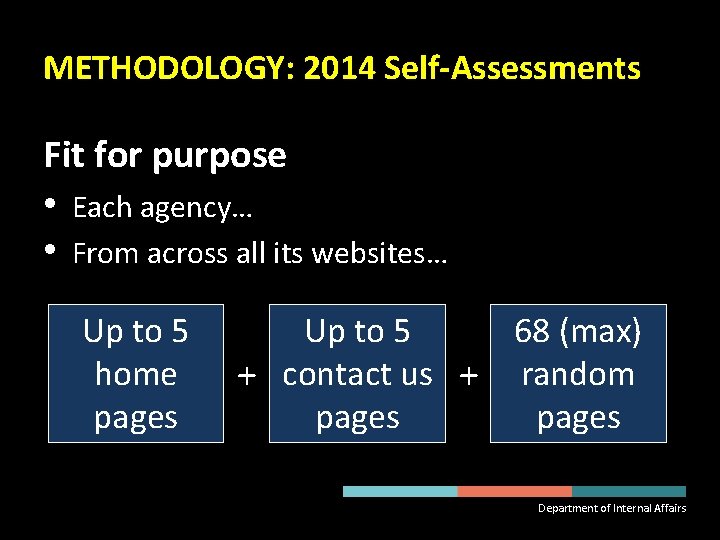
METHODOLOGY: 2014 Self-Assessments Fit for purpose • Each agency… • From across all its websites… Up to 5 home pages Up to 5 68 (max) + contact us + random pages Department of Internal Affairs
METHODOLOGY : 2014 Self-Assessments Fit for purpose • Simple results spreadsheet • Easy-to-understand guides for in-house assessment Department of Internal Affairs
METHODOLOGY : 2014 Self-Assessments Page selection • Weighted toward the most visited pages from • the agency's most visited websites. Suggested procedures for selecting pages, e. g. Google Analytics Department of Internal Affairs
METHODOLOGY: 2014 Self-Assessments Page assessment • In-house, external vendor, or combination? • Assessment guides for practical help • Incorrect/inaccurate assessment expected Department of Internal Affairs
METHODOLOGY: 2014 Self-Assessments Risk register Group, rate, and prioritise associated risks: – Where is the biggest bang for the buck? – Immediate fix or wait for redesign? – How to respond if the risk occurs? Department of Internal Affairs
ANALYSIS: 2014 Self-Assessments Auditing the results • Web Standards Working Group (WSWG) • 5 pages from each assessment: – 1 home page – 1 contact us page – 3 random pages Department of Internal Affairs
ANALYSIS: 2014 Self-Assessments Risk register review Best effort to: • Check rated impact severity of identified risks • Find risks that were overlooked Department of Internal Affairs

Department of Internal Affairs
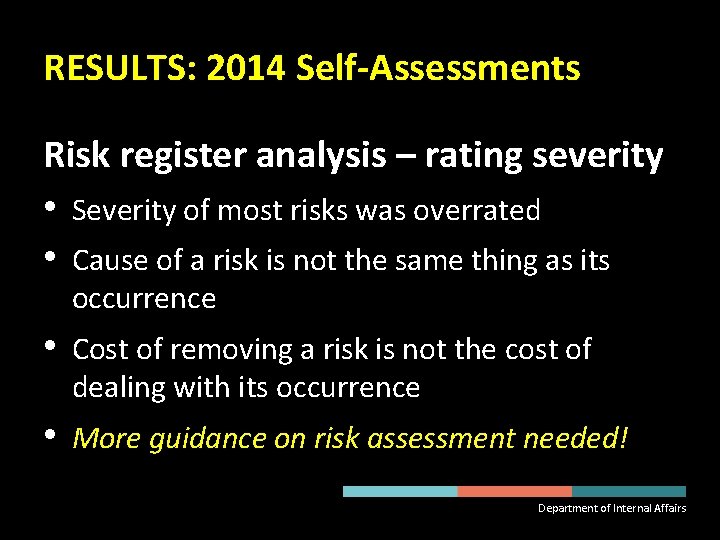
RESULTS: 2014 Self-Assessments Risk register analysis – rating severity • Severity of most risks was overrated • Cause of a risk is not the same thing as its occurrence • Cost of removing a risk is not the cost of dealing with its occurrence • More guidance on risk assessment needed! Department of Internal Affairs
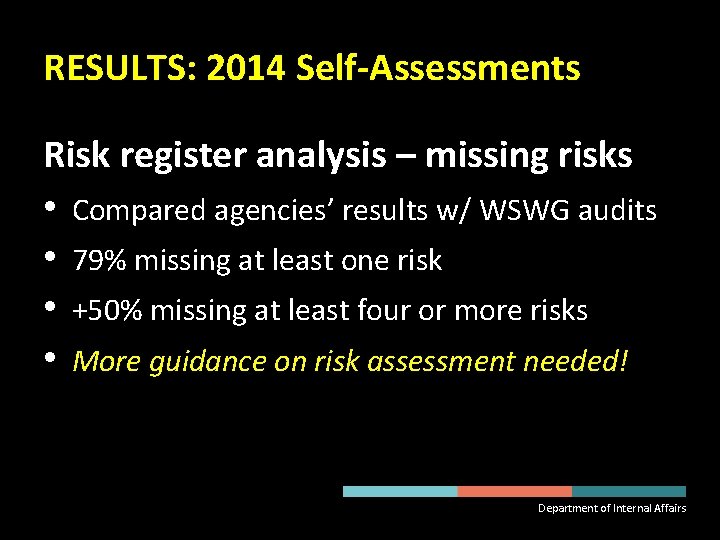
RESULTS: 2014 Self-Assessments Risk register analysis – missing risks • Compared agencies’ results w/ WSWG audits • 79% missing at least one risk • +50% missing at least four or more risks • More guidance on risk assessment needed! Department of Internal Affairs
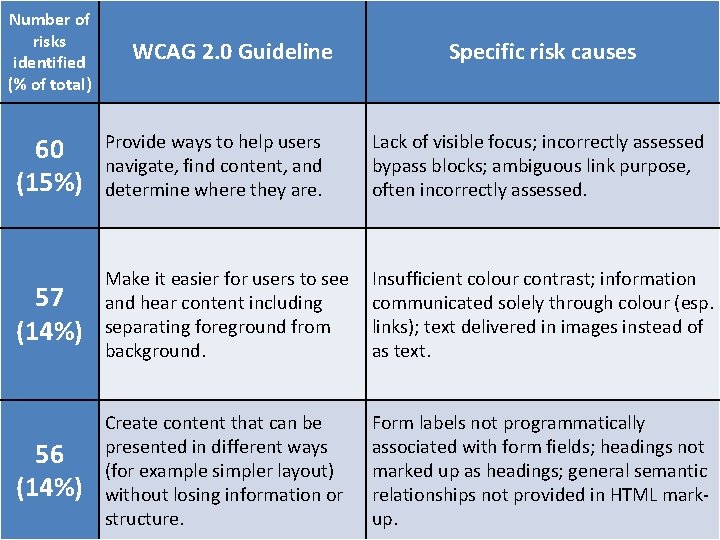
Number of risks identified (% of total) WCAG 2. 0 Guideline Specific risk causes 60 (15%) Provide ways to help users navigate, find content, and determine where they are. Lack of visible focus; incorrectly assessed bypass blocks; ambiguous link purpose, often incorrectly assessed. 57 (14%) Make it easier for users to see and hear content including separating foreground from background. Insufficient colour contrast; information communicated solely through colour (esp. links); text delivered in images instead of as text. 56 (14%) Create content that can be presented in different ways (for example simpler layout) without losing information or structure. Form labels not programmatically associated with form fields; headings not marked up as headings; general semantic relationships not provided in HTML mark. Department of Internal Affairs up.
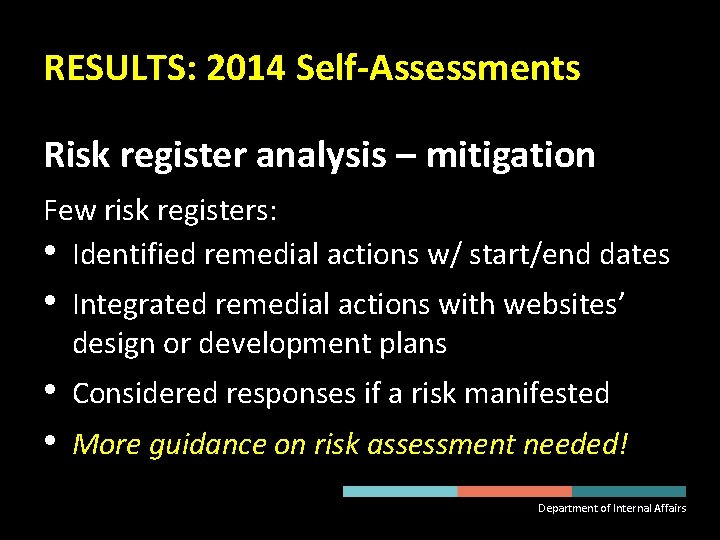
RESULTS: 2014 Self-Assessments Risk register analysis – mitigation Few risk registers: • Identified remedial actions w/ start/end dates • Integrated remedial actions with websites’ design or development plans • • Considered responses if a risk manifested More guidance on risk assessment needed! Department of Internal Affairs
RESULTS: 2014 Self-Assessments Agencies’ self-assessed scores Department of Internal Affairs
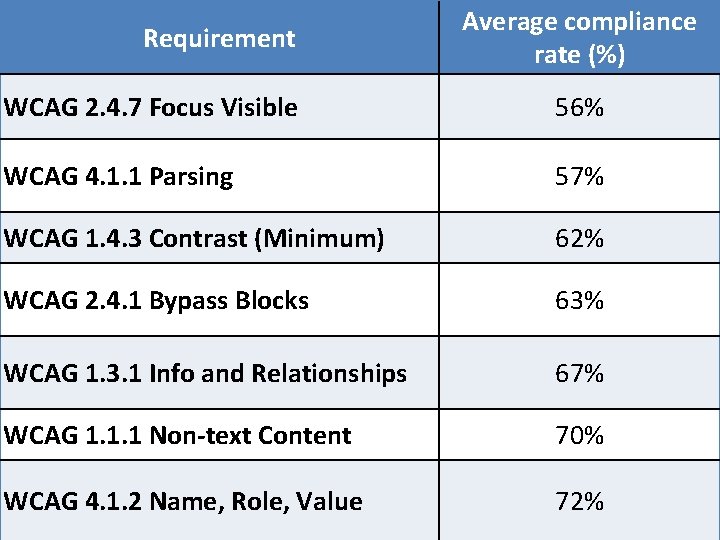
Requirement Average compliance rate (%) WCAG 2. 4. 7 Focus Visible 56% WCAG 4. 1. 1 Parsing 57% WCAG 1. 4. 3 Contrast (Minimum) 62% WCAG 2. 4. 1 Bypass Blocks 63% WCAG 1. 3. 1 Info and Relationships 67% WCAG 1. 1. 1 Non-text Content 70% WCAG 4. 1. 2 Name, Role, Value 72% Department of Internal Affairs
RESULTS: 2014 Self-Assessments WSWG audit scores Department of Internal Affairs
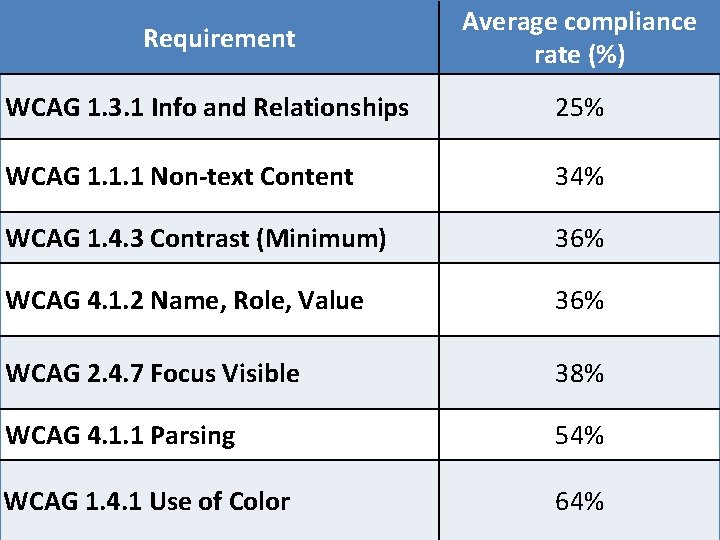
Requirement Average compliance rate (%) WCAG 1. 3. 1 Info and Relationships 25% WCAG 1. 1. 1 Non-text Content 34% WCAG 1. 4. 3 Contrast (Minimum) 36% WCAG 4. 1. 2 Name, Role, Value 36% WCAG 2. 4. 7 Focus Visible 38% WCAG 4. 1. 1 Parsing 54% WCAG 1. 4. 1 Use of Color 64% Department of Internal Affairs
RESULTS: 2014 Self-Assessments Self-assessed vs. audit scores Department of Internal Affairs
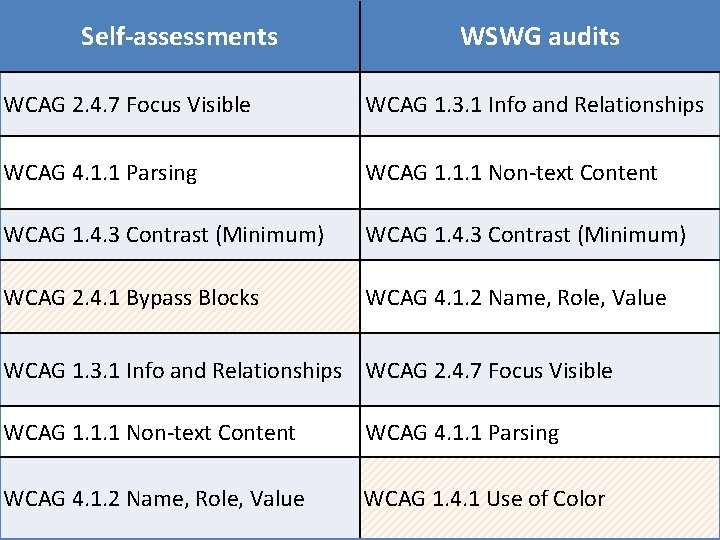
Self-assessments WSWG audits WCAG 2. 4. 7 Focus Visible WCAG 1. 3. 1 Info and Relationships WCAG 4. 1. 1 Parsing WCAG 1. 1. 1 Non-text Content WCAG 1. 4. 3 Contrast (Minimum) WCAG 2. 4. 1 Bypass Blocks WCAG 4. 1. 2 Name, Role, Value WCAG 1. 3. 1 Info and Relationships WCAG 2. 4. 7 Focus Visible WCAG 1. 1. 1 Non-text Content WCAG 4. 1. 1 Parsing WCAG 4. 1. 2 Name, Role, Value WCAG 1. 4. 1 Use of. Department Colorof Internal Affairs
RESULTS: 2014 Self-Assessments Audit variances • Difference between the two scores • Indication of accuracy or understanding • Some passing marks the WSWG audits considered failures, and vice versa • Greater the variance, the less the reqt was understood or accurately assessed Department of Internal Affairs
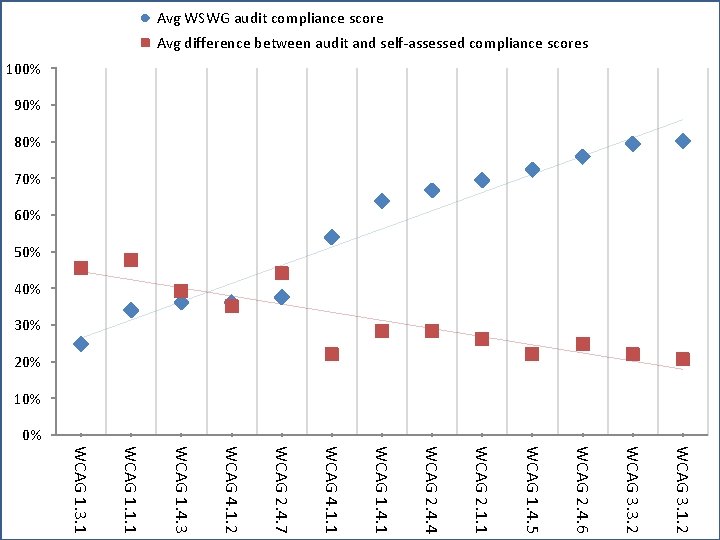
Avg WSWG audit compliance score Avg difference between audit and self-assessed compliance scores 100% 90% 80% 70% 60% 50% 40% 30% 20% 10% 0% WCAG 3. 1. 2 WCAG 3. 3. 2 WCAG 2. 4. 6 WCAG 1. 4. 5 WCAG 2. 1. 1 WCAG 2. 4. 4 WCAG 1. 4. 1 WCAG 4. 1. 1 WCAG 2. 4. 7 WCAG 4. 1. 2 WCAG 1. 4. 3 WCAG 1. 1. 1 WCAG 1. 3. 1 Department of Internal Affairs
RESULTS: 2014 Self-Assessments Audit variances – Interesting bits • Top 5 reqts with highest variance are in the top 7 with the lowest compliance • These top 5 reqts are: – common failures across agency web pages – the most often incorrectly assessed or understood Department of Internal Affairs
RESULTS: 2014 Self-Assessments Audit variances – Interesting bits • Top 5 reqts arguably 5 of the most important: – WCAG 1. 1. 1 Non-text Content – WCAG 1. 3. 1 Info and Relationships – WCAG 1. 4. 3 Contrast (Minimum) – WCAG 2. 4. 7 Focus Visible – WCAG 4. 1. 2 Name, Role, Value Department of Internal Affairs
CONCLUSIONS: 2014 Self-Assessments A worthwhile effort • Improved understanding of accessibility • Opportunity to discuss, learn, and ask • Confirm, with evidence, most common issues • Better understand current state • Identify what needs improvemement • Inform training and education Department of Internal Affairs

FUTURE PLANS Department of Internal Affairs
FUTURE PLANS: 2014 Self-Assessments Workshops – govt and vendors • Shift focus from compliance to risk mgmt • Integrate with govt ICT maturity model • Focus on most common and least understood • • requirements Help agencies understand the ‘why’ Embed accessibility in day-to-day processes Department of Internal Affairs
FUTURE PLANS: 2014 Self-Assessments More practical guidance • Web Accessibility Standard Assessment Guide • will be published Direct people to and help them navigate existing guidance and resources Department of Internal Affairs
FUTURE PLANS: 2014 Self-Assessments Virtual community of expertise • Stop relying on one working group or team • Take a coaching role and deliver hands-on • • training to lift capability Build community of advocates and experts across agencies, vendors, jurisdictions Openly share our experiences, good and bad Department of Internal Affairs
…like here at OZe. WAI! Thanks. Department of Internal Affairs
- Slides: 41