
New York State Immigrant Eligibility for Medicaid This
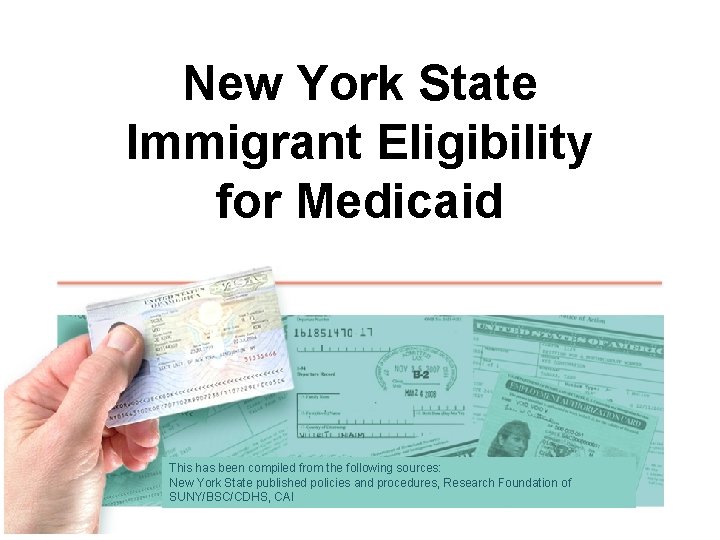
New York State Immigrant Eligibility for Medicaid This has been compiled from the following sources: Adapted New York Statefrom published policies and procedures, Research Foundation of SUNY/BSC/CDHS, CAI © 2012 The Research Foundation for SUNY/BSC/CDHS
Objectives § Interpret immigrant eligibility guidelines for government funded health insurance programs § Identify the different immigration statuses § Recognize immigrants’ concerns § Review acceptable forms of documentation § Understand WMS coding for each immigration category 2
Federal Immigration Agencies § There are 2 Federal Immigration Agencies under the Department of Homeland Security: – USCIS: United States Citizenship and Immigration Services – ICE: Immigration and Customs Enforcement § Within the Department of Justice there is: – EOIR: Executive Office of Immigration Review 3
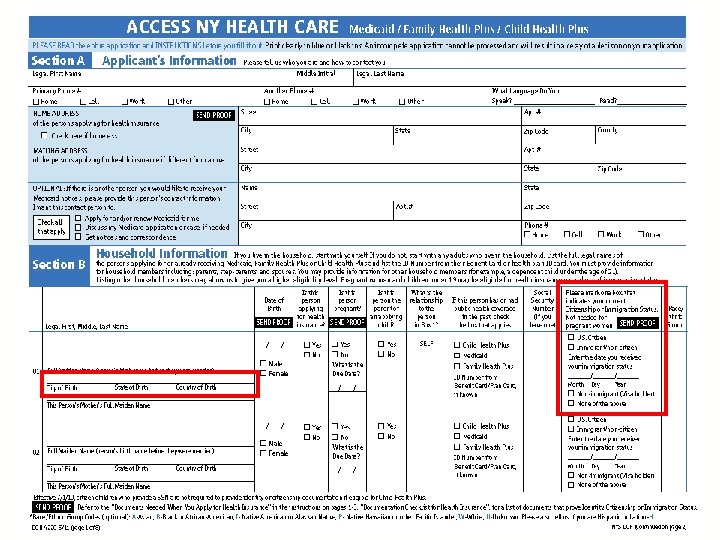
Who is Eligible? § To be eligible for MA an individual must be a U. S. Citizen, U. S. National, Native American or be an immigrant in “satisfactory immigration status” 4
5
Documentation Guide § Category 1: U. S. Citizens § Category 2: Qualified Aliens § Category 3: Persons who are Permanently Residing in the U. S. Under Color of Law (PRUCOL) § Category 4: Non-Immigrants § Category 5: Undocumented Aliens 6
Citizens (Category 1) § U. S. Citizens include: – Born in the United States – Naturalized U. S. citizens – U. S. Nationals – Native Americans § Includes Native Americans born in Canada or belonging to a federally recognized tribal group (Category 2 on Documentation Guide) 7
Immigrants § All immigrants in a satisfactory immigration status may be eligible for Medicaid as long as the applicant meets the other eligibility requirements of the program. 8
Personal Responsibility and Work Opportunity Reconciliation Act of 1996 (PRWORA) § PRWORA identified certain categories of immigrants who were not eligible for federally funded public programs if they: – Entered the US on or after August, 22 1996 and – Have not resided in the US in a qualified alien status for at least five years § This is known as the “federal five year ban” 9
PRWORA § Established new immigration categories – Qualified Aliens – Non-Qualified Aliens 10
Federal Five Year Ban § Qualified Aliens were eligible for public programs – Established five year ban on application for public programs for some groups § Non-Qualified Aliens, including PRUCOL were not eligible for public programs 11
Aliessa v. Novello and Adamolekun v. Novello Court Cases § Restored Medicaid coverage to residents of NYS who were: – Qualified Aliens who entered the US on or after August 22, 1996 – PRUCOLs regardless of when they entered the US 12
Aliessa v. Novello and Adamolekun v. Novello Court Cases, cont'd. § Since these groups are outside the federal legislation, they do not have federal financial funding for their medical costs under Medicaid while in the five year ban – Medicaid is state funded during the first five years § All NYS immigrants in satisfactory immigration status are eligible for Medicaid, if otherwise eligible 13
What is Satisfactory Immigration Status? § “Satisfactory immigration status” is defined as an immigration status that does not make the individual ineligible for benefits under the applicable program 14
Who has Satisfactory Immigration Status? § Satisfactory immigration status includes: – Qualified Aliens – PRUCOL 15
Qualified Aliens (Category 2) § Qualified aliens are persons who usually live and work here with the permission of the federal immigration agency § No five year waiting period for health benefits § Some immigrants are not eligible for Medicaid benefits with Federal Financial Participation 16
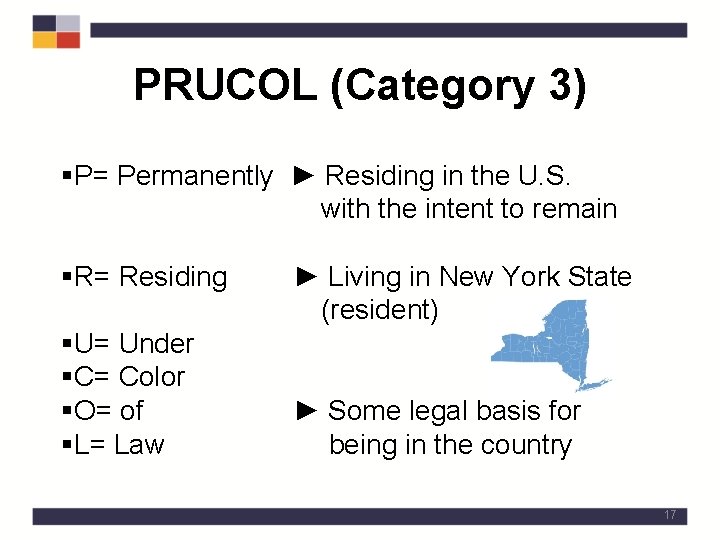
PRUCOL (Category 3) §P= Permanently ► Residing in the U. S. with the intent to remain §R= Residing §U= Under §C= Color §O= of §L= Law ► Living in New York State (resident) ► Some legal basis for being in the country 17
PRUCOL, cont'd. § People who are living in the United States with the federal immigration agencies’ knowledge and permission or acquiescence § The federal immigration agencies are not taking steps to deport the immigrant, at least for the time being 18
PRUCOL, cont'd. Two groups: § “knowledge and permission” § “knowledge and acquiescence” – Acquiescence is to agree by default or inaction 19
Non-Immigrants (Category 4) and Undocumented Aliens (Category 5) § Temporary Non-Immigrants § Special Non-Immigrants § Undocumented Aliens 20
Immigrants Limited to the Treatment of an Emergency Medical Condition § Undocumented: – People without immigration documentation § Temporary non-immigrants: – Visitors to the US, e. g. , short term visa holders, students, tourists who are not adjusting their status with USCIS NOTE: Undocumented and/or Non-immigrant children may be eligible for Child Health Plus, if they meet certain requirements. 21
Undocumented Aliens § Immigrants who: – Are unable to provide documentation because they have entered the U. S. without inspection/paperwork OR – Lawfully entered the United States, but have violated the terms of their status § Over-stayed a visa 22
Undocumented Aliens, cont’d. § Only eligible for Medicaid for treatment of an emergency medical condition 23
Undocumented Aliens, cont’d. § A medical condition (including emergency labor and delivery) manifesting itself by acute symptoms of sufficient severity (including severe pain) such that the absence of immediate medical attention could reasonably be expected to result in: – Placing the person’s health in serious jeopardy; – Serious impairment to bodily functions; or – Serious dysfunction of any bodily organ or part. 24
Exceptions for Non-Immigrants § Special Non-Immigrants: – Non-immigrant visa statuses allow a visa holder to work in the United States and eventually adjust to lawful permanent resident status § Visas K, N, R, S, T, U, V – These individuals would be considered PRUCOL if the individual has filed to adjust their status 25
Immigrant Categories 26
Qualified Aliens Category 2 27
Qualified Aliens § Qualified aliens include: – Lawful Permanent Residents (“Green Card” holders/LPR’s) – Refugees – Asylees – Persons granted withholding of deportation or removal – Persons paroled into the U. S. for at least one year 28
Qualified Aliens, cont’d. § Qualified aliens also include: – Cuban-Haitian entrants – Amerasians – Battered individuals and their dependents – Veterans or active U. S. armed forces and their immediate family members – Victims of a severe form of human trafficking 29
Lawful Permanent Resident § Often called a “Green Card Holder” § Individual who has been granted authorization to live and work in the US on a permanent basis § Individuals may become a permanent resident in several different ways 30
Permanent Resident Card I-551 (Green Card) § Most, but not all, Qualified aliens will have a Permanent Resident Card “Green Card” § Immigrant does not have to provide any other proof of his or her immigration status when they have a Green Card § Green Card contains the date the immigrant received qualified status - DOS 31
Refugees § Refugee status or asylum may be granted to people who have been persecuted or fear they will be persecuted on account of race, religion, nationality, and/or membership in a particular social group or political opinion § Refugees are unable or unwilling to return home because they fear serious harm § Refugees seek legal immigration status before entering the US 32
Refugee Medical Assistance (RMA) § Refugee Medical Assistance is a Federal program available to certain refugees: – Limited time period (8 months) – Must be ineligible for “regular” Medicaid – Primarily limited to single individuals or childless couples – Not full time students 33
RMA, cont’d. § The term “refugee” includes the following groups: – Refugees – Asylees – Cuban and Haitian entrants – Amerasians – Federally certified victims of a severe form of human trafficking – Certain family members of certified trafficking victims – Special Immigrant Visa – May include other groups –see 10 OHIP/INF 02 34
RMA, cont'd. § Two sources of funding: – State Medicaid Plan § Costs shared between state, local and federal governments – Federal RMA § 100% federally reimbursable 35
RMA, cont'd. § Refugee families with children may participate during their first eight months in US only if they become ineligible for State’s “regular” Medicaid plan 36
RMA Eligibility § Eligibility is first determined using the MAGI -Like budgeting process for Medicaid – EEC code of “M” § If found eligible for Medicaid coverage must be authorized for 12 months without regard to RMA 37
RMA Eligibility, cont’d. § If ineligible for Medicaid under the MAGI-Like budgeting methodology, eligibility must be determined under the ADC budgeting process, individuals will be allowed to spend down to the Medically Needy level – Remove EEC code of “M” – Since the level used for ADC is less than the MAGI level, the RMA budget will always result in a spenddown 38
RMA Eligibility, cont’d. § See 10 OHIP/INF-02 for information on changes in income during the eight months of coverage and start dates of coverage § AFA Coding: Code 317 (End of State. Federal Charge) should be used – Date entered should include time to reconsider eligibility 39
Redetermination After RMA Coverage § Using standard Medicaid rules, redetermine refugee’s eligibility – Single refugees who are not parent/caretaker relatives no longer have access to ADC budgeting methodology § If eligible for Medicaid, remove the S/F Charge code of “ 30” and enter correct code if applicable 40
Asylees § Asylum may be granted to people who have been persecuted or fear they will be persecuted on account of race, religion, nationality, and/or membership in a particular social group or political opinion § Asylees are unable or unwilling to return home because they fear serious harm § Asylees seek legal immigration status after entering the US 41
Persons Granted Withholding of Deportation or Removal § Immigrant who has been ordered to leave the US, i. e. , deported § Deportation or removal has been withheld/stopped because an immigration ruling has been made that the individual’s life or freedom is threatened in the country of deportation 42
Parolees Admitted into the US for at Least One Year § Humanitarian parole is used sparingly to bring someone who is otherwise inadmissible into the United States for a temporary period of time due to a compelling emergency – To anyone applying for admission into the United States based on urgent humanitarian reasons or if there is a significant public benefit 43
Parolees Admitted into the US for at Least One Year § For a period of time that corresponds with the length of the emergency or humanitarian situation § Parolees must depart the United States before the expiration of their parole § A request for re-parole must be approved by USCIS 44
Cuban-Haitian Entrants § May adjust to permanent status if – Met criteria for C/H entrant and have continuously resided in the United States since before January 1, 1982 45
Amerasians § These immigrants are certain Amerasian children – Must have been born in Vietnam after December 31, 1950, and before October 22, 1982, and – Have been fathered by a U. S. citizen § Other family members may be admitted to the US under this provision 46
Victims of Battery or Abuse § An alien who has been battered or abused in the US by a spouse or parent or a member of the spouse’s or parent’s family residing in the same household § Parent of a battered or abused child § Child of a battered or abused parent 47
Victims of Battery or Abuse, cont’d. § Must be a substantial connection between the battery and abuse and the need for public benefits, e. g. , Medicaid § Alien must no longer live with batterer or abuser 48
Victims of Battery or Abuse, cont’d. § Some forms of documentation require a referral to a Domestic Violence Liaison (DVL) – DVL will conduct a credibility assessment – If applicants cannot document eligibility in any other immigration category and cannot document that USCIS or immigration court has determined the alien to be battered or abused, refer to DVL for credibility assessment 49
Victims of Battery or Abuse, cont’d. § Request alien’s permission for DVL referral if immigrant presents following documents WITH credible evidence of battery or abuse: – I-797 Notice of Action indicating that alien has pending or approved I-360 self petition – I-94 coded K 3, K 4, V 1, V 2, V 3 – Other USCIS document indicating K or V Visa and pending or approved I-130 petition with credible evidence of battery or abuse 50
Victims of Battery or Abuse, cont’d. § Request alien’s permission for DVL referral of immigrants that present the following documents WITH credible evidence of battery or abuse: – I-94 or foreign passport annotated CR 1, CR 2, CR 6, or CR 7 – I-766 annotated A 9, A 15, C 10 51
Victims of Battery or Abuse, cont’d. § Documentation where NO referral required: – I-797 Notice of Action indicating that alien has an approved or pending I-360 self petition – Order from Executive Office for Immigration Review granting or finding a prima facie case for granting suspension of deportation or cancellation of removal 52
Veterans or Active U. S. Armed Forces and Their Immediate Families § Includes immigrants who have served or are currently serving in the U. S. military – And their immediate family members 53
Veterans or Active U. S. Armed Forces and Their Immediate Families, cont’d. § Members of the U. S. armed forces and their dependents (spouses and children) may be eligible for citizenship – Under special provisions of the Immigration and Nationality Act (INA) – Have access to expedited and overseas processing of naturalization or change in status applications 54
Victims of a Severe Form of Human Trafficking § Human trafficking is a form of modern-day slavery in which traffickers lure individuals with false promises of employment and a better life § Allows victims of human trafficking to remain in the U. S. to assist in investigations or prosecutions of human trafficking violators 55
Victims of a Severe Form of Human Trafficking § Must be physically present in the U. S. when applying for this immigration status § USCIS may issue T or trafficking visas to family members while overseas 56

PRUCOL Category 3 57
PRUCOL Aliens § PRUCOL Aliens are not eligible for federal funding – Except pregnant women and children under 21 § This is true regardless of the amount of time they have lived in the U. S. 58
PRUCOL Aliens, cont’d. § Persons paroled into the U. S. for less than a year § Persons under an Order of Supervision § Persons granted an indefinite stay of deportation § Persons granted an indefinite voluntary departure § Persons “by the petition” of an immediate relative 59
PRUCOL Aliens, cont'd. § Persons who have applied for an adjustment of status to lawful permanent resident § Persons granted stays of deportation § Persons granted voluntary departure status under Section 242(b) § Persons granted deferred action status § Persons who entered and continuously resided in U. S. before 1/1/72 60
PRUCOL Aliens, cont'd. § Persons granted suspension of deportation pursuant to Section 244 of INA; USCIS does not contemplate departure § Others living in U. S. with knowledge and permission or knowledge and acquiescence of USCIS and whose departure the USCIS does not contemplate enforcing § Deferred Action for Childhood Arrivals (DACA) 61
Persons Paroled into the U. S. for Less Than a Year § Non-citizens allowed to enter the U. S. without being granted admission – “Parole” is for humanitarian reasons or for which there is a significant public benefit to allow entry 62
Persons Paroled into the U. S. for Less Than a Year § Humanitarian parole is used sparingly to bring someone who is otherwise inadmissible into the United States for a temporary period of time due to a compelling emergency – To anyone applying for admission into the United States based on urgent humanitarian reasons or if there is a significant public benefit 63
Persons Paroled into the U. S. for Less Than a Year § For a period of time that corresponds with the length of the emergency or humanitarian situation § Parolees must depart the United States before the expiration of their parole § A request for re-parole must be approved by USCIS § Parole does not grant any immigration benefits 64
Persons Under an Order of Supervision § Non-citizens who have been found deportable – Certain factors exist which make it unlikely that they will be deported § These immigrants must comply with an Order of Supervision 65
Persons Granted an Indefinite Stay of Deportation § Non-citizens who have been found deportable § The actual deportation has been deferred indefinitely – Usually for humanitarian purposes 66
Persons Granted Indefinite Voluntary Departure § Status granted before April 1997 § Non-citizens who have been found deportable § Departure deferred indefinitely due to humanitarian reasons 67
Persons “by the Petition” of an Immediate Relative § Non-citizens who are immediate relatives of a U. S. citizen/Lawful Permanent Resident – Spouse, father, mother, or unmarried child under 21 § Who has filed an I-130 Relative Petition on their behalf 68
Persons Who Have Applied for an Adjustment of Status to Lawful Permanent Resident § Non-citizens who currently have a satisfactory immigration status (may be another PRUCOL category) § Have applied for an adjustment in status to Lawful Permanent Resident 69
Persons Granted Stays of Deportation § Non-citizens who have been found deportable § USCIS may defer deportation for a specified period of time due to humanitarian reasons 70
Persons Granted Voluntary Departure Status under Section 242(b) of the INA § This Section has been repealed § Essentially affected non-citizens who had a removal order or order of deportation but who were granted a deferral of the action 71
Persons Granted Deferred Action Status § Deferred Action Status is a situation where the USCIS is considering either a change of status or reviewing the non-citizen’s circumstances § While this decision is being made, the immigrant is granted a deferred action status 72
Persons Who Entered and Continuously Resided in the U. S. Before 1/1/72 § Result of “Immigration Amnesty Law” § Allows persons who entered the U. S. before 1/1/72 and have lived in the U. S. since that time to apply for Lawful Permanent Resident status § Must apply for “registry” and document entry and residence 73
Persons Granted Suspension of Deportation Pursuant to Section 244 of INA § These immigrants are non-citizens who have been found by the USCIS to be deportable – They have met a period of continuous residence and – Have filed an application for the USCIS to suspend deportation – This petition has been granted 74
Deferred Action for Childhood Arrivals (DACA) § Certain immigrants who came to the U. S. as children (through no fault of their own) may request consideration of deferred action for a period of two years – Subject to renewal § Does not provide lawful status § Not eligible for FFP Medicaid or CHPlus 75
Others Living in the U. S. with Knowledge and Permission or Acquiescence of USCIS § This category includes any non-citizen who can document/verify that the USCIS knows that the immigrant is residing in the U. S. , and § Can document/verify that the USCIS has either granted them permission to remain in the U. S. or has knowledge of their presence (acquiescence) 76
Others Living in the U. S. with Knowledge and Permission or Acquiescence of USCIS, cont’d. § Applicants for adjustment of status to LPR, asylum, suspension of deportation, cancellation of removal, or requesting deferred action § Persons granted Deferred Enforced Departure due to conditions in their home country § Permanent non-immigrants pursuant to PL 99239 that applies to citizens of Micronesia and the Marshall Islands 77
Others Living in the U. S. with Knowledge and Permission or Acquiescence of USCIS, cont’d. § Persons granted or who have applied for Temporary Protected Status – Granted to citizens of countries where: § There is an ongoing armed conflict where return of nationals to that state would pose a serious threat to their personal safety; § An environmental disaster has occurred resulting in a substantial, temporary disruption of living conditions, and the state has requested TPS designation; § Extraordinary and temporary conditions exist that prevent nationals from returning safely 78
Others Living in the U. S. with Knowledge and Permission or Acquiescence of USCIS, cont'd. § Granted for 6 -18 months, then reviewed to assess if the national can be safely returned to their native country 79
Others Living in the U. S. with Knowledge and Permission or Acquiescence of USCIS, cont’d. § Visas for Special Non-Immigrants § (Category 4 in Desk Aid) – K – Spouses, fiancées, and children of U. S. citizens – N – Parents or children of Special immigrants – Religious Workers and their children – S – For informants and their children providing critical information about a criminal organization or terrorism 80
Others Living in the U. S. with Knowledge and Permission or Acquiescence of USCIS, cont’d. § Visas for Special Non-Immigrants, cont'd. – T – Victims of Severe Form of Human Trafficking – U – Victims of certain criminal activities and their family including parents – V – Spouses and children of Lawful Permanent Residents – There are other groups of immigrants that may fall into this category 81
Non-Immigrants and Undocumented Aliens Categories 4 and 5 82
Temporary Non-Immigrants § Lawfully admitted to U. S. § Will stay in U. S. temporarily or for a specific time period § Issued a visa by U. S. 83
Temporary Non-Immigrants, cont’d. § Foreign Government representatives on official business (A) § Visitors for business or pleasure (B-1 or B-2) § Crewmember on shore leave (D) § Treaty Traders and investors (E) § Foreign Students (F) § Representatives of international organizations (G) § Temporary workers (including agricultural workers) (H) § Members of the foreign press (I) 84
Temporary Non-Immigrants, cont’d. § Exchange visitors (J) § Intra-company transferees (L) § Parents or Children of Certain Special Non. Immigrants (N) § Persons with extraordinary ability or achievement (O) § Artists, entertainers, and athletes (P) § Cultural exchange visitors (Q) § Religious workers (R) 85
Medicaid for Temporary Non-Immigrants § Many Temporary Non-Immigrants do not qualify for Medicaid because they have not established residency in New York State § Some Temporary Non-Immigrants are only eligible for emergency Medicaid – Federal funding is available for these cases – Temporary Non-Immigrants are not required to apply for an SSN 86
Special Non-Immigrants § Individuals who enter the U. S. lawfully for a specific reason, often humanitarian – Certain groups of Special Non-Immigrants are allowed to work in the U. S. – Some Special Non-Immigrants may eventually apply to adjust their status to a Lawful Permanent Resident 87
Special Non-Immigrants, cont’d. § Special Non-Immigrants are those with the following codes on their documents: – K – Dependants of U. S. citizens – N – Parents or Children of Certain Special Non-Immigrants – Religious workers and their dependents 88
Special Non-Immigrants, cont’d. § Special Non-Immigrants are also those with the following codes on their documents: – S – Informants of criminal or terrorist organizations (called the “snitch visa”) – T – Victims of Trafficking – U – Certain crime victims – V – Dependents of LPR 89
Special Non-Immigrants Medicaid PRUCOL – eligible for Medicaid Note: PRUCOL Non-Immigrants must apply for an SSN 90
Victims of Trafficking (T visas) § Considered refugees – May have a letter from the Office of Refugee Resettlement § May receive Refugee Medicaid 91
Undocumented Aliens § Do not have the permission to remain in the U. S. – May have entered the U. S. lawfully but violated their term of status. – May have entered the U. S. unlawfully and have not received permission to remain 92
Documentation for Undocumented Aliens § Many undocumented aliens simply have no documents § If the individual entered the U. S. lawfully, they should have some documentation to verify this – If the immigrant is undocumented this verification may have expired 93
Undocumented Aliens and Medicaid § Adults (21+ years of age) and children age 19 and 20 – Emergency Medicaid only § Children (up to 19 years of age) – May be eligible for CHPlus 94
Undocumented Aliens and Medicaid, cont’d. § Physician no longer required to complete the DOH-4471 “Certification of an Emergency Medical Condition”; § Individuals may apply without an existing emergency medical condition § 12 -Month Authorization 95
Undocumented Aliens and Medicaid, cont’d. § Only eligible for Medicaid for treatment of an emergency medical condition if: – A medical condition (including emergency labor and delivery) manifesting itself by symptoms of sufficient severity (including severe pain) such that the absence of immediate medical attention could reasonably be expected to result in: § Placing the patient’s health in serious jeopardy; § Serious impairment to bodily functions; or § Serious dysfunction of any bodily organ or part 96
Undocumented Aliens and Medicaid, cont’d. § This definition must be met at the time medical service is provided, or it is not considered to be an emergency medical condition § Not all services that are medically necessary meet the federal definition of emergency medical condition 97
Undocumented Aliens and Medicaid, cont’d. § Emergency medical conditions do not include debilitating conditions (e. g. , heart disease, or other medical conditions requiring rehabilitation) resulting from the initial event which later requires ongoing regimented care 98
Undocumented Aliens and Medicaid, cont’d. § The potentially fatal consequence of discontinuing Medicaid coverage of ongoing care, even if such care is medically necessary, does not transform the condition into an emergency medical condition 99
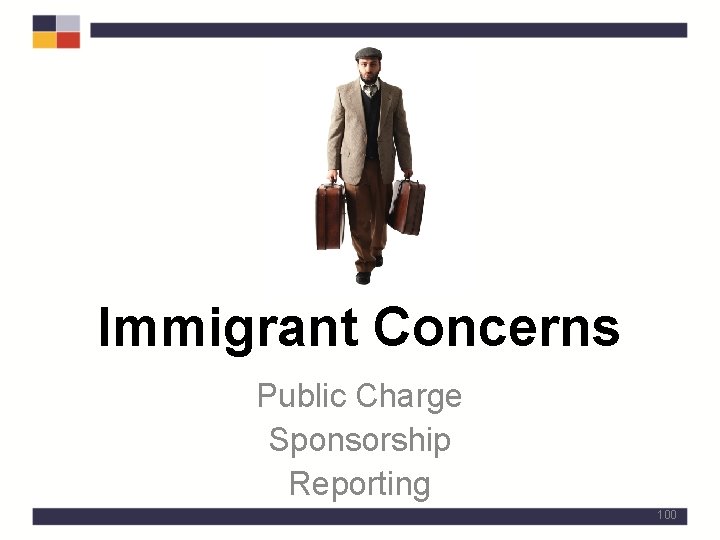
Immigrant Concerns Public Charge Sponsorship Reporting 100
Public Charge § What is a Public Charge? – Public Charge is the term used by USCIS to describe immigrants who become dependent on public benefits while living in this country 101
Public Charge & Health Benefits § USCIS can try to exclude or refuse to admit or adjust the status of an immigrant it finds to be a public charge § Use of government funded health benefits should NOT make an immigrant a public charge 102
Exceptions to Public Charge § There is one exception to this rule: – Use of Medicaid for long-term institutionalization 103
Does Public Charge Apply to all Immigrant Categories? § Public Charge never applies to an immigrant who is a: – Refugee – Asylee – Amerasian immigrant at initial admission – An Entrant under the Cuban Adjustment Act, Nicaraguan Adjustment and Central American Relief Act; or Haitian Refugee Immigration Fairness Act 104
Does Public Charge Apply to all Immigrant Categories? § USCIS does not make a public charge determination when a Lawful Permanent Resident (LPR) applies for citizenship or naturalizes 105
Affidavits of Support (AOS) I-864 § An AOS is an USCIS form signed by an immigrant’s sponsor. The sponsor promises to financially support the immigrant if USCIS allows the immigrant into the country 106
Affidavits of Support (AOS) I-864, cont’d. § After December 19, 1997, USCIS required a new AOS from the sponsor of an immigrant applying for an immigrant visa or for adjustment of status – Only sponsors who signed the new Affidavit of Support can potentially be held liable for repayment of their sponsored immigrant’s use of Medicaid benefits 107
Sponsor Deeming and Liability § Sponsor Deeming means that a sponsor’s income and resources are included when determining the immigrant’s income and resources 108
Sponsor Deeming and Liability, cont’d. § Sponsor Liability means that the sponsor is financially responsible for the immigrant and may be required to repay costs for the immigrant’s health care services provided through Medicaid § NYS does not currently use either Sponsor Deeming or Liability 109
Sponsor Deeming § Sponsor deeming will not be applied to immigrants who use: – Medicaid – CHPlus, or – prenatal care services 110
Sponsor Deeming, cont’d. § Sponsor deeming also does not apply to immigrants who were not sponsored as part of the USCIS process or who did not have an AOS, e. g. , refugees, asylees, battered individuals, etc. 111
Sponsor Deeming and Liability § Now: – Neither Sponsor Deeming nor Sponsor Liability are currently being used by New York State right now for health programs § In the future: – NYS may try to make the immigrant’s sponsor liable to repay the immigrant’s Medicaid costs 112
Reporting § It is New York State’s policy NOT to report information from applications (Access NY) for Medicaid, CHPlus or prenatal care to the federal immigration agency 113
Reporting, cont’d. § State has told districts that there is NO duty to report an immigrant’s status to the federal immigration agency § Immigration status must be confidential unless the federal immigration agency has issued final order of deportation 114
Can the Receipt of Government Health Benefits Harm an Immigrant’s Status? § Most immigrants will be unaffected if they receive government-funded health care benefits for: – Medicaid – CHPlus, or – prenatal care services 115
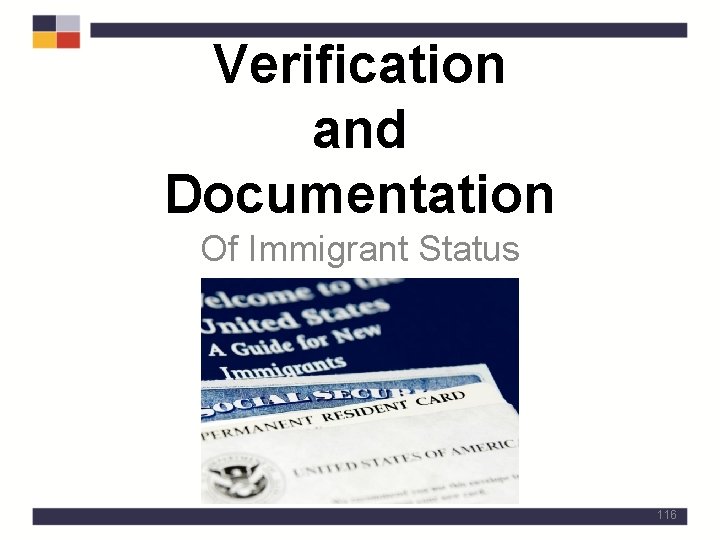
Verification and Documentation Of Immigrant Status 116
Verification of Status § Verification of status is the process used by the government to determine an immigrant’s status – An immigrant must be asked to verify their status when applying for Medicaid or CHPlus § If a Qualified alien or PRUCOL alien, they must document their status – ALL applicants for public health insurance MUST verify identity 117
Verification of Status § An undocumented child applying for CHPlus does not have to document status (i. e. , there are no documents to provide) § An undocumented applicant seeking coverage for treatment of an emergency medical condition does not have to verify his or her status 118
Verification of Status, cont'd. § Only exception: Pregnant women do NOT have to verify their immigration status while pregnant or throughout the 60 day post partum period 119
Social Security Numbers (SSN) and Immigrants § Immigrants who do NOT have to apply for SSNs: – Pregnant Women – Immigrants who are applying for Medicaid for treatment of emergency medical conditions § Undocumented immigrants § Temporary Non-immigrants (visitors, students, etc. ) 120
SSNs and Immigrants § All other immigrants must have an SSN or apply for one – SSA assigns SSNs to immigrants lawfully residing in the U. S. with a USCIS work authorization – SSA will issue an SSN to individuals who have a valid non-work reason § If the immigrant is required by law to have an SSN to receive a federally-funded benefit, such as Medicaid 121
SSNs and Immigrants, cont’d. § Immigrants with work authorization who do NOT have an SSN – Must apply – Provide LDSS with documentation of their SSN application 122
SSNs and Immigrants, cont’d. § Immigrants without work authorization must also apply for an SSN – LDSS must provide a letter that verifies that the immigrant is applying for a federal or state funded program § Letter must be issued for each applicant § Copies of these letters are Attachment I and II of 08 OHIP/INF 02 123
SSNs and Immigrants, cont’d. § PRUCOL immigrants may be denied an SSN because of their immigration status – Immigrant must provide documentation of this denial – These individuals do not have to reapply for an SSN unless their immigration status changes 124
Always Remember… § Clients should be strongly discouraged from: – using false information (e. g. SSN) or false documents when applying for any of these programs; and – falsely attesting that they do not have, or can not obtain legal immigration documents or paperwork 125
Asking Immigrants for Documentation § Immigrants are often unsure of their specific immigration status – May not realize which document is important for public health insurance programs § Ask – What documents do you have? – What additional documents do you have? 126
Immigrant Documentation § I-551 or Legal Permanent Resident card – Often called a “Green Card” § I-94 – Arrival/Departure Record § I-766 or I-688 B – the Employment Authorization Document § Other immigration documents 127
Permanent Resident Card I-551 (Green Card) § Green cards are now green again – Old Green cards do not have expiration dates – Newer cards have expiration dates, BUT an expired Green card does NOT mean the immigrant has lost his or her LPR status 128
I-94 Arrival/Departure Record § Issued by U. S. Customs and Border Protection at an authorized Port of Entry – Often stapled to a page in the alien’s passport § Shows how long the alien may remain in the U. S. § Shows the terms of admission to the U. S. § Serves as evidence of lawful status § May have temporary LPR status stamp 129
I-94 Arrival/Departure Record, cont’d. § After the initial I-94 is issued – USCIS can extend a period of admission or – Alter a non-immigrant’s status § The immigrant will be issued an I-797 A Notice of Action in these situations 130
Automated I-94 § US Customs and Border Protection (USCBP) is no longer providing paper I-94 cards at air and sea ports of entry § Downloadable I-94 (record of admission) can be obtained from www. cbp. gov/I 94 – Can be printed and used as evidence of a lawful admission 131
Automated I-94, cont’d. § Since automation only affects air and sea arrivals, a paper I-94 will still be given at land border ports of entry § See I-94 Automation Fact Sheet for more information 132
I-94 Arrival/Departure Record, cont’d. § The I-94 form will contain: – Codes of Admission – Date Entered Country (DEC) – How long the person may remain in the U. S. § Check the Key to I-94 Arrival/Departure Record Desk Aid for codes § No DOS or Alien Number on I-94 133
Employment Authorization Document (EAD card) I-766 § USCIS permits many immigrants to work legally in the U. S. These immigrants will be issued an Employment Authorization Document (EAD card) § This card has a category section with a special code that can tell you a client’s immigration status § Check Key to I-766, Employment Authorization Document (EAD card) Desk Aid 134
Employment Authorization Document (EAD card) I-766, cont’d. § I-688 B is an older Employment Authorization Document and is no longer issued by USCIS § Not every immigrant with an EAD card is eligible for Medicaid (check the code) § An immigrant’s status could have changed, so it’s important to review ALL documents 135
U. S. Travel Document § Permit to Re-enter Form I-327 – Issued to permanent residents allowing them to leave and return to U. S. § Refugee Travel Document Form I-571 – Verification of Refugee or Asylee status § Both have digital images and pages for visas and entry/exit stamps 136
Non-Immigrant Visas § Four types § Two forms – both are attached to passport pages: – Non-machine readable visa – Machine readable § Visas used for entry purposes – Must be valid on the date of entry to U. S. – May not be valid after entry to U. S. 137
Border Crossing Card § Allows bearer to enter the U. S. – Does NOT allow the individual to live in the U. S. § Has an effective period – Indicates whether the individual is allowed to work in the U. S. § May be a B 1/B 2 visa for entry to the U. S. as a visitor or tourist 138
I-94 W – Visa Waiver § Nationals of some countries can enter the U. S. without a visa under the Visa Waiver Program – Given a green I-94 W – Allowed to stay in U. S. for up to 90 days 139
I-94 W – Visa Waiver, cont’d. § Issued to nationals of some countries when they enter the U. S. – Visas are not required for some countries 140
I-797 A – Notice of Action § Extends period of admission into U. S. after I-94 is issued § Immigrant must apply for the extension and the I-797 A is the Notice of Action 141
Other Immigrant Documents PRUCOL § The federal immigration agency will not give an immigrant a piece of paper saying “PRUCOL” § You will need to review all paperwork to and from the federal immigration agency to determine if someone is PRUCOL NYS Department of Health 142
PRUCOL Knowledge and Permission or Knowledge and Acquiescence These elements must be established for the immigrant to be PRUCOL NYS Department of Health 143
PRUCOL, cont’d. Knowledge and Permission: § Aliens will have a form of documentation issued by the federal immigration agency that shows that the agency has granted the alien a particular status or relief – I-94 Arrival/Departure Record – I-766 Employment Authorization – “Notice of Action” (Form I-797) issued by USCIS – Other correspondence from the federal immigration agency NYS Department of Health 144
PRUCOL, cont’d. Knowledge and Acquiescence: § Two ways… – First, immigrants may have a document from the federal immigration agency that demonstrates acquiescence; or – The federal immigration agency has failed to respond to the immigrant’s application, petition or letter within a “reasonable period of time” NYS Department of Health 145
PRUCOL, cont’d. Reasonable Period Of Time § Local departments of social services should consider that a “reasonable period of time” is six months § The six-month period is measured from the date that the alien, or the alien’s representative, mailed to the federal immigration agency the initial letter requesting relief NYS Department of Health 146
PRUCOL, cont’d. Additional Guidelines § Requests must clearly state the type of relief sought § Must show that the request was mailed to and received by the federal immigration agency § Follow-up with the federal immigration agency on the status of the request during the six month “reasonable time” period NYS Department of Health 147
PRUCOL, cont’d. § What can you do if USCIS fails to respond? – By sending Form G-845 to USCIS, you may be able to obtain verification of an immigrant’s status from USCIS – (See page 30 and Attachment B-1 of 04 OMM/ADM-7 for further details) § If the USCIS verifies the status in response to the G-845 then the immigrant might be considered PRUCOL NYS Department of Health 148
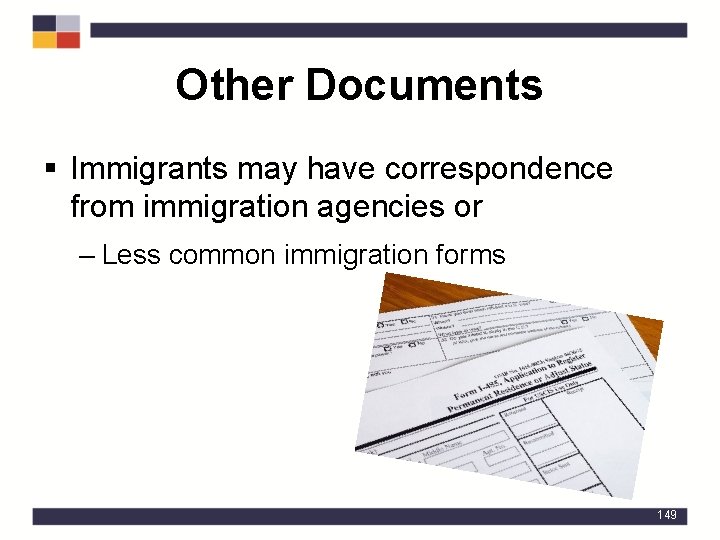
Other Documents § Immigrants may have correspondence from immigration agencies or – Less common immigration forms 149
Lost or Expired Immigration Documents § Immigration status for public health insurance are based on immigration documents issued by USCIS – Immigrants are required by law to carry immigration documentation § May have lost documents or may be carrying documents that have expired – Refer these immigrants to USCIS for replacement documents 150
Expired Documents § Generally, expired immigration documents cannot establish an immigrant’s status – Exception: Lawful Permanent Resident card or I-151 or I-551 (“Green Card”) is still valid even if expiration date has passed § Immigrant should be encouraged to renew their Green Card 151
Expired Documents, cont’d. § Generally, expired immigration documents cannot establish an immigrant’s status, cont’d. – Exception: If the only documentation an immigrant can provide is an expired EAD card, then it can be used to determine immigration status IF the immigrant has other supporting documentation/ correspondence from the USCIS 152
Verifying Expired Documents § If using an expired immigration document: – Send a G-845 (Documentation Verification Request) to USCIS § http: //uscis. gov § Go to Forms and Fees 153
Verifying Expired Documents, cont’d. – Advise the immigrant that s/he needs to go to USCIS and renew their documents § Many immigrants do not renew their documents because of the fees involved in renewals § USCIS can waive their fee if the applicant can establish that s/he is unable to pay the fee. – Information can be found at www. uscis. gov – Use the immigration status on the submitted documentation to determine eligibility 154

WMS Coding Upstate 155
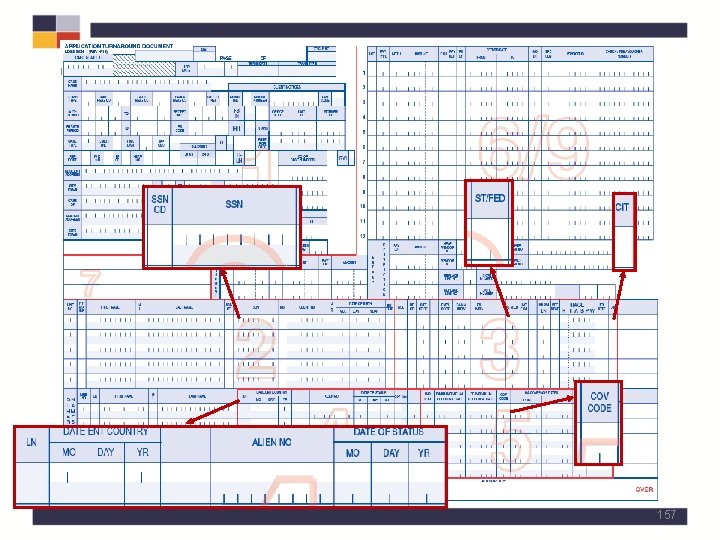
Systems Entries § Social Security Number Code § State/Federal Charge Code § Citizenship/Alien Indicator Code § Date of Status § Date Entered Country § Medicaid Coverage Codes 156
157
Social Security Number Code (SSN) 158
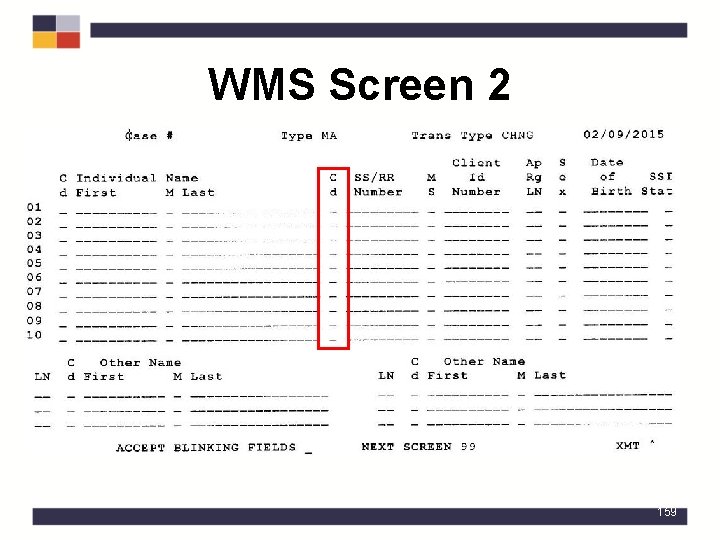
WMS Screen 2 159
SSNs and Immigrants Match § Not all Immigrants are eligible to receive a Social Security Number – Must apply for Social Security Number § Immigrants may have Social Security Numbers that may be validated through SSA 160
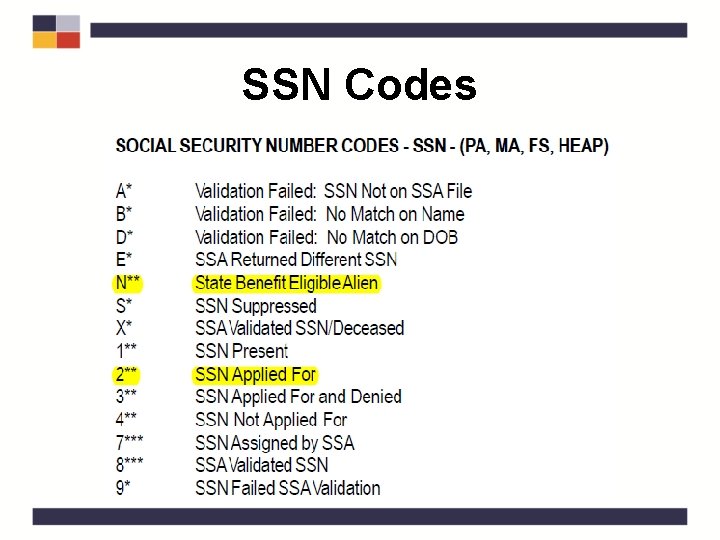
SSN Codes
SSN Code “ 2” “SSN Applied For” § For immigrants who have applied for an SSN but who have not yet received the SSN or a denial 162
SSN Code “N” “State Benefit Eligible Alien” § For aliens who have not received work authorization from the USCIS, or § Whose immigration status prevents them from being authorized by the USCIS to work in the United States 163
SSN Code “N” “State Benefit Eligible Alien”, cont’d. § The purpose of this code is to identify a Medical Assistance (MA) applicant or recipient who has – Met all MA eligibility requirements including pursuing an SSN – But has been denied an SSN by the Social Security Administration (SSA), solely due to immigration status 164
State and Federal Charge Codes (St/Fed Chgs) Citizenship/Alien Indicator Code (Cit/ACI) 165
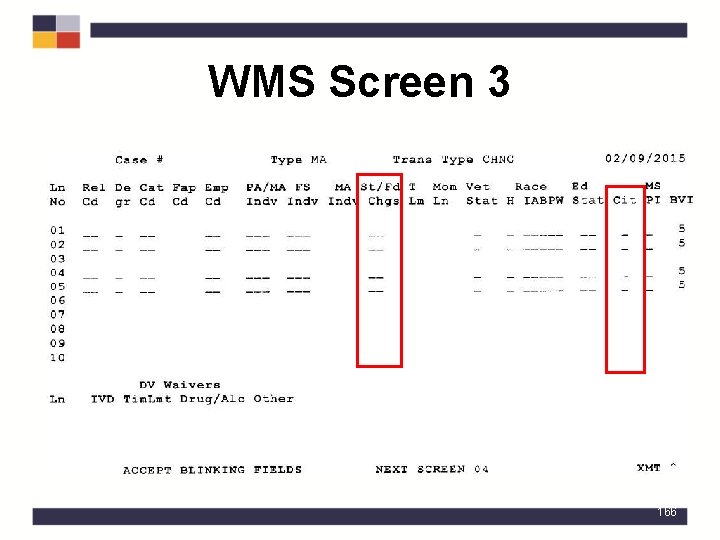
WMS Screen 3 166
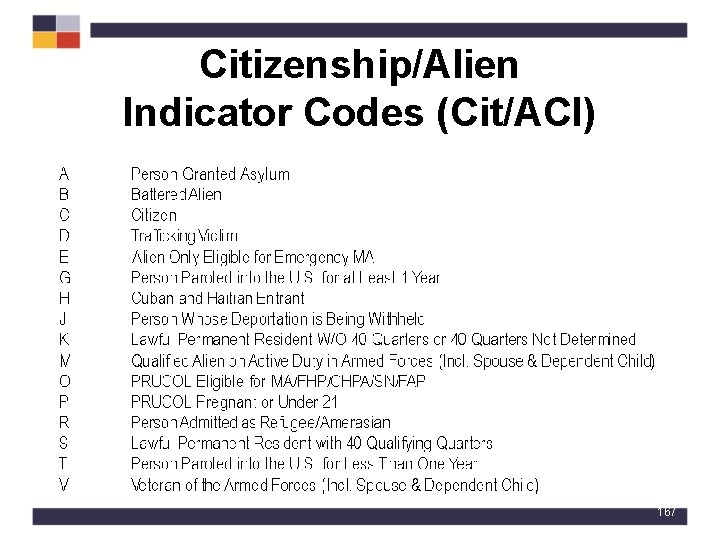
Citizenship/Alien Indicator Codes (Cit/ACI) 167
Citizenship/Alien Indicator Code § Indicates that the individual is: – A citizen – A Qualified Alien – A PRUCOL Alien – An undocumented or temporary non-immigrant who is only eligible for treatment of emergency medical conditions § Pregnant women do not require a Citizenship/Alien Indicator Code 168
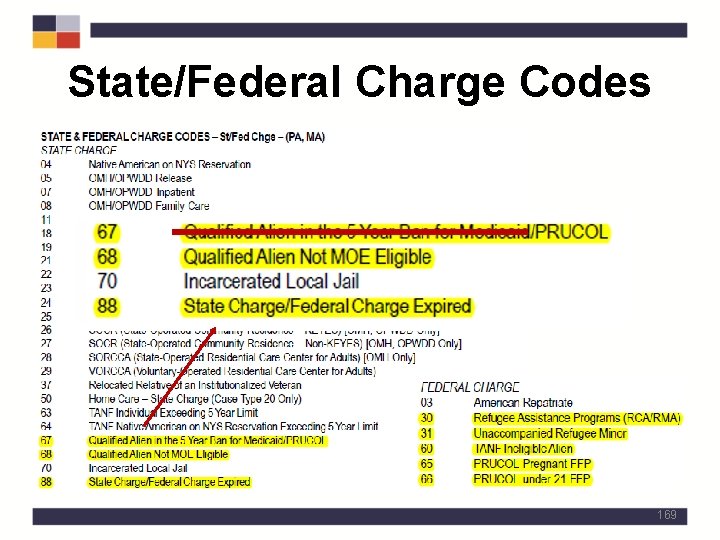
State/Federal Charge Codes 169
State/Federal Charge Codes § State/Federal Charge Codes tell NYS when the immigrant is eligible for federal funding for their Medicaid costs § Immigrants eligible for federal funding: – Qualified Aliens not subject to the five year ban or who have lived in the U. S. for more than five years – Non-immigrants eligible for treatment of an emergency medical condition – No State/Federal Charge Code is needed for these immigrants 170
State/Federal Charge Codes, cont’d. § No federal funding is available to: – Certain Qualified Immigrants within the five year ban – PRUCOL immigrants § These immigrants require a State/Federal charge code so that no federal financial participation is requested 171
State/Federal Charge Code 30 § S/F Charge Code 30 is only assigned when an immigrant is not otherwise eligible for “regular” Medicaid and eligibility for the Refugee Medical Assistance (RMA) program has been determined § S/F Code 30 must be removed at the end of the initial eight-month eligibility period 172
Alien Number Date Entered Country (DEC) Date of Status (DOS) 173
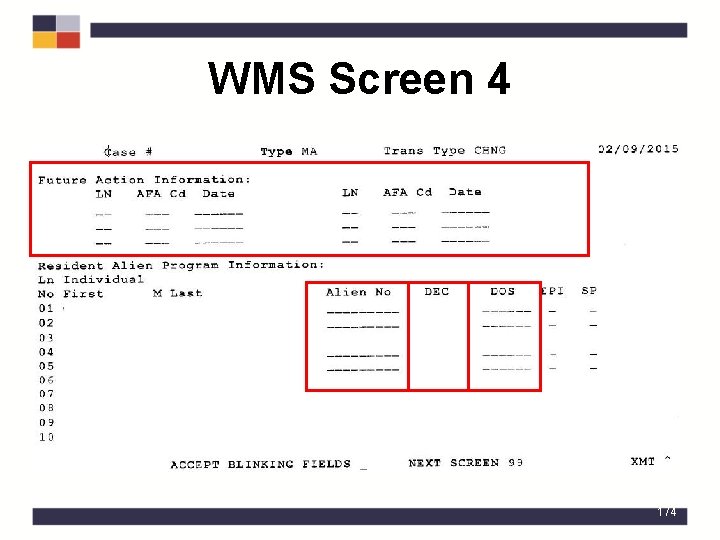
WMS Screen 4 174
Alien Number § File number assigned by USCIS § Found on immigration document § Enter 9 digit code – Do not enter the “A” – If less than 9 digits, zero fill to the left of the first digit 175
Date Entered Country (DEC) § The Date Entered Country (DEC) is the date the immigrant physically entered the United States – Date may or may not be the same as the Date of Status (DOS) – Must be same date or earlier than DOS – Field contains six characters: MMDDYY 176
Federal Medicaid § Eligibility for federal Medicaid is based on the DEC date for some qualified immigrants – May be subject to the five year ban 177
Date of Status (DOS) § The Date of Status (DOS) is the date the immigrant was granted or achieved his or her qualified immigration status – Field contains six characters: MMDDYY 178
ACI codes “C”, “E” and “O” § Both DOS and the DEC are required case record elements for all applicants/recipients except those with ACI codes of: – “C” - citizen – “O” - PRUCOL immigrants (optional) – “E” - Undocumented and Temporary Non. Immigrants § Pregnant women are not required to document citizenship or immigration status – ACI code field may be left blank 179
Requesting a Change to the DOS or DEC § Both the DOS and DEC fields have been “locked” and any changes to these fields will result in the following errors: – 1410 – DOS Changes Prohibited For Qualified Aliens – 1417 – Date Changes to DEC are Prohibited – 1439 – Changes to DOS and DEC are Limited to Day Only 180
Requesting a Change to the DOS or DEC, cont’d. § Upstate Inter-Agency Date Of Status (DOS) and Date Entered Country (DEC) Transmittal Form (LDSS-4929) – GIS 08 MA/014 – GIS 13 MA/03 181

MA Coverage Codes (CV. CODE) 182
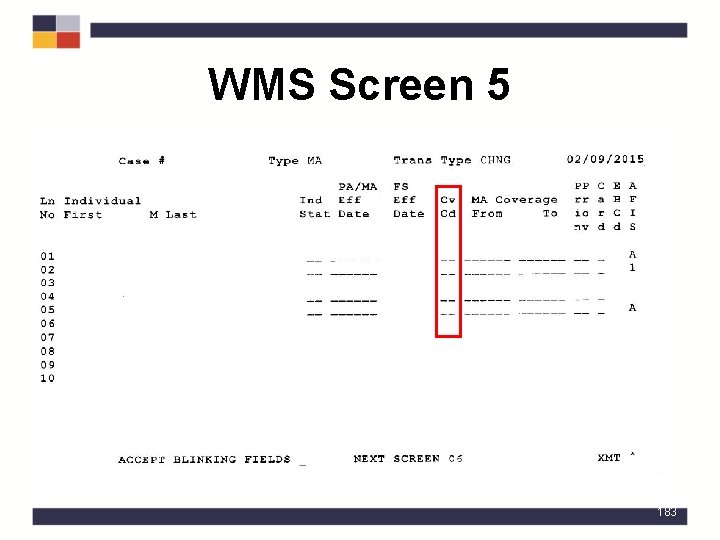
WMS Screen 5 183
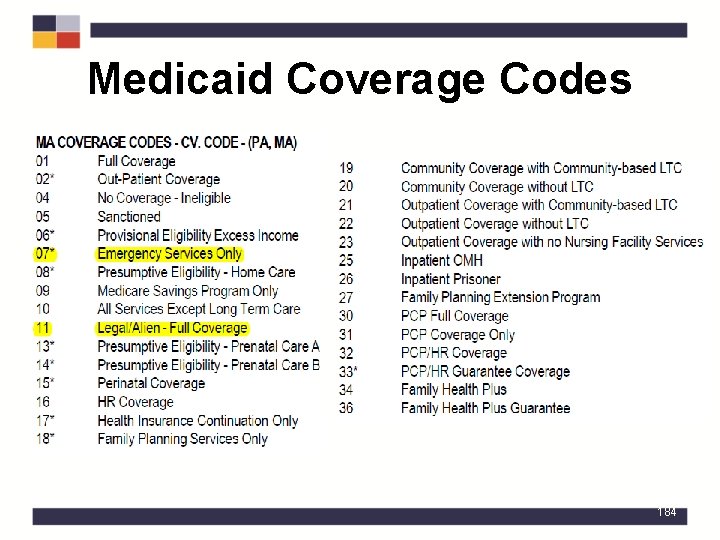
Medicaid Coverage Codes 184
Coverage Code 07 § Emergency Services Only - used for undocumented adult immigrants or certain temporary non-immigrants who are eligible for Medicaid for the treatment of an emergency medical condition only 185
Coverage Code 11 § Legal/Alien – Full Coverage - used for Qualified Aliens in the Federal 5 year ban and PRUCOL who are fully eligible for Medicaid – Can be used for both SSI-R and non SSI-R immigrants 186
Coverage Code 01 § Full Coverage - used for immigrants who are eligible for Federal reimbursement: – Non SSI-Related who are fully eligible for Medicaid – Pregnant Women who are fully eligible for Medicaid – Institutionalized immigrants who have documented 60 months of resources and are not subject to a transfer penalty 187
Coverage Code 19 § Community Coverage with CB-LTC - used for SSI-R immigrants who are eligible for Federal reimbursement and have documented current resources 188
Coverage Code 20 § Community Coverage w/o LTC - used for SSI-R immigrants who are eligible for Federal reimbursement and have attested to their resources 189
Other MA Coverage Codes § Additional Coverage Codes that can be used even if in Federal 5 year ban: – CC 06 – Provisional Eligibility Excess Income – CC 09 – Medicare Savings Program Only § QMB, SLIMB, QI, QDWI – CC 18 – Family Planning Services Only – CC 30 – PCP Full Coverage 190
Summary We are now able to: § Interpret immigrant eligibility guidelines for government funded health insurance programs § Identify the different immigration statuses § Recognize immigrants’ concerns § Review acceptable forms of documentation § Understand WMS coding for each immigration category 191
- Slides: 191