
New York City College of Technology Electrical Telecommunication
- Slides: 11
New York City College of Technology Electrical & Telecommunication Engineering Technology Renewable Energy Reduces Greenhouse Gas Emission and Climate Change By: Zeeshan Ahmad Environmental Economics ECON 2505 Prof. Sean P. Mac. Donald May 24, 2017
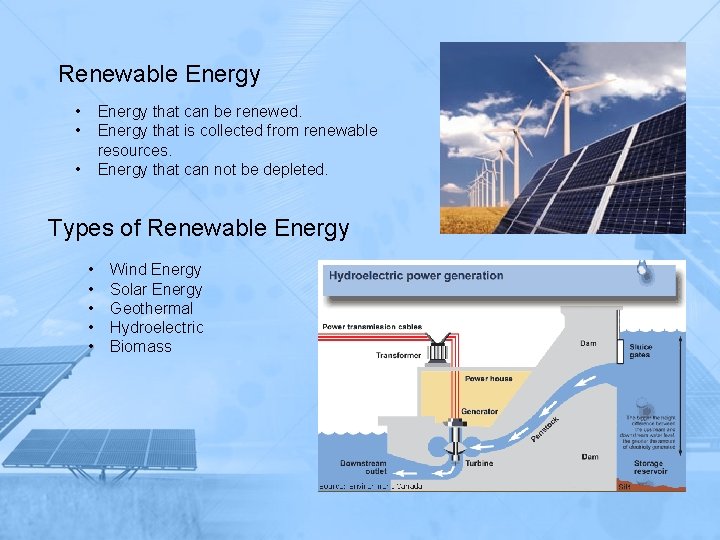
Renewable Energy • • Energy that can be renewed. Energy that is collected from renewable resources. Energy that can not be depleted. • Types of Renewable Energy • • • Wind Energy Solar Energy Geothermal Hydroelectric Biomass
How Renewable Energy Reduces(RES) Carbon Emission? • • According to Garavand et al. , the greenhouse gas (GHG) emission of electric power sectors around the world is about 1/3 of the total world GHG emission, indicating the significance of electric power sectors in the global warming issue. Electricity production also accounts for more than one-third of U. S. greenhouse gas emission, with coal-fired power plants produce 25%, and natural gas-fired power plants produce 6% of U. S. greenhouse gases. Compared to them, Renewable Energy Resources produce little to zero greenhouse gas emission. Natural gas emits 0. 6 -2 pounds of CO 2 equivalent per k. Wh. Coal emits 1. 4 -3. 6 pounds of CO 2 equivalent per k. Wh. Wind emits 0. 02 -0. 04 pounds of CO 2 equivalent per k. Wh. Solar emits 0. 07 -0. 2, geothermal 0. 1 -0. 2, and hydroelectric 0. 1 -0. 5. According to Union of Concerned Scientists (UCS), renewable energy will lower about 277 million metric tons of power plants CO 2 annually by 2025. So, reduction in greenhouse gas emission will ultimately slower the process of climate change.
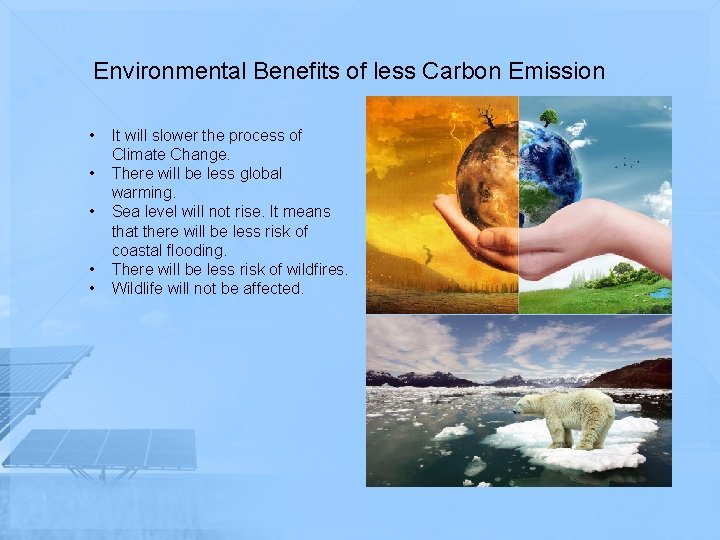
Environmental Benefits of less Carbon Emission • • • It will slower the process of Climate Change. There will be less global warming. Sea level will not rise. It means that there will be less risk of coastal flooding. There will be less risk of wildfires. Wildlife will not be affected.
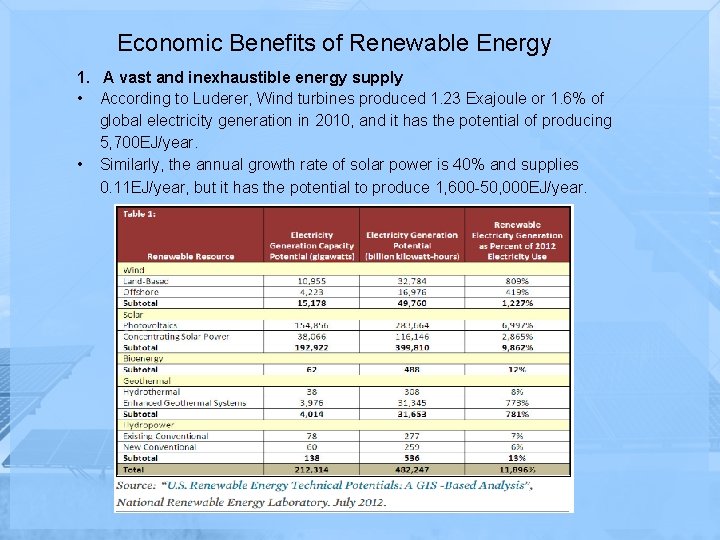
Economic Benefits of Renewable Energy 1. A vast and inexhaustible energy supply • According to Luderer, Wind turbines produced 1. 23 Exajoule or 1. 6% of global electricity generation in 2010, and it has the potential of producing 5, 700 EJ/year. • Similarly, the annual growth rate of solar power is 40% and supplies 0. 11 EJ/year, but it has the potential to produce 1, 600 -50, 000 EJ/year.
Economic Benefits (Cont. …) • • • 2. • • 3. • • • According to the U. S Department of Energy Sun. Shot, solar power has the capacity to deliver $400 billion in environmental and health benefits in the U. S by 2050. Current installed solar system supplied 20 gigawatt power, and resulting in reduction of greenhouse gases by 17 million metric tons which is worth almost $700 million per year. The reductions emission are worth $259 billion in reduced global climate damages, and $167 billion in health and environmental benefits. Jobs and other Economic Benefits According to UCS, renewable energy would create more than three times as many jobs as producing an equivalent amount of electricity from fossil fuels—resulting in a benefit of 202, 000 new jobs in 2025. In 2011, the solar industry employed approximately 100, 000 people on a part-time or full-time basis, including jobs in solar installation, manufacturing, and sales. Stable Energy Prices The costs of renewable energy technologies have declined steadily, and are projected to drop even more. The average price of a solar panel has dropped almost 60 percent since 2011. UCS’s analysis of the economic benefits of a 25 percent renewable electricity standard found that such a policy would lead to 4. 1 percent lower natural gas prices and 7. 6 percent lower electricity prices by 2030.
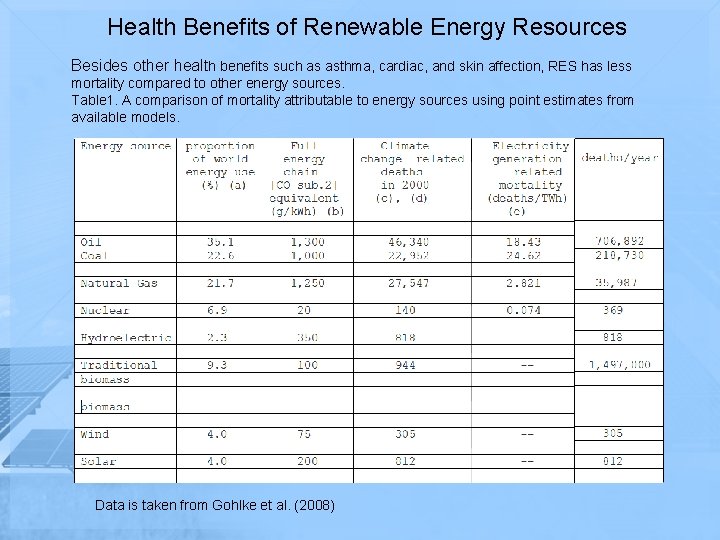
Health Benefits of Renewable Energy Resources Besides other health benefits such as asthma, cardiac, and skin affection, RES has less mortality compared to other energy sources. Table 1. A comparison of mortality attributable to energy sources using point estimates from available models. Data is taken from Gohlke et al. (2008)
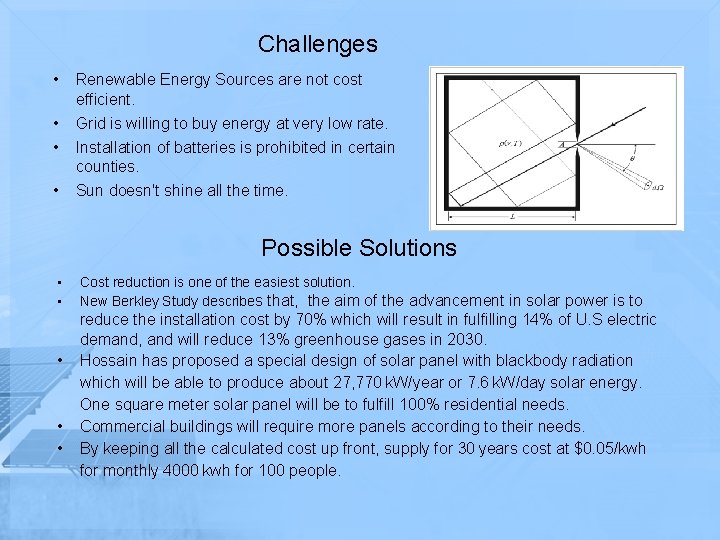
Challenges • Renewable Energy Sources are not cost efficient. • • Grid is willing to buy energy at very low rate. • Sun doesn't shine all the time. Installation of batteries is prohibited in certain counties. Possible Solutions • • • Cost reduction is one of the easiest solution. New Berkley Study describes that, the aim of the advancement in solar power is to reduce the installation cost by 70% which will result in fulfilling 14% of U. S electric demand, and will reduce 13% greenhouse gases in 2030. Hossain has proposed a special design of solar panel with blackbody radiation which will be able to produce about 27, 770 k. W/year or 7. 6 k. W/day solar energy. One square meter solar panel will be to fulfill 100% residential needs. Commercial buildings will require more panels according to their needs. By keeping all the calculated cost up front, supply for 30 years cost at $0. 05/kwh for monthly 4000 kwh for 100 people.
Conclusion • Deploying solar energy can ensure economic, reliable, and climate-friendly power system for future global energy demand. • There will be less fluctuations in electricity price, less carbon emission, and more generated power output. • Mortality associated with electricity generation can be reduced upto 90%.
References • • • Garavand, S. A. , Imani, H. , & Memarinezhad, H. (2014). Investigation the effects of electricity price variation under power market on optimal selection of wind turbines with purpose of Co 2 emission reduction. Advances in Environmental Biology, 697 -703. Retrieved from http: //go. galegroup. com. citytech. ezproxy. cuny. edu: 2048/ps/i. do? p=AONE&sw=w&u=cuny_nytc&v=2. 1&it=r&id= GALE%7 CA 392176594&asid=6 b 3 f 0 f 8070 eafc 333347 a 185 c 62 feadb Gohlke, J. M. , Hrynkow, S. H. , & Portier, C. J. (2008). Health, economy, and environment: sustainable energy choices for a nation. Environmental Health Perspectives, 116(6), A 236. Retrieved from http: //go. galegroup. com. citytech. ezproxy. cuny. edu: 2048/ps/i. do? p=AONE&sw=w&u=cuny_nytc&v=2. 1&it=r&id= GALE%7 CA 181148409&asid=3 bba 11 dbdecdb 71 aaf 661 cbd 78 b 010 dc Hossain, M. (2016). Solar energy integration into advanced building design for meeting energy demand environment problem. International Journal of Energy Research, 40(9), 1293 -1300. Retrieved from • • • http: //onlinelibrary. wiley. com. citytech. ezproxy. cuny. edu: 2048/doi/10. 1002/er. 3525/full Luderer, G. , Krey, V. , Calvin, K. , Merrick, J. , Mima, S. , Pietzcker, R. , . . . Wada, K. (2014). The role of renewable energy in climate stabilization: Results from the EMF 27 scenarios. Climatic Change, 123(3), 427 -441. Retrieved from https: //link-springer-com. citytech. ezproxy. cuny. edu/article/10. 1007/s 10584 -013 -0924 -z New Berkeley Lab Study Tallies Environmental and Public Health Benefits of Solar Power. (2016, May 18). States News Service. Retrieved from http: //go. galegroup. com. citytech. ezproxy. cuny. edu: 2048/ps/i. do? p=AONE&sw=w&u=cuny_nytc&v=2. 1&it=r&id= GALE%7 CA 452835091&asid=548 b 29 f 72208 eb 3 cfdf 259050 e 3 b 61 d 7 Union of Concerned Scientists. (n. d. ). Benefits of renewable energy use. Retrieved from http: //www. ucsusa. org/clean-energy/renewable-energy/public-benefits-of-renewable-power#. WSCth. Wjyvcs