
New WalkingWorking Surfaces and PPE Fall Protection Rule


- Slides: 43
New Walking-Working Surfaces and PPE (Fall Protection) Rule
Purpose of the New Rule • To update the outdated subpart D standard, incorporating new technology and industry practices • To increase consistency with OSHA’s construction standards (CFR 1926 subparts L, M, and X) • To add new provisions to subpart I that set forth criteria requirements for personal fall protection equipment 2
Major Changes • Fall Protection Flexibility • Updated Scaffold Requirements • Phase-in of ladder safety systems or personal fall arrest systems on fixed ladders • Phase-out of “qualified climbers” on outdoor advertising structures • Rope descent systems • Adds requirements for personal fall protection equipment (final § 1910. 140) • Adds training requirements 3
Organization of Subpart D § 1910. 21 – Scope, Application and Definitions § 1910. 22 – General Requirements § 1910. 23 – Ladders § 1910. 24 – Stepbolts and Manhole Steps § 1910. 25 – Stairways § 1910. 26 – Dockboards § 1910. 27 – Scaffolds and Rope Descent Systems § 1910. 28 – Duty to Have Fall Protection § 1910. 29 – Fall Protection Systems Criteria and Practices § 1910. 30 –Training Requirements
§ 1910. 21 – Scope and definitions • Consolidates definitions into one section • Adds new definitions to provide clarity 5
§ 1910. 22 – General Requirements • Maintains housekeeping provisions • Walking-working surfaces must be designed to meet their maximum intended load, free of recognized hazards, and routinely inspected • Repairs to be done, or overseen, by competent person 6
§ 1910. 22 • Passageways, storerooms, service rooms, and walking-working surfaces are kept in a clean, orderly, and sanitary condition. • Floor of each workroom maintained in a clean and, to the extent feasible, in a dry condition. • Walking-working surfaces maintained free of hazards such as sharp or protruding objects, loose boards, corrosion, leaks, spills, snow, and ice. – Loads – Access/Egress – Inspection, Maintenance and Repair 7
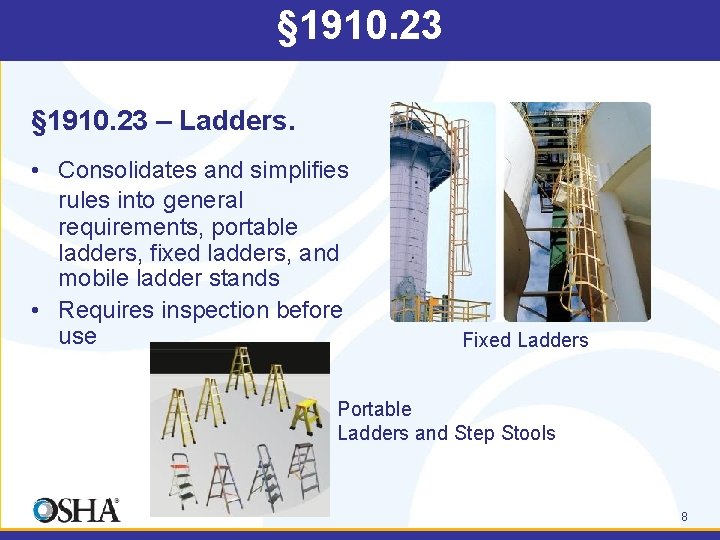
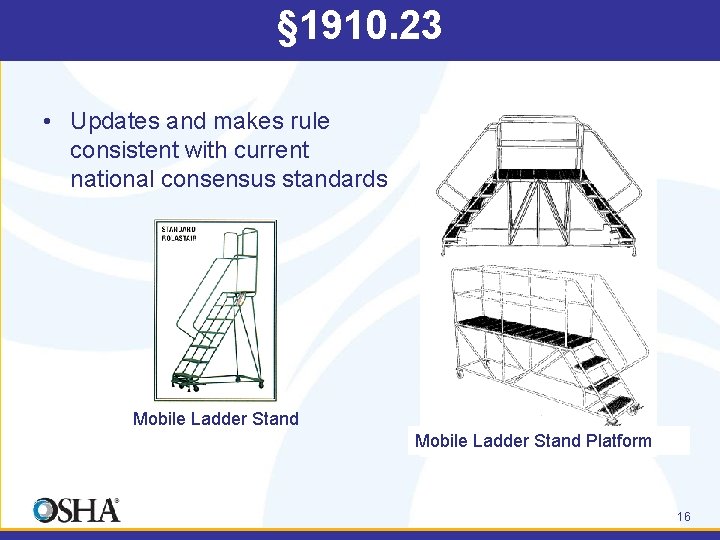
§ 1910. 23 – Ladders. • Consolidates and simplifies rules into general requirements, portable ladders, fixed ladders, and mobile ladder stands • Requires inspection before use Fixed Ladders Portable Ladders and Step Stools 8
§ 1910. 23 General requirements for all ladders • Ladder surfaces are free of puncture and laceration hazards • Ladders are used only for the purposes for which they were designed • Ladders are inspected before initial use in each work shift, and more frequently as necessary • Any ladder with structural or other defects is immediately tagged “Dangerous: Do Not Use”… and removed from service until repaired… or replaced 9
§ 1910. 23 General requirements for all ladders (cont. ) • Each employee faces the ladder when climbing up or down it • Each employee uses at least one hand to grasp the ladder when climbing up and down it • No employee carries any object or load that could cause the employee to lose balance and fall while climbing up or down the ladder 10
§ 1910. 23 Portable ladders • Rungs and steps are corrugated, knurled, dimpled, coated with skid-resistant material, treated to minimize the possibility of slipping • Each stepladder or combination ladder used in a stepladder mode is equipped with a metal spreader or locking device that securely holds the front and back sections in an open position while the ladder is in use 11
§ 1910. 23 Portable ladders (cont. ) • Ladders not loaded beyond the maximum intended load • Ladders used only on stable and level surfaces unless they are secured or stabilized to prevent accidental displacement • No ladder moved, shifted, or extended while an employee is on it 12
§ 1910. 23 Portable ladders (cont. ) • Ladders placed in locations such as passageways, doorways, or driveways where they can be displaced by other activities or traffic – Are secured to prevent accidental displacement; or – Are guarded by a temporary barricade, such as a row of traffic cones or caution tape, to keep the activities or traffic away from the ladder • Portable ladders used on slippery surfaces are secured and stabilized 13
§ 1910. 23 Portable ladders (cont. ) • Top of a non-self-supporting ladder is placed so that both side rails are supported, unless the equipped with a single support attachment • Ladders and ladder sections not tied or fastened together to provide added length unless they are specifically designed for such use • Ladders not placed on boxes, barrels, or other unstable bases to obtain additional height 14
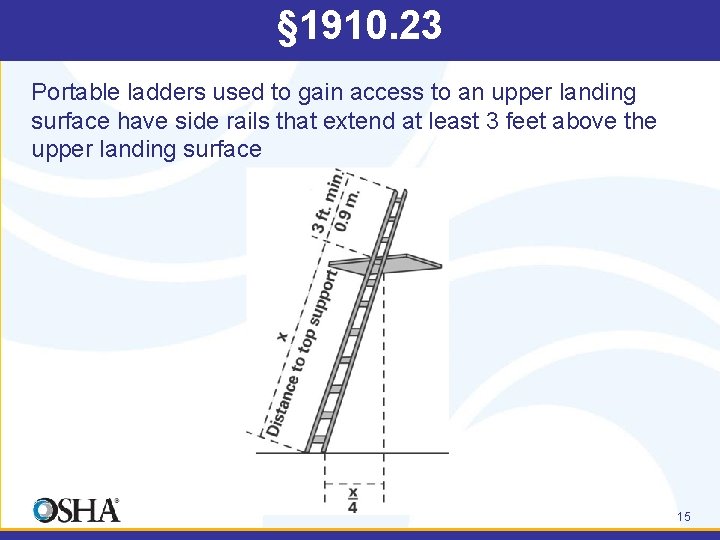
§ 1910. 23 Portable ladders used to gain access to an upper landing surface have side rails that extend at least 3 feet above the upper landing surface 15
§ 1910. 23 • Updates and makes rule consistent with current national consensus standards Mobile Ladder Stand Platform 16
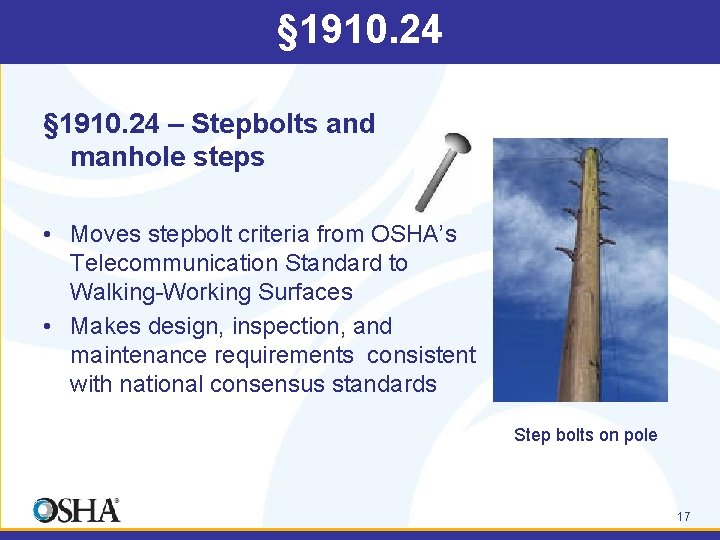
§ 1910. 24 – Stepbolts and manhole steps • Moves stepbolt criteria from OSHA’s Telecommunication Standard to Walking-Working Surfaces • Makes design, inspection, and maintenance requirements consistent with national consensus standards Step bolts on pole 17
§ 1910. 25 – Stairways • • Adds design and use criteria for spiral stairs, ship stairs, and alternating treadtype stairs Updates design criteria for stairs and landings, consistent with national consensus standards 18
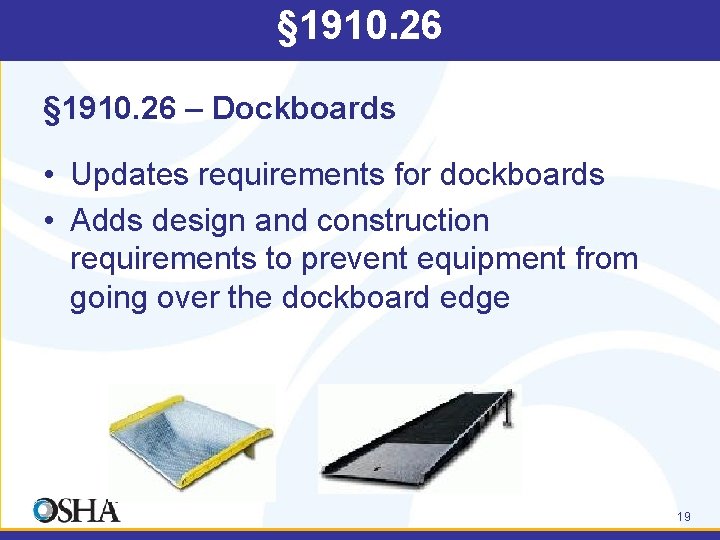
§ 1910. 26 – Dockboards • Updates requirements for dockboards • Adds design and construction requirements to prevent equipment from going over the dockboard edge 19
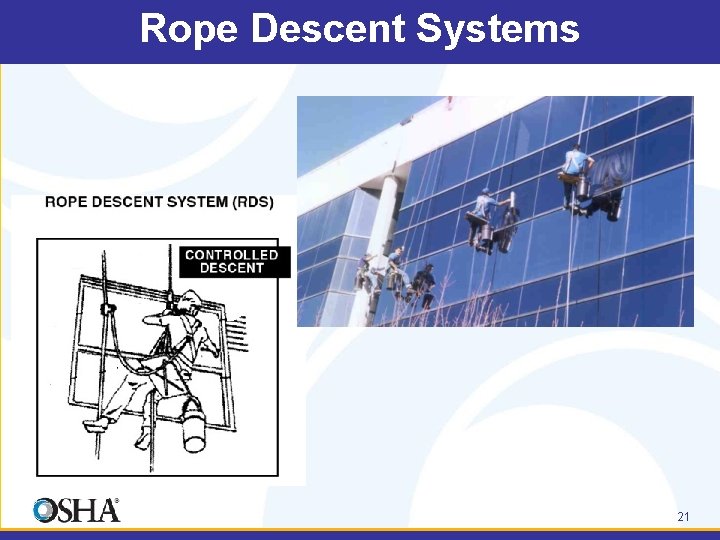
§ 1910. 27 – Scaffolds and Rope Descent Systems (RDS) • Requires that employers using scaffolds follow the construction standard • Adds provision allowing use of RDS, which codifies a 1991 OSHA memo allowing RDS • Requires certification of anchorages starting 1 year after final rule published • Requires RDS have separate fall arrest system 20
Rope Descent Systems 21
§ 1910. 28 – Duty to have fall protection and falling object protection • Consolidates general industry fall protection requirements into one section • Makes requirements and format consistent with construction standard • Incorporates new technology that is consistent with national consensus standards • Gives employers flexibility to use the system that works best to protect workers in their situation 22
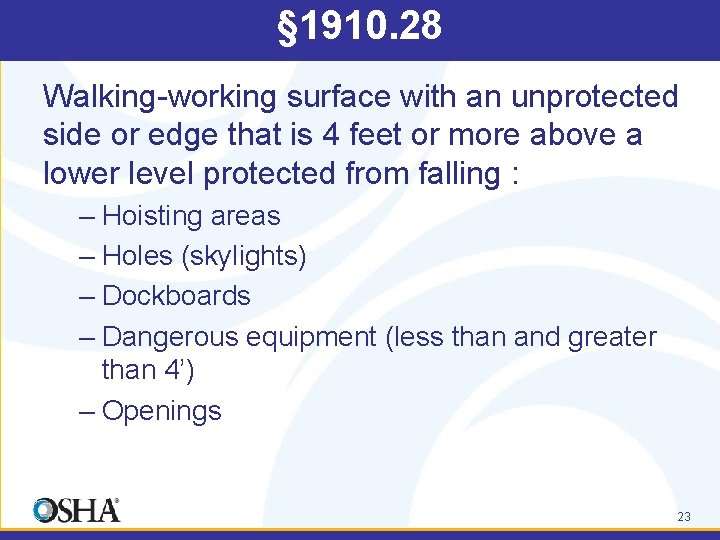
§ 1910. 28 Walking-working surface with an unprotected side or edge that is 4 feet or more above a lower level protected from falling : – Hoisting areas – Holes (skylights) – Dockboards – Dangerous equipment (less than and greater than 4’) – Openings 23
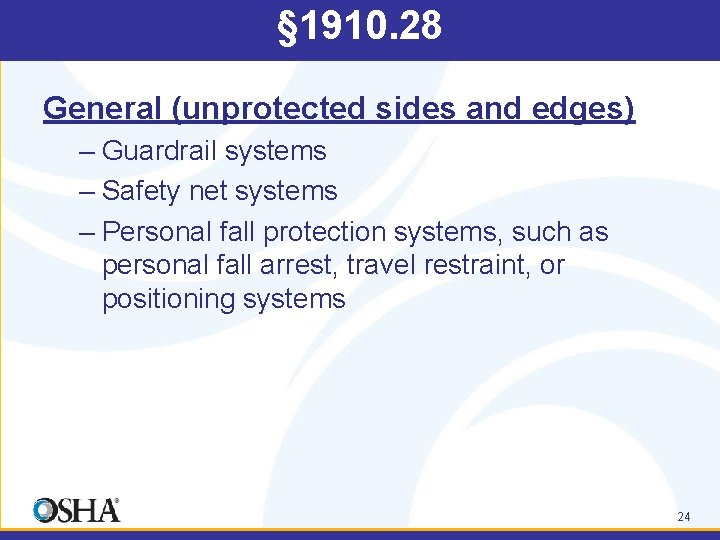
§ 1910. 28 General (unprotected sides and edges) – Guardrail systems – Safety net systems – Personal fall protection systems, such as personal fall arrest, travel restraint, or positioning systems 24
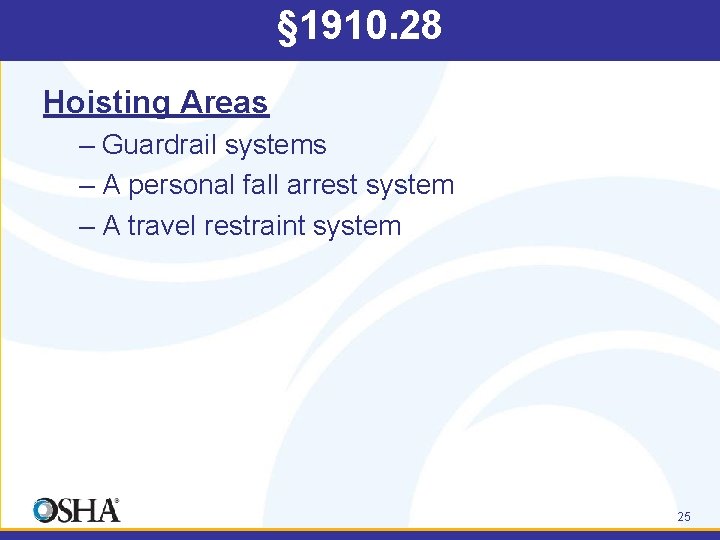
§ 1910. 28 Hoisting Areas – Guardrail systems – A personal fall arrest system – A travel restraint system 25
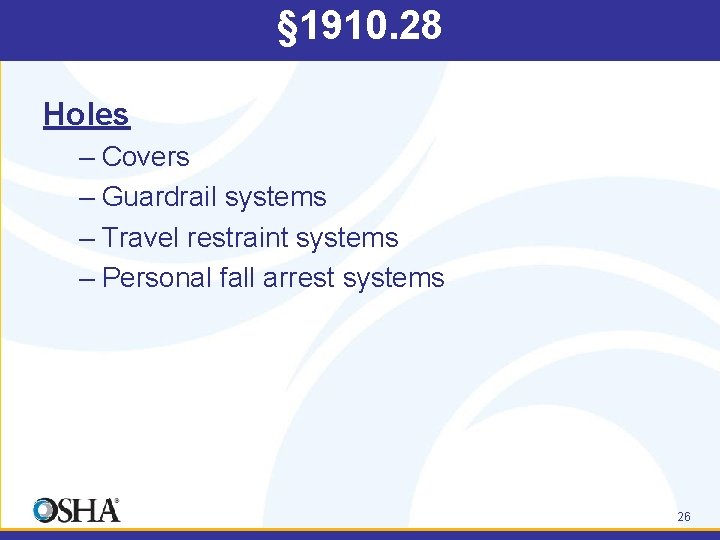
§ 1910. 28 Holes – Covers – Guardrail systems – Travel restraint systems – Personal fall arrest systems 26
§ 1910. 28 Dockboards – Guardrail system or handrails are not required when: • Dockboards are used solely for materials-handling operations using motorized equipment; • Employees engaged in these operations are not exposed to fall hazards greater than 10 feet; and • Those employees have been trained in accordance with § 1910. 30. 27
§ 1910. 28 Runways and similar walkways – Guardrail system 28
§ 1910. 28 Dangerous equipment – Less than 4 feet above dangerous equipment protected by a guardrail system or a travel restraint system, unless the equipment is covered or guarded to eliminate the hazard – 4 feet or more above dangerous equipment must be protected from a fall: • • Guardrail systems Safety net systems Travel restraint systems Personal fall arrest systems 29
§ 1910. 28 Openings – Where the inside bottom edge of the opening is less than 39 inches above that walkingworking surface and the outside bottom edge of the opening is 4 feet or more above a lower level is protected from falling by the use of: • • Guardrail systems Safety net systems Travel restraint systems Personal fall arrest systems 30
§ 1910. 28 Other – Repair pits, service pits, and assembly pits less than 10 feet in depth – Fixed ladders (that extend more than 24 above a lower level) – Outdoor advertising (billboards) – Stairways – Scaffolds and rope descent systems – Slaughtering Facility Platforms – Walking-working surfaces not otherwise addressed – Protection from Falling objects 31
§ 1910. 29 – Fall protection systems criteria Specifies design and installation requirements of each fall protection system available to employers including: • • Guardrails Stair rails Designated areas Safety nets • • Covers Cages and wells Ladder safety systems Toeboards
§ 1910. 30 – Training • Adds training and retraining requirements addressing fall hazards and equipment hazards • Requires employers make training understandable to workers 33
§ 1910. 30 • Before any employee is exposed to a fall hazard, the employer must provide training for each employee who uses personal fall protection systems or who is required to be trained as specified elsewhere in this subpart. Employers must ensure employees are trained in the requirements of this paragraph on or before May 17, 2017 34
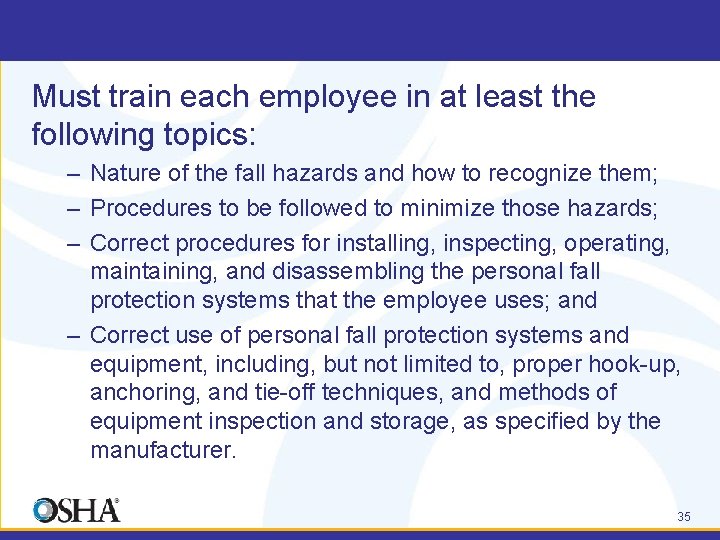
Must train each employee in at least the following topics: – Nature of the fall hazards and how to recognize them; – Procedures to be followed to minimize those hazards; – Correct procedures for installing, inspecting, operating, maintaining, and disassembling the personal fall protection systems that the employee uses; and – Correct use of personal fall protection systems and equipment, including, but not limited to, proper hook-up, anchoring, and tie-off techniques, and methods of equipment inspection and storage, as specified by the manufacturer. 35
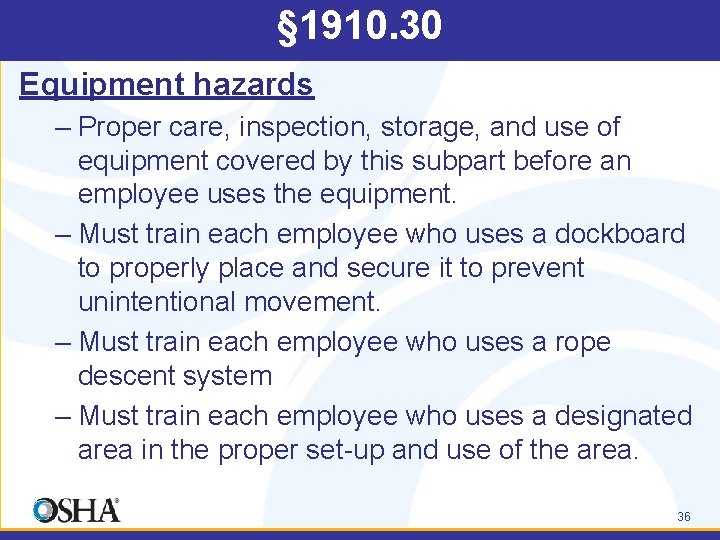
§ 1910. 30 Equipment hazards – Proper care, inspection, storage, and use of equipment covered by this subpart before an employee uses the equipment. – Must train each employee who uses a dockboard to properly place and secure it to prevent unintentional movement. – Must train each employee who uses a rope descent system – Must train each employee who uses a designated area in the proper set-up and use of the area. 36
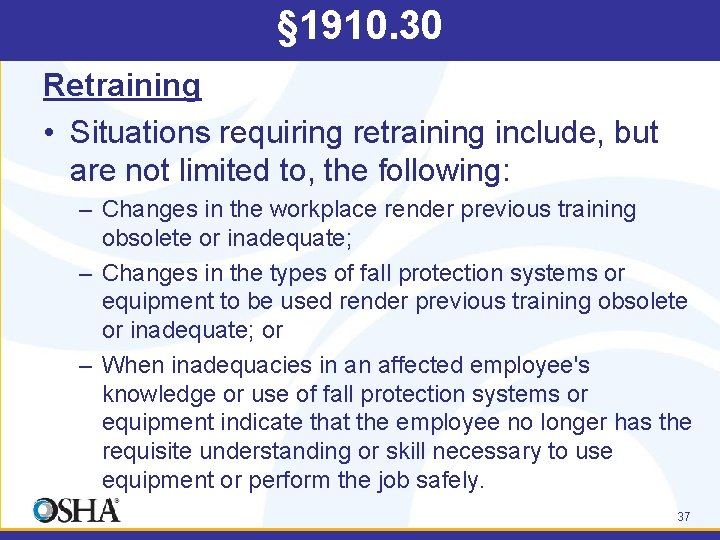
§ 1910. 30 Retraining • Situations requiring retraining include, but are not limited to, the following: – Changes in the workplace render previous training obsolete or inadequate; – Changes in the types of fall protection systems or equipment to be used render previous training obsolete or inadequate; or – When inadequacies in an affected employee's knowledge or use of fall protection systems or equipment indicate that the employee no longer has the requisite understanding or skill necessary to use equipment or perform the job safely. 37
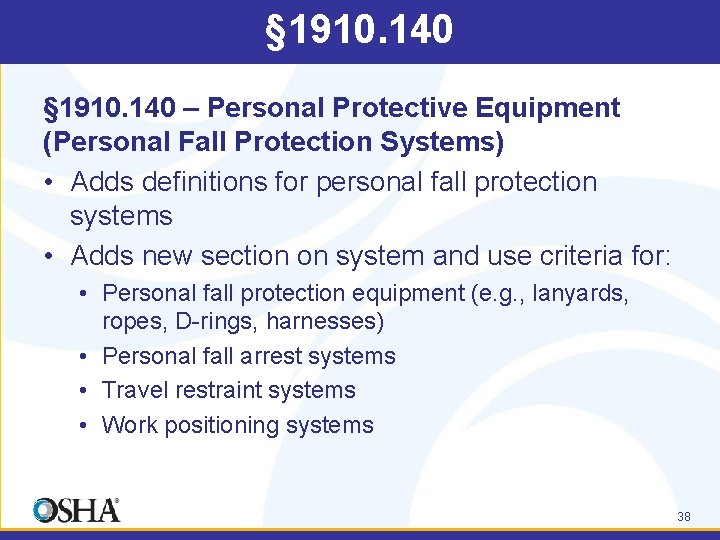
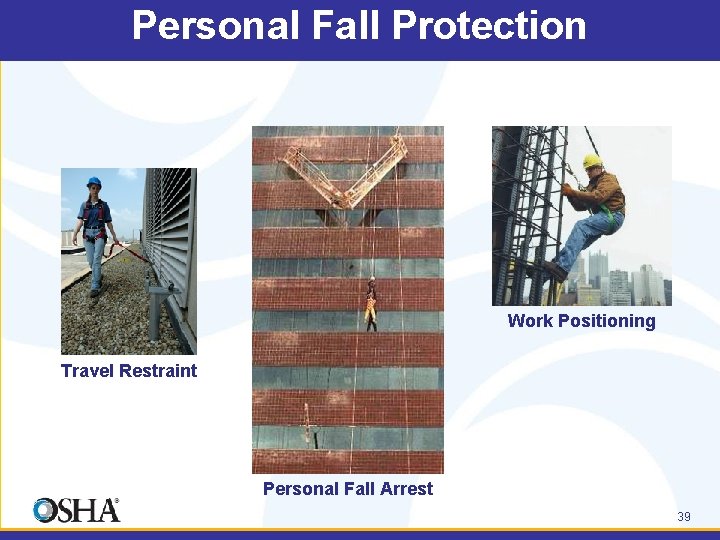
§ 1910. 140 – Personal Protective Equipment (Personal Fall Protection Systems) • Adds definitions for personal fall protection systems • Adds new section on system and use criteria for: • Personal fall protection equipment (e. g. , lanyards, ropes, D-rings, harnesses) • Personal fall arrest systems • Travel restraint systems • Work positioning systems 38
Personal Fall Protection Work Positioning Travel Restraint Personal Fall Arrest 39
Major Changes • Fall Protection Flexibility • Updated Scaffold Requirements • Phase-in of ladder safety systems or personal fall arrest systems on fixed ladders • Phase-out of “qualified climbers” on outdoor advertising structures • Rope descent systems • Adds requirements for personal fall protection equipment (final § 1910. 140) • Adds training requirements 40
Main Effective Dates • • Published: November 18, 2016 Rule overall: January 17, 2017 Training: 6 months after publication Building anchorages for RDS: 1 year after publication • Fixed ladder fall protection: 2 years after publication • Installation of ladder safety system or personal fall arrest system on fixed ladders: 20 years after publication 41
Compliance Assistance Resources • OSHA’s new webpage on subparts D&I: www. osha. gov/walking-working-surfaces/index. html • Fact sheets • FAQs 42
Compliance Assistance Resources • OSHA’s new webpage on subparts D&I: www. osha. gov/walking-working-surfaces/index. html • Fact sheets • FAQs 43