
New ultrasonic technique for the study of the
- Slides: 18
New ultrasonic technique for the study of the properties of track-etched pores in polymer films. Tomás E. Gómez Álvarez-Arenas, Pavel. Yu. Apel, Oleg Orelovitch and Manuel Muñoz. Spanish Research Council (CSIC) Instituto de Acústica and Instituto de Física Aplicada Madrid, Spain. Flerov Laboratory of Nuclear Reactions (JINR) Dubna, Russia. 24 th International Conference on Nuclear Tracks in Solids, Bologna, 1 -5 September 2008
Presentation schedule - Objective of the work -Air-Coupled Ultrasound (AC-US): a new ultrasonic technique. -Basic description of the Ion-Track Membranes (ITM). -Description of the experimental set-up. - How does ultrasonic waves transmit though ITM? -Experimental results. -Conclusions. 24 th International Conference on Nuclear Tracks in Solids, Bologna, 1 -5 September 2008
Objective of the work TO DEMONSTRATE THAT: 1. It is possible to propagate short ultrasound pulses along pore channels in track-etch membranes. 2. This ultrasound propagation is independent of any other propagation mode present in the membrane. 3. It is possible to isolate and sense this propagation. 4. This provides valuable information about the pore channels. Phase and magnitude spectral analysis of air-coupled and wide-band ultrasounds. 24 th International Conference on Nuclear Tracks in Solids, Bologna, 1 -5 September 2008
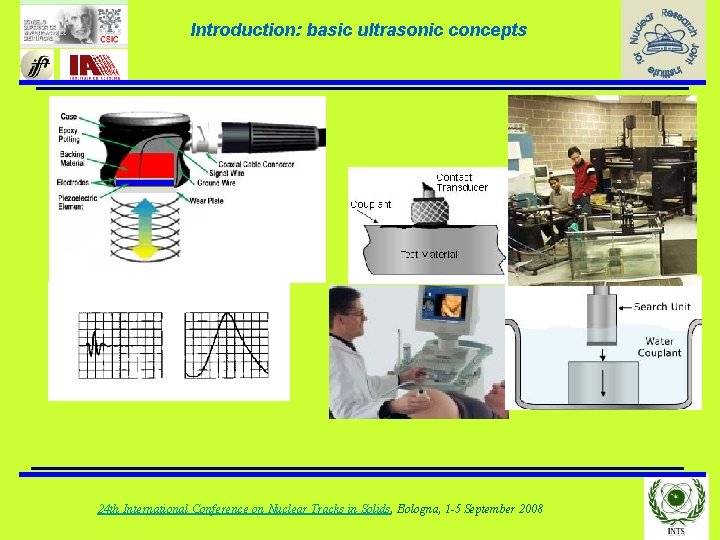
Introduction: basic ultrasonic concepts 24 th International Conference on Nuclear Tracks in Solids, Bologna, 1 -5 September 2008
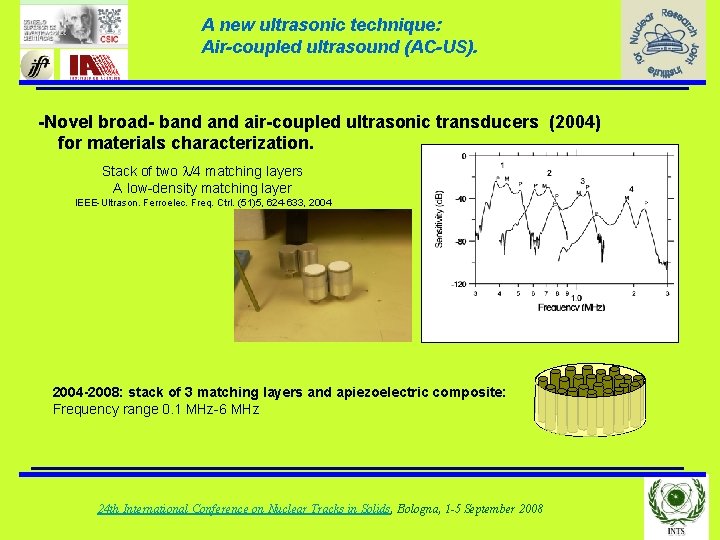
A new ultrasonic technique: Air-coupled ultrasound (AC-US). -Novel broad- band air-coupled ultrasonic transducers (2004) for materials characterization. Stack of two /4 matching layers A low-density matching layer IEEE-Ultrason. Ferroelec. Freq. Ctrl. (51)5, 624 -633, 2004 -2008: stack of 3 matching layers and apiezoelectric composite: Frequency range 0. 1 MHz-6 MHz 24 th International Conference on Nuclear Tracks in Solids, Bologna, 1 -5 September 2008
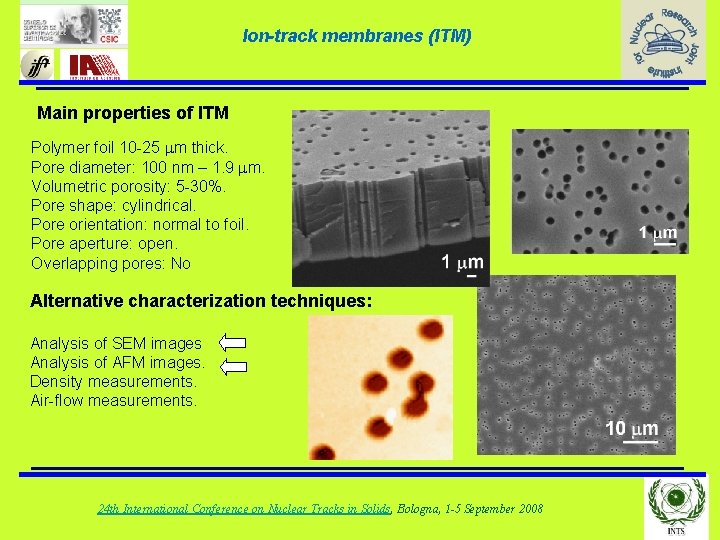
Ion-track membranes (ITM) Main properties of ITM Polymer foil 10 -25 m thick. Pore diameter: 100 nm – 1. 9 m. Volumetric porosity: 5 -30%. Pore shape: cylindrical. Pore orientation: normal to foil. Pore aperture: open. Overlapping pores: No Alternative characterization techniques: Analysis of SEM images Analysis of AFM images. Density measurements. Air-flow measurements. 24 th International Conference on Nuclear Tracks in Solids, Bologna, 1 -5 September 2008
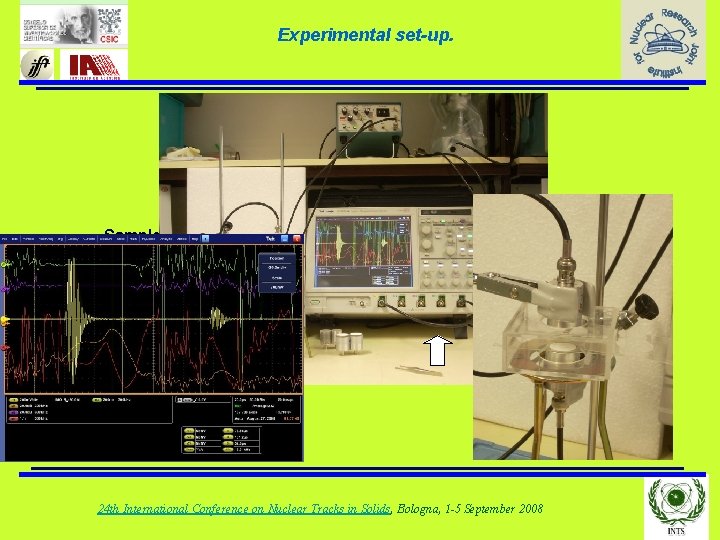
Experimental set-up. Pulser/receiver Transmitter tr. Sample Holder Digital oscilloscope Receiver tr. Transducers holder 24 th International Conference on Nuclear Tracks in Solids, Bologna, 1 -5 September 2008
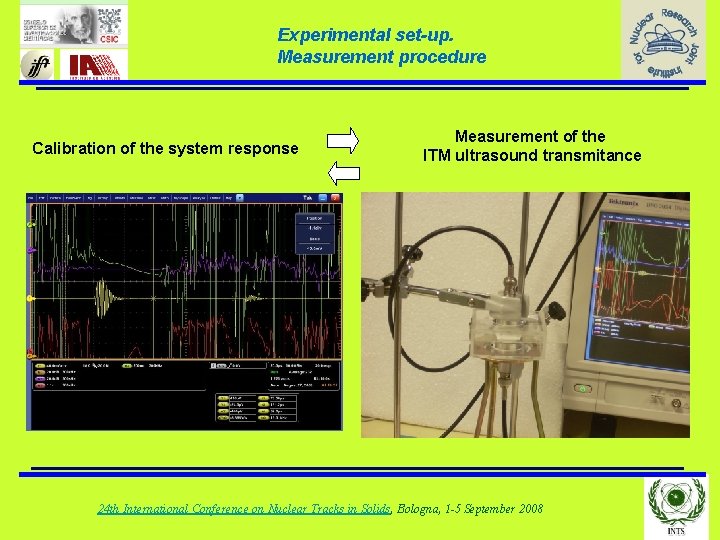
Experimental set-up. Measurement procedure Calibration of the system response Measurement of the ITM ultrasound transmitance 24 th International Conference on Nuclear Tracks in Solids, Bologna, 1 -5 September 2008
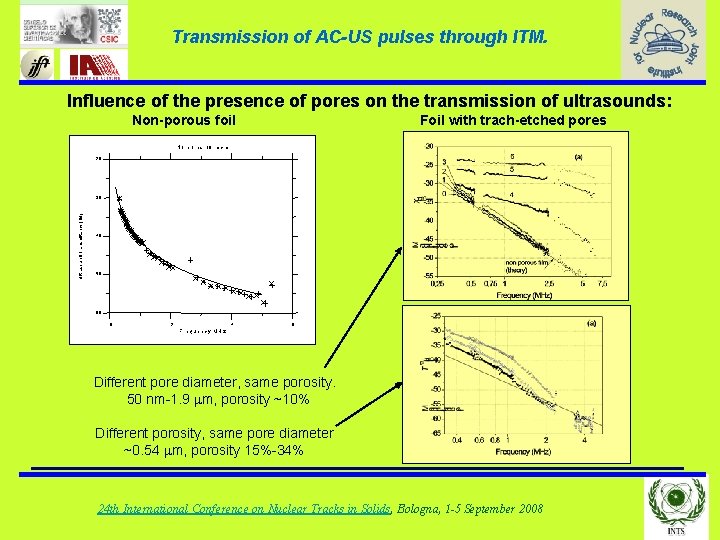
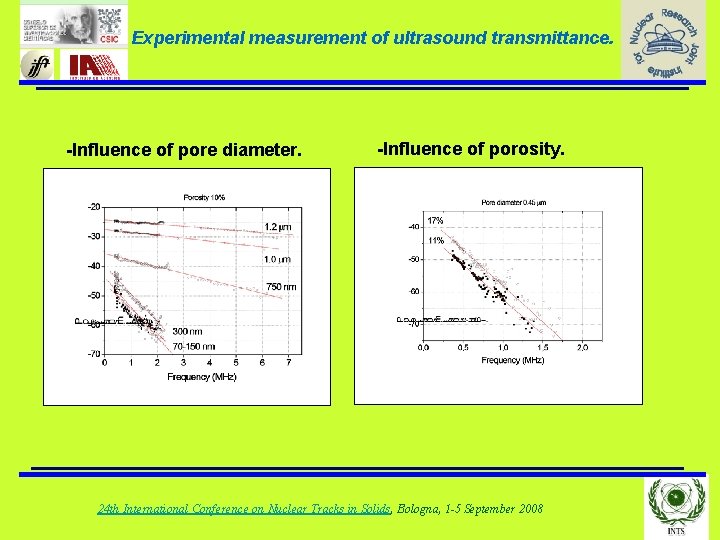
Transmission of AC-US pulses through ITM. Influence of the presence of pores on the transmission of ultrasounds: Non-porous foil Foil with trach-etched pores N o pores 10 m c m -20 i Ultrasound Transmitance (d. B) -30 -40 -50 -60 0 2 4 6 F re q ue n c y M H z Different pore diameter, same porosity. 50 nm-1. 9 m, porosity ~10% Different porosity, same pore diameter ~0. 54 m, porosity 15%-34% 24 th International Conference on Nuclear Tracks in Solids, Bologna, 1 -5 September 2008
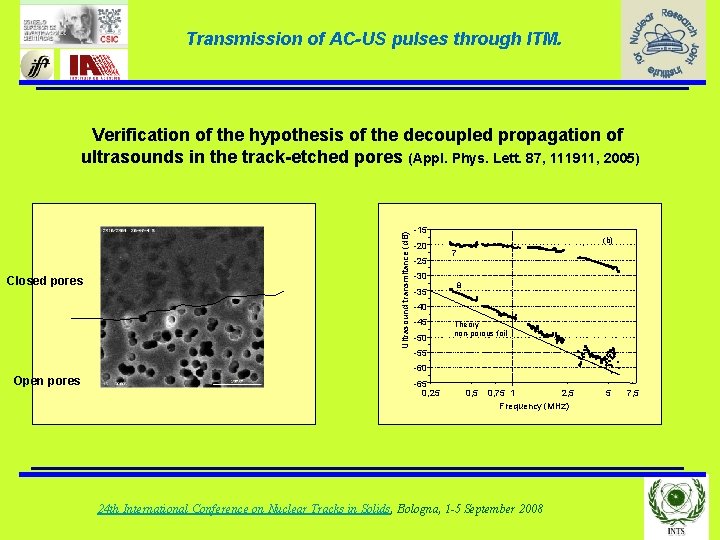
Transmission of AC-US pulses through ITM. Closed pores Ultrasound transmitance (d. B) Verification of the hypothesis of the decoupled propagation of ultrasounds in the track-etched pores (Appl. Phys. Lett. 87, 111911, 2005) -15 -20 -25 -30 -35 (b) 7 8 -40 -45 -50 Theory non-porous foil -55 -60 Open pores -65 0, 25 0, 75 1 2, 5 Frequency (MHz) 24 th International Conference on Nuclear Tracks in Solids, Bologna, 1 -5 September 2008 5 7, 5
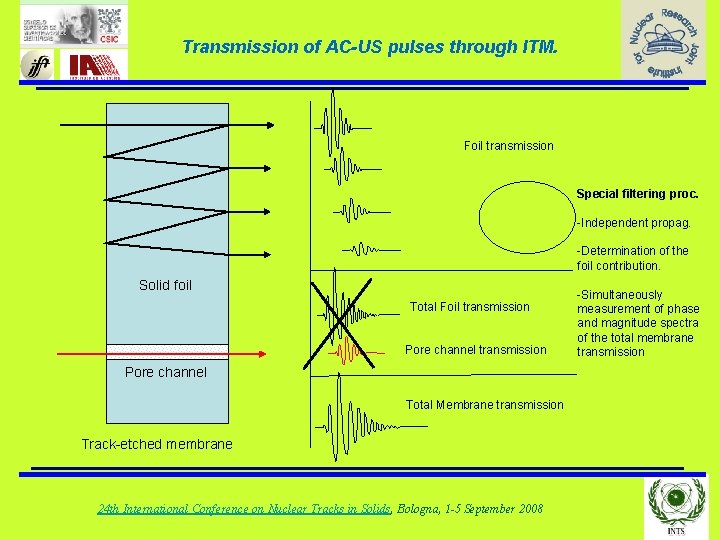
Transmission of AC-US pulses through ITM. Foil transmission Special filtering proc. -Independent propag. -Determination of the foil contribution. Solid foil Total Foil transmission Pore channel Total Membrane transmission Track-etched membrane 24 th International Conference on Nuclear Tracks in Solids, Bologna, 1 -5 September 2008 -Simultaneously measurement of phase and magnitude spectra of the total membrane transmission
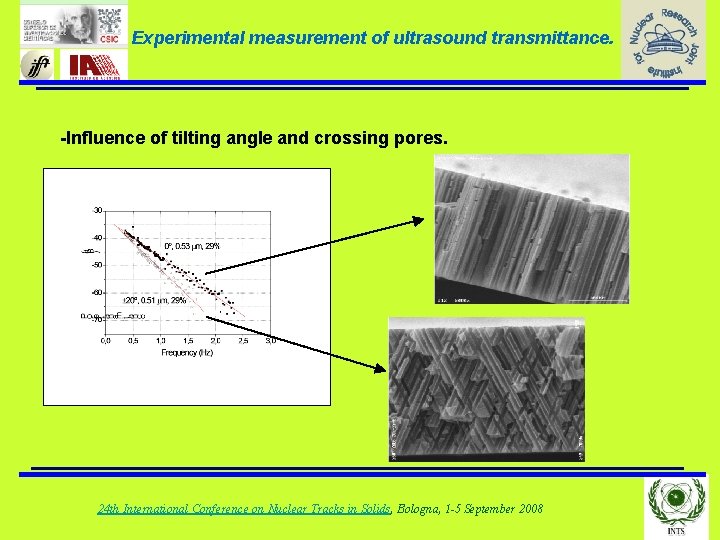
Transmission of AC-US pulses through ITM. Factors that affect the propagation of ultrasounds in the Track-etched pores Pore diameter. Pore sinuosity. Crossing pores. Pore tortuosity. L’ L Pore aperture at the interface L’=L/cos L Open pore Closed pore 24 th International Conference on Nuclear Tracks in Solids, Bologna, 1 -5 September 2008
Experimental measurement of ultrasound transmittance. -Influence of pore diameter. -Influence of porosity. 24 th International Conference on Nuclear Tracks in Solids, Bologna, 1 -5 September 2008
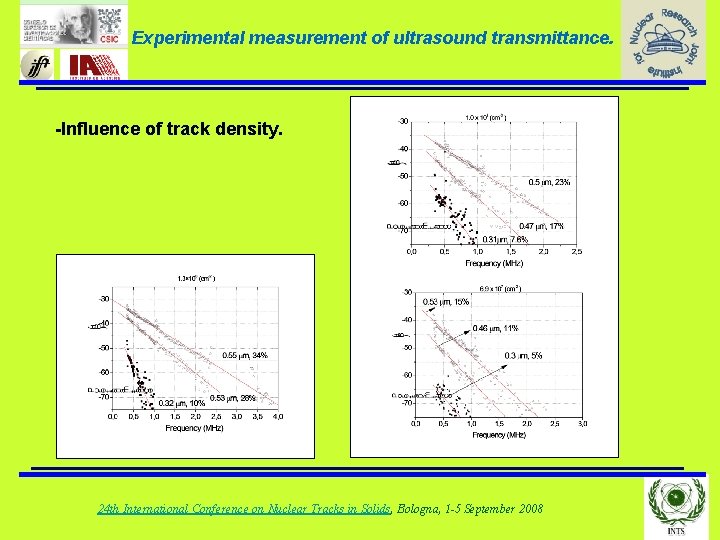
Experimental measurement of ultrasound transmittance. -Influence of track density. 24 th International Conference on Nuclear Tracks in Solids, Bologna, 1 -5 September 2008
Experimental measurement of ultrasound transmittance. -Influence of tilting angle and crossing pores. 24 th International Conference on Nuclear Tracks in Solids, Bologna, 1 -5 September 2008
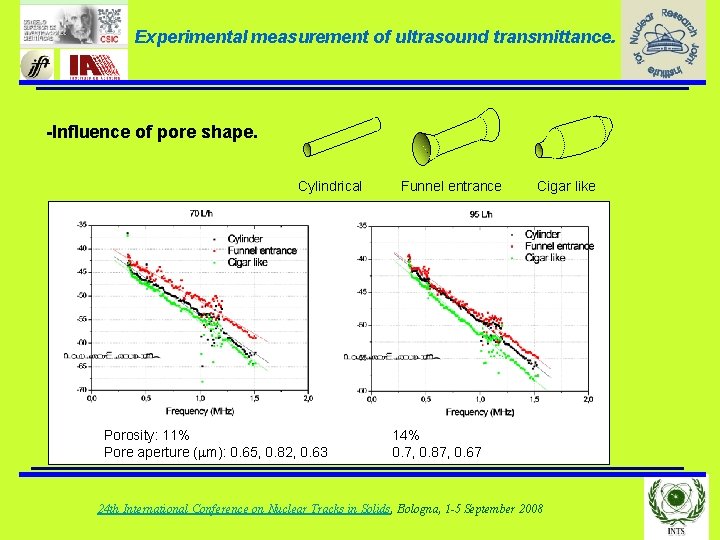
Experimental measurement of ultrasound transmittance. -Influence of pore shape. Cylindrical Porosity: 11% Pore aperture ( m): 0. 65, 0. 82, 0. 63 Funnel entrance Cigar like 14% 0. 7, 0. 87, 0. 67 24 th International Conference on Nuclear Tracks in Solids, Bologna, 1 -5 September 2008
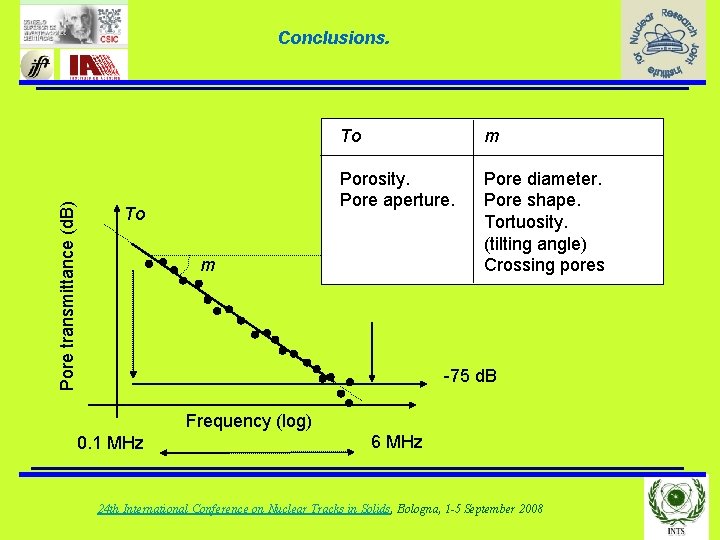
Pore transmittance (d. B) Conclusions. To To m Porosity. Pore aperture. Pore diameter. Pore shape. Tortuosity. (tilting angle) Crossing pores m -75 d. B Frequency (log) 0. 1 MHz 6 MHz 24 th International Conference on Nuclear Tracks in Solids, Bologna, 1 -5 September 2008
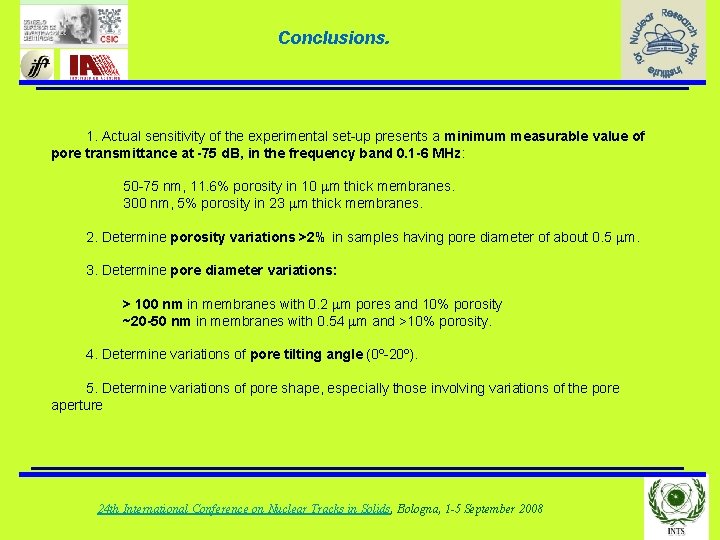
Conclusions. 1. Actual sensitivity of the experimental set-up presents a minimum measurable value of pore transmittance at -75 d. B, in the frequency band 0. 1 -6 MHz: 50 -75 nm, 11. 6% porosity in 10 m thick membranes. 300 nm, 5% porosity in 23 m thick membranes. 2. Determine porosity variations >2% in samples having pore diameter of about 0. 5 m. 3. Determine pore diameter variations: > 100 nm in membranes with 0. 2 m pores and 10% porosity ~20 -50 nm in membranes with 0. 54 m and >10% porosity. 4. Determine variations of pore tilting angle (0º-20º). 5. Determine variations of pore shape, especially those involving variations of the pore aperture 24 th International Conference on Nuclear Tracks in Solids, Bologna, 1 -5 September 2008