
New Types of Physics Competitions for Secondary School

- Slides: 33
New Types of Physics Competitions for Secondary School Students Dr. Zsuzsanna Rajkovits and Árpád Drozdy Department of General Physics Eötvös University, Budapest, Hungary
Importance of the competitions • open new possibilities to extend the students’ knowledge in physics and other sciences • prove the individual abilities of students • their capability to work in a team • students’ results are in connection with the educational and scientific level of the participating countries
International Physics Competitions • International Physics Olympiad IPh. O • International Conference of Young Scientists ICYS • International Young Physicists’ Tournament IYPT
International Conference of Young Scientists (ICYS) • Founders: Eötvös University, Budapest, Hungary, Zsuzsanna Rajkovits (email: rajzsu@ludens. elte. hu) Belarus State University, Minsk, Belarus, Leonid Markovich (email: markovich@bsu. by) • (http: //metal. elte. hu/~icys)
The aim of the organizers • to acquaint the secondary school students with the methods of scientific research - from the pointing up the topic - to summing up the results of the research in a foreign-language lecture • to give challenging opportunity for the young scientists to measure their strength in an international field
Individual competition (one lecturer) • • physics mathematics computer science (robotic) environmental sciences (ecology) (as applied chemistry, physics, biology, geology, meteorology)
Characteristic features of ICYS • research report (ten-minute) • subject chosen from any part of the mentioned sciences • language: English • short scientific discussion • international jury • prefer experimental investigation
History of ICYS 1994 -2002 • Participating countries: Belarus, Hungary, Russia, Ukraine, Georgia, Yugoslavia, The Netherlands, Greece, Macedonia, Singapore, Poland, Slovakia, Czech Republic, India, USA, Germany, Finland • Lectures: yearly approximately 60 -70 lectures • Participants: annually about 100 -120 • Participation fee: 100 USD/person • Duration of ICYS: nearly a week
Organizers of ICYS Hungary, Visegrád (1994, 1996, 1998) Belarus, Baranavichi (1995, 1997, 1999) The Netherlands, Nijmegen (2000) Poland, Katowice (2001) Georgia, Kutaisi (2002) Czech Republic, Prague (2003) The next potential organizers: The Netherlands, Nijmegen (2004) Poland, Katowice (2005) Germany (2006)
Importance in teaching the students • to do research work • to present their own results • to formulate research reports in foreign languages • to write contribution
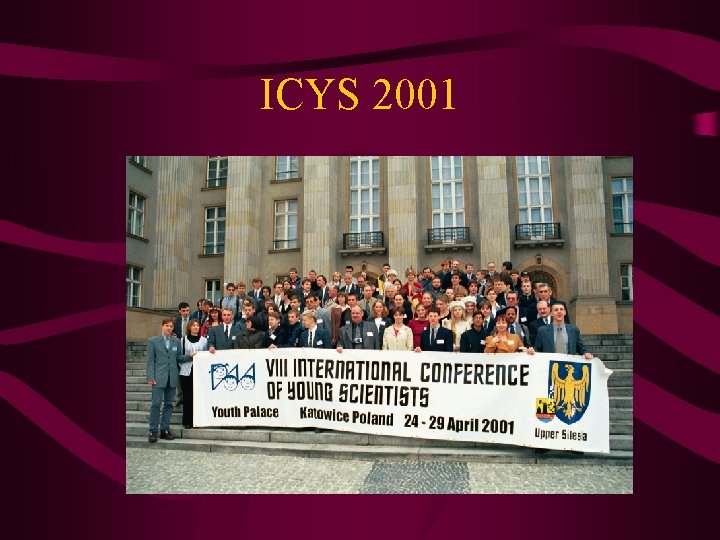
ICYS 2001
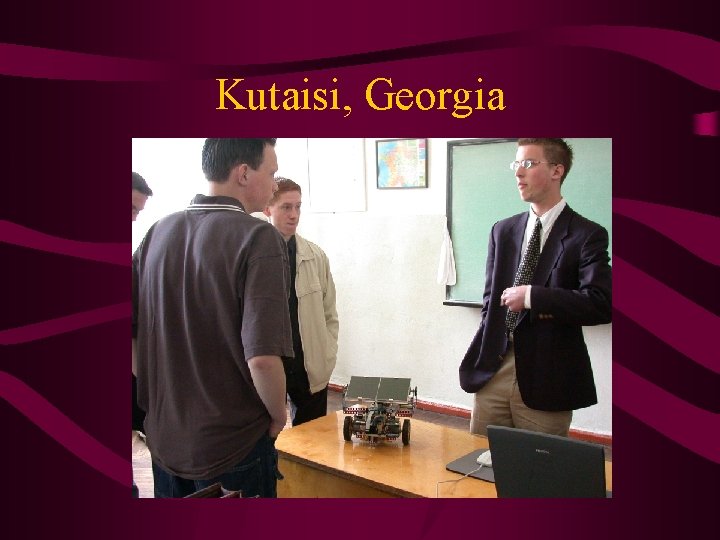
Kutaisi, Georgia
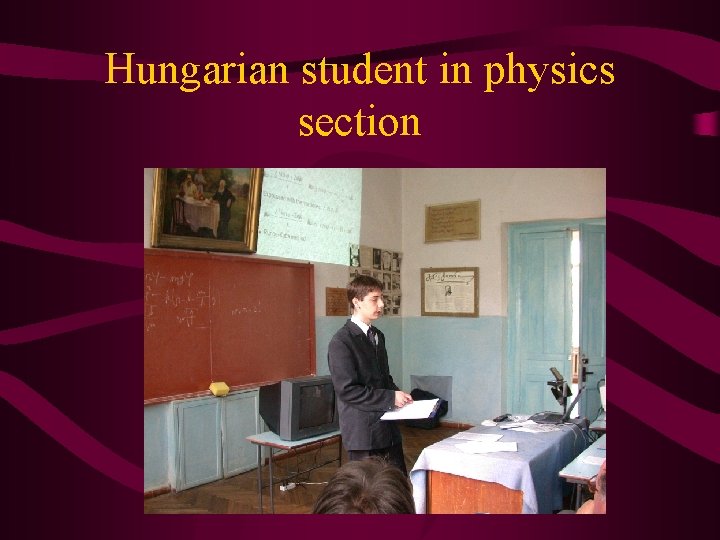
Hungarian student in physics section
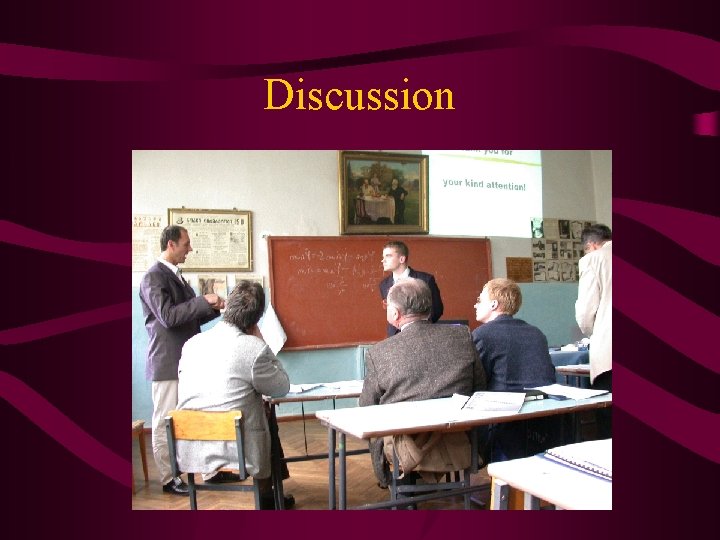
Discussion
IYPT in Hungary • Hungarian team’s preparatory work: Eötvös University, Department of General Physics, Budapest • Organization of IYPT 13 th IYPT 2000 Budapest, Hungary
Preparatory work in Hungary • Publication of the problems in Hungarian language (KöMa. L, Mathematical and Physical Journal for Secondary School Students) (November, December) • sending of the solutions (March, April) (3 -4 solutions for every student) • selection of the students (March, April) presentation of a solved problem in English, jury • composition of the Hungarian team
Intensive traning of the team Eötvös University, Budapest • • • lectures (university professors, specialists) experimenting (video recording) learning to work in TEAM modelling of the phenomenon formulation the reports (each team member is responsible for 3 -4 problems ) • presentation of lectures
Problems of IYPT • Kapitza's school's problems (open-ended problems) • from every day life and nature • from various fields of physics • from the boundary areas of physics with other sciences • „up-to date” problems (nowadays investigated)
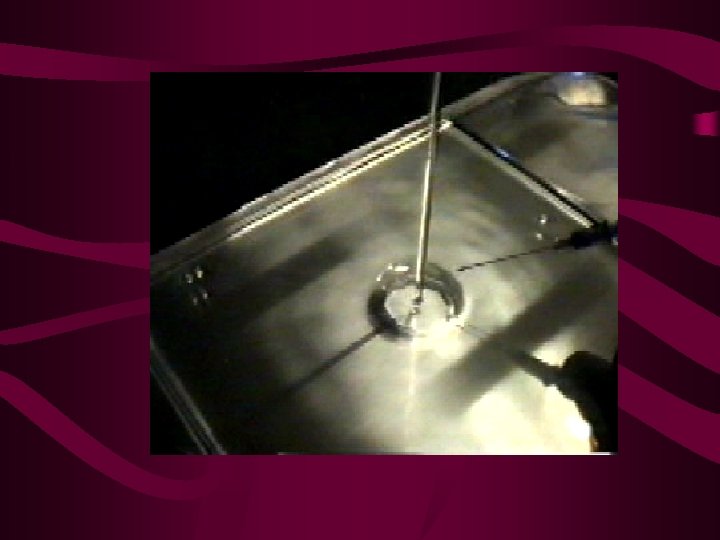
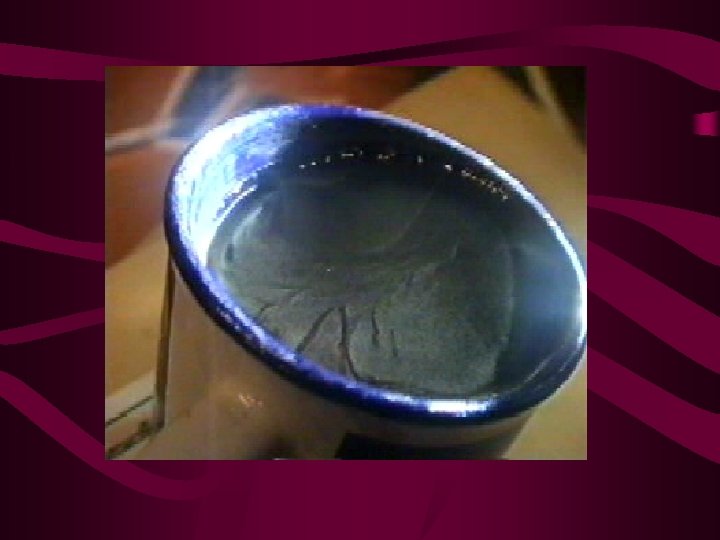
Everyday life and nature Jet-spread A water jet falling onto a horizontal plane spreads out radially. At some distance from the center the thickness of the layer increases dramatically. Explain the phenomenon. Tea cup If one fills a cup with hot tea, a thin layer of steam emerges above the surface. One can see that some parts of the steam layer disapper suddenly and reapper after a few seconds. Investigate and explain this phenomenon.
„Up-to-date” problems Liquid fingers When a layer of hot salt solution lies above a layer of cold water, the interface between the two layers becomes unstable and a structure resembling fingers develops in the fluid. Investigate and explain this phenomenon. Coloured sand Allow a mixture of differently coloured, granular materials to trickle into a transparent, narrow container. The materials build up in distinct bands. Investigate and explain this phenomenon.
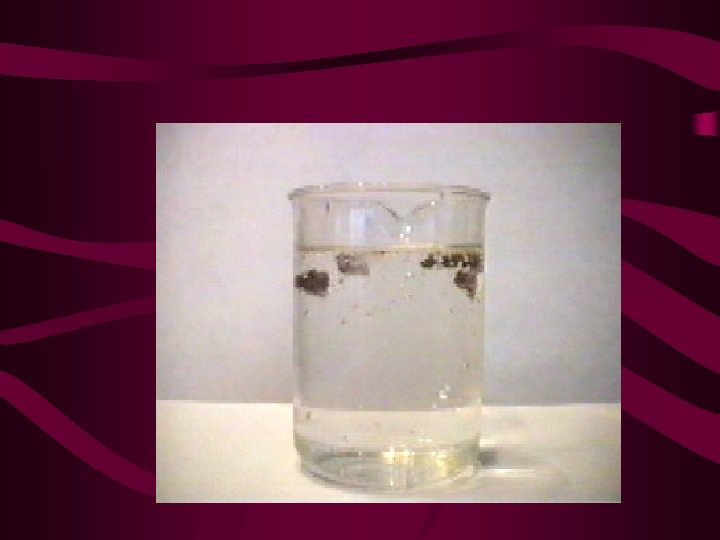
Various fields of physics Flotation A piece of chocolate, which is dropped into a glass of soda water, periodically sinks and goes back to the surface. Investigate the dependence of the period of these oscillations on various parameters. Coherer It is known that a glass tube with two electrodes and metallic filing between them (coherer) has different resistance in d. c. and a. c. current. Investigate the frequency dependence of coherer's resistance!
Boundary areas of physics with other sciences Blue blood Human blood is known to be red, but the veins seem to be blue. Explain this phenomenon and illustrate it by a model. Aspen leaf Even in windless weather aspen leaves tremble slightly. Why does an aspen leaf tremble?
Solution of a problem • • the problems seem simple solution is difficult own approach and method, creativity the solution developed during discussion
Students need our help: • in finding appropriate literature • in learning things which are not in the plan of physics education in the secondary schools • in making some experiments by devices which they do not have in their schools • in the composition of the report • in writing an article
Successful participation (team composition) • • experimental work theoretical consideration applying the information technology skill in presentation
Educational value of the competitions • working method is similar to the methods of the research work in science • team work • successful future career • friendship • beginning of an international co-operation • acquaintance with different countries, cultures, traditions
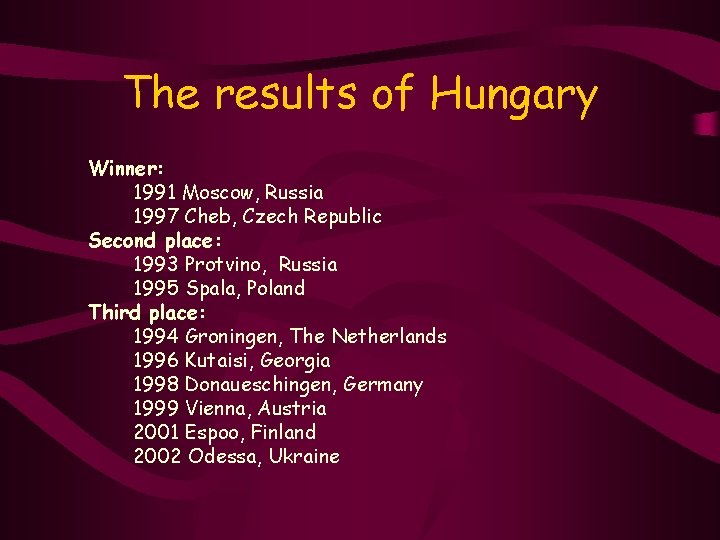
The results of Hungary Winner: 1991 Moscow, Russia 1997 Cheb, Czech Republic Second place: 1993 Protvino, Russia 1995 Spala, Poland Third place: 1994 Groningen, The Netherlands 1996 Kutaisi, Georgia 1998 Donaueschingen, Germany 1999 Vienna, Austria 2001 Espoo, Finland 2002 Odessa, Ukraine
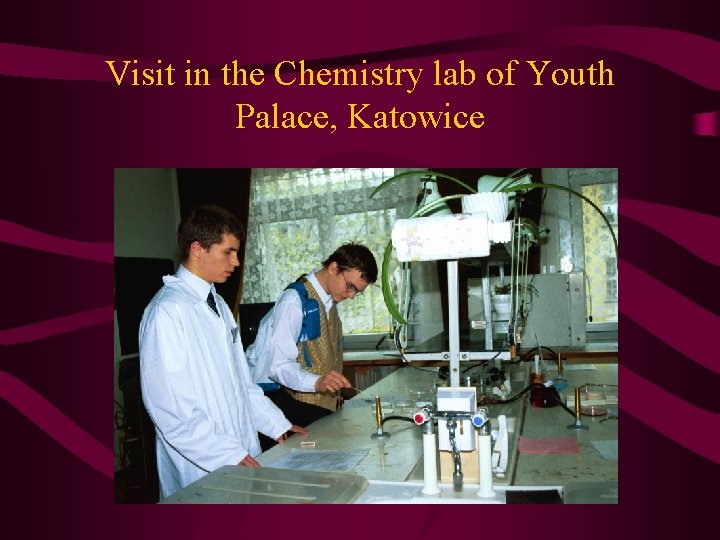
Visit in the Chemistry lab of Youth Palace, Katowice
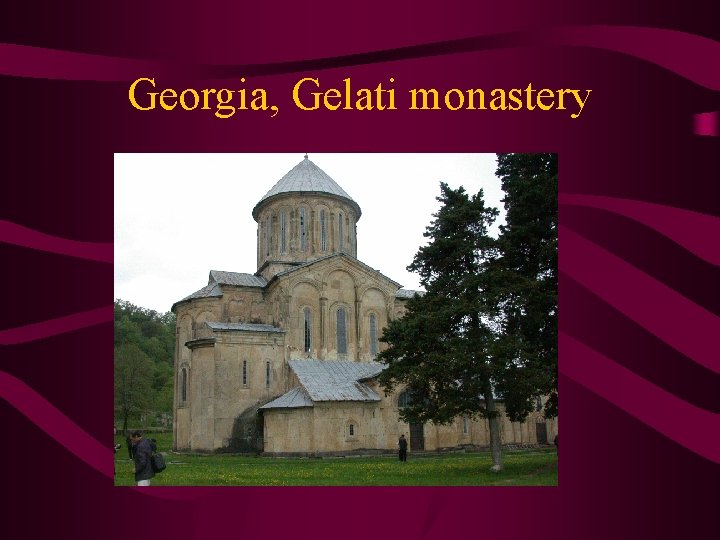
Georgia, Gelati monastery
Georgia, Kutaisi, tradition