
New TSA standards What do they mean for
- Slides: 13
New TSA standards - What do they mean for involving customers Yvonne Davies Scrutiny & Empowerment Partners 2 nd February 2012
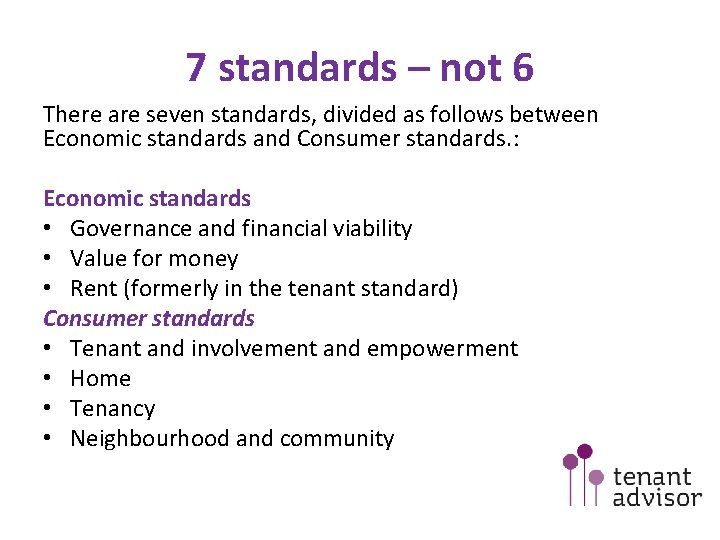
7 standards – not 6 There are seven standards, divided as follows between Economic standards and Consumer standards. : Economic standards • Governance and financial viability • Value for money • Rent (formerly in the tenant standard) Consumer standards • Tenant and involvement and empowerment • Home • Tenancy • Neighbourhood and community
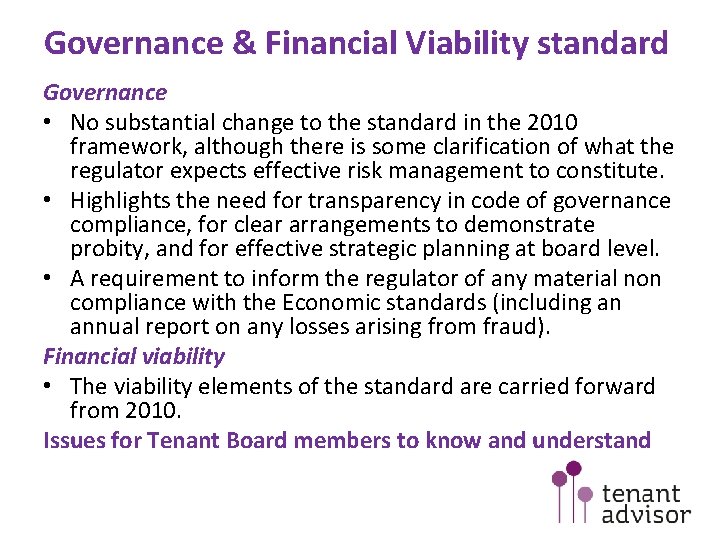
Governance & Financial Viability standard Governance • No substantial change to the standard in the 2010 framework, although there is some clarification of what the regulator expects effective risk management to constitute. • Highlights the need for transparency in code of governance compliance, for clear arrangements to demonstrate probity, and for effective strategic planning at board level. • A requirement to inform the regulator of any material non compliance with the Economic standards (including an annual report on any losses arising from fraud). Financial viability • The viability elements of the standard are carried forward from 2010. Issues for Tenant Board members to know and understand
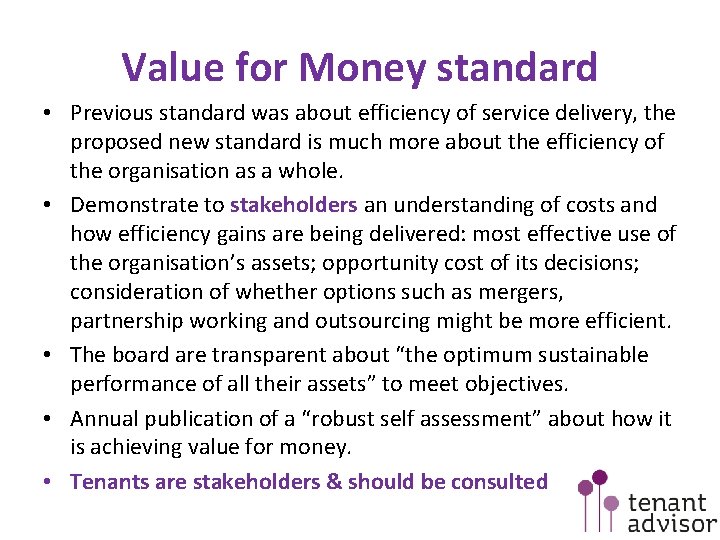
Value for Money standard • Previous standard was about efficiency of service delivery, the proposed new standard is much more about the efficiency of the organisation as a whole. • Demonstrate to stakeholders an understanding of costs and how efficiency gains are being delivered: most effective use of the organisation’s assets; opportunity cost of its decisions; consideration of whether options such as mergers, partnership working and outsourcing might be more efficient. • The board are transparent about “the optimum sustainable performance of all their assets” to meet objectives. • Annual publication of a “robust self assessment” about how it is achieving value for money. • Tenants are stakeholders & should be consulted
Rent standard and guidance • The revised regulatory framework, read alongside the separately-published Annex E (Rent Standard Guidance), confirms that the approach to increasing social rents remains in line with the rent restructuring guidance that was issued in 2001. The annex confirms that rents can be increased by a limit of the Retail Price Index (RPI) + 0. 5% in a single year. • Rent increases from 1 April 2012, for example, this means that the relevant rate is 6. 1% comprising RPI at 5. 6%+0. 5%. A big rent increase on its way this year – needs a discussion with tenants
Tenant Inv. &empowerment standard • Requirement to provide mechanisms for tenants to influence and be involved in housing management and service delivery. (Scrutiny) • The requirement to provide tenants with timely and accessible information about the landlord’s performance (among other matters) has been moved into this standard (it was formerly in the Neighbourhoods and Community standard). • There is a significant new requirement, however, to allow tenants the opportunity to be involved in undertaking a range of repair tasks, and to share in savings made. Cashback scheme) Expected changes to increase scrutiny and consult on Cashback
Home standard • It reiterates the Decent Homes Standard (DHS), although this is very much a minimum requirement and landlords will need to meet any higher standards of design and quality that applied when the home was built if these were required as a condition of public funding. when deciding to develop to higher standards. • The standard clarifies the regulator’s power to grant a temporary waiver who do not meet DHS No news here
Tenancy Standard (Tenure) • Grant tenancies compatible with purpose of accommodation, the needs of individual households, the sustainability of the community, and the efficient use of their housing stock. Providers are required to have clear policies about the tenancies they will grant. • Free to use traditional full assured periodic (so-called “lifetime”) tenancies • The policy should take account of the needs of vulnerable households. • No requirement that a tenancy policy should be the same in all types of housing or in all the areas in which the landlord operates. • Use of fixed-term tenancies is no longer restricted to property let at Affordable Rents: in other words = no linkage between rent levels and tenure type. • Policy about circumstances in which extension to the terms is granted Landlords must formulate a policy on succession • Internal appeal mechanisms allowing tenants to challenge decisions Support to tenants to understand tenure changes and to influence new policies
Tenancy Standard (Allocations) • Providers must sign up with at least one of the four major online house swap providers that currently make up Home. Swap Direct. • Landlords are obliged to provide tenants with free access to a single internet-based mutual exchange service - not several. If a tenant, by using the service provided by his or her landlord, discovers several matches with properties hosted by other providers, there is no obligation on the landlord to pay the costs of subscribing to additional services so the tenant can view them. • Landlords must take "reasonable steps" to publicise this service and provide "reasonable support" to help tenants who do not have internet access to use the service. Support to tenants to understand changes to allocations and to mutual exchanges and to influence new policies
Neighbourhood & Community standard • The requirement for local area co-operation now refers to “relevant partners” rather than specifically to Local Strategic Partnerships. • Requirements on housing associations to set out in an annual report how they are meeting their obligations under this standard have been removed No big changes
Economic standards • Economic standards – apply to HAs • Organisations with no indication of risk can expect minimal levels of regulatory engagement. • Whilst not prescribing procedures, the regulator seeks regular returns and assurances on financial health, strength and liquidity. • Regulatory assessments will continue to be published for providers with more than 1000 units.
Consumer standards • Landlords’ governing bodies are responsible for compliance and “the regulator has no role in monitoring providers’ performance or compliance. ” • No day-to-day regulatory involvement in housing management and service delivery. • The regulator’s enforcement powers are available only if it thinks that the breach of a standard will give rise to actual or potential “serious detriment” to tenants or applicants for housing.
Has anyone consulted tenants? Has anyone started work on new policies? yvonne@tenantadvisor. net 07867974659