
New Testament Background I General BackgroundThe entrance of
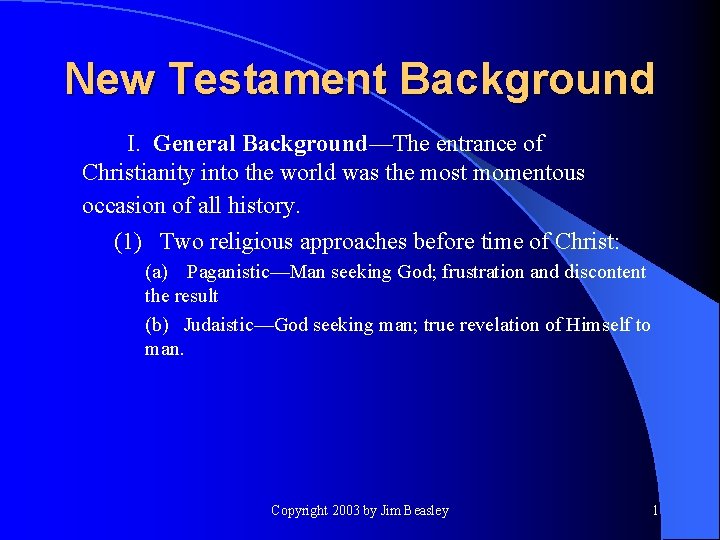
New Testament Background I. General Background—The entrance of Christianity into the world was the most momentous occasion of all history. (1) Two religious approaches before time of Christ: (a) Paganistic—Man seeking God; frustration and discontent the result (b) Judaistic—God seeking man; true revelation of Himself to man. Copyright 2003 by Jim Beasley 1
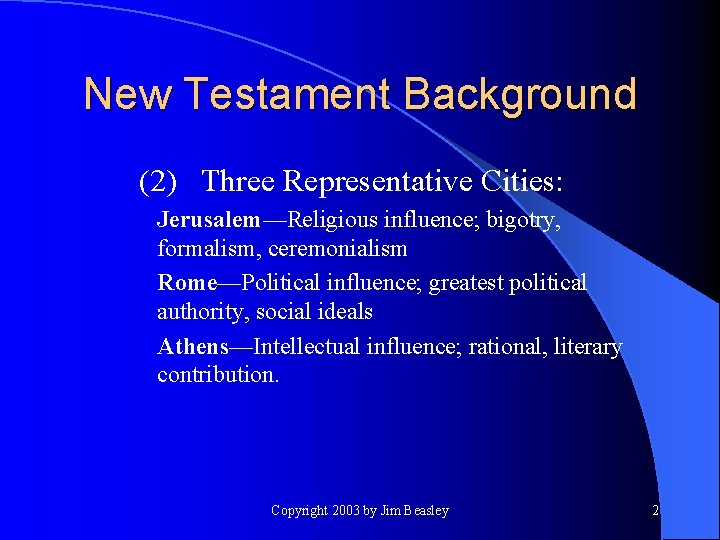
New Testament Background (2) Three Representative Cities: Jerusalem—Religious influence; bigotry, formalism, ceremonialism Rome—Political influence; greatest political authority, social ideals Athens—Intellectual influence; rational, literary contribution. Copyright 2003 by Jim Beasley 2
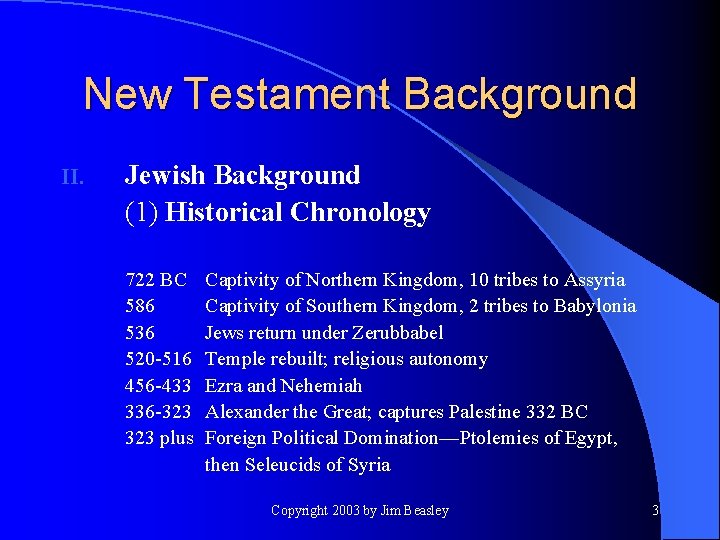
New Testament Background II. Jewish Background (1) Historical Chronology 722 BC 586 536 520 -516 456 -433 336 -323 plus Captivity of Northern Kingdom, 10 tribes to Assyria Captivity of Southern Kingdom, 2 tribes to Babylonia Jews return under Zerubbabel Temple rebuilt; religious autonomy Ezra and Nehemiah Alexander the Great; captures Palestine 332 BC Foreign Political Domination—Ptolemies of Egypt, then Seleucids of Syria Copyright 2003 by Jim Beasley 3
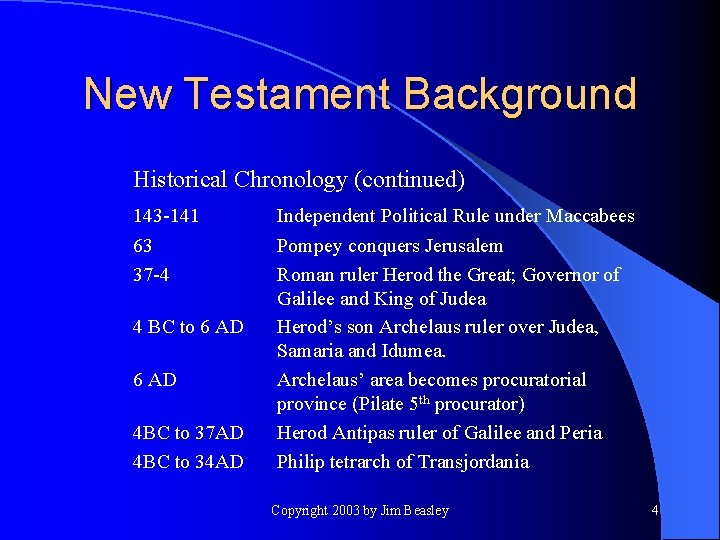
New Testament Background Historical Chronology (continued) 143 -141 63 37 -4 4 BC to 6 AD 4 BC to 37 AD 4 BC to 34 AD Independent Political Rule under Maccabees Pompey conquers Jerusalem Roman ruler Herod the Great; Governor of Galilee and King of Judea Herod’s son Archelaus ruler over Judea, Samaria and Idumea. Archelaus’ area becomes procuratorial province (Pilate 5 th procurator) Herod Antipas ruler of Galilee and Peria Philip tetrarch of Transjordania Copyright 2003 by Jim Beasley 4
New Testament Background (2) Results of Jewish Captivities (a) (b) (c) (d) (e) (f) (g) The dispersion of the Jews (Diaspora) to Mesopotamian valley, Egypt, Africa, Asia Minor and Arabia. Jews of captivity cured of tendency to paganism and idolatry. Monotheism thoroughly entrenched in Jewish mind. Jews attracted by Persian cults and dualism and The law and the rest of the Scriptures become the center of national life Growth of the Messianic hope as the only solution to national problems. Beginning and development of the synagogue and of the class known as scribes. Copyright 2003 by Jim Beasley 5
New Testament Background (3) Rise of Jewish Religious Parties. (a) The Pharisees—Orthodox party, literal interpretation of Scriptures, attached to the synagogue, religious and academic aristocracy. Beliefs: (i) Immortality of soul, resurrection of dead, punishment and rewards. (ii) Good and bad angels. (iii) Added traditions to Old Testament. (iv) Stressed minutae of the Law. Copyright 2003 by Jim Beasley 6
New Testament Background (b) The Saducees—Liberal party, priestly, political and social aristocracy. Attached to the temple, chief priests from this group. Beliefs: (i) No after-life (ii) No angels (iii) Rested on Old Testament alone, rejected tradition (iv) Not strict about Old Testament laws (c) The Essenes—Ascetic party, separatist, precursors of the monastics. Copyright 2003 by Jim Beasley 7
New Testament Background (4) Literary and Philosophical Efforts (a) Despite Jewish resistance, Hellenization attracted many Jews. (b) Steps in the development of a liberal party: (i) Certain features of science, culture and religion were supplementary revelation, the Old Testament was not adequate. (ii) Elements of Greek philosophy and science were considered to be as valid and as authoritative as the Old Testatment. (iii) Some of these pagan revelations, i. e. Greek philosophy, were more important than the Old Testament. Copyright 2003 by Jim Beasley 8
New Testament Background (c) Some Jews tried to reconcile Greek philosophy and Jewish orthodoxy. Flower of the Jewish Hellenes was Philo (20 BC - ca 40 AD), Alexandrian philosopher, logos concept. (d) Great influence of eastern dualism and western philosophy seen in literature of the Inter-biblical period: (i) Apocrypha (hidden things) (ii) Pseudepigraphy (works falsely ascribed to O. Testament authors). Copyright 2003 by Jim Beasley 9
New Testament Background (e) Greatest literary contribution—the Septuagint (LXX) (i) Produced in Alexandria under Ptolemies somewhere between 250 and 150. (ii) Produced for Greek-speaking Jews of the Dispersion (iii) Tremendous influence on the Church. Copyright 2003 by Jim Beasley 10
New Testament Background At about the time of Jesus, many Jews were trying to reconcile Greek thinking with the Old Testament. Some were even making it equivalent. What might be the pros and cons of such action and is there a parallel activity today? l What were some Jewish conceptions of the Messiah? How might their history color their thinking? l Copyright 2003 by Jim Beasley 11
New Testament Background III. Greek Background (1) Early Period (c. 600 BC) Two strands of thought: worship of gods and goddesses of the pantheon, and animism. (2) Pre-Socratic Period (500 -470 BC) (a) General Conditions (i) Worship of deities fading but polytheism still exists (ii) Sin considered ignorance which knowledge can dispel. Copyright 2003 by Jim Beasley 12
New Testament Background (b) New Emphases (i) Homocentric religion—man the measure of all (humanism) (ii) The State is above the individual. (c) Period of Socrates, Plato, and Aristotle. (iii) Philosophers 1. Socrates— 399 BC (death) 2. Plato— 347 BC (death) 3. Aristotle— 322 BC (death) Copyright 2003 by Jim Beasley 13
New Testament Background (iv) Supreme Quests 1. What is Nature? (Water, raw being, numbers, fire, mind) 2. Kosmos or Order 3. The problem of the good. 4. The immortality of the soul (d) Religious Age of Hellenistic Philosophy (100 BC--) (i) General interests 1. Religion 2. Ethics Copyright 2003 by Jim Beasley 14
New Testament Background ii) (iii) Major quests 1. God and the world. 2. Emanations (intermediaries) 3. Dualism 4. Ethics (Stoicism) The Greek Contribution: Philosophical and Literary 1. The most elaborate, intellectual systems yet conceived. 2. Inadequacy of philosophy to solve life’s problems. Copyright 2003 by Jim Beasley 15
New Testament Background 3. (iv) The incomparable Greek language. Opinions of Greek philosophy by Christians 1. Apologists and Polemicists (Justin Martyr, Origen, Athenagoras): They regarded Greek philosophy as a stepping-stone to Christianity 2. Opponents of Greek Philosophy (Tertullian): Attacked Greek philosophy as heretical and foolish. Copyright 2003 by Jim Beasley 16
New Testament Background IV. The Roman Background (1) Its importance: Roman Empire was the chief sphere of the church’s expansion. (2) Nature of the Roman character: Practical, utilitarian, mundane, imitative. (3) Roman Emphases: (a) On organization—Emphasis on State grew from concept of the family, i. e. , absolute, centralized control. This became emphasis of Roman Church later on. (b) On law—Jurisprudence, understanding of forensic theology later on. Copyright 2003 by Jim Beasley 17
New Testament Background (4) Pax Romana: Enforced peace under an iron fist prepared world for the Gospel. This was the greatest contribution of Rome. (a) Roman roads. (b) Safety on the highways. (c) Wayside inns. (d) 3 AD Roman citizenship widely extended. (e) New Unity of empire brought in a new concept of unity. Extension of the use of Greek. Copyright 2003 by Jim Beasley 18
New Testament Background (5) (6) Roman Religion—Combination of: (a) State worship—Expressed in political loyalty and adherence to old beliefs. (b) Oriental religions brought back by soldiers—syncretism resulted, out of confusing combination came monotheism which was sun-worship. (c) Inadequacy of this religion seen in its non-acceptance by subject peoples. Roman Policy to Subject Peoples (Especially the Jews) (a) Policy flexible. . Copyright 2003 by Jim Beasley 19
New Testament Background (b) (c) Respect of local religions. Protected if quiet, persecuted if in uproar. (7) The Roman Contribution: Political and Social (a) Practical Roman character. (b) Roman organization and law. (c) Pax Romana (d) Bankrupt religion. (e) Lenient policy to local religions. (f) Roman citizenship. (g) Communication. Copyright 2003 by Jim Beasley 20
New Testament Background l How did God use the Greeks and Romans to prepare the way for Jesus? l What is your opinion of Greek philosophy? Is it useful or not? Copyright 2003 by Jim Beasley 21
- Slides: 21