
New Teacher Orientation Working with Second Language Learners

- Slides: 25
New Teacher Orientation: Working with Second Language Learners August 15, 2012
Why talk about ESL?
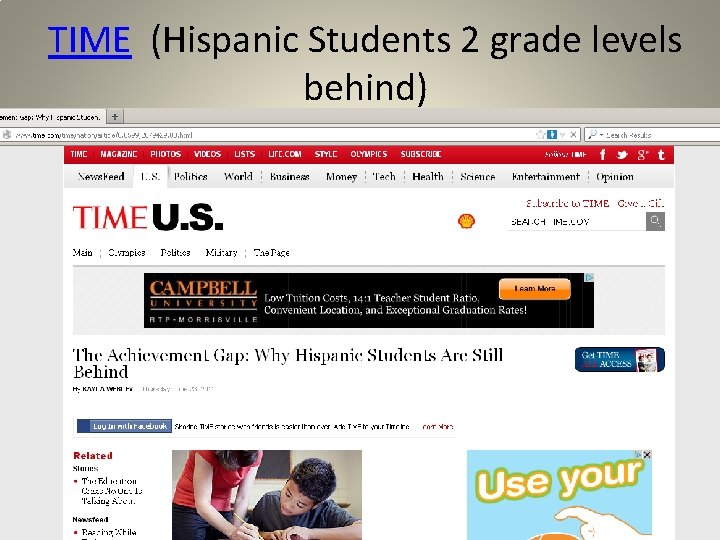
TIME (Hispanic Students 2 grade levels behind)
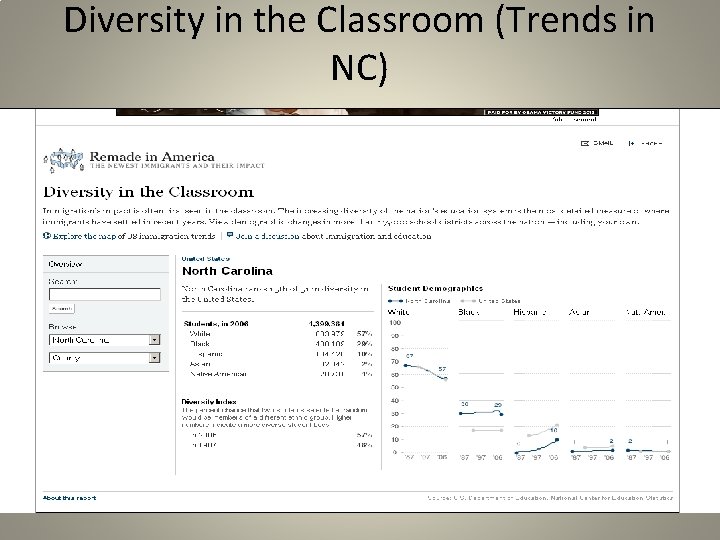
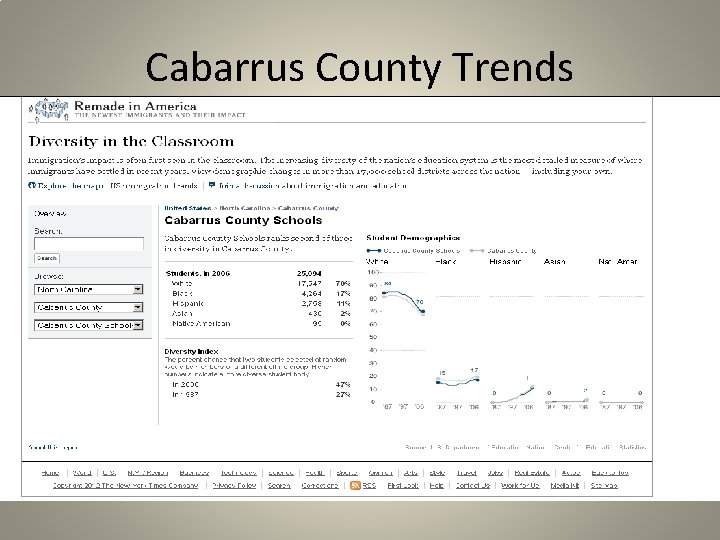
Diversity in the Classroom (Trends in NC)
Cabarrus County Trends
So what’s a teacher to do?
Preparation: Essential Questions 1. What do I do when I have ESL students in my class? 2. What strategies can I incorporate that will help ESL students access the content? 3. How do I know what Modifications or Accommodations are appropriate?
Preparation: Essential Understandings 1. ESL students can add diversity to any classroom. 2. ESL students have a plan for learning just as EC students do. 3. ESL students need to be taught the same curriculum as regular ed students but need support to access the content. (graphic, sensory, interactive) 4. The Can Do Descriptors are an important tool to differentiate learning and assessment.
Building Background: Activating Prior Knowledge How well do you know……… ESL ELL Newcomer LEP ACCESS Proficiency Level P-Form polleverywhere. com
Poll. Everywhere. com Directions 1. Open up Text App. 2. Compose a new message. 3. Recipient is 225740 4. Wait for a Notification Message. 5. Now type in the answer choice. 6. Send. 7. Watch the graph bars change.
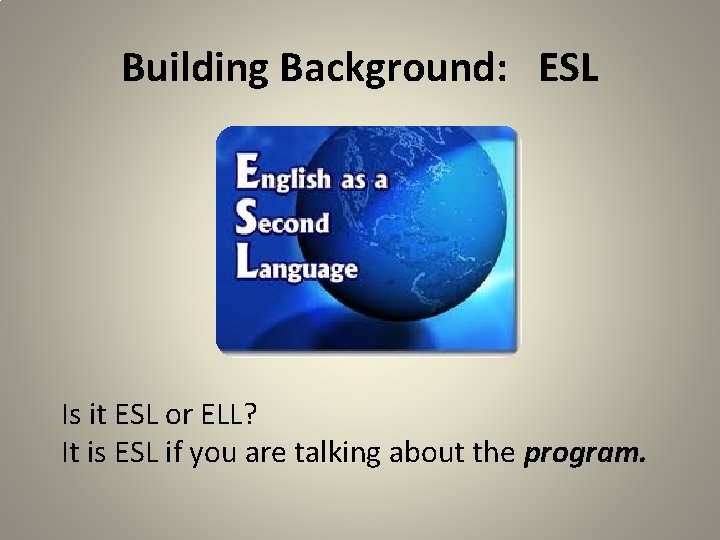
Building Background: ESL Is it ESL or ELL? It is ESL if you are talking about the program.
ELL talks about the student. ELL is English Language Learner.
Newcomer A newcomer is new to the United States and usually has no or very limited English.
LEP is an acronym used by the Federal Government. LEP stands for Limited English Proficient.
ACCESS LEP students take a test in February. The test is called ACCESS. It measures English proficiency in Listening, Speaking, Reading, Writing.
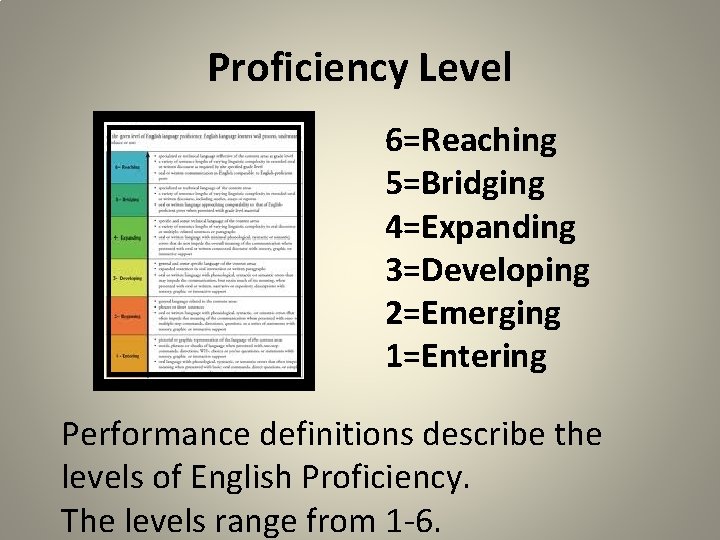
Proficiency Level 6=Reaching 5=Bridging 4=Expanding 3=Developing 2=Emerging 1=Entering Performance definitions describe the levels of English Proficiency. The levels range from 1 -6.
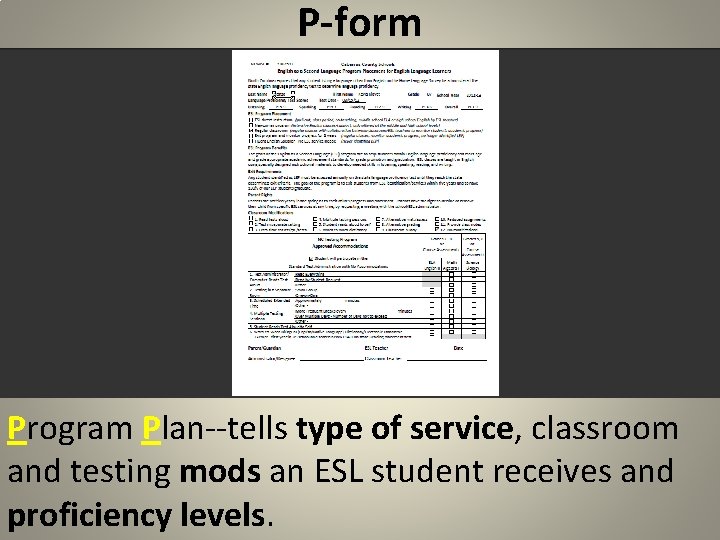
P-form Program Plan--tells type of service, classroom and testing mods an ESL student receives and proficiency levels.
Can Do Descriptors
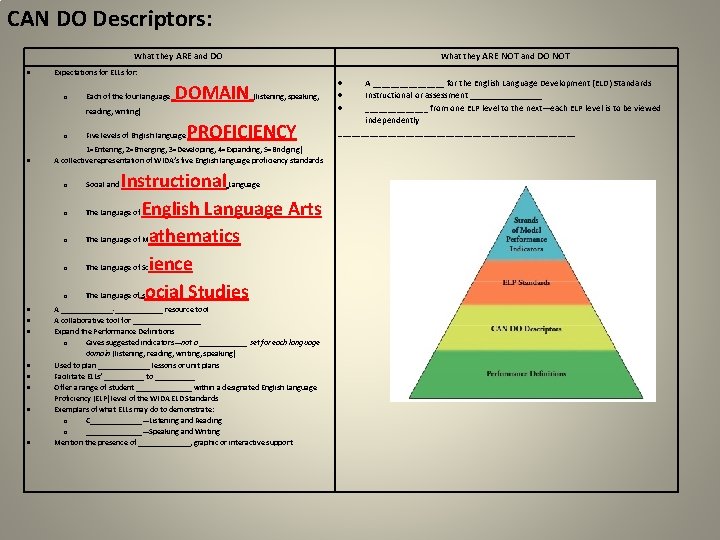
CAN DO Descriptors: What they ARE and DO: What they ARE NOT and DO NOT: Expectations for ELLs for: o Each of the four language DOMAIN (listening, speaking, reading, writing) o Five levels of English language PROFICIENCY 1=Entering, 2=Emerging, 3=Developing, 4=Expanding, 5=Bridging) A collective representation of WIDA’s five English language proficiency standards Instructional English Language Arts athematics ience ocial Studies o Social and o The Language of M o The Language of Sc o The Language of s Language A _______-______ resource tool A collaborative tool for _________ Expand the Performance Definitions o Gives suggested indicators—not a ______ set for each language domain (listening, reading, writing, speaking) Used to plan _______ lessons or unit plans Facilitate ELLs’ _____ to _____ Offer a range of student _______ within a designated English Language Proficiency (ELP) level of the WIDA ELD Standards Exemplars of what ELLs may do to demonstrate: o C_______—Listening and Reading o _______—Speaking and Writing Mention the presence of _______, graphic or interactive support A ________ for the English Language Development (ELD) Standards Instructional or assessment ________ from one ELP level to the next—each ELP level is to be viewed independently ___________________________
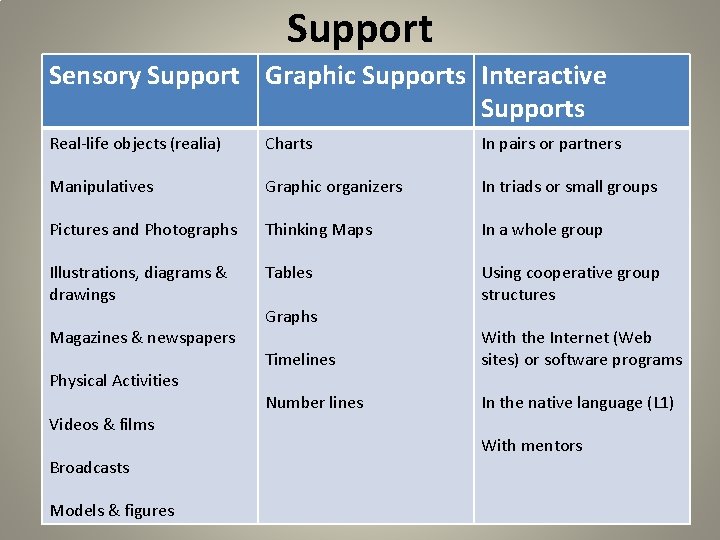
Support Sensory Support Graphic Supports Interactive Supports Real-life objects (realia) Charts In pairs or partners Manipulatives Graphic organizers In triads or small groups Pictures and Photographs Thinking Maps In a whole group Illustrations, diagrams & drawings Tables Using cooperative group structures Magazines & newspapers Physical Activities Videos & films Broadcasts Models & figures Graphs Timelines With the Internet (Web sites) or software programs Number lines In the native language (L 1) With mentors
Meet Angela
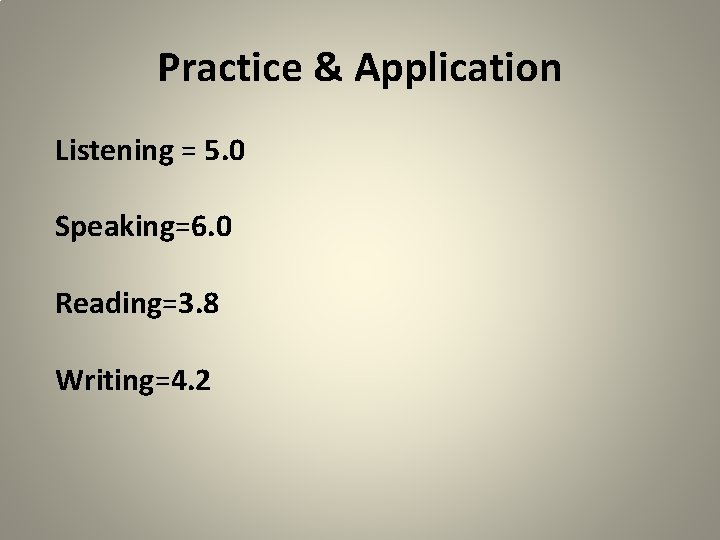
Practice & Application Listening = 5. 0 Speaking=6. 0 Reading=3. 8 Writing=4. 2
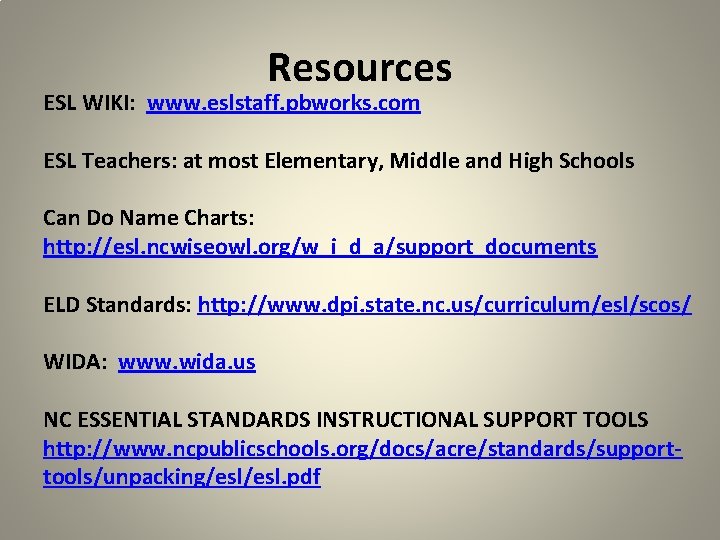
Resources ESL WIKI: www. eslstaff. pbworks. com ESL Teachers: at most Elementary, Middle and High Schools Can Do Name Charts: http: //esl. ncwiseowl. org/w_i_d_a/support_documents ELD Standards: http: //www. dpi. state. nc. us/curriculum/esl/scos/ WIDA: www. wida. us NC ESSENTIAL STANDARDS INSTRUCTIONAL SUPPORT TOOLS http: //www. ncpublicschools. org/docs/acre/standards/supporttools/unpacking/esl. pdf
Review/Assessment 1. What will you do when you see you have an ESL student/s in your class? 2. How will you make sure the ESL students in your class have access to the content? 3. What will you do if an ESL student is struggling? 4. What resources or tools can you use for ESL students?
Questions/Comments? Carey Haney, K-12 ESL Instructional Specialist, Cabarrus County Schools carey. haney@cabarrus. k 12. nc. us Ana Perez, ESL Student Services and Accountability Coordinator, Cabarrus County Schools ana. perez@cabarrus. k 12. nc. us Ben Allred, Director of Title III, Cabarrus County Schools benjamin. allred@cabarrus. k 12. nc. us