
NEW STUDENT ORIENTATION Messages from fellow Students NEW
- Slides: 13
NEW STUDENT ORIENTATION Messages from fellow Students
NEW STUDENT ORIENTATION • In the beginning, everyone is nervous. • The first day of class is critical. Don’t miss it! • Don’t miss Opening Day for Students. Get your books, attend information sessions, meet students, faculty, and staff, and complete your to-do check list. • The first few weeks can be tough. Don’t be shocked. Don’t panic. You’ve got this! • Push yourself outside your comfort zone. • Always expect the unexpected. • Get involved! Opening D ay Tidbits
NEW STUDENT ORIENTATION Attendance is Required Instructors usually take attendance at the start of lecture and lab classes. For hybrid/web-assisted courses you must attend class oncampus. For online courses, attendance is recorded by class participation and timely submission of completed assignments. College Policy: Students may not exceed more than 20% absence in a course to remain enrolled. If excessive absence occurs before the 75% withdraw deadline, the instructor may administratively withdraw you from the course, without effecting your GPA. After the 75% withdrawal deadline, the instructor may issue a grade of “F”, which affects your GPA. Note: Financial Aid recipients who stop attending class prior to the 75% point of the semester may be obligated to pay back a portion of their tuition.
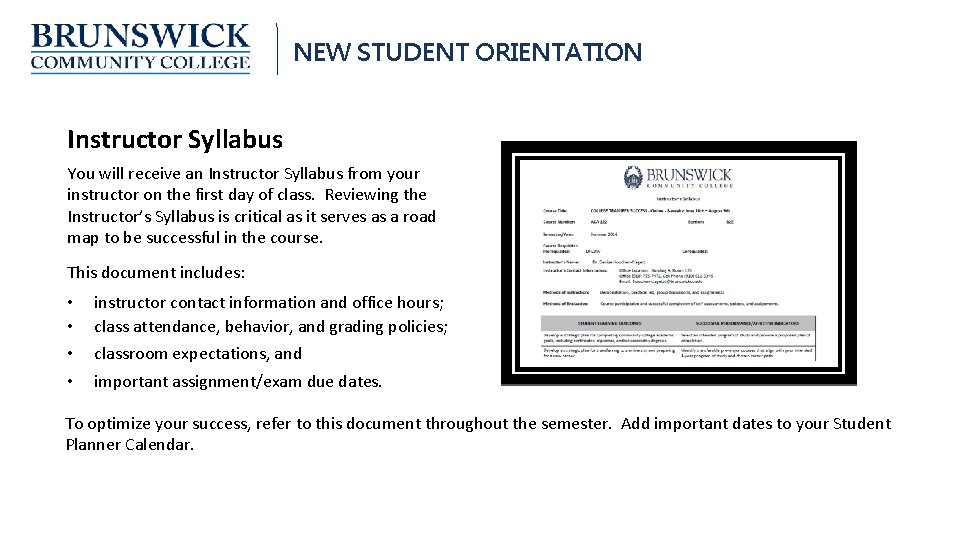
NEW STUDENT ORIENTATION Instructor Syllabus You will receive an Instructor Syllabus from your instructor on the first day of class. Reviewing the Instructor’s Syllabus is critical as it serves as a road map to be successful in the course. This document includes: • • instructor contact information and office hours; class attendance, behavior, and grading policies; classroom expectations, and important assignment/exam due dates. To optimize your success, refer to this document throughout the semester. Add important dates to your Student Planner Calendar.
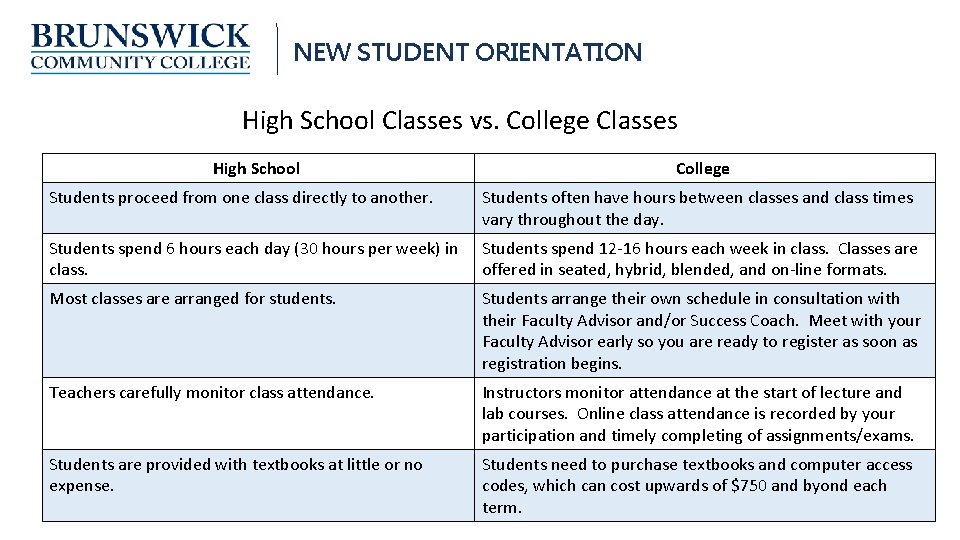
NEW STUDENT ORIENTATION High School Classes vs. College Classes High School College Students proceed from one class directly to another. Students often have hours between classes and class times vary throughout the day. Students spend 6 hours each day (30 hours per week) in class. Students spend 12 -16 hours each week in class. Classes are offered in seated, hybrid, blended, and on-line formats. Most classes are arranged for students. Students arrange their own schedule in consultation with their Faculty Advisor and/or Success Coach. Meet with your Faculty Advisor early so you are ready to register as soon as registration begins. Teachers carefully monitor class attendance. Instructors monitor attendance at the start of lecture and lab courses. Online class attendance is recorded by your participation and timely completing of assignments/exams. Students are provided with textbooks at little or no expense. Students need to purchase textbooks and computer access codes, which can cost upwards of $750 and byond each term.
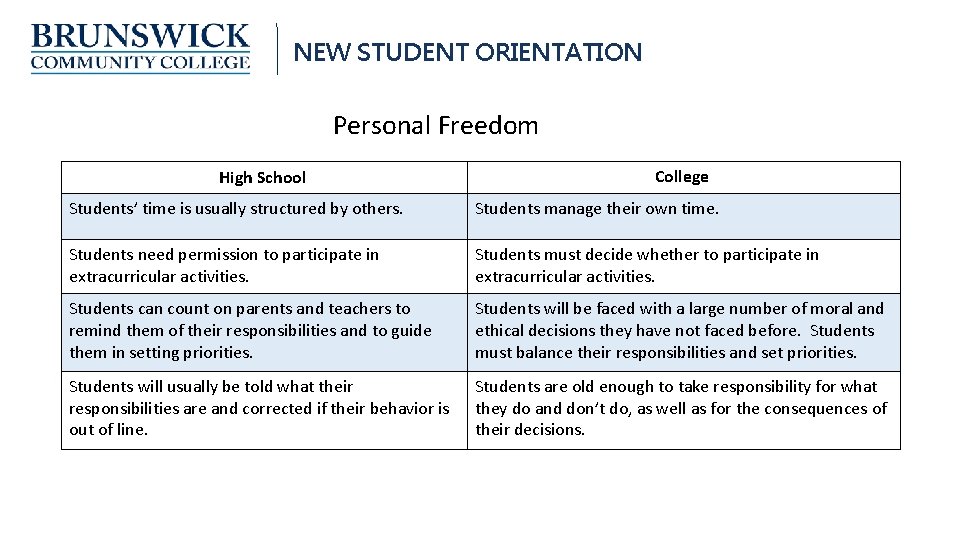
NEW STUDENT ORIENTATION Personal Freedom High School College Students’ time is usually structured by others. Students manage their own time. Students need permission to participate in extracurricular activities. Students must decide whether to participate in extracurricular activities. Students can count on parents and teachers to remind them of their responsibilities and to guide them in setting priorities. Students will be faced with a large number of moral and ethical decisions they have not faced before. Students must balance their responsibilities and set priorities. Students will usually be told what their responsibilities are and corrected if their behavior is out of line. Students are old enough to take responsibility for what they do and don’t do, as well as for the consequences of their decisions.
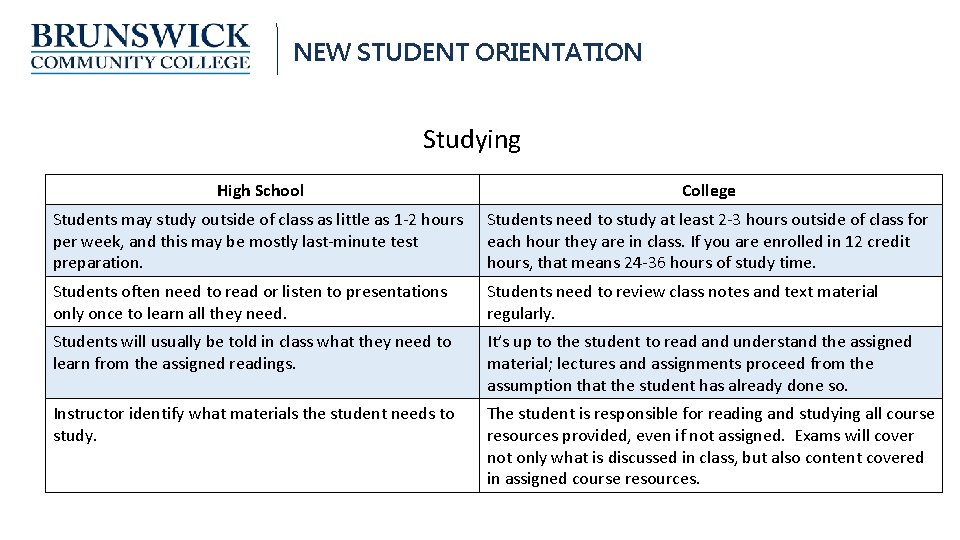
NEW STUDENT ORIENTATION Studying High School College Students may study outside of class as little as 1 -2 hours per week, and this may be mostly last-minute test preparation. Students need to study at least 2 -3 hours outside of class for each hour they are in class. If you are enrolled in 12 credit hours, that means 24 -36 hours of study time. Students often need to read or listen to presentations only once to learn all they need. Students need to review class notes and text material regularly. Students will usually be told in class what they need to learn from the assigned readings. It’s up to the student to read and understand the assigned material; lectures and assignments proceed from the assumption that the student has already done so. Instructor identify what materials the student needs to study. The student is responsible for reading and studying all course resources provided, even if not assigned. Exams will cover not only what is discussed in class, but also content covered in assigned course resources.
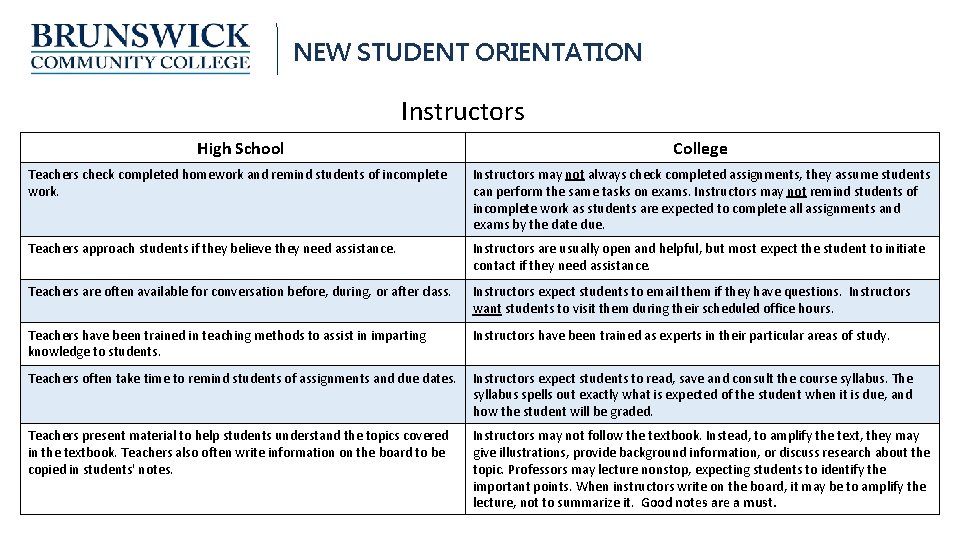
NEW STUDENT ORIENTATION Instructors High School College Teachers check completed homework and remind students of incomplete work. Instructors may not always check completed assignments, they assume students can perform the same tasks on exams. Instructors may not remind students of incomplete work as students are expected to complete all assignments and exams by the date due. Teachers approach students if they believe they need assistance. Instructors are usually open and helpful, but most expect the student to initiate contact if they need assistance. Teachers are often available for conversation before, during, or after class. Instructors expect students to email them if they have questions. Instructors want students to visit them during their scheduled office hours. Teachers have been trained in teaching methods to assist in imparting knowledge to students. Instructors have been trained as experts in their particular areas of study. Teachers often take time to remind students of assignments and due dates. Instructors expect students to read, save and consult the course syllabus. The syllabus spells out exactly what is expected of the student when it is due, and how the student will be graded. Teachers present material to help students understand the topics covered in the textbook. Teachers also often write information on the board to be copied in students' notes. Instructors may not follow the textbook. Instead, to amplify the text, they may give illustrations, provide background information, or discuss research about the topic. Professors may lecture nonstop, expecting students to identify the important points. When instructors write on the board, it may be to amplify the lecture, not to summarize it. Good notes are a must.
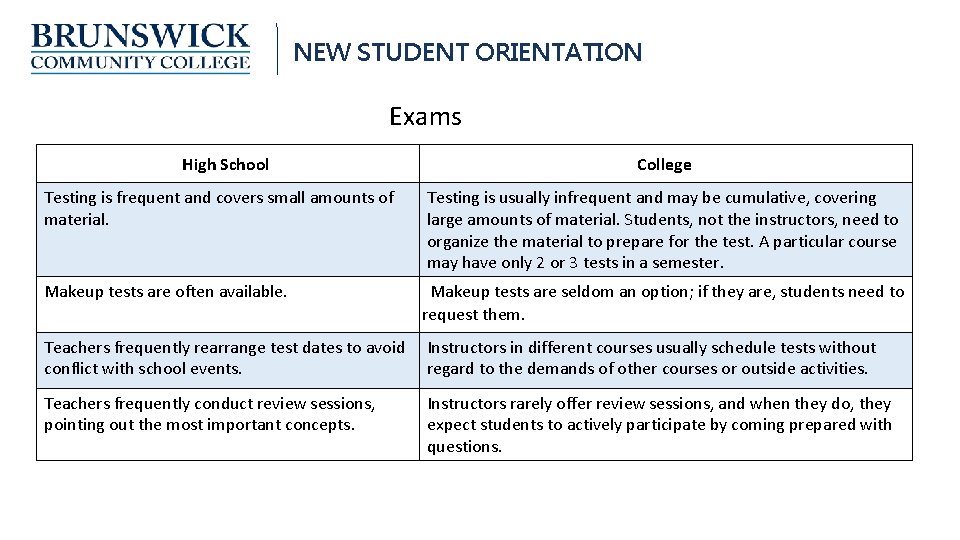
NEW STUDENT ORIENTATION Exams High School College Testing is frequent and covers small amounts of material. Testing is usually infrequent and may be cumulative, covering large amounts of material. Students, not the instructors, need to organize the material to prepare for the test. A particular course may have only 2 or 3 tests in a semester. Makeup tests are often available. Makeup tests are seldom an option; if they are, students need to request them. Teachers frequently rearrange test dates to avoid Instructors in different courses usually schedule tests without conflict with school events. regard to the demands of other courses or outside activities. Teachers frequently conduct review sessions, pointing out the most important concepts. Instructors rarely offer review sessions, and when they do, they expect students to actively participate by coming prepared with questions.
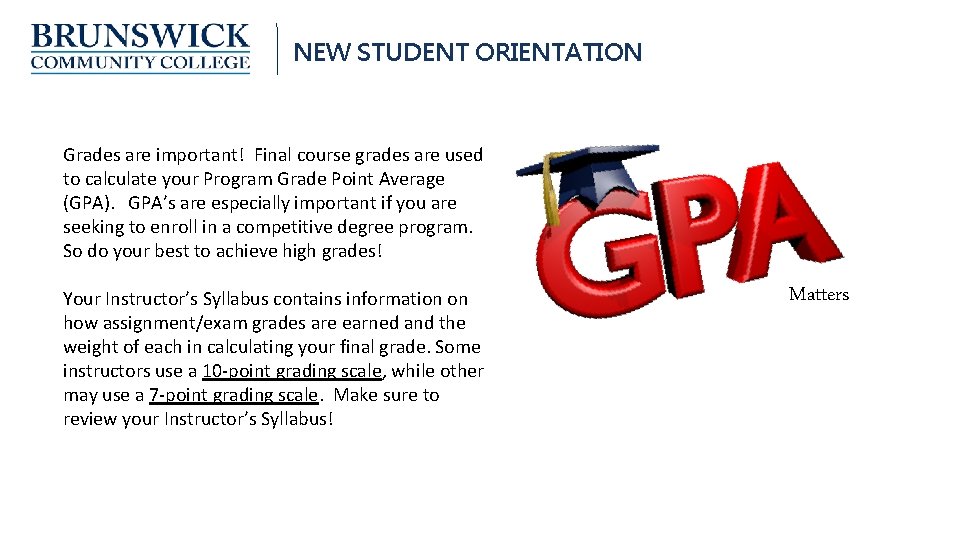
NEW STUDENT ORIENTATION GPA Matters Grades are important! Final course grades are used to calculate your Program Grade Point Average (GPA). GPA’s are especially important if you are seeking to enroll in a competitive degree program. So do your best to achieve high grades! Your Instructor’s Syllabus contains information on how assignment/exam grades are earned and the weight of each in calculating your final grade. Some instructors use a 10 -point grading scale, while other may use a 7 -point grading scale. Make sure to review your Instructor’s Syllabus! Matters
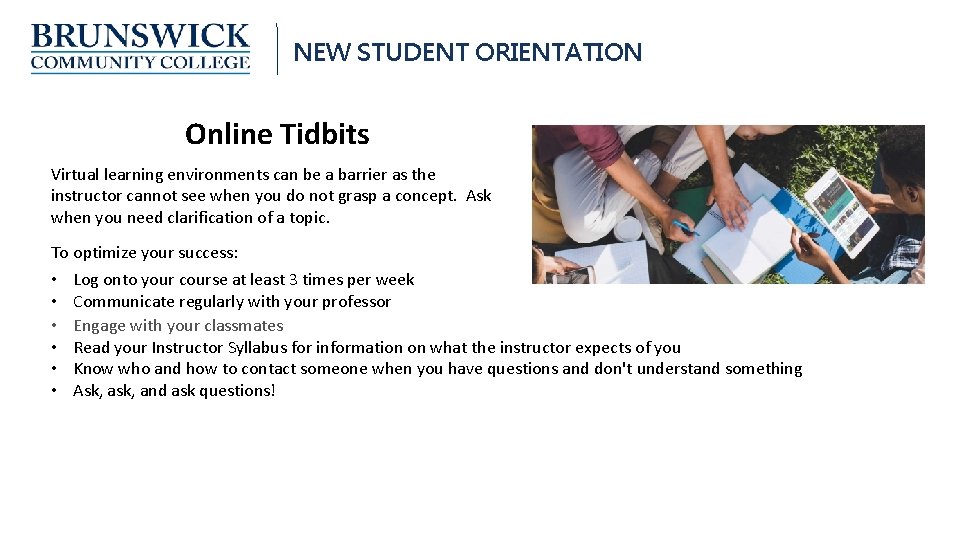
NEW STUDENT ORIENTATION Online Tidbits Virtual learning environments can be a barrier as the instructor cannot see when you do not grasp a concept. Ask when you need clarification of a topic. To optimize your success: • • • Log onto your course at least 3 times per week Communicate regularly with your professor Engage with your classmates Read your Instructor Syllabus for information on what the instructor expects of you Know who and how to contact someone when you have questions and don't understand something Ask, and ask questions!
NEW STUDENT ORIENTATION Appeals/Grievances BCC is committed to resolving complaints in a timely, fair, and amicable manner. Grade and attendance appeals are submitted directly to the instructor, and if unresolved shall be adjudicated through the Director, Department Chair, or Dean of the area of instruction. All other forms of Appeals/Grievances with the exception of Title IX are submitted to the Vice President of Student Affairs. Sexual harassment complaints may be directed to the Vice President of Student Affairs or the College’s Title IX Coordinator. Student Grievance Policy
NEW STUDENT ORIENTATION Academic Integrity BCC is an institution that values academic integrity. BCC students will refrain from acts of academic dishonesty such as cheating, fabrication, lying, bribery, assuming another’s identify, and/or using any electronic devices not specifically allowed by the instructor in class. Plagiarism is also an act of academic dishonesty and can sometimes get you kicked out of a class or program. Review your Student Catalog and Handbook for policies and procedures relative to Expectations of Adult Learners and the Honor Code.