
New station based OSCE exam in 9 th
New station based (OSCE) exam in 9 th semester Associate Professor Annetine Staff Head of examination committee, member of semester committee Professor Kai-Håkon Carlsen Head of semester committee, member of examination committee Professor Per Brodal Member of semester committee, member of examination committee Felt for signatur(enhet, navn og tittel)
Background • Decided by the Board of the Medical faculty, University of Oslo • From autumn semester 2008: written essay examination form of 9 th semester has been exchanged with a station based (OSCE) examination • First station based examination for 9 th semester will be held on Wednesday the 14 th of January • Two trial exams have been held: – Winter (11 students) and summer (26 students) 2008
When and where? • Wednesday 14 th of January 2009 • Class divided into 4 equal-sized groups (26 students in each group) • Rikshospitalet, Ferdighetssenteret (Skills training center) • Groups 1+2: 8. 30 -12. 27 – 8. 30: • Register (give your e-mail address for later feedback on exam result) • Get your ID number to be used throughout the exam – 8. 40 -8. 50: Information about exam – 9. 00: start of station exam (24 test stations and 2 rest stations) • 3 h 27 min (7 min x 26 +1 min x 25) for each student – 12. 27: end of exam • Group 1+2 leave together and assemble until 13. 00, to prevent contact with Group 3+4 • Groups 3+4: 12. 30 -16. 27 – Same program as above (except allowed to leave 16. 27)
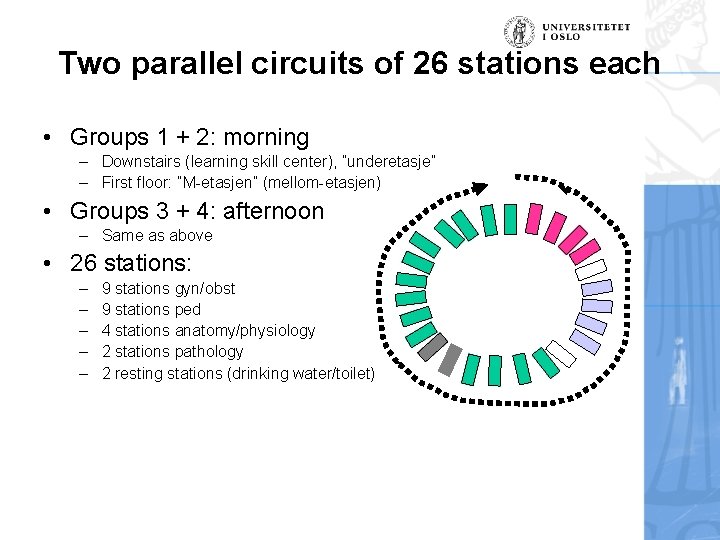
Two parallel circuits of 26 stations each • Groups 1 + 2: morning – Downstairs (learning skill center), ”underetasje” – First floor: ”M-etasjen” (mellom-etasjen) • Groups 3 + 4: afternoon – Same as above • 26 stations: – – – 9 stations gyn/obst 9 stations ped 4 stations anatomy/physiology 2 stations pathology 2 resting stations (drinking water/toilet)

Station content • OSCE: objective standardized clinical evaluation: – Read the instructions carefully – Do what you are instructed to do • Perform an examination, a test, etc. /talk to a patient/examiner/mannequin (specified in the instruction) /fill in paper forms etc. • If asked to communicate with a person, act as you would as a medical doctor: be polite, introduce yourself, tell what to do etc (read instructions and see what you are asked to do) • Short answer questions – Read the instructions carefully – Do what you are instructed to do • Fill in paper forms etc, write short answers • MCQ: multiple choice questions – Read the instructions carefully – Do what you are instructed to do (tick most probable diagnosis etc) • Leave paper form at station – face down (not to be seen by other students), will be picked up by examiners for scoring

In English or Norwegian? • We assume most students will do most of the test in English, as all questions are in English, but the choice is yours! • All station instructions are given in English • Students may communicate with examinator/patient/mannequin/actor in either English or Norwegian • Students may answer in written in either English or Norwegian
Stations: 7 min work and 1 minute walk/rest • 8. 30: Register • 8. 40 -8. 50/12. 40 -12. 50: information by examination committee leader • 8. 50/12. 50: Go to your first assigned station – First thing when arriving at the station: Fill in your ID number or show ID badge to examiner if no paper to fill in • 9. 00/ 13. 00: First whistle: – start working at your first station (2 students will start at a rest station) • 9. 07/13. 07: Second whistle: – stop working, leave station at once (remember ID number on paper forms) – go to next station: • Move according to ascending numbers: If you started at number 26, your next station is number 1, and so forth. • follow direction of arrows on the floor • 9. 08/13. 08: Third whistle: – start working at your second station • 9. 15/13. 15: 4 th whistle: – stop working, leave for next station etc
Between work stations: 1 minute to rest/change room before next station • 1 minute break before next whistle: – Go to next task – Stand with back to task until next whistle • Exception: some rooms with closed doors may have short information/instruction on door and you use part of the 1 minute break to read this. Enter the room at next whistle (you then have 7 min to perform the task) • 12. 27/16. 27: – LAST whistle (double sound): exam over – Groups 1+ 2: Move to assembly room at once, stay there until the next two groups (3+4) have started • Students or teachers are not allowed to remove any test material from the exam rooms
Scoring system of exam • Each station: – – Same scoring system for all students Examiners use a standardized, predesigned scoring system A station constitutes 1/24 of total score (24 stations) Questions/tasks in one station may be weighted differently according to importance – At OSCE stations: • Examiner marks: – ”failed/passed” etc for each task – a ”global score”: e. g. Excellent, good, borderline, poor (not passed), very poor (not passed)
Passing limits • To pass the test: – 50% correct score totally (mean of the 24 stations) • as well as 50 correct score for each of the 4 subjects: – Ped (mean of 9 stations) – Obst/gyn (mean of 9 stations) – Pathology (mean of 2 stations) – Anatomy/physiology (mean of 4 stations) • What are global assessments at OSCE stations used for? – Intern evaluation for exam committee: • Correlation global score and percentage score? (does excellent performance give a high score, do students below 50% score poor globally etc)
When will you know your result? • Answer forms corrected by teachers on test day (14. 01) – Plotted answers electronically controlled by 16. 01. 08 • Exam committee meets with the class to receive feedback the day after exam: 15. 01: 13. 30 -15. 30 – Each station is discussed, the students will evaluate the exam (orally and scoring: ”global assessment”) – Individual students results are not known or given • Exam committee will meet 19. 01. 08 – Reevaluate exam forms of students not passing exam • Also by external exam sensor • Individual results mailed to each student within few days – After 19. 01. 08
If you do not attend ordinary exam 14. 01. 2009 or fail? • Students who do not have a legitimate reason for being absent from an examination are not allowed to attend the resit examination, and will be transferred to the following class. • The following reasons qualify for a postponed examination: – a) The student falls ill prior to the examination (this must be confirmed by a written letter from a doctor) – b) The student falls ill during the examination (the students must immediately contact the Student Health Service at Blindern) – c) Students who have not passed the previous examination – d) Other important reasons: for example, death in the immediate family • Resit exam: 24 th of February 2009 – Oral (At the same level of difficulty as the station exam) – If failed station based exam: • retested in the 1 -2 subjects that failed the 14 th of Januar • If failed 3 -4 subjects: all 4 subject will be retested • If do not attend resit exam, or fail: • New ordinary station based exam in June 2009

All students are offered station based examination training prior to ordinary exam • December: 1 st, 3 rd and 4 th GOOD LUCK TO ALL!
- Slides: 13