
New Skillsets and Core Competencies for Knowledge Workers
- Slides: 22
New Skill-sets and Core Competencies for Knowledge Workers – The Shift to Individual Responsibility for Lifelong Learning Andy BELL Director of TDP Development Ltd. United Kingdom 1
New Skill-Sets and Core Competencies for Knowledge Workers The Shift to Individual Responsibility for Lifelong Learning 2
TDP Development Ltd Andrew Bell Director 3
TDP Development Ltd Areas of work: q Work in Accountancy and Financial Services q Competency Research and Modelling q Assessment and Training Consultancy with UK based Accountancy Professional Institutes q Development Work with Senior Finance Professionals Private/Public Sector 4
The Knowledge Age Chinese Imprecation: “I curse you: May you live in an Important Age” 5
The Knowledge Age “For Countries in the vanguard of the world economy the balance between knowledge and resources has shifted so far towards the former that knowledge has become the most important factor determining the standard of living …… Today’s most technologically advanced economies are truly knowledge based” World Bank 1998 World Development Report 6
The Knowledge Age “The emergence of knowledge based economies has profound implications for the determinants of growth, the organisation of production and its effects on employment and skill requirements and may call for new orientation in industry related policies” OECD 1998 7
The Knowledge Age The Knowledge Economy q A knowledge driven economy is one in which the generation and exploitation of knowledge has come to play a predominant role q It is a general phenomenon - encompassing the exploitation and use of knowledge in all production and service activities not just those classified as High-Tec or knowledge intensive q The value of organisations resides entirely in its patents and its Staff 8
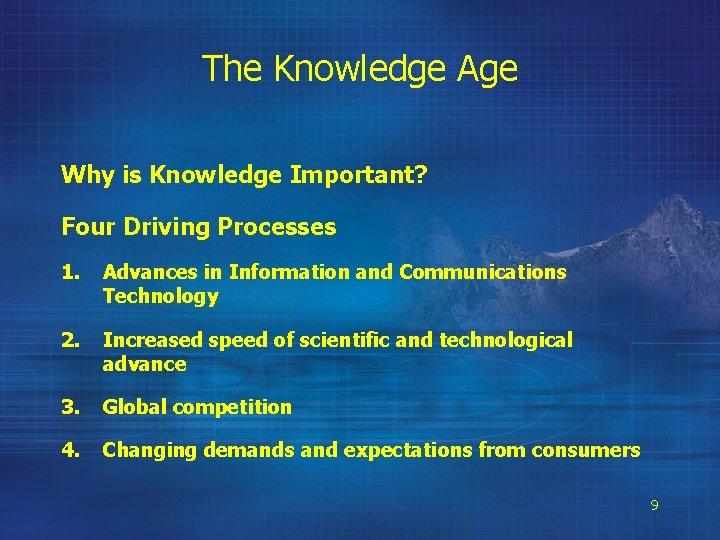
The Knowledge Age Why is Knowledge Important? Four Driving Processes 1. Advances in Information and Communications Technology 2. Increased speed of scientific and technological advance 3. Global competition 4. Changing demands and expectations from consumers 9
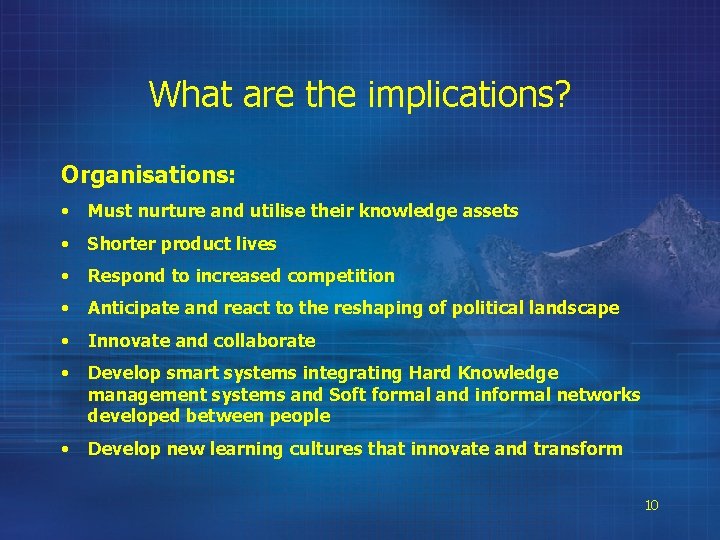
What are the implications? Organisations: • Must nurture and utilise their knowledge assets • Shorter product lives • Respond to increased competition • Anticipate and react to the reshaping of political landscape • Innovate and collaborate • Develop smart systems integrating Hard Knowledge management systems and Soft formal and informal networks developed between people • Develop new learning cultures that innovate and transform 10
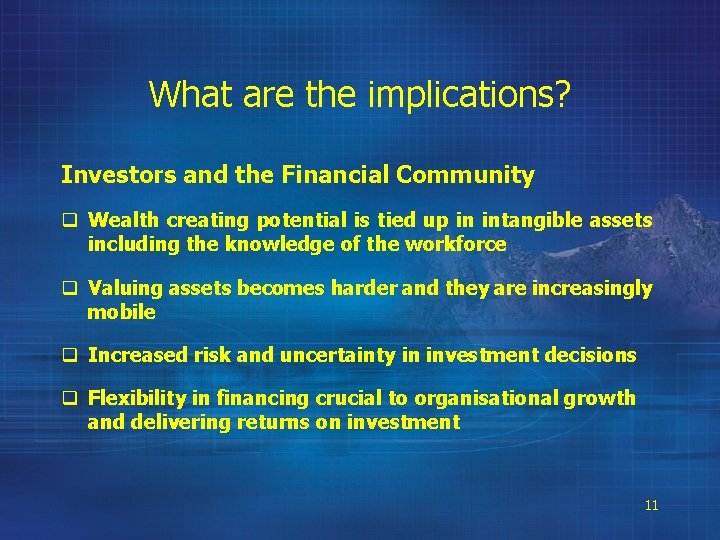
What are the implications? Investors and the Financial Community q Wealth creating potential is tied up in intangible assets including the knowledge of the workforce q Valuing assets becomes harder and they are increasingly mobile q Increased risk and uncertainty in investment decisions q Flexibility in financing crucial to organisational growth and delivering returns on investment 11
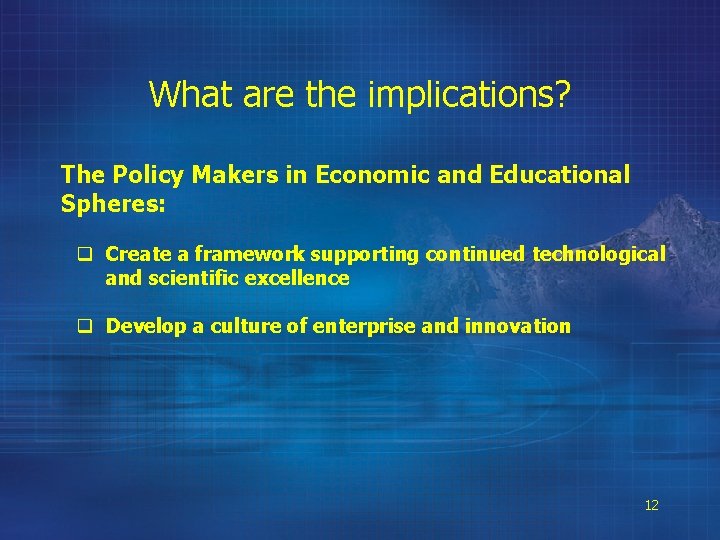
What are the implications? The Policy Makers in Economic and Educational Spheres: q Create a framework supporting continued technological and scientific excellence q Develop a culture of enterprise and innovation 12
What are the implications? For Employees – The Knowledge Worker: q Acquire and maintain new and relevant skills q Develop as a Reflective Practitioner q Take personal responsibility for continuous learning throughout their lifetime q Take responsibility of their intellectual capital as well as their well-being and life balance 13
What are the implications? Educators and Trainers q Learner Centred approaches to education and continued learning q Dynamic and Interactive systems q Learning systems, which encourage ownership q Based on a model of shared learning q Learning Systems which encourage experiential and reflective practice q Focused on developing the effective Reflective Practitioner 14
The Knowledge Worker Knowledge workers are not simply the holders of specialised knowledge – requirements change rapidly. Rather the knowledge worker must: q Sense and respond to unstructured knowledge q Create and produce structured knowledge q Connect the two to create value to the organisation 15
Shift to Personal Responsibility Core Skills Sets and Competencies for the Knowledge worker Overarching – q Continuous Learning q Reflective Practitioner q Developing Mastery q Develop competencies which support learning and which themselves can be learnt 16
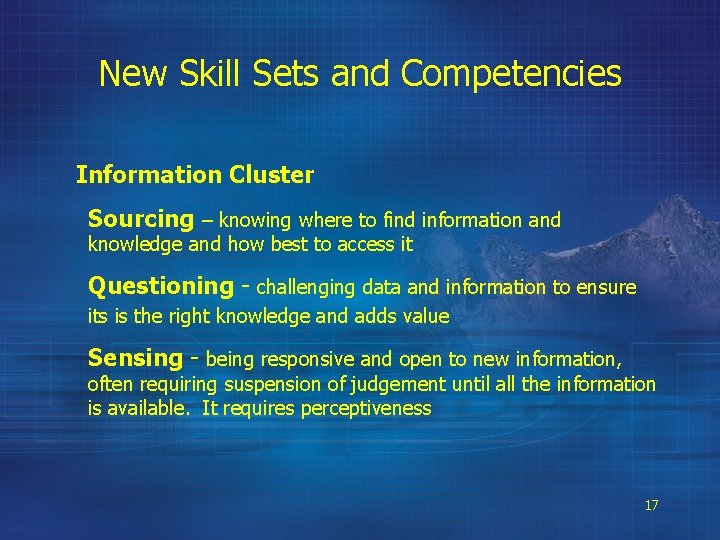
New Skill Sets and Competencies Information Cluster Sourcing – knowing where to find information and knowledge and how best to access it Questioning - challenging data and information to ensure its is the right knowledge and adds value Sensing - being responsive and open to new information, often requiring suspension of judgement until all the information is available. It requires perceptiveness 17
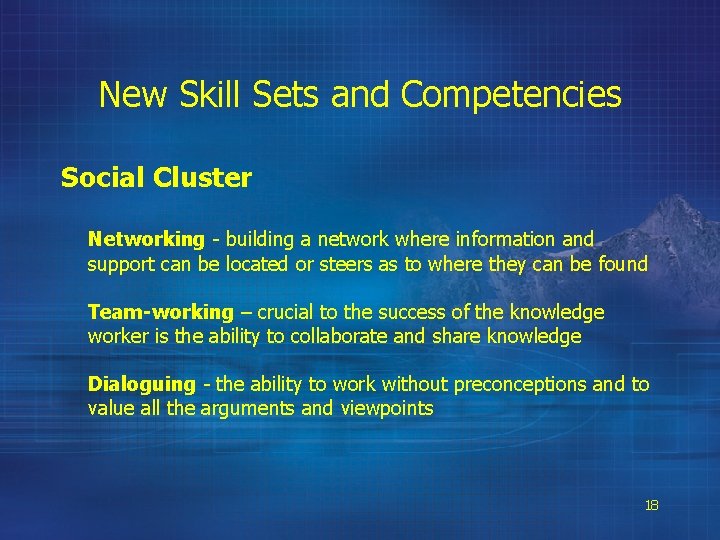
New Skill Sets and Competencies Social Cluster Networking - building a network where information and support can be located or steers as to where they can be found Team-working – crucial to the success of the knowledge worker is the ability to collaborate and share knowledge Dialoguing - the ability to work without preconceptions and to value all the arguments and viewpoints 18
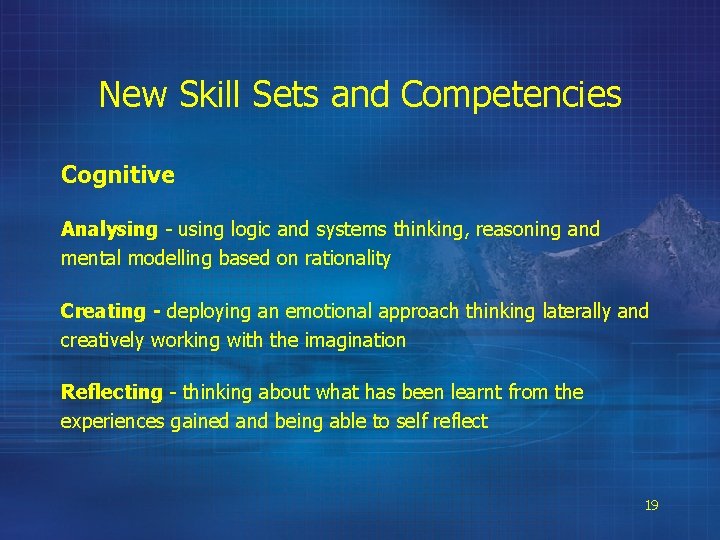
New Skill Sets and Competencies Cognitive Analysing - using logic and systems thinking, reasoning and mental modelling based on rationality Creating - deploying an emotional approach thinking laterally and creatively working with the imagination Reflecting - thinking about what has been learnt from the experiences gained and being able to self reflect 19
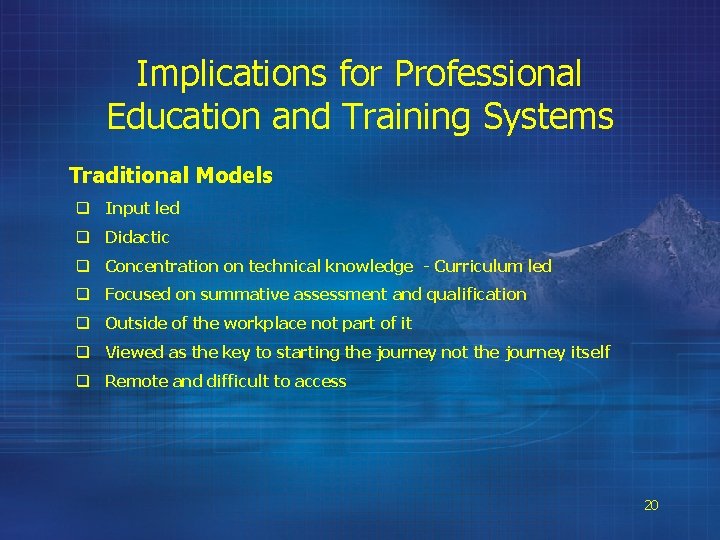
Implications for Professional Education and Training Systems Traditional Models q Input led q Didactic q Concentration on technical knowledge - Curriculum led q Focused on summative assessment and qualification q Outside of the workplace not part of it q Viewed as the key to starting the journey not the journey itself q Remote and difficult to access 20
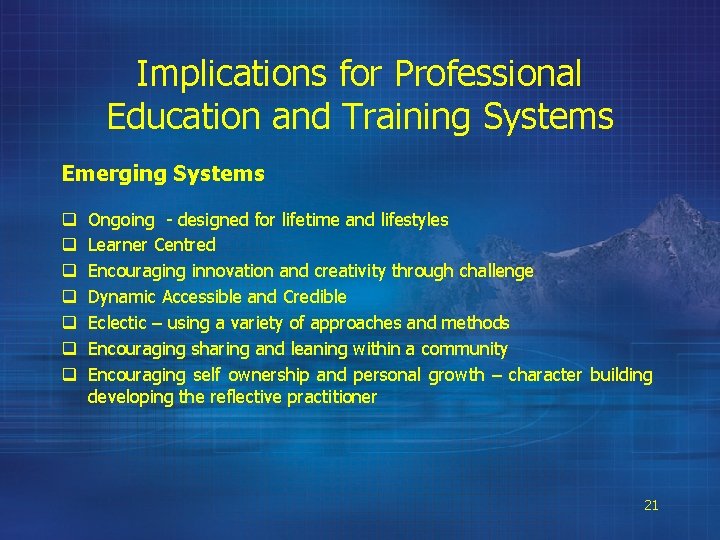
Implications for Professional Education and Training Systems Emerging Systems q q q q Ongoing - designed for lifetime and lifestyles Learner Centred Encouraging innovation and creativity through challenge Dynamic Accessible and Credible Eclectic – using a variety of approaches and methods Encouraging sharing and leaning within a community Encouraging self ownership and personal growth – character building developing the reflective practitioner 21
New Skill Sets and Competencies “People cannot afford to choose between reason and intuition or head and heart anymore than they would choose to walk on one leg or see with one eye” Peter Senge 22