
New Simrad sonar SX 90 Low frequency sonar

- Slides: 21
New Simrad sonar SX 90 Low frequency sonar
Simrad Omni Sonars General advantages: • • Combination of horizontal and vertical beams Full roll and pitch stabilization as standard Multiple frequency selection Advanced Pulse Forms FM Hyperbolic, PSK. . . Dual mode presentation Easy to operate Menu in your own language Easy installation
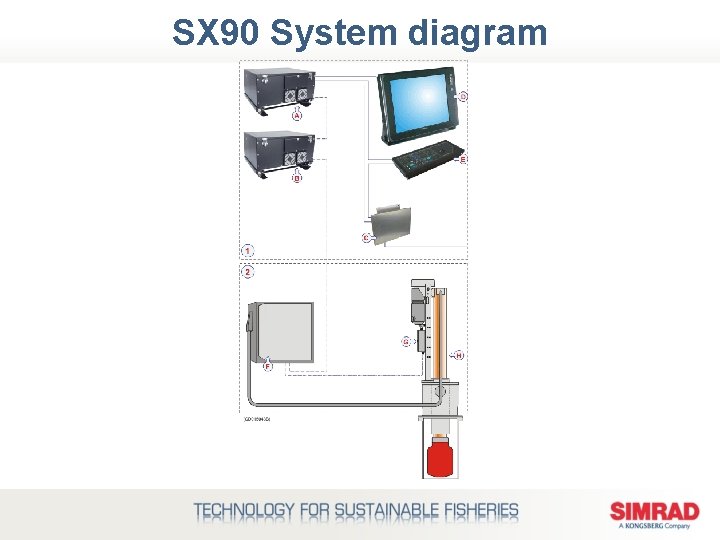
SX 90 System diagram
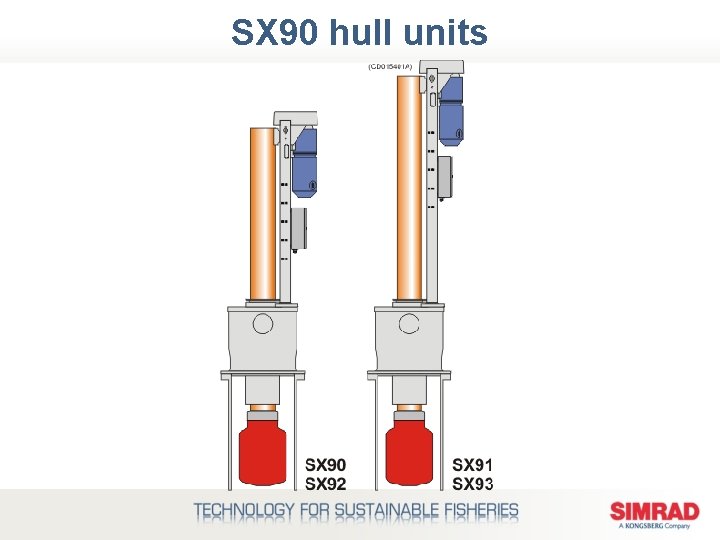
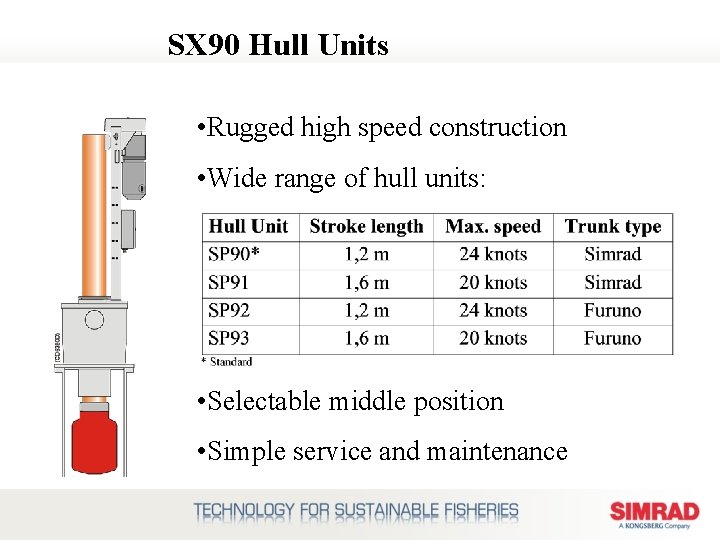
SX 90 hull units
SX 90 Hull Units • Rugged high speed construction • Wide range of hull units: • Selectable middle position • Simple service and maintenance
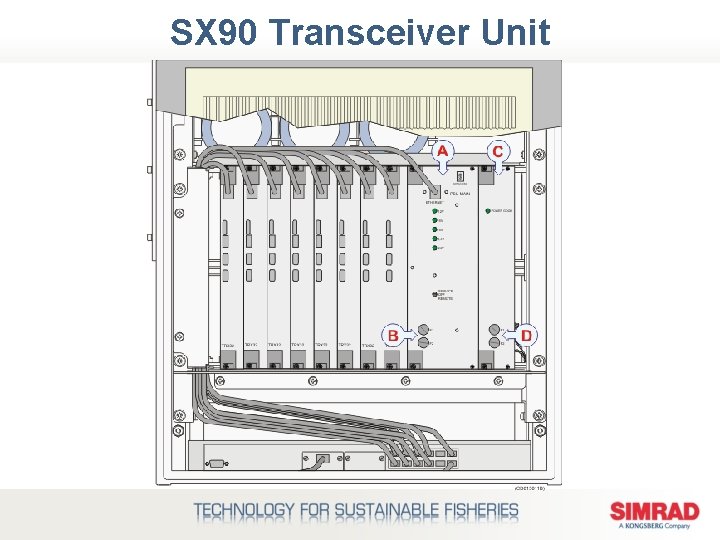
SX 90 Transceiver Unit
SX 90 heat exchanger door
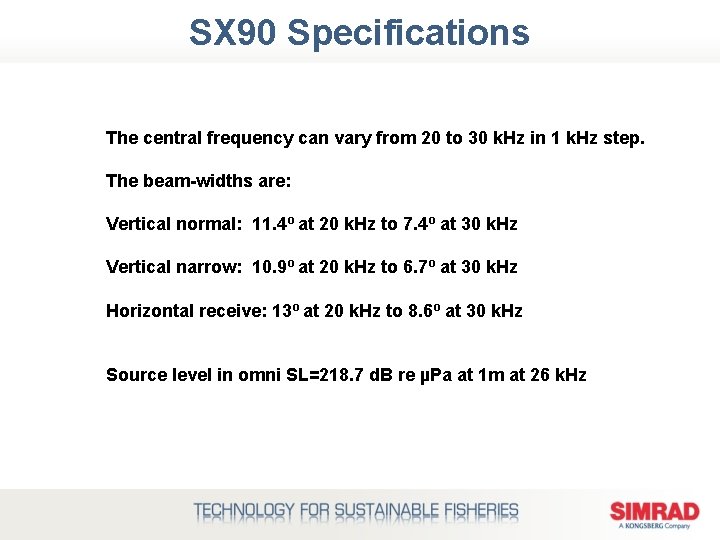
SX 90 Specifications The central frequency can vary from 20 to 30 k. Hz in 1 k. Hz step. The beam-widths are: Vertical normal: 11. 4º at 20 k. Hz to 7. 4º at 30 k. Hz Vertical narrow: 10. 9º at 20 k. Hz to 6. 7º at 30 k. Hz Horizontal receive: 13º at 20 k. Hz to 8. 6º at 30 k. Hz Source level in omni SL=218. 7 d. B re µPa at 1 m at 26 k. Hz
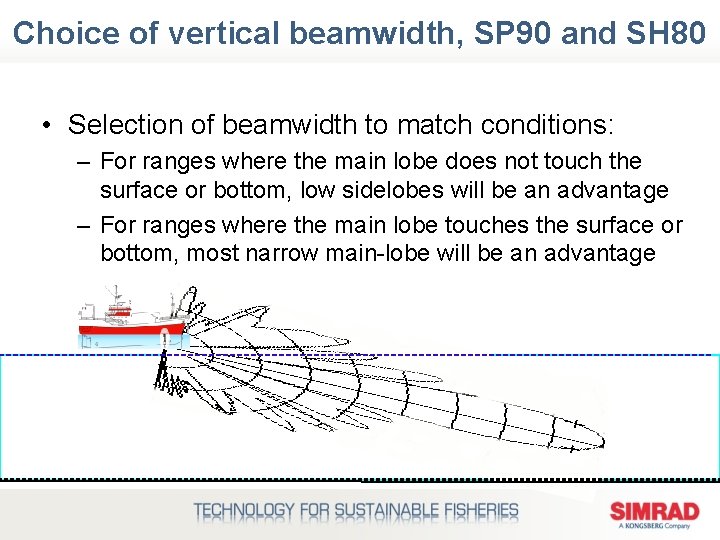
Choice of vertical beamwidth, SP 90 and SH 80 • Selection of beamwidth to match conditions: – For ranges where the main lobe does not touch the surface or bottom, low sidelobes will be an advantage – For ranges where the main lobe touches the surface or bottom, most narrow main-lobe will be an advantage
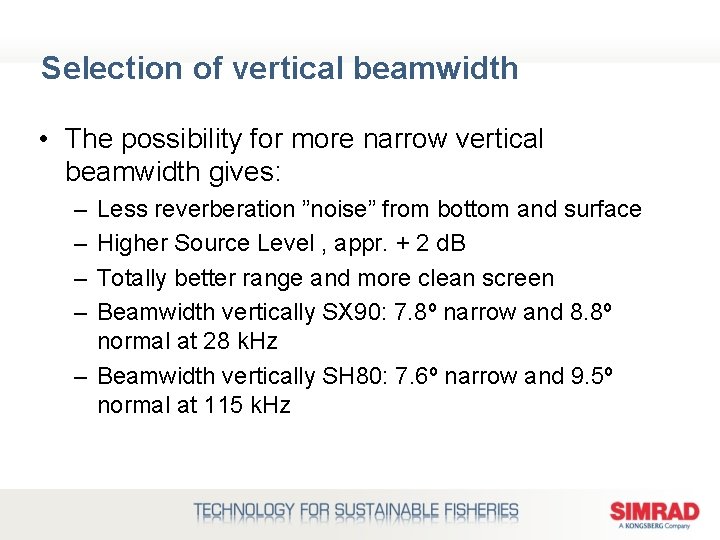
Selection of vertical beamwidth • The possibility for more narrow vertical beamwidth gives: – – Less reverberation ”noise” from bottom and surface Higher Source Level , appr. + 2 d. B Totally better range and more clean screen Beamwidth vertically SX 90: 7. 8º narrow and 8. 8º normal at 28 k. Hz – Beamwidth vertically SH 80: 7. 6º narrow and 9. 5º normal at 115 k. Hz
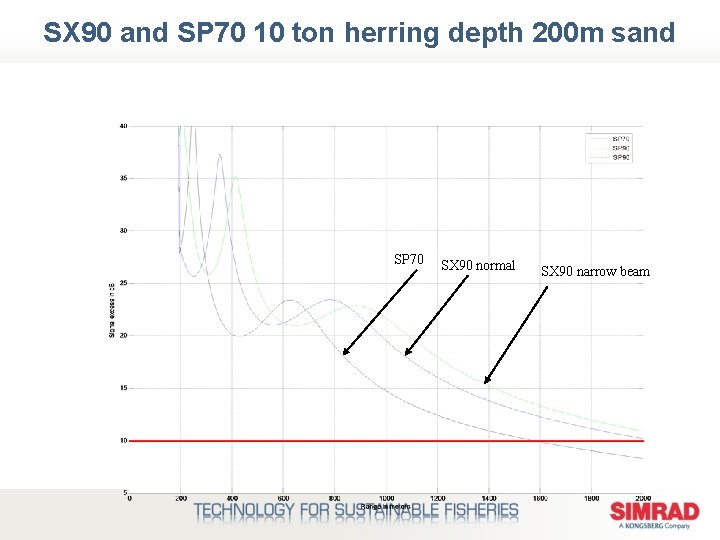
SX 90 and SP 70 10 ton herring depth 200 m sand SP 70 SX 90 normal SX 90 narrow beam
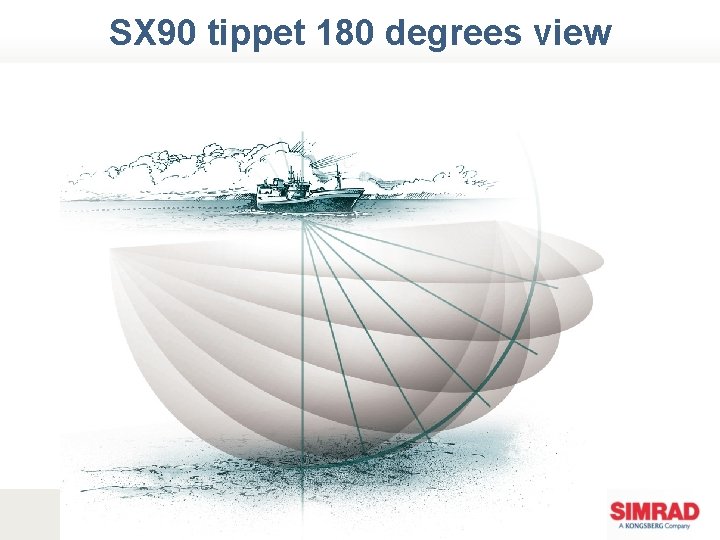
SX 90 tippet 180 degrees view
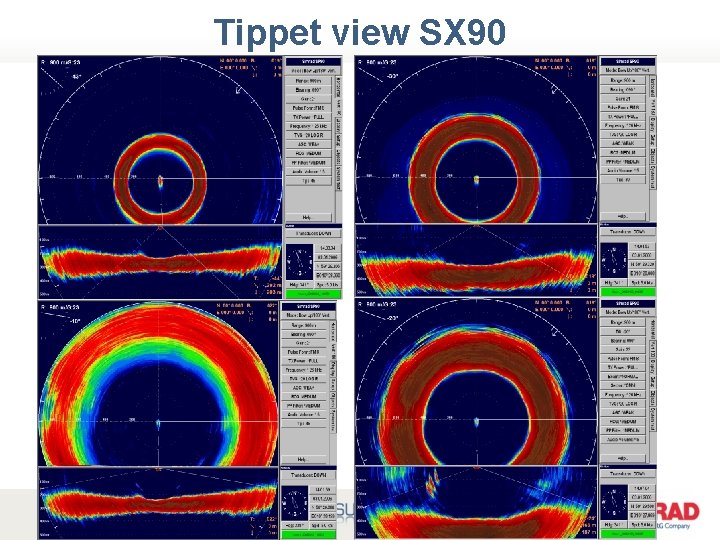
Tippet view SX 90
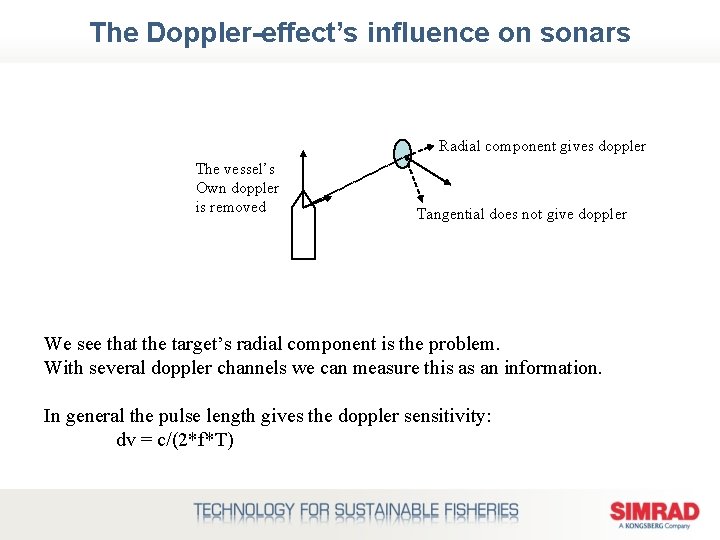
The Doppler-effect’s influence on sonars Radial component gives doppler The vessel’s Own doppler is removed Tangential does not give doppler We see that the target’s radial component is the problem. With several doppler channels we can measure this as an information. In general the pulse length gives the doppler sensitivity: dv = c/(2*f*T)
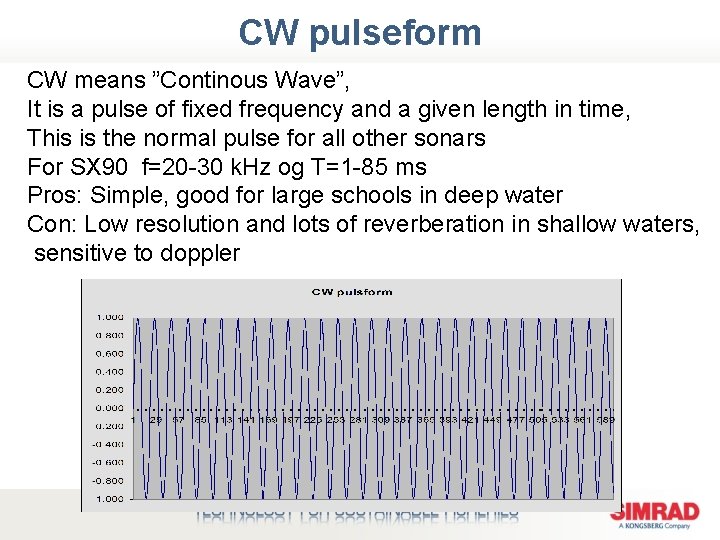
CW pulseform CW means ”Continous Wave”, It is a pulse of fixed frequency and a given length in time, This is the normal pulse for all other sonars For SX 90 f=20 -30 k. Hz og T=1 -85 ms Pros: Simple, good for large schools in deep water Con: Low resolution and lots of reverberation in shallow waters, sensitive to doppler
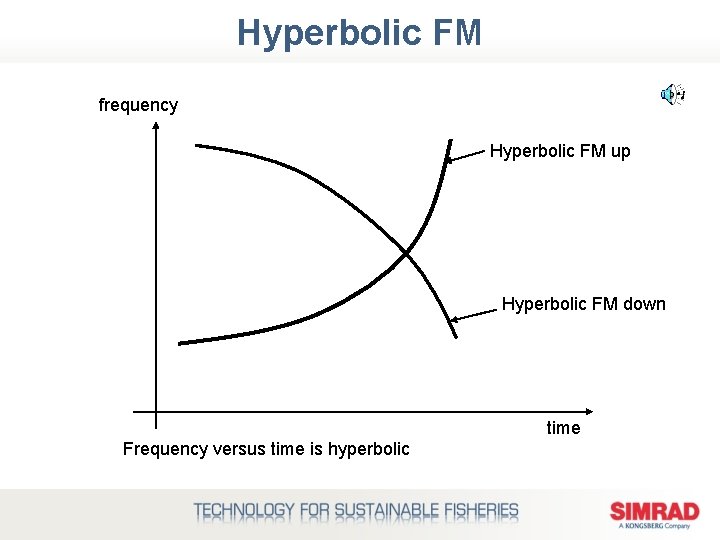
FM Hyperbolic FM means Frequency Modulation, which mean that the Frequency will vary in a hyperbolic way with time Pros: High resolution in range with high energy and insensitive to target doppler Cons: Complicated, needs processing ”Matched filter” Correlator, more complicated than PSK
Hyperbolic FM frequency Hyperbolic FM up Hyperbolic FM down time Frequency versus time is hyperbolic
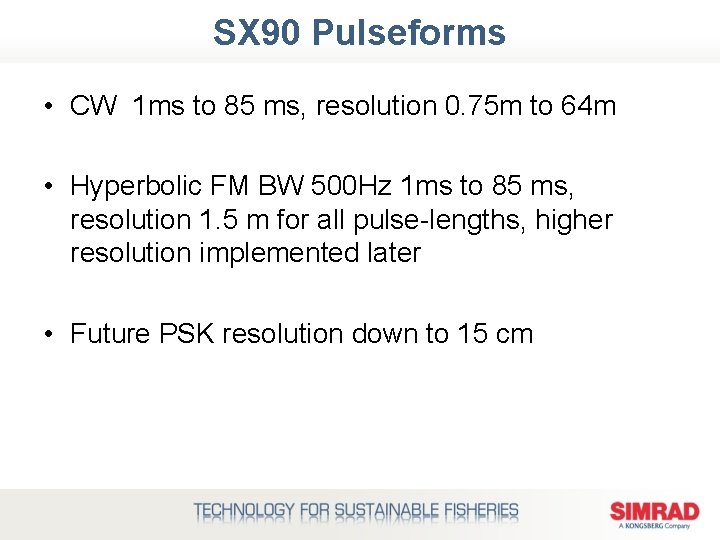
SX 90 Pulseforms • CW 1 ms to 85 ms, resolution 0. 75 m to 64 m • Hyperbolic FM BW 500 Hz 1 ms to 85 ms, resolution 1. 5 m for all pulse-lengths, higher resolution implemented later • Future PSK resolution down to 15 cm
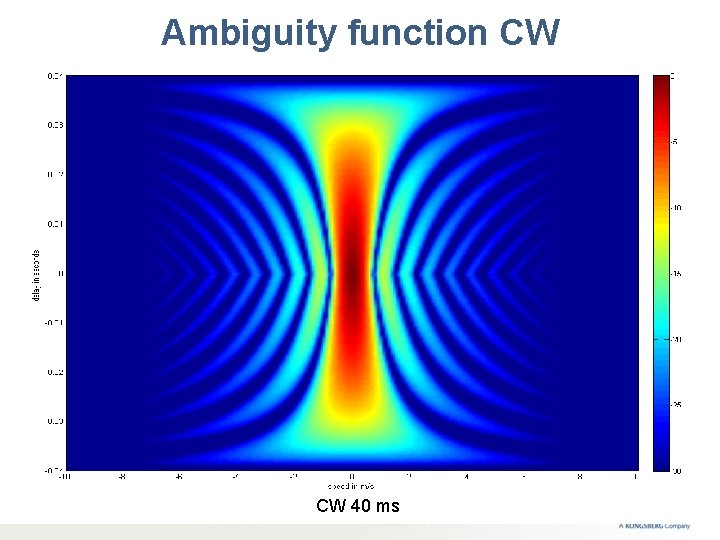
Ambiguity function CW CW 40 ms
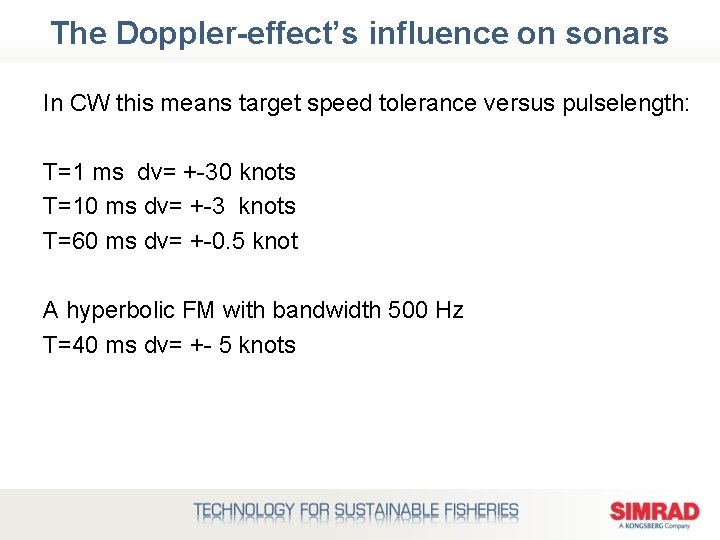
The Doppler-effect’s influence on sonars In CW this means target speed tolerance versus pulselength: T=1 ms dv= +-30 knots T=10 ms dv= +-3 knots T=60 ms dv= +-0. 5 knot A hyperbolic FM with bandwidth 500 Hz T=40 ms dv= +- 5 knots
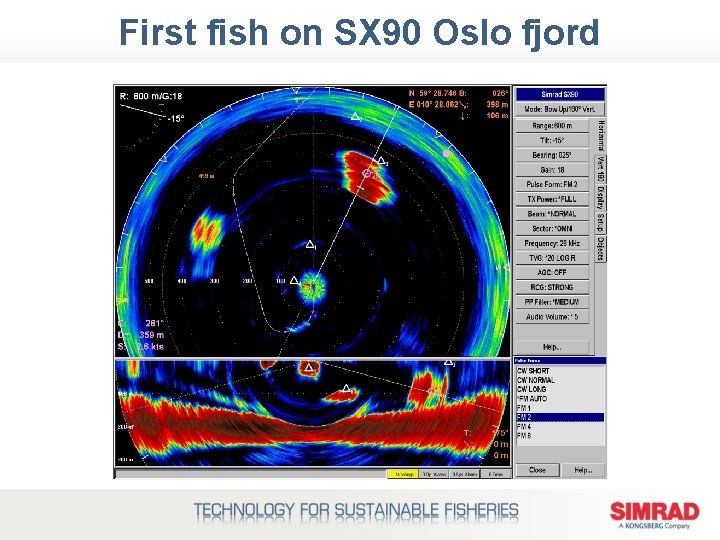
First fish on SX 90 Oslo fjord