
New School Transportation Supervisor Training School Transportation Unit





- Slides: 136
New School Transportation Supervisor Training School Transportation Unit 1580 Logan Street, Suite 310 Denver, CO 80203 2015 -2016
Intent of Training § This presentation has been developed for the School Transportation Supervisor to provide information and resources regarding pupil transportation. § Who can provide you with information? § What resources are available? § When should certain things be done? § Where can you find this information? § How do you find what you are looking for? 2
If I had a $1. 00……for every time I was told……. . “ There is no way I could ever do your job!” Why? 3
THE ABILITY TO WORK TOGETHER TOWARD A COMMON VISION Ability to direct individual accomplishments toward organizational objectives The fuel that allows common people to obtain uncommon results. Simply stated, it is less me and more WE!
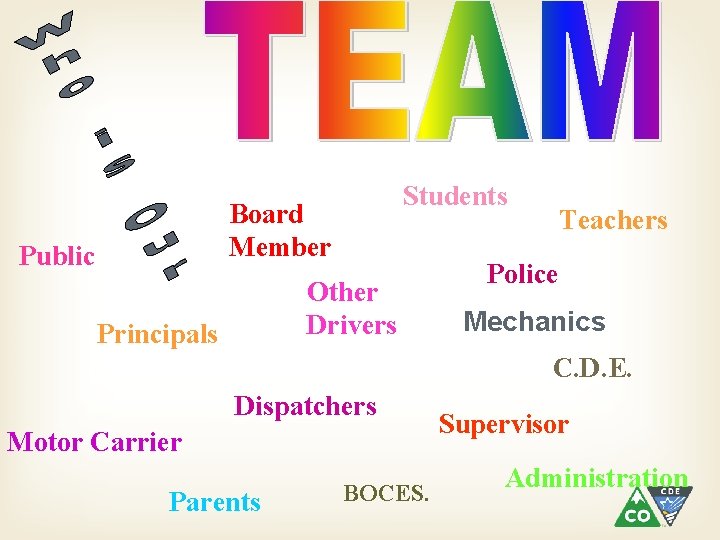
Students Board Member Public Other Drivers Principals Teachers Police Mechanics C. D. E. Dispatchers Motor Carrier Parents BOCES. Supervisor Administration
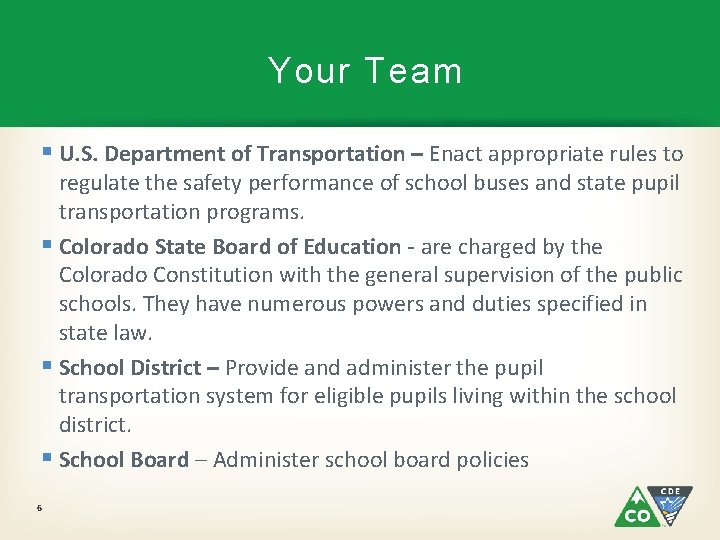
Your Team § U. S. Department of Transportation – Enact appropriate rules to regulate the safety performance of school buses and state pupil transportation programs. § Colorado State Board of Education - are charged by the Colorado Constitution with the general supervision of the public schools. They have numerous powers and duties specified in state law. § School District – Provide and administer the pupil transportation system for eligible pupils living within the school district. § School Board – Administer school board policies 6
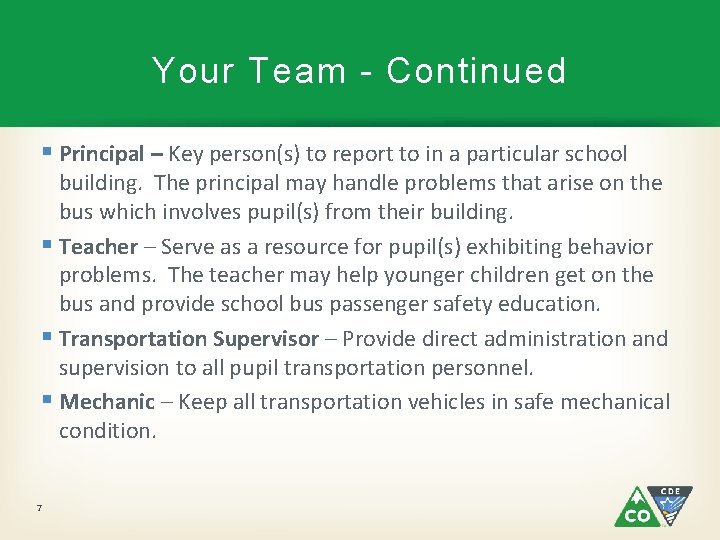
Your Team - Continued § Principal – Key person(s) to report to in a particular school building. The principal may handle problems that arise on the bus which involves pupil(s) from their building. § Teacher – Serve as a resource for pupil(s) exhibiting behavior problems. The teacher may help younger children get on the bus and provide school bus passenger safety education. § Transportation Supervisor – Provide direct administration and supervision to all pupil transportation personnel. § Mechanic – Keep all transportation vehicles in safe mechanical condition. 7
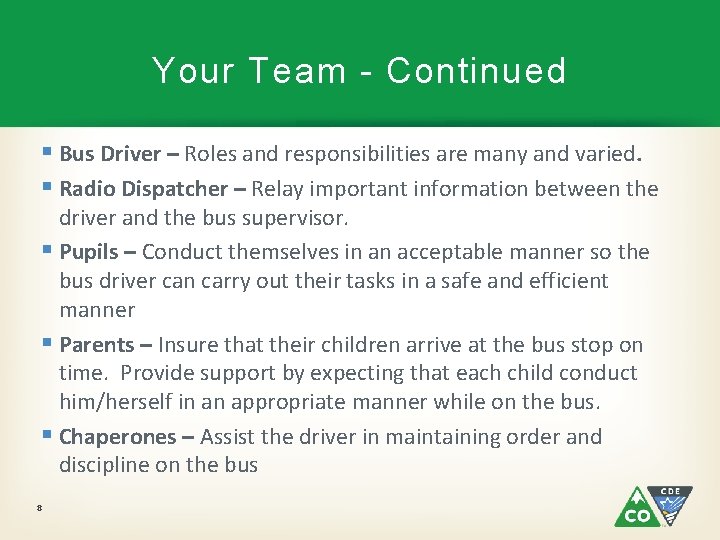
Your Team - Continued § Bus Driver – Roles and responsibilities are many and varied. § Radio Dispatcher – Relay important information between the driver and the bus supervisor. § Pupils – Conduct themselves in an acceptable manner so the bus driver can carry out their tasks in a safe and efficient manner § Parents – Insure that their children arrive at the bus stop on time. Provide support by expecting that each child conduct him/herself in an appropriate manner while on the bus. § Chaperones – Assist the driver in maintaining order and discipline on the bus 8
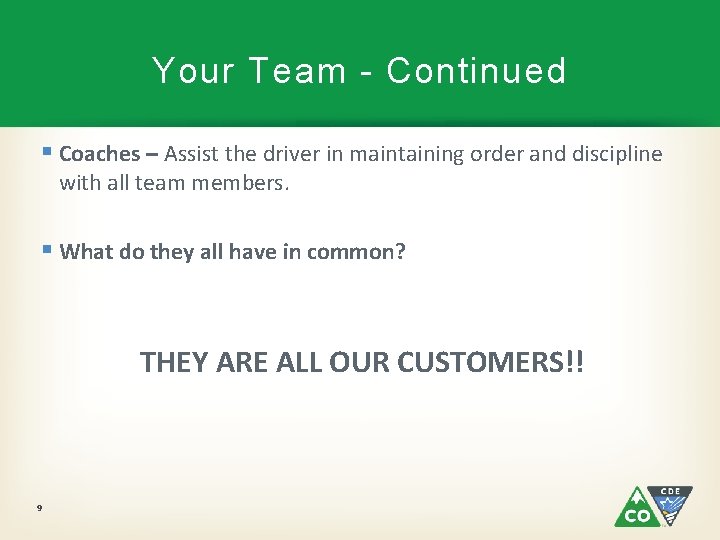
Your Team - Continued § Coaches – Assist the driver in maintaining order and discipline with all team members. § What do they all have in common? THEY ARE ALL OUR CUSTOMERS!! 9
Customer Creed § The customer is the reason for our being here § It takes months to find a customer, seconds to lose one § Always be courteous and polite during each customer contact § Always do more than is expected when you handle a customer’s problem § Never promise more than you can deliver § Continually look for ways to improve quality and add value and safety to our product 10
CUSTOMER CONCEPT WHAT ARE THE 3 MOST IMPORTANT TASKS OF YOUR JOB? 1. SAFETY 2. RIDER RELATIONSHIPS 3. INSPECTED AND SAFE VEHICLE
Whether you like it or not…. YOU ARE IN A FISH BOWL!! 12
If there is one thing you remember from this class. . If you didn’t write it down……. you didn’t do it!! 13
Communication § Students § Parents § Staff § Administration § Public 14
Laws § A law is a requirement that has been passed by a legislative body and signed by the chief executive. At the Federal level the legislative body is the Congress. At the State level it is the state legislature. Laws are requirements that must be obeyed. § The “National Traffic and Motor Vehicle Safety Act” and the “Motor Vehicle and School Bus Safety Amendments of 1974” are examples of Federal laws. These laws authorize and require the National Highway Traffic Safety Administration to officially announce rules on safety performance requirements in the manufacture of school buses. § The requirements that must be met to become a school bus driver and all the other laws contained within the Colorado Vehicle Code are examples of state laws. 15
Rules and Regulations § Rules and regulations are synonymous terms to describe a requirement adopted by an executive department with the authority to establish rules for carrying out the program. A definite procedure must be followed when adopting administrative rules. When adopted, the rules have the same effect as though they were laws. They are requirements that must be obeyed. § Colorado Department of Education § At the Federal level, the U. S. Department of Transportation have been given the authority by law to establish administrative rules to carry out pupil transportation programs. § The school bus Federal Motor Vehicle Safety Standards promulgated by the National Highway Traffic Safety Administration are examples of federal rules. 16
Policy § A policy is a course of action, guiding principle or procedure adopted by any authoritative body that is considered to be expedient, prudent, or advantageous. Policies are principles or procedures that one is expected to follow, and should follow, but it is not absolutely mandated as a law or rule. § School boards may have policies and procedures at the local school district level related to the pupil transportation program. § Local school districts may have policies on: § � Checking the bus after each run for sleeping students § � Student Discipline Procedures § � Reporting in writing all bus conditions requiring adjustment or repair form § � Reporting all accidents to bus supervisor (district forms) 17
Recommendation § A recommendation is a statement giving advice or counsel. Any organization or individual might recommend some type of action. It is strictly advisory. It is not required. § The local transportation supervisor could also have a number of recommendations. These would vary by school district and could range from manner of operation of the bus to how drivers are to dress. 18
Difference § � Law: A requirement established by a legislative body that must be followed. § � Rule/Regulation: A requirement established by an administrative department that must be followed. § � Policy: A guideline established by an authoritative body that is expected, but not absolutely required to be followed. § � Recommendation: A guideline that should be followed § 4204 -R-235. 00 School District Rules § 235. 01 None of these rules shall preclude a school district/service provider from establishing a more rigid standard or policy when deemed necessary by the local board of education/service provider. 19
CORA § "CORA" stands for "Colorado Open Records Act". In the spirit of open government, the Colorado Open Records Act [1] requires that most public records be available to the public. Anyone can request information that is in the possession of a government office, including the Secretary of State’s office. 20
CDE Website www. cde. state. co. us
Acronyms § ARM – Administrator’s Reference Manual § CDE – Colorado Department of Education § DOT – Department of Transportation § FMVSS – Federal Motor Vehicle Safety Standards § FMCSA – Federal Motor Carrier Safety Administration § NHTSA - National Highway Traffic Safety Administration § NAPT – National Association for Pupil Transportation § CSPTA – Colorado State Pupil Transportation Association § C. R. S. – Colorado Revised Statutes 22
4204 -R-202. 00 School Transportation Vehicle Operator Classifications 23
Character Requirements § Good Attitude § Mentally and Physically § § § 24 Prepared Performs required inspections of vehicle and reports defects promptly Follow the speed limits Makes complete stops Courteous to other drivers Respectful and caring to all passengers § Follows district procedures/policies § Basic Driving Skills
The Bee's Be On Time Be Conscientious Be Positive Be Courteous Be Rested Be Sensible Be Sober Be Drug Free Be Positive Be Well Groomed 25
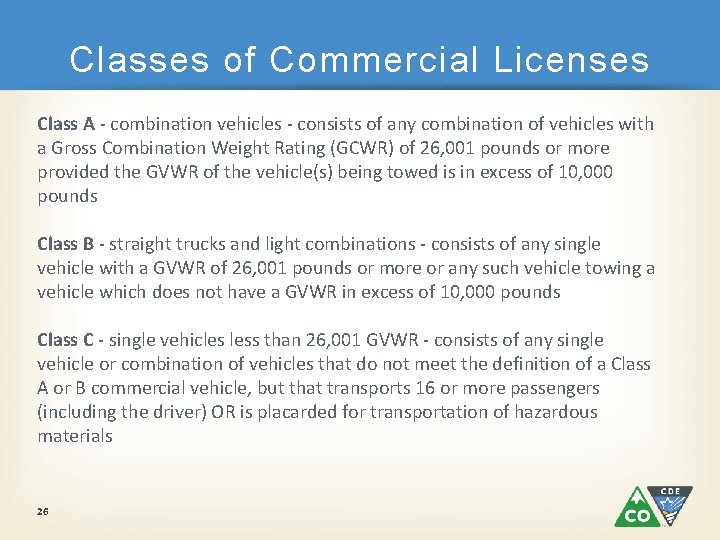
Classes of Commercial Licenses Class A - combination vehicles - consists of any combination of vehicles with a Gross Combination Weight Rating (GCWR) of 26, 001 pounds or more provided the GVWR of the vehicle(s) being towed is in excess of 10, 000 pounds Class B - straight trucks and light combinations - consists of any single vehicle with a GVWR of 26, 001 pounds or more or any such vehicle towing a vehicle which does not have a GVWR in excess of 10, 000 pounds Class C - single vehicles less than 26, 001 GVWR - consists of any single vehicle or combination of vehicles that do not meet the definition of a Class A or B commercial vehicle, but that transports 16 or more passengers (including the driver) OR is placarded for transportation of hazardous materials 26
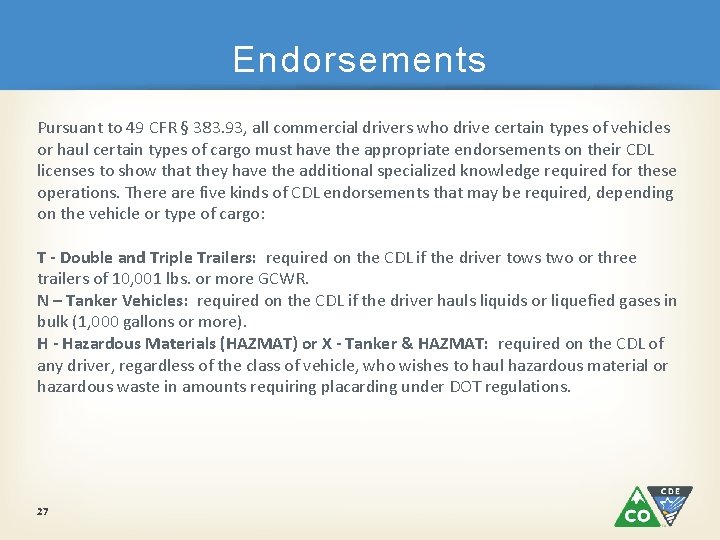
Endorsements Pursuant to 49 CFR § 383. 93, all commercial drivers who drive certain types of vehicles or haul certain types of cargo must have the appropriate endorsements on their CDL licenses to show that they have the additional specialized knowledge required for these operations. There are five kinds of CDL endorsements that may be required, depending on the vehicle or type of cargo: T - Double and Triple Trailers: required on the CDL if the driver tows two or three trailers of 10, 001 lbs. or more GCWR. N – Tanker Vehicles: required on the CDL if the driver hauls liquids or liquefied gases in bulk (1, 000 gallons or more). H - Hazardous Materials (HAZMAT) or X - Tanker & HAZMAT: required on the CDL of any driver, regardless of the class of vehicle, who wishes to haul hazardous material or hazardous waste in amounts requiring placarding under DOT regulations. 27
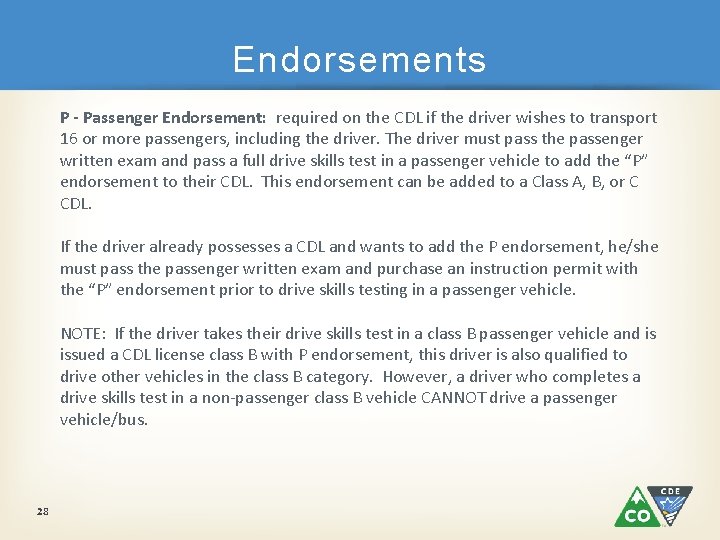
Endorsements P - Passenger Endorsement: required on the CDL if the driver wishes to transport 16 or more passengers, including the driver. The driver must pass the passenger written exam and pass a full drive skills test in a passenger vehicle to add the “P” endorsement to their CDL. This endorsement can be added to a Class A, B, or C CDL. If the driver already possesses a CDL and wants to add the P endorsement, he/she must pass the passenger written exam and purchase an instruction permit with the “P” endorsement prior to drive skills testing in a passenger vehicle. NOTE: If the driver takes their drive skills test in a class B passenger vehicle and is issued a CDL license class B with P endorsement, this driver is also qualified to drive other vehicles in the class B category. However, a driver who completes a drive skills test in a non-passenger class B vehicle CANNOT drive a passenger vehicle/bus. 28
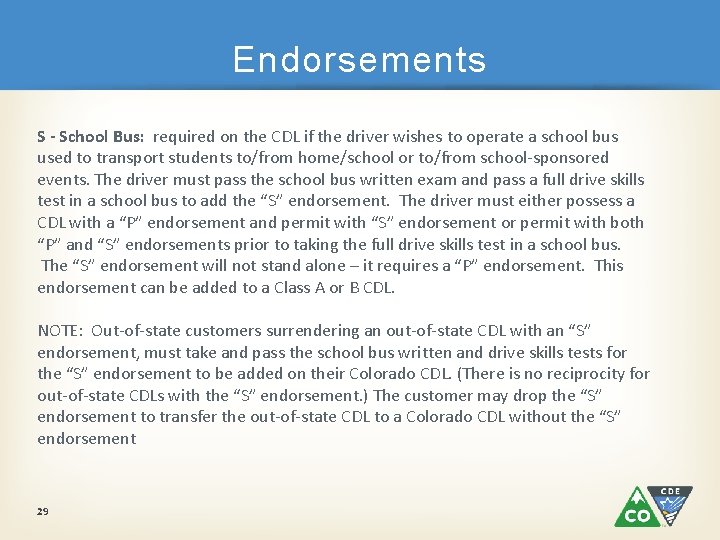
Endorsements S - School Bus: required on the CDL if the driver wishes to operate a school bus used to transport students to/from home/school or to/from school-sponsored events. The driver must pass the school bus written exam and pass a full drive skills test in a school bus to add the “S” endorsement. The driver must either possess a CDL with a “P” endorsement and permit with “S” endorsement or permit with both “P” and “S” endorsements prior to taking the full drive skills test in a school bus. The “S” endorsement will not stand alone – it requires a “P” endorsement. This endorsement can be added to a Class A or B CDL. NOTE: Out-of-state customers surrendering an out-of-state CDL with an “S” endorsement, must take and pass the school bus written and drive skills tests for the “S” endorsement to be added on their Colorado CDL. (There is no reciprocity for out-of-state CDLs with the “S” endorsement. ) The customer may drop the “S” endorsement to transfer the out-of-state CDL to a Colorado CDL without the “S” endorsement 29
CDL Restrictions Intrastate Restriction: certain CDL drivers are authorized to operate only within the state of Colorado. These drivers will have this restriction on their CDL limiting them to driving a commercial vehicle solely within Colorado. The “K” restriction is required: For all CDL drivers 18 years of age up to 21 years of age If a CDL driver cannot meet the requirements for the DOT medical (part 391, FMSCR) and has a waiver issued by the Colorado State Patrol If a FMCSA exemption only allows for intrastate commerce If the CDL driver self certifies to Non Excepted Intrastate Driving (option C) or Excepted Intrastate Driving (option D) If a driver surrenders an out-of-state license that has the “K” restriction on it and one of the four requirements above is not present, the “K” restriction does not transfer over to the Colorado CDL. 30
CDL Restrictions L - Air Brakes Restriction: if a driver is tested in a commercial vehicle that does not have air brakes, a restriction will be placed on the driver's CDL showing that they are not qualified to operate vehicles with air brakes. To remove this restriction from a CDL license, the driver must pass the air brakes written exam, purchase a CDL permit with the restriction removed, pass a full driving skills test in a vehicle equipped with air brakes and purchase a new CDL. All normal fees apply. No Tractor/Trailer – No Tractor Trailer: required on a Class A CDL for drivers who tow trailers that have a GVWR of 10, 001 lbs or more but do not drive tractor-trailers; the GCWR must be over 26, 001 lbs. , but the towing unit is less than 26, 001 lbs. 31
KNOW THE CDL REGULATIONS 60 Day Suspension 60 -120 Day Suspension 1 Year Suspension Life Suspension Commercial Driver License Skills Test Required 32
EMPLOYER RESPONSIBILITIES No Employer shall knowingly: Allow, require, permit or authorize an employee to operate a commercial motor vehicle in the U. S. when: ü The employee’s commercial motor vehicle driver license has been suspended, revoked, or canceled, OR ü The employee has lost the right to operate a commercial motor vehicle in a state. 33
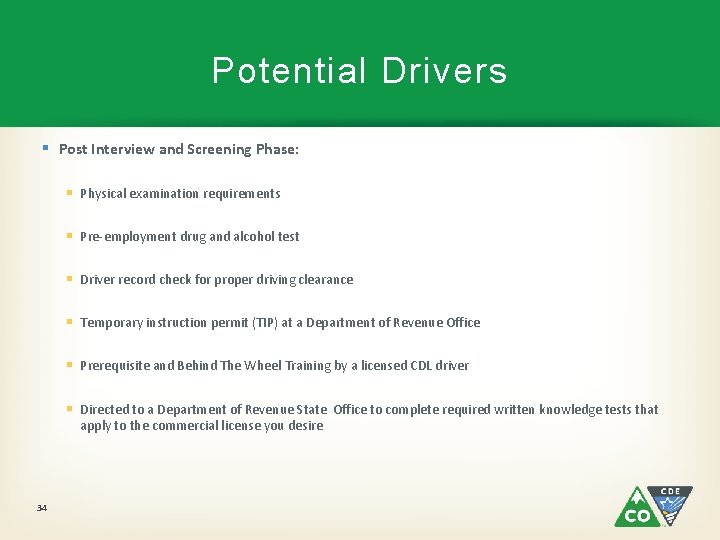
Potential Drivers § Post Interview and Screening Phase: § Physical examination requirements § Pre-employment drug and alcohol test § Driver record check for proper driving clearance § Temporary instruction permit (TIP) at a Department of Revenue Office § Prerequisite and Behind The Wheel Training by a licensed CDL driver § Directed to a Department of Revenue State Office to complete required written knowledge tests that apply to the commercial license you desire 34
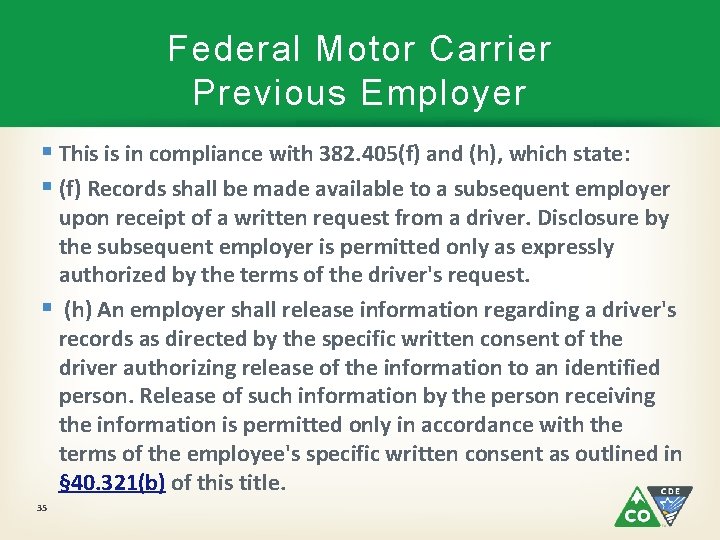
Federal Motor Carrier Previous Employer § This is in compliance with 382. 405(f) and (h), which state: § (f) Records shall be made available to a subsequent employer upon receipt of a written request from a driver. Disclosure by the subsequent employer is permitted only as expressly authorized by the terms of the driver's request. § (h) An employer shall release information regarding a driver's records as directed by the specific written consent of the driver authorizing release of the information to an identified person. Release of such information by the person receiving the information is permitted only in accordance with the terms of the employee's specific written consent as outlined in § 40. 321(b) of this title. 35
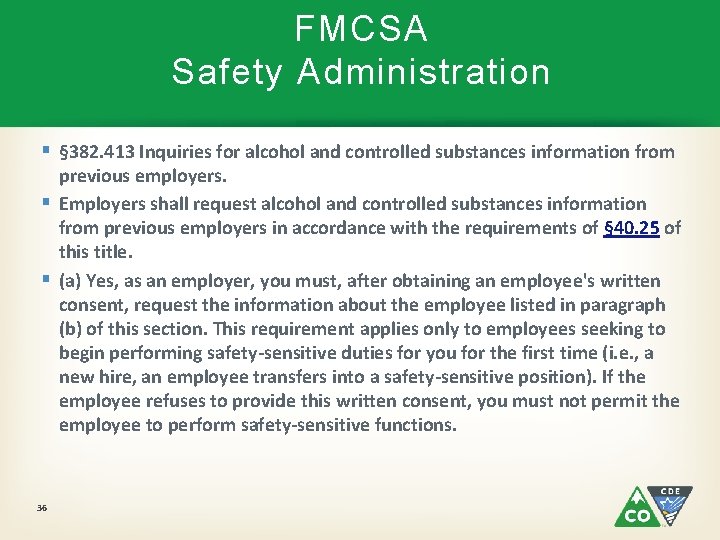
FMCSA Safety Administration § § 382. 413 Inquiries for alcohol and controlled substances information from previous employers. § Employers shall request alcohol and controlled substances information from previous employers in accordance with the requirements of § 40. 25 of this title. § (a) Yes, as an employer, you must, after obtaining an employee's written consent, request the information about the employee listed in paragraph (b) of this section. This requirement applies only to employees seeking to begin performing safety-sensitive duties for you for the first time (i. e. , a new hire, an employee transfers into a safety-sensitive position). If the employee refuses to provide this written consent, you must not permit the employee to perform safety-sensitive functions. 36
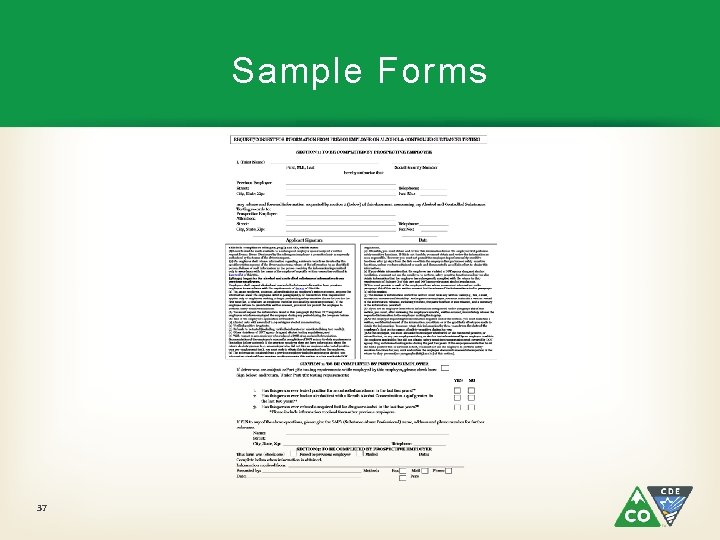
Sample Forms 37
Federal Requirements- Continued § What drug tests are required § Pre-employment § Reasonable Suspicion § Post Accident § 1. If there is a human fatality as a result of the accident, your driver must be tested. § 2. If your driver receives a citation for a moving violation and there is bodily injury that results in medical treatment away from the scene, your driver must be tested. § 3. If your driver receives a citation for a moving violation and there is disabling damage to any of the vehicles involved, your driver must be tested. § The key point in Numbers 2 and 3 is that the driver must first have been issued a citation for a moving violation.
Federal Requirements- Continued § Random Selection § Return-to-duty § Follow-up 39
Obtaining a CDL § How do I get a CDL for the first time? § You must hold a valid regular driver’s license and be at least 18 years old before applying for a CDL § CDL school is not required, but recommended § You will need to visit a driver’s license office and successfully pass the written tests that apply to the commercial license you desire. Once you have successfully passed the required exams, purchase a CDL permit ($14. 00) § Class B – minimum exams required are § General knowledge § Air brakes (required if driving a vehicle with air brakes § Class C – minimum exams required are § General knowledge § Passenger (required if carrying 16 passengers or more including driver) § Hazardous materials (required if transporting hazardous materials) 40
Obtaining a CDL You will be required to: Show current DOT medical card from a FMCSA Certified Medical Examiner Show proof of address, list of acceptable documents (Two required) Show your original, non-laminated Social Security card or know your Social Security number Schedule a drive skills test Return to driver’s license office with your drive skills test completion form and purchase a CDL ($35. 00 or $37. 00 if you have a motorcycle endorsement) 41
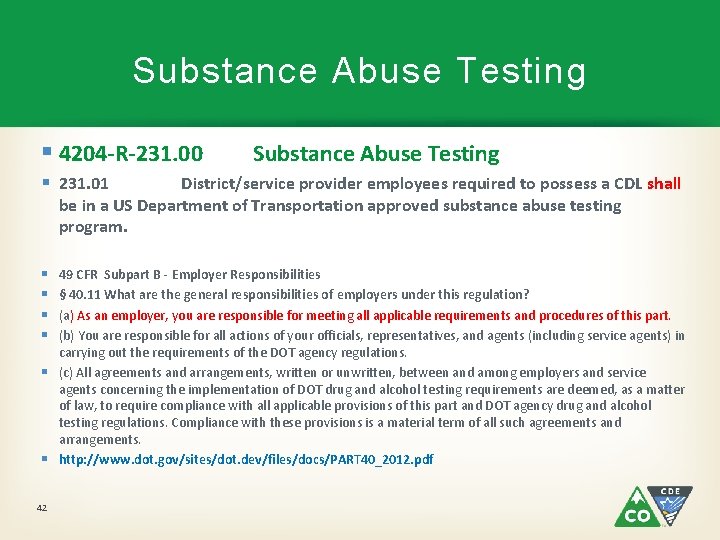
Substance Abuse Testing § 4204 -R-231. 00 Substance Abuse Testing § 231. 01 District/service provider employees required to possess a CDL shall be in a US Department of Transportation approved substance abuse testing program. § § 49 CFR Subpart B - Employer Responsibilities § 40. 11 What are the general responsibilities of employers under this regulation? (a) As an employer, you are responsible for meeting all applicable requirements and procedures of this part. (b) You are responsible for all actions of your officials, representatives, and agents (including service agents) in carrying out the requirements of the DOT agency regulations. § (c) All agreements and arrangements, written or unwritten, between and among employers and service agents concerning the implementation of DOT drug and alcohol testing requirements are deemed, as a matter of law, to require compliance with all applicable provisions of this part and DOT agency drug and alcohol testing regulations. Compliance with these provisions is a material term of all such agreements and arrangements. § http: //www. dot. gov/sites/dot. dev/files/docs/PART 40_2012. pdf 42
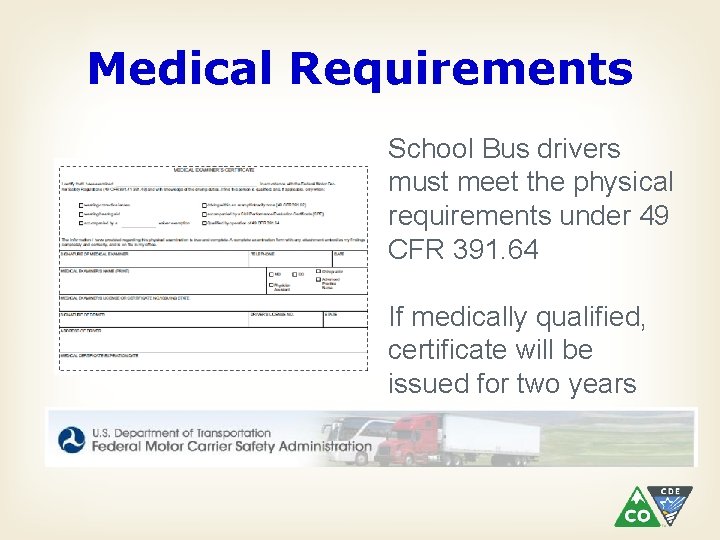
Medical Requirements School Bus drivers must meet the physical requirements under 49 CFR 391. 64 If medically qualified, certificate will be issued for two years
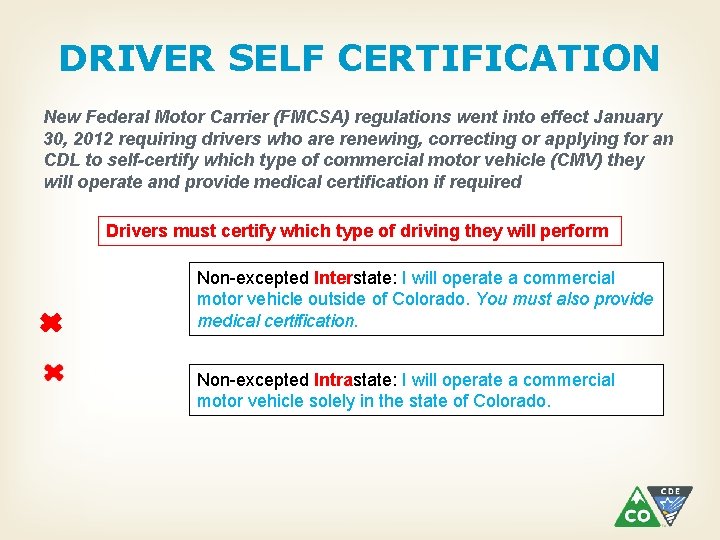
DRIVER SELF CERTIFICATION New Federal Motor Carrier (FMCSA) regulations went into effect January 30, 2012 requiring drivers who are renewing, correcting or applying for an CDL to self-certify which type of commercial motor vehicle (CMV) they will operate and provide medical certification if required Drivers must certify which type of driving they will perform Non-excepted Interstate: I will operate a commercial motor vehicle outside of Colorado. You must also provide medical certification. Non-excepted Intrastate: I will operate a commercial motor vehicle solely in the state of Colorado.
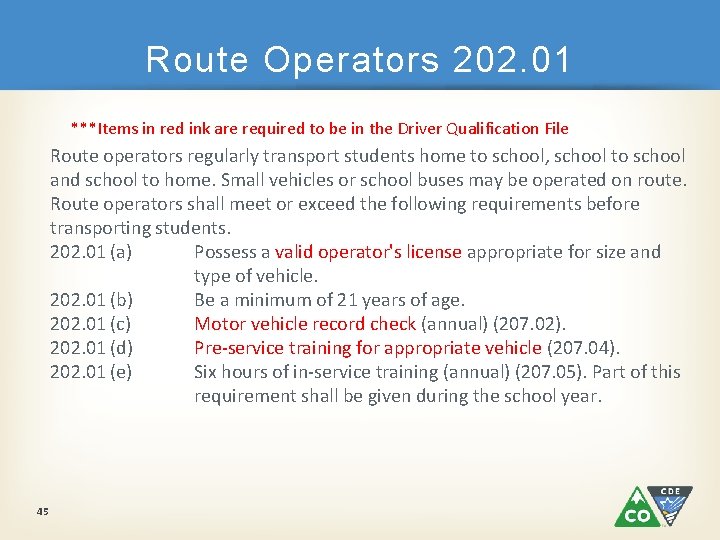
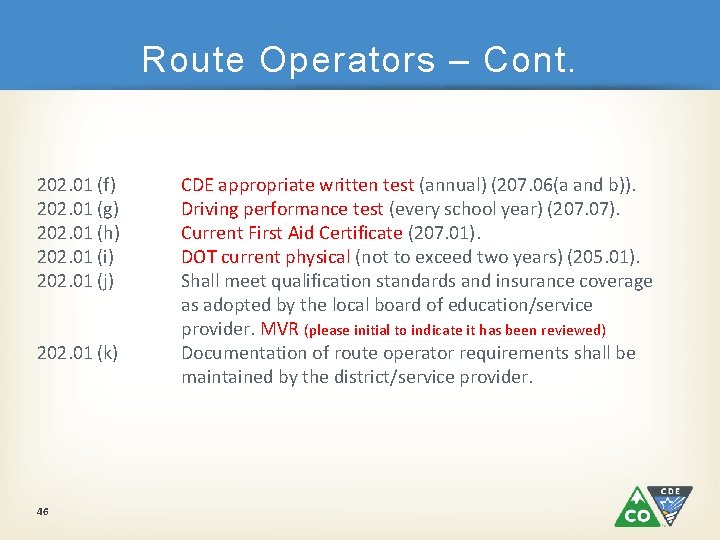
Route Operators 202. 01 ***Items in red ink are required to be in the Driver Qualification File Route operators regularly transport students home to school, school to school and school to home. Small vehicles or school buses may be operated on route. Route operators shall meet or exceed the following requirements before transporting students. 202. 01 (a) Possess a valid operator's license appropriate for size and type of vehicle. 202. 01 (b) Be a minimum of 21 years of age. 202. 01 (c) Motor vehicle record check (annual) (207. 02). 202. 01 (d) Pre-service training for appropriate vehicle (207. 04). 202. 01 (e) Six hours of in-service training (annual) (207. 05). Part of this requirement shall be given during the school year. 45
Route Operators – Cont. 202. 01 (f) 202. 01 (g) 202. 01 (h) 202. 01 (i) 202. 01 (j) 202. 01 (k) 46 CDE appropriate written test (annual) (207. 06(a and b)). Driving performance test (every school year) (207. 07). Current First Aid Certificate (207. 01). DOT current physical (not to exceed two years) (205. 01). Shall meet qualification standards and insurance coverage as adopted by the local board of education/service provider. MVR (please initial to indicate it has been reviewed) Documentation of route operator requirements shall be maintained by the district/service provider.
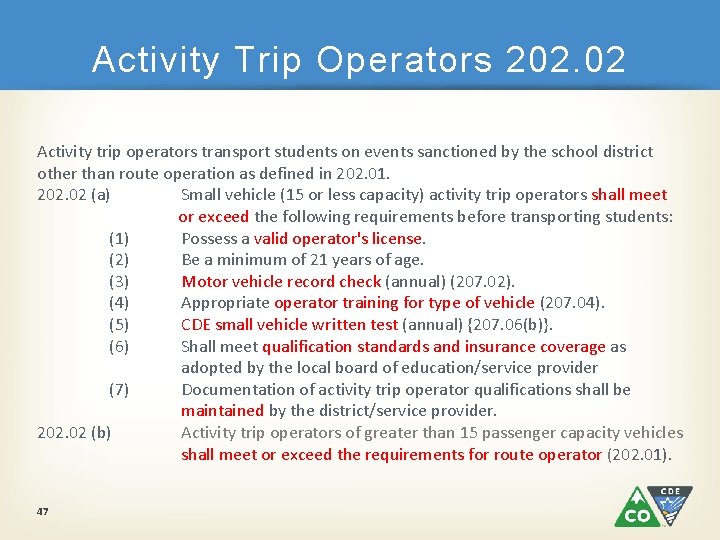
Activity Trip Operators 202. 02 Activity trip operators transport students on events sanctioned by the school district other than route operation as defined in 202. 01. 202. 02 (a) Small vehicle (15 or less capacity) activity trip operators shall meet or exceed the following requirements before transporting students: (1) Possess a valid operator's license. (2) Be a minimum of 21 years of age. (3) Motor vehicle record check (annual) (207. 02). (4) Appropriate operator training for type of vehicle (207. 04). (5) CDE small vehicle written test (annual) {207. 06(b)}. (6) Shall meet qualification standards and insurance coverage as adopted by the local board of education/service provider (7) Documentation of activity trip operator qualifications shall be maintained by the district/service provider. 202. 02 (b) Activity trip operators of greater than 15 passenger capacity vehicles shall meet or exceed the requirements for route operator (202. 01). 47
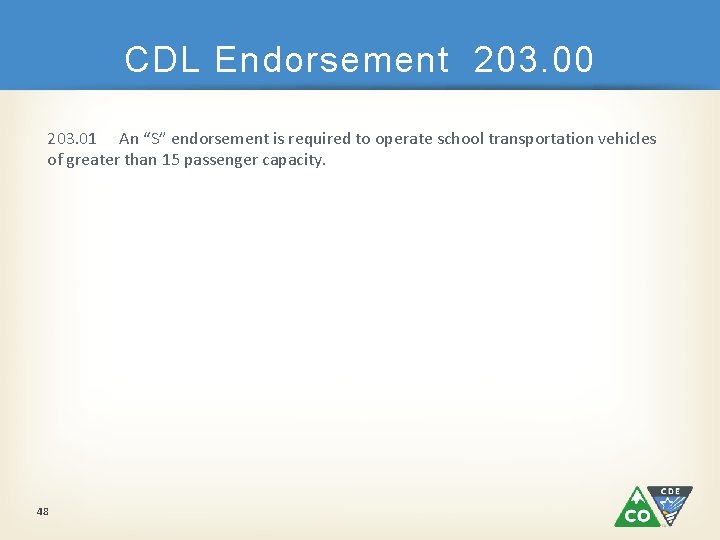
CDL Endorsement 203. 00 203. 01 An “S” endorsement is required to operate school transportation vehicles of greater than 15 passenger capacity. 48
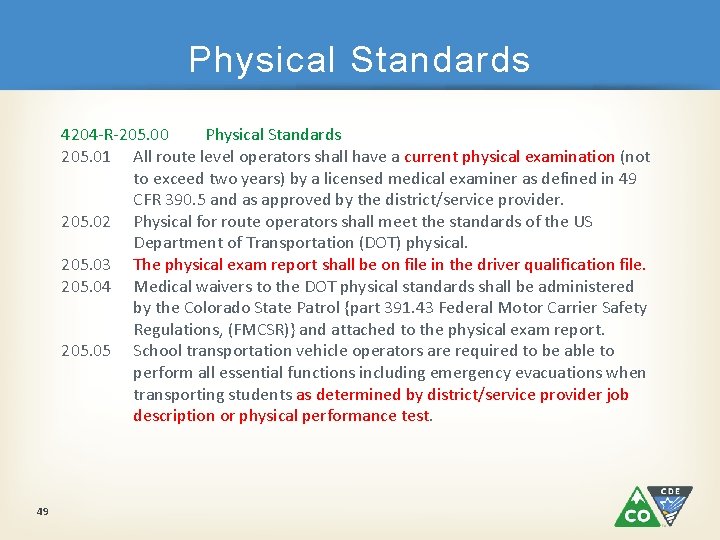
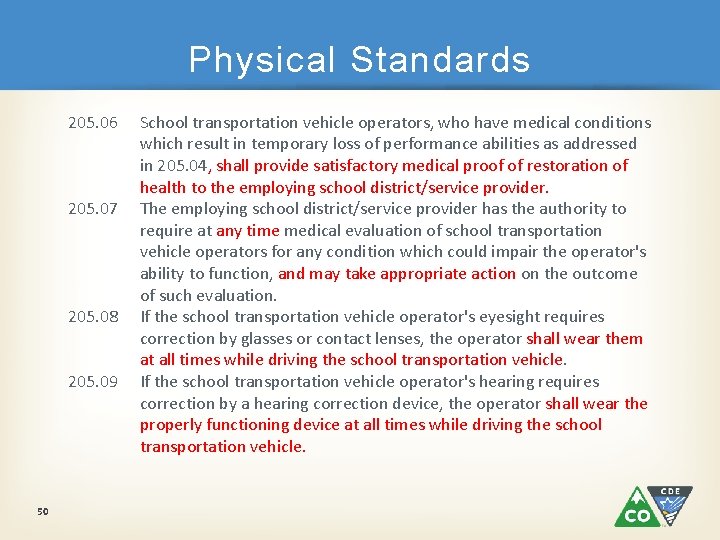
Physical Standards 4204 -R-205. 00 Physical Standards 205. 01 All route level operators shall have a current physical examination (not to exceed two years) by a licensed medical examiner as defined in 49 CFR 390. 5 and as approved by the district/service provider. 205. 02 Physical for route operators shall meet the standards of the US Department of Transportation (DOT) physical. 205. 03 The physical exam report shall be on file in the driver qualification file. 205. 04 Medical waivers to the DOT physical standards shall be administered by the Colorado State Patrol {part 391. 43 Federal Motor Carrier Safety Regulations, (FMCSR)} and attached to the physical exam report. 205. 05 School transportation vehicle operators are required to be able to perform all essential functions including emergency evacuations when transporting students as determined by district/service provider job description or physical performance test. 49
Physical Standards 205. 06 205. 07 205. 08 205. 09 50 School transportation vehicle operators, who have medical conditions which result in temporary loss of performance abilities as addressed in 205. 04, shall provide satisfactory medical proof of restoration of health to the employing school district/service provider. The employing school district/service provider has the authority to require at any time medical evaluation of school transportation vehicle operators for any condition which could impair the operator's ability to function, and may take appropriate action on the outcome of such evaluation. If the school transportation vehicle operator's eyesight requires correction by glasses or contact lenses, the operator shall wear them at all times while driving the school transportation vehicle. If the school transportation vehicle operator's hearing requires correction by a hearing correction device, the operator shall wear the properly functioning device at all times while driving the school transportation vehicle.
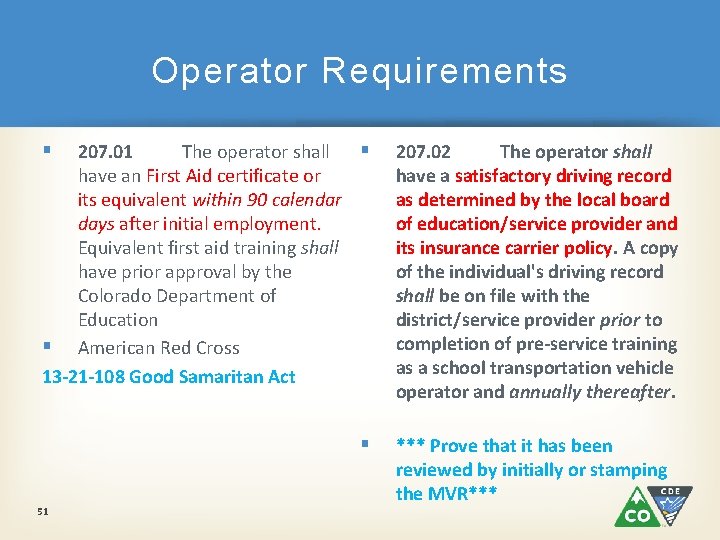
Operator Requirements § 207. 01 The operator shall § have an First Aid certificate or its equivalent within 90 calendar days after initial employment. Equivalent first aid training shall have prior approval by the Colorado Department of Education § American Red Cross 13 -21 -108 Good Samaritan Act § 51 207. 02 The operator shall have a satisfactory driving record as determined by the local board of education/service provider and its insurance carrier policy. A copy of the individual's driving record shall be on file with the district/service provider prior to completion of pre-service training as a school transportation vehicle operator and annually thereafter. *** Prove that it has been reviewed by initially or stamping the MVR***
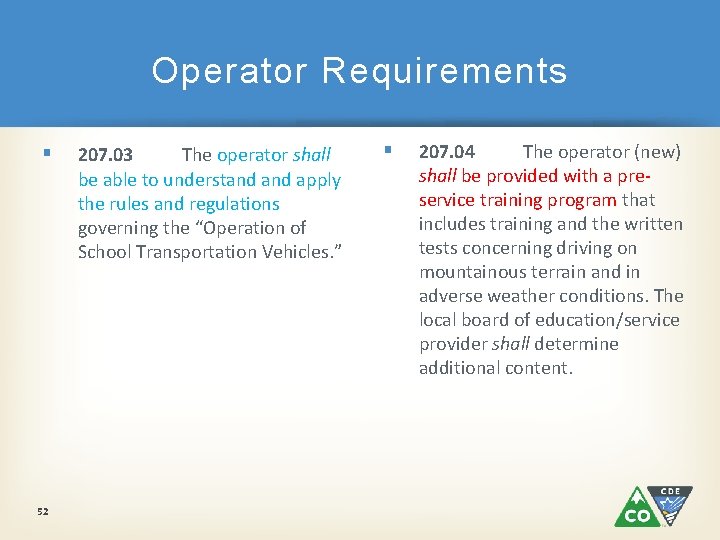
Operator Requirements § 52 207. 03 The operator shall be able to understand apply the rules and regulations governing the “Operation of School Transportation Vehicles. ” § 207. 04 The operator (new) shall be provided with a preservice training program that includes training and the written tests concerning driving on mountainous terrain and in adverse weather conditions. The local board of education/service provider shall determine additional content.
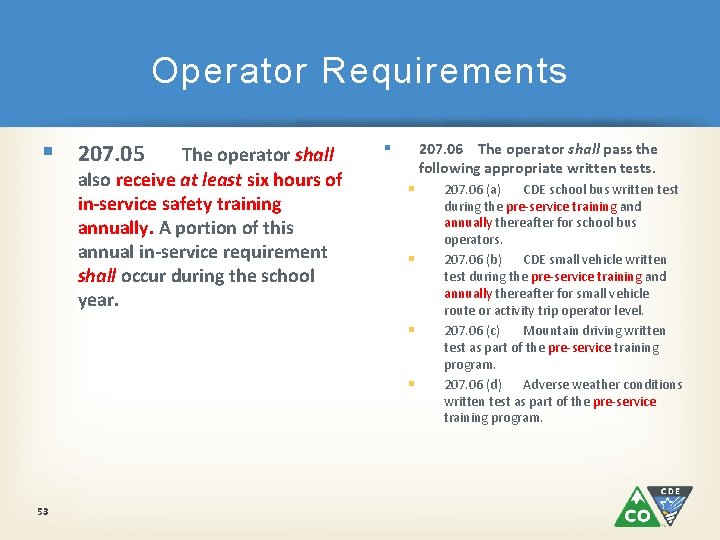
Operator Requirements § 207. 05 The operator shall also receive at least six hours of in-service safety training annually. A portion of this annual in-service requirement shall occur during the school year. § 207. 06 The operator shall pass the following appropriate written tests. § § 53 207. 06 (a) CDE school bus written test during the pre-service training and annually thereafter for school bus operators. 207. 06 (b) CDE small vehicle written test during the pre-service training and annually thereafter for small vehicle route or activity trip operator level. 207. 06 (c) Mountain driving written test as part of the pre-service training program. 207. 06 (d) Adverse weather conditions written test as part of the pre-service training program.
Operator Requirements § 54 207. 07 The driving performance test shall be part of the pre-service training and given every school year thereafter for route operators. This test shall be conducted in a vehicle, which is similar in type and size to the vehicle the applicant plans to operate, and shall include a vehicle inspection evaluation similar to a pre-trip inspection. § 207. 07 (a) Documentation shall be maintained that the driving performance test was conducted. § 207. 08 All training required by section 207. 00 shall be documented by the district/service provider.
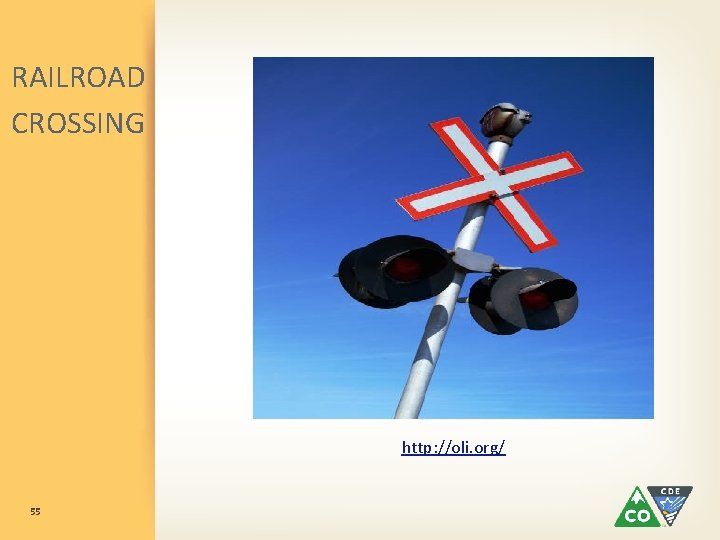
RAILROAD CROSSING http: //oli. org/ 55
4204 -R-209. 00 Railroad Crossings 209. 01 The following rules shall apply to all school/activity buses whether transporting students or not during the process of approaching, stopping, and crossing of railroad tracks. 209. 01 (a) The four-way hazard lamps shall be activated not less than 200 feet from the railroad crossing to alert other motorists of the pending stop for the crossing. 209. 01 (b) When stopped, the bus shall be as far to the right of the roadway as possible, and shall not form two lanes of traffic unless the highway is marked for four or more lanes of traffic. 209. 01 (c) The bus shall be stopped within 50 feet but not less than 15 feet from the nearest rail. 209. 01 (d) A prearranged signal shall be used to alert students to the need for quiet aboard the bus when approaching railroad tracks. Turn off all noise making equipment (fans, heaters, radio, etc. ). 56
209. 01 (e) After quietness aboard the stopped bus has been achieved, open the service door and operator window, listen and look in both directions along the track(s) for any approaching train(s) and for signals indicating the approach of a train. 209. 01 (f)If the tracks are clear, the service door shall be closed prior to placing the bus in motion, the bus may then proceed in a gear low enough to permit crossing the tracks without having to manually shift gears. Hazard lamps shall be turned off after the bus has cleared the tracks. 209. 01 (g) When two or more tracks are to be crossed, do not stop a second time unless the bus is completely clear of the first crossing and has at least fifteen (15) feet clearance in front and at least fifteen (15) feet clearance to the rear. 209. 01 (h) Before crossing the tracks, ensure there is adequate room on the other side of the tracks and train right-of-way for the entire length of the bus plus 15 feet in case the bus must stop. 209. 02 Buses are not required to stop at crossings which are controlled by an “exempt crossing” sign or at crossings controlled by a red, amber, green traffic control signal when it is in the green position, or when crossing is controlled by police officer, or human flag person. 57
Definition of “School bus” per Model Traffic Code for Colorado (92) "School bus" means every motor vehicle which is owned by or under contract to a public or governmental agency and operated for the transportation of children to or from school or any school-sponsored activities, or which is privately owned and operated for compensation but it does not include informal or intermittent arrangements, such as sharing of actual gasoline expense or participation in a car pool, for the transportation of children to or from school or any school-sponsored activities. 58
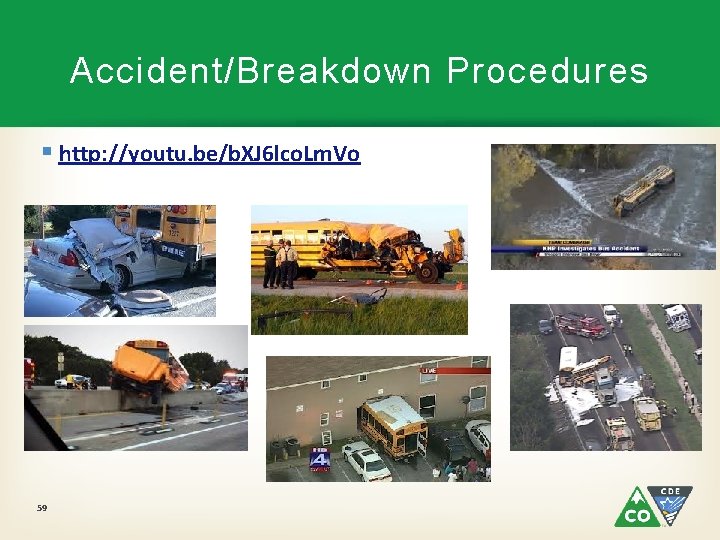
Accident/Breakdown Procedures § http: //youtu. be/b. XJ 6 lco. Lm. Vo 59
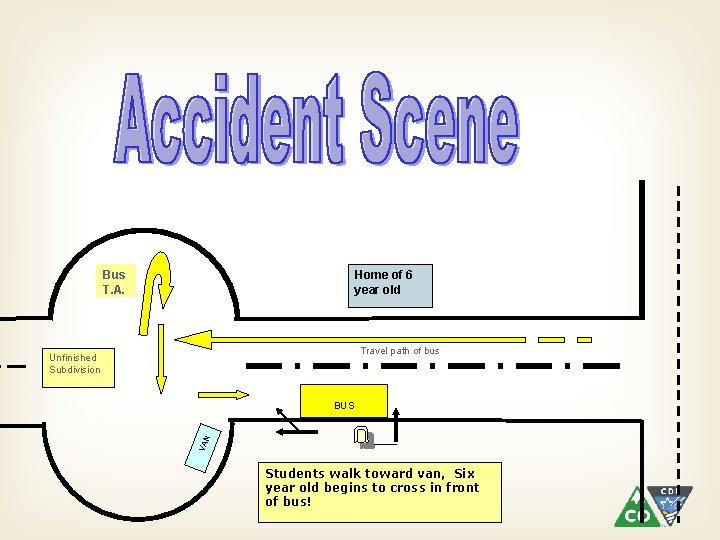
SCHOOL BUS FATALITY CASE § A 6 -year old girl was run over by her school bus § The next slide shows a diagram of the accident location Student Page 29 60
Bus T. A. Home of 6 year old Travel path of bus Unfinished Subdivision VA N BUS Students walk toward van, Six year old begins to cross in front of bus!
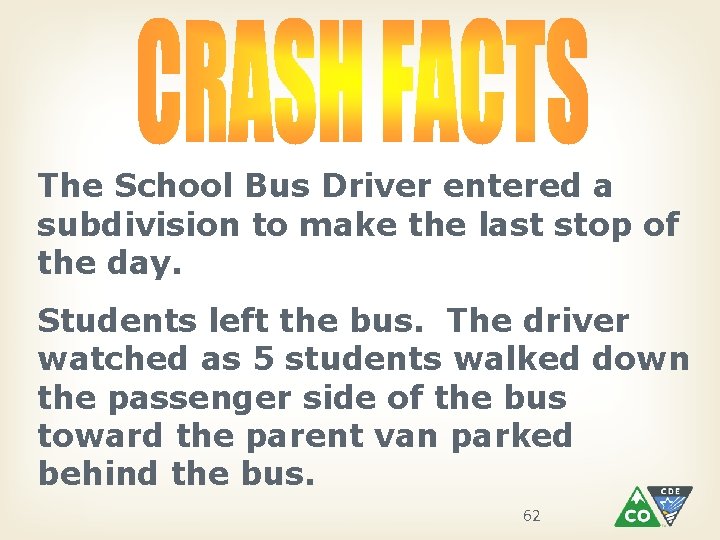
The School Bus Driver entered a subdivision to make the last stop of the day. Students left the bus. The driver watched as 5 students walked down the passenger side of the bus toward the parent van parked behind the bus. 62
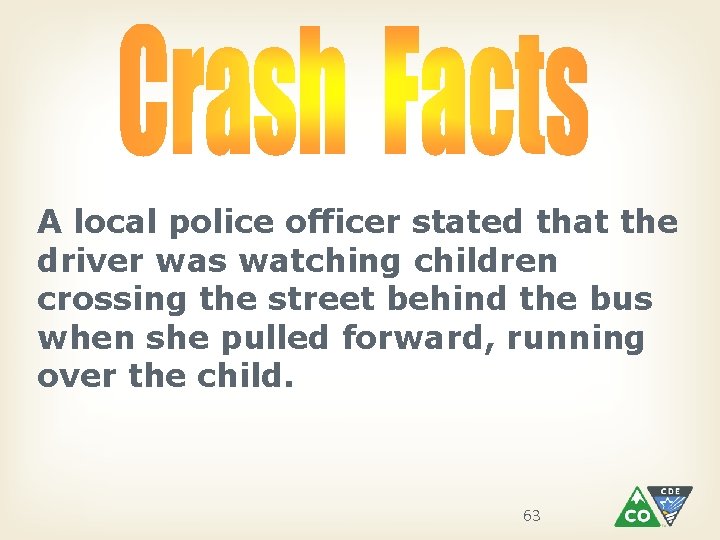
A local police officer stated that the driver was watching children crossing the street behind the bus when she pulled forward, running over the child. 63
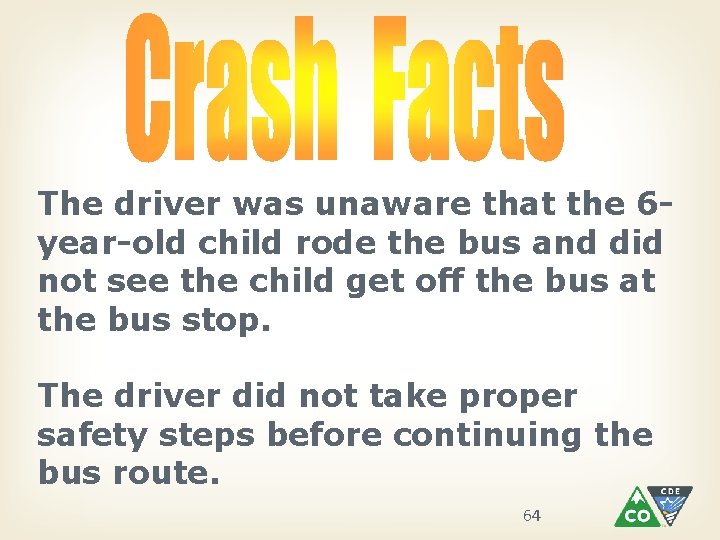
The driver was unaware that the 6 year-old child rode the bus and did not see the child get off the bus at the bus stop. The driver did not take proper safety steps before continuing the bus route. 64
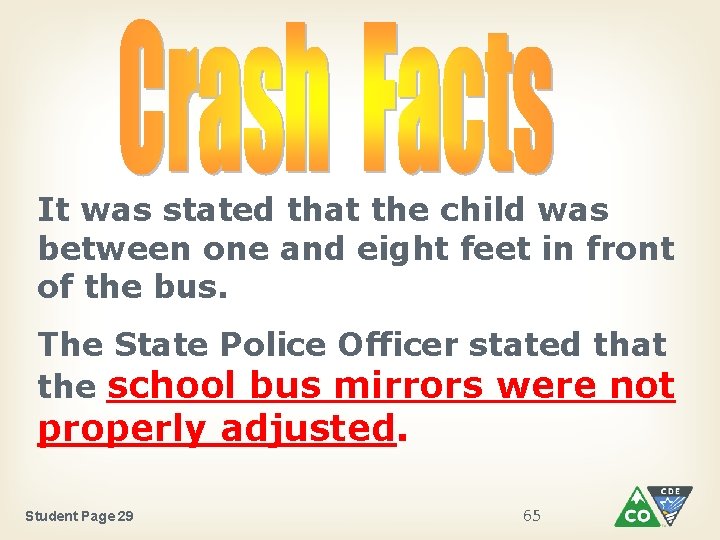
It was stated that the child was between one and eight feet in front of the bus. The State Police Officer stated that the school bus mirrors were not properly adjusted. Student Page 29 65
Court Findings School Bus Driver's Responsibilities: • Driver owed a duty to the student. • Driver did not follow bus stop laws. • Inappropriate events resulted in the death of a child. 66
Court Findings ü Establish regulation governing the conduct of students for their safety while en route to and from school ü Statues and rules indicate a high degree of care in the transportation of students. 67
Four Conditions of Determining Liability 1. Duty – an obligation to perform 2. Breach of duty – a failure to perform a duty 3. Cause – the failure to perform 4. Damage - failure to control the vehicle 68
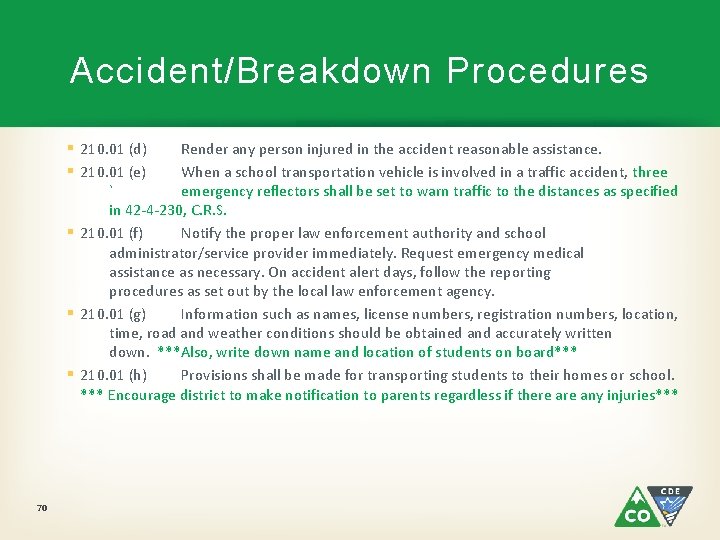
Accident/Breakdown Procedures § 4204 -R-210. 00 Accident/Breakdown Procedures § 210. 01 The following procedures shall be observed in the case of an accident involving a school transportation vehicle. § 210. 01 (a) § 210. 01 (b) Stop the vehicle immediately. Remain at the scene of the accident. If the accident occurred on the traveled portion, median or ramp of a divided highway and each vehicle can be safely moved, move the vehicles to a nearby safe location. (42 -4 -1602, C. R. S. as amended). § 210. 01 (c) Make certain all students are in a safe place. If it is determined that it is unsafe to keep students inside the school transportation vehicle, then evacuate the students to a safe place, away from traffic. 69
Accident/Breakdown Procedures § 210. 01 (d) § 210. 01 (e) Render any person injured in the accident reasonable assistance. When a school transportation vehicle is involved in a traffic accident, three ` emergency reflectors shall be set to warn traffic to the distances as specified in 42 -4 -230, C. R. S. § 210. 01 (f) Notify the proper law enforcement authority and school administrator/service provider immediately. Request emergency medical assistance as necessary. On accident alert days, follow the reporting procedures as set out by the local law enforcement agency. § 210. 01 (g) Information such as names, license numbers, registration numbers, location, time, road and weather conditions should be obtained and accurately written down. ***Also, write down name and location of students on board*** § 210. 01 (h) Provisions shall be made for transporting students to their homes or school. *** Encourage district to make notification to parents regardless if there any injuries*** 70
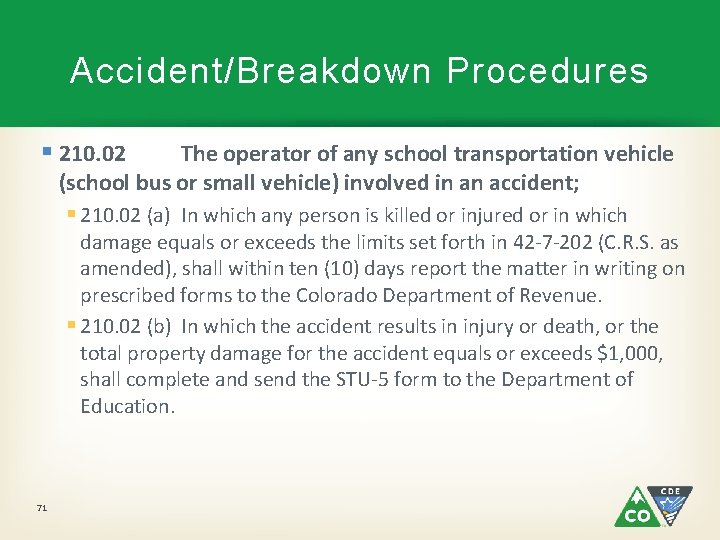
Accident/Breakdown Procedures § 210. 02 The operator of any school transportation vehicle (school bus or small vehicle) involved in an accident; § 210. 02 (a) In which any person is killed or injured or in which damage equals or exceeds the limits set forth in 42 -7 -202 (C. R. S. as amended), shall within ten (10) days report the matter in writing on prescribed forms to the Colorado Department of Revenue. § 210. 02 (b) In which the accident results in injury or death, or the total property damage for the accident equals or exceeds $1, 000, shall complete and send the STU-5 form to the Department of Education. 71
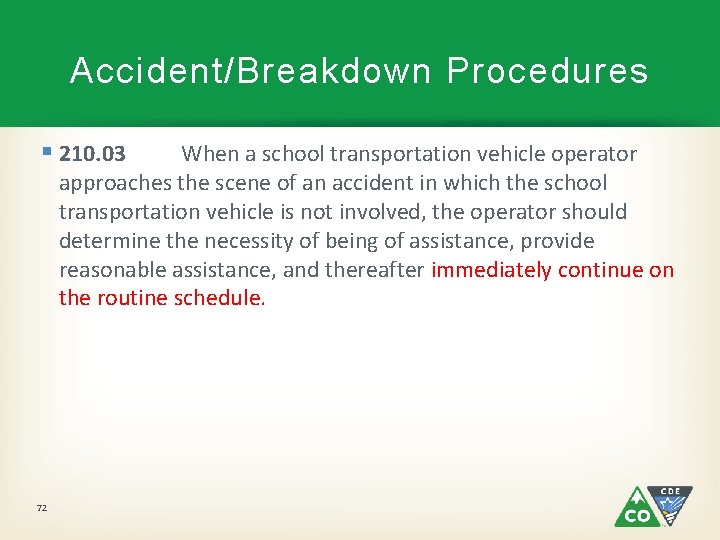
Accident/Breakdown Procedures § 210. 03 When a school transportation vehicle operator approaches the scene of an accident in which the school transportation vehicle is not involved, the operator should determine the necessity of being of assistance, provide reasonable assistance, and thereafter immediately continue on the routine schedule. 72
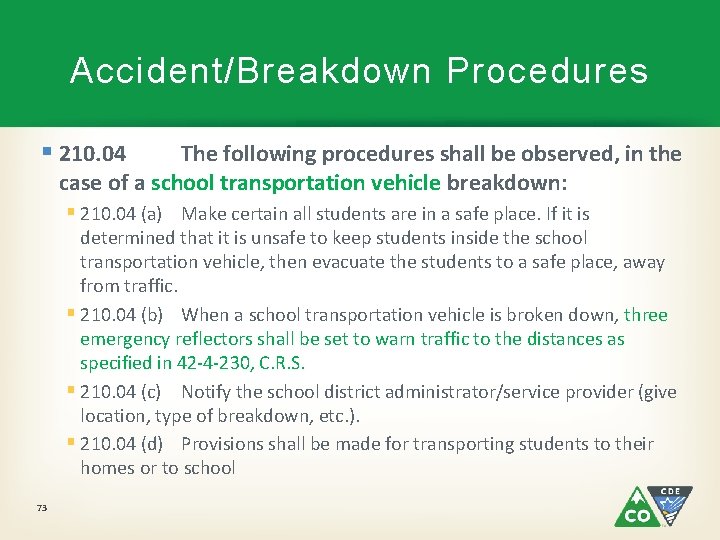
Accident/Breakdown Procedures § 210. 04 The following procedures shall be observed, in the case of a school transportation vehicle breakdown: § 210. 04 (a) Make certain all students are in a safe place. If it is determined that it is unsafe to keep students inside the school transportation vehicle, then evacuate the students to a safe place, away from traffic. § 210. 04 (b) When a school transportation vehicle is broken down, three emergency reflectors shall be set to warn traffic to the distances as specified in 42 -4 -230, C. R. S. § 210. 04 (c) Notify the school district administrator/service provider (give location, type of breakdown, etc. ). § 210. 04 (d) Provisions shall be made for transporting students to their homes or to school 73
§Documentation 74
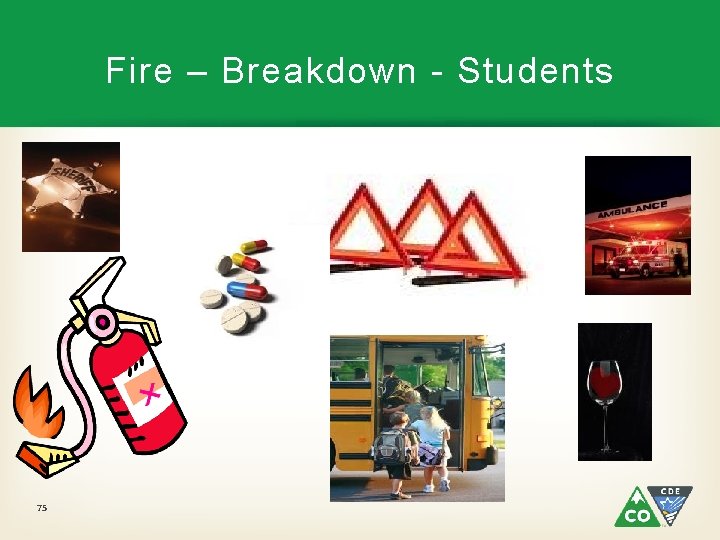
Fire – Breakdown - Students 75
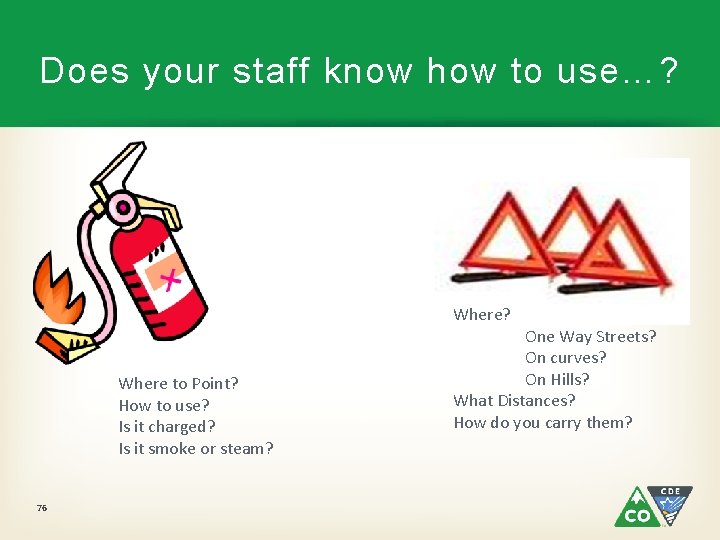
Does your staff know how to use…? Where to Point? How to use? Is it charged? Is it smoke or steam? 76 One Way Streets? On curves? On Hills? What Distances? How do you carry them?
Evacuations § 4204 -R-216 Emergency Evacuation Drills Emergency evacuation drills shall be conducted at least twice during each school year for route operators and students who are transported the day of the drill. 216. 01 (a) One drill shall be through the emergency door(s) unless district/service provider policy precludes such practice. 216. 01(b) One drill shall be conducted in the fall and the second drill conducted in the spring. 216. 01© Substitute and activity trip operators of 16 or greater capacity vehicles shall be involved in the drills. 216. 02 Students on activity trips shall receive emergency evacuation instruction prior to departure. 216. 03 Records shall be maintained documenting that the required evacuation drills were conducted or evacuation instruction was given. 77
The Question is…. Are my students safer inside the bus or outside the bus? 78
Speed Limits § 211. 01 The maximum school transportation vehicle speed limit shall be as posted and in compliance with the laws and ordinances of the jurisdiction in which the school transportation vehicle is being operated; however, speed should be governed by reasonable judgment and existing operating conditions 79
Speed – Vehicle Code § 1101. Speed limits. § (1) No person shall drive a vehicle on a highway at a speed greater than is reasonable and prudent under the conditions then existing. § (4) Except as otherwise provided in paragraph (c) of subsection (8) of this section, any speed in excess of the lawful speeds set forth in subsection (2) of this section shall be prima facie evidence that such speed was not reasonable or prudent under the conditions then existing. As used in this subsection (4), “prima facie evidence” means evidence which is sufficient proof that the speed was not reasonable or prudent under the conditions then existing, and which will remain sufficient proof of such fact, unless contradicted and overcome by evidence bearing upon the question of whether or not the speed was reasonable and prudent under the conditions then existing. § http: //youtu. be/CWwb. Agm. E 3 N 4 80
Convoy Distance § 212. 01 A school transportation vehicle shall not follow another convoy vehicle within 300 feet when traveling outside the corporate limit of a town or city. The preceding is not intended to prevent a school transportation vehicle from passing another motor vehicle. 81
Substitute Assignment § 4204 -R-213. 00 § 213. 01 Substitute Assignment A school transportation vehicle operator shall not have the authority to assign a substitute operator without the prior approval of the district/service provider 82
Pre-Trip Inspection § 4204 -R-214. 00 § 214. 01 Pre-trip Vehicle Inspection Each school transportation vehicle shall have a daily pretrip inspection performed and documented by the school transportation vehicle operator, or a district/service provider authorized transportation employee, prior to the vehicle being placed in service. The pre-trip inspection requirements shall include as a minimum: service brake test, park brake test, lights (inside and outside), mirrors, emergency equipment, emergency door(s), wheels, tires, wipers, horn, and exhaust system. Additional inspection items shall be determined by the district/service provider. 83
Repairs and Maintenance § 4204 -R-215. 00 § 215. 01 Repairs and Maintenance The district/service provider shall have a system to document that the defects and deficiencies of school transportation vehicles and the action taken addressing the reported defect or deficiency are being reported. § 215. 02 All repairs and regular maintenance shall be documented utilizing a district/service provider designed system within a separate file for each vehicle. 84
Emergency Evacuation Drills § 4204 -R-216. 00 Emergency Evacuation Drills § 216. 01 Emergency evacuation drills with students shall be conducted at least twice during each school year. § 216. 01 (a) One drill shall be through the emergency door(s) unless district/service provider policy precludes such practice. § 216. 01 (b) One drill shall be conducted in the fall and the second drill be conducted in the spring. § 216. 01 (c) Substitute and activity trip operators of greater than 15 capacity vehicles shall be involved in the drills. § 216. 02 Students on activity trips shall receive emergency evacuation instruction prior to departure. § 216. 03 Records shall be maintained showing that the required evacuation drills were conducted and evacuation instruction was received. 85
Strobe Lamps § 4204 -R-217. 00 Strobe Lamps § 217. 01 When a school transportation vehicle is equipped with a roof mounted strobe lamp, it shall be operated in the following manner: § The use of the strobe lamp will only be permitted when the bus presents a hazard to other motorists, such as: loading or unloading students in inclement weather or to enhance visibility of the bus when barriers inhibit such visibility. § 217. 02 A school bus operator may use the strobe, in addition to the hazard lamps, to warn other motorists that the bus is not in motion or is being operated at a speed of twenty-five miles per hour or less. 86
Use of Tobacco Products, etc. § 4204 -R-218. 00 Use of Tobacco Products, Controlled Substances, or Alcohol § 218. 01 Use of tobacco products, controlled substances, or alcohol aboard all school transportation vehicles shall be prohibited at all times. 87
Food and Drink § 4204 -R-219. 00 Food and Drink § 219. 01 The school transportation vehicle operator shall not consume food and drink unless the vehicle is stopped at a safe location with the park brake set. *** Does this indicate if students are on board or not? *** 88
Backing § 4204 -R-220. 00 Backing § 89 220. 01 The school bus operator shall use extreme caution when backing. It is recommended that the rear of the school bus be observed and directed by a second responsible person stationed outside of the bus. Before backing on roadway or school grounds, the horn or audible warning device shall be sounded and hazard lamps actuated.
Towing § 4204 -R-221. 00 Towing § § 90 221. 01 School transportation vehicles shall not be operated with a trailer or other vehicle attached while students are being transported. 221. 01 (a) Exemption: district Vo-Ag program small vehicles meeting the current CDE towing criteria may tow trailers to the extent that trailering is a necessary component of their Vo-Ag program.
Authorized Passengers § 4204 -R-222. 00 Authorized Passengers § 222. 01 No one except school personnel and students regularly assigned to a school transportation vehicle for a particular route and schedule may ride in such vehicle, unless he or she has received prior authorization from the appropriate district/service provider administrator or designee. § What about chaperones? Their Children? § § 91 Police Officers? Parents?
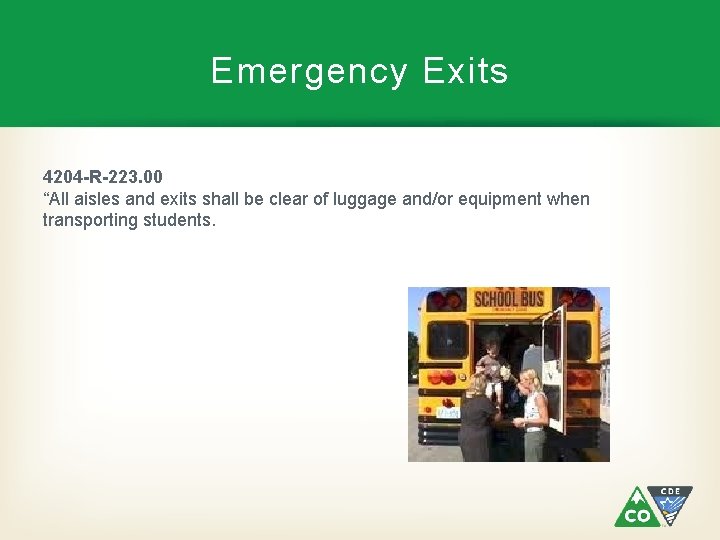
Transportation of Unsafe Items § 4204 -R-223. 00 Transportation of Unsafe Items § § § 92 223. 01 School transportation vehicles shall not transport any items, materials, or equipment which in any way would endanger the lives, health, or safety of the students and school transportation vehicle operator. In addition, any item or items, which could break or produce injury if tossed about inside of the school transportation vehicle shall be properly stored or secured to reduce the danger to a minimum. In addition, the school transportation vehicle operator shall make a reasonable and prudent determination that all carry on items are properly handled in order to minimize the danger to all others. 223. 02 All aisles and exits shall be clear of luggage and/or equipment when transporting students. **website**
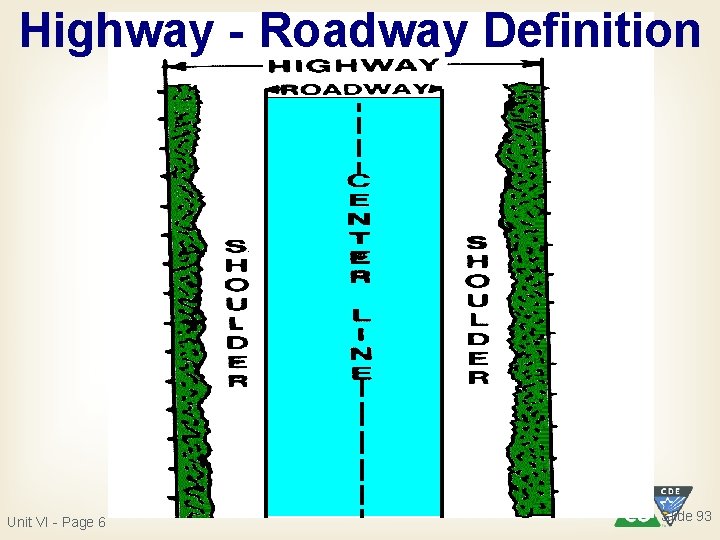
Highway - Roadway Definition Unit VI - Page 6 Slide 93
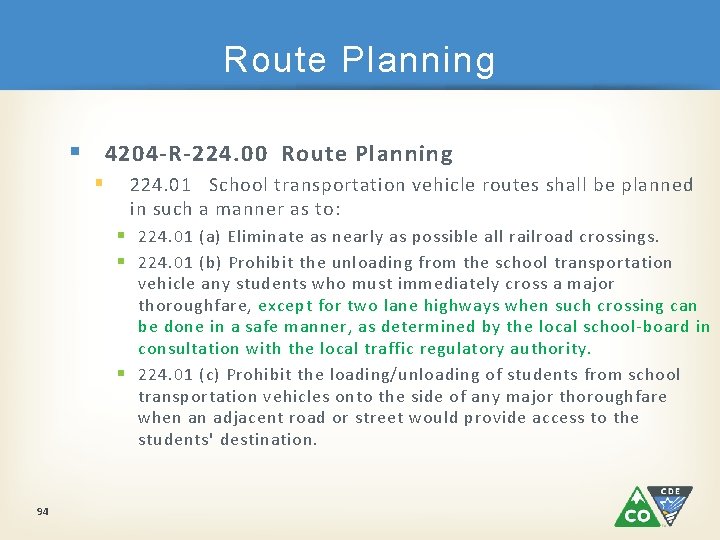
Route Planning § 4204 -R-224. 00 Route Planning § 224. 01 School transportation vehicle routes shall be planned in such a manner as to: § 224. 01 (a) Eliminate as nearly as possible all railroad crossings. § 224. 01 (b) Prohibit the unloading from the school transportation vehicle any students who must immediately cross a major thoroughfare, except for two lane highways when such crossing can be done in a safe manner, as determined by the local school-board in consultation with the local traffic regulatory authority. § 224. 01 (c) Prohibit the loading/unloading of students from school transportation vehicles onto the side of any major thoroughfare when an adjacent road or street would provide access to the students' destination. 94
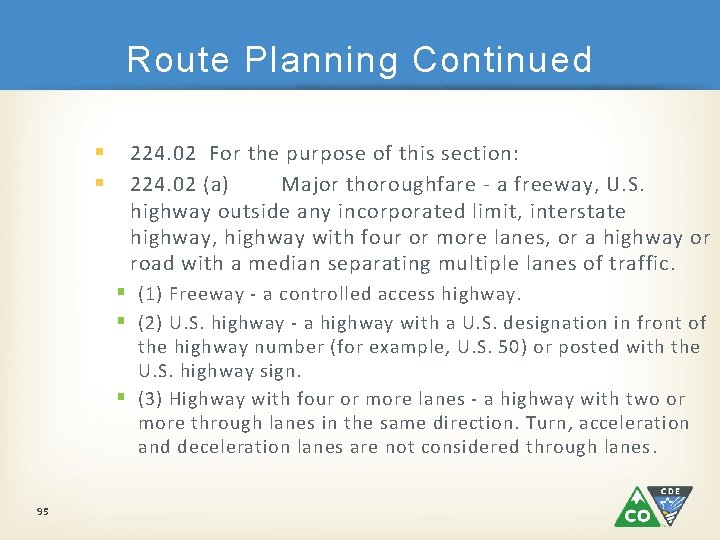
Route Planning Continued § § 224. 02 For the purpose of this section: 224. 02 (a) Major thoroughfare - a freeway, U. S. highway outside any incorporated limit, interstate highway, highway with four or more lanes, or a highway or road with a median separating multiple lanes of traffic. § (1) Freeway - a controlled access highway. § (2) U. S. highway - a highway with a U. S. designation in front of the highway number (for example, U. S. 50) or posted with the U. S. highway sign. § (3) Highway with four or more lanes - a highway with two or more through lanes in the same direction. Turn, acceleration and deceleration lanes are not considered through lanes. 95
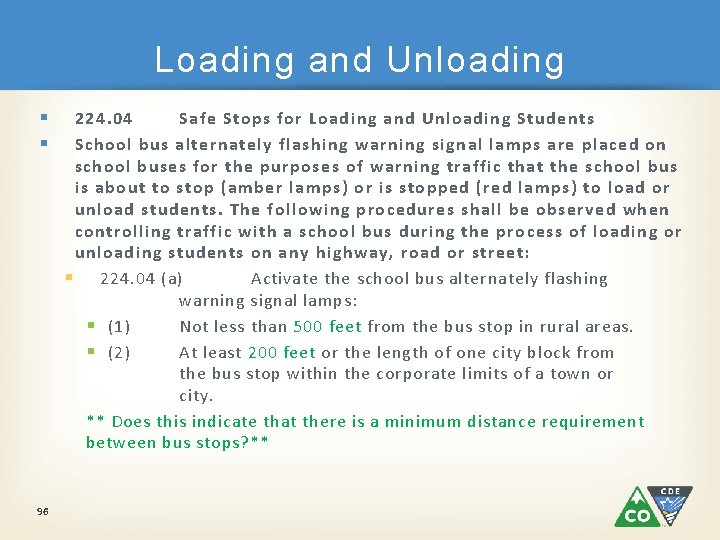
Loading and Unloading § § 96 224. 04 Safe Stops for Loading and Unloading Students School bus alternately flashing warning signal lamps are placed on school buses for the purposes of warning traffic that the school bus is about to stop (amber lamps) or is stopped (red lamps) to load or unload students. The following procedures shall be observed when controlling traffic with a school bus during the process of loading or unloading students on any highway, road or street: § 224. 04 (a) Activate the school bus alternately flashing warning signal lamps: § (1) Not less than 500 feet from the bus stop in rural areas. § (2) At least 200 feet or the length of one city block from the bus stop within the corporate limits of a town or city. ** Does this indicate that there is a minimum distance requirement between bus stops? **
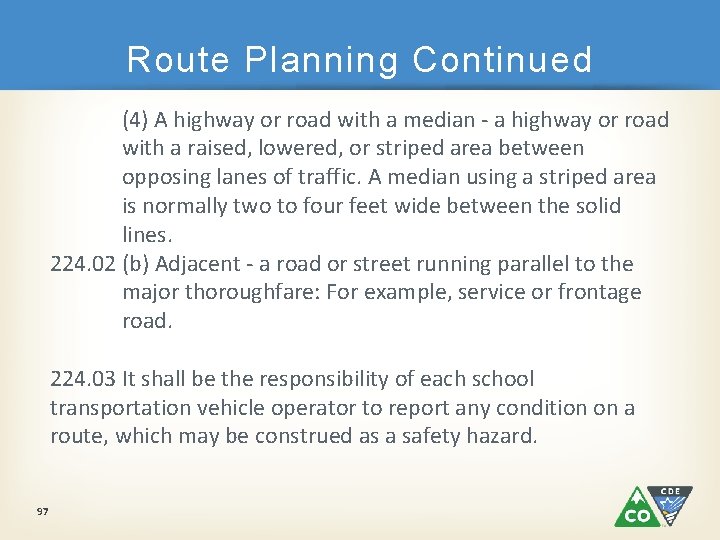
Route Planning Continued (4) A highway or road with a median - a highway or road with a raised, lowered, or striped area between opposing lanes of traffic. A median using a striped area is normally two to four feet wide between the solid lines. 224. 02 (b) Adjacent - a road or street running parallel to the major thoroughfare: For example, service or frontage road. 224. 03 It shall be the responsibility of each school transportation vehicle operator to report any condition on a route, which may be construed as a safety hazard. 97
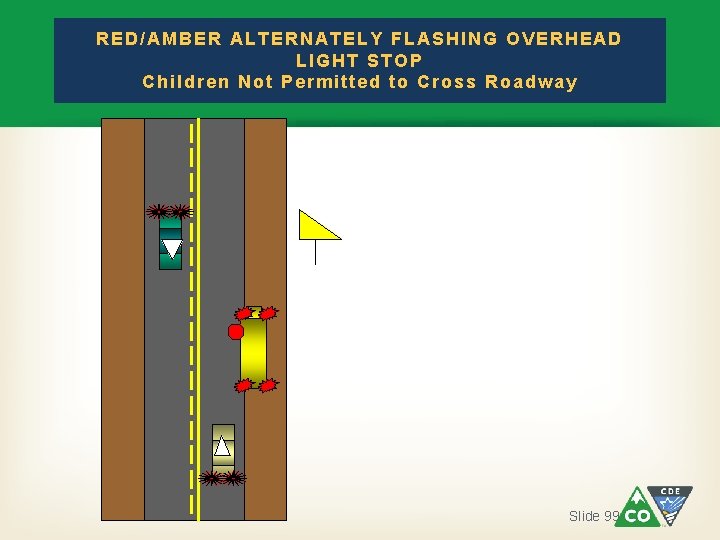
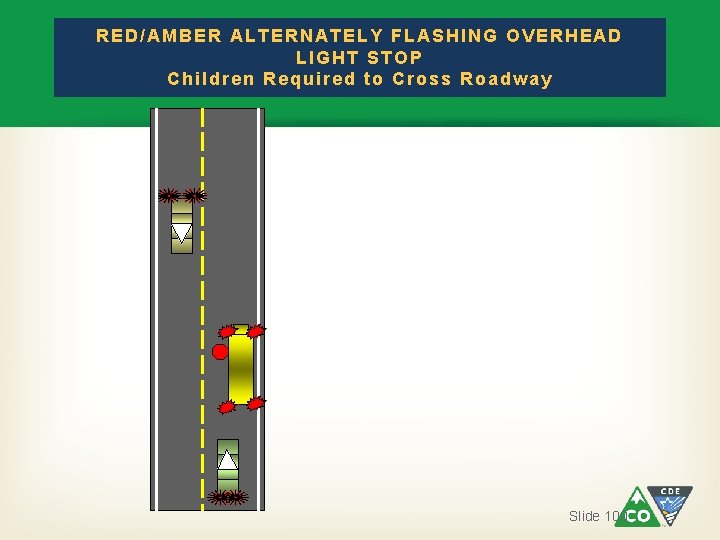
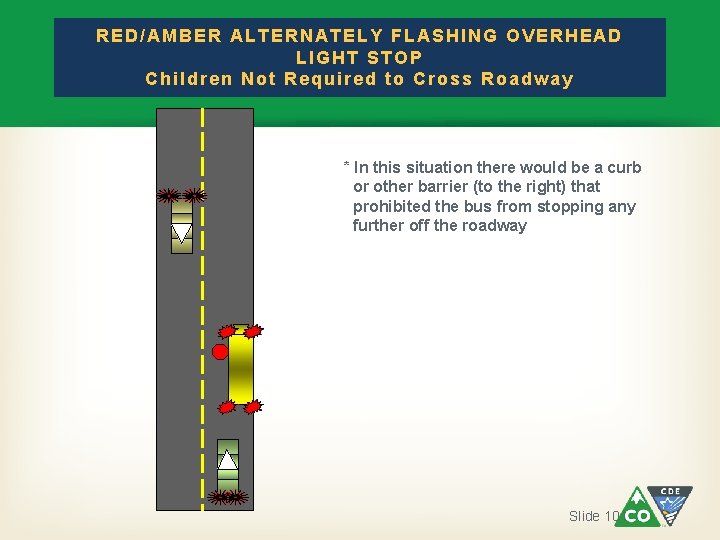
Loading and Unloading § § § 98 224. 04 (b) The red alternately flashing warning signal lamps shall be activated whenever the bus is stopped for the purpose of receiving or discharging students. The same red lamps shall also be activated when the school bus is stopped behind or has met a school bus that has activated its red alternately flashing warning signal lamps, and at no other time. 224. 04 (c) Every school bus shall stop as far to the right of the roadway as possible before discharging or loading students; except that the school bus may stop in the traffic lane when a student must cross the roadway. *** Look at 224. 04 e ***
RED/AMBER ALTERNATELY FLASHING OVERHEAD LIGHT STOP Children Not Permitted to Cross Roadway Slide 99
RED/AMBER ALTERNATELY FLASHING OVERHEAD LIGHT STOP Children Required to Cross Roadway Slide 100
RED/AMBER ALTERNATELY FLASHING OVERHEAD LIGHT STOP Children Not Required to Cross Roadway * In this situation there would be a curb or other barrier (to the right) that prohibited the bus from stopping any further off the roadway Slide 101
Loading and Unloading § 224. 04 (d) § § 102 Exceptions: (1) A school bus shall be exempt from this section when stopped for the purpose of discharging or loading students who require the assistance of a lift device only when no student is required to cross the roadway. Such bus shall stop as far to the right off the roadway as possible to reduce obstruction to traffic. (2) School bus loading and unloading zones, which are properly designated, marked, and supervised within the corporate limits of a town or city, may be exempted from this section by local traffic authority and board of education policy. In rural areas, the use of the alternating flashing lamps may be exempted from this section when the local traffic regulatory authority and local board of education has by prior written designation declared such actuation unnecessary.
Loading and Unloading § § 103 224. 04 (e) Stop the bus to allow sufficient area to the right and front of the school bus so students may clear the school bus safely while in sight of the operator. 224. 04 (f) When stopped, the parking brake or equivalent shall be set prior to loading and unloading. Transmission shall be placed in neutral or in park, (if vehicle is so equipped). 224. 04 (g) Students shall be instructed to walk a distance of approximately ten (10) feet in front of the school bus and wait for operator's signal before crossing the roadway. 224. 04 (h) Students shall be instructed to stand away from the curb or roadway so, when the bus stops to load, they are not next to the bus.
Loading and Unloading § § § 104 224. 05 Location of student stops should consider factors including; visibility, lateral clearance, student access, and control of other motorists. 224. 06 The route operator shall not relocate the student stop without supervisor approval. The supervisor shall specify the procedure for a route operator to relocate a student stop in an emergency. 224. 07 The district shall have a procedure in place to verify that no students are inadvertently left on the bus at the end of the run or trip.
IMPROPER USE OF THE ALTERNATELY FLASHING RED LIGHTS The alternating flashing red lights are: • • • Not used for reasons other than loading or unloading school pupils Not used while backing Not used in making turns or turnarounds Not used when stopping at railroad crossings Not used for fog or inclement weather driving
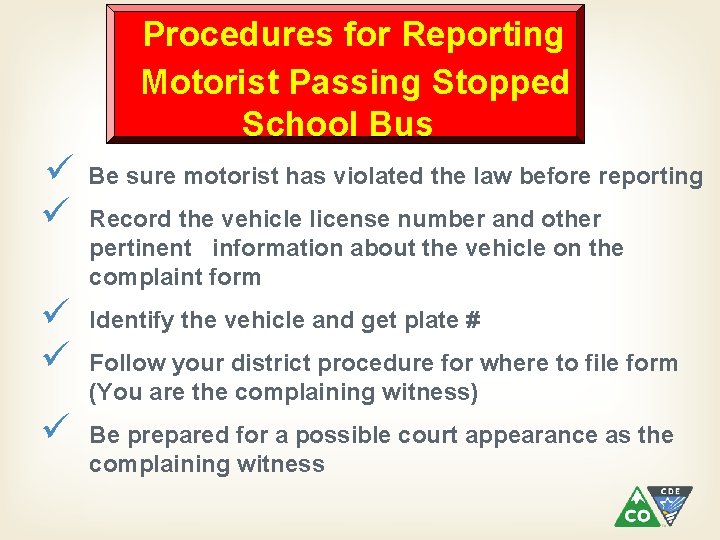
Procedures for Reporting Motorist Passing Stopped School Bus ü ü ü Be sure motorist has violated the law before reporting Record the vehicle license number and other pertinent information about the vehicle on the complaint form Identify the vehicle and get plate # Follow your district procedure for where to file form (You are the complaining witness) Be prepared for a possible court appearance as the complaining witness
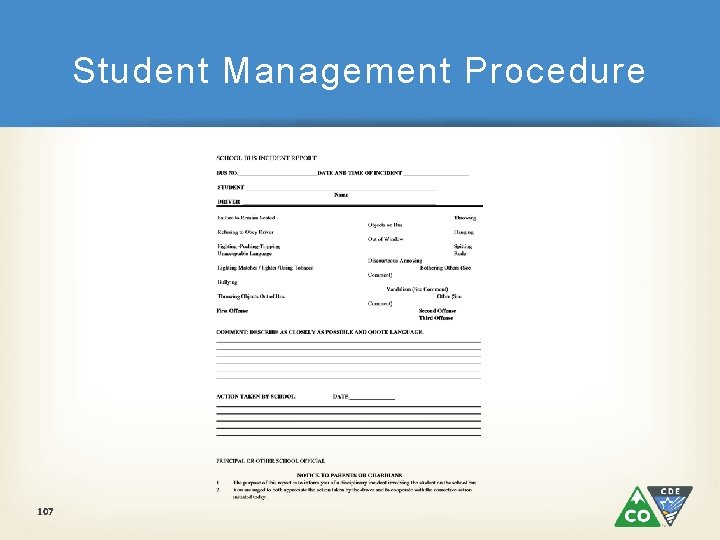
Student Management Procedure 107
Standees § § 108 4204 -R-225. 00 Standees 225. 01 Students shall not be permitted to stand in any school transportation vehicle while the vehicle is in motion. This does not preclude authorized persons (such as; bus assistants) from moving about as required.
Vehicle Capacity/Safety Belts § § § 109 4204 -R-226. 00 Vehicle Capacity 226. 01 The number of passengers transported on any school transportation vehicle shall not exceed the vehicle passenger seating capacity. Small vehicle capacity shall not exceed the number of safety belts as designed by the vehicle manufacturer. 4204 -R-227. 00 Safety Belts 227. 01 A school transportation vehicle operator shall have the safety belt fastened and properly adjusted whenever the school transportation vehicle is in motion. 227. 02 Students in a small vehicle shall have their safety belts fastened and properly adjusted prior to the small vehicle being put in motion.
Fueling § 4204 -R-228. 00 Fueling § 228. 01 School transportation vehicles shall not be fueled while students are on board, except in instances when unloading the students would present a greater hazard or peril to their safety. 110
Hours of Service § 4204 -R-229. 00 Hours of Service for School Transportation Vehicle Operators § 229. 01 No school transportation vehicle operator shall drive nor shall the school district/service provider permit or require an operator to drive: § 229. 01 (a) After being on-duty 14 hours following 10 § 111 hours off duty. This would include on-duty time for all employers. Ten hours off duty may be consecutive or accumulated in two or more periods of off duty time with one period having a minimum of 6 consecutive hours off duty. 229. 01 (b) After being on-duty for more than 70 hours in any seven consecutive days.
Hour of Service Continued § 229. 01 (b) After being on-duty for more than 70 hours in any seven consecutive days. § 229. 02 Nothing in these rules prohibits a school district/service provider from complying with part 395 of the Federal Motor Carrier Safety Regulations (FMCSR) in place of this section. 112
Definitions regarding HOS § 229. 03 § § § 113 Definitions: 229. 03 (a) Adverse driving conditions - In case of emergency, an operator may complete their trip without being in violation if such trip reasonably could have been completed absent the emergency. 229. 03 (b) Day - Means any 24 -consecutive hour period beginning at the time designated by the school district/service provider. 229. 03 (c) On-duty time - Includes all time worked for any and all employers, including all driving and non-driving duties.
Definitions regarding HOS § 229. 03 (d) Off-duty time - School transportation vehicle operators may consider waiting time at special events, meal stops, or activity trips as off-duty if the following criteria is met: (compensated waiting time does not necessitate on-duty time) § (a) the operator shall be relieved of all duty and responsibility for the care and custody of the vehicle, its accessories, and students, and § (b) the operator shall be at liberty to pursue activities of their choice including leaving the premises on which the bus is located. 114
Definitions § 229. 04 The operator shall document that they are in compliance with this section, hours of service. § 229. 04 (a) An operator's daily log shall be completed for the trip in the operator's own handwriting, when the trip requires a scheduled or unscheduled overnight stay away from the work reporting location. § 229. 05 No school transportation vehicle operator shall transport students, nor shall the school district/service provider require the operator to transport students, while the operator's ability or alertness is so impaired, through fatigue, illness or any other cause, as to make it unsafe for the operator to transport students. 115
Mountainous Terrain § 4204 -R-230. 00 School Buses Operated on Mountainous Terrain § 230. 01 School buses, when operated on mountainous terrain, shall be equipped with an appropriate capacity retarder or students shall not occupy the front row of seats and seats located next to the emergency door(s) unless the students is adequately restrained in a fixed position as required by 42 -41901 (1)(a) and (b), C. R. S. 116
Substance Abuse/Cell Phones § 4204 -R-231. 00 Substance Abuse Testing § 231. 01 District/service provider employees required to possess a CDL shall be in a US Department of Transportation approved substance abuse testing program. § 4204 -R-232. 00 Cell Phones/Two Way Radios § 232. 01 School districts/service providers shall have a procedure to govern the use of cell phones and two way radios by school transportation vehicle operators. This procedure shall include limiting the use of these devices while the vehicle is in motion and restricting the use of personal cell phones. 117
Service Door/Headlights § 4204 -R-233. 00 Service Door § 233. 01 No school bus operator shall operate the bus on public roadways with the service door open except when required by regulation. § 4204 -R-234. 00 Headlight Operation § 234. 01 The school transportation vehicle's headlights or daytime running headlights shall be activated while the vehicle is in motion. 118
School District Rules § 4204 -R-235. 00 School District Rules § 235. 01 None of these rules shall preclude a school district/service provider from establishing a more rigid standard or policy when deemed necessary by the local board of education/service provider. 119
(Page 10) Just the Facts Ma’am § Bus referrals should be : • Accurate and objective § Record facts as they occur – don’t rely on memory § Record only current behavior • Be Specific • Detail the behavior and actual curse words if used • Avoid editorial statements § “Debbie is a problem like the whole group” § “David is just like his brother…” • Consistent • Puts events in sequence • Be truthful § Avoid opportunities to manufacture details
What if They Don’t Have a Solution? § Assigned bus seat § Predetermined number of days to fit the behavior § Conference with student § Private time to discuss behavior and solutions § Bus Referral Report/Write Up § Communication with parent § Follow district/department procedures Unit VII 122
SPECIAL EDUCATION 123
New Student Rider Information § The transportation department (the supervisor) will be contacted regarding a new student rider. Within a very short period of time, normally within 10 days the student will need to begin riding the school bus.
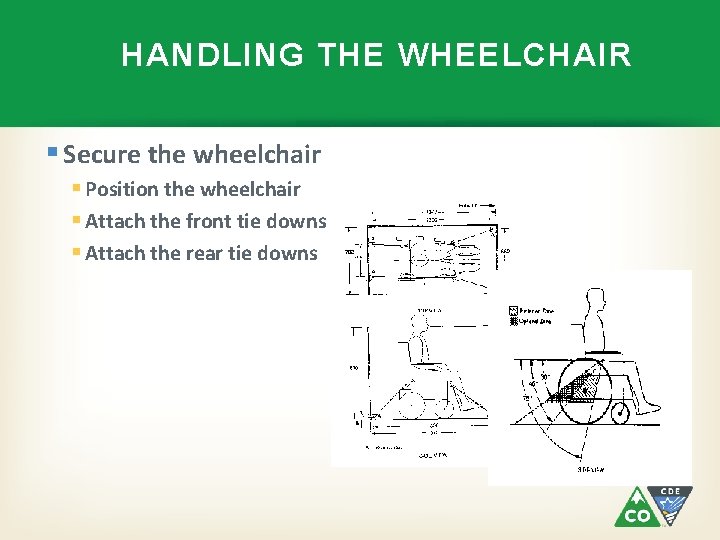
HANDLING THE WHEELCHAIR § Secure the wheelchair § Position the wheelchair § Attach the front tie downs § Attach the rear tie downs
Child Safety Restraint Systems (CSRS) § All CSRS’s must meet Federal Motor Safety Standards § Children required to use car seats, safety vests, etc. , must be fitted to the necessary device properly for the safety of the child. § A Team approach (OT, PT, teacher, transportation supervisor, etc. ) should determine the appropriate equipment to be used. Unit VIII - Page 28 Slide 127
Summary § All school bus drivers and aides must receive appropriate training through their respective districts in all aspects of transporting students with disabilities. § Bus drivers/aides should always feel that it is appropriate to ask questions. Unit VIII - Page 30 Slide 128
Activity Route Planning Considerations § § § Have discussion w/ Supervisor Times and Locations Special Situations § § Bridges, tunnels, toll roads Special Stops § Rest Stops § Suggested no more than 90 minutes between stops § § Food Stops Possible Fuel Stops
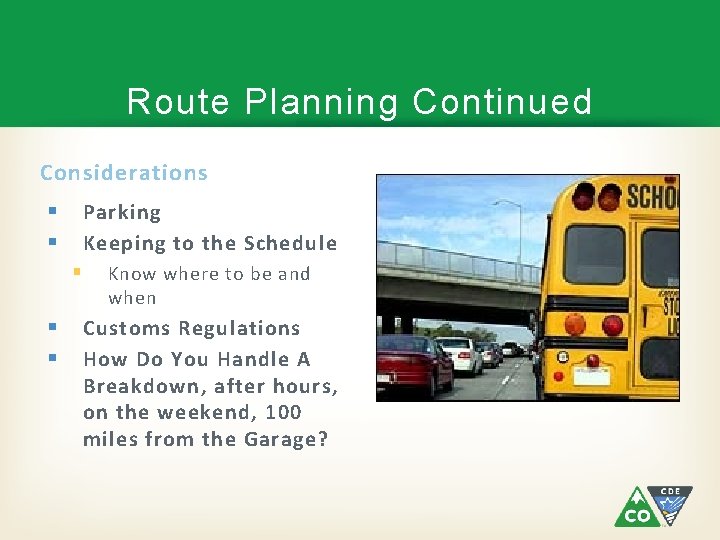
Route Planning Continued Considerations § § Parking Keeping to the Schedule § § § Know where to be and when Customs Regulations How Do You Handle A Breakdown, after hours, on the weekend, 100 miles from the Garage?
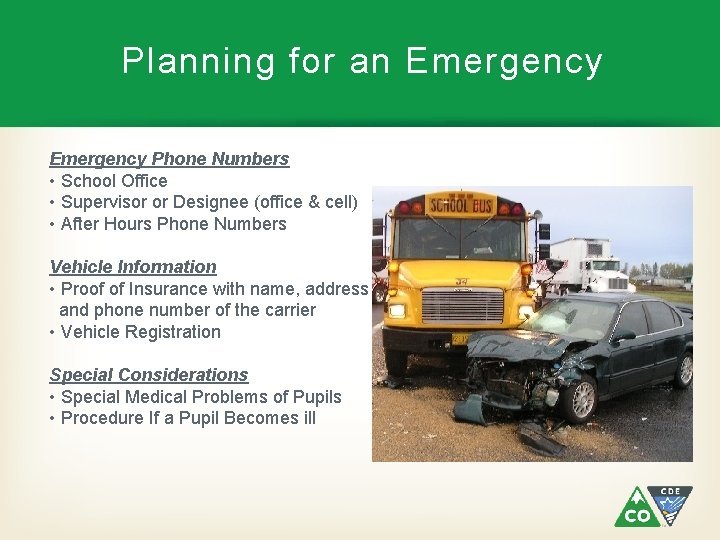
Planning for an Emergency Phone Numbers • School Office • Supervisor or Designee (office & cell) • After Hours Phone Numbers Vehicle Information • Proof of Insurance with name, address and phone number of the carrier • Vehicle Registration Special Considerations • Special Medical Problems of Pupils • Procedure If a Pupil Becomes ill
Emergency Exits 4204 -R-223. 00 “All aisles and exits shall be clear of luggage and/or equipment when transporting students.
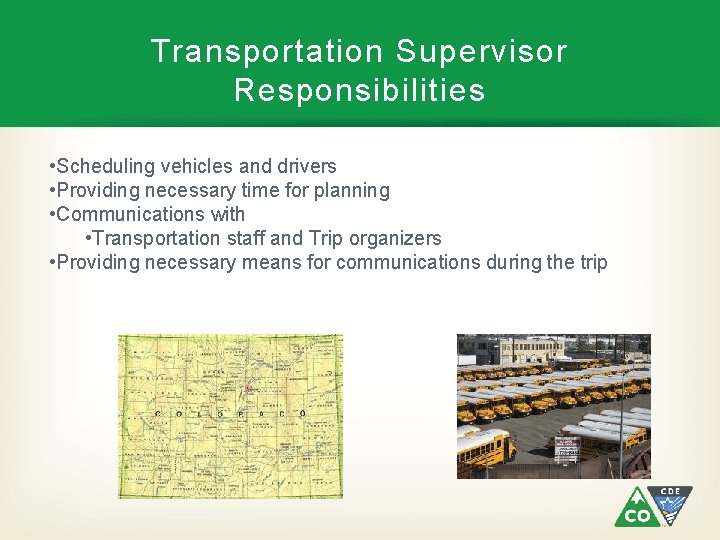
Transportation Supervisor Responsibilities • Scheduling vehicles and drivers • Providing necessary time for planning • Communications with • Transportation staff and Trip organizers • Providing necessary means for communications during the trip
School Transportation Advisory Review (STAR) Most people think that we are coming with a magnifying glass to find non-compliant items……. When we are actually coming to give you a helping hand to bring you into compliance with state and federal regulations/rules. . 134
STAR Process § Notice of Selection sent to Superintendent § § § 135 with Data Sheet that is required to be completed and returned to CDE by the date indicated in the letter. Notice of Approximate date ( 30 days prior) Review - either Technical or Administrative Follow up letter to Superintendent § Commendations § Non-Compliance Concerns District Response (within 30 days) Thank You – “You’re Good”
COMMON THINGS WE FIND § § Lack of Documentation DQ File items expired/missing Annual Inspection Forms incomplete/inaccurate Shop § No written process of documentation - from pre-trip, repair request, out of service, repairs, work orders, driver notification repaired. § § Inspectors expired Site Certifications not valid § Buses § Unsecured items § Seats unhooked § Window stickers missing § First Aid/Fluid Kits incomplete § You gotta be kidding me items! 136
CDE Projects § § § 137 Emergency Contact List Trainer Listserv 2015 -16 New Review Process Transporting Students with Disabilities Manual Operation Rules Revision TAC Administrator Reference Manual STU Forms Revision Bus Driver/Small Vehicle Tests – new annually – June 1 st First Aid Third Party Testers Website
Questions/Comments Thank You! If we can be of any assistance, please do not hesitate to contact us. DRIVE SAFE 138