
New Research Management For Technical Support Services Specification

- Slides: 21
New Research Management For Technical Support Services Specification for Phase 1 (Technology) Evidence Base on Cloud Computing Stakeholder Engagement 23 March 2011 Julie Ash
Research aims Carbon Trust are conducting an initial study to identify the opportunities and risks for carbon savings generated by Cloud Computing in overall terms. Understanding the business decision surrounding cloud computing and the benefits promoted by service providers will inform the Carbon Trust on the following; What interventions might it be useful for the Carbon Trust to consider? What information is needed to develop guidance and decision support models for carbon beneficial cloud computing solutions? The study will provide a credible fact base that can be used as a source of information for future research and intervention.
Research Questions The questions this research aims to address are as follows; What impact will cloud computing have on energy consumption in the future? Why will delivering scalable, on-demand IT capabilities generate CO 2 e savings? What levels of CO 2 e savings can be generated by different cloud computing service and deployment models? How are CO 2 e savings from cloud computing influenced by market conditions and service providers growth strategies? Are CO 2 e savings actively promoted by service providers and considered by customers as part of the cloud computing business decision?
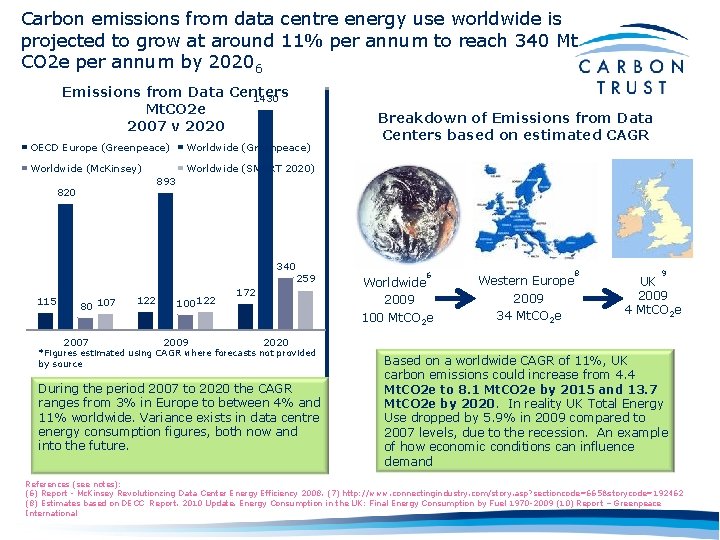
Carbon emissions from data centre energy use worldwide is projected to grow at around 11% per annum to reach 340 Mt CO 2 e per annum by 20206 Emissions from Data Centers 1430 Mt. CO 2 e 2007 v 2020 OECD Europe (Greenpeace) Worldwide (Mc. Kinsey) Worldwide (SMART 2020) 893 820 340 259 115 Breakdown of Emissions from Data Centers based on estimated CAGR 80 107 2007 122 100 122 2009 172 6 Worldwide 2009 100 Mt. CO 2 e Western Europe 2009 34 Mt. CO 2 e 8 9 UK 2009 4 Mt. CO 2 e 2020 *Figures estimated using CAGR where forecasts not provided by source During the period 2007 to 2020 the CAGR ranges from 3% in Europe to between 4% and 11% worldwide. Variance exists in data centre energy consumption figures, both now and into the future. Based on a worldwide CAGR of 11%, UK carbon emissions could increase from 4. 4 Mt. CO 2 e to 8. 1 Mt. CO 2 e by 2015 and 13. 7 Mt. CO 2 e by 2020. In reality UK Total Energy Use dropped by 5. 9% in 2009 compared to 2007 levels, due to the recession. An example of how economic conditions can influence demand References (see notes): (6) Report - Mc. Kinsey Revolutionzing Data Center Energy Efficiency 2008. (7) http: //www. connectingindustry. com/story. asp? sectioncode=665&storycode=192462 (8) Estimates based on DECC Report. 2010 Update. Energy Consumption in the UK: Final Energy Consumption by Fuel 1970 -2009 (10) Report – Greenpeace International
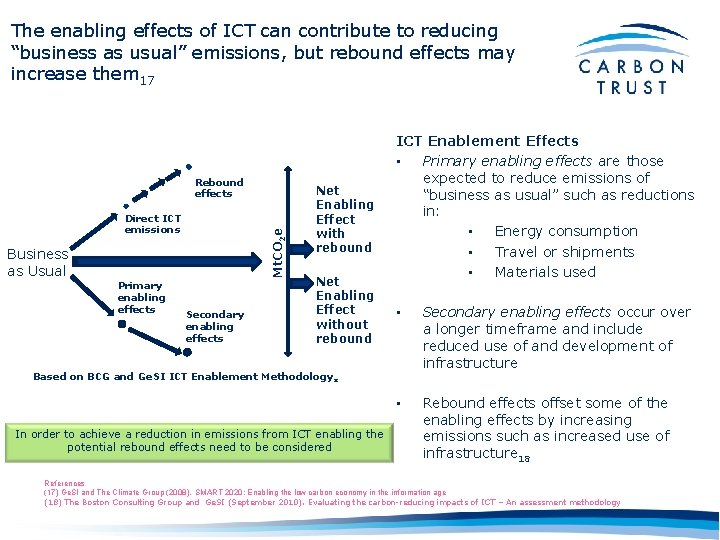
The enabling effects of ICT can contribute to reducing “business as usual” emissions, but rebound effects may increase them 17 Rebound effects Mt. CO 2 e Direct ICT emissions Business as Usual Primary enabling effects Secondary enabling effects Net Enabling Effect with rebound Net Enabling Effect without rebound ICT Enablement Effects • Primary enabling effects are those expected to reduce emissions of “business as usual” such as reductions in: • Energy consumption • Travel or shipments • Materials used • Secondary enabling effects occur over a longer timeframe and include reduced use of and development of infrastructure • Rebound effects offset some of the enabling effects by increasing emissions such as increased use of infrastructure 18 Based on BCG and Ge. SI ICT Enablement Methodologyx In order to achieve a reduction in emissions from ICT enabling the potential rebound effects need to be considered References (17) Ge. SI and The Climate Group (2008). SMART 2020: Enabling the low carbon economy in the information age (18) The Boston Consulting Group and Ge. SI (September 2010). Evaluating the carbon-reducing impacts of ICT – An assessment methodology
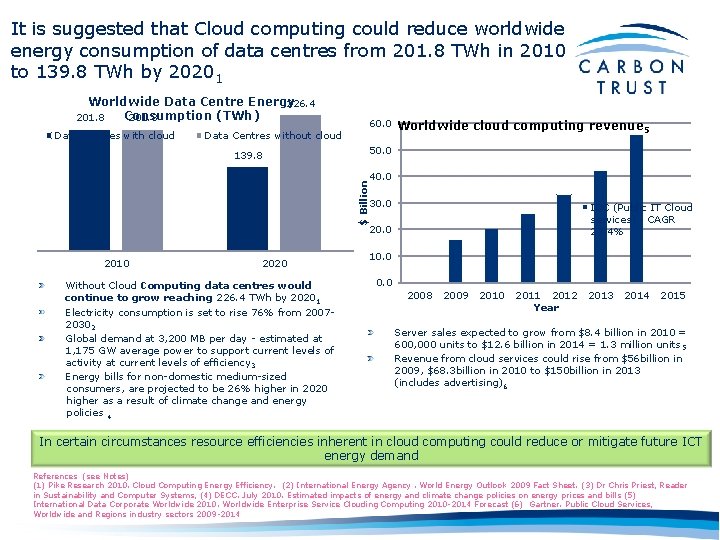
It is suggested that Cloud computing could reduce worldwide energy consumption of data centres from 201. 8 TWh in 2010 to 139. 8 TWh by 20201 Worldwide Data Centre Energy 226. 4 Consumption (TWh) 201. 8 Data Centres with cloud 60. 0 Data Centres without cloud 50. 0 $ Billion 139. 8 2010 2020 Without Cloud Computing data centres would continue to grow reaching 226. 4 TWh by 20201 Electricity consumption is set to rise 76% from 200720302 Global demand at 3, 200 MB per day - estimated at 1, 175 GW average power to support current levels of activity at current levels of efficiency 3 Energy bills for non-domestic medium-sized consumers, are projected to be 26% higher in 2020 higher as a result of climate change and energy policies 4 Worldwide cloud computing revenue 5 40. 0 30. 0 IDC (Public IT Cloud services) - CAGR 27. 4% 20. 0 10. 0 2008 2009 2010 2011 2012 Year 2013 2014 2015 Server sales expected to grow from $8. 4 billion in 2010 = 600, 000 units to $12. 6 billion in 2014 = 1. 3 million units 5 Revenue from cloud services could rise from $56 billion in 2009, $68. 3 billion in 2010 to $150 billion in 2013 (includes advertising) 6 In certain circumstances resource efficiencies inherent in cloud computing could reduce or mitigate future ICT energy demand References (see Notes) (1) Pike Research 2010. Cloud Computing Energy Efficiency. (2) International Energy Agency. World Energy Outlook 2009 Fact Sheet. (3) Dr Chris Priest, Reader in Sustainability and Computer Systems, (4) DECC. July 2010. Estimated impacts of energy and climate change policies on energy prices and bills (5) International Data Corporate Worldwide 2010. Worldwide Enterprise Service Clouding Computing 2010 -2014 Forecast (6) Gartner. Public Cloud Services, Worldwide and Regions industry sectors 2009 -2014
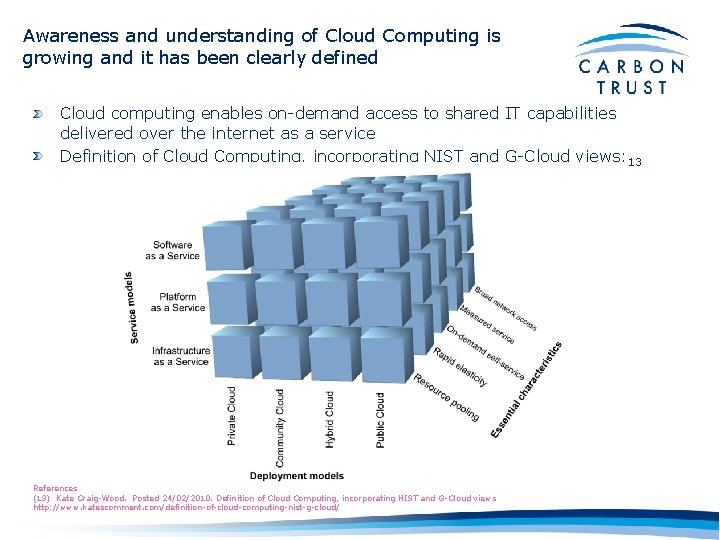
Awareness and understanding of Cloud Computing is growing and it has been clearly defined Cloud computing enables on-demand access to shared IT capabilities delivered over the internet as a service Definition of Cloud Computing, incorporating NIST and G-Cloud views: 13 References (13) Kate Craig-Wood. Posted 24/02/2010. Definition of Cloud Computing, incorporating NIST and G-Cloud views http: //www. katescomment. com/definition-of-cloud-computing-nist-g-cloud/
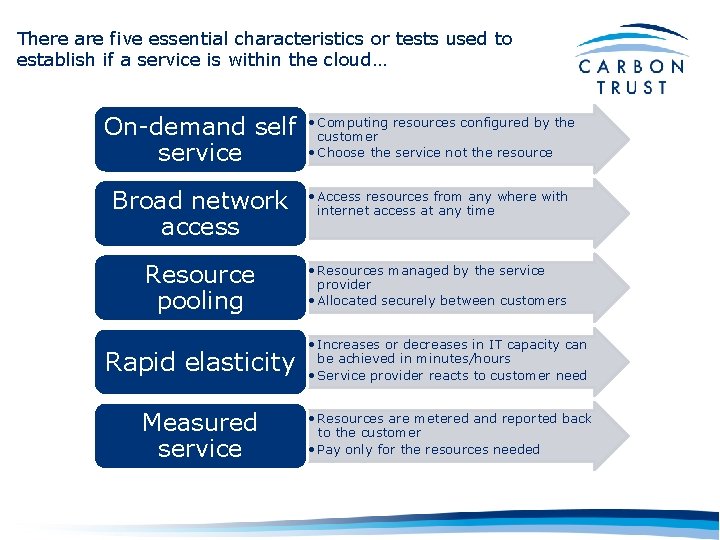
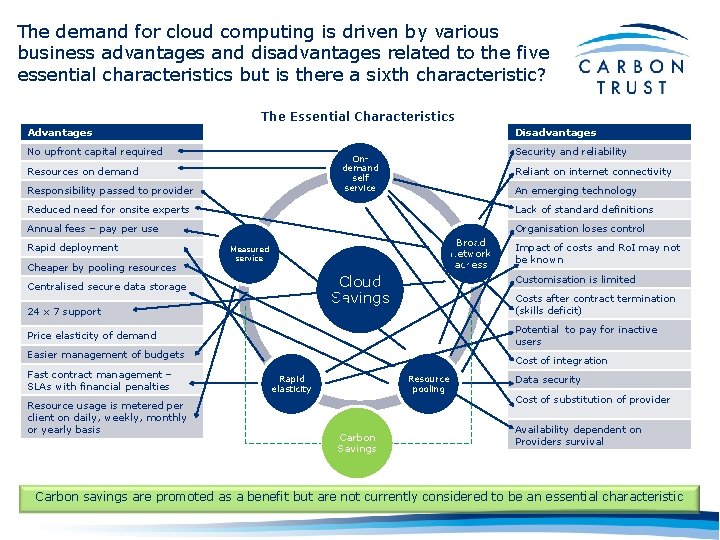
There are five essential characteristics or tests used to establish if a service is within the cloud… On-demand self service • Computing resources configured by the customer • Choose the service not the resource Broad network access • Access resources from any where with internet access at any time Resource pooling • Resources managed by the service provider • Allocated securely between customers Rapid elasticity • Increases or decreases in IT capacity can be achieved in minutes/hours • Service provider reacts to customer need Measured service • Resources are metered and reported back to the customer • Pay only for the resources needed
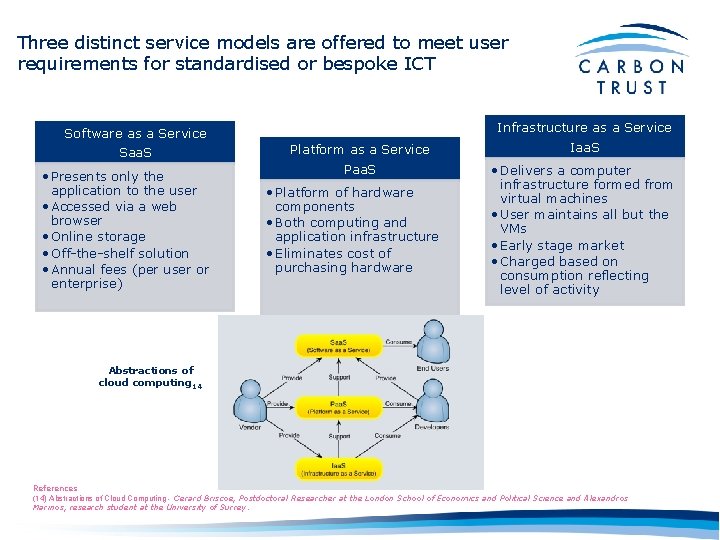
Three distinct service models are offered to meet user requirements for standardised or bespoke ICT Software as a Service Saa. S • Presents only the application to the user • Accessed via a web browser • Online storage • Off-the-shelf solution • Annual fees (per user or enterprise) Platform as a Service Paa. S • Platform of hardware components • Both computing and application infrastructure • Eliminates cost of purchasing hardware Infrastructure as a Service Iaa. S • Delivers a computer infrastructure formed from virtual machines • User maintains all but the VMs • Early stage market • Charged based on consumption reflecting level of activity Abstractions of cloud computing 14 References (14) Abstractions of Cloud Computing - Gerard Briscoe, Postdoctoral Researcher at the London School of Economics and Political Science and Alexandros Marinos, research student at the University of Surrey.
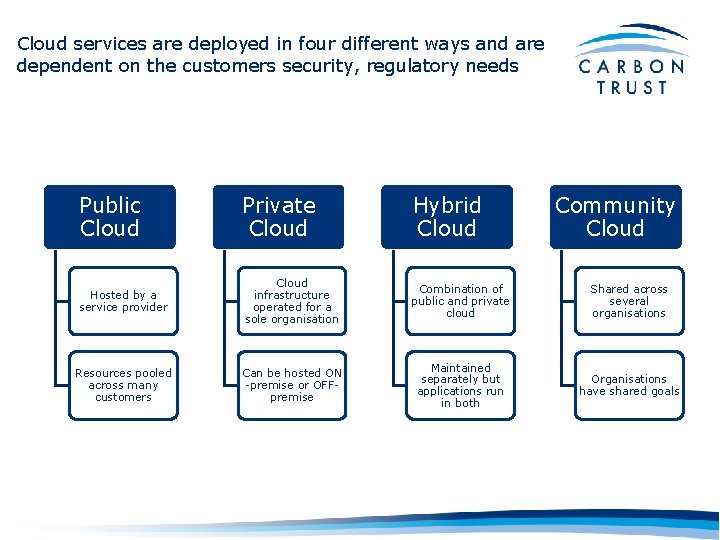
Cloud services are deployed in four different ways and are dependent on the customers security, regulatory needs Public Cloud Private Cloud Hybrid Cloud Community Cloud Hosted by a service provider Cloud infrastructure operated for a sole organisation Combination of public and private cloud Shared across several organisations Resources pooled across many customers Can be hosted ON -premise or OFFpremise Maintained separately but applications run in both Organisations have shared goals
The demand for cloud computing is driven by various business advantages and disadvantages related to the five essential characteristics but is there a sixth characteristic? The Essential Characteristics Disadvantages Advantages No upfront capital required Security and reliability Ondemand self service Resources on demand Responsibility passed to provider Reliant on internet connectivity An emerging technology Lack of standard definitions Reduced need for onsite experts Organisation loses control Annual fees – pay per use Rapid deployment Cheaper by pooling resources Broad network access Measured service Cloud Savings Centralised secure data storage 24 x 7 support Customisation is limited Costs after contract termination (skills deficit) Potential to pay for inactive users Price elasticity of demand Easier management of budgets Fast contract management – SLAs with financial penalties Resource usage is metered per client on daily, weekly, monthly or yearly basis Impact of costs and Ro. I may not be known Cost of integration Rapid elasticity Resource pooling Carbon Savings Data security Cost of substitution of provider Availability dependent on Providers survival Carbon savings are promoted as a benefit but are not currently considered to be an essential characteristic
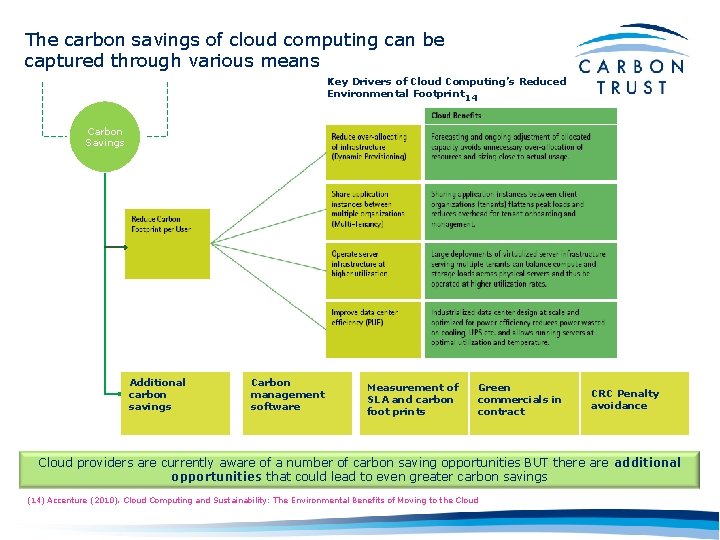
The carbon savings of cloud computing can be captured through various means Key Drivers of Cloud Computing’s Reduced Environmental Footprint 14 Carbon Savings Additional carbon savings Carbon management software Measurement of SLA and carbon foot prints Green commercials in contract CRC Penalty avoidance Cloud providers are currently aware of a number of carbon saving opportunities BUT there additional opportunities that could lead to even greater carbon savings (14) Accenture (2010). Cloud Computing and Sustainability: The Environmental Benefits of Moving to the Cloud
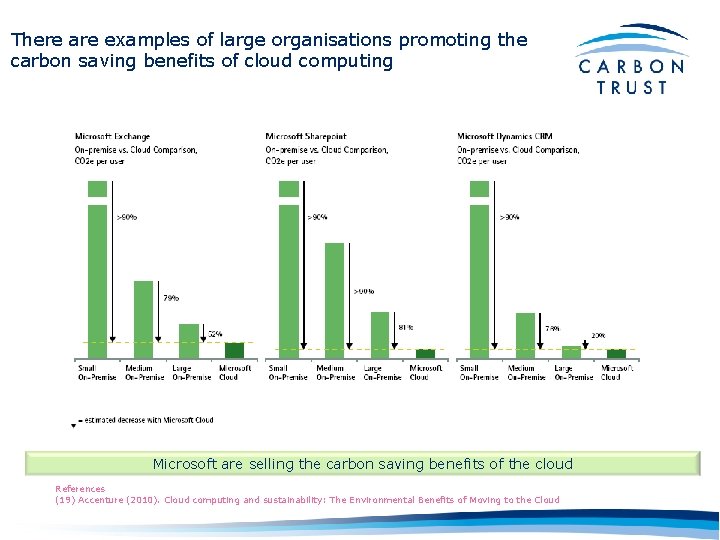
There are examples of large organisations promoting the carbon saving benefits of cloud computing Microsoft are selling the carbon saving benefits of the cloud References (19) Accenture (2010). Cloud computing and sustainability: The Environmental Benefits of Moving to the Cloud
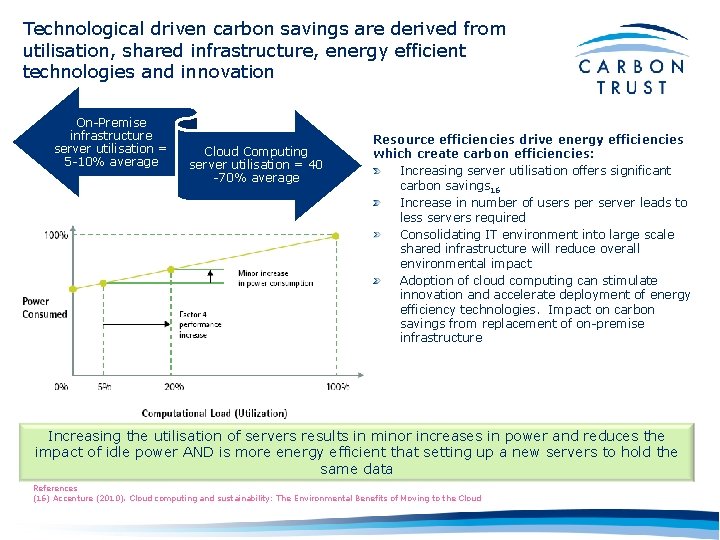
Technological driven carbon savings are derived from utilisation, shared infrastructure, energy efficient technologies and innovation On-Premise infrastructure server utilisation = 5 -10% average Cloud Computing server utilisation = 40 -70% average Resource efficiencies drive energy efficiencies which create carbon efficiencies: Increasing server utilisation offers significant carbon savings 16 Increase in number of users per server leads to less servers required Consolidating IT environment into large scale shared infrastructure will reduce overall environmental impact Adoption of cloud computing can stimulate innovation and accelerate deployment of energy efficiency technologies. Impact on carbon savings from replacement of on-premise infrastructure Increasing the utilisation of servers results in minor increases in power and reduces the impact of idle power AND is more energy efficient that setting up a new servers to hold the same data References (16) Accenture (2010). Cloud computing and sustainability: The Environmental Benefits of Moving to the Cloud
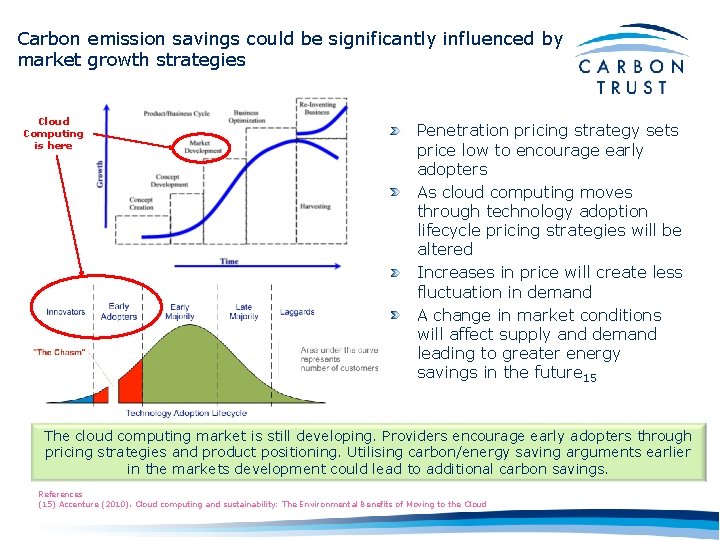
Carbon emission savings could be significantly influenced by market growth strategies Cloud Computing is here Penetration pricing strategy sets price low to encourage early adopters As cloud computing moves through technology adoption lifecycle pricing strategies will be altered Increases in price will create less fluctuation in demand A change in market conditions will affect supply and demand leading to greater energy savings in the future 15 The cloud computing market is still developing. Providers encourage early adopters through pricing strategies and product positioning. Utilising carbon/energy saving arguments earlier in the markets development could lead to additional carbon savings. References (15) Accenture (2010). Cloud computing and sustainability: The Environmental Benefits of Moving to the Cloud
Technological change increases the efficiency with which a resource is used tends to increase (not decrease) the rate of consumption of that resource 20 Jevons Paradox: Improved energy efficiency which lowers the relative cost of using a resource increases demand potentially counteracts any savings from the increased efficiency Jevons Paradox in the context of Cloud Computing: The ‘simplicity of the cloud offer’ may lead to increased ICT consumption by consumer and increased energy use. Enhanced technology solutions (e. g. media richness) increase demand for complex processing needs (e. g. faster processors) and coupled with changing consumer behaviour increases energy. Without a carbon feedback mechanism the combination of market growth strategies and cloud computing characteristics could increase consumer demand to a level that offsets any potential carbon savings References (20) Alcott, B. 2005. Jevons’ Paradox. Ecological Economics 54 (2005) 9– 21. Retrieved from http: //www. blakealcott. org/pdf/sdarticle. pdf
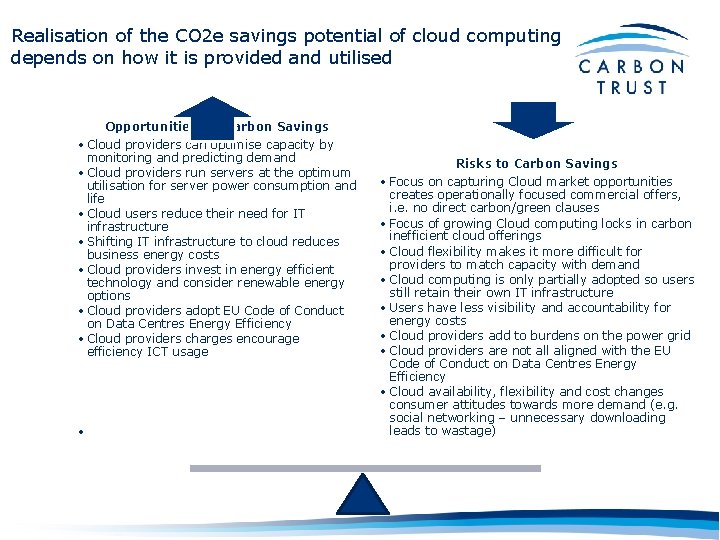
Realisation of the CO 2 e savings potential of cloud computing depends on how it is provided and utilised Opportunities for Carbon Savings • Cloud providers can optimise capacity by monitoring and predicting demand • Cloud providers run servers at the optimum utilisation for server power consumption and life • Cloud users reduce their need for IT infrastructure • Shifting IT infrastructure to cloud reduces business energy costs • Cloud providers invest in energy efficient technology and consider renewable energy options • Cloud providers adopt EU Code of Conduct on Data Centres Energy Efficiency • Cloud providers charges encourage efficiency ICT usage • Risks to Carbon Savings • Focus on capturing Cloud market opportunities creates operationally focused commercial offers, i. e. no direct carbon/green clauses • Focus of growing Cloud computing locks in carbon inefficient cloud offerings • Cloud flexibility makes it more difficult for providers to match capacity with demand • Cloud computing is only partially adopted so users still retain their own IT infrastructure • Users have less visibility and accountability for energy costs • Cloud providers add to burdens on the power grid • Cloud providers are not all aligned with the EU Code of Conduct on Data Centres Energy Efficiency • Cloud availability, flexibility and cost changes consumer attitudes towards more demand (e. g. social networking – unnecessary downloading leads to wastage)
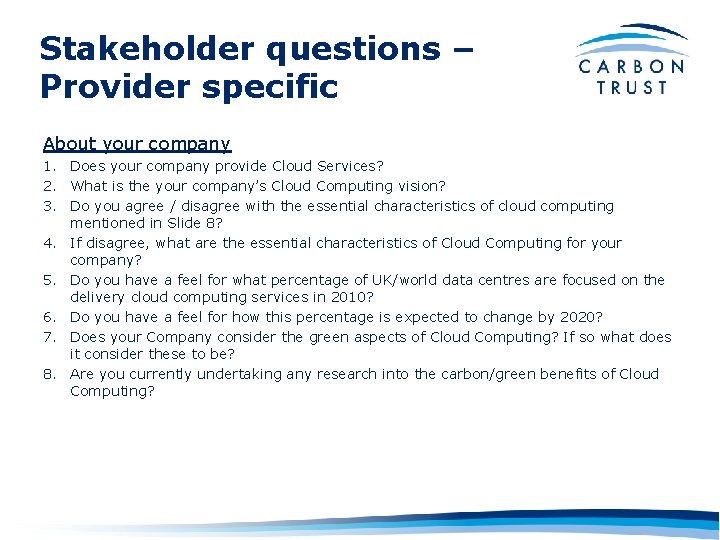
Stakeholder questions – Provider specific About your company 1. Does your company provide Cloud Services? 2. What is the your company’s Cloud Computing vision? 3. Do you agree / disagree with the essential characteristics of cloud computing mentioned in Slide 8? 4. If disagree, what are the essential characteristics of Cloud Computing for your company? 5. Do you have a feel for what percentage of UK/world data centres are focused on the delivery cloud computing services in 2010? 6. Do you have a feel for how this percentage is expected to change by 2020? 7. Does your Company consider the green aspects of Cloud Computing? If so what does it consider these to be? 8. Are you currently undertaking any research into the carbon/green benefits of Cloud Computing?
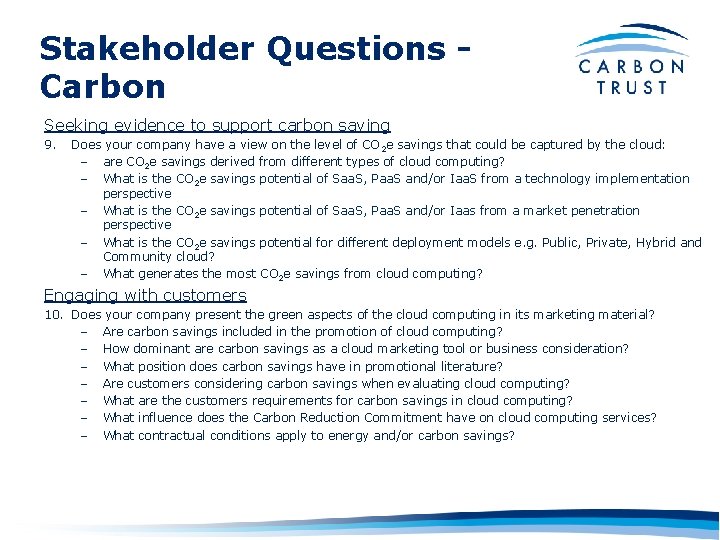
Stakeholder Questions Carbon Seeking evidence to support carbon saving 9. Does your company have a view on the level of CO 2 e savings that could be captured by the cloud: – are CO 2 e savings derived from different types of cloud computing? – What is the CO 2 e savings potential of Saa. S, Paa. S and/or Iaa. S from a technology implementation perspective – What is the CO 2 e savings potential of Saa. S, Paa. S and/or Iaas from a market penetration perspective – What is the CO 2 e savings potential for different deployment models e. g. Public, Private, Hybrid and Community cloud? – What generates the most CO 2 e savings from cloud computing? Engaging with customers 10. Does your company present the green aspects of the cloud computing in its marketing material? – Are carbon savings included in the promotion of cloud computing? – How dominant are carbon savings as a cloud marketing tool or business consideration? – What position does carbon savings have in promotional literature? – Are customers considering carbon savings when evaluating cloud computing? – What are the customers requirements for carbon savings in cloud computing? – What influence does the Carbon Reduction Commitment have on cloud computing services? – What contractual conditions apply to energy and/or carbon savings?
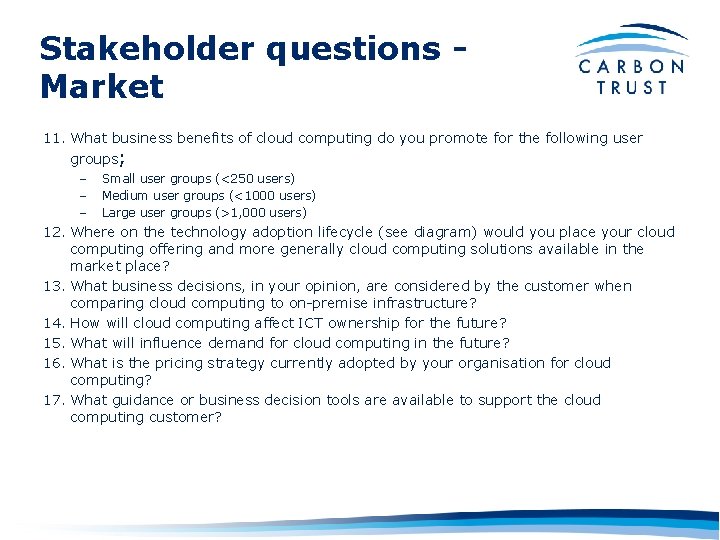
Stakeholder questions Market 11. What business benefits of cloud computing do you promote for the following user groups; – – – Small user groups (<250 users) Medium user groups (<1000 users) Large user groups (>1, 000 users) 12. Where on the technology adoption lifecycle (see diagram) would you place your cloud computing offering and more generally cloud computing solutions available in the market place? 13. What business decisions, in your opinion, are considered by the customer when comparing cloud computing to on-premise infrastructure? 14. How will cloud computing affect ICT ownership for the future? 15. What will influence demand for cloud computing in the future? 16. What is the pricing strategy currently adopted by your organisation for cloud computing? 17. What guidance or business decision tools are available to support the cloud computing customer?