
New Republic Washington Adams Jefferson DO NOW Please
New Republic Washington, Adams, Jefferson
DO NOW: • Please answer the following question on a piece of paper and be prepared to share your answer • Think about all of the rules we have at school. If something is not clearly expressed as a rule, does that mean you can do it? Explain in at least 5 sentences.
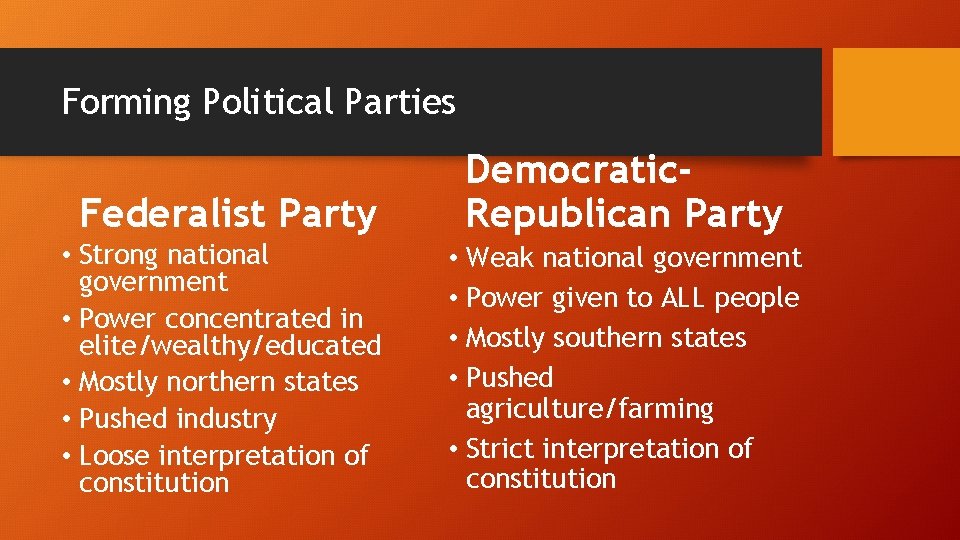
Forming Political Parties Federalist Party Democratic. Republican Party • Strong national government • Power concentrated in elite/wealthy/educated • Mostly northern states • Pushed industry • Loose interpretation of constitution • Weak national government • Power given to ALL people • Mostly southern states • Pushed agriculture/farming • Strict interpretation of constitution
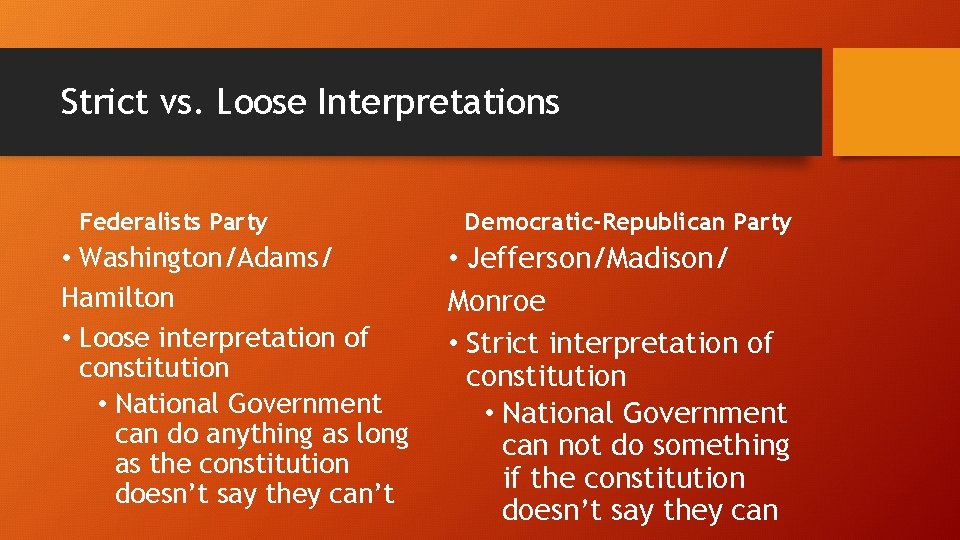
Strict vs. Loose Interpretations Federalists Party • Washington/Adams/ Hamilton • Loose interpretation of constitution • National Government can do anything as long as the constitution doesn’t say they can’t Democratic-Republican Party • Jefferson/Madison/ Monroe • Strict interpretation of constitution • National Government can not do something if the constitution doesn’t say they can
Strict vs. Loose Interpretations • Schoology Discussion Post: • Please read the directions on Schoology • When it comes to the National Government, should we have a strict or loose interpretation of the Constitution? • How do we determine where the line should be drawn if we go with a loose interpretation?
Alexander Hamilton and National Bank • Nations Finance Organizer • You will need a BLUE textbook • Each of you will need a textbook and organizer to complete • You must fill out each section of the organizer with 3 -5 bullet points • You are looking to summarize each section with the MOST IMPORTANT information
Virginia and Kentucky Resolutions • Written by Jefferson and Madison • Written to try and limit Congress’s power • Stated that since the states came together to create the country, the states can nullify a national law • Can a state say they do not have to follow a federal law?
REVIEW 1. What are the two political parties that were formed in the New Republic? 2. Who were the leaders of each party? 3. Who was the person in charge of the National Bank? 4. Define loose OR strict interpretation 5. Define tariff
Whiskey Rebellion • We will be reading an article discussing the Whiskey Rebellion • As you read, we will be using our Talk to the Text Strategies • Circle words you don't know • Underline/highlight key information • Write comments/questions in the margins • Summarize each section
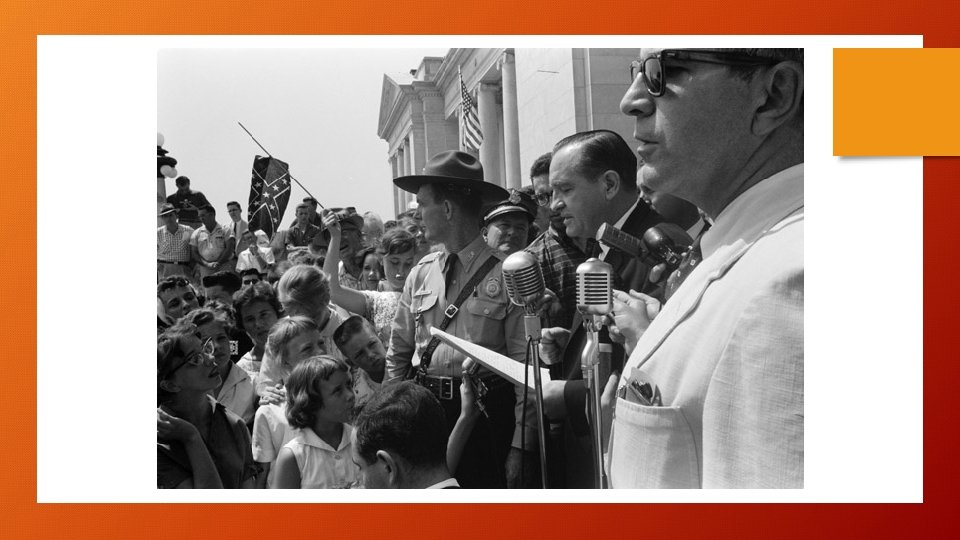
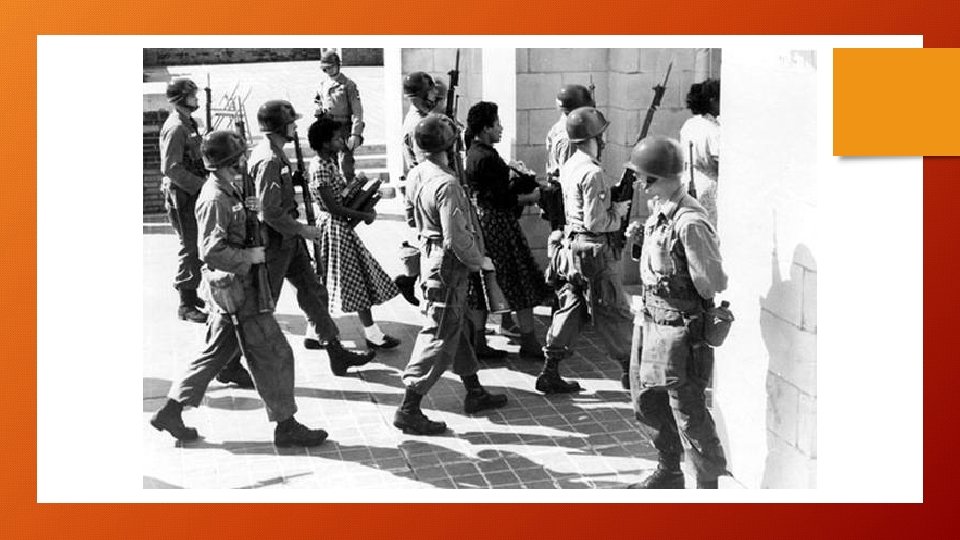
Domestic Policy • Washington • Militia Law of 1792 • Federal Government can use militia of one state against another state • Precedent-An action that is seen as an example • Other Presidents use Washington's example to stop problems
Review • 1. Name one of the warnings that Washington gave us in his Farwell Address. • 2. What is a tariff? • 3. Name one of the political parties formed in the Early Republic, and one of the leaders of that party.
Economic Policy • Adams • Supported Hamilton and the National Bank • Kept tariffs Washington created
Foreign Policy • We are going to watch a clip from “John Adams” • Pay attention to the following: • The relationship between John Adams and Thomas Jefferson • What is happening between the United States and French • How does Adams’ cabinet interact with him
Foreign Policy • John Adams • Alien Act-Increases time to become a citizen from 5 to 14 years; President can imprison/deport immigrants who were dangerous to country or from a hostile nation • XYZ Affair-French asked U. S. for a $10 M bribe to stop attacking US trade ships • Sided more with Britain than France because they wanted to avoid war

Domestic Policy • Adams • Sedition Act-Made it illegal to write/say false statements that were critical of the Federal Government

Review • 1. Define loose interpretation of the constitution. • 2. Define strict interpretation of the construction. • 3. Which group of immigrants did the Alien Act target? • 4. Why were people upset with the Sedition Act?
Domestic Policy • Jefferson • Marbury v. Madison • Lewis and Clark Expedition
Marbury v. Madison-WHO • John Adams • WIlliam Marbury • Thomas Jefferson • James Madison • John Marshall
Marbury v. Madison-When • 1803 • End of John Adam's Presidency
Marbury v. Madison-Why • John Adams appointed 16 judges on the last day of his presidency • Thomas Jefferson was angry because he took over the next day • Marbury asked Madison (Sec. Of State) to give him his job • Madison refused because he was a Democratic. Republican
Marbury v. Madison-Issues • Does Marbury have a right to the job? • Does the Supreme Court have the authority to review acts of Congress and say they are unconstitutional? • Can Congress expand the power of the Supreme Court beyond what is written in the Constitution?
Marbury v. Madison-Ruling • Yes. Marbury has a right to the job • He was appointed the job once John Adams signed the paperwork • Yes. The Supreme Court has the authority to review acts of Congress • It is their job to say what laws are unconstitutional • No. Congress cannot expand the power of the Supreme Court • "The Supreme Court shall have original jurisdiction in all cases affecting ambassadors, other public ministers and consuls, and those in which a state shall be a party"

Economic Policy • Jefferson • Opposed National Bank • Supported farming and agriculture • Lower federal taxes • Opposed Whiskey Tax and led to rebellion • Opposed Tariffs • Embargo Act 1803 -Prohibited American ships from all foreign trade
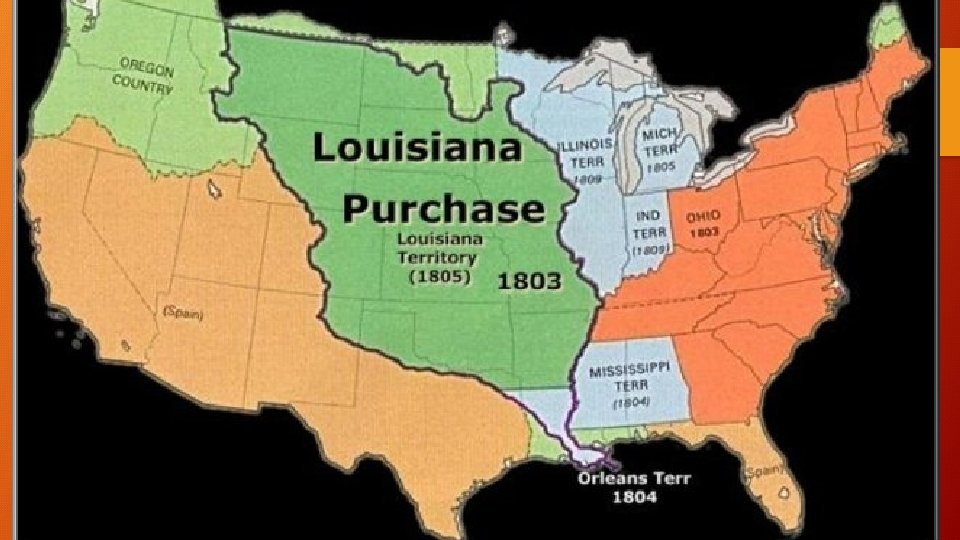
Foreign Policy • Democratic-Republican (Thomas Jefferson) • Purchases Louisiana from France in 1803 • Paid $15 million for over 800, 000 square miles • Sided with France because they helped us defeat the British
Foreign Policy-Louisiana Purchase • Plenipotentiary-A person who has the power to act on behalf of a government • Cede-to give up (power or territory) • Incontestable-Not able to be disputed • Sovereignty-Supreme power or authority • Appurtenances-An item associated with a particular style of living • Edifices-A building; especially a large, imposing one • Immunities-Exemption or protection from something unpleasant
Federalists v. Democratic-Republicans • You will be responding to the following essay prompt • You should write a 3 or 5 paragraph essay to answer the question • Write an essay comparing the Federalists Party and the Democratic-Republican party. Be sure to include their ideas on several important issues. For example, interpretation of the Constitution, foreign policy, etc. • IF YOU DO NOT THINK YOU WILL GET FINISHED IN CLASS AND DO NOT HAVE A COMPUTER AT HOME, PLEASE HAND WRITE YOUR ESSAY. • DUE-February 1 st (Friday) AT THE BEGINNING OF CLASS
- Slides: 29