
New Project Directors Orientation Presentation 1 Introduction to
- Slides: 30
New Project Directors’ Orientation Presentation 1 Introduction to the Corporation for National & Community Service and Senior Corps
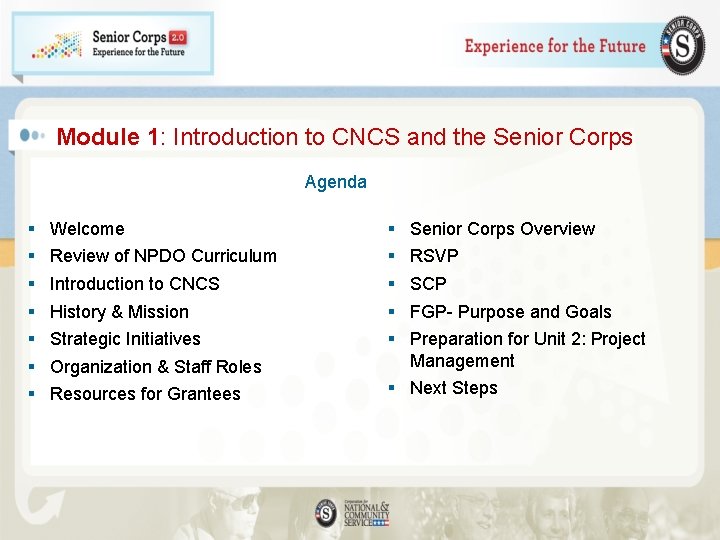
Module 1: Introduction to CNCS and the Senior Corps Agenda § § § § Welcome Review of NPDO Curriculum Introduction to CNCS History & Mission Strategic Initiatives Organization & Staff Roles Resources for Grantees § § § Senior Corps Overview RSVP SCP FGP- Purpose and Goals Preparation for Unit 2: Project Management § Next Steps
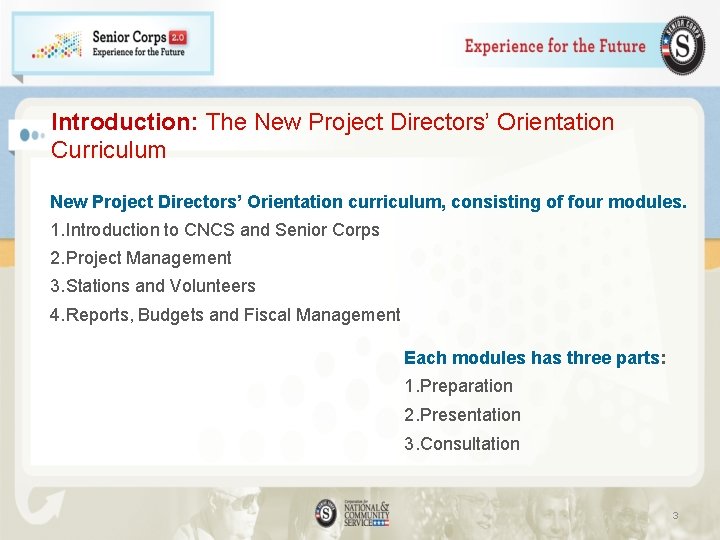
Introduction: The New Project Directors’ Orientation Curriculum New Project Directors’ Orientation curriculum, consisting of four modules. 1. Introduction to CNCS and Senior Corps 2. Project Management 3. Stations and Volunteers 4. Reports, Budgets and Fiscal Management Each modules has three parts: 1. Preparation 2. Presentation 3. Consultation 3
Module 1: Introduction to CNCS Mission Statement The mission of the Corporation for National & Community Service is to improve lives, strengthen communities and foster civic engagement through service and volunteering. http: //www. nationalservice. gov/about/role_impact/mission. asp 4
Module 1: Introduction to CNCS Our Guiding Principles As we pursue our goals, we are guided by principles including: • Put the needs of local communities first. • Strengthen the public-private partnerships that underpin all of our programs. • Use our programs to build stronger, more efficient, and more sustainable community networks capable of mobilizing volunteers. • Help rural and economically distressed communities obtain access to public and private resources. • Support diverse organizations, including faith-based and other community organizations, minority colleges, and disability organizations. • For a complete list go to http: //www. nationalservice. gov/about/role_impact/mission. asp 5
Module 1: Introduction to CNCS How does CNCS achieve its mission? § Provides grants and training and technical assistance to developing and expanding volunteer organizations. § Explores, develops, and models effective approaches for using volunteers to meet the nation's human needs. § Conducts and disseminates research that helps develop and cultivate knowledge that will enhance the overall effectiveness of national and community service programs. 6
Module 1: Introduction to CNCS –National Service Timeline On the National Service Timeline you can review the history of national service—from the creation of the Civilian Conservation Corps in 1933 to the launch of FEMA Corps in 2012. This timeline provides a quick glance at key dates and milestones during the past century, including these Senior Corps milestones: 1960 s Demonstration projects for the Retired and Senior Volunteer Program (RSVP), the Foster Grandparent Program, and the Senior Companion Program (which together are known today as Senior Corps) are launched to demonstrate the effectiveness of the service model and to engage older Americans in a range of service activities. 1969 - Retired Senior Volunteer Program was authorized under Title VI of the Older Americans Act. 1973 The Foster Grandparent Program, the Retired Senior Volunteer Program, and the Senior Companion Program are authorized under the Domestic Volunteer Service Act of 1973. September 1993 President Bill Clinton signs the National and Community Service Trust Act of 1993, creating the Corporation for National and Community Service to expand opportunities for Americans to serve their communities. The Foster Grandparent Program, the Retired and Senior Volunteer Program, and the Senior Companion Program are combined to create Senior Corps. With passage of National and Community Service Act, Congress changes Retired Senior Volunteer Program to Retired “and” Senior Volunteer program to reflect that not all volunteers were retired. April 2009 On April 21, 2009, President Barack Obama signed the Edward M. Kennedy Serve America Act, which reauthorizes and expands national http: //www. nationalservice. gov/about/role_impact/history_timeline. asp service programs administered by the Corporation for National and Community Service. 7
Module 1: Domestic Volunteer Service Act of 1973 - DVSA § Authorized: § RSVP § Senior Companion Program § Foster Grandparent Program § Created the federal agency ACTION to administer: § VISTA § Peace Corps § RSVP § Senior Companion Program § Foster Grandparent Program § http: //www. nationalservice. gov/about/role_impact/history. asp 8
Module 1: The National and Community Service Trust Act of 1993 - NCSA § Created the Corporation for National and Community Service § Combined ACTION and the Commission on National and Community Service § Created State Commissions § Made VISTA and the NCCC part of Ameri. Corps § Encompassed Foster Grandparent Program, RSVP, and Senior Companion Program into Senior Corps § http: //www. nationalservice. gov/about/role_impact/history. asp 9
Module 1: The Edward Kennedy Serve America Act of 2009 - SAA § § § Reauthorized and expanded National Service programs Amended the NCSA and DVSA Created the Social Innovation Fund, the Volunteer Generation Fund, and the Nonprofit Capacity Building Program § § § Required competition for RSVP grants Elevated the importance of evaluation for CNCS and its grantees Drives service as a solution in the areas of education, health, clean energy, veterans, and economic opportunity § Increases service opportunities for older Americans by expanding age and income eligibility for Foster Grandparents and Senior Companions. 10
Modules 1: CNCS Special Initiatives & Special Days of Service § September 11 th National Day of Service and Remembrance § Martin Luther King Jr. Day of Service § National Mentoring Month § President’s Volunteer Service Award § Veterans and Military Families § Senior Corps Week § The complete list of special initiatives: http: //www. nationalservice. gov/about/initiatives/index. asp 11
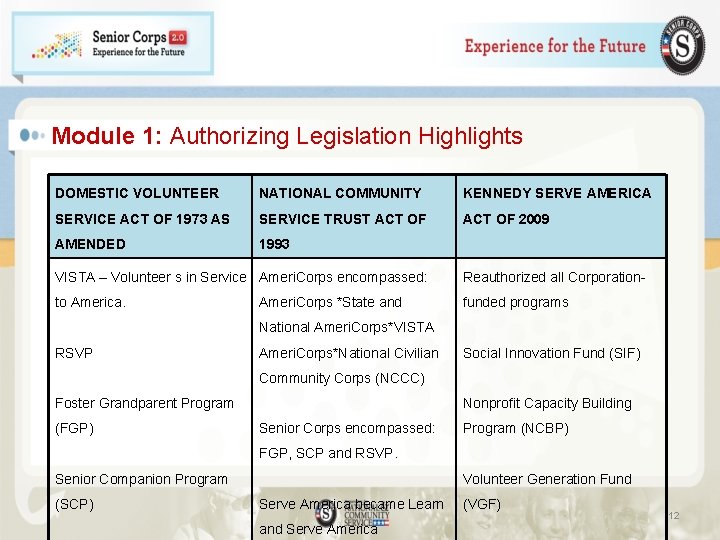
Module 1: Authorizing Legislation Highlights DOMESTIC VOLUNTEER NATIONAL COMMUNITY KENNEDY SERVE AMERICA SERVICE ACT OF 1973 AS SERVICE TRUST ACT OF 2009 AMENDED 1993 VISTA – Volunteer s in Service Ameri. Corps encompassed: Reauthorized all Corporation- to America. funded programs Ameri. Corps *State and National Ameri. Corps*VISTA RSVP Ameri. Corps*National Civilian Social Innovation Fund (SIF) Community Corps (NCCC) Foster Grandparent Program (FGP) Nonprofit Capacity Building Senior Corps encompassed: Program (NCBP) FGP, SCP and RSVP. Senior Companion Program (SCP) Volunteer Generation Fund Serve America became Learn and Serve America (VGF) 12
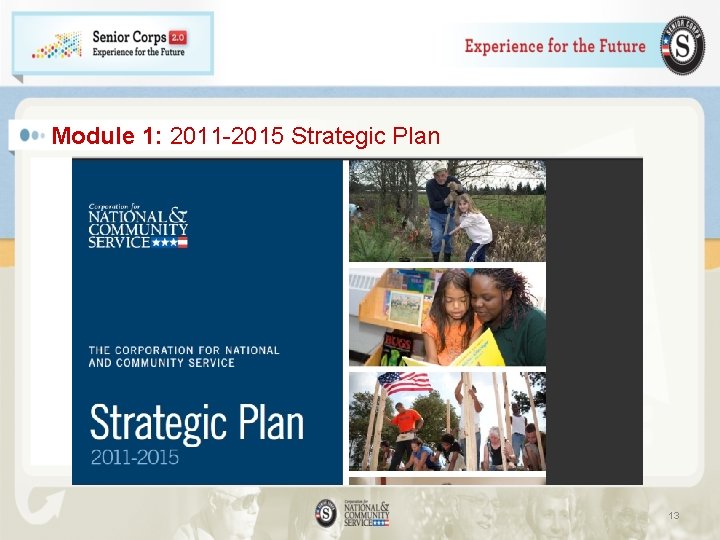
Module 1: 2011 -2015 Strategic Plan 13
Module 1: 2011 -2015 Strategic Plan - Four Strategic Goals To focus our efforts, the Strategic Plan lays out four Strategic Goals: • Increase the impact of national service on community needs in communities served by CNCS-supported programs 1. Strengthen national service so that participants engaged in CNCS-supported programs consistently find satisfaction, meaning and opportunity 2. Maximize the value we add to grantees, partners and participants 2. Fortify management operations and sustain a capable, responsive and accountable organization 3. http: //www. nationalservice. gov/about/focus_areas/index. asp 3. http: //www. nationalservice. gov/pdf/11_0203_cncs_strategic_plan. pdf 14
Module 1: 2011 -2015 Strategic Plan – Six Priority Areas 1. Disaster Services 2. Economic Opportunity 3. Education 4. Environmental Stewardship 5. Healthy Futures 6. Veterans and Military Families 15
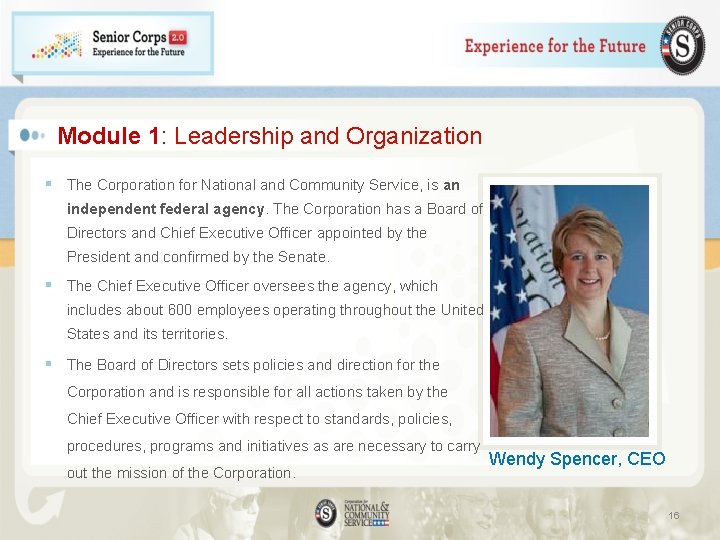
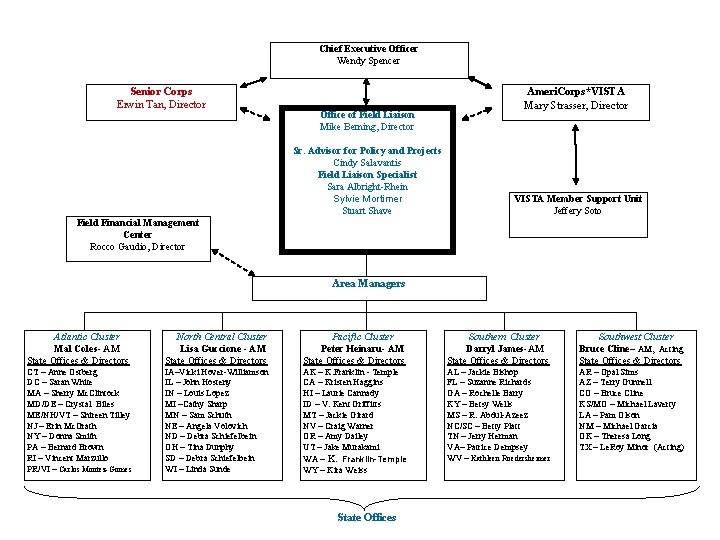
Module 1: Leadership and Organization § The Corporation for National and Community Service, is an independent federal agency. The Corporation has a Board of Directors and Chief Executive Officer appointed by the President and confirmed by the Senate. § The Chief Executive Officer oversees the agency, which includes about 600 employees operating throughout the United States and its territories. § The Board of Directors sets policies and direction for the Corporation and is responsible for all actions taken by the Chief Executive Officer with respect to standards, policies, procedures, programs and initiatives as are necessary to carry out the mission of the Corporation. Wendy Spencer, CEO 16
Chief Executive Officer Wendy Spencer Senior Corps Erwin Tan, Director Office of Field Liaison Mike Berning, Director Sr. Advisor for Policy and Projects Cindy Salavantis Field Liaison Specialist Sara Albright-Rhein Sylvie Mortimer Stuart Shave Ameri. Corps*VISTA Mary Strasser, Director VISTA Member Support Unit Jeffery Soto Field Financial Management Center Rocco Gaudio, Director Area Managers Atlantic Cluster Mal Coles- AM State Offices & Directors North Central Cluster Lisa Guccione - AM State Offices & Directors Pacific Cluster Peter Heinaru- AM State Offices & Directors Southern Cluster Darryl James-AM State Offices & Directors Southwest Cluster Bruce Cline– AM, Acting State Offices & Directors CT – Anne Ostberg DC – Saran White MA – Sherry Mc. Clintock MD/DE – Crystal Biles ME/NH/VT – Shireen Tilley NJ – Erin Mc. Grath NY – Donna Smith PA – Bernard Brown RI – Vincent Marzullo PR/VI – Carlos Montez-Gomes IA–Vicki Hover-Williamson IL – John Hosteny IN – Louis Lopez MI –Cathy Sharp MN – Sam Schuth NE – Angela Volovich ND – Debra Schiefelbein OH – Tina Dunphy SD – Debra Schiefelbein WI – Linda Sunde AK – K. Franklin - Temple CA – Kristen Haggins HI – Laurie Cannady ID – V. Kent Griffitts MT – Jackie Girard NV – Craig Warner OR – Amy Dailey UT – Jake Murakami WA – K. Franklin-Temple WY – Kira Weiss AL – Jackie Bishop FL – Suzanne Richards GA – Rochelle Barry KY – Betsy Wells MS – R. Abdul-Azeez NC/SC – Betty Platt TN – Jerry Herman VA– Patrice Dempsey WV – Kathleen Roedersheimer AR – Opal Sims AZ – Terry Gunnell CO – Bruce Cline KS/MO – Michael Laverty LA – Pam Olson NM – Michael Garcia OK – Theresa Long TX – Le. Roy Minor (Acting) State Offices
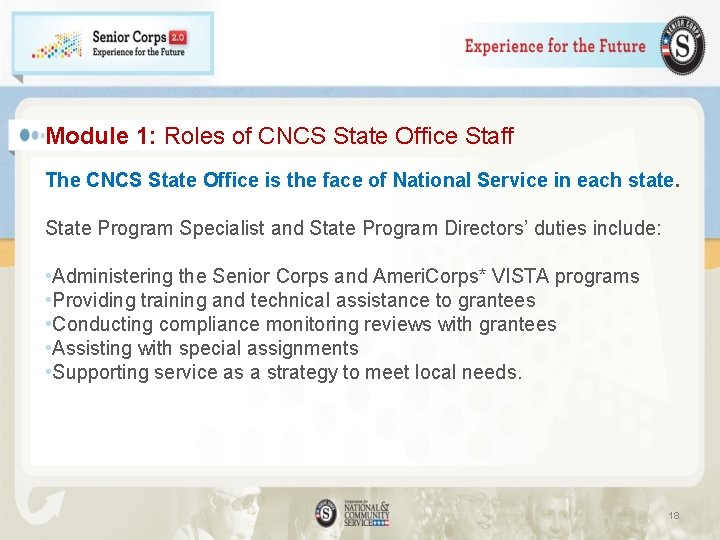
Module 1: Roles of CNCS State Office Staff The CNCS State Office is the face of National Service in each state. State Program Specialist and State Program Directors’ duties include: • Administering the Senior Corps and Ameri. Corps* VISTA programs • Providing training and technical assistance to grantees • Conducting compliance monitoring reviews with grantees • Assisting with special assignments • Supporting service as a strategy to meet local needs. 18
Module 1: The Senior Corps Programs 19
Module 1: RSVP Volunteers: Lead With Experience §have flexibility to choose where they want to serve §serve a few hours to more than 40 hours a week. §provide a wide variety of community services 20
Module 1: Senior Companion Program Senior Companions: Making Independence A Reality §help adults who need extra assistance to live independently in their own homes §are 55 and older §serve 15 - 40 hrs. /week §Income-eligible participants receive a stipend. 21
Module 1: The Foster Grandparent Program Foster Grandparents: Share Today. Shape Tomorrow § devote their volunteer service to disadvantaged or disabled youth. § are 55 and older. § serve 15 - 40 hrs. /week. § Income-eligible participants receive a stipend. 22
Module 1: FGP - Purpose: The Foster Companion Program provides grants to qualified agencies and organizations for the dual purpose of engaging persons 55 and older, particularly those with limited incomes, in volunteer service to meet critical community needs; and to provide a high quality experience that will enrich the lives of the volunteers. 23
Module 1: FGP - Goals The Goals of the Foster Grandparent Program are to: §Enable low-income persons aged 60 and over to remain physically and mentally active and to enhance their self-esteem through continued participation in needed community services. §Enable children with either exceptional or special needs to achieve improved physical, mental, emotional, and social development thereby helping them to reach social, behavioral, developmental, and educational goals. §Provide a stipend and other benefits which enable eligible persons to participate as Foster Grandparents without cost to themselves. 24
Module 1: CNCS Resources for Senior Corps Projects § CNCS Website § Senior Corps Website § Get. Involved. gov is where you will find: § Senior Corps logos § Brochures § Fact Sheets § Templates § Videos § Volunteer. Match § http: //www. volunteermatch. org/ 25
Module 1: CNCS Resources for Senior Corps Projects The National Service Knowledge Network is where you will find: §Performance Measurement and Work Plan tools §Forms §Program Handbooks §Online courses §Effective Practices §Enrollment for NSSCtalk (Senior Corps online discussion group) §http: //www. nationalserviceresources. org/lists/nssctalk §http: //nationalserviceresources. org/ 26
Module 1: Next Steps Preparation: • If you have not completed the first Preparation assignment, take some time to complete it. § Review the Introduction and Chapter 1 of the FGP Operations Handbook. § Locate all of the documents that will be used in the New Project Directors’ Orientation § Visit National Service Knowledge Network: http: //nationalserviceresources. org/ § Visit www. Get. Involved. gov and order supplies or download logos. § Check-out NSSCtalk: www. nationalserviceresources. org/lists/nssctalk Consultation: • Schedule time with your CNCS State Program Officer to discuss the first module. 27
Module 2 – Project Management Module 2 will cover the following chapters of the FGP Operations Handbook. CHAPTER 2: PROJECT OPERATIONS Eligibility, Awards, and Sponsorship Sponsor Responsibilities Special Limitations CHAPTER 4: COMMUNITY PARTICIPATION Local Ownership. Community Advisory Group CHAPTER 5: PROJECT STAFF General Provisions Structure Personnel Policies for Project Staff Roles Volunteer Supervision Please note that Chapter 3: Performance Measurements, will not be discussed in the New Project Directors Orientation. Training for the new Performance Measurements can be found on the National Service Knowledge Network: http: //www. nationalserviceresources. org/npm/fgp 28
Module 2: Preparation Assignment Preparation: §Review Chapters: 2, 4, 5 of the Operations Handbook §Review Compliance Monitoring Guide, Sections: A. 1 -6; B-2; D-all §Review the policies and procedures manual for your project §Review your Notice of Grant Award, the Certifications, and Assurances. §Complete Self- Assessment Checklist described in Chapter 13 and found in Appendix 10 of the Operations Handbook. Write down your questions and areas for improvement as you go through the assessment. 29
Module 1: Websites Code of Federal Regulations for FGP: §http: //www. ecfr. gov/cgi-bin/textidx? c=ecfr&sid=362 a 61 ebba 884 e 03918 c 67 c 3 e 4 e 0 e 356&rgn=div 5&view=text&node=45: 4. 1. 9. 11. 34&idno=45 FGP Operations Handbook. §http: //www. seniorcorps. gov/pdf/fgp_handbook. pdf 2010 Handbook Supplement: http: //www. nationalserviceresources. org/files/FY-2010 -Handbooks-Annual. Supplement. pdf OMB Circulars: §http: //www. whitehouse. gov/omb/circulars_default §http: //www. nationalserviceresources. org/demystifying-omb CNCS Website: §http: //www. nationalservice. gov/about/role_impact/mission. asp §http: //www. nationalservice. gov/about/role_impact/history. asp §http: //www. nationalservice. gov/about/focus_areas/index. asp §http: //www. nationalservice. gov/pdf/11_0203_cncs_strategic_plan. pdf §http: //www. nationalserviceresources. org/demystifying-omb National Service Knowledge Network: §http: //nationalserviceresources. org/ §http: //www. nationalserviceresources. org/lists/nssctalk Volunteer. Match: http: //www. volunteermatch. org/ 30