
New Program Information Session Presented by Susan Tighe
New Program Information Session Presented by: Susan Tighe, Linda Coslovi, Doug Welch Kim Dej, Melissa Pool, Stephanie Baschiera Lori Goff December 10, 2020 mcmaster. ca |
Agenda Welcome & Introduction • Provost and Vice President (Academic) Susan Tighe Provost’s Priorities and SMA 3 • Provost and Vice President (Academic) Susan Tighe SMA 3 metrics and Strategic Alignment Fund • Associate Vice-President Finance and Planning (Academic) Linda Coslovi IQAP Considerations for New Program Proposals • Associate Registrar & Graduate Secretary, Stephanie Baschiera • Director, Mac. Pherson Institute, Lori Goff • University Registrar, Melissa Pool • Vice-Provost & Dean of Graduate Studies, Doug Welch Wrap Up & Next Steps / Questions • Moderated by Acting Vice-Provost (Faculty), Kim Dej mcmaster. ca 1, 2021 | 2
Provost’s Priorities, SMA 3 and SAF Presented by: Susan Tighe and Linda Coslovi mcmaster. ca |
Provost and Vice-President (Academic) • Senior Vice-President, Chief Academic Officer, Chief Budget Officer • Provides academic vision and leadership: o Academic budget, space allocation; strategic planning. o Faculty recruitment, retention and promotion o Attracting and retaining excellent students o Enrolment management o Graduate and undergraduate program development and assessment o Student life • Foster environment of equity and inclusion, creativity, scholarship, innovation, research and teaching excellence • Enable students, staff and faculty members to excel • University Fund enables for Strategic Alignment Fund mcmaster. ca 4 1, 2021 | 4
Provost current priorities § High Quality Teaching: Virtual and hybrid learning § SMA 3: New revenue generation § Inclusive Excellence: BIPOC Cluster Hires, Indigenous Programing § Diversified Internationalization § Outstanding student experience § Faculty reviews and Decanal searches (DSB) § Mc. Master Teaching and Learning Strategic Plan implementation § Brighter World Research Initiative § Community engagement § Assisting with visioning and strategic planning § Mitigating risk post COVID mcmaster. ca 1, 2021 | 5
Strategic Mandate Agreement (SMA 3) Outlines shared objectives and priorities between the Ministry and the University. o o o Term is for 5 years and started in 2020/21. Drastic change in how the Ministry provides funding to Universities. Shift from virtually 100% enrollment-based to only 40%, with 60% flowing based on 10 performance outcome metrics. COVID-19 uncertainty funding for years 1 and 2 has been uncoupled from the performance metrics. Performance metrics start year 3. mcmaster. ca 1, 2021 | 6
Strategic Mandate Agreement (SMA 3) Performance Metrics 1. Graduate Employment Rate in a Related Field 2. Institutional Strength/Focus 3. Graduation Rate 4. Community/Local Impact – Student Enrolment 5. Economic Impact (Institution-specific) 6. Research Funding & Capacity: Federal Tri-Agency Funding Secured 7. Experiential Learning 8. Research Revenue Attracted from Private Sector Sources 9. Graduate Employment Earnings 10. Skills & Competencies mcmaster. ca 1, 2021 | 7
MCU: Strategic Mandate Agreement (SMA 3) Metric #2 - Mc. Master Areas of Strength – Our narrative • Mission provide our students with a comprehensive and integrated education. • Integration of student learning across multiple disciplines to tackle emerging and pressing societal concerns, recognizing that even the most specialized problem, requires multifaceted perspectives and solutions. • Students develop innovation and business skills with ethics and communications, developing their capacity to enrich societal health and well-being. • Mc. Master pioneered many innovative interdisciplinary programs: o o • Arts & Science Program since 1981 Integrated Science, Engineering and Management, Integrated Business and Humanities, and Integrated Biomedical Engineering and Health Sciences programs. Interdisciplinary programming important future of higher education. We will continue to play to all our strengths by expanding these kinds of offerings. mcmaster. ca 1, 2021 | 8
Strategic Alignment Fund Interdisciplinary Programming Considered for seed funding through internal SAF competition to create new interdisciplinary programs as per CIP coding classifications(code 30). Code 30 – Multidisciplinary/interdisciplinary studies “programs that derive from two or more distinct programs to provide a cross cutting focus on a subject concentration that is not subsumed under a single discipline or occupation field” Other Requirements: Graduate (minimum 10 student intake at steady state) and/or Undergraduate (minimum 30 student intake at steady state) programs, with a minimum of 15% international. Can be new incremental students or existing students (ie. New or replacement programs), however no new provincial funding is available at this time, so upper level conversion of traditional single stream programs preferred. Programs crossing a minimum of two Faculties will receive higher funding awards however Programs that are purely within one Faculty will still be considered, but with lower funding parameters, and generally cannot be comprised of programming already specified as strengths in SMA 3. mcmaster. ca 1, 2021 | 9
Information Resources ü Areas of Strength in SMA 3: o o o 11: Computer and information sciences and support services 14: Engineering 27: Mathematics and Statistics 30: Multidisciplinary/interdisciplinary studies 51: Health professions and related programs 52: Business, management, marketing & related support services ü Full CIP Definitions: Stats. Can: Classification of Instructional Programs (CIP) Canada 2016 ü Templates: https: //budgetmodel. mcmaster. ca/tools/policy-guidelines For questions regarding SMA 3, CIP codes, SAF eligibility, Budget & Resources template and MOU template, please contact: Linda Coslovi@mcmaster. ca 1, 2021 | 10
IQAP Considerations for New Program Proposals Presented by: • Stephanie Baschiera and Lori Goff Additional commentary by: • Doug Welch and Melissa Pool mcmaster. ca |
New Program Development: Supports Available Mac. Pherson Institute, School of Graduate Studies, Institutional Research and Analysis, and the Library • Consultations with interdisciplinary team & applicable university central units • Self-study guidebook and template • Website: IQAP. mcmaster. ca • Information sessions • Support developing or revising program learning outcomes • Library consultation • Review of new program proposal drafts • Booking and coordinating site visit Other considerations beyond scope of IQAP Office Support: proposal writing; market analyse; comparator data; and evidence of student demand mcmaster. ca 1, 2021 | 12
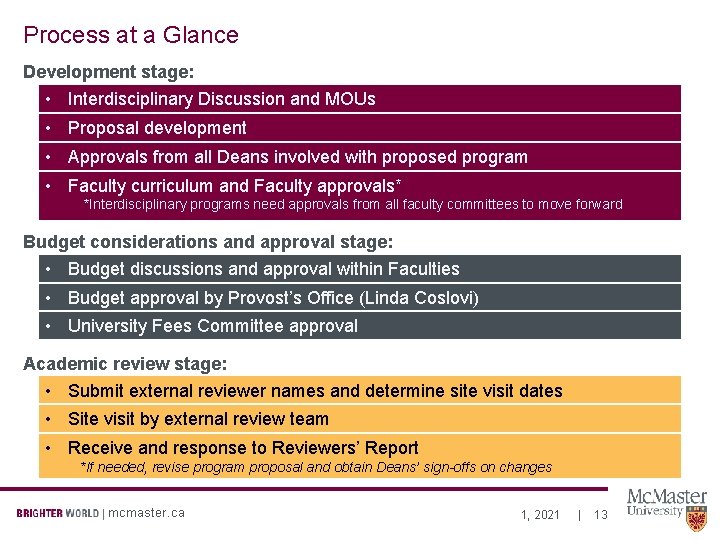
Process at a Glance Development stage: • Interdisciplinary Discussion and MOUs • Proposal development • Approvals from all Deans involved with proposed program • Faculty curriculum and Faculty approvals* *Interdisciplinary programs need approvals from all faculty committees to move forward Budget considerations and approval stage: • Budget discussions and approval within Faculties • Budget approval by Provost’s Office (Linda Coslovi) • University Fees Committee approval Academic review stage: • Submit external reviewer names and determine site visit dates • Site visit by external review team • Receive and response to Reviewers’ Report *If needed, revise program proposal and obtain Deans’ sign-offs on changes mcmaster. ca 1, 2021 | 13
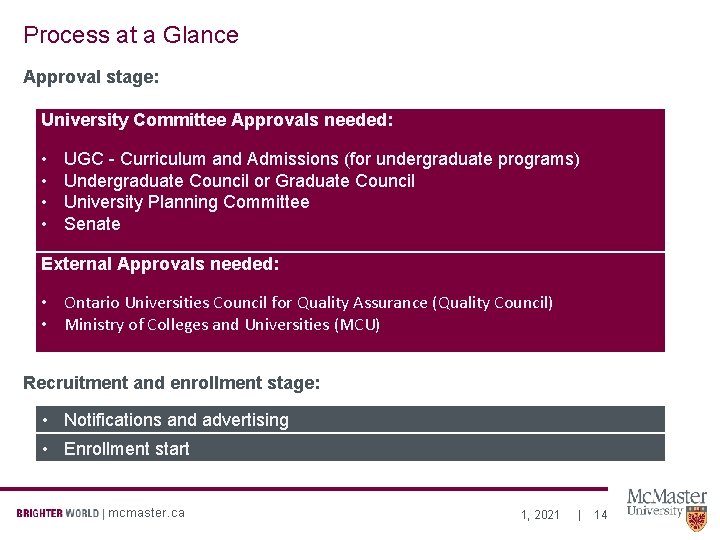
Process at a Glance Approval stage: University Committee Approvals needed: • • UGC - Curriculum and Admissions (for undergraduate programs) Undergraduate Council or Graduate Council University Planning Committee Senate External Approvals needed: • Ontario Universities Council for Quality Assurance (Quality Council) • Ministry of Colleges and Universities (MCU) Recruitment and enrollment stage: • Notifications and advertising • Enrollment start mcmaster. ca 1, 2021 | 14
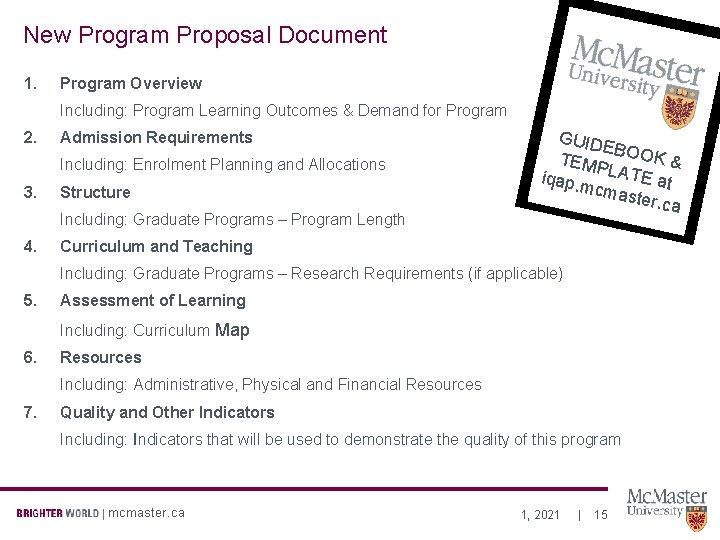
New Program Proposal Document 1. Program Overview Including: Program Learning Outcomes & Demand for Program 2. Admission Requirements Including: Enrolment Planning and Allocations 3. Structure Including: Graduate Programs – Program Length 4. GUID EB TEMP OOK & iqap. m LATE at cmas ter. ca Curriculum and Teaching Including: Graduate Programs – Research Requirements (if applicable) 5. Assessment of Learning Including: Curriculum Map 6. Resources Including: Administrative, Physical and Financial Resources 7. Quality and Other Indicators Including: Indicators that will be used to demonstrate the quality of this program mcmaster. ca 1, 2021 | 15

Next Steps and Questions Moderated by: Kim Dej mcmaster. ca |

Susan Tighe, Linda Coslovi Doug Welch Kim Dej Melissa Pool Stephanie Baschiera Lori Goff mcmaster. ca |
- Slides: 17