
New Physics in charm mixing and CP violation
- Slides: 51
New Physics in charm mixing and CP violation Alexey A. Petrov Wayne State University Table of Contents: • Introduction • Mixing: current/future experimental constraints • Mixing: theoretical expectations • Standard Model • New Physics • Conclusions and outlook Alexey A Petrov (WSU) BBCB-2007 Joint Workshop, Beijing
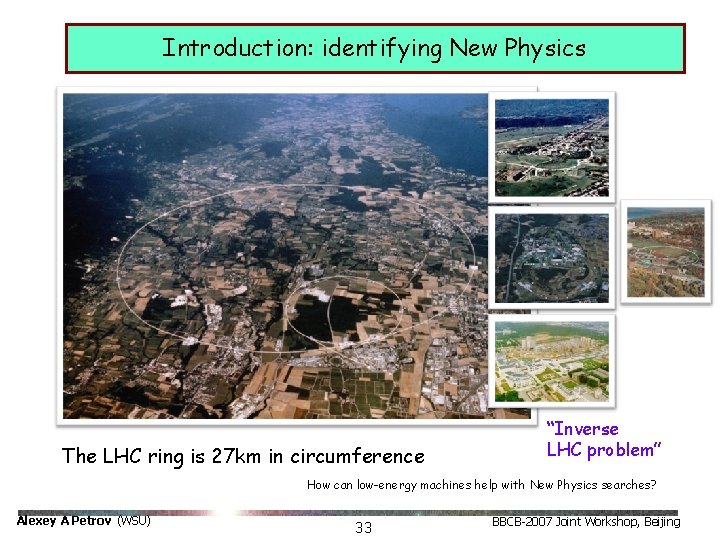
Introduction: identifying New Physics The LHC ring is 27 km in circumference “Inverse LHC problem” How can low-energy machines help with New Physics searches? Alexey A Petrov (WSU) 33 BBCB-2007 Joint Workshop, Beijing
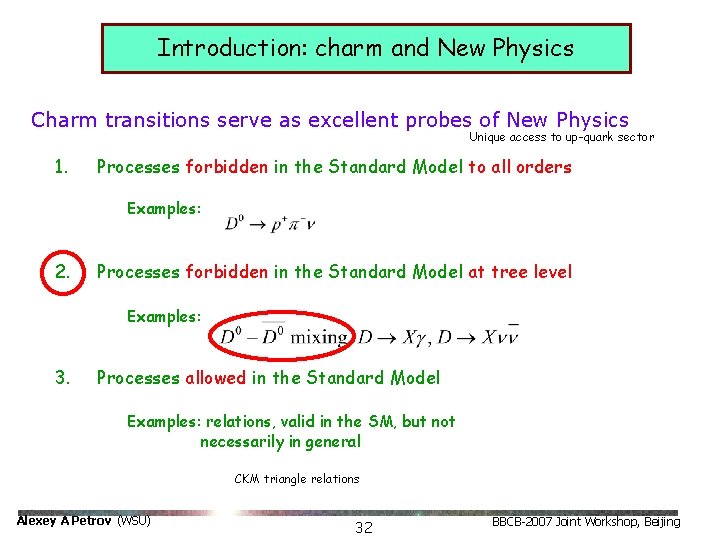
Introduction: charm and New Physics Charm transitions serve as excellent probes of New Physics Unique access to up-quark sector 1. Processes forbidden in the Standard Model to all orders Examples: 2. Processes forbidden in the Standard Model at tree level Examples: 3. Processes allowed in the Standard Model Examples: relations, valid in the SM, but not necessarily in general CKM triangle relations Alexey A Petrov (WSU) 32 BBCB-2007 Joint Workshop, Beijing
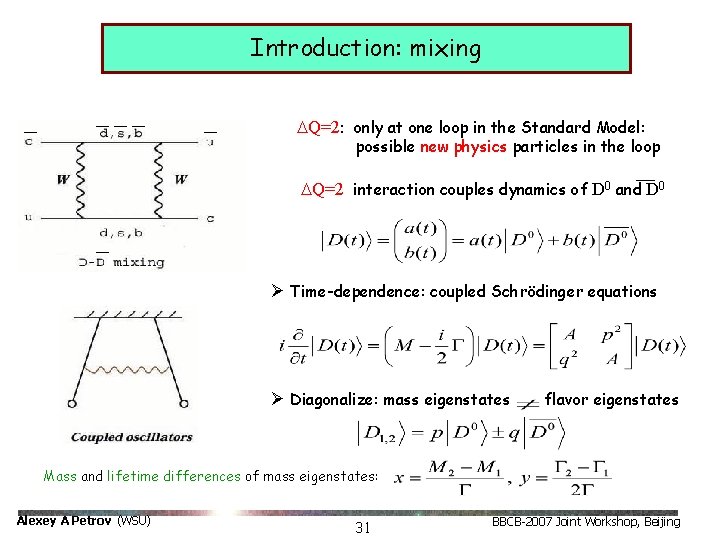
Introduction: mixing DQ=2: only at one loop in the Standard Model: possible new physics particles in the loop DQ=2 interaction couples dynamics of D 0 and D 0 Ø Time-dependence: coupled Schrödinger equations Ø Diagonalize: mass eigenstates flavor eigenstates Mass and lifetime differences of mass eigenstates: Alexey A Petrov (WSU) 31 BBCB-2007 Joint Workshop, Beijing
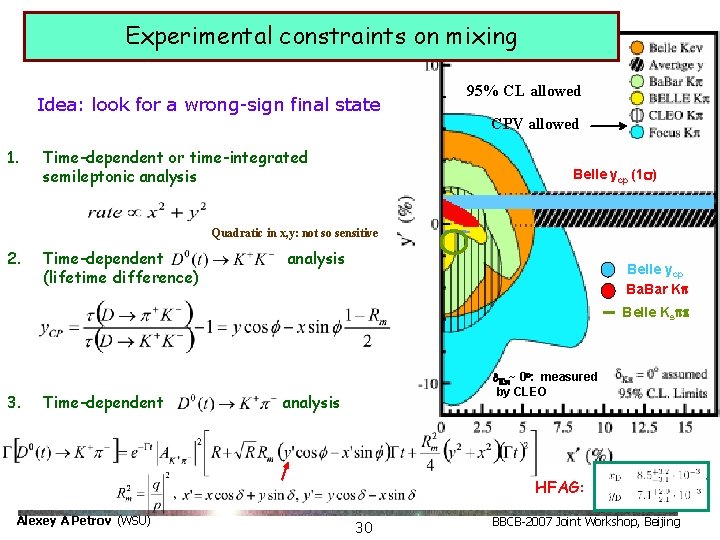
Experimental constraints on mixing Idea: look for a wrong-sign final state 1. Time-dependent or time-integrated semileptonic analysis 95% CL allowed CPV allowed Belle ycp (1 s) Quadratic in x, y: not so sensitive 2. Time-dependent (lifetime difference) analysis Belle ycp Ba. Bar Kp Belle Kspp 3. Time-dependent d. Kp~ 0 : measured by CLEO analysis HFAG: Alexey A Petrov (WSU) 30 BBCB-2007 Joint Workshop, Beijing
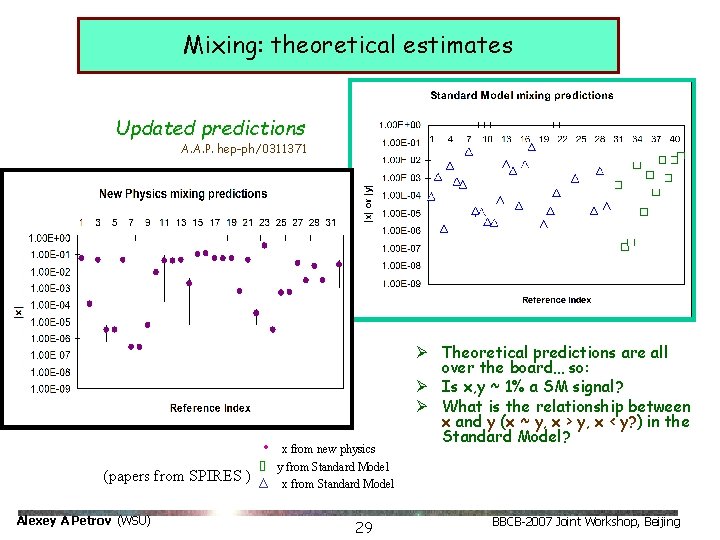
Mixing: theoretical estimates Updated predictions A. A. P. hep-ph/0311371 • (papers from SPIRES ) Alexey A Petrov (WSU) x from new physics y from Standard Model Δ x from Standard Model 29 Ø Theoretical predictions are all over the board… so: Ø Is x, y ~ 1% a SM signal? Ø What is the relationship between x and y (x ~ y, x > y, x < y? ) in the Standard Model? BBCB-2007 Joint Workshop, Beijing
New Physics and charm mixing parameters Alexey Petrov (WSU) BBCB-2007 Joint Workshop, Beijing
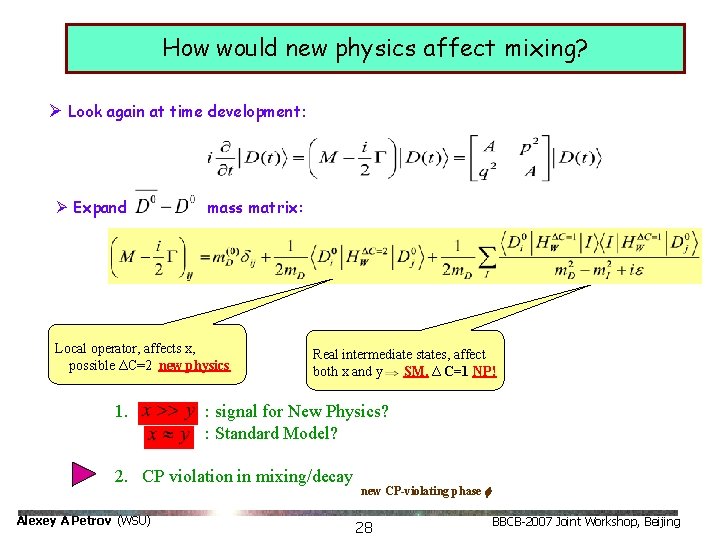
How would new physics affect mixing? Ø Look again at time development: Ø Expand mass matrix: Local operator, affects x, possible ΔC=2 new physics 1. Real intermediate states, affect both x and y SM, Δ C=1 NP! : signal for New Physics? : Standard Model? 2. CP violation in mixing/decay Alexey A Petrov (WSU) new CP-violating phase f 28 BBCB-2007 Joint Workshop, Beijing
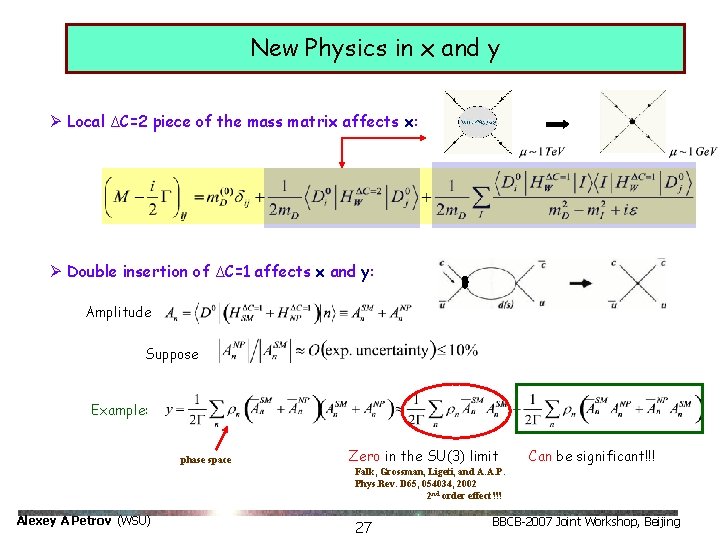
New Physics in x and y Ø Local ΔC=2 piece of the mass matrix affects x: Ø Double insertion of ΔC=1 affects x and y: Amplitude Suppose Example: phase space Zero in the SU(3) limit Can be significant!!! Falk, Grossman, Ligeti, and A. A. P. Phys. Rev. D 65, 054034, 2002 2 nd order effect!!! Alexey A Petrov (WSU) 27 BBCB-2007 Joint Workshop, Beijing
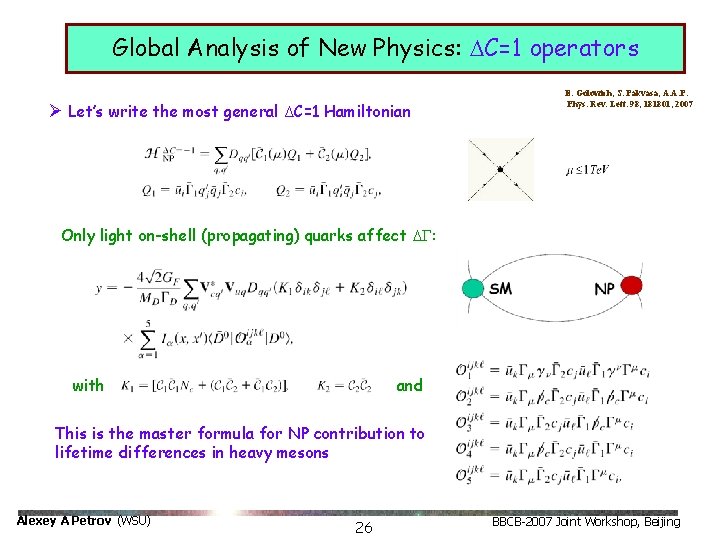
Global Analysis of New Physics: DC=1 operators Ø Let’s write the most general ΔC=1 Hamiltonian E. Golowich, S. Pakvasa, A. A. P. Phys. Rev. Lett. 98, 181801, 2007 Only light on-shell (propagating) quarks affect DG: with and This is the master formula for NP contribution to lifetime differences in heavy mesons Alexey A Petrov (WSU) 26 BBCB-2007 Joint Workshop, Beijing
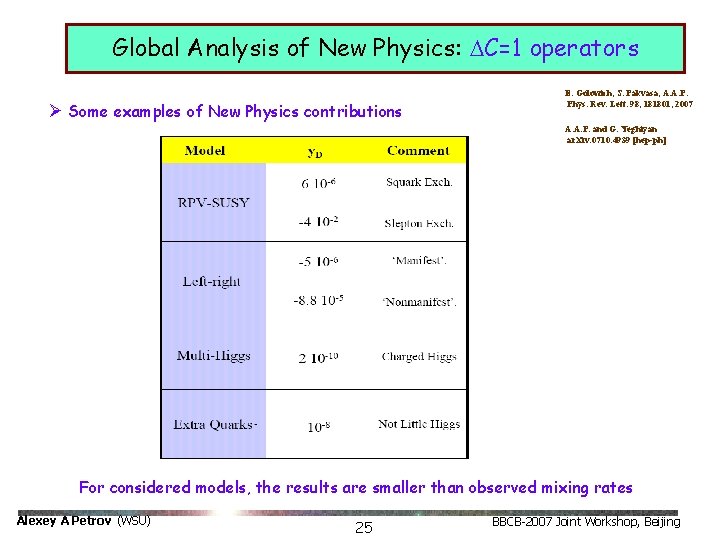
Global Analysis of New Physics: DC=1 operators Ø Some examples of New Physics contributions E. Golowich, S. Pakvasa, A. A. P. Phys. Rev. Lett. 98, 181801, 2007 A. A. P. and G. Yeghiyan ar. Xiv: 0710. 4939 [hep-ph] For considered models, the results are smaller than observed mixing rates Alexey A Petrov (WSU) 25 BBCB-2007 Joint Workshop, Beijing
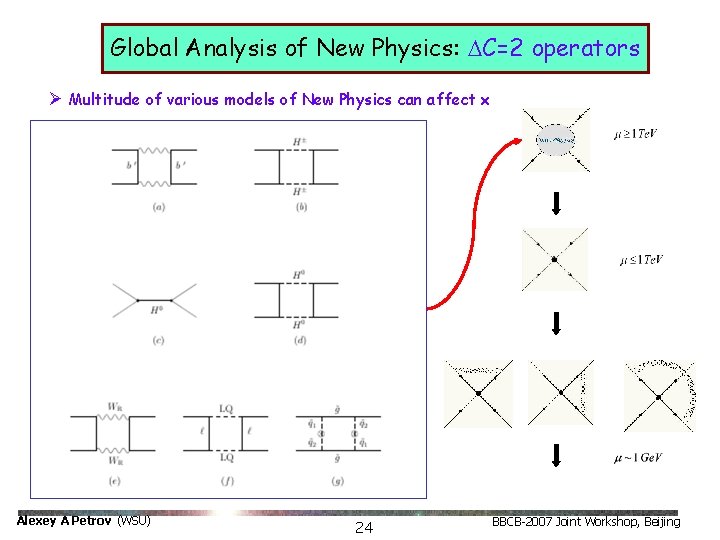
Global Analysis of New Physics: DC=2 operators Ø Multitude of various models of New Physics can affect x Alexey A Petrov (WSU) 24 BBCB-2007 Joint Workshop, Beijing
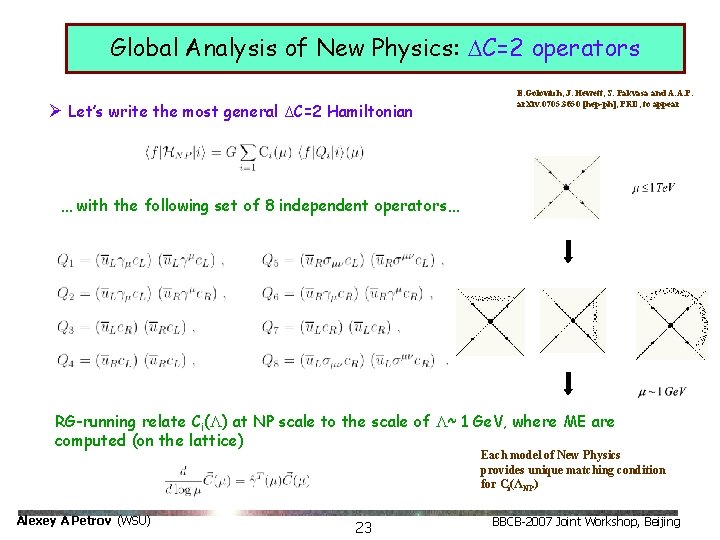
Global Analysis of New Physics: DC=2 operators Ø Let’s write the most general ΔC=2 Hamiltonian E. Golowich, J. Hewett, S. Pakvasa and A. A. P. ar. Xiv: 0705. 3650 [hep-ph], PRD, to appear … with the following set of 8 independent operators… RG-running relate Ci(Λ) at NP scale to the scale of Λ~ 1 Ge. V, where ME are computed (on the lattice) Each model of New Physics provides unique matching condition for Ci(ΛNP) Alexey A Petrov (WSU) 23 BBCB-2007 Joint Workshop, Beijing
Resume: New Physics contributions do not suffer from QCD uncertainties as much as SM contributions since they are shortdistance dominated. Alexey A Petrov (WSU) 22 BBCB-2007 Joint Workshop, Beijing
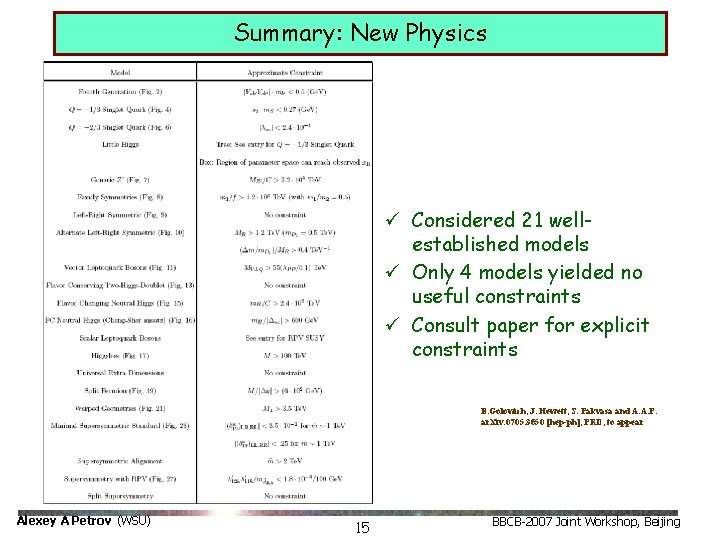
New Physics in x: lots of extras E. Golowich, J. Hewett, S. Pakvasa and A. A. P. ar. Xiv: 0705. 3650 [hep-ph], PRD, to appear Ø Extra gauge bosons Left-right models, horizontal symmetries, etc. Ø Extra scalars Two-Higgs doublet models, leptoquarks, Higgsless, etc. Ø Extra fermions 4 th generation, vector-like quarks, little Higgs, etc. Ø Extra dimensions Universal extra dimensions, split fermions, warped ED, etc. Ø Extra symmetries SUSY: MSSM, alignment models, split SUSY, etc. Total: 21 models considered Alexey A Petrov (WSU) 21 BBCB-2007 Joint Workshop, Beijing
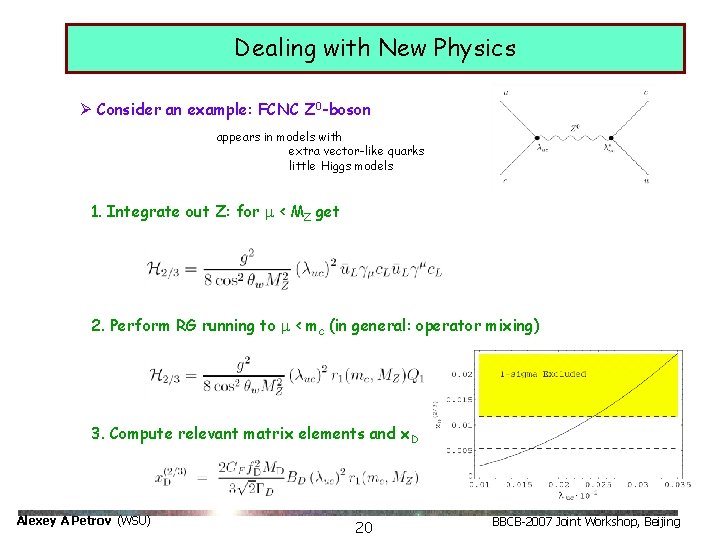
Dealing with New Physics Ø Consider an example: FCNC Z 0 -boson appears in models with extra vector-like quarks little Higgs models 1. Integrate out Z: for m < MZ get 2. Perform RG running to m < mc (in general: operator mixing) 3. Compute relevant matrix elements and x. D Alexey A Petrov (WSU) 20 BBCB-2007 Joint Workshop, Beijing
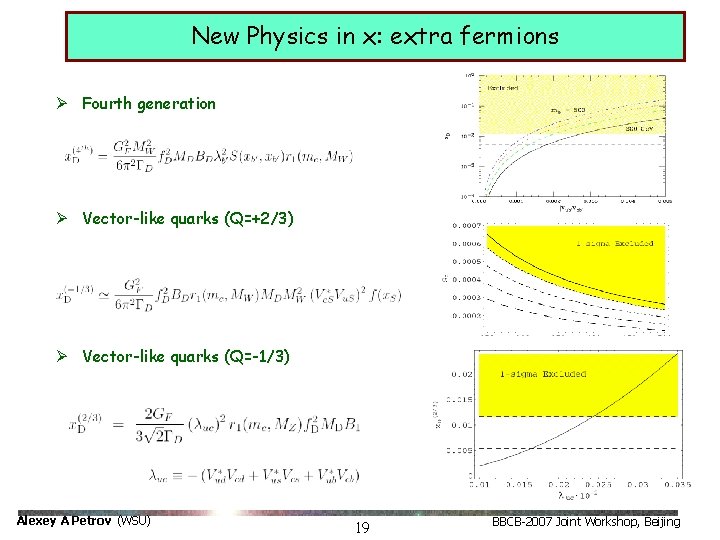
New Physics in x: extra fermions Ø Fourth generation Ø Vector-like quarks (Q=+2/3) Ø Vector-like quarks (Q=-1/3) Alexey A Petrov (WSU) 19 BBCB-2007 Joint Workshop, Beijing
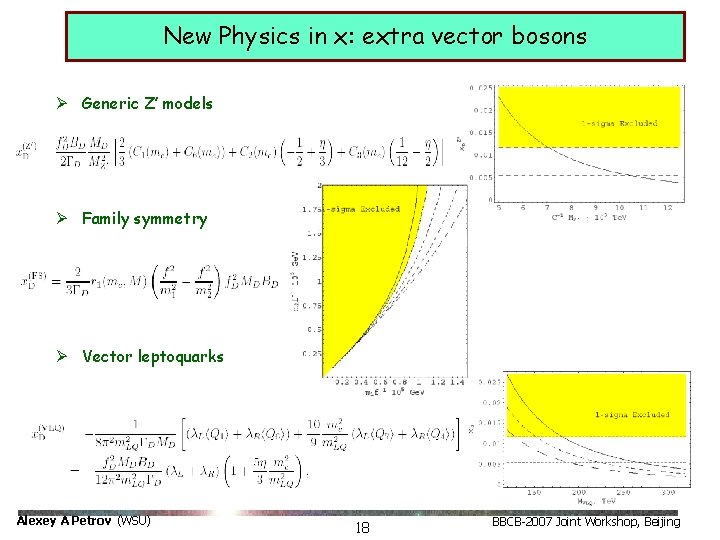
New Physics in x: extra vector bosons Ø Generic Z’ models Ø Family symmetry Ø Vector leptoquarks Alexey A Petrov (WSU) 18 BBCB-2007 Joint Workshop, Beijing
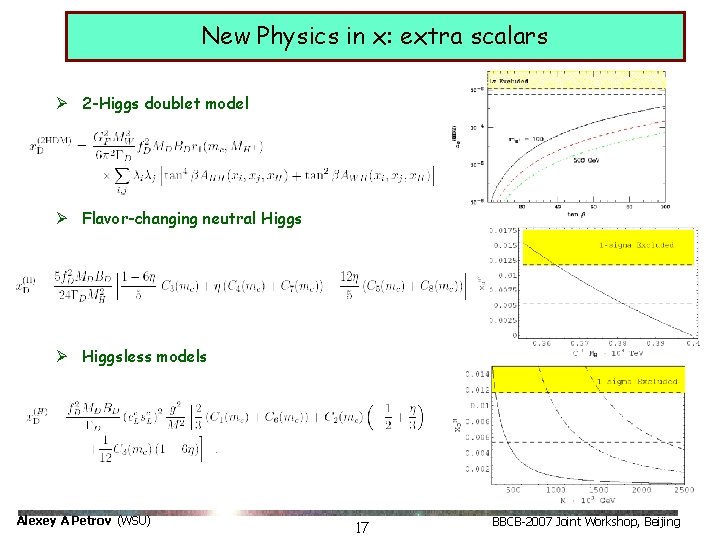
New Physics in x: extra scalars Ø 2 -Higgs doublet model Ø Flavor-changing neutral Higgs Ø Higgsless models Alexey A Petrov (WSU) 17 BBCB-2007 Joint Workshop, Beijing
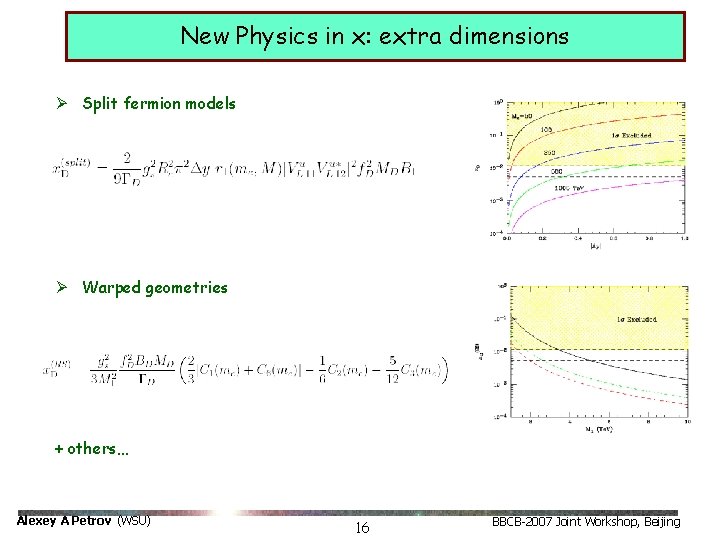
New Physics in x: extra dimensions Ø Split fermion models Ø Warped geometries + others… Alexey A Petrov (WSU) 16 BBCB-2007 Joint Workshop, Beijing
Summary: New Physics ü Considered 21 wellestablished models ü Only 4 models yielded no useful constraints ü Consult paper for explicit constraints E. Golowich, J. Hewett, S. Pakvasa and A. A. P. ar. Xiv: 0705. 3650 [hep-ph], PRD, to appear Alexey A Petrov (WSU) 15 BBCB-2007 Joint Workshop, Beijing
New Physics and CP violation in charm Alexey Petrov (WSU) BBCB-2007 Joint Workshop, Beijing
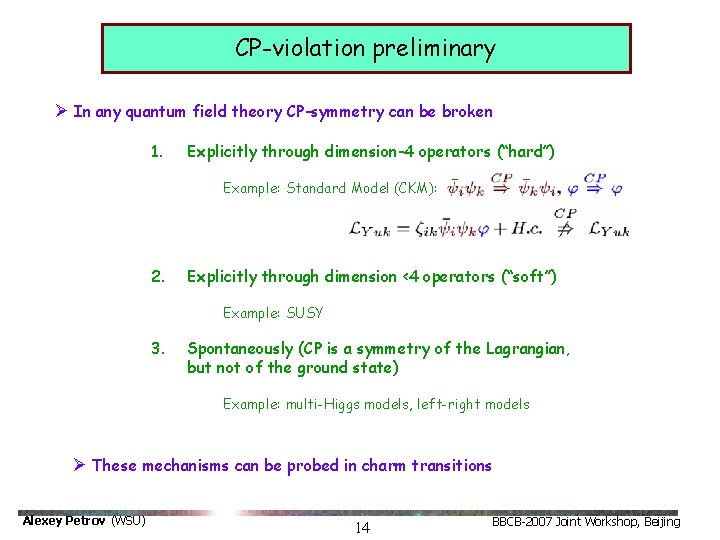
CP-violation preliminary Ø In any quantum field theory CP-symmetry can be broken 1. Explicitly through dimension-4 operators (“hard”) Example: Standard Model (CKM): 2. Explicitly through dimension <4 operators (“soft”) Example: SUSY 3. Spontaneously (CP is a symmetry of the Lagrangian, but not of the ground state) Example: multi-Higgs models, left-right models Ø These mechanisms can be probed in charm transitions Alexey Petrov (WSU) 14 BBCB-2007 Joint Workshop, Beijing
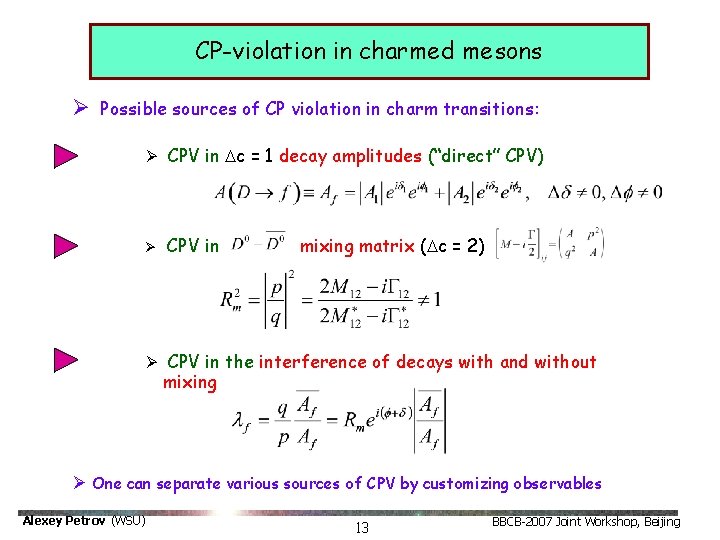
CP-violation in charmed mesons Ø Possible sources of CP violation in charm transitions: Ø CPV in Dc = 1 decay amplitudes (“direct” CPV) Ø CPV in mixing matrix (Dc = 2) Ø CPV in the interference of decays with and without mixing Ø One can separate various sources of CPV by customizing observables Alexey Petrov (WSU) 13 BBCB-2007 Joint Workshop, Beijing
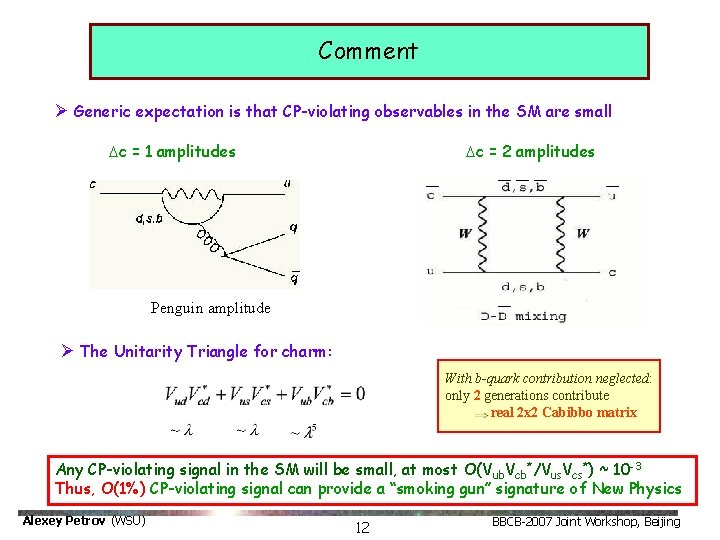
Comment Ø Generic expectation is that CP-violating observables in the SM are small Dc = 1 amplitudes Dc = 2 amplitudes Penguin amplitude Ø The Unitarity Triangle for charm: With b-quark contribution neglected: only 2 generations contribute real 2 x 2 Cabibbo matrix Any CP-violating signal in the SM will be small, at most O(V ub. Vcb*/Vus. Vcs*) ~ 10 -3 Thus, O(1%) CP-violating signal can provide a “smoking gun” signature of New Physics Alexey Petrov (WSU) 12 BBCB-2007 Joint Workshop, Beijing
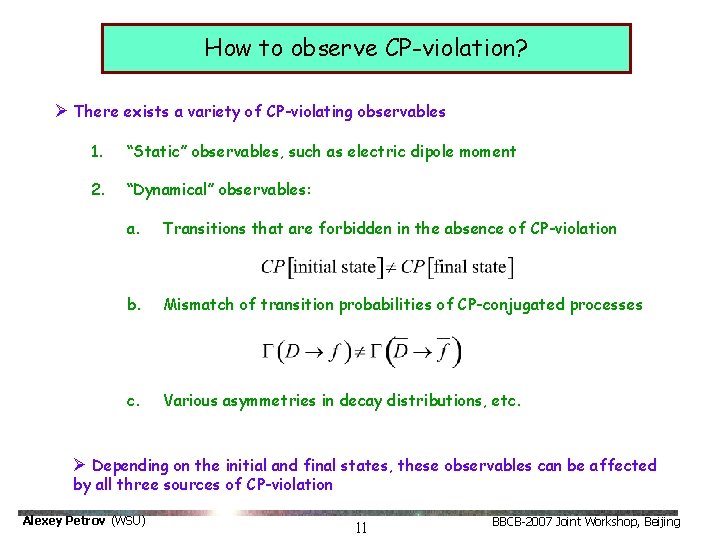
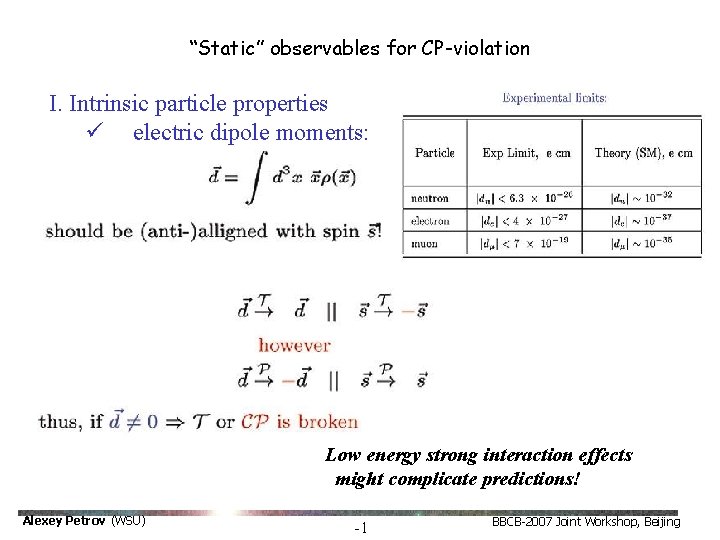
How to observe CP-violation? Ø There exists a variety of CP-violating observables 1. “Static” observables, such as electric dipole moment 2. “Dynamical” observables: a. Transitions that are forbidden in the absence of CP-violation b. Mismatch of transition probabilities of CP-conjugated processes c. Various asymmetries in decay distributions, etc. Ø Depending on the initial and final states, these observables can be affected by all three sources of CP-violation Alexey Petrov (WSU) 11 BBCB-2007 Joint Workshop, Beijing
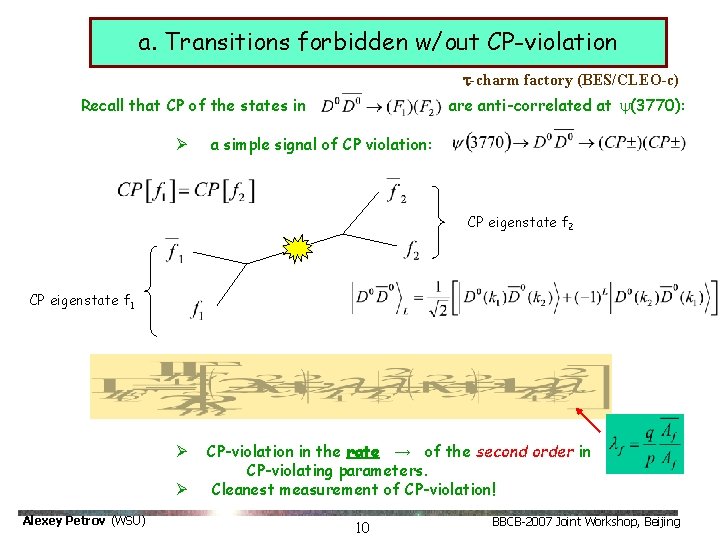
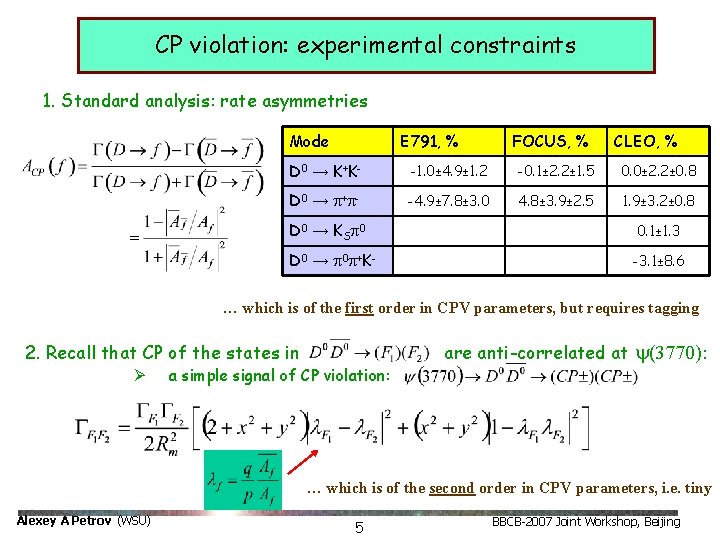
a. Transitions forbidden w/out CP-violation t-charm factory (BES/CLEO-c) Recall that CP of the states in Ø are anti-correlated at y(3770): a simple signal of CP violation: CP eigenstate f 2 CP eigenstate f 1 Ø Ø Alexey Petrov (WSU) CP-violation in the rate → of the second order in CP-violating parameters. Cleanest measurement of CP-violation! 10 BBCB-2007 Joint Workshop, Beijing
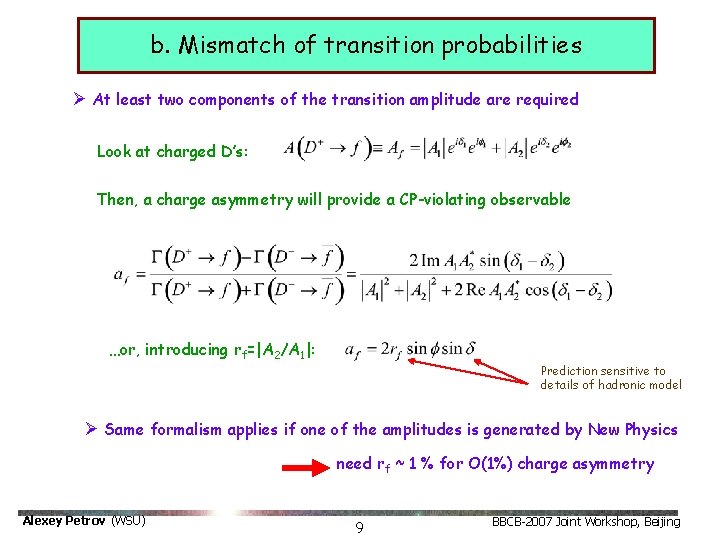
b. Mismatch of transition probabilities Ø At least two components of the transition amplitude are required Look at charged D’s: Then, a charge asymmetry will provide a CP-violating observable …or, introducing rf=|A 2/A 1|: Prediction sensitive to details of hadronic model Ø Same formalism applies if one of the amplitudes is generated by New Physics need rf ~ 1 % for O(1%) charge asymmetry Alexey Petrov (WSU) 9 BBCB-2007 Joint Workshop, Beijing
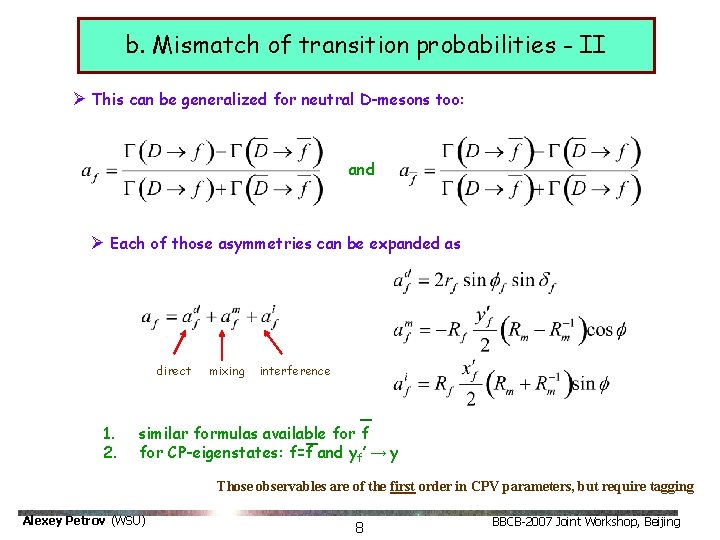
b. Mismatch of transition probabilities - II Ø This can be generalized for neutral D-mesons too: and Ø Each of those asymmetries can be expanded as direct 1. 2. mixing interference similar formulas available for f for CP-eigenstates: f=f and yf’ → y Those observables are of the first order in CPV parameters, but require tagging Alexey Petrov (WSU) 8 BBCB-2007 Joint Workshop, Beijing
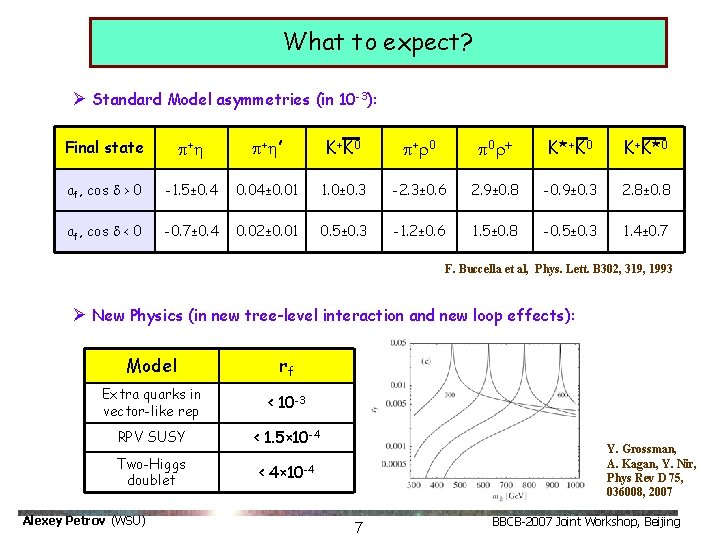
What to expect? Ø Standard Model asymmetries (in 10 -3): Final state p+ h p+h’ K+ K 0 p+ r 0 p 0 r + K*+K 0 K+K*0 af, cos d > 0 -1. 5± 0. 4 0. 04± 0. 01 1. 0± 0. 3 -2. 3± 0. 6 2. 9± 0. 8 -0. 9± 0. 3 2. 8± 0. 8 af, cos d < 0 -0. 7± 0. 4 0. 02± 0. 01 0. 5± 0. 3 -1. 2± 0. 6 1. 5± 0. 8 -0. 5± 0. 3 1. 4± 0. 7 F. Buccella et al, Phys. Lett. B 302, 319, 1993 Ø New Physics (in new tree-level interaction and new loop effects): Model rf Extra quarks in vector-like rep < 10 -3 RPV SUSY < 1. 5× 10 -4 Two-Higgs doublet < 4× 10 -4 Alexey Petrov (WSU) Y. Grossman, A. Kagan, Y. Nir, Phys Rev D 75, 036008, 2007 7 BBCB-2007 Joint Workshop, Beijing
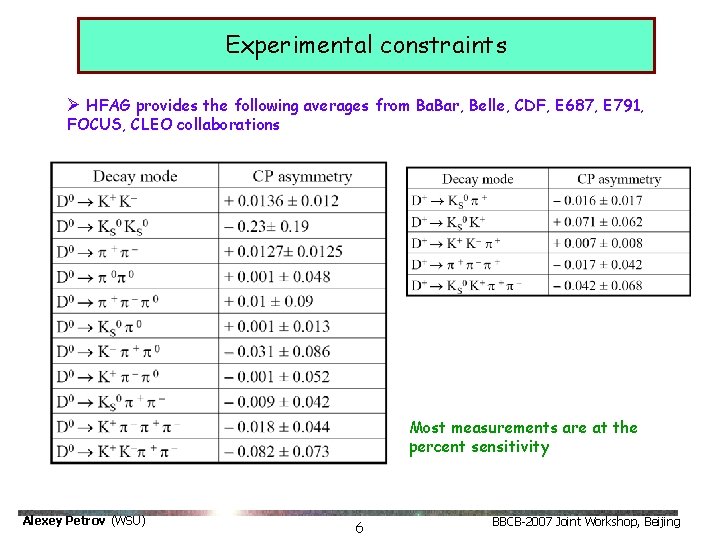
Experimental constraints Ø HFAG provides the following averages from Ba. Bar, Belle, CDF, E 687, E 791, FOCUS, CLEO collaborations Most measurements are at the percent sensitivity Alexey Petrov (WSU) 6 BBCB-2007 Joint Workshop, Beijing
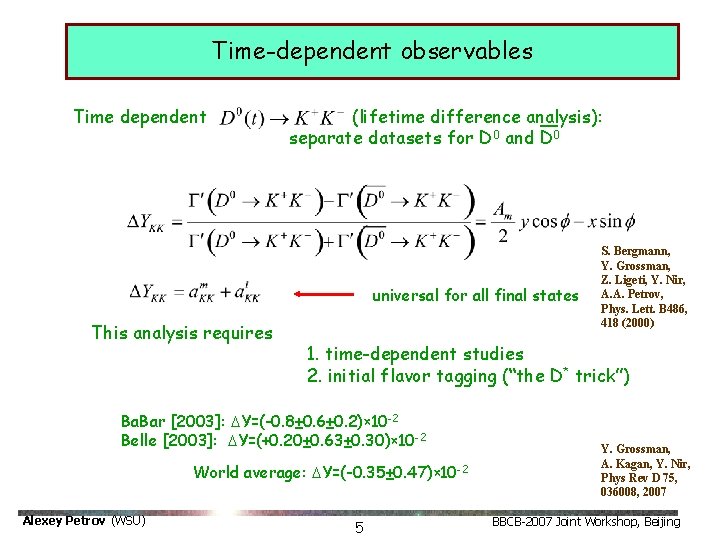
Time-dependent observables Time dependent (lifetime difference analysis): separate datasets for D 0 and D 0 universal for all final states This analysis requires 1. time-dependent studies 2. initial flavor tagging (“the D* trick”) Ba. Bar [2003]: DY=(-0. 8± 0. 6± 0. 2)× 10 -2 Belle [2003]: DY=(+0. 20± 0. 63± 0. 30)× 10 -2 World average: DY=(-0. 35± 0. 47)× 10 -2 Alexey Petrov (WSU) S. Bergmann, Y. Grossman, Z. Ligeti, Y. Nir, A. A. Petrov, Phys. Lett. B 486, 418 (2000) 5 Y. Grossman, A. Kagan, Y. Nir, Phys Rev D 75, 036008, 2007 BBCB-2007 Joint Workshop, Beijing
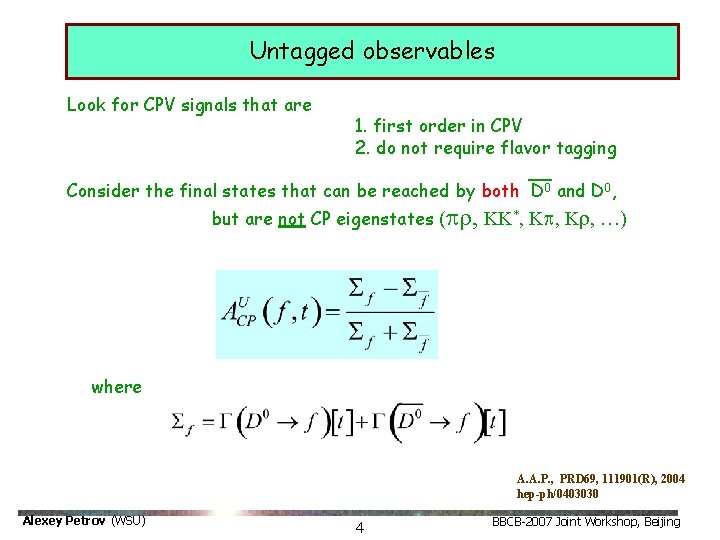
Untagged observables Look for CPV signals that are 1. first order in CPV 2. do not require flavor tagging Consider the final states that can be reached by both D 0 and D 0, but are not CP eigenstates (pr, KK*, Kp, Kr, …) where A. A. P. , PRD 69, 111901(R), 2004 hep-ph/0403030 Alexey Petrov (WSU) 4 BBCB-2007 Joint Workshop, Beijing
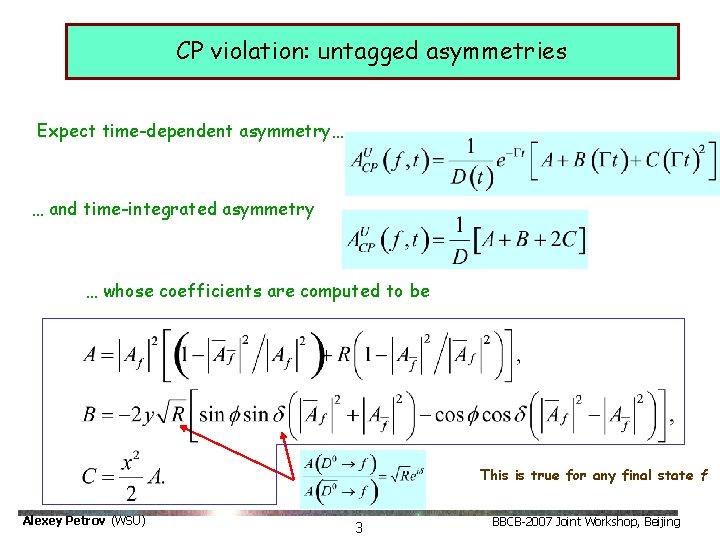
CP violation: untagged asymmetries Expect time-dependent asymmetry… … and time-integrated asymmetry … whose coefficients are computed to be This is true for any final state f Alexey Petrov (WSU) 3 BBCB-2007 Joint Workshop, Beijing
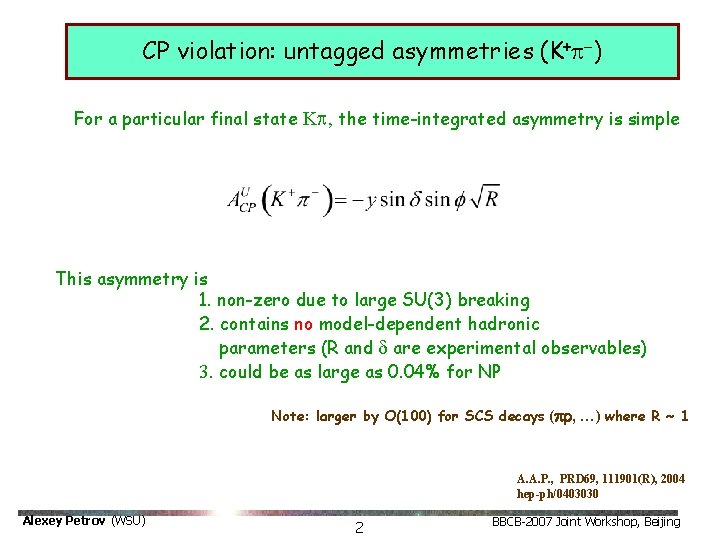
CP violation: untagged asymmetries (K+p-) For a particular final state Kp, the time-integrated asymmetry is simple This asymmetry is 1. non-zero due to large SU(3) breaking 2. contains no model-dependent hadronic parameters (R and d are experimental observables) 3. could be as large as 0. 04% for NP Note: larger by O(100) for SCS decays (pr, …) where R ~ 1 A. A. P. , PRD 69, 111901(R), 2004 hep-ph/0403030 Alexey Petrov (WSU) 2 BBCB-2007 Joint Workshop, Beijing
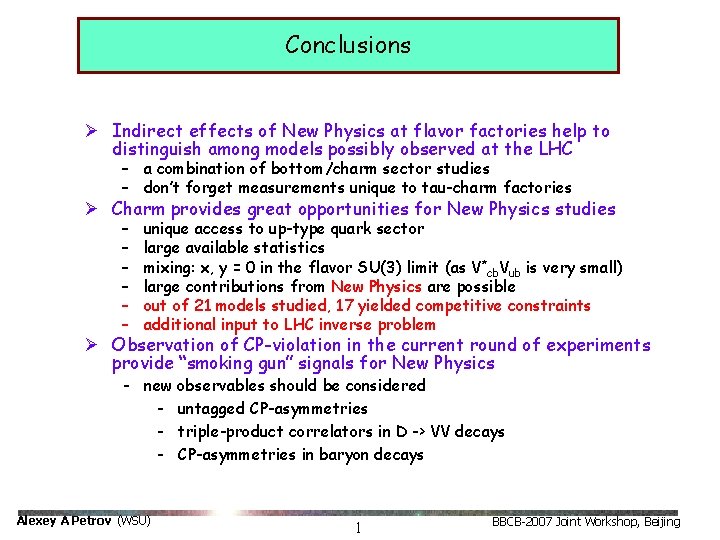
Conclusions Ø Indirect effects of New Physics at flavor factories help to distinguish among models possibly observed at the LHC – a combination of bottom/charm sector studies – don’t forget measurements unique to tau-charm factories Ø Charm provides great opportunities for New Physics studies – – – unique access to up-type quark sector large available statistics mixing: x, y = 0 in the flavor SU(3) limit (as V*cb. Vub is very small) large contributions from New Physics are possible out of 21 models studied, 17 yielded competitive constraints additional input to LHC inverse problem Ø Observation of CP-violation in the current round of experiments provide “smoking gun” signals for New Physics - new observables should be considered - untagged CP-asymmetries - triple-product correlators in D -> VV decays - CP-asymmetries in baryon decays Alexey A Petrov (WSU) 1 BBCB-2007 Joint Workshop, Beijing
Additional slides Alexey A Petrov (WSU) 0 BBCB-2007 Joint Workshop, Beijing
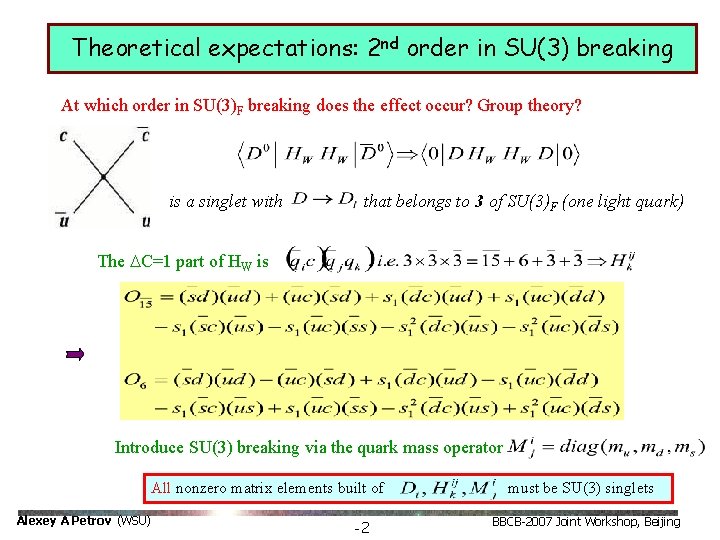
Theoretical expectations: 2 nd order in SU(3) breaking At which order in SU(3)F breaking does the effect occur? Group theory? is a singlet with that belongs to 3 of SU(3)F (one light quark) The DC=1 part of HW is Introduce SU(3) breaking via the quark mass operator All nonzero matrix elements built of Alexey A Petrov (WSU) -2 must be SU(3) singlets BBCB-2007 Joint Workshop, Beijing
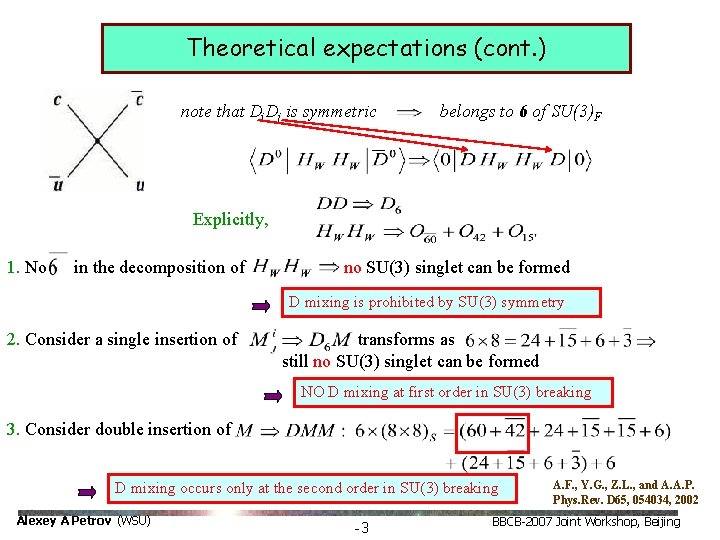
Theoretical expectations (cont. ) note that Di. Dj is symmetric belongs to 6 of SU(3)F Explicitly, 1. No in the decomposition of no SU(3) singlet can be formed D mixing is prohibited by SU(3) symmetry 2. Consider a single insertion of transforms as still no SU(3) singlet can be formed NO D mixing at first order in SU(3) breaking 3. Consider double insertion of D mixing occurs only at the second order in SU(3) breaking Alexey A Petrov (WSU) -3 A. F. , Y. G. , Z. L. , and A. A. P. Phys. Rev. D 65, 054034, 2002 BBCB-2007 Joint Workshop, Beijing
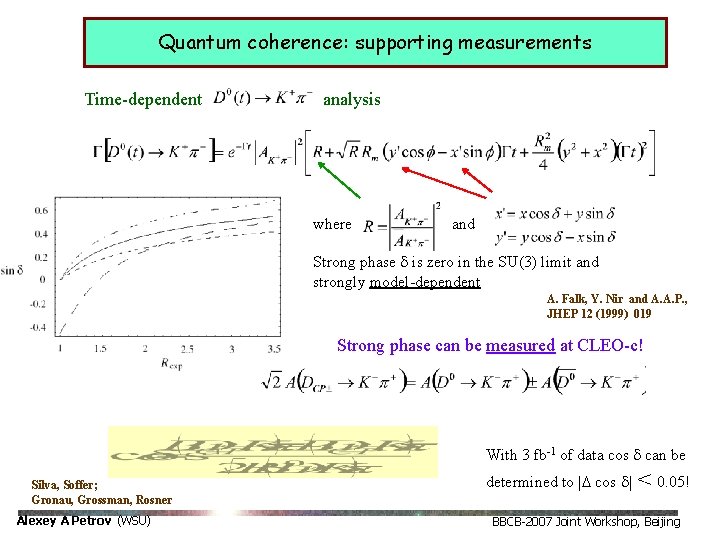
Quantum coherence: supporting measurements Time-dependent analysis where and Strong phase d is zero in the SU(3) limit and strongly model-dependent A. Falk, Y. Nir and A. A. P. , JHEP 12 (1999) 019 Strong phase can be measured at CLEO-c! With 3 fb-1 of data cos d can be Silva, Soffer; Gronau, Grossman, Rosner Alexey A Petrov (WSU) determined to |D cos d| < 0. 05! BBCB-2007 Joint Workshop, Beijing
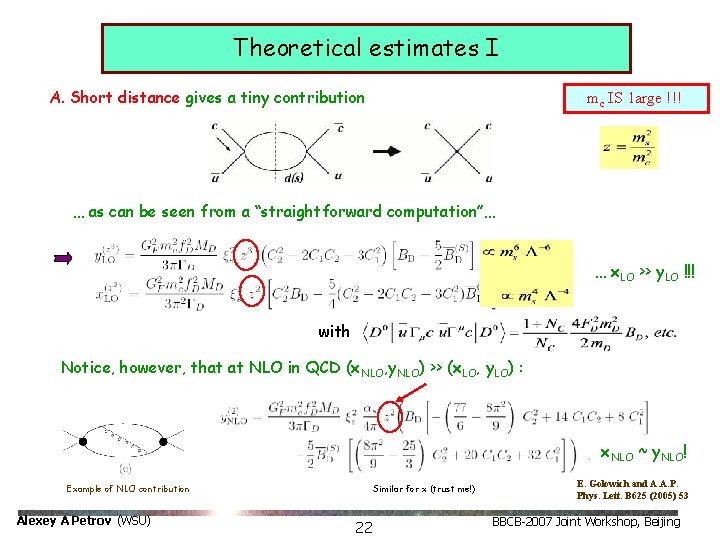
Theoretical estimates I A. Short distance gives a tiny contribution mc IS large !!! … as can be seen from a “straightforward computation”… … x. LO >> y. LO !!! with Notice, however, that at NLO in QCD (x. NLO, y. NLO) >> (x. LO, y. LO) : x. NLO ~ y. NLO! Example of NLO contribution Alexey A Petrov (WSU) Similar for x (trust me!) 22 E. Golowich and A. A. P. Phys. Lett. B 625 (2005) 53 BBCB-2007 Joint Workshop, Beijing
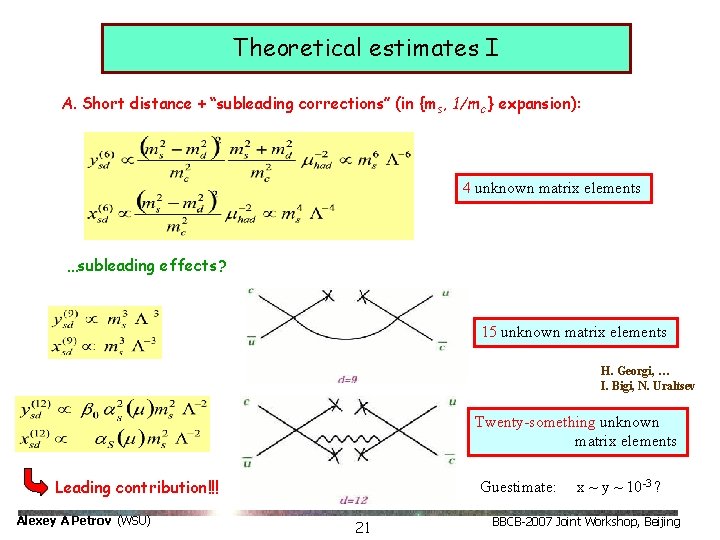
Theoretical estimates I A. Short distance + “subleading corrections” (in {ms, 1/mc } expansion): 4 unknown matrix elements …subleading effects? 15 unknown matrix elements H. Georgi, … I. Bigi, N. Uraltsev Twenty-something unknown matrix elements Leading contribution!!! Alexey A Petrov (WSU) Guestimate: 21 x ~ y ~ 10 -3 ? BBCB-2007 Joint Workshop, Beijing
Resume: model-independent computation with model-dependent result Alexey A Petrov (WSU) 20 BBCB-2007 Joint Workshop, Beijing
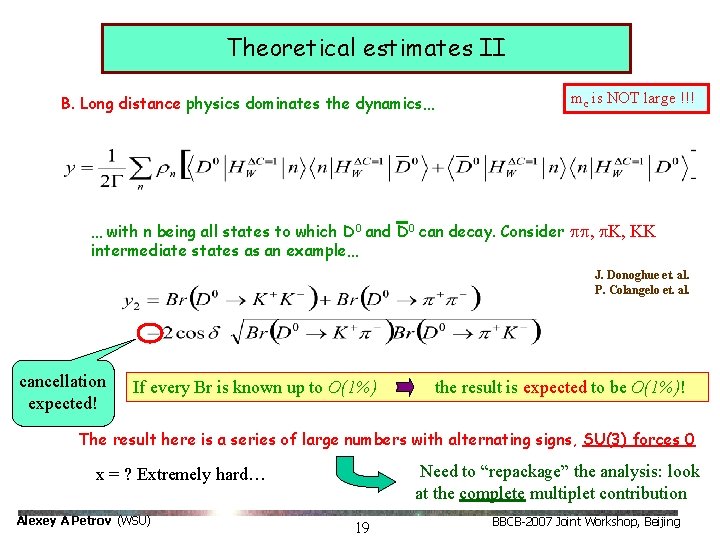
Theoretical estimates II B. Long distance physics dominates the dynamics… mc is NOT large !!! … with n being all states to which D 0 and D 0 can decay. Consider pp, p. K, KK intermediate states as an example… J. Donoghue et. al. P. Colangelo et. al. cancellation expected! If every Br is known up to O(1%) the result is expected to be O(1%)! The result here is a series of large numbers with alternating signs, SU(3) forces 0 Need to “repackage” the analysis: look at the complete multiplet contribution x = ? Extremely hard… Alexey A Petrov (WSU) 19 BBCB-2007 Joint Workshop, Beijing
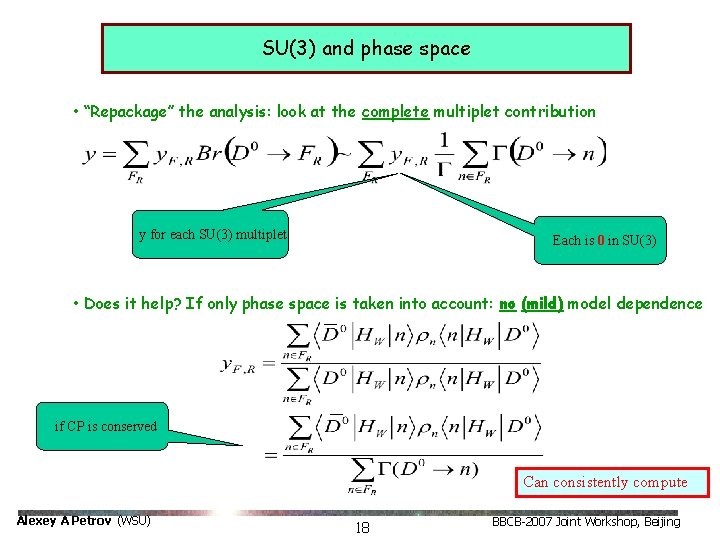
SU(3) and phase space • “Repackage” the analysis: look at the complete multiplet contribution y for each SU(3) multiplet Each is 0 in SU(3) • Does it help? If only phase space is taken into account: no (mild) model dependence if CP is conserved Can consistently compute Alexey A Petrov (WSU) 18 BBCB-2007 Joint Workshop, Beijing
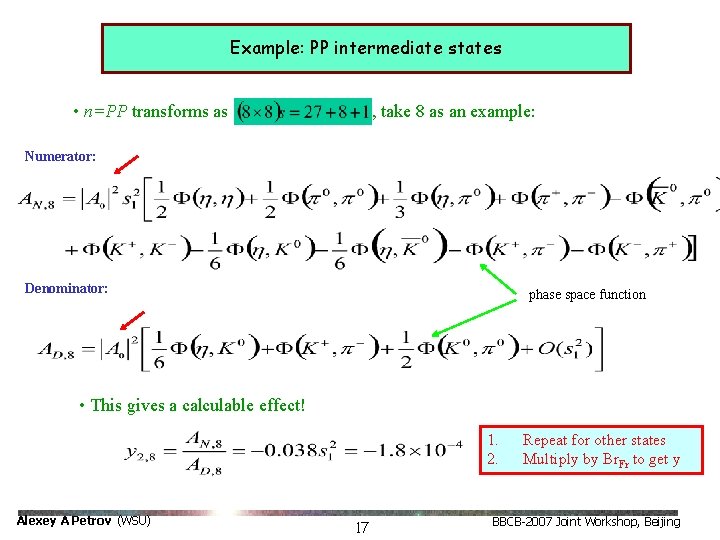
Example: PP intermediate states • n=PP transforms as , take 8 as an example: Numerator: Denominator: phase space function • This gives a calculable effect! 1. 2. Alexey A Petrov (WSU) 17 Repeat for other states Multiply by Br. Fr to get y BBCB-2007 Joint Workshop, Beijing
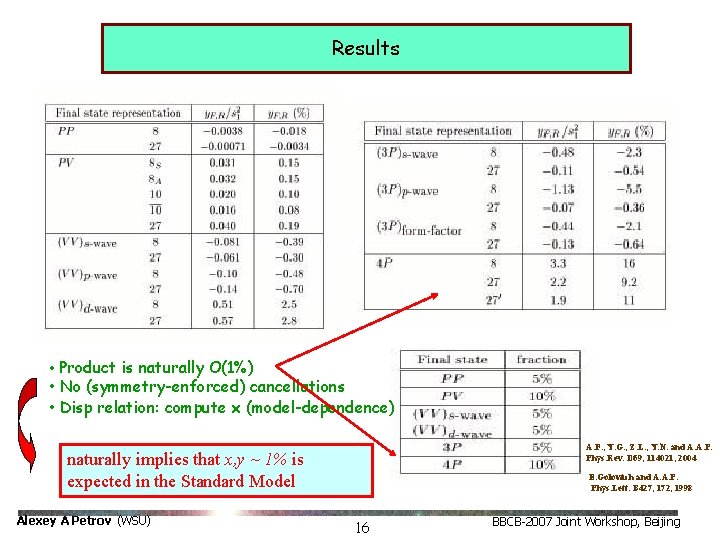
Results • Product is naturally O(1%) • No (symmetry-enforced) cancellations • Disp relation: compute x (model-dependence) A. F. , Y. G. , Z. L. , Y. N. and A. A. P. Phys. Rev. D 69, 114021, 2004 naturally implies that x, y ~ 1% is expected in the Standard Model Alexey A Petrov (WSU) E. Golowich and A. A. P. Phys. Lett. B 427, 172, 1998 16 BBCB-2007 Joint Workshop, Beijing
Resume: a contribution to x and y of the order of 1% is natural in the SM What about New Physics? Alexey A Petrov (WSU) 15 BBCB-2007 Joint Workshop, Beijing
CP violation: experimental constraints 1. Standard analysis: rate asymmetries Mode E 791, % FOCUS, % CLEO, % D 0 → K + K- -1. 0± 4. 9± 1. 2 -0. 1± 2. 2± 1. 5 0. 0± 2. 2± 0. 8 D 0 → p+ p- -4. 9± 7. 8± 3. 0 4. 8± 3. 9± 2. 5 1. 9± 3. 2± 0. 8 D 0 → K S p 0 0. 1± 1. 3 D 0 → p 0 p+ K- -3. 1± 8. 6 … which is of the first order in CPV parameters, but requires tagging 2. Recall that CP of the states in Ø a simple signal of CP violation: are anti-correlated at y(3770): … which is of the second order in CPV parameters, i. e. tiny Alexey A Petrov (WSU) 5 BBCB-2007 Joint Workshop, Beijing
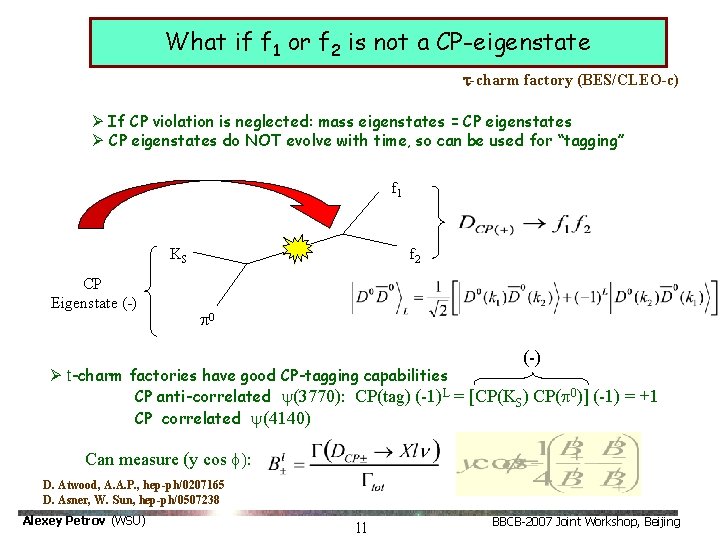
What if f 1 or f 2 is not a CP-eigenstate t-charm factory (BES/CLEO-c) Ø If CP violation is neglected: mass eigenstates = CP eigenstates Ø CP eigenstates do NOT evolve with time, so can be used for “tagging” f 1 KS CP Eigenstate (-) f 2 p 0 (-) Ø t-charm factories have good CP-tagging capabilities CP anti-correlated y(3770): CP(tag) (-1)L = [CP(KS) CP(p 0)] (-1) = +1 CP correlated y(4140) Can measure (y cos f): D. Atwood, A. A. P. , hep-ph/0207165 D. Asner, W. Sun, hep-ph/0507238 Alexey Petrov (WSU) 11 BBCB-2007 Joint Workshop, Beijing
“Static” observables for CP-violation I. Intrinsic particle properties ü electric dipole moments: Low energy strong interaction effects might complicate predictions! Alexey Petrov (WSU) -1 BBCB-2007 Joint Workshop, Beijing