
New Pattern Matching Algorithms for Network Security Applications
![Overview of My Thesis Three types of patterns … “. *<embed[^>]*javascript ^filex 3 ax](https://slidetodoc.com/presentation_image_h2/98310d221fc016dfd122e6edbe04e71d/image-7.jpg "Overview of My Thesis Three types of patterns … “. *<embed[^>]*javascript ^filex 3 ax")
![Why not DFA? (cont. ) State explosion may happen NFA DFA Pattern: “. *1[0|1]](https://slidetodoc.com/presentation_image_h2/98310d221fc016dfd122e6edbe04e71d/image-12.jpg "Why not DFA? (cont. ) State explosion may happen NFA DFA Pattern: “. *1[0|1]")
![Ordered Binary Decision Diagram (OBDD) [Bryant 1986] OBDDs: Compact representation of Boolean functions x](https://slidetodoc.com/presentation_image_h2/98310d221fc016dfd122e6edbe04e71d/image-23.jpg "Ordered Binary Decision Diagram (OBDD) [Bryant 1986] OBDDs: Compact representation of Boolean functions x")
![Part II: Extension of NFA-OBDD to Model Submatch Extraction [ANCS’ 12] Joint work with](https://slidetodoc.com/presentation_image_h2/98310d221fc016dfd122e6edbe04e71d/image-29.jpg "Part II: Extension of NFA-OBDD to Model Submatch Extraction [ANCS’ 12] Joint work with")
![Related Work • • • Multiple DFAs [Yu et al. , ANCS’ 06] XFAs](https://slidetodoc.com/presentation_image_h2/98310d221fc016dfd122e6edbe04e71d/image-53.jpg "Related Work • • • Multiple DFAs [Yu et al. , ANCS’ 06] XFAs")

![Other Contributions • Enhancing Users’ Comprehension of Android Permissions [SPSM’ 12] • Enhancing Mobile](https://slidetodoc.com/presentation_image_h2/98310d221fc016dfd122e6edbe04e71d/image-57.jpg "Other Contributions • Enhancing Users’ Comprehension of Android Permissions [SPSM’ 12] • Enhancing Mobile")
- Slides: 57
New Pattern Matching Algorithms for Network Security Applications Liu Yang Department of Computer Science Rutgers University Liu Yang April 4 th, 2013
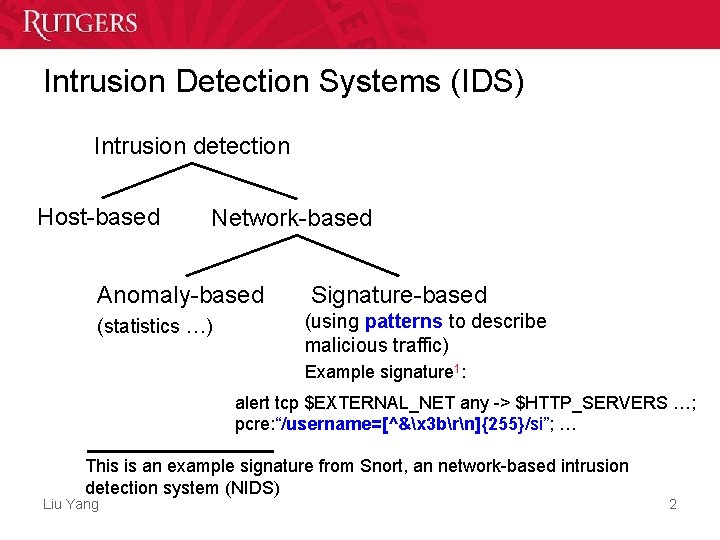
Intrusion Detection Systems (IDS) Intrusion detection Host-based Network-based Anomaly-based (statistics …) Signature-based (using patterns to describe malicious traffic) Example signature 1: alert tcp $EXTERNAL_NET any -> $HTTP_SERVERS …; pcre: “/username=[^&x 3 brn]{255}/si”; … This is an example signature from Snort, an network-based intrusion detection system (NIDS) Liu Yang 2
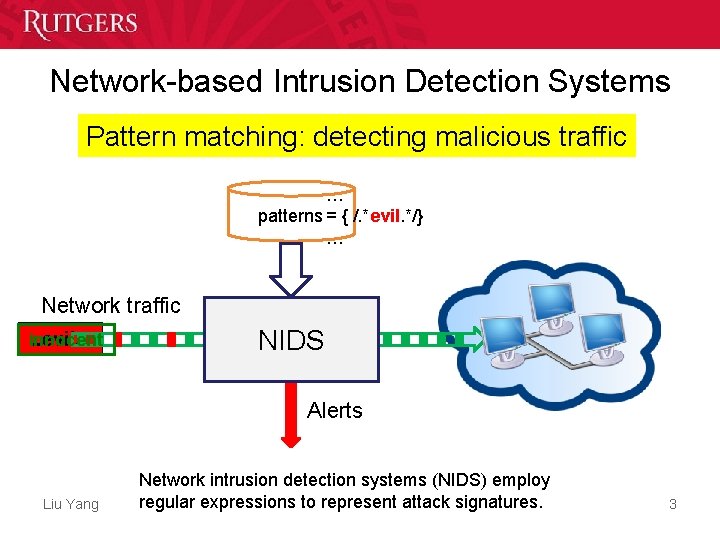
Network-based Intrusion Detection Systems Pattern matching: detecting malicious traffic … patterns = { /. *evil. */} … Network traffic innocent. . evil. . NIDS Alerts Liu Yang Network intrusion detection systems (NIDS) employ regular expressions to represent attack signatures. 3
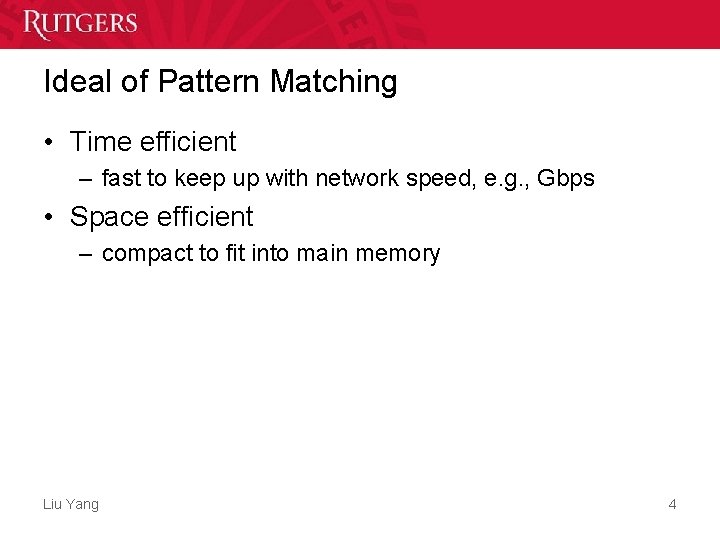
Ideal of Pattern Matching • Time efficient – fast to keep up with network speed, e. g. , Gbps • Space efficient – compact to fit into main memory Liu Yang 4
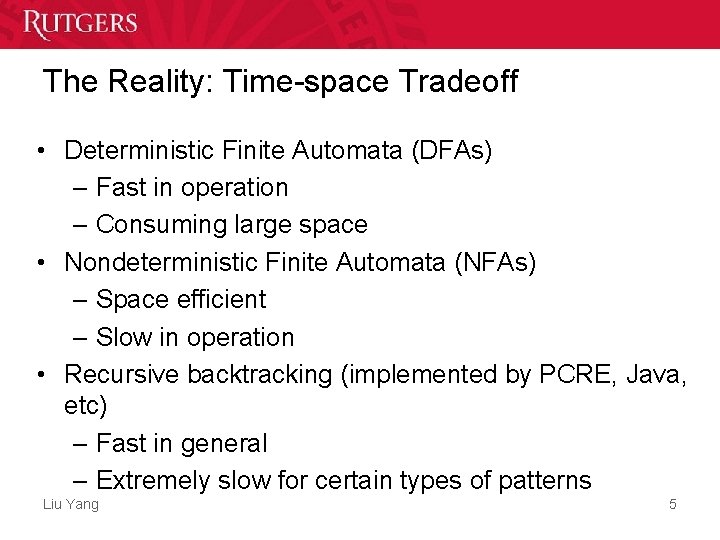
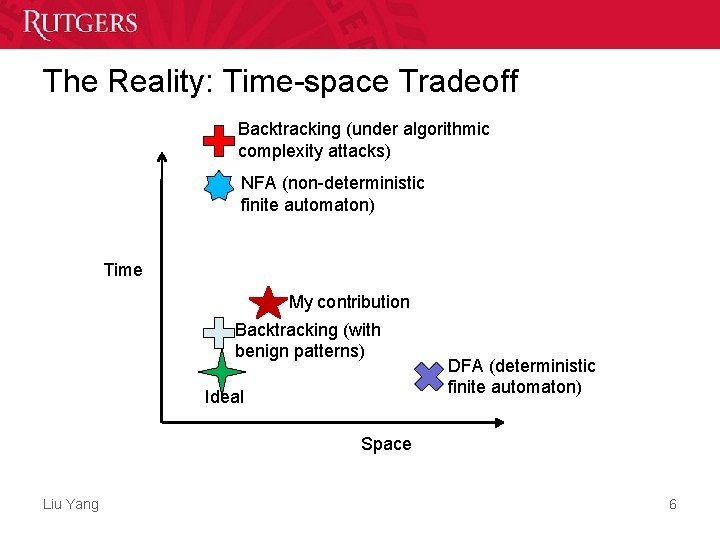
The Reality: Time-space Tradeoff • Deterministic Finite Automata (DFAs) – Fast in operation – Consuming large space • Nondeterministic Finite Automata (NFAs) – Space efficient – Slow in operation • Recursive backtracking (implemented by PCRE, Java, etc) – Fast in general – Extremely slow for certain types of patterns Liu Yang 5
The Reality: Time-space Tradeoff Backtracking (under algorithmic complexity attacks) NFA (non-deterministic finite automaton) Time My contribution Backtracking (with benign patterns) Ideal DFA (deterministic finite automaton) Space Liu Yang 6
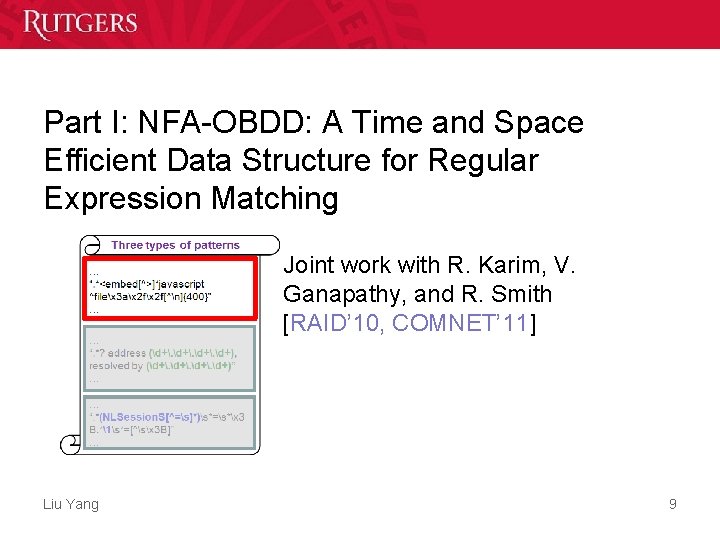
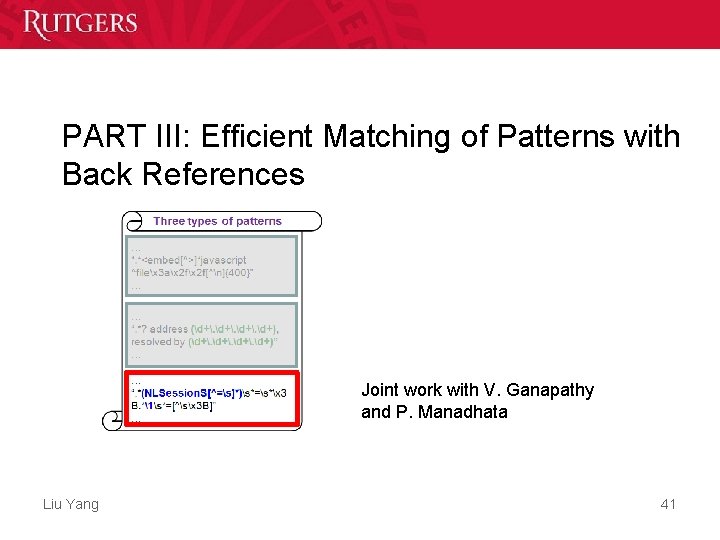
Overview of My Thesis Three types of patterns … “. *<embed[^>]*javascript ^filex 3 ax 2 f[^n]{400}” … … “. *? address (d+. d+), resolved by (d+. d+)” … … “. *(NLSession. S[^=s]*)s*=s*x 3 B. *1s*=[^sx 3 B]” … Liu Yang Regular expressions NFA-OBDD [RAID’ 10, COMNET’ 11] Regular expressions +submatch extraction Submatch-OBDD [ANCS’ 12] Regular expressions +back references NFA-backref [to submit] 7
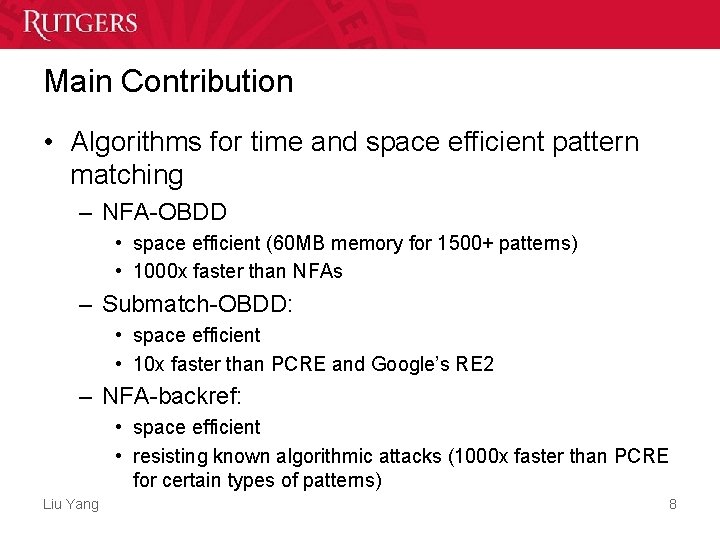
Main Contribution • Algorithms for time and space efficient pattern matching – NFA-OBDD • space efficient (60 MB memory for 1500+ patterns) • 1000 x faster than NFAs – Submatch-OBDD: • space efficient • 10 x faster than PCRE and Google’s RE 2 – NFA-backref: • space efficient • resisting known algorithmic attacks (1000 x faster than PCRE for certain types of patterns) Liu Yang 8
Part I: NFA-OBDD: A Time and Space Efficient Data Structure for Regular Expression Matching Joint work with R. Karim, V. Ganapathy, and R. Smith [RAID’ 10, COMNET’ 11] Liu Yang 9
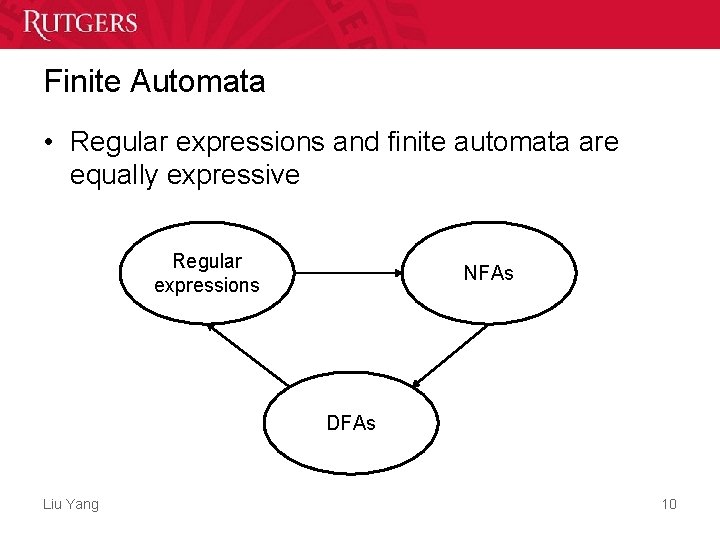
Finite Automata • Regular expressions and finite automata are equally expressive Regular expressions NFAs DFAs Liu Yang 10
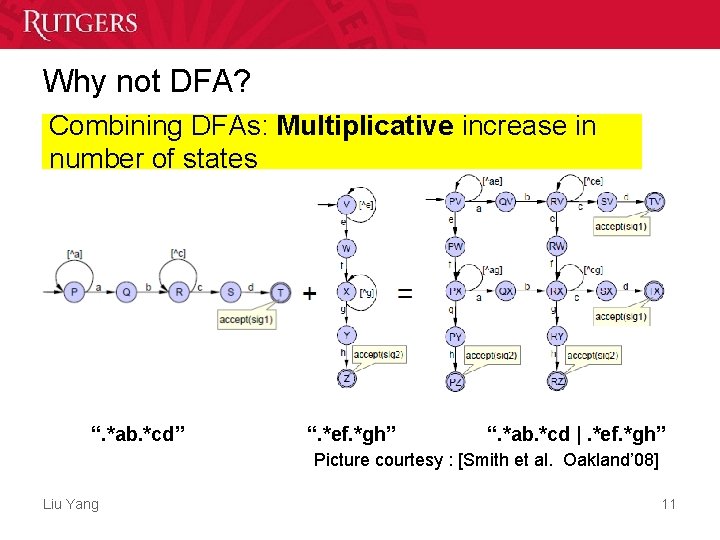
Why not DFA? Combining DFAs: Multiplicative increase in number of states “. *ab. *cd” “. *ef. *gh” “. *ab. *cd |. *ef. *gh” Picture courtesy : [Smith et al. Oakland’ 08] Liu Yang 11
Why not DFA? (cont. ) State explosion may happen NFA DFA Pattern: “. *1[0|1] {3} ” State explosion n O(2^n) The value of quantifier n is up to 255 in Snort Liu Yang 12
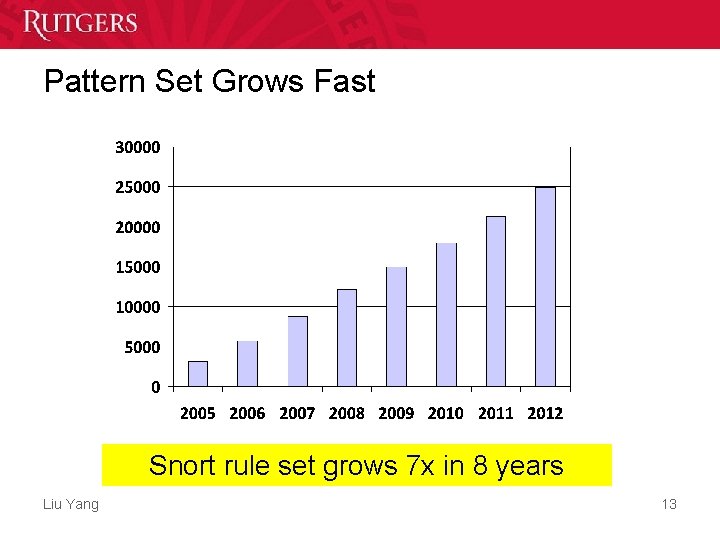
Pattern Set Grows Fast Snort rule set grows 7 x in 8 years Liu Yang 13
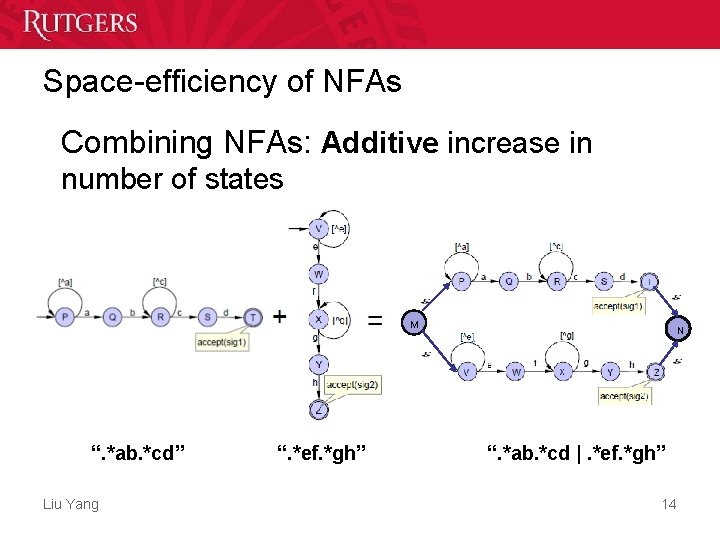
Space-efficiency of NFAs Combining NFAs: Additive increase in number of states M “. *ab. *cd” Liu Yang “. *ef. *gh” N “. *ab. *cd |. *ef. *gh” 14
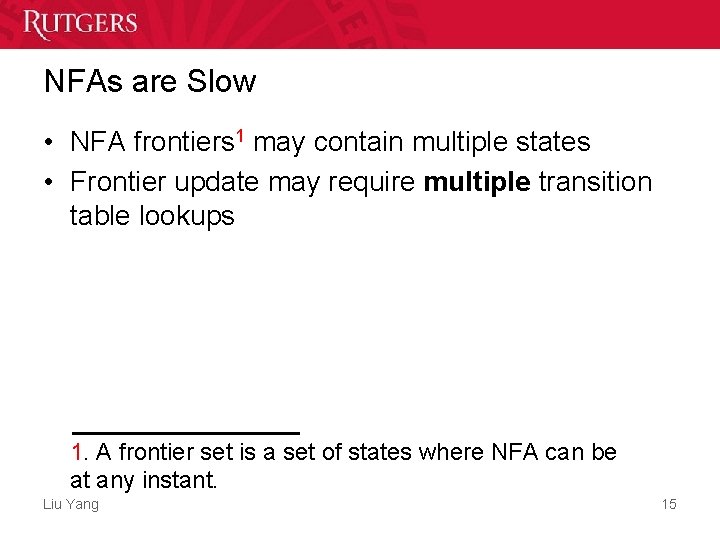
NFAs are Slow • NFA frontiers 1 may contain multiple states • Frontier update may require multiple transition table lookups 1. A frontier set is a set of states where NFA can be at any instant. Liu Yang 15
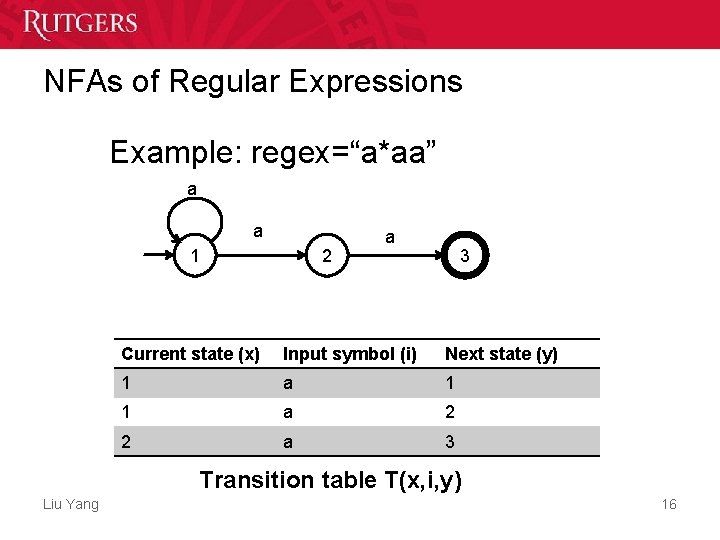
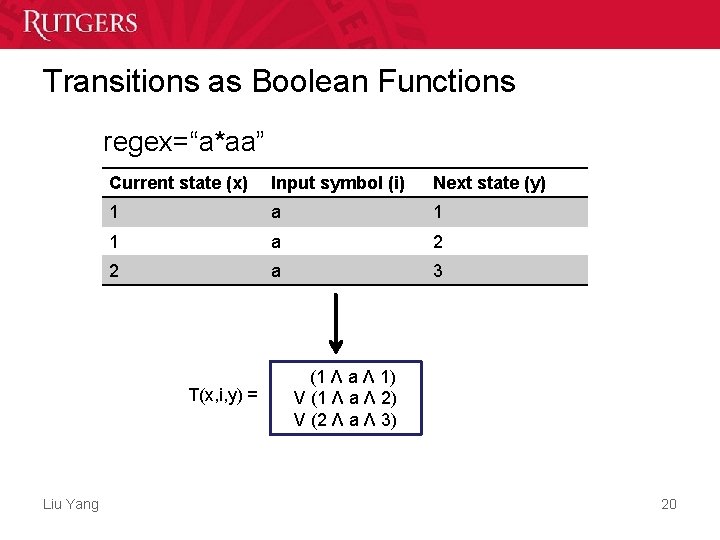
NFAs of Regular Expressions Example: regex=“a*aa” a a 1 2 a 3 Current state (x) Input symbol (i) Next state (y) 1 a 1 1 a 2 2 a 3 Transition table T(x, i, y) Liu Yang 16
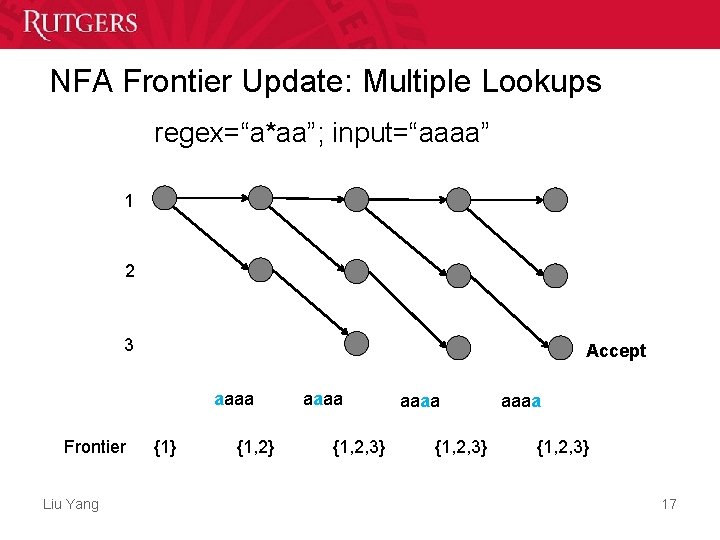
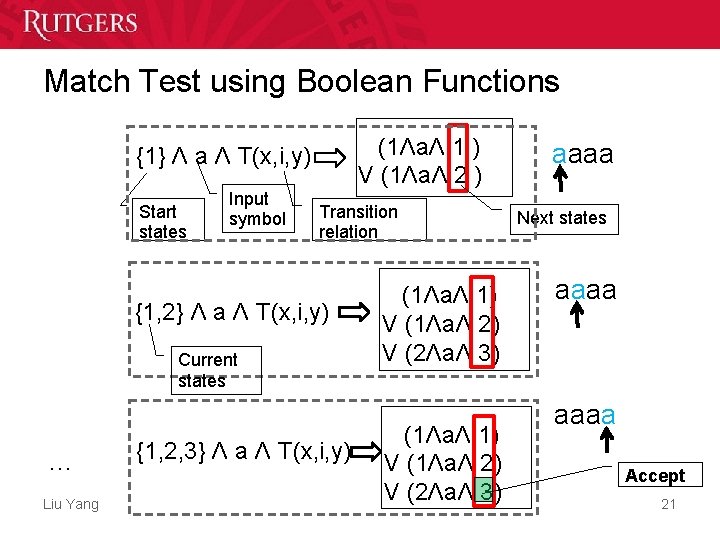
NFA Frontier Update: Multiple Lookups regex=“a*aa”; input=“aaaa” 1 2 3 Accept aaaa Frontier Liu Yang {1} {1, 2} aaaa {1, 2, 3} 17
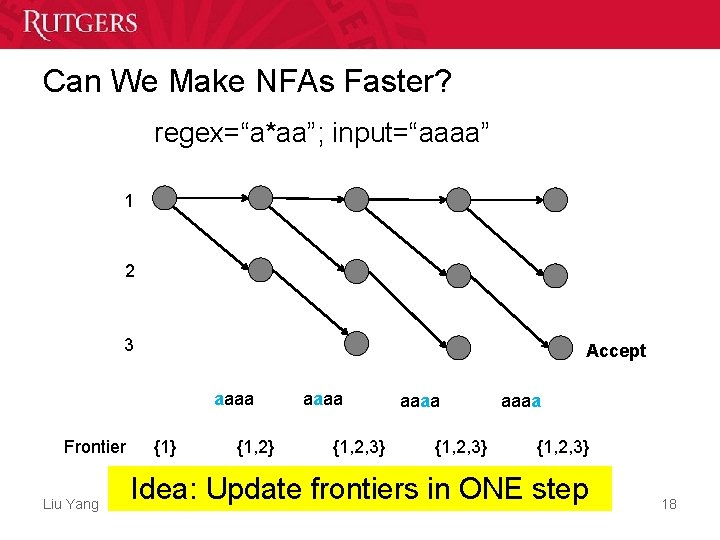
Can We Make NFAs Faster? regex=“a*aa”; input=“aaaa” 1 2 3 Accept aaaa Frontier Liu Yang {1} {1, 2} aaaa {1, 2, 3} Idea: Update frontiers in ONE step 18
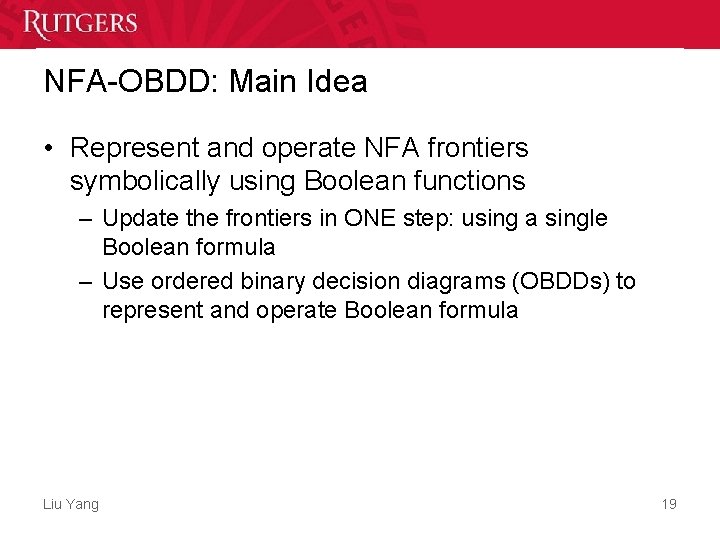
NFA-OBDD: Main Idea • Represent and operate NFA frontiers symbolically using Boolean functions – Update the frontiers in ONE step: using a single Boolean formula – Use ordered binary decision diagrams (OBDDs) to represent and operate Boolean formula Liu Yang 19
Transitions as Boolean Functions regex=“a*aa” Current state (x) Input symbol (i) Next state (y) 1 a 1 1 a 2 2 a 3 T(x, i, y) = Liu Yang (1 Λ a Λ 1) V (1 Λ a Λ 2) V (2 Λ a Λ 3) 20
Match Test using Boolean Functions (1ΛaΛ 1 ) V (1ΛaΛ 2 ) {1} Λ a Λ T(x, i, y) Start states Input symbol Transition relation {1, 2} Λ a Λ T(x, i, y) Current states … Liu Yang {1, 2, 3} Λ a Λ T(x, i, y) (1ΛaΛ 1) V (1ΛaΛ 2) V (2ΛaΛ 3) aaaa Next states aaaa Accept 21
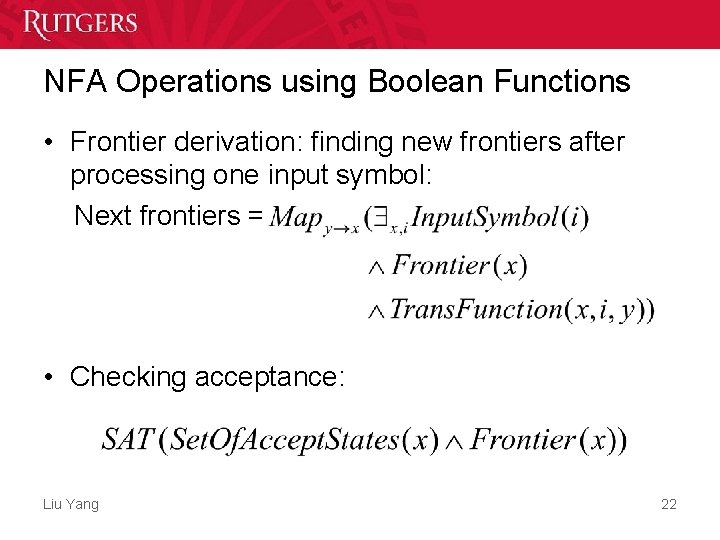
NFA Operations using Boolean Functions • Frontier derivation: finding new frontiers after processing one input symbol: Next frontiers = • Checking acceptance: Liu Yang 22
Ordered Binary Decision Diagram (OBDD) [Bryant 1986] OBDDs: Compact representation of Boolean functions x 1 x 2 x 3 x 4 x 5 x 6 F(x) 0 1 1 1 0 0 1 1 1 0 1 Liu Yang 23
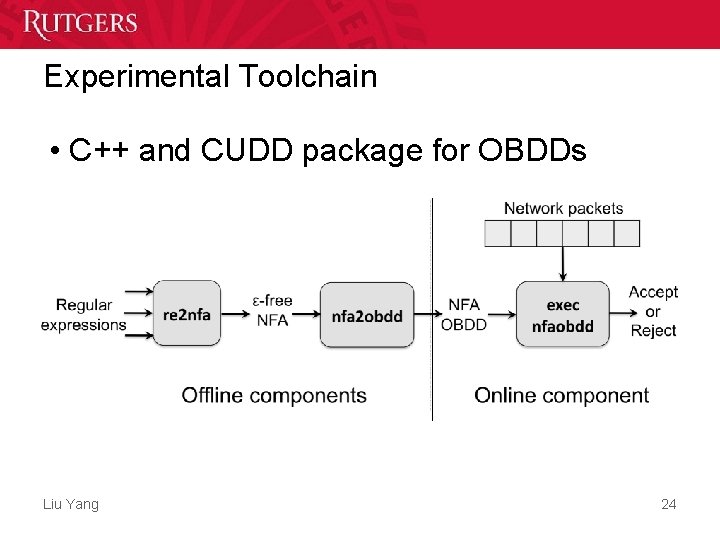
Experimental Toolchain • C++ and CUDD package for OBDDs Liu Yang 24
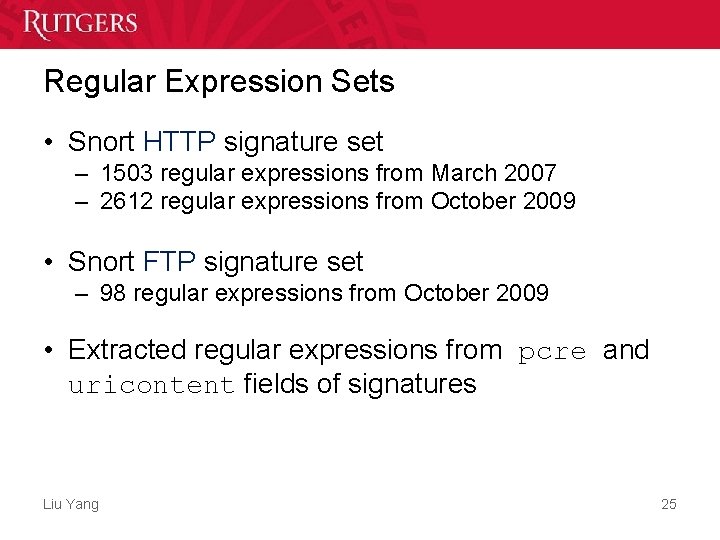
Regular Expression Sets • Snort HTTP signature set – 1503 regular expressions from March 2007 – 2612 regular expressions from October 2009 • Snort FTP signature set – 98 regular expressions from October 2009 • Extracted regular expressions from pcre and uricontent fields of signatures Liu Yang 25
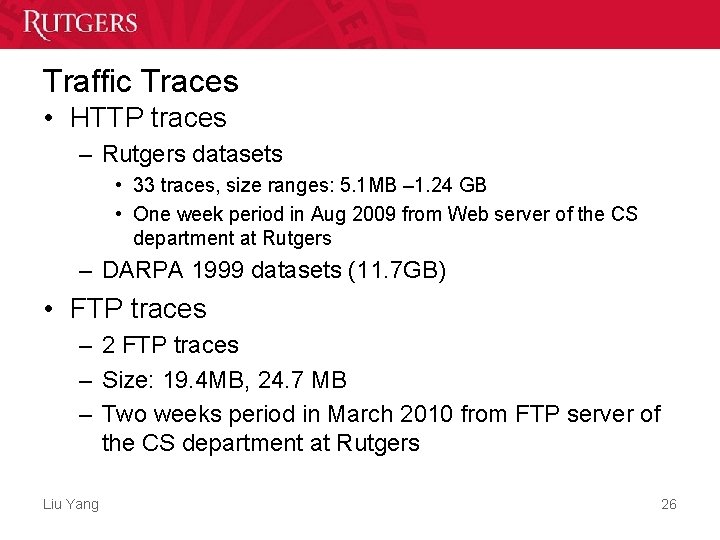
Traffic Traces • HTTP traces – Rutgers datasets • 33 traces, size ranges: 5. 1 MB – 1. 24 GB • One week period in Aug 2009 from Web server of the CS department at Rutgers – DARPA 1999 datasets (11. 7 GB) • FTP traces – 2 FTP traces – Size: 19. 4 MB, 24. 7 MB – Two weeks period in March 2010 from FTP server of the CS department at Rutgers Liu Yang 26
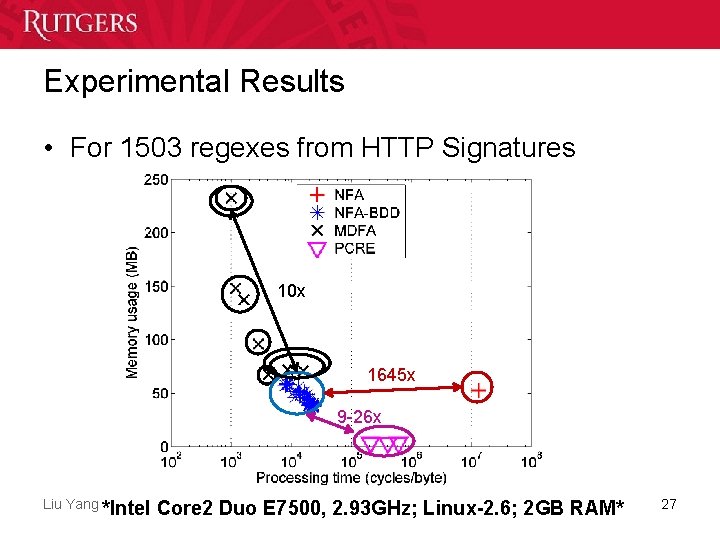
Experimental Results • For 1503 regexes from HTTP Signatures 10 x 1645 x 9 -26 x Liu Yang *Intel Core 2 Duo E 7500, 2. 93 GHz; Linux-2. 6; 2 GB RAM* 27
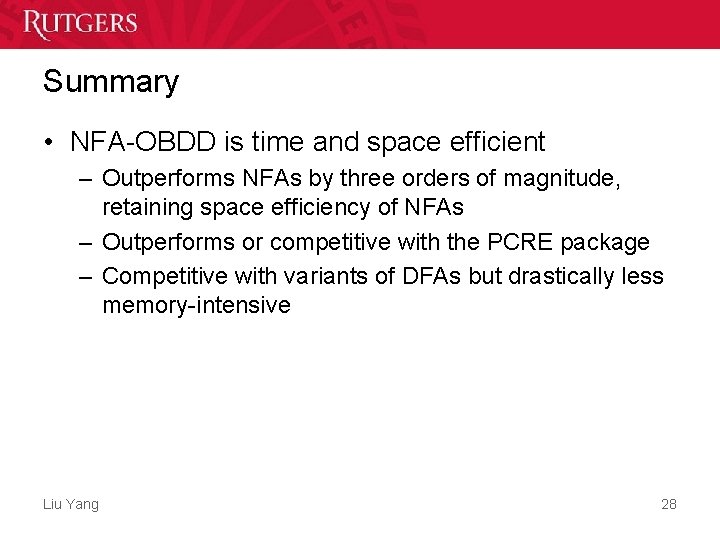
Summary • NFA-OBDD is time and space efficient – Outperforms NFAs by three orders of magnitude, retaining space efficiency of NFAs – Outperforms or competitive with the PCRE package – Competitive with variants of DFAs but drastically less memory-intensive Liu Yang 28
Part II: Extension of NFA-OBDD to Model Submatch Extraction [ANCS’ 12] Joint work with P. Manadhata, W. Horne, P. Rao, and V. Ganapathy Liu Yang 29
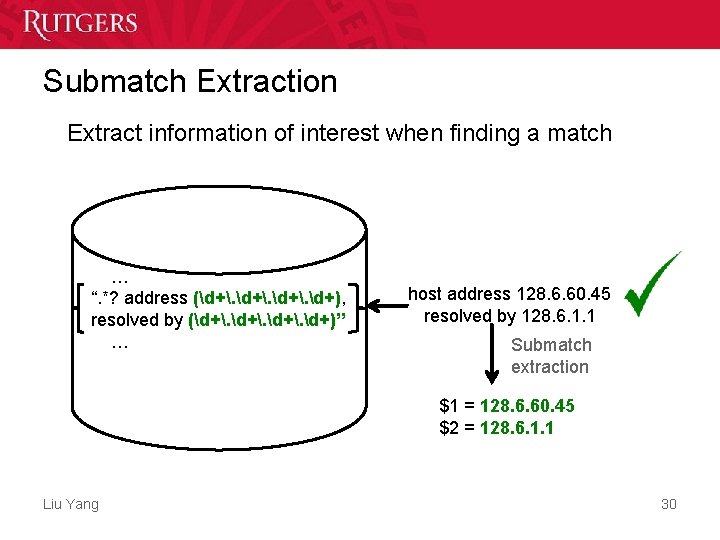
Submatch Extraction Extract information of interest when finding a match … “. *? address (d+. d+), resolved by (d+. d+)” … host address 128. 6. 60. 45 resolved by 128. 6. 1. 1 Submatch extraction $1 = 128. 6. 60. 45 $2 = 128. 6. 1. 1 Liu Yang 30
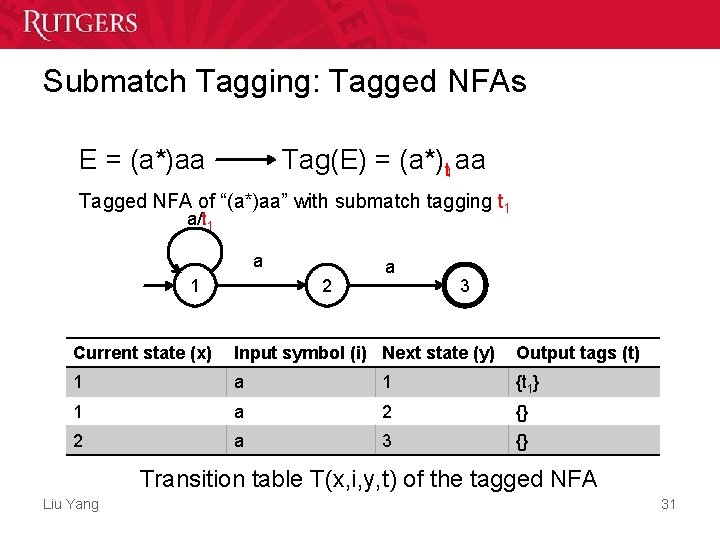
Submatch Tagging: Tagged NFAs E = (a*)aa Tag(E) = (a*)t 1 aa Tagged NFA of “(a*)aa” with submatch tagging t 1 a/t 1 a 1 2 a 3 Current state (x) Input symbol (i) Next state (y) Output tags (t) 1 a 1 {t 1} 1 a 2 {} 2 a 3 {} Transition table T(x, i, y, t) of the tagged NFA Liu Yang 31
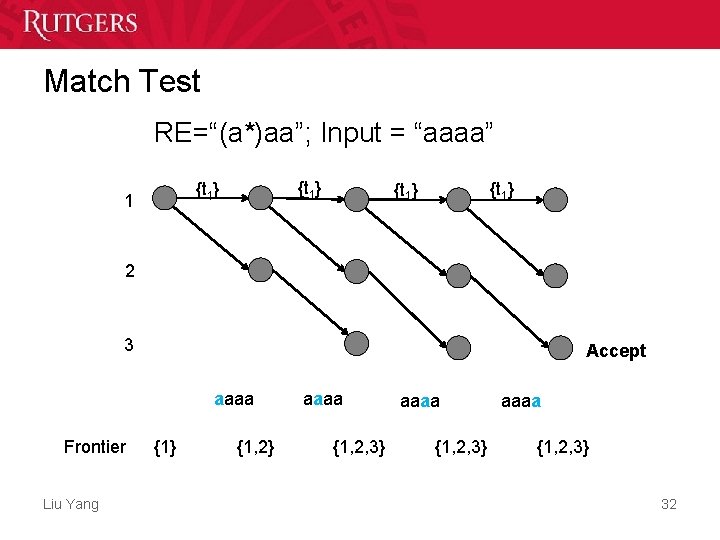
Match Test RE=“(a*)aa”; Input = “aaaa” {t 1} 1 {t 1} 2 3 Accept aaaa Frontier Liu Yang {1} {1, 2} aaaa {1, 2, 3} 32
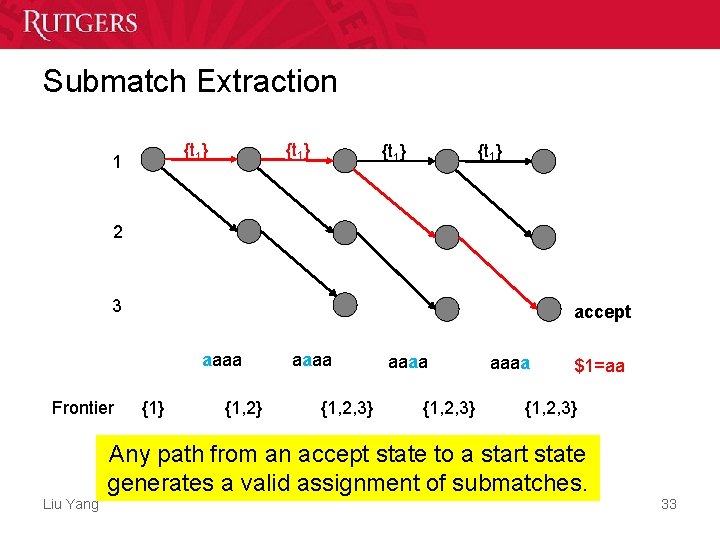
Submatch Extraction {t 1} 1 {t 1} 2 3 accept aaaa Frontier {1} {1, 2} aaaa {1, 2, 3} aaaa $1=aa {1, 2, 3} Any path from an accept state to a start state generates a valid assignment of submatches. Liu Yang 33
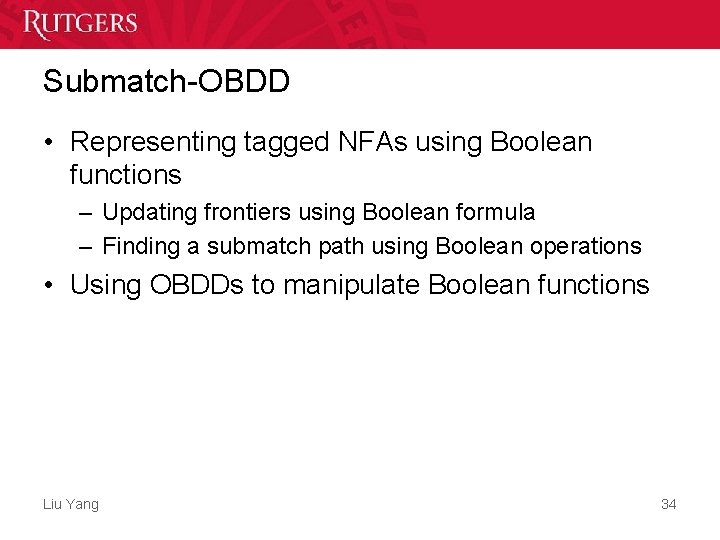
Submatch-OBDD • Representing tagged NFAs using Boolean functions – Updating frontiers using Boolean formula – Finding a submatch path using Boolean operations • Using OBDDs to manipulate Boolean functions Liu Yang 34
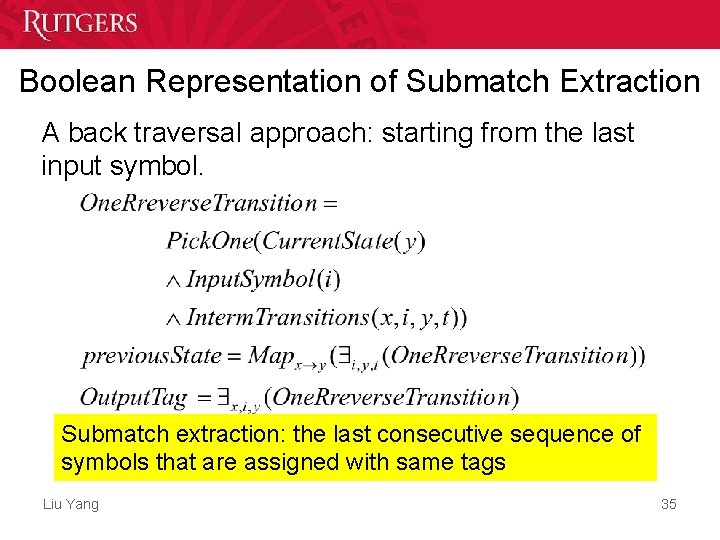
Boolean Representation of Submatch Extraction A back traversal approach: starting from the last input symbol. Submatch extraction: the last consecutive sequence of symbols that are assigned with same tags Liu Yang 35
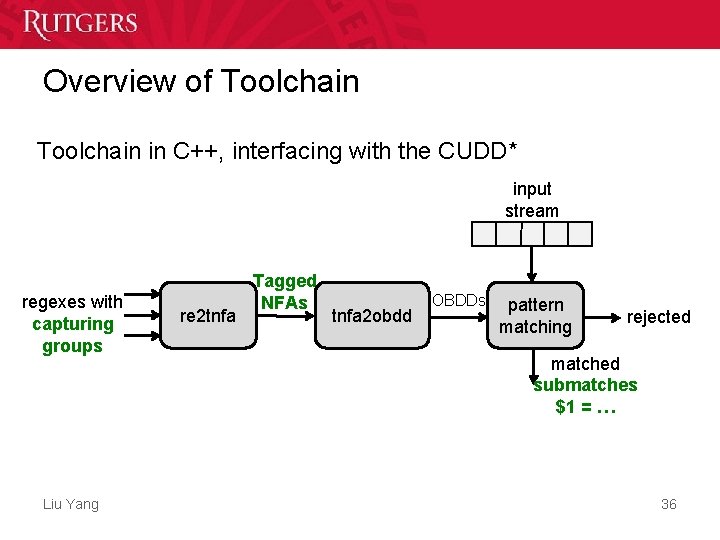
Overview of Toolchain in C++, interfacing with the CUDD* input stream regexes with capturing groups Liu Yang re 2 tnfa Tagged NFAs tnfa 2 obdd OBDDs pattern matching rejected matched submatches $1 = … 36
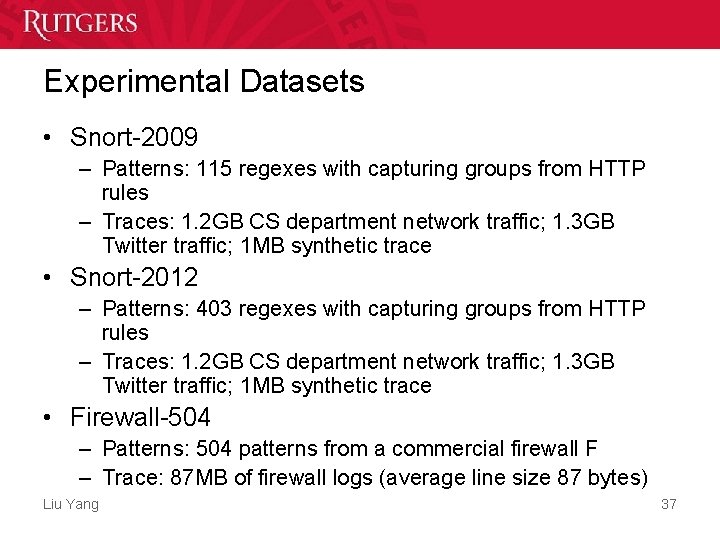
Experimental Datasets • Snort-2009 – Patterns: 115 regexes with capturing groups from HTTP rules – Traces: 1. 2 GB CS department network traffic; 1. 3 GB Twitter traffic; 1 MB synthetic trace • Snort-2012 – Patterns: 403 regexes with capturing groups from HTTP rules – Traces: 1. 2 GB CS department network traffic; 1. 3 GB Twitter traffic; 1 MB synthetic trace • Firewall-504 – Patterns: 504 patterns from a commercial firewall F – Trace: 87 MB of firewall logs (average line size 87 bytes) Liu Yang 37
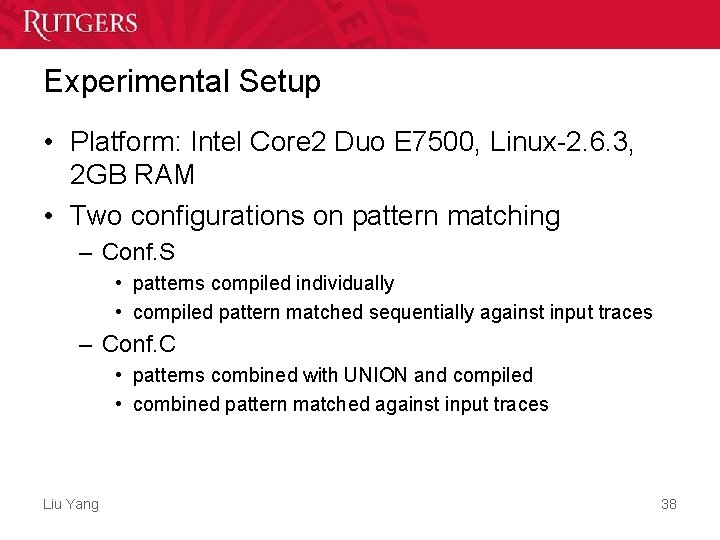
Experimental Setup • Platform: Intel Core 2 Duo E 7500, Linux-2. 6. 3, 2 GB RAM • Two configurations on pattern matching – Conf. S • patterns compiled individually • compiled pattern matched sequentially against input traces – Conf. C • patterns combined with UNION and compiled • combined pattern matched against input traces Liu Yang 38
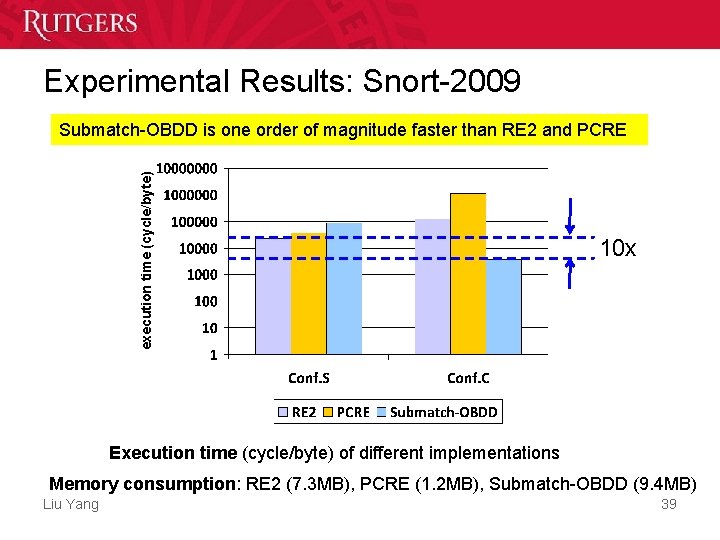
Experimental Results: Snort-2009 execution time (cycle/byte) Submatch-OBDD is one order of magnitude faster than RE 2 and PCRE 10 x Execution time (cycle/byte) of different implementations Memory consumption: RE 2 (7. 3 MB), PCRE (1. 2 MB), Submatch-OBDD (9. 4 MB) Liu Yang 39
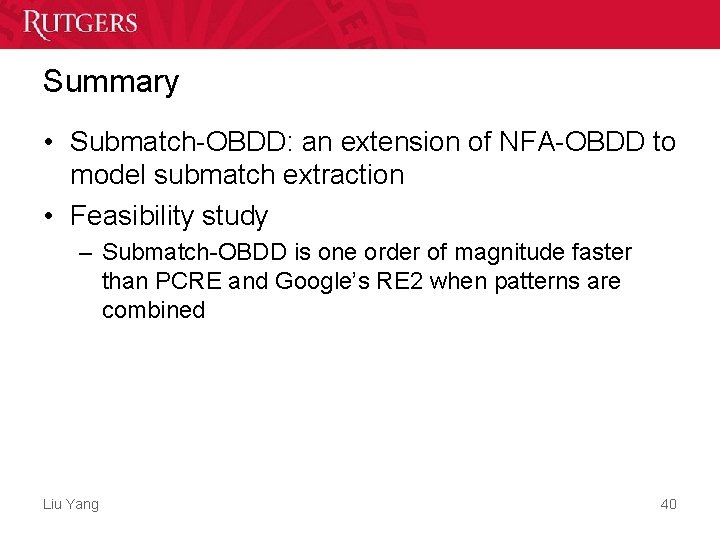
Summary • Submatch-OBDD: an extension of NFA-OBDD to model submatch extraction • Feasibility study – Submatch-OBDD is one order of magnitude faster than PCRE and Google’s RE 2 when patterns are combined Liu Yang 40
PART III: Efficient Matching of Patterns with Back References Joint work with V. Ganapathy and P. Manadhata Liu Yang 41
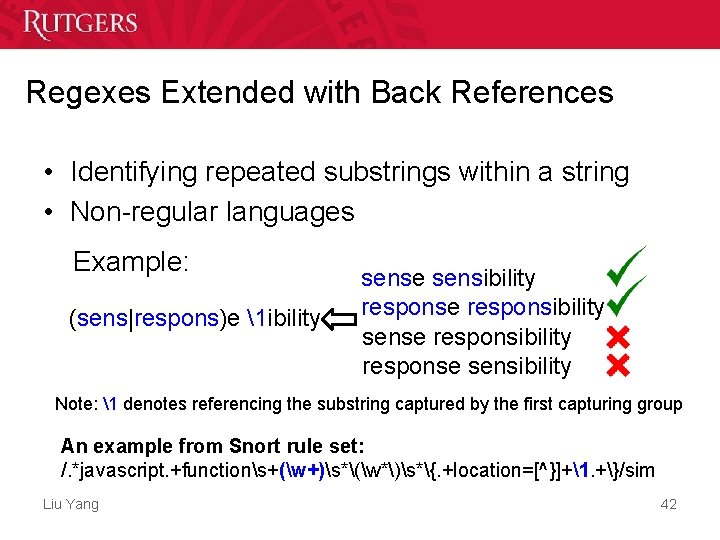
Regexes Extended with Back References • Identifying repeated substrings within a string • Non-regular languages Example: (sens|respons)e 1 ibility sense sensibility response responsibility sense responsibility response sensibility Note: 1 denotes referencing the substring captured by the first capturing group An example from Snort rule set: /. *javascript. +functions+(w+)s*(w*)s*{. +location=[^}]+1. +}/sim Liu Yang 42
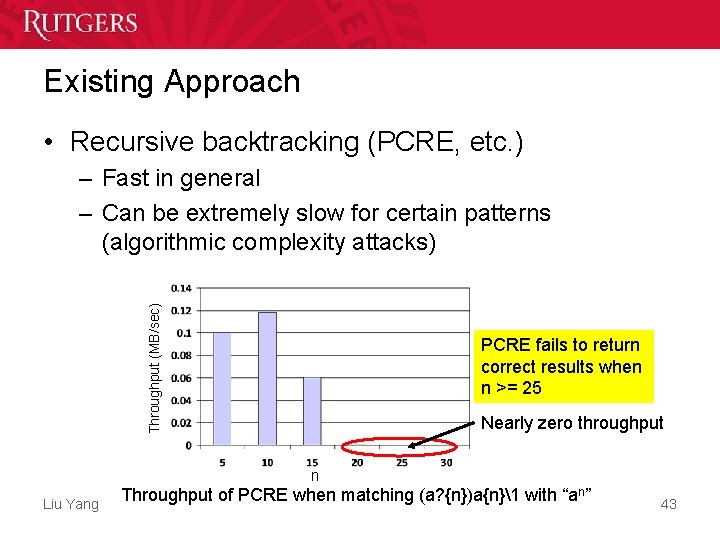
Existing Approach • Recursive backtracking (PCRE, etc. ) Throughput (MB/sec) – Fast in general – Can be extremely slow for certain patterns (algorithmic complexity attacks) PCRE fails to return correct results when n >= 25 Nearly zero throughput n Liu Yang Throughput of PCRE when matching (a? {n})a{n}1 with “an” 43
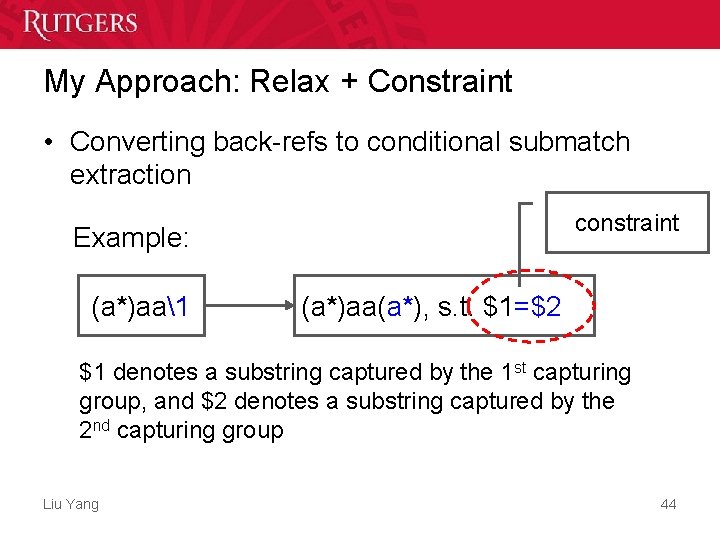
My Approach: Relax + Constraint • Converting back-refs to conditional submatch extraction constraint Example: (a*)aa1 (a*)aa(a*), s. t. $1=$2 $1 denotes a substring captured by the 1 st capturing group, and $2 denotes a substring captured by the 2 nd capturing group Liu Yang 44
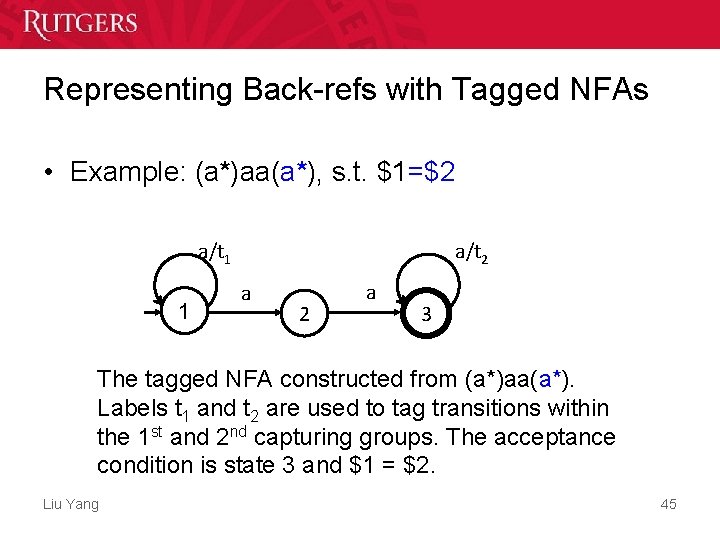
Representing Back-refs with Tagged NFAs • Example: (a*)aa(a*), s. t. $1=$2 a/t 1 1 a 2 a 3 The tagged NFA constructed from (a*)aa(a*). Labels t 1 and t 2 are used to tag transitions within the 1 st and 2 nd capturing groups. The acceptance condition is state 3 and $1 = $2. Liu Yang 45
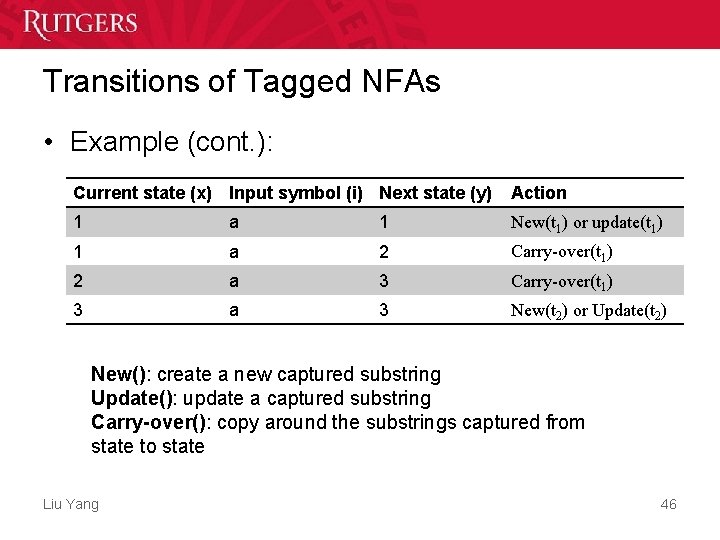
Transitions of Tagged NFAs • Example (cont. ): Current state (x) Input symbol (i) Next state (y) Action 1 a 1 New(t 1) or update(t 1) 1 a 2 Carry-over(t 1) 2 a 3 Carry-over(t 1) 3 a 3 New(t 2) or Update(t 2) New(): create a new captured substring Update(): update a captured substring Carry-over(): copy around the substrings captured from state to state Liu Yang 46
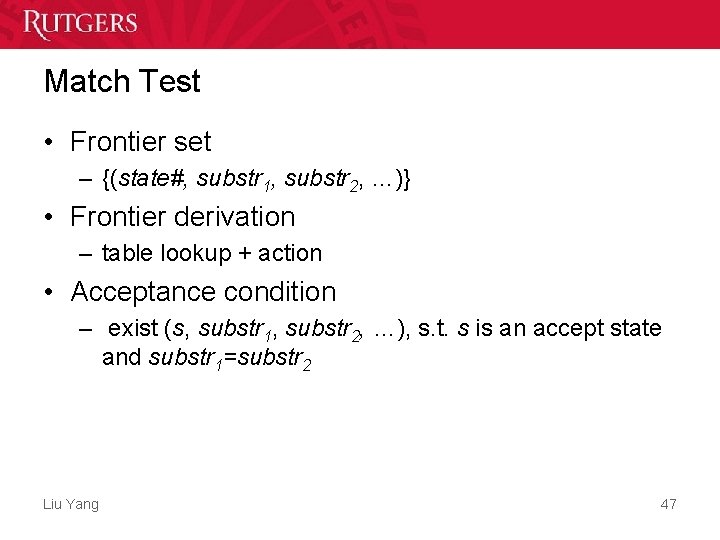
Match Test • Frontier set – {(state#, substr 1, substr 2, …)} • Frontier derivation – table lookup + action • Acceptance condition – exist (s, substr 1, substr 2, …), s. t. s is an accept state and substr 1=substr 2 Liu Yang 47
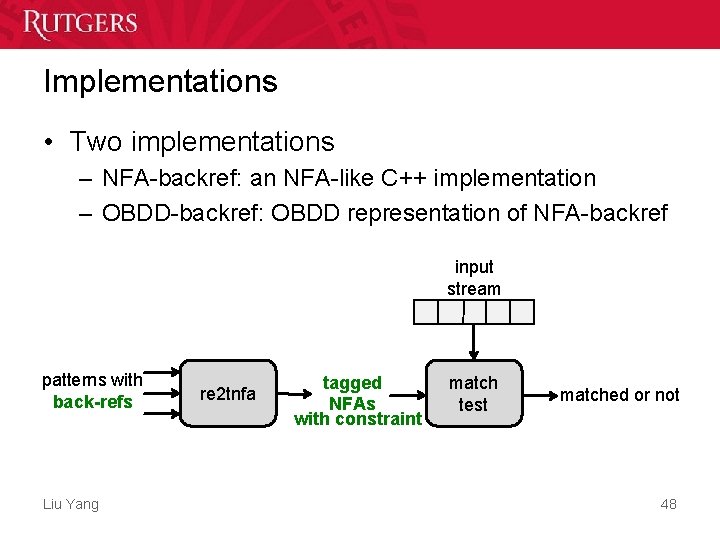
Implementations • Two implementations – NFA-backref: an NFA-like C++ implementation – OBDD-backref: OBDD representation of NFA-backref input stream patterns with back-refs Liu Yang re 2 tnfa tagged NFAs with constraint match test matched or not 48
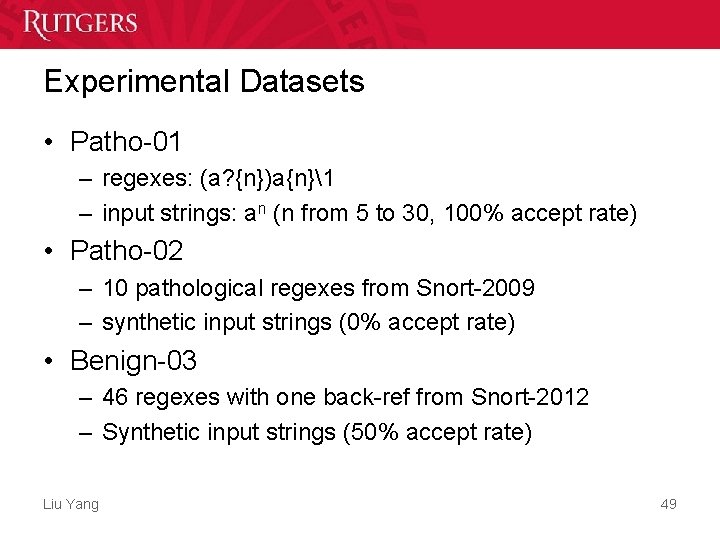
Experimental Datasets • Patho-01 – regexes: (a? {n})a{n}1 – input strings: an (n from 5 to 30, 100% accept rate) • Patho-02 – 10 pathological regexes from Snort-2009 – synthetic input strings (0% accept rate) • Benign-03 – 46 regexes with one back-ref from Snort-2012 – Synthetic input strings (50% accept rate) Liu Yang 49
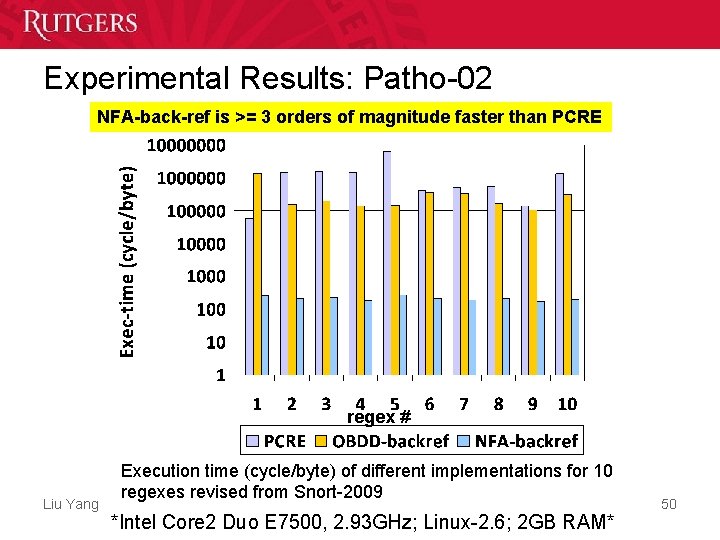
Experimental Results: Patho-02 NFA-back-ref is >= 3 orders of magnitude faster than PCRE regex # Liu Yang Execution time (cycle/byte) of different implementations for 10 regexes revised from Snort-2009 *Intel Core 2 Duo E 7500, 2. 93 GHz; Linux-2. 6; 2 GB RAM* 50
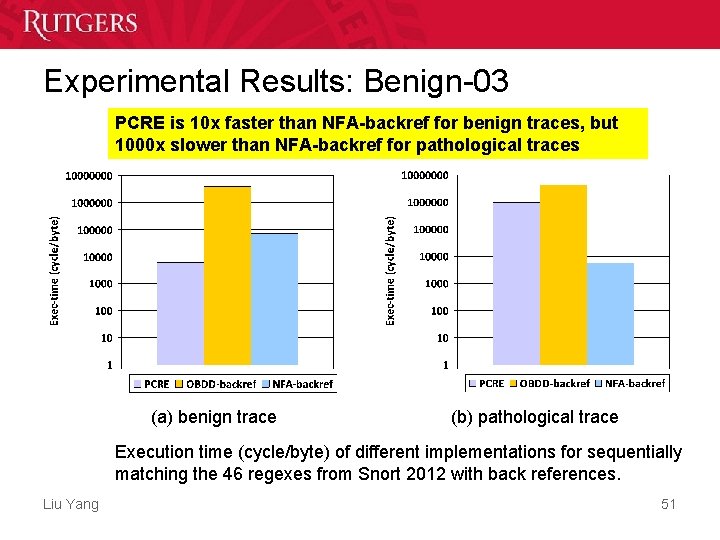
Experimental Results: Benign-03 PCRE is 10 x faster than NFA-backref for benign traces, but 1000 x slower than NFA-backref for pathological traces (a) benign trace (b) pathological trace Execution time (cycle/byte) of different implementations for sequentially matching the 46 regexes from Snort 2012 with back references. Liu Yang 51
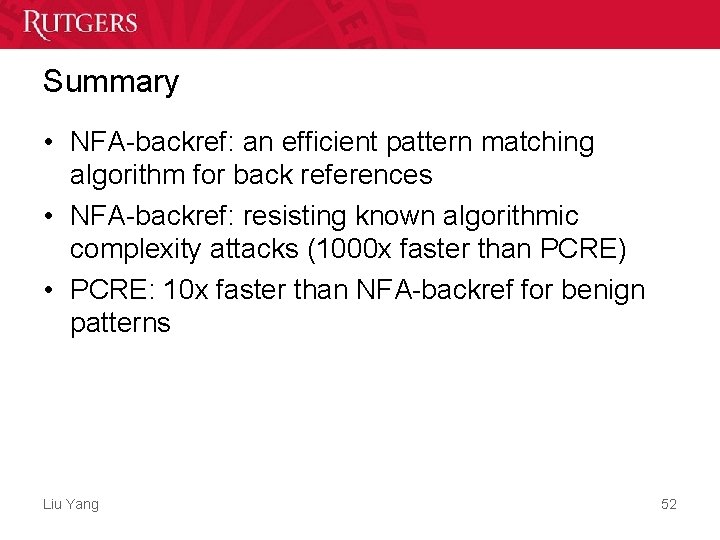
Summary • NFA-backref: an efficient pattern matching algorithm for back references • NFA-backref: resisting known algorithmic complexity attacks (1000 x faster than PCRE) • PCRE: 10 x faster than NFA-backref for benign patterns Liu Yang 52
Related Work • • • Multiple DFAs [Yu et al. , ANCS’ 06] XFAs [Smith et al. , Oakland’ 08, SIGCOMM’ 08] D 2 FA [Kumar et al. , SIGCOMM’ 06] Hybrid finite automata [Becchi et al. , ANCS’ 08] Multibyte speculative matching [Luchaup et al. , RAID’ 09] DFA-based Submatch extraction [Horne et al. , LATA’ 13] RE 2 [Cox, code. google. com/p/re 2] TNFA [Laurikari et al. , SPIRE’ 00] PCRE [www. pcre. org] Many more – see my papers for details Liu Yang 53
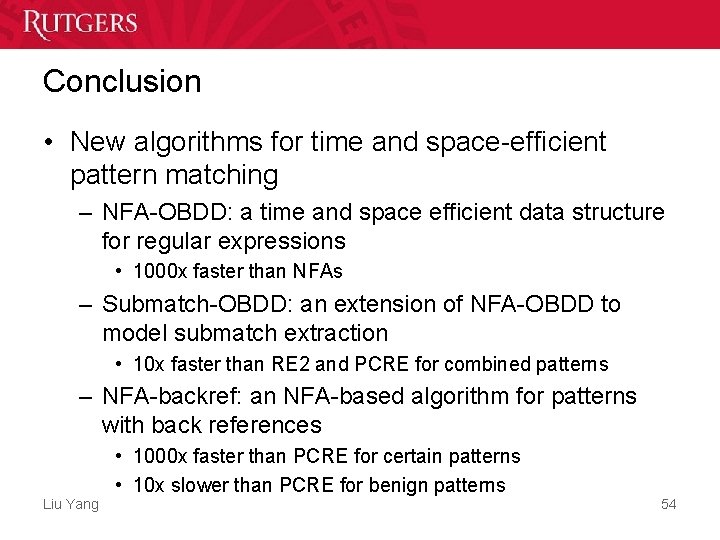
Conclusion • New algorithms for time and space-efficient pattern matching – NFA-OBDD: a time and space efficient data structure for regular expressions • 1000 x faster than NFAs – Submatch-OBDD: an extension of NFA-OBDD to model submatch extraction • 10 x faster than RE 2 and PCRE for combined patterns – NFA-backref: an NFA-based algorithm for patterns with back references • 1000 x faster than PCRE for certain patterns • 10 x slower than PCRE for benign patterns Liu Yang 54
Acknowledgment • Advisor: Prof. Vinod Ganapathy • Research directors: Prof. Vinod Ganapathy, Prof. Liviu Iftode • Thesis Committee: Prof. Vinod Ganapathy, Prof. Liviu Iftode, Prof. Badri Nath, and Dr. Abhinav Srivastava • Co-authors: Vinod Ganapathy, Liviu Iftode, Randy Smith, Rezwana Karim, Pratyusa Manadhata, William Horne, Prasad Rao, Nader Boushehrinejadmoradi, Pallab Roy, Markus Jakobsson, … • Colleagues: Mohan Dhawan, Shakeel Butt, Lu Han, Amruta Gokhale, Rezwana Karim, and Nader Boushehrinejadmoradi • My wife: Weiwei Tang Liu Yang 55
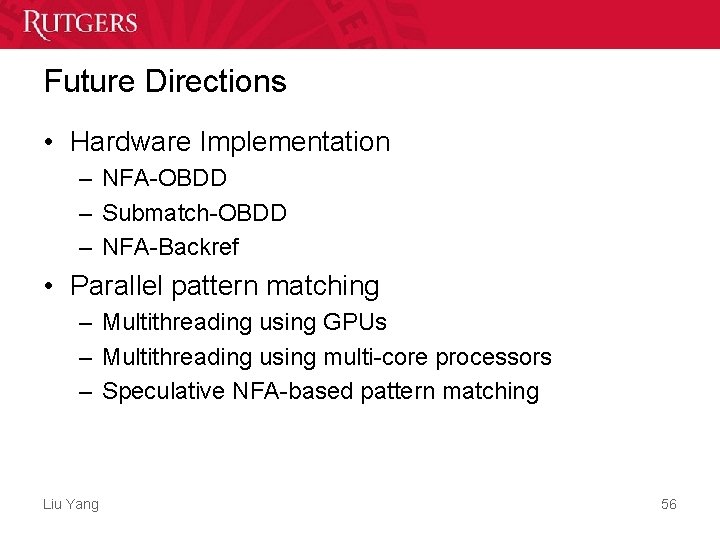
Future Directions • Hardware Implementation – NFA-OBDD – Submatch-OBDD – NFA-Backref • Parallel pattern matching – Multithreading using GPUs – Multithreading using multi-core processors – Speculative NFA-based pattern matching Liu Yang 56
Other Contributions • Enhancing Users’ Comprehension of Android Permissions [SPSM’ 12] • Enhancing Mobile Malware Detection with Social Collaboration [Socialcom’ 12] • Quantifying Security in Preference-based Authentication [DIM’ 08] • Love and Authentication [CHI’ 08] • Discount Anonymous On-demand Routing for Mobile Ad hoc Networks [Secure. Comm’ 06] Liu Yang 57