
New Pathways in Lipid Care Navigating the Latest

![ODYSSEY OUTCOMES vs FOURIER LLTs ODYSSEY OUTCOMES[a, b] (N = 18, 536) FOURIER[c] (N](https://slidetodoc.com/presentation_image_h/dcdf226b53d38b3306c7d19d0eb88aa4/image-4.jpg "ODYSSEY OUTCOMES vs FOURIER LLTs ODYSSEY OUTCOMES[a, b] (N = 18, 536) FOURIER[c] (N")
- Slides: 18
New Pathways in Lipid Care Navigating the Latest Guidelines Panelists James A. Underberg, MD, MS Clinical Assistant Professor of Medicine NYU School of Medicine & NYU Center for Prevention of Cardiovascular Disease President National Lipid Association Director Bellevue Hospital Lipid Clinic New York, New York Christie M. Ballantyne, MD Professor and Vice Chair of Research Department of Medicine Chief Sections of Cardiology and Cardiovascular Research Director Center for Cardiometabolic Prevention Baylor College of Medicine Houston, Texas
Treatment Gaps in Patients at High Risk for ASCVD and FH Despite statin evidence and ACC guidelines in 2013 advocating for statins, getting LDL-C to lower levels is proving to be a big challenge • FH patients don't start treatment until about 39 years of age • Many patients are on 1 or 2 drugs • Patients who are statin intolerant are not taking any statins
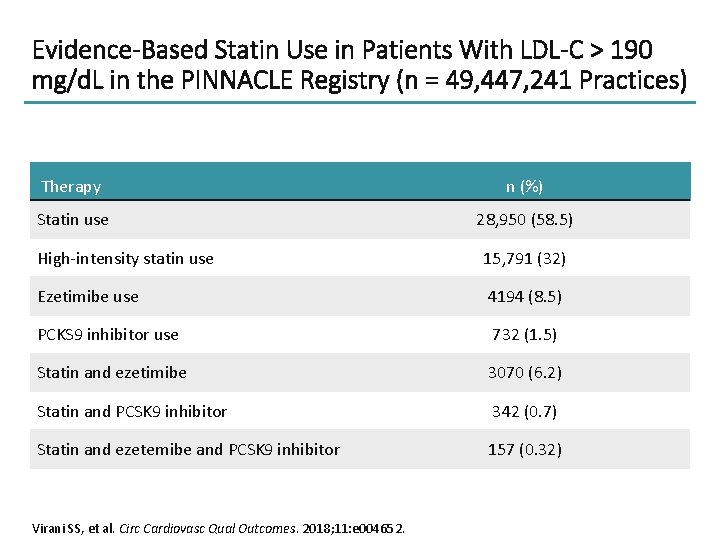
Evidence-Based Statin Use in Patients With LDL-C > 190 mg/d. L in the PINNACLE Registry (n = 49, 447, 241 Practices) Therapy n (%) Statin use 28, 950 (58. 5) High-intensity statin use 15, 791 (32) Ezetimibe use 4194 (8. 5) PCKS 9 inhibitor use 732 (1. 5) Statin and ezetimibe 3070 (6. 2) Statin and PCSK 9 inhibitor 342 (0. 7) Statin and ezetemibe and PCSK 9 inhibitor 157 (0. 32) Virani SS, et al. Circ Cardiovasc Qual Outcomes. 2018; 11: e 004652.
ODYSSEY OUTCOMES vs FOURIER LLTs ODYSSEY OUTCOMES[a, b] (N = 18, 536) FOURIER[c] (N = 27, 564) High-intensity stain, % 88. 9 69. 2 Moderate-/low-intensity statin, % 8. 5 30. 4 Ezetimibe, % 2. 9 5. 1 LLTs a. Schwartz GG. et al. Data presented at ACC 2018. b. Goodman SG, et al. ACC 2017. Abstract 1203 -307. c. Sabatine MS, et al. Am Heart J. 2016; 173: 94 -101.
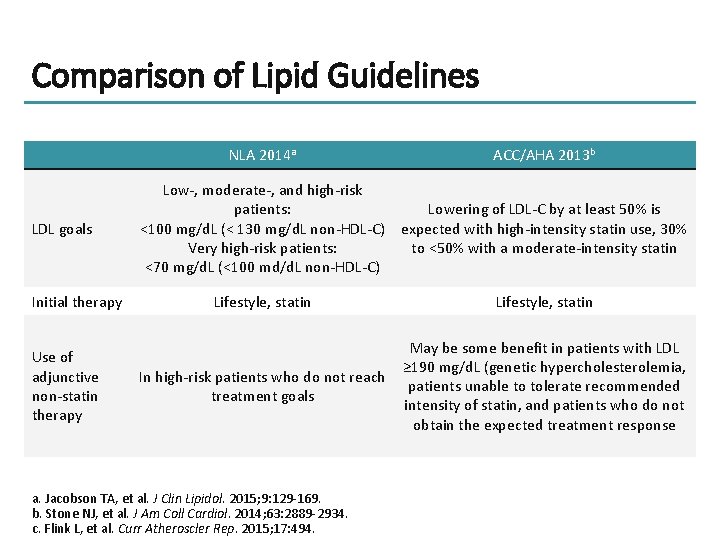
Comparison of Lipid Guidelines NLA 2014 a LDL goals Initial therapy Use of adjunctive non-statin therapy ACC/AHA 2013 b Low-, moderate-, and high-risk Lowering of LDL-C by at least 50% is patients: <100 mg/d. L (< 130 mg/d. L non-HDL-C) expected with high-intensity statin use, 30% Very high-risk patients: to <50% with a moderate-intensity statin <70 mg/d. L (<100 md/d. L non-HDL-C) Lifestyle, statin In high-risk patients who do not reach treatment goals May be some benefit in patients with LDL ≥ 190 mg/d. L (genetic hypercholesterolemia, patients unable to tolerate recommended intensity of statin, and patients who do not obtain the expected treatment response a. Jacobson TA, et al. J Clin Lipidol. 2015; 9: 129 -169. b. Stone NJ, et al. J Am Coll Cardiol. 2014; 63: 2889 -2934. c. Flink L, et al. Curr Atheroscler Rep. 2015; 17: 494.
Monitoring Therapeutic Response and Adherence to Statin Therapy ACC/AHA 2013 Lipid Guidelines Stone NJ, et al. J Am Coll Cardiol. 2014; 63: 2889 -2934.
Variability in LDL-C Reduction on High-Intensity Statin Insights From JUPITER Trial Figure No Longer Available Ridker PM, et al. Eur Heart J. 2016; 37: 1373 -1379.
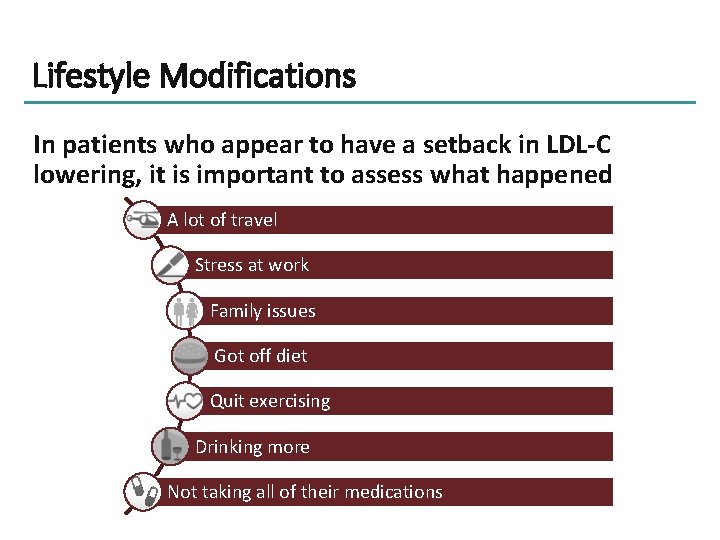
Lifestyle Modifications In patients who appear to have a setback in LDL-C lowering, it is important to assess what happened A lot of travel Stress at work Family issues Got off diet Quit exercising Drinking more Not taking all of their medications
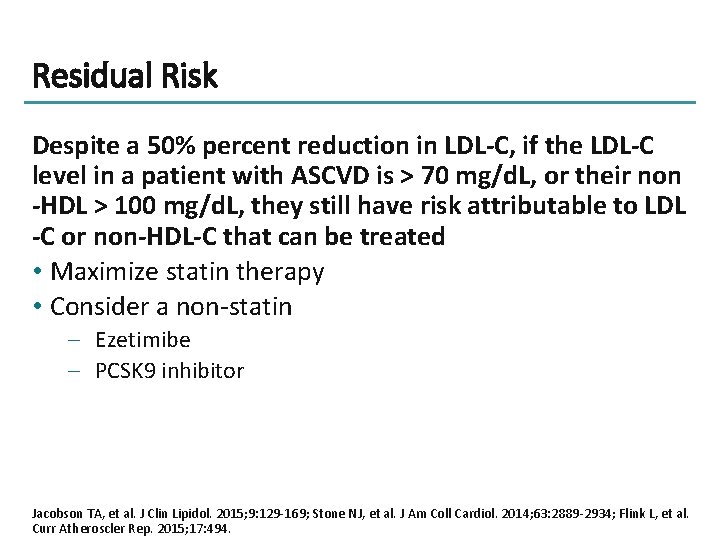
Residual Risk Despite a 50% percent reduction in LDL-C, if the LDL-C level in a patient with ASCVD is > 70 mg/d. L, or their non -HDL > 100 mg/d. L, they still have risk attributable to LDL -C or non-HDL-C that can be treated • Maximize statin therapy • Consider a non-statin – Ezetimibe – PCSK 9 inhibitor Jacobson TA, et al. J Clin Lipidol. 2015; 9: 129 -169; Stone NJ, et al. J Am Coll Cardiol. 2014; 63: 2889 -2934; Flink L, et al. Curr Atheroscler Rep. 2015; 17: 494.
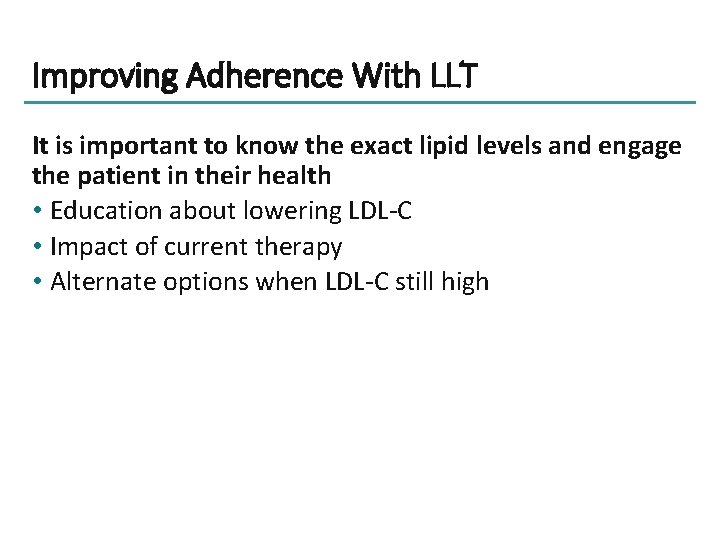
Improving Adherence With LLT It is important to know the exact lipid levels and engage the patient in their health • Education about lowering LDL-C • Impact of current therapy • Alternate options when LDL-C still high
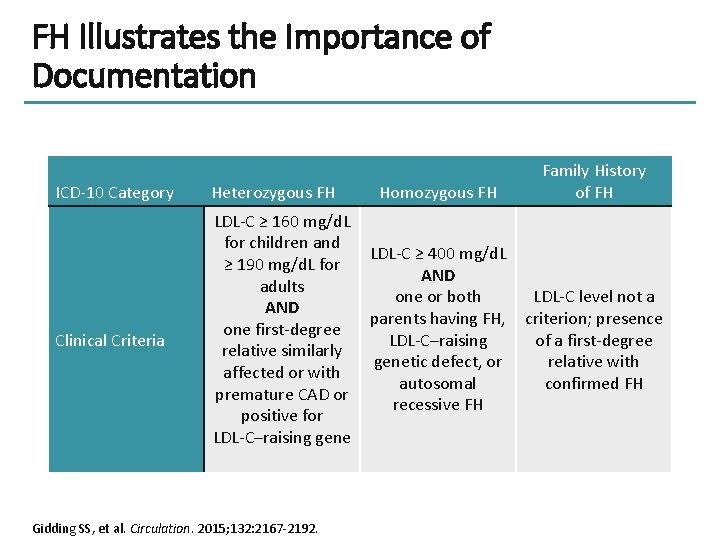
FH Illustrates the Importance of Documentation ICD-10 Category Clinical Criteria Heterozygous FH LDL-C ≥ 160 mg/d. L for children and ≥ 190 mg/d. L for adults AND one first-degree relative similarly affected or with premature CAD or positive for LDL-C–raising gene Gidding SS, et al. Circulation. 2015; 132: 2167 -2192. Homozygous FH LDL-C ≥ 400 mg/d. L AND one or both parents having FH, LDL-C–raising genetic defect, or autosomal recessive FH Family History of FH LDL-C level not a criterion; presence of a first-degree relative with confirmed FH
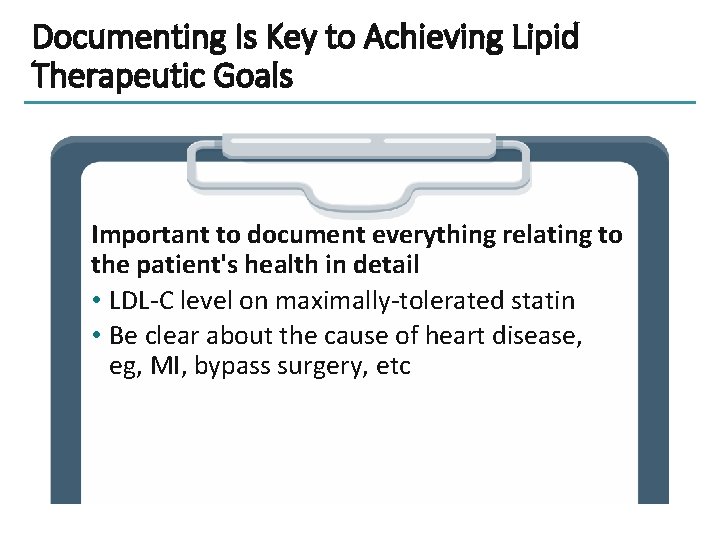
Documenting Is Key to Achieving Lipid Therapeutic Goals Important to document everything relating to the patient's health in detail • LDL-C level on maximally-tolerated statin • Be clear about the cause of heart disease, eg, MI, bypass surgery, etc
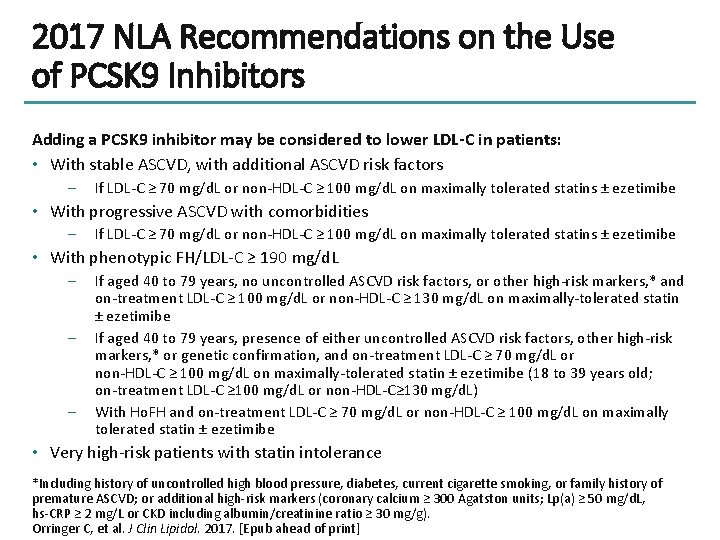
2017 NLA Recommendations on the Use of PCSK 9 Inhibitors Adding a PCSK 9 inhibitor may be considered to lower LDL-C in patients: • With stable ASCVD, with additional ASCVD risk factors – If LDL-C ≥ 70 mg/d. L or non-HDL-C ≥ 100 mg/d. L on maximally tolerated statins ± ezetimibe • With progressive ASCVD with comorbidities – If LDL-C ≥ 70 mg/d. L or non-HDL-C ≥ 100 mg/d. L on maximally tolerated statins ± ezetimibe • With phenotypic FH/LDL-C ≥ 190 mg/d. L – – – If aged 40 to 79 years, no uncontrolled ASCVD risk factors, or other high-risk markers, * and on-treatment LDL-C ≥ 100 mg/d. L or non-HDL-C ≥ 130 mg/d. L on maximally-tolerated statin ± ezetimibe If aged 40 to 79 years, presence of either uncontrolled ASCVD risk factors, other high-risk markers, * or genetic confirmation, and on-treatment LDL-C ≥ 70 mg/d. L or non-HDL-C ≥ 100 mg/d. L on maximally-tolerated statin ± ezetimibe (18 to 39 years old; on-treatment LDL-C ≥ 100 mg/d. L or non-HDL-C≥ 130 mg/d. L) With Ho. FH and on-treatment LDL-C ≥ 70 mg/d. L or non-HDL-C ≥ 100 mg/d. L on maximally tolerated statin ± ezetimibe • Very high-risk patients with statin intolerance *Including history of uncontrolled high blood pressure, diabetes, current cigarette smoking, or family history of premature ASCVD; or additional high-risk markers (coronary calcium ≥ 300 Agatston units; Lp(a) ≥ 50 mg/d. L, hs-CRP ≥ 2 mg/L or CKD including albumin/creatinine ratio ≥ 30 mg/g). Orringer C, et al. J Clin Lipidol. 2017. [Epub ahead of print]
2017 Updated ACC Consensus Document on Role of Non-Statin Therapies for LDL-C Lowering Figure No Longer Available Lloyd-Jones D, et al. J Am Coll Cardiol. 2017; 70: 1785 -1822.
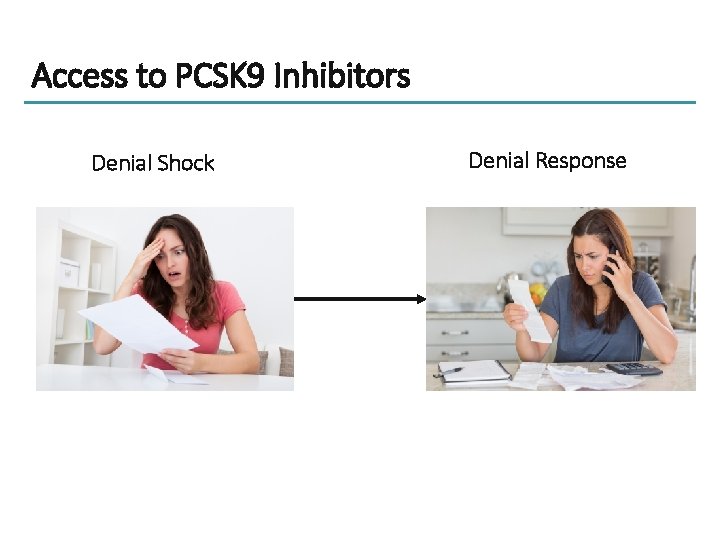
Access to PCSK 9 Inhibitors Denial Shock Denial Response
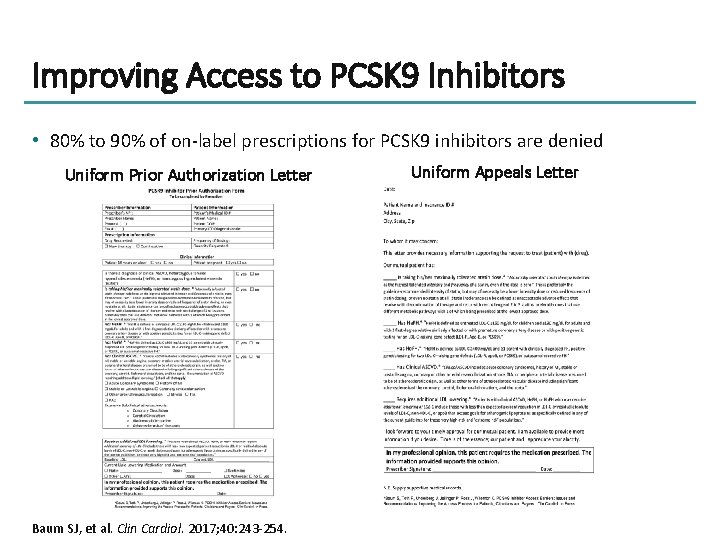
Improving Access to PCSK 9 Inhibitors • 80% to 90% of on-label prescriptions for PCSK 9 inhibitors are denied Uniform Prior Authorization Letter Baum SJ, et al. Clin Cardiol. 2017; 40: 243 -254. Uniform Appeals Letter
Concluding Remarks • Nonstatin therapies are available • The guidelines are all consistent in recommending non-statins after we have optimized statin therapy in high-risk patients • A unified guideline is currently in the works
Thank you for participating in this Thank you foractivity. participating in this activity. To proceed to the online CME/CE test, click on the Earn Credit link on this page.