
New paradigms in spincharge coupled physics in mutliband
New paradigms in spin-charge coupled physics in mutli-band systems JAIRO SINOVA Texas A&M University Institute of Physics ASCR Hitachi Cambridge Institute of Physics ASCR Joerg Wünderlich, A. Irvine, et al Tomas Jungwirth, Vít Novák, et al University of Würzburg University of Nottingham Laurens Molenkamp, E. Hankiewiecz, et al Bryan Gallagher, Richard Campion, et al. Freie Universitaet Berlin April 12 th, 2010 Research fueled by:
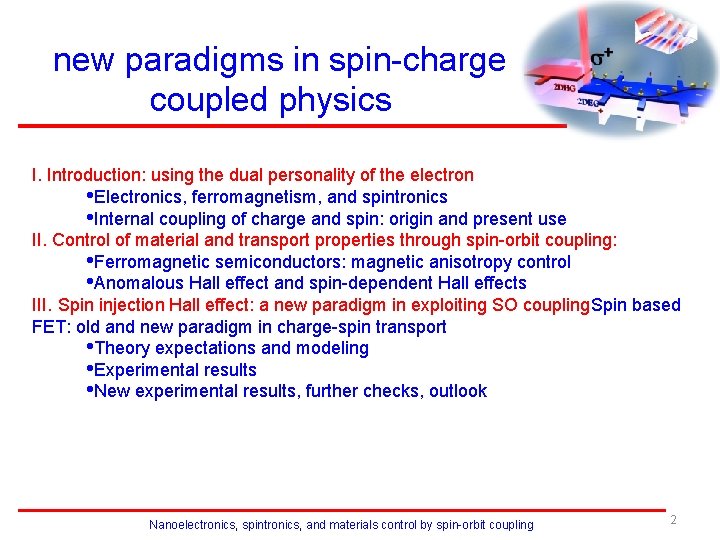
new paradigms in spin-charge coupled physics I. Introduction: using the dual personality of the electron • Electronics, ferromagnetism, and spintronics • Internal coupling of charge and spin: origin and present use II. Control of material and transport properties through spin-orbit coupling: • Ferromagnetic semiconductors: magnetic anisotropy control • Anomalous Hall effect and spin-dependent Hall effects III. Spin injection Hall effect: a new paradigm in exploiting SO coupling. Spin based FET: old and new paradigm in charge-spin transport • Theory expectations and modeling • Experimental results • New experimental results, further checks, outlook Nanoelectronics, spintronics, and materials control by spin-orbit coupling 2
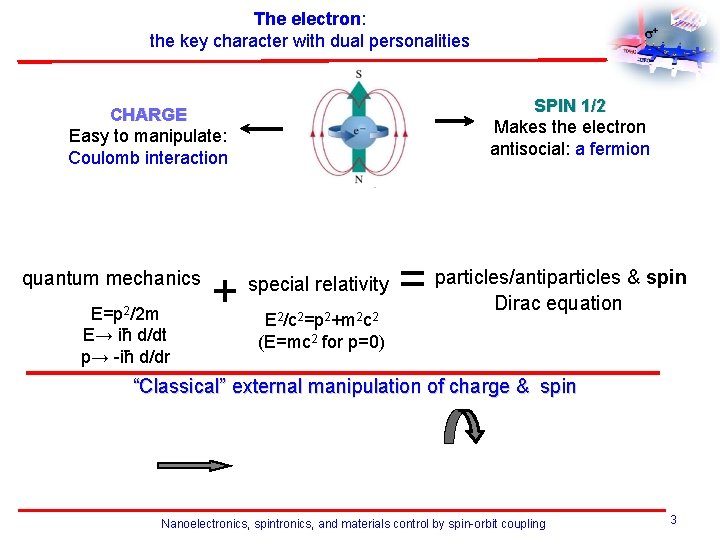
The electron: the key character with dual personalities SPIN 1/2 Makes the electron antisocial: a fermion CHARGE Easy to manipulate: Coulomb interaction quantum mechanics E=p 2/2 m E→ iħ d/dt p→ -iħ d/dr + special relativity E 2/c 2=p 2+m 2 c 2 (E=mc 2 for p=0) & spin = particles/antiparticles Dirac equation “Classical” external manipulation of charge & spin Nanoelectronics, spintronics, and materials control by spin-orbit coupling 3
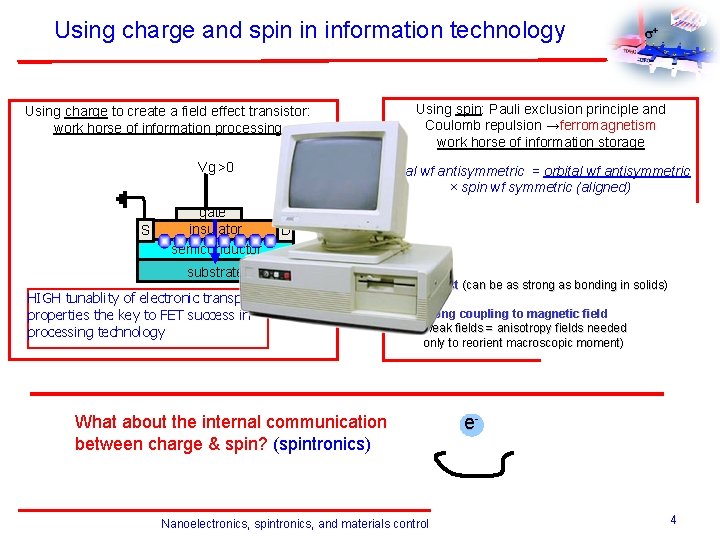
Using charge and spin in information technology Using charge to create a field effect transistor: work horse of information processing Vg >0 S gate insulator semiconductor Using spin: Pauli exclusion principle and Coulomb repulsion →ferromagnetism work horse of information storage total wf antisymmetric = orbital wf antisymmetric × spin wf symmetric (aligned) D substrate HIGH tunablity of electronic transport properties the key to FET success in processing technology What about the internal communication between charge & spin? (spintronics) • Robust (can be as strong as bonding in solids) • Strong coupling to magnetic field (weak fields = anisotropy fields needed only to reorient macroscopic moment) e- Nanoelectronics, spintronics, and materials control by spin-orbit coupling 4
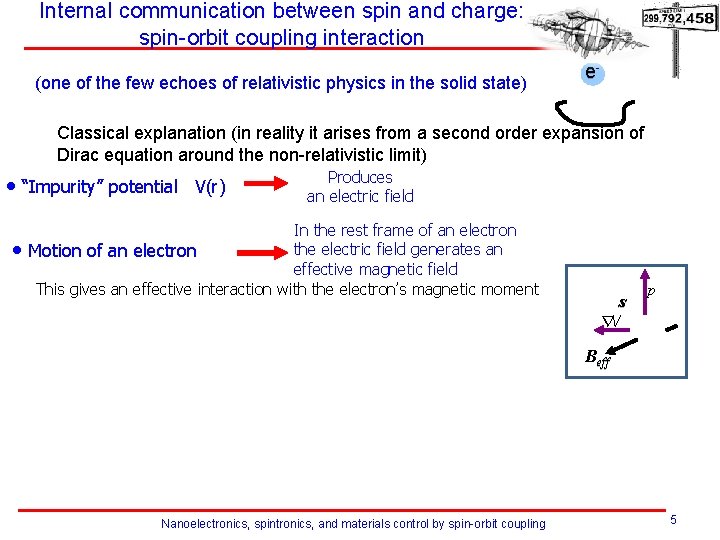
Internal communication between spin and charge: spin-orbit coupling interaction (one of the few echoes of relativistic physics in the solid state) e- Classical explanation (in reality it arises from a second order expansion of Dirac equation around the non-relativistic limit) • “Impurity” potential • V(r) Produces an electric field In the rest frame of an electron the electric field generates an Motion of an electron effective magnetic field This gives an effective interaction with the electron’s magnetic moment s p ∇V Beff Nanoelectronics, spintronics, and materials control by spin-orbit coupling 5
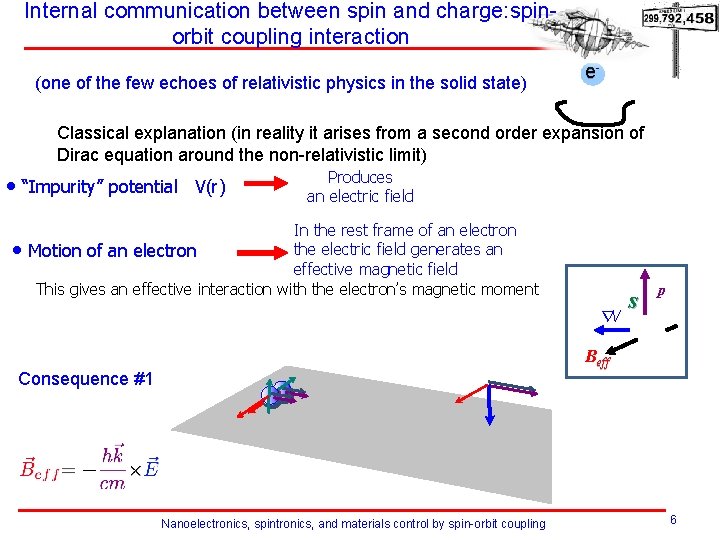
Internal communication between spin and charge: spinorbit coupling interaction (one of the few echoes of relativistic physics in the solid state) e- Classical explanation (in reality it arises from a second order expansion of Dirac equation around the non-relativistic limit) • “Impurity” potential • V(r) Produces an electric field In the rest frame of an electron the electric field generates an Motion of an electron effective magnetic field This gives an effective interaction with the electron’s magnetic moment ∇V s p Beff Consequence #1 Nanoelectronics, spintronics, and materials control by spin-orbit coupling 6
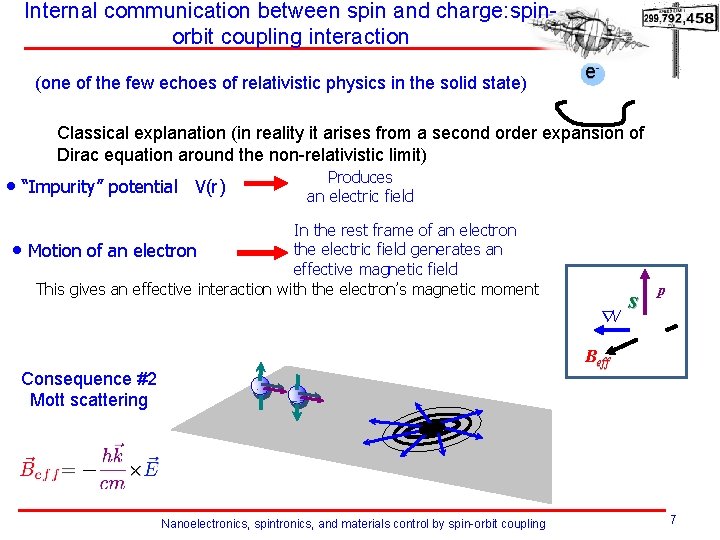
Internal communication between spin and charge: spinorbit coupling interaction (one of the few echoes of relativistic physics in the solid state) e- Classical explanation (in reality it arises from a second order expansion of Dirac equation around the non-relativistic limit) • “Impurity” potential • V(r) Produces an electric field In the rest frame of an electron the electric field generates an Motion of an electron effective magnetic field This gives an effective interaction with the electron’s magnetic moment ∇V s p Beff Consequence #2 Mott scattering Nanoelectronics, spintronics, and materials control by spin-orbit coupling 7
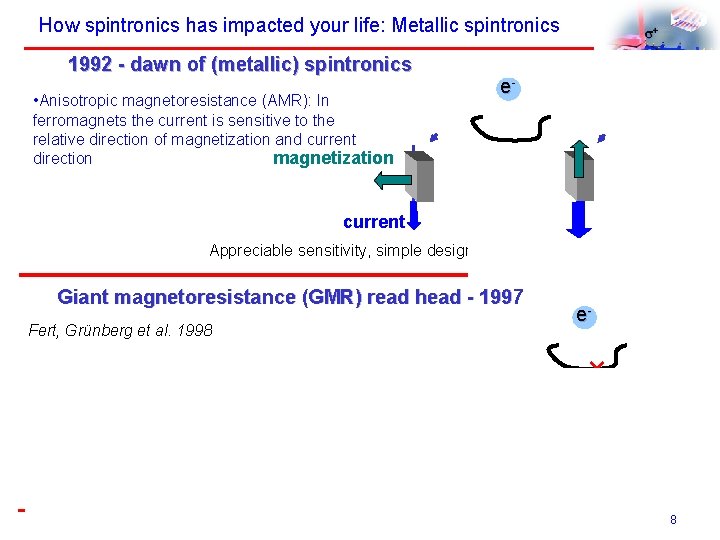
How spintronics has impacted your life: Metallic spintronics 1992 - dawn of (metallic) spintronics • Anisotropic magnetoresistance (AMR): In ferromagnets the current is sensitive to the relative direction of magnetization and current direction magnetization e- current Appreciable sensitivity, simple design, cheap BUT only a 2 -8 % effect Giant magnetoresistance (GMR) read head - 1997 Fert, Grünberg et al. 1998 e- × Nobel Price 2007 Fert and Grünberg High sensitivity, very large effect 30 -100% ↑↑ and ↑↓ are almost on and off states: “ 1” and “ 0” & magnetic → memory bit Nanoelectronics, spintronics, and materials control by spin-orbit coupling 8
new paradigms in spin-charge coupled physics I. Introduction: using the dual personality of the electron • Electronics, ferromagnetism, and spintronics • Internal coupling of charge and spin: origin and present use II. Control of material and transport properties through spin-orbit coupling: • Ferromagnetic semiconductors: magnetic anisotropy control • Anomalous Hall effect and spin-dependent Hall effects III. Spin injection Hall effect: a new paradigm in exploiting SO coupling. Spin based FET: old and new paradigm in charge-spin transport • Theory expectations and modeling • Experimental results • New experimental results, further checks, outlook Nanoelectronics, spintronics, and materials control by spin-orbit coupling 9
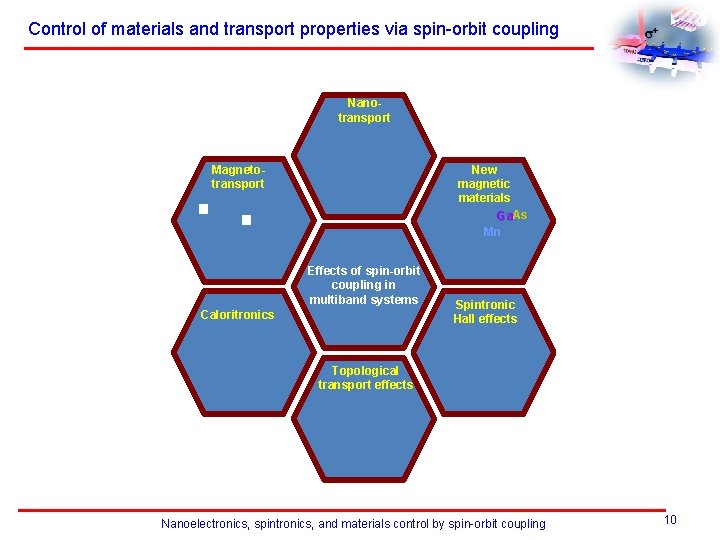
Control of materials and transport properties via spin-orbit coupling Nanotransport New magnetic materials Ga. As Mn Magnetotransport Effects of spin-orbit coupling in multiband systems Caloritronics Spintronic Hall effects Topological transport effects Nanoelectronics, spintronics, and materials control by spin-orbit coupling 10
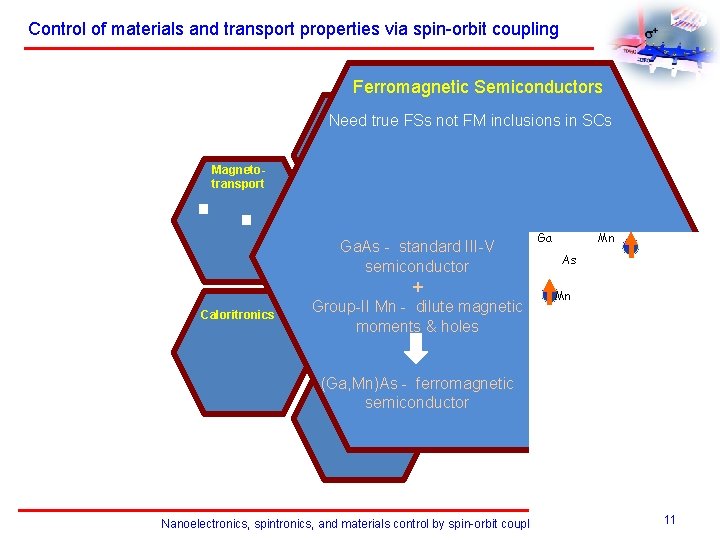
Control of materials and transport properties via spin-orbit coupling Ferromagnetic Semiconductors Nanotransport Need true FSs not FM inclusions in SCs Magnetotransport Ga. As - standard III-V Effects of semiconductor spin-orbit Ga coupling in + multiband systems Caloritronics dilute Spintronic magnetic Hall effects Group-II Mn moments & holes Mn As Mn Topological transport effects (Ga, Mn)As - ferromagnetic semiconductor Nanoelectronics, spintronics, and materials control by spin-orbit coupling 11
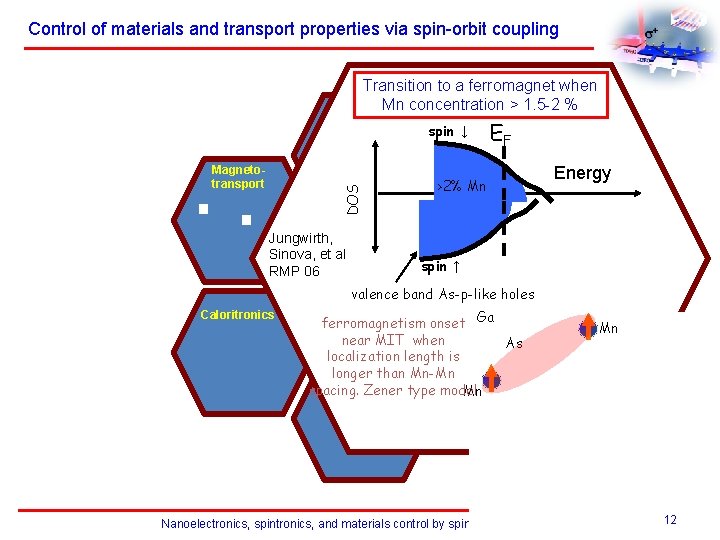
Control of materials and transport properties via spin-orbit coupling Transition to a ferromagnet when Nano- Mn concentration > 1. 5 -2 % transport DOS Magnetotransport spin ↓ EF New magnetic >2% Mn materials Ga. As Mn Energy Jungwirth, Sinova, et al Effects of spin-orbit spin ↑ RMP 06 Caloritronics coupling in valence band As-p-like holes multiband systems Spintronic Hall effects ferromagnetism onset Ga near MIT when localization length is Topological longer than Mn-Mn transport effects spacing. Zener type model Mn As Nanoelectronics, spintronics, and materials control by spin-orbit coupling Mn 12
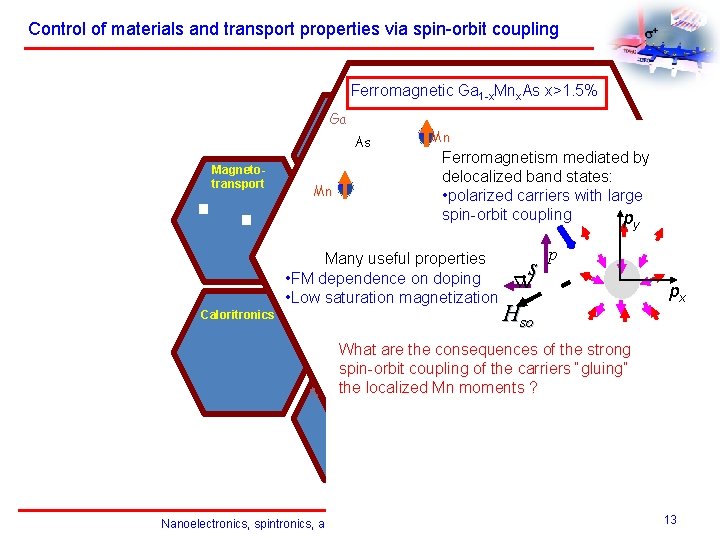
Control of materials and transport properties via spin-orbit coupling Transition to a. Ga ferromagnet when Ferromagnetic 1 -x. Mnx. As x>1. 5% Nano- Mn concentration increases transport Ga Magnetotransport Mn DOS As EF spin Mn ↓ Ferromagnetism mediated by New delocalized band states: magnetic >2% Mn • polarized materials carriers with large As Gacoupling spin-orbit p y Mn Many useful properties Caloritronics s Effects of spin-orbit spin ↑ • FM dependence ∇V coupling in on doping valence band As-p-like holes • Low saturation magnetization multiband systems Spintronic H p px Hall Ga effects so ferromagnetism onset Mn near MIT when As What arelength the consequences of the strong localization is spin-orbit Topological longer than coupling Mn-Mn of the carriers “gluing” transport effects the Zener localized moments ? spacing. type. Mn model Mn Nanoelectronics, spintronics, and materials control by spin-orbit coupling 13
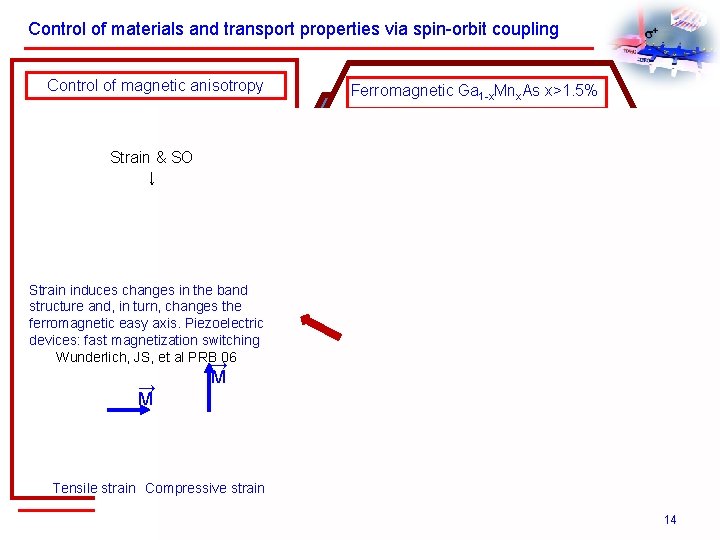
Control of materials and transport properties via spin-orbit coupling Control of magnetic anisotropy Ferromagnetic Ga 1 -x. Mnx. As x>1. 5% Nanotransport Ga Strain & SO ↓ As Magnetotransport Mn Mn Ferromagnetism mediated by New delocalized band states: magnetic • polarized materials carriers with large As Gacoupling spin-orbit p y Mn Many useful properties Strain induces changes in the band structure and, in turn, changes the Caloritronics ferromagnetic easy axis. Piezoelectric devices: fast magnetization switching Wunderlich, JS, et al PRB 06 → M s Effects of of spin-orbit • FM dependence coupling in multiband ∇V coupling in on doping systems • Low saturation magnetization multiband systems Spintronic p H px Hall effects so What are the consequences of the strong spin-orbit coupling of the carriers “gluing” Topological transport effects the localized Mn moments ? Tensile strain Compressive strain Nanoelectronics, spintronics, and materials control by spin-orbit coupling 14
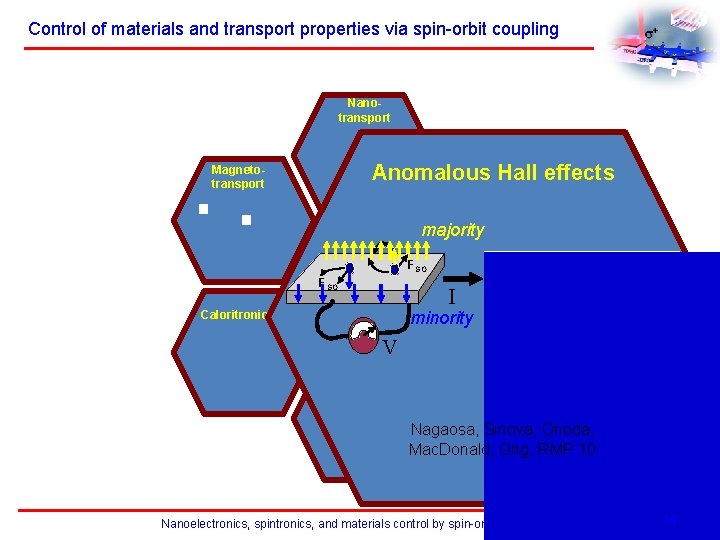
Control of materials and transport properties via spin-orbit coupling Nanotransport Magnetotransport New Anomalous Hall effects magnetic materials Ga. As majority. Mn FSO Effects of spin-orbit FSOcoupling in multiband systems ISpintronic Hall effects minority Caloritronics V Topological transport effects Nagaosa, Sinova, Onoda, Mac. Donald, Ong, RMP 10 Nanoelectronics, spintronics, and materials control by spin-orbit coupling 15
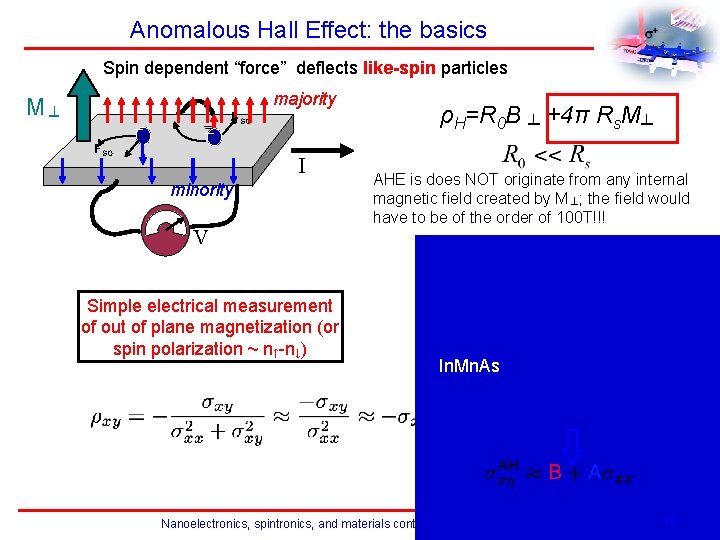
Anomalous Hall Effect: the basics Spin dependent “force” deflects like-spin particles M⊥ _ __ majority FSO I minority V Simple electrical measurement of out of plane magnetization (or spin polarization ~ n↑-n↓) ρH=R 0 B ┴ +4π Rs. M┴ AHE is does NOT originate from any internal magnetic field created by M⊥; the field would have to be of the order of 100 T!!! In. Mn. As Nanoelectronics, spintronics, and materials control by spin-orbit coupling 16
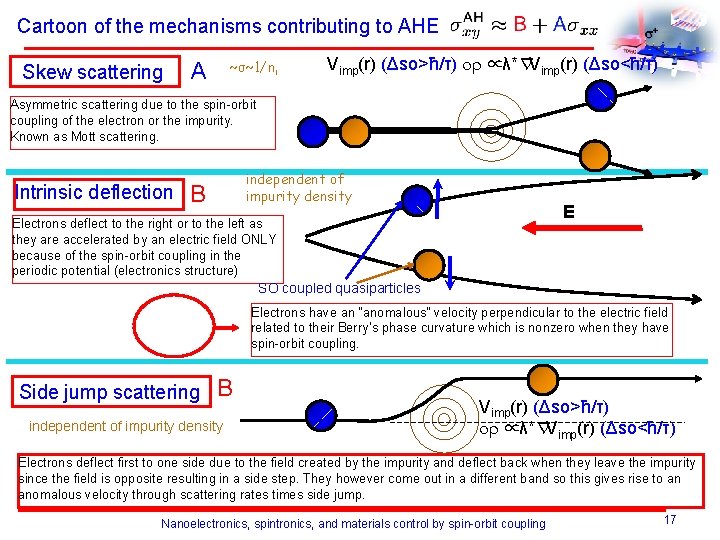
Cartoon of the mechanisms contributing to AHE Skew scattering ~σ~1/ni A Vimp(r) (Δso>ħ/τ) or ∝λ*∇Vimp(r) (Δso<ħ/τ) Asymmetric scattering due to the spin-orbit coupling of the electron or the impurity. Known as Mott scattering. Intrinsic deflection independent of impurity density B E Electrons deflect to the right or to the left as they are accelerated by an electric field ONLY because of the spin-orbit coupling in the periodic potential (electronics structure) SO coupled quasiparticles Electrons have an “anomalous” velocity perpendicular to the electric field related to their Berry’s phase curvature which is nonzero when they have spin-orbit coupling. Side jump scattering B independent of impurity density Vimp(r) (Δso>ħ/τ) or ∝λ*∇Vimp(r) (Δso<ħ/τ) Electrons deflect first to one side due to the field created by the impurity and deflect back when they leave the impurity since the field is opposite resulting in a side step. They however come out in a different band so this gives rise to an anomalous velocity through scattering rates times side jump. Nanoelectronics, spintronics, and materials control by spin-orbit coupling 17
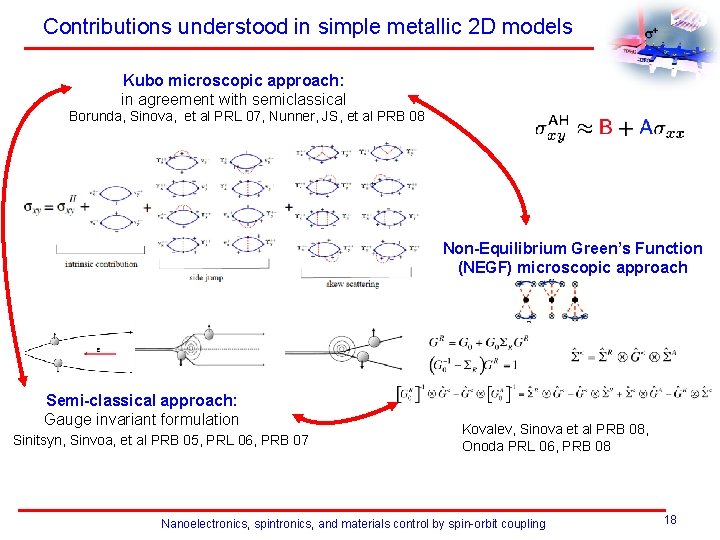
Contributions understood in simple metallic 2 D models Kubo microscopic approach: in agreement with semiclassical Borunda, Sinova, et al PRL 07, Nunner, JS, et al PRB 08 Non-Equilibrium Green’s Function (NEGF) microscopic approach Semi-classical approach: Gauge invariant formulation Sinitsyn, Sinvoa, et al PRB 05, PRL 06, PRB 07 Kovalev, Sinova et al PRB 08, Onoda PRL 06, PRB 08 Nanoelectronics, spintronics, and materials control by spin-orbit coupling 18
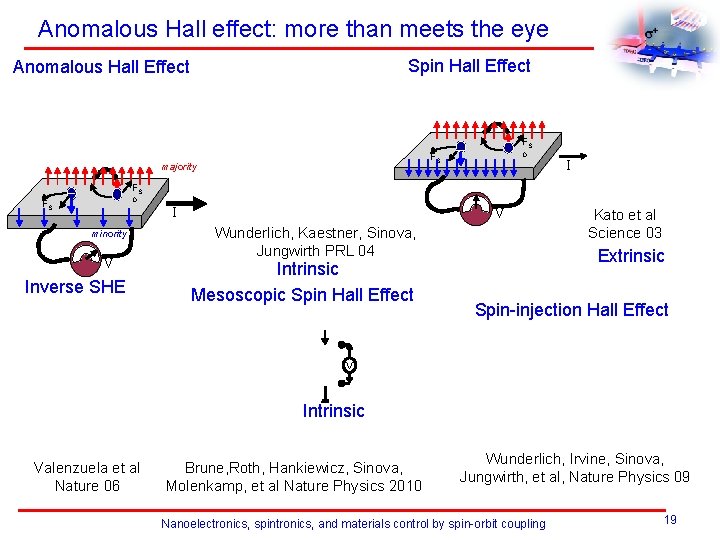
Anomalous Hall effect: more than meets the eye Spin Hall Effect Anomalous Hall Effect _ FS majority _ _ _ FS O O I FS O FS I O minority V Inverse SHE V Wunderlich, Kaestner, Sinova, Jungwirth PRL 04 Intrinsic Mesoscopic Spin Hall Effect Kato et al Science 03 Extrinsic Spin-injection Hall Effect V Intrinsic Valenzuela et al Nature 06 Brune, Roth, Hankiewicz, Sinova, Molenkamp, et al Nature Physics 2010 Wunderlich, Irvine, Sinova, Jungwirth, et al, Nature Physics 09 Nanoelectronics, spintronics, and materials control by spin-orbit coupling 19
new paradigms in spin-charge coupled physics I. Introduction: using the dual personality of the electron • Electronics, ferromagnetism, and spintronics • Internal coupling of charge and spin: origin and present use II. Control of material and transport properties through spin-orbit coupling: • Ferromagnetic semiconductors: magnetic anisotropy control • Anomalous Hall effect and spin-dependent Hall effects III. Spin injection Hall effect: a new paradigm in exploiting SO coupling. Spin based FET: old and new paradigm in charge-spin transport • Theory expectations and modeling • Experimental results • New experimental results, further checks, outlook Nanoelectronics, spintronics, and materials control by spin-orbit coupling 20
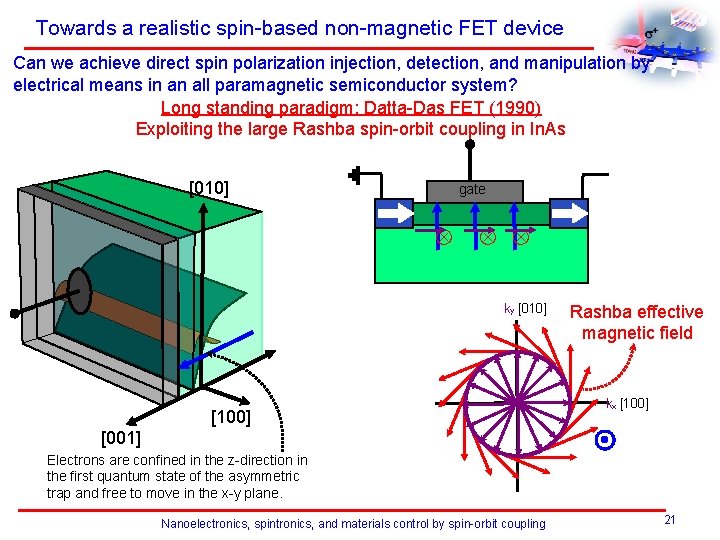
Towards a realistic spin-based non-magnetic FET device Can we achieve direct spin polarization injection, detection, and manipulation by electrical means in an all paramagnetic semiconductor system? Long standing paradigm: Datta-Das FET (1990) Exploiting the large Rashba spin-orbit coupling in In. As [010] gate ⊗ ⊗ ⊗ ky [010] [100] Rashba effective magnetic field kx [100] [001] Electrons are confined in the z-direction in the first quantum state of the asymmetric trap and free to move in the x-y plane. Nanoelectronics, spintronics, and materials control by spin-orbit coupling 21
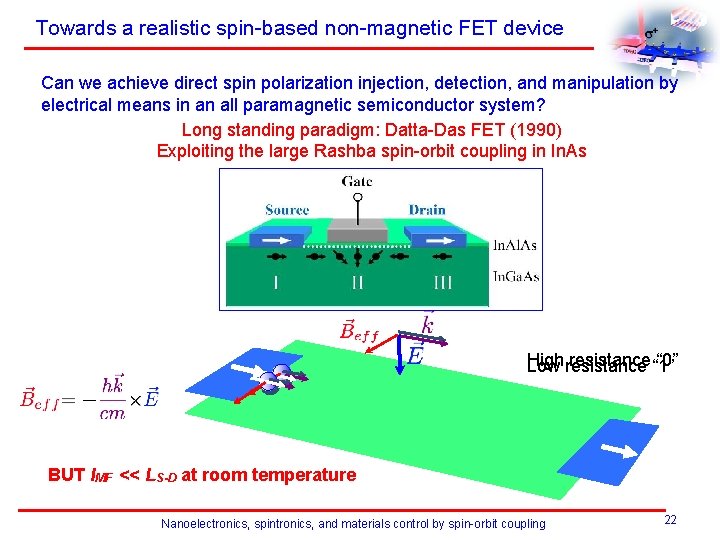
Towards a realistic spin-based non-magnetic FET device Can we achieve direct spin polarization injection, detection, and manipulation by electrical means in an all paramagnetic semiconductor system? Long standing paradigm: Datta-Das FET (1990) Exploiting the large Rashba spin-orbit coupling in In. As High resistance “ 1” “ 0” Low resistance BUT l. MF << LS-D at room temperature Nanoelectronics, spintronics, and materials control by spin-orbit coupling 22
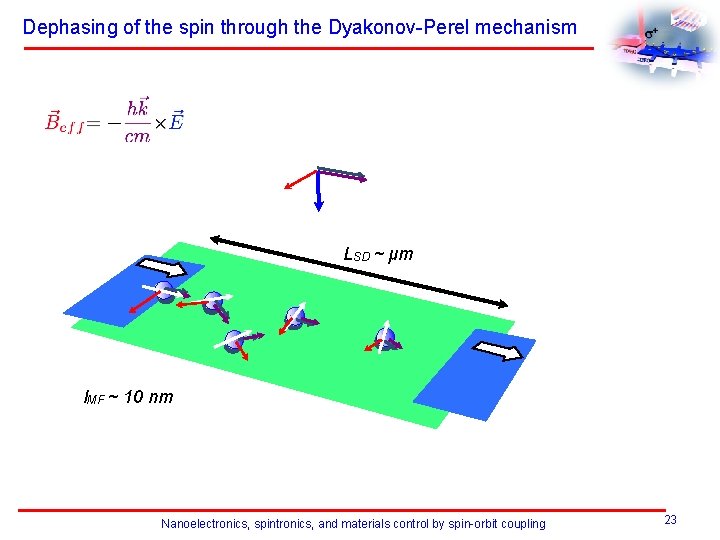
Dephasing of the spin through the Dyakonov-Perel mechanism LSD ~ μm l. MF ~ 10 nm Nanoelectronics, spintronics, and materials control by spin-orbit coupling 23
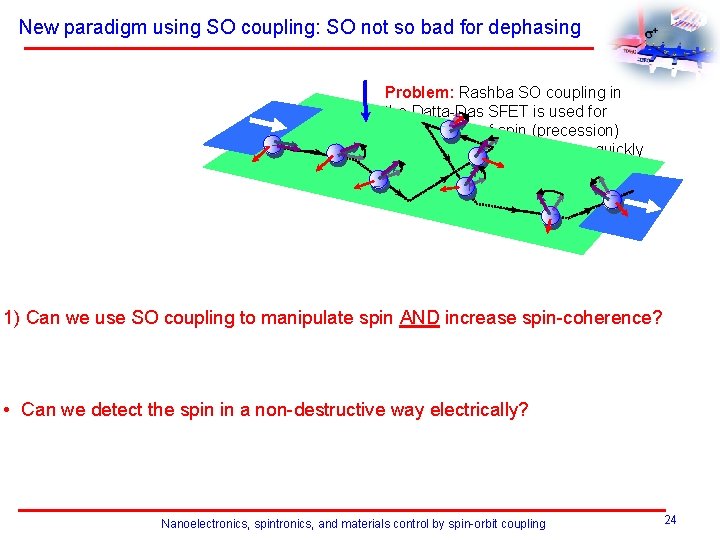
New paradigm using SO coupling: SO not so bad for dephasing Problem: Rashba SO coupling in the Datta-Das SFET is used for manipulation of spin (precession) BUT it dephases the spin too quickly (DP mechanism). 1) Can we use SO coupling to manipulate spin AND increase spin-coherence? • Can we detect the spin in a non-destructive way electrically? Nanoelectronics, spintronics, and materials control by spin-orbit coupling 24
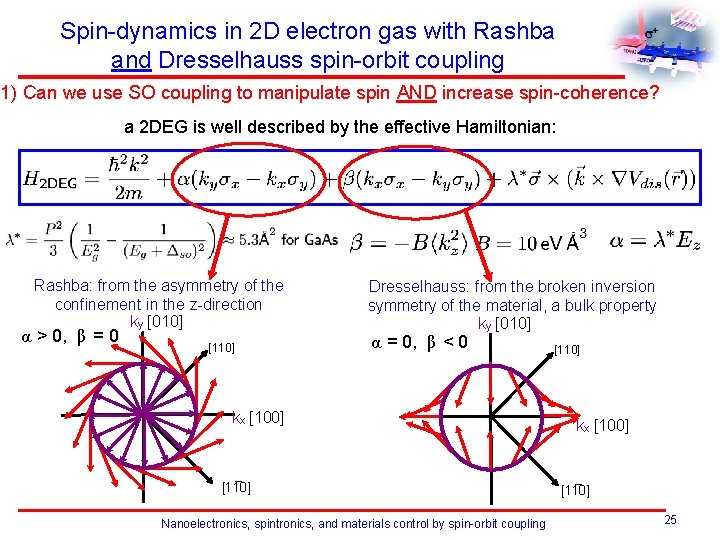
Spin-dynamics in 2 D electron gas with Rashba and Dresselhauss spin-orbit coupling 1) Can we use SO coupling to manipulate spin AND increase spin-coherence? a 2 DEG is well described by the effective Hamiltonian: Rashba: from the asymmetry of the confinement in the z-direction ky [010] α > 0, β = 0 [110] Dresselhauss: from the broken inversion symmetry of the material, a bulk property ky [010] α = 0, β < 0 kx [100] _ [110] Nanoelectronics, spintronics, and materials control by spin-orbit coupling [110] kx [100] _ [110] 25
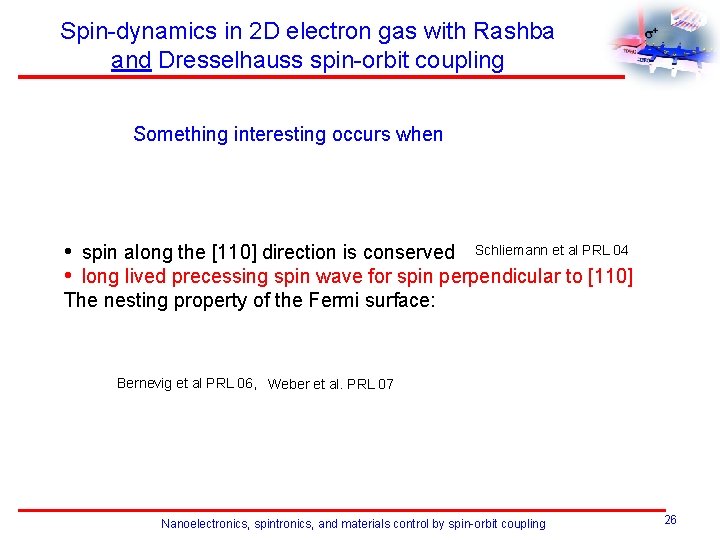
Spin-dynamics in 2 D electron gas with Rashba and Dresselhauss spin-orbit coupling Something interesting occurs when • spin along the [110] direction is conserved Schliemann et al PRL 04 • long lived precessing spin wave for spin perpendicular to [110] The nesting property of the Fermi surface: Bernevig et al PRL 06, Weber et al. PRL 07 Nanoelectronics, spintronics, and materials control by spin-orbit coupling 26
![Effects of Rashba and Dresselhaus SO coupling ky [010] α > 0, β =](http://slidetodoc.com/presentation_image_h/d99f722f100ba895bcd7ac5e5a01bc6b/image-27.jpg "Effects of Rashba and Dresselhaus SO coupling ky [010] α > 0, β =")
Effects of Rashba and Dresselhaus SO coupling ky [010] α > 0, β = 0 α = -β [110] ky [010] [110] kx [100] _ [110] α = 0, β < 0 kx [100] ky [010] [110] kx [100] _ [110] Nanoelectronics, spintronics, and materials control by spin-orbit coupling 27
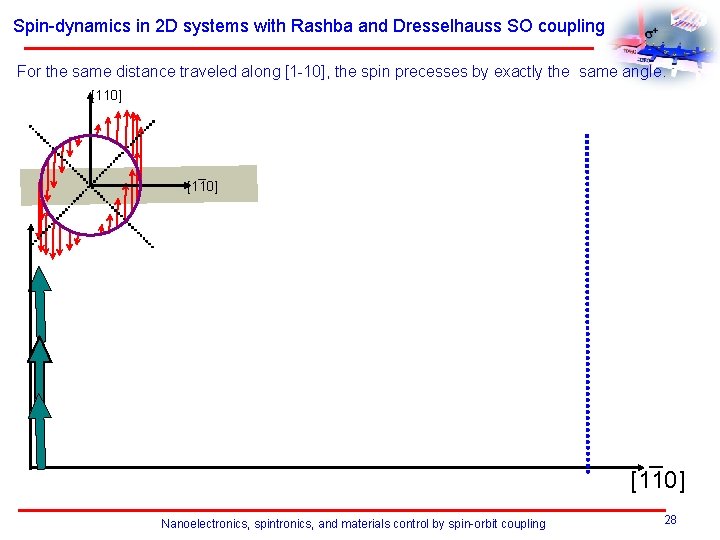
Spin-dynamics in 2 D systems with Rashba and Dresselhauss SO coupling For the same distance traveled along [1 -10], the spin precesses by exactly the same angle. [110] _ [110] Nanoelectronics, spintronics, and materials control by spin-orbit coupling 28
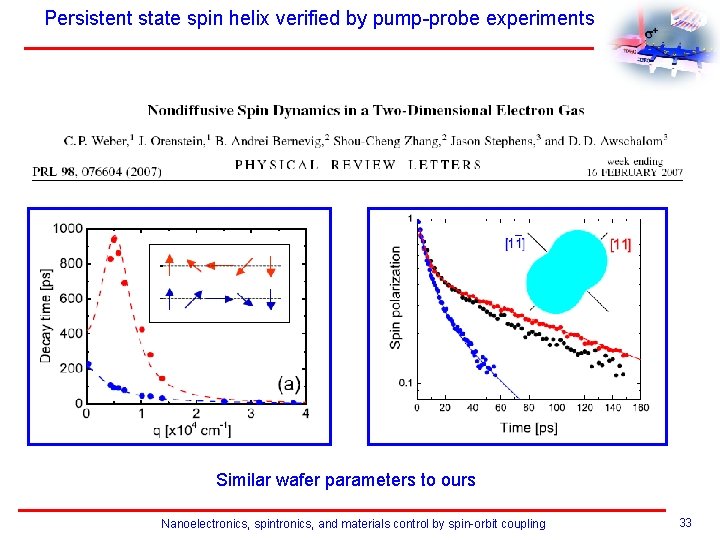
Persistent state spin helix verified by pump-probe experiments Similar wafer parameters to ours Nanoelectronics, spintronics, and materials control by spin-orbit coupling 33
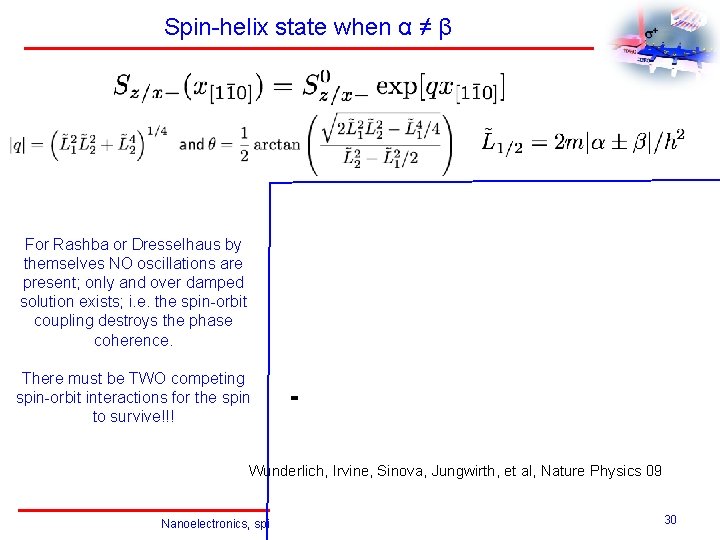
Spin-helix state when α ≠ β For Rashba or Dresselhaus by themselves NO oscillations are present; only and over damped solution exists; i. e. the spin-orbit coupling destroys the phase coherence. There must be TWO competing spin-orbit interactions for the spin to survive!!! Wunderlich, Irvine, Sinova, Jungwirth, et al, Nature Physics 09 Nanoelectronics, spintronics, and materials control by spin-orbit coupling 30
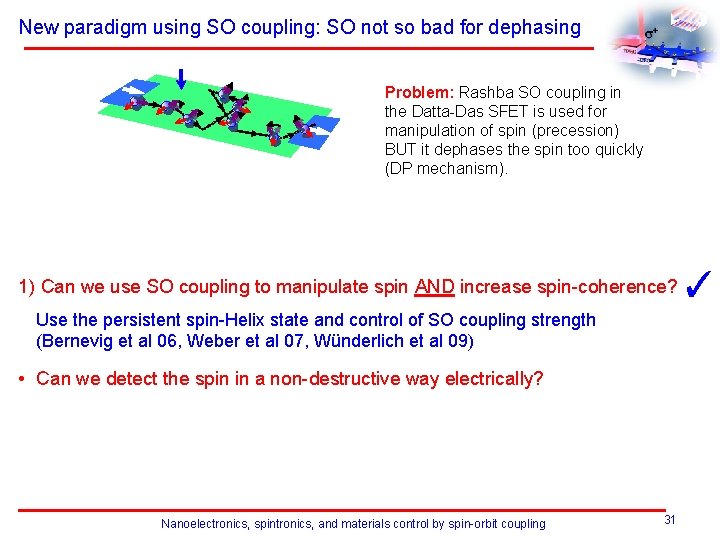
New paradigm using SO coupling: SO not so bad for dephasing Problem: Rashba SO coupling in the Datta-Das SFET is used for manipulation of spin (precession) BUT it dephases the spin too quickly (DP mechanism). 1) Can we use SO coupling to manipulate spin AND increase spin-coherence? Use the persistent spin-Helix state and control of SO coupling strength (Bernevig et al 06, Weber et al 07, Wünderlich et al 09) • Can we detect the spin in a non-destructive way electrically? Nanoelectronics, spintronics, and materials control by spin-orbit coupling 31 ✓
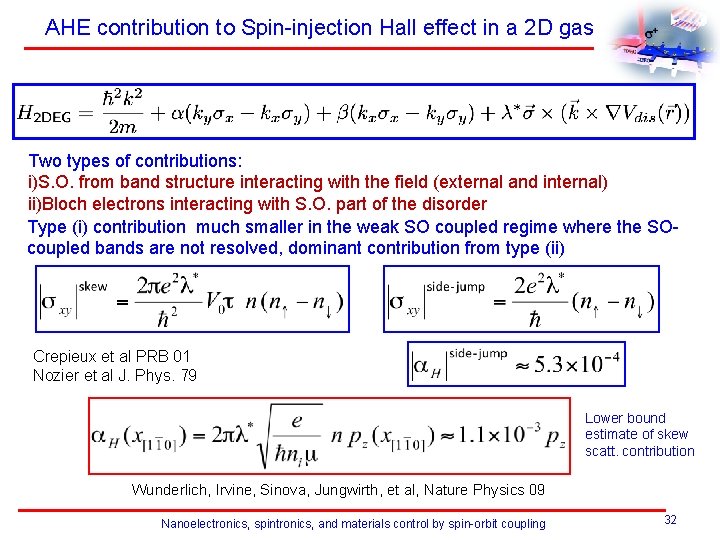
AHE contribution to Spin-injection Hall effect in a 2 D gas Two types of contributions: i)S. O. from band structure interacting with the field (external and internal) ii)Bloch electrons interacting with S. O. part of the disorder Type (i) contribution much smaller in the weak SO coupled regime where the SOcoupled bands are not resolved, dominant contribution from type (ii) Crepieux et al PRB 01 Nozier et al J. Phys. 79 Lower bound estimate of skew scatt. contribution Wunderlich, Irvine, Sinova, Jungwirth, et al, Nature Physics 09 Nanoelectronics, spintronics, and materials control by spin-orbit coupling 32
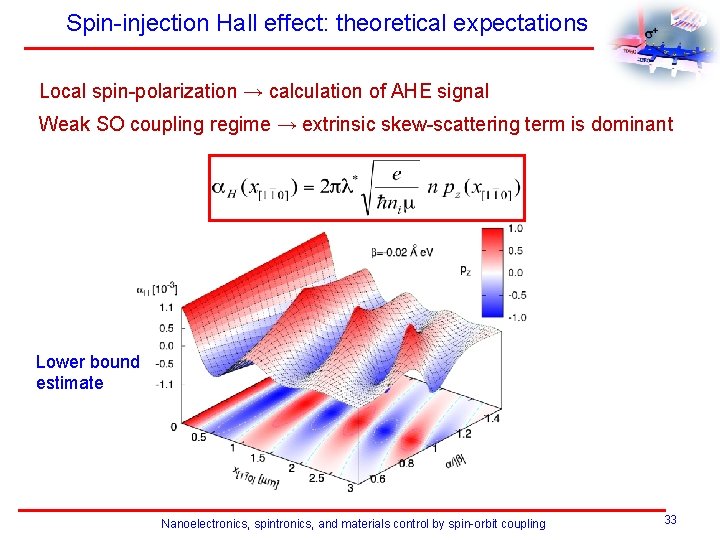
Spin-injection Hall effect: theoretical expectations Local spin-polarization → calculation of AHE signal Weak SO coupling regime → extrinsic skew-scattering term is dominant Lower bound estimate Nanoelectronics, spintronics, and materials control by spin-orbit coupling 33
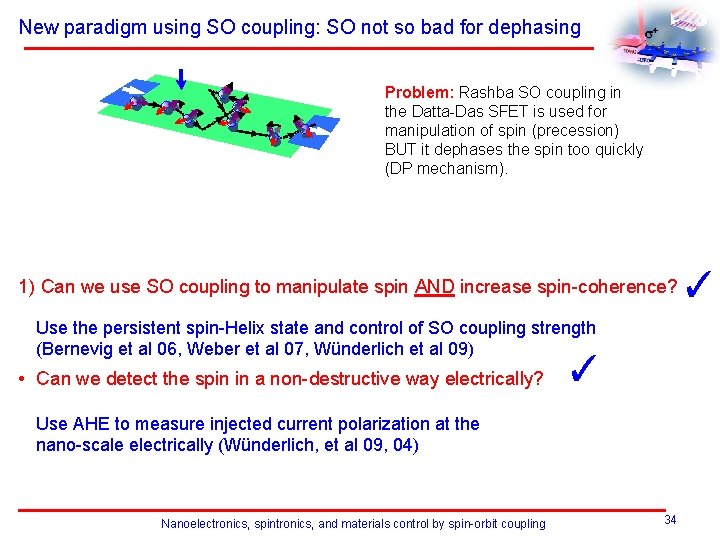
New paradigm using SO coupling: SO not so bad for dephasing Problem: Rashba SO coupling in the Datta-Das SFET is used for manipulation of spin (precession) BUT it dephases the spin too quickly (DP mechanism). 1) Can we use SO coupling to manipulate spin AND increase spin-coherence? Use the persistent spin-Helix state and control of SO coupling strength (Bernevig et al 06, Weber et al 07, Wünderlich et al 09) • Can we detect the spin in a non-destructive way electrically? ✓ Use AHE to measure injected current polarization at the nano-scale electrically (Wünderlich, et al 09, 04) Nanoelectronics, spintronics, and materials control by spin-orbit coupling 34 ✓
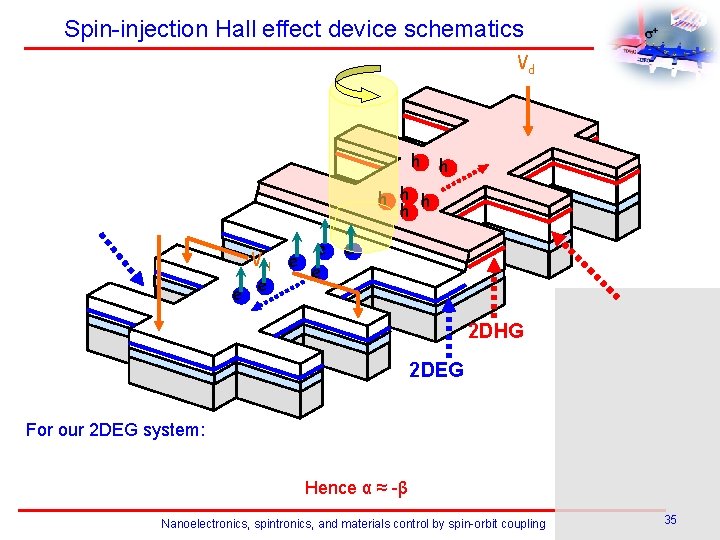
Spin-injection Hall effect device schematics Vd h h h Vs e e VH e e 2 DHG 2 DEG For our 2 DEG system: Hence α ≈ -β Nanoelectronics, spintronics, and materials control by spin-orbit coupling 35
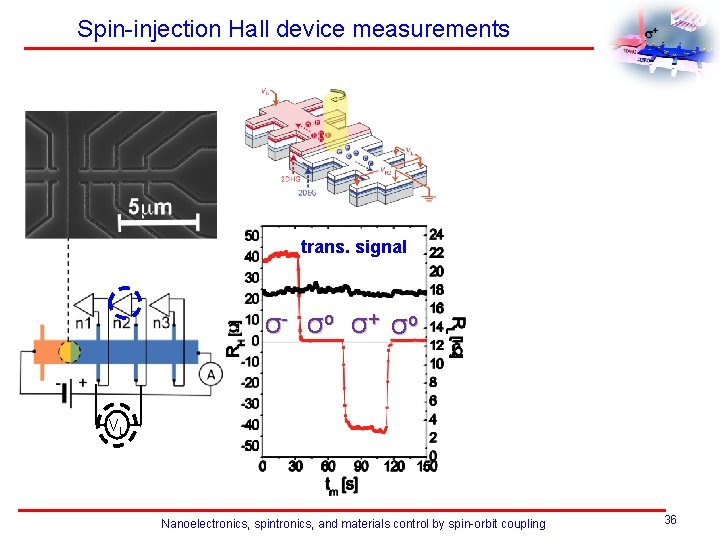
Spin-injection Hall device measurements trans. signal σ- σo σ+ σo VL Nanoelectronics, spintronics, and materials control by spin-orbit coupling 36
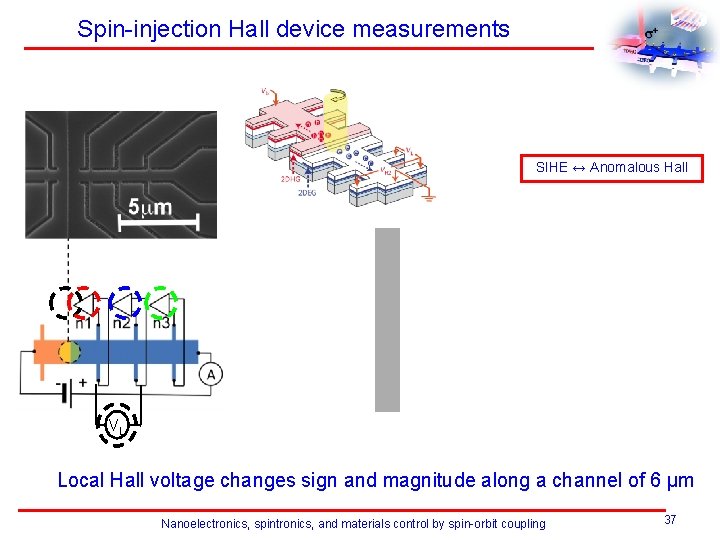
Spin-injection Hall device measurements SIHE ↔ Anomalous Hall trans. signal σ- σo σ+ σo VL Local Hall voltage changes sign and magnitude along a channel of 6 μm Nanoelectronics, spintronics, and materials control by spin-orbit coupling 37
Further experimental tests of the observed SIHE Nanoelectronics, spintronics, and materials control by spin-orbit coupling 38
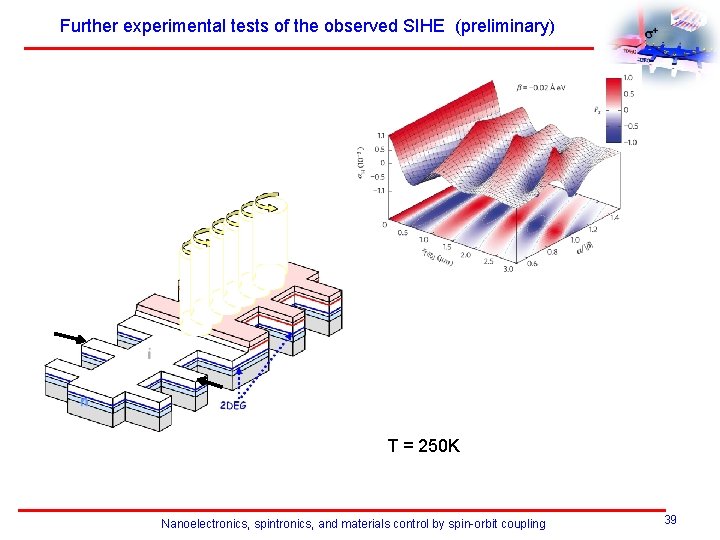
Further experimental tests of the observed SIHE (preliminary) T = 250 K Nanoelectronics, spintronics, and materials control by spin-orbit coupling 39
![Further experimental tests of the observed SIHE (preliminary) [1 -10] - bar [110] -](http://slidetodoc.com/presentation_image_h/d99f722f100ba895bcd7ac5e5a01bc6b/image-40.jpg "Further experimental tests of the observed SIHE (preliminary) [1 -10] - bar [110] -")
Further experimental tests of the observed SIHE (preliminary) [1 -10] - bar [110] - bar Nanoelectronics, spintronics, and materials control by spin-orbit coupling 40
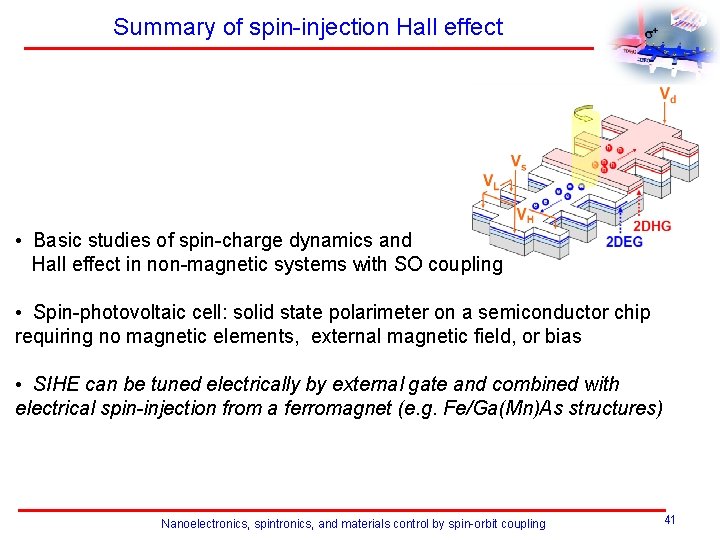
Summary of spin-injection Hall effect • Basic studies of spin-charge dynamics and Hall effect in non-magnetic systems with SO coupling • Spin-photovoltaic cell: solid state polarimeter on a semiconductor chip requiring no magnetic elements, external magnetic field, or bias • SIHE can be tuned electrically by external gate and combined with electrical spin-injection from a ferromagnet (e. g. Fe/Ga(Mn)As structures) Nanoelectronics, spintronics, and materials control by spin-orbit coupling 41
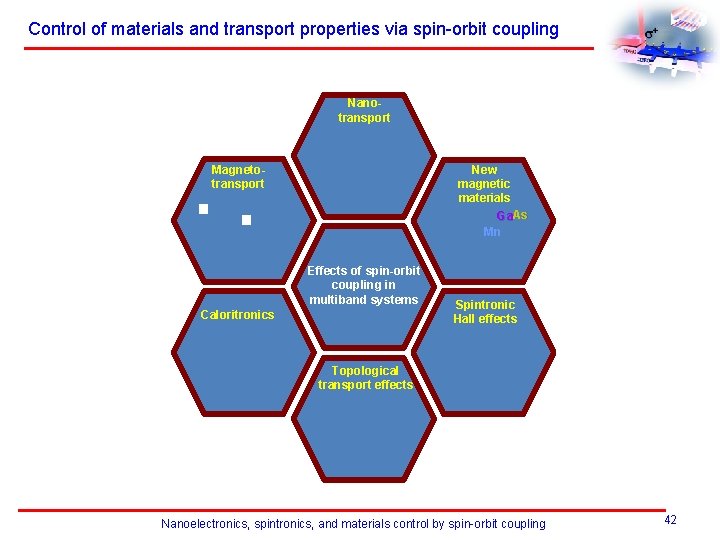
Control of materials and transport properties via spin-orbit coupling Nanotransport New magnetic materials Ga. As Mn Magnetotransport Effects of spin-orbit coupling in multiband systems Caloritronics Spintronic Hall effects Topological transport effects Nanoelectronics, spintronics, and materials control by spin-orbit coupling 42
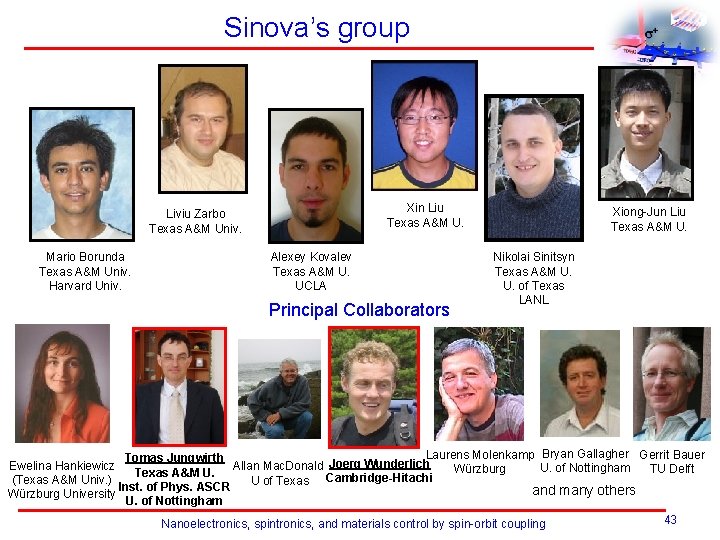
Sinova’s group Xin Liu Texas A&M U. Liviu Zarbo Texas A&M Univ. Mario Borunda Texas A&M Univ. Harvard Univ. Alexey Kovalev Texas A&M U. UCLA Principal Collaborators Xiong-Jun Liu Texas A&M U. Nikolai Sinitsyn Texas A&M U. U. of Texas LANL Laurens Molenkamp Bryan Gallagher Gerrit Bauer Tomas Jungwirth Ewelina Hankiewicz Allan Mac. Donald Joerg Wunderlich U. of Nottingham Würzburg TU Delft Texas A&M U. (Texas A&M Univ. ) U of Texas Cambridge-Hitachi Inst. of Phys. ASCR and many others Würzburg University U. of Nottingham Nanoelectronics, spintronics, and materials control by spin-orbit coupling 43
- Slides: 43