
New ONAP Architecture Diagrams for Beijing Whitepaper Kevin
New ONAP Architecture Diagrams for Beijing Whitepaper Kevin Mc. Donnell 5/29/18
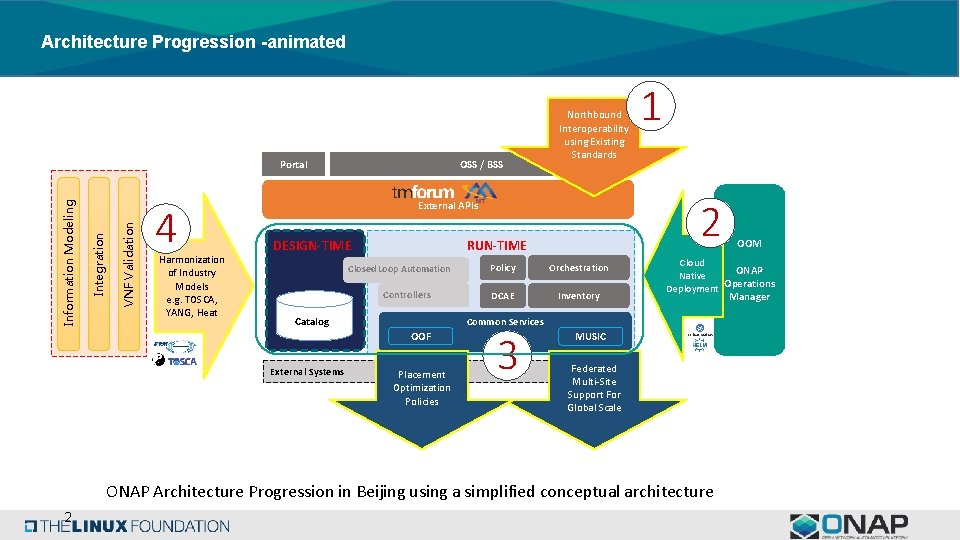
Architecture Progression -animated VNF Validation Integration Information Modeling Portal 4 Harmonization of Industry Models e. g. TOSCA, YANG, Heat OSS / BSS Northbound Interoperability using Existing Standards 2 External APIs DESIGN-TIME RUN-TIME Closed Loop Automation Controllers Policy Orchestration DCAE Inventory OOF Placement Optimization Policies 3 MUSIC Federated Multi-Site Support For Global Scale ONAP Architecture Progression in Beijing using a simplified conceptual architecture 2 OOM Cloud ONAP Native Operations Deployment Manager Common Services Catalog External Systems 1
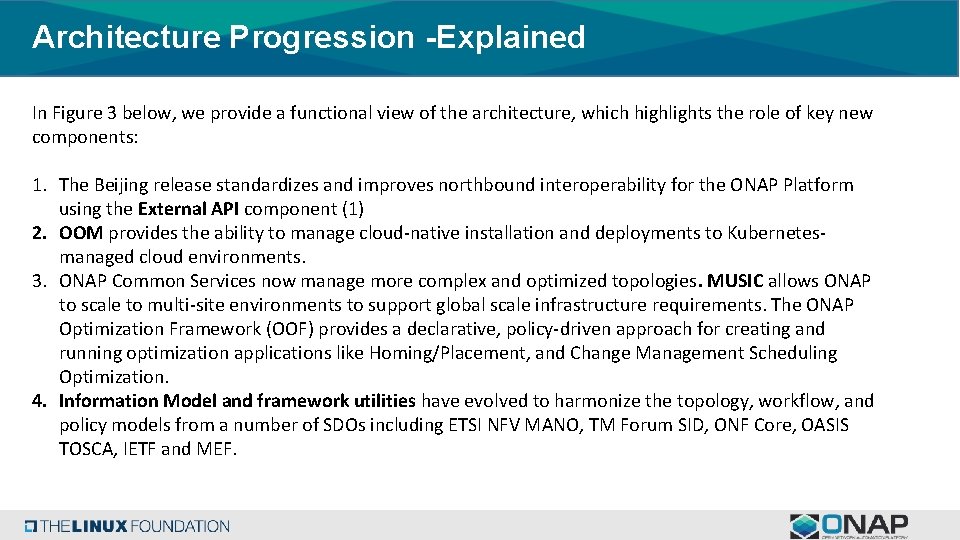
Architecture Progression -Explained In Figure 3 below, we provide a functional view of the architecture, which highlights the role of key new components: 1. The Beijing release standardizes and improves northbound interoperability for the ONAP Platform using the External API component (1) 2. OOM provides the ability to manage cloud-native installation and deployments to Kubernetesmanaged cloud environments. 3. ONAP Common Services now manage more complex and optimized topologies. MUSIC allows ONAP to scale to multi-site environments to support global scale infrastructure requirements. The ONAP Optimization Framework (OOF) provides a declarative, policy-driven approach for creating and running optimization applications like Homing/Placement, and Change Management Scheduling Optimization. 4. Information Model and framework utilities have evolved to harmonize the topology, workflow, and policy models from a number of SDOs including ETSI NFV MANO, TM Forum SID, ONF Core, OASIS TOSCA, IETF and MEF.
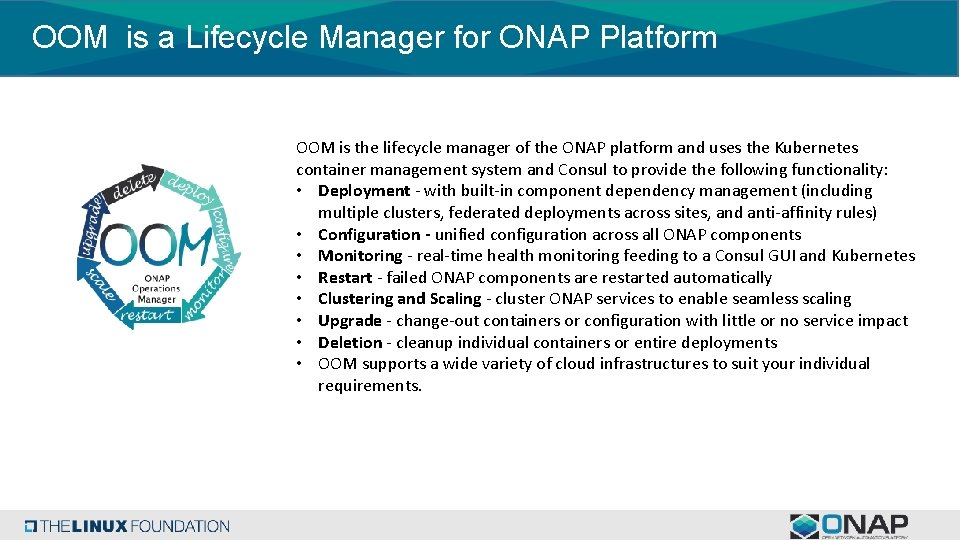
OOM is a Lifecycle Manager for ONAP Platform OOM is the lifecycle manager of the ONAP platform and uses the Kubernetes container management system and Consul to provide the following functionality: • Deployment - with built-in component dependency management (including multiple clusters, federated deployments across sites, and anti-affinity rules) • Configuration - unified configuration across all ONAP components • Monitoring - real-time health monitoring feeding to a Consul GUI and Kubernetes • Restart - failed ONAP components are restarted automatically • Clustering and Scaling - cluster ONAP services to enable seamless scaling • Upgrade - change-out containers or configuration with little or no service impact • Deletion - cleanup individual containers or entire deployments • OOM supports a wide variety of cloud infrastructures to suit your individual requirements.
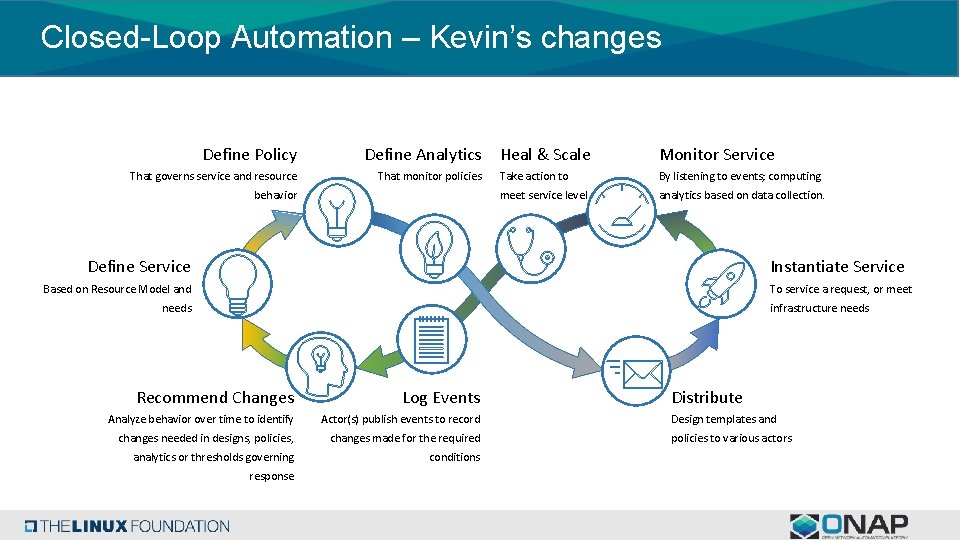
Closed-Loop Automation – Kevin’s changes Define Policy Define Analytics That governs service and resource That monitor policies behavior Heal & Scale Monitor Service Take action to By listening to events; computing meet service level analytics based on data collection. Define Service Instantiate Service Based on Resource Model and To service a request, or meet needs infrastructure needs Recommend Changes Log Events Analyze behavior over time to identify Actor(s) publish events to record changes needed in designs, policies, changes made for the required analytics or thresholds governing conditions response Distribute Design templates and policies to various actors
- Slides: 5