
New Nuclear Regulatory Requirements and Conformity Assessment of
- Slides: 25
New Nuclear Regulatory Requirements and Conformity Assessment of Japan November 26 th, 2015 Seitaro HANAMI Interantional Affairs Office Nuclear Regulation Authority (NRA)
Contents A) About Nuclear Regulation Authority (NRA) B) New Nuclear Regulatory Requirements C) Conformity Assessment 1
A) About Nuclear Regulation Authority (NRA) 2
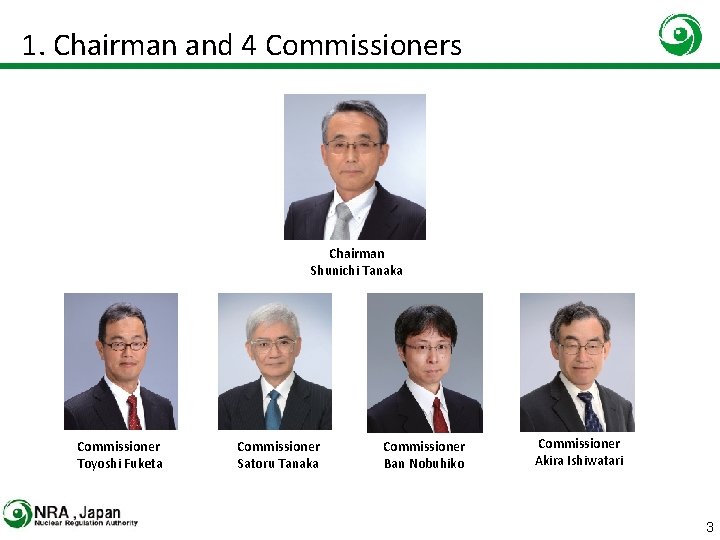
1. Chairman and 4 Commissioners Chairman Shunichi Tanaka Commissioner Toyoshi Fuketa Commissioner Satoru Tanaka Commissioner Ban Nobuhiko Commissioner Akira Ishiwatari 3
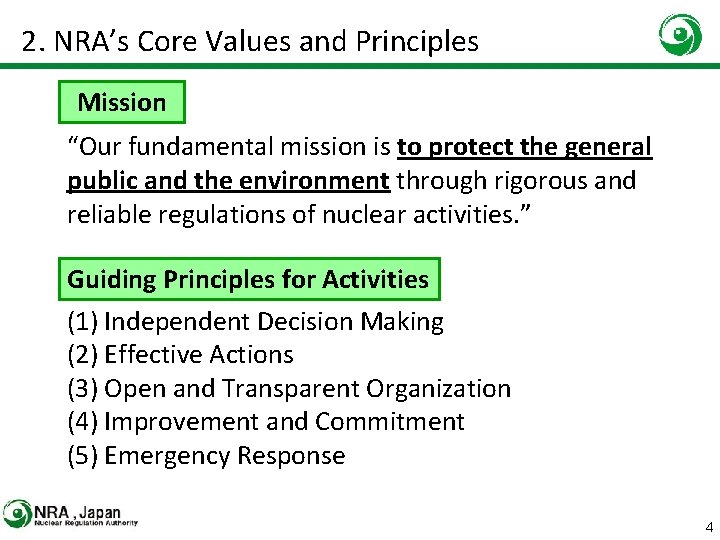
2. NRA’s Core Values and Principles Mission “Our fundamental mission is to protect the general public and the environment through rigorous and reliable regulations of nuclear activities. ” Guiding Principles for Activities (1) Independent Decision Making (2) Effective Actions (3) Open and Transparent Organization (4) Improvement and Commitment (5) Emergency Response 4
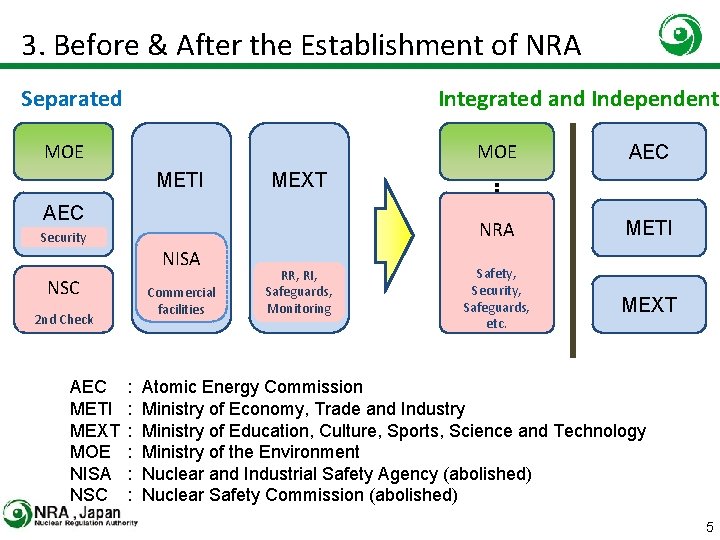
3. Before & After the Establishment of NRA Separated Integrated and Independent MOE METI Security NSC Commercial facilities 2 nd Check AEC METI MEXT MOE NISA NSC : : : AEC NRA METI Safety, Security, Safeguards, etc. MEXT AEC NISA MOE RR, RI, Safeguards, Monitoring Atomic Energy Commission Ministry of Economy, Trade and Industry Ministry of Education, Culture, Sports, Science and Technology Ministry of the Environment Nuclear and Industrial Safety Agency (abolished) Nuclear Safety Commission (abolished) 5
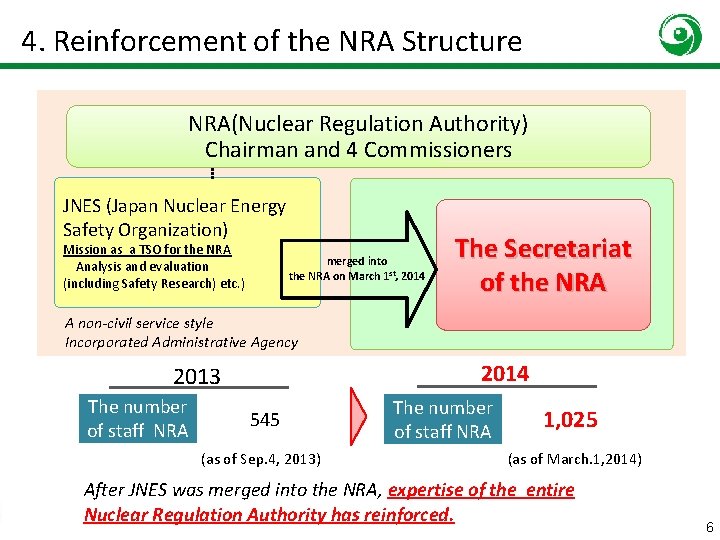
4. Reinforcement of the NRA Structure NRA(Nuclear Regulation Authority) Chairman and 4 Commissioners JNES (Japan Nuclear Energy Safety Organization) Mission as a TSO for the NRA Analysis and evaluation (including Safety Research) etc. ) merged into the NRA on March 1 st, 2014 The Secretariat of the NRA A non-civil service style Incorporated Administrative Agency 2014 2013 The number of staff NRA 545 (as of Sep. 4, 2013) The number of staff NRA 1, 025 (as of March. 1, 2014) After JNES was merged into the NRA, expertise of the entire Nuclear Regulation Authority has reinforced. 6
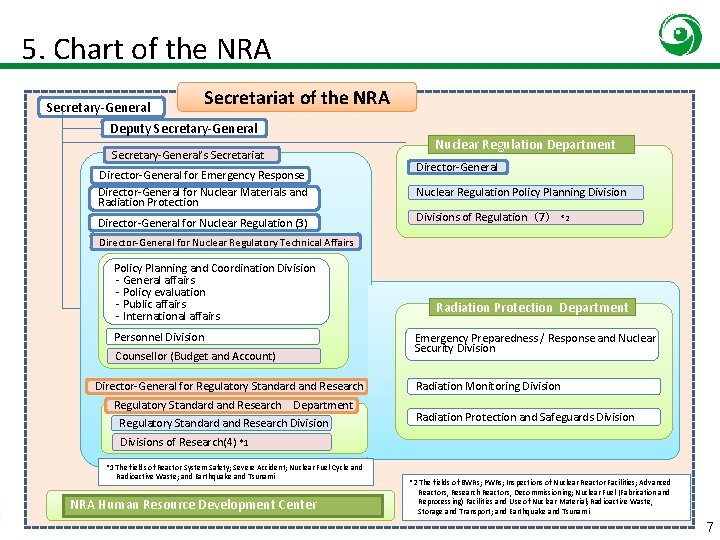
5. Chart of the NRA Secretary-General Secretariat of the NRA Deputy Secretary-General’s Secretariat Director-General for Emergency Response Director-General for Nuclear Materials and Radiation Protection Director-General for Nuclear Regulation (3) Nuclear Regulation Department Director-General Nuclear Regulation Policy Planning Divisions of Regulation(7) *2 Director-General for Nuclear Regulatory Technical Affairs Policy Planning and Coordination Division - General affairs - Policy evaluation - Public affairs - International affairs Personnel Division Counsellor (Budget and Account) Director-General for Regulatory Standard and Research Department Regulatory Standard and Research Division Radiation Protection Department Emergency Preparedness / Response and Nuclear Security Division Radiation Monitoring Division Radiation Protection and Safeguards Divisions of Research(4) *1 *1 The fields of Reactor System Safety; Severe Accident; Nuclear Fuel Cycle and Radioactive Waste; and Earthquake and Tsunami NRA Human Resource Development Center *2 The fields of BWRs; PWRs; Inspections of Nuclear Reactor Facilities; Advanced Reactors, Research Reactors, Decommissioning; Nuclear Fuel (Fabrication and Reprocessing) Facilities and Use of Nuclear Material; Radioactive Waste, Storage and Transport; and Earthquake and Tsunami 7 7
B) New Nuclear Regulatory Requirements 8
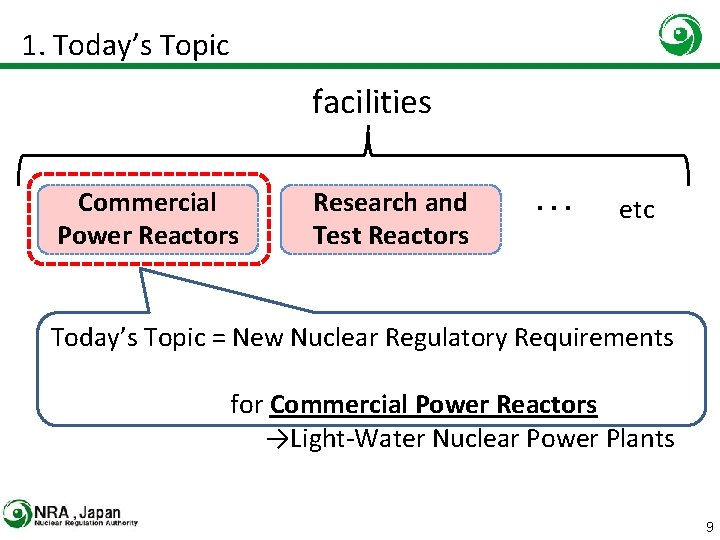
1. Today’s Topic facilities Commercial Power Reactors Research and Test Reactors ・・・ etc Today’s Topic = New Nuclear Regulatory Requirements for Commercial Power Reactors →Light-Water Nuclear Power Plants 9
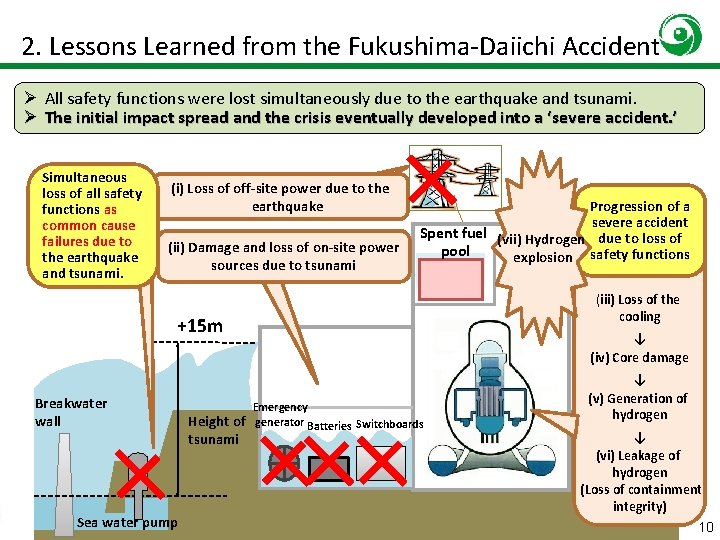
2. Lessons Learned from the Fukushima-Daiichi Accident Ø All safety functions were lost simultaneously due to the earthquake and tsunami. Ø The initial impact spread and the crisis eventually developed into a ‘severe accident. ’ Simultaneous loss of all safety functions as common cause failures due to the earthquake and tsunami. (i) Loss of off-site power due to the earthquake (ii) Damage and loss of on-site power sources due to tsunami Progression of a severe accident Spent fuel (vii) Hydrogen due to loss of pool explosion safety functions (iii) Loss of the cooling +15 m Breakwater wall Sea water pump Height of tsunami ↓ (iv) Core damage Emergency generator Batteries Switchboards ↓ (v) Generation of hydrogen ↓ (vi) Leakage of hydrogen (Loss of containment integrity) 10
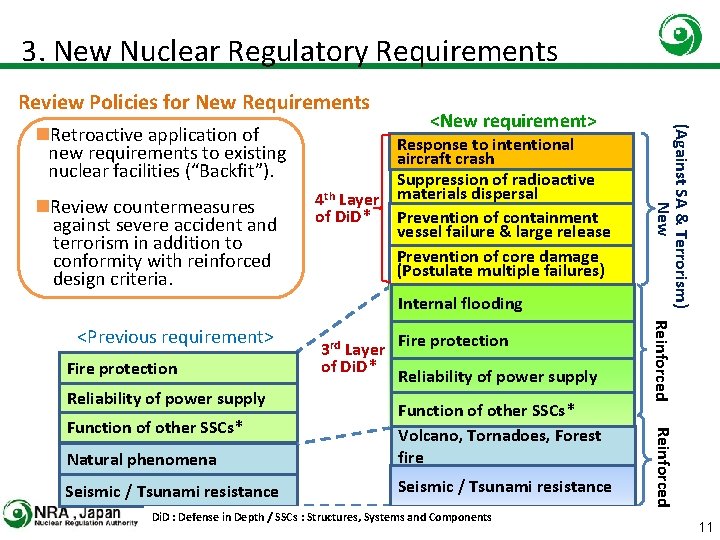
3. New Nuclear Regulatory Requirements Review Policies for New Requirements n. Review countermeasures against severe accident and terrorism in addition to conformity with reinforced design criteria. Response to intentional aircraft crash Suppression of radioactive th 4 Layer materials dispersal of Di. D* Prevention of containment vessel failure & large release Prevention of core damage (Postulate multiple failures) Internal flooding <Previous requirement> Fire protection Reliability of power supply 3 rd Layer Fire protection of Di. D* Reliability of power supply Seismic / Tsunami resistance Function of other SSCs* Di. D : Defense in Depth / SSCs : Structures, Systems and Components Reinforced Natural phenomena Function of other SSCs* Volcano, Tornadoes, Forest fire (Against SA & Terrorism) New Reinforced n. Retroactive application of new requirements to existing nuclear facilities (“Backfit”). <New requirement> 11
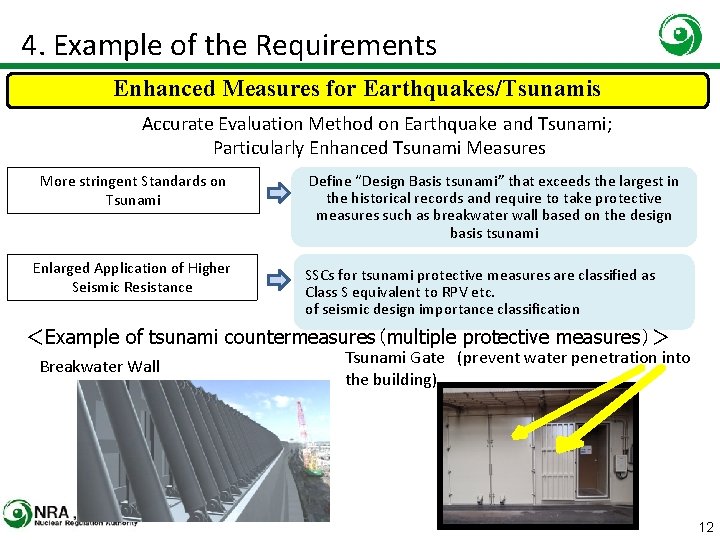
4. Example of the Requirements Enhanced Measures for Earthquakes/Tsunamis Accurate Evaluation Method on Earthquake and Tsunami; Particularly Enhanced Tsunami Measures More stringent Standards on Tsunami Enlarged Application of Higher Seismic Resistance Define “Design Basis tsunami” that exceeds the largest in the historical records and require to take protective measures such as breakwater wall based on the design basis tsunami SSCs for tsunami protective measures are classified as Class S equivalent to RPV etc. of seismic design importance classification <Example of tsunami countermeasures(multiple protective measures)> Breakwater Wall Tsunami Gate (prevent water penetration into the building) 12
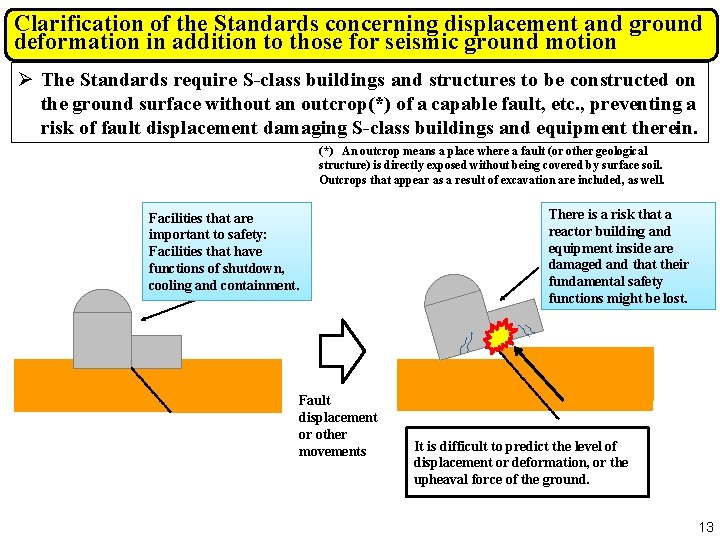
Clarification of the Standards concerning displacement and ground deformation in addition to those for seismic ground motion Ø The Standards require S-class buildings and structures to be constructed on the ground surface without an outcrop(*) of a capable fault, etc. , preventing a risk of fault displacement damaging S-class buildings and equipment therein. (*) An outcrop means a place where a fault (or other geological structure) is directly exposed without being covered by surface soil. Outcrops that appear as a result of excavation are included, as well. Facilities that are important to safety: Facilities that have functions of shutdown, cooling and containment. Fault displacement or other movements There is a risk that a reactor building and equipment inside are damaged and that their fundamental safety functions might be lost. It is difficult to predict the level of displacement or deformation, or the upheaval force of the ground. 13
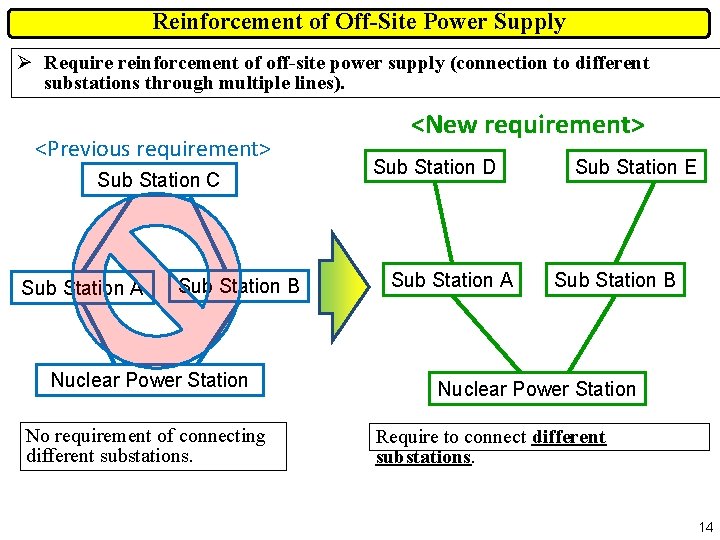
Reinforcement of Off-Site Power Supply Ø Require reinforcement of off-site power supply (connection to different substations through multiple lines). <Previous requirement> Sub Station C Sub Station A Sub Station B Nuclear Power Station No requirement of connecting different substations. <New requirement> Sub Station D Sub Station A Sub Station E Sub Station B Nuclear Power Station Require to connect different substations. 14
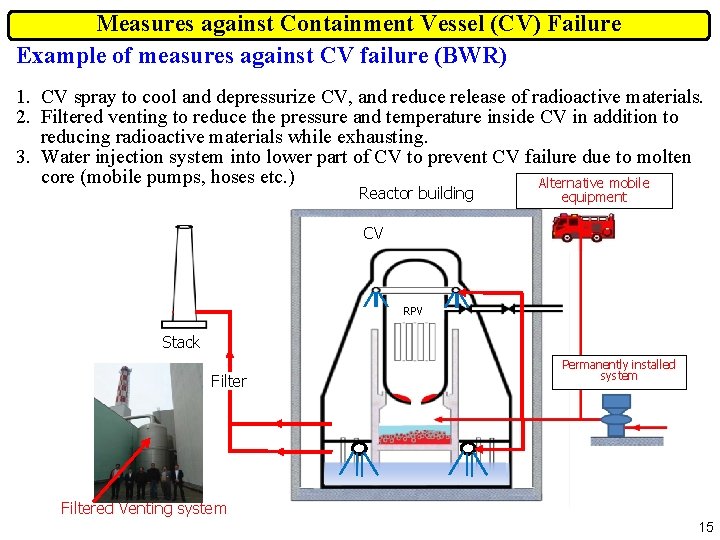
Measures against Containment Vessel (CV) Failure Example of measures against CV failure (BWR) 1. CV spray to cool and depressurize CV, and reduce release of radioactive materials. 2. Filtered venting to reduce the pressure and temperature inside CV in addition to reducing radioactive materials while exhausting. 3. Water injection system into lower part of CV to prevent CV failure due to molten core (mobile pumps, hoses etc. ) Alternative mobile Reactor building equipment CV RPV Stack Filter Permanently installed system Filtered Venting system 15
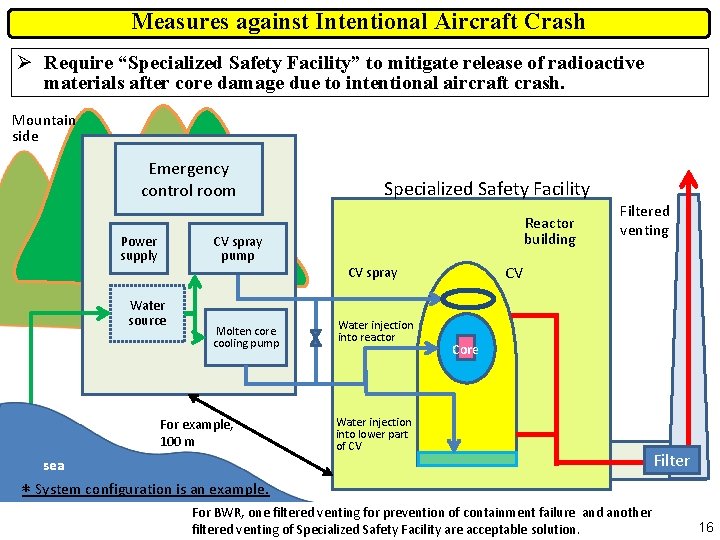
Measures against Intentional Aircraft Crash Ø Require “Specialized Safety Facility” to mitigate release of radioactive materials after core damage due to intentional aircraft crash. Mountain side Emergency control room Specialized Safety Facility Reactor building CV spray pump Power supply CV CV spray Water source Molten core cooling pump For example, 100 m Water injection into reactor Filtered venting Core Water injection into lower part of CV sea Filter * System configuration is an example. For BWR, one filtered venting for prevention of containment failure and another filtered venting of Specialized Safety Facility are acceptable solution. 16
C) Conformity Assessment 17
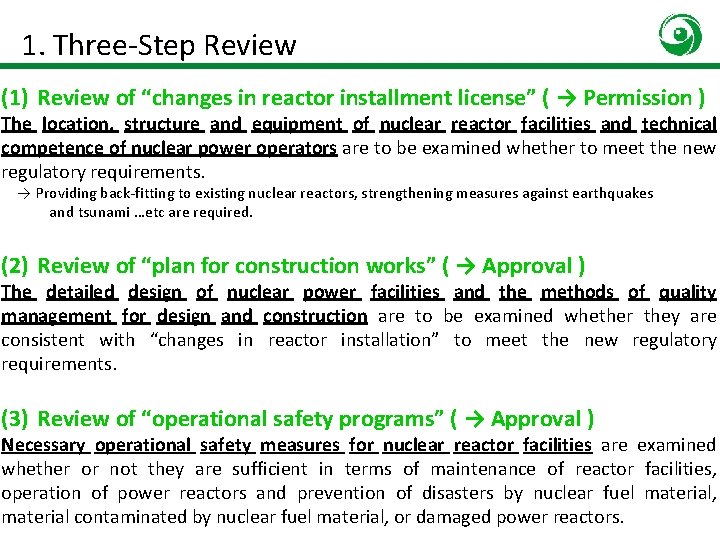
1. Three-Step Review (1) Review of “changes in reactor installment license” ( → Permission ) The location, structure and equipment of nuclear reactor facilities and technical competence of nuclear power operators are to be examined whether to meet the new regulatory requirements. → Providing back-fitting to existing nuclear reactors, strengthening measures against earthquakes and tsunami …etc are required. (2) Review of “plan for construction works” ( → Approval ) The detailed design of nuclear power facilities and the methods of quality management for design and construction are to be examined whether they are consistent with “changes in reactor installation” to meet the new regulatory requirements. (3) Review of “operational safety programs” ( → Approval ) Necessary operational safety measures for nuclear reactor facilities are examined whether or not they are sufficient in terms of maintenance of reactor facilities, operation of power reactors and prevention of disasters by nuclear fuel material, 18 material contaminated by nuclear fuel material, or damaged power reactors.
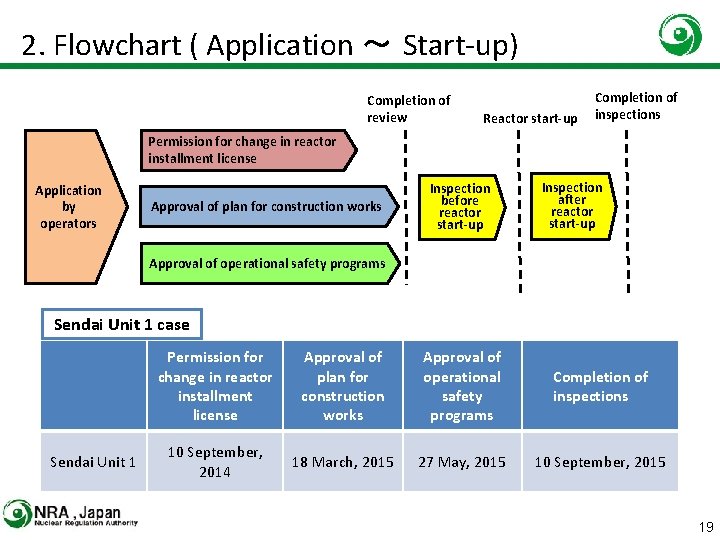
2. Flowchart ( Application ~ Start-up) Completion of review Reactor start-up Completion of inspections Permission for change in reactor installment license Application by operators Approval of plan for construction works Inspection before reactor start-up Inspection after reactor start-up Approval of operational safety programs Sendai Unit 1 case Sendai Unit 1 Permission for change in reactor installment license Approval of plan for construction works Approval of operational safety programs Completion of inspections 10 September, 2014 18 March, 2015 27 May, 2015 10 September, 2015 19
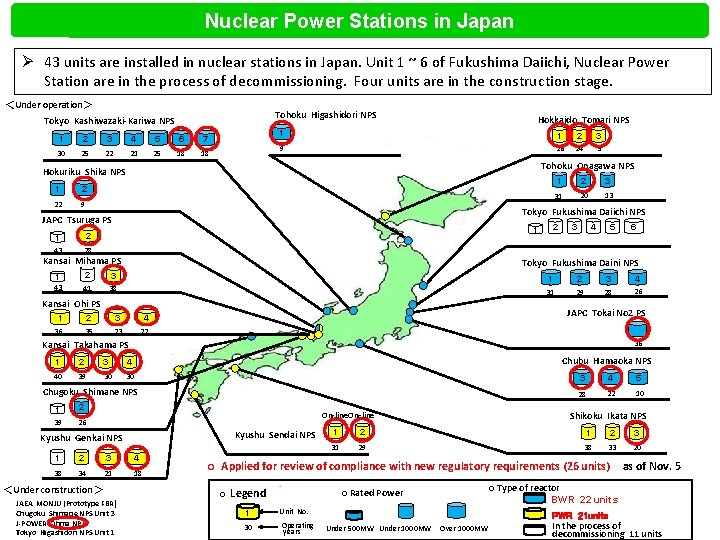
Nuclear Power Stations in Japan Ø 43 units are installed in nuclear stations in Japan. Unit 1 ~ 6 of Fukushima Daiichi, Nuclear Power Station are in the process of decommissioning. Four units are in the construction stage. <Under operation> Tohoku Higashidori NPS Tokyo Kashiwazaki-Kariwa NPS 1 2 3 4 5 30 25 22 21 25 6 7 18 18 Hokkaido Tomari NPS 1 1 2 3 9 26 24 5 Tohoku Onagawa NPS Hokuriku Shika NPS 1 2 22 9 1 2 3 31 20 13 Tokyo Fukushima Daiichi NPS JAPC Tsuruga PS 1 1 2 43 28 1 2 3 43 41 38 Kansai Mihama PS 2 4 3 5 Tokyo Fukushima Daini NPS Kansai Ohi PS 1 2 3 4 36 35 23 22 1 2 3 4 31 29 28 26 JAPC Tokai No 2 PS 36 Kansai Takahama PS 1 2 3 4 40 39 30 30 Chubu Hamaoka NPS Chugoku Shimane NPS 1 2 39 26 On-line Kyushu Sendai NPS Kyushu Genkai NPS 1 2 3 4 38 34 21 18 <Under construction > JAEA MONJU (Prototype FBR) Chugoku Shimane NPS Unit 3 J-POWER Ohma NPP Tokyo Higashidori NPS Unit 1 6 3 4 5 28 22 10 Shikoku Ikata NPS 1 2 3 31 29 38 33 20 ○ Applied for review of compliance with new regulatory requirements (26 units) ○ Legend ○ Type of reactor BWR 22 units ○ Rated Power 1 Unit No. 30 Operating years Under 500 MW Under 1000 MW as of Nov. 5 Over 1000 MW PWR 21 units In the process of decommissioning 11 units
Thank you for your attention. Our homepage URL: http: //www. nsr. go. jp/english/ 21
Appendix a. Clarification of the Standards for Determining Capable Faults b. Determination of More Accurate Design Basis Seismic Ground Motions 22
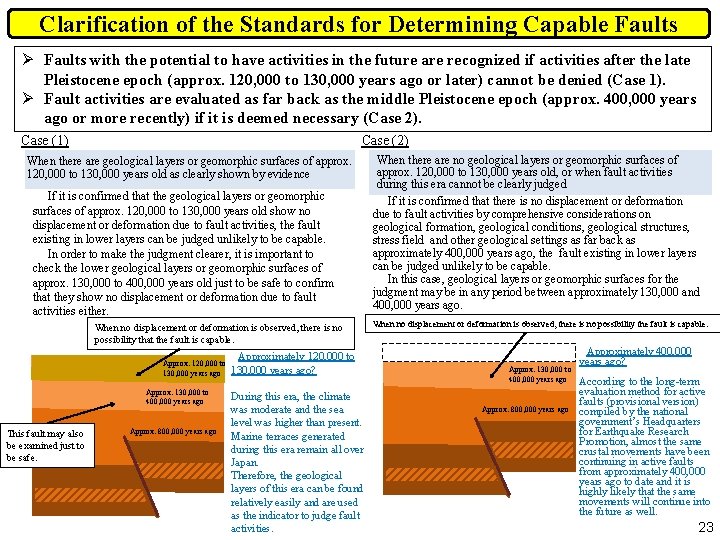
Clarification of the Standards for Determining Capable Faults Ø Faults with the potential to have activities in the future are recognized if activities after the late Pleistocene epoch (approx. 120, 000 to 130, 000 years ago or later) cannot be denied (Case 1). Ø Fault activities are evaluated as far back as the middle Pleistocene epoch (approx. 400, 000 years ago or more recently) if it is deemed necessary (Case 2). 活断層の認定基準を厳格化 Case (1) Case (2) When there are geological layers or geomorphic surfaces of approx. 120, 000 to 130, 000 years old as clearly shown by evidence If it is confirmed that the geological layers or geomorphic surfaces of approx. 120, 000 to 130, 000 years old show no displacement or deformation due to fault activities, the fault existing in lower layers can be judged unlikely to be capable. In order to make the judgment clearer, it is important to check the lower geological layers or geomorphic surfaces of approx. 130, 000 to 400, 000 years old just to be safe to confirm that they show no displacement or deformation due to fault activities either. When no displacement or deformation is observed, there is no possibility that the fault is capable. Approx. 120, 000 to 130, 000 years ago Approx. 130, 000 to 400, 000 years ago This fault may also be examined just to be safe. Approx. 800, 000 years ago Approximately 120, 000 to 130, 000 years ago? During this era, the climate was moderate and the sea level was higher than present. Marine terraces generated during this era remain all over Japan. Therefore, the geological layers of this era can be found relatively easily and are used as the indicator to judge fault activities. When there are no geological layers or geomorphic surfaces of approx. 120, 000 to 130, 000 years old, or when fault activities during this era cannot be clearly judged If it is confirmed that there is no displacement or deformation due to fault activities by comprehensive considerations on geological formation, geological conditions, geological structures, stress field and other geological settings as far back as approximately 400, 000 years ago, the fault existing in lower layers can be judged unlikely to be capable. In this case, geological layers or geomorphic surfaces for the judgment may be in any period between approximately 130, 000 and 400, 000 years ago. When no displacement or deformation is observed, there is no possibility the fault is capable. 約12~13万年前 Approx. 130, 000 to 400, 000 years ago Approx. 800, 000 years ago Approximately 400, 000 years ago? According to the long-term evaluation method for active faults (provisional version) compiled by the national government’s Headquarters for Earthquake Research Promotion, almost the same crustal movements have been continuing in active faults from approximately 400, 000 years ago to date and it is highly likely that the same movements will continue into the future as well. 23
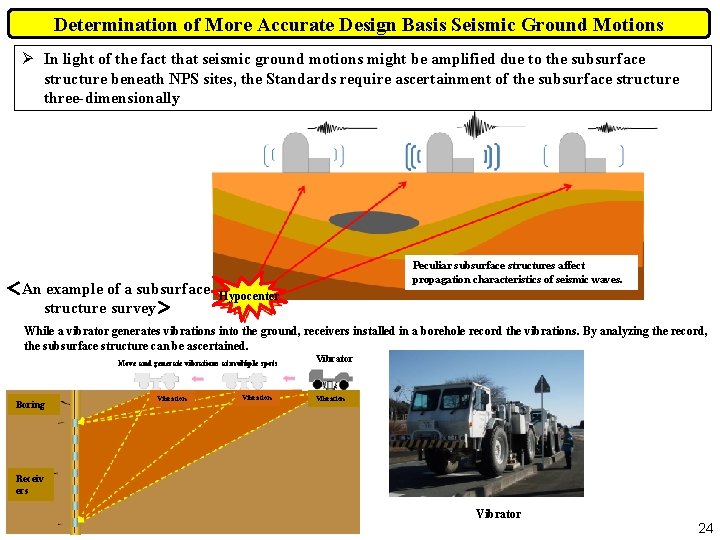
Determination of More Accurate Design Basis Seismic Ground Motions Ø In light of the fact that seismic ground motions might be amplified due to the subsurface structure beneath NPS sites, the Standards require ascertainment of the subsurface structure three-dimensionally <An example of a subsurface structure survey> Peculiar subsurface structures affect propagation characteristics of seismic waves. Hypocenter While a vibrator generates vibrations into the ground, receivers installed in a borehole record the vibrations. By analyzing the record, the subsurface structure can be ascertained. Move and generate vibrations at multiple spots Boring Vibration Vibrator Vibration Receiv ers Vibrator 起振車 24