
NEW NPS Interventions 1 NPS Interventions Overview 2
- Slides: 19
NEW NPS Interventions 1
NPS Interventions Overview 2
In House Interventions Overview • To support effective service user desistance and rehabilitation, the National Probation Service will manage and deliver Accredited Programmes, Structured Interventions, Unpaid Work and Senior Attendance Centres from Day 1, 26 June 2021 • Probation Practitioners will have a variety of statutory services available to them • There will be clear boundaries between rehabilitative interventions delivered by NPS Intervention Team colleagues, 121 work delivered by Probation Practitioners and specialist Commissioned Rehabilitative Services through the Dynamic Framework • Service user change activity undertaken by Probation Practitioners will be underpinned by a nationally approved toolkit to supplement and support delivery of other interventions • Post sentence, Probation Practitioners will allocate the Rehabilitation Activity Requirement days and select and sequence specific interventions that address the most significant areas of need linked to a service user’s reoffending 3
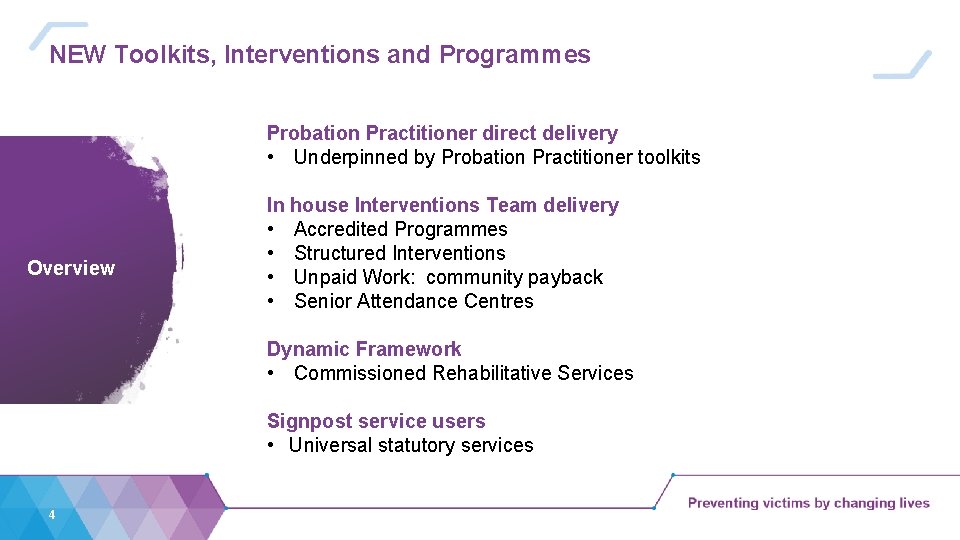
NEW Toolkits, Interventions and Programmes Probation Practitioner direct delivery • Underpinned by Probation Practitioner toolkits Overview In house Interventions Team delivery • Accredited Programmes • Structured Interventions • Unpaid Work: community payback • Senior Attendance Centres Dynamic Framework • Commissioned Rehabilitative Services Signpost service users • Universal statutory services 4
Accredited Programmes 5
Accredited Programmes • HMPPS’ intervention of choice, based on robust international evidence • Available as a sentence of the court under the Criminal Justice Act 2003; three statutory purposes – sentencing reform, offender rehabilitation, public protection • May be added as licence conditions to all types of prison licences and post sentence supervision • Sufficient number of appropriately trained interventions staff to deliver both Accredited Programmes and Structured Interventions, providing greater operational resilience in meeting changing demands and reducing the likelihood of burnout; additional sessional staff as required Overview • Delivered by two trained facilitators in a group setting for up to 12 service users • Alternate delivery format, developed in response to Covid-19, available in exceptional cases to meet diverse needs • All regions to deliver as a minimum: Thinking Skills Programme, Building Better Relationships and Sexual Offending programmes • Delivery of other programmes flexible, based on regional need, at the discretion of each Regional Probation Director • The NPS will also deliver Accredited Programmes for external organisations such as the Children and Family Court Advisory and Support Service, where required 6
Accredited Programmes: Day 1 • All staff delivering Accredited Programmes, including our Divisional Sex Offender Unit teams, will work in new Intervention Teams in our 11 regions and Wales • Processes in place to: 1) allocate Accredited Programme requirements to the regional delivery team within set timescales, 2) notify Programmes Teams of sentence requirements, 3) produce and share summary of attendance notes, three way meetings and post programme reports, and 4) deal with transfers in and out to other regions, and in from youth services Overview • Additional eligibility and suitability checks in place to ensure the right service users are on the right programmes • New timeliness checks at six and three months from end of sentence, to ensure requirements are completed in time and improve Sentencer confidence • Resolve will be delivered where it is currently delivered for Day 1 • Referral and management of Accredited Programmes will be through existing NPS systems • The NPS will deliver the Partner Link Worker service 7
Structured Interventions 8
Structured Interventions • Available as a sentence of the court via a Rehabilitation Activity Requirement under the Offender Rehabilitation Act 2014; fall under the sentencing purposes reform and rehabilitation of offenders, public protection • May be added as licence conditions, including Release on Temporary Licence and Post Sentence Supervision Overview • Based on evidence of effectiveness and a consistent delivery model in three key need areas: emotional management, domestic abuse and attitudes, thinking and behaviour; four session minimum • Targeted at lower risk service users and those ineligible or unsuitable for Accredited Programmes • Primary aim is to secure cognitive and behavioural change; delivered in a group setting, 121 or remotely, to meet specific diverse needs • Meet the Correctional Services Accreditation and Advice Panel endorsed principles for effective interventions • A register of approved Structured Interventions will be centrally maintained and available to Regional Probation Directors for delivery in their region 9
Structured Interventions: Day 1 • Current delivery of Structured Interventions will be maintained as far as possible • Probation Practitioners will refer service users through existing NPS systems • Structured Interventions currently delivered by CRCs will continue to be delivered in the need areas of: Emotional Management, Domestic Abuse and Attitudes, Thinking and Behaviour Overview • All staff delivering Structured Interventions will work in our new Interventions Teams • A national Effective Interventions Panel will review Structured Interventions and approve those which meet the Correctional Services Accreditation and Advice Panel effectiveness principles • Regional Probation Directors will choose the suite of Structured Interventions to be delivered in their region • Post Day 1 roll out of approved Structured Interventions will take place and roll down those not approved 10
Unpaid Work 11
Unpaid Work • Primarily a punishment, with rehabilitation an important additional consideration • Investing in training to ensure public, staff and service user safety • Increased time to allow for a comprehensive pre placement assessment and induction • Supports rehabilitation through skill development in a practical work environment, delivered by sufficient numbers of appropriately trained staff Overview • 20% of hours can be used to develop employment skills for those with an identified need • Placements local to service users, with a maximum travel time of 90 minutes each way, from home to the initial worksite • Community groups will engage in nominating work projects; the provision of high numbers of good quality placements will enable local community payback • Updated Unpaid Work Probation Instruction and Community Payback Operating Manual 12
Unpaid Work: Day 1 • All placements currently being delivered will continue • Core staff delivering Unpaid Work will work in the new probation service; staff learning and development needs will be assessed and training arranged • Probation Practitioners will complete a minimum layer 1 OASys, which the Placement Coordinator will use to identify the most appropriate placement Overview • Increased focus on completions within 12 months of sentence, supported by management information and six and nine month progress reviews • n. Delius used as the case management system for service user scheduling; scheduling supervisors on to Unpaid Work projects will be done through spreadsheets • Nominations for Unpaid Work schemes will continue through the national Gov. uk website • Arrangements in place to ensure availability of vehicles, tools, equipment, PPE, mobile phones, laptops and access to petty cash for essential project needs 13
Senior Attendance Centres 14
Senior Attendance Centres • The Senior Attendance Centre requirement is available as a sentence of the court under the Criminal Justice Act 2003 • One of 12 requirements that can be imposed as part of a community sentence or a suspended sentence; can be imposed as a consequence of non payment of fines Overview • Senior Attendance Centres regimes can accommodate male and female service users aged 18 to 24 • Offer young women provision through separate facilities and separate female only reporting times and instructions • Service users historically required to attend three hour sessions, generally on a Saturday; no statutory specification, good practice to trial different delivery patterns • Minimum number of hours for the total requirement within a community sentence is 12; 36 hour maximum 15
Senior Attendance Centres: Day 1 • All existing Senior Attendance Centres will continue as before • Senior Attendance Centre staff will continue in the same roles at the same centres Overview • Sessional staff will be offered the opportunity to continue with an agency registered with the NPS • All staff will have access to the same equipment and resources 16
NPS Interventions: Day 1 to End State Changes 17
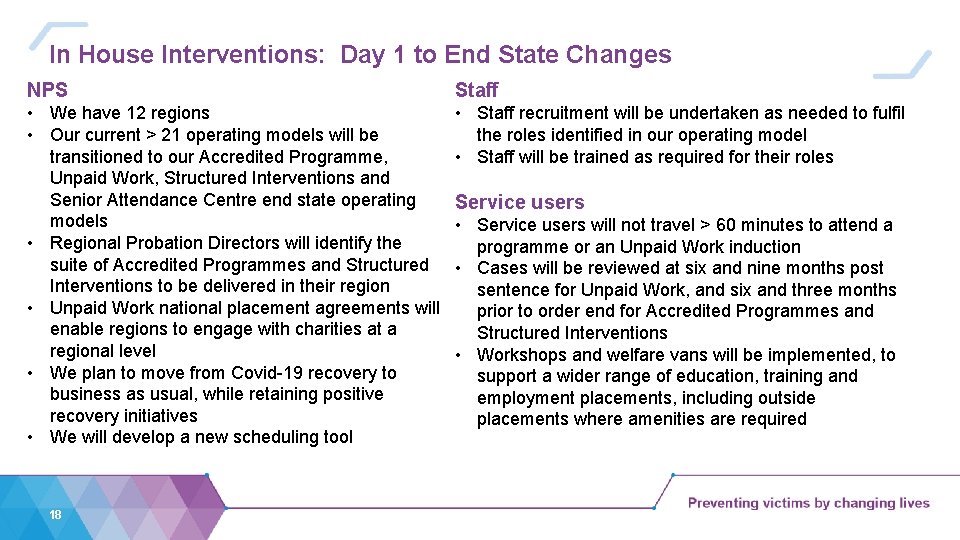
In House Interventions: Day 1 to End State Changes NPS Staff • We have 12 regions • Our current > 21 operating models will be transitioned to our Accredited Programme, Unpaid Work, Structured Interventions and Senior Attendance Centre end state operating models • Regional Probation Directors will identify the suite of Accredited Programmes and Structured Interventions to be delivered in their region • Unpaid Work national placement agreements will enable regions to engage with charities at a regional level • We plan to move from Covid-19 recovery to business as usual, while retaining positive recovery initiatives • We will develop a new scheduling tool • Staff recruitment will be undertaken as needed to fulfil the roles identified in our operating model • Staff will be trained as required for their roles 18 Service users • Service users will not travel > 60 minutes to attend a programme or an Unpaid Work induction • Cases will be reviewed at six and nine months post sentence for Unpaid Work, and six and three months prior to order end for Accredited Programmes and Structured Interventions • Workshops and welfare vans will be implemented, to support a wider range of education, training and employment placements, including outside placements where amenities are required
In House Interventions: more information • Detailed information is available to you: • Accredited Programmes Operating Model March 2021 • Structured Interventions Operating Model March 2021 • Unpaid Work Operating Model March 2021 • Senior Attendance Centres Operating Model March 2021 • Please speak with your manager on how your role might be affected • For questions / clarifications from the Probation Reform Programme In House Interventions team, contact Ali Searle at alison. searle@justice. gov. uk 19