
New Nations Emerge 1945Present III The Modern Middle
- Slides: 12
New Nations Emerge (1945–Present) III. The Modern Middle East Takes Shape
New Nations Emerge (1945–Present) III. The Modern Middle East Takes Shape Learning Objectives • • • Analyze the development of modern nations in the Middle East. Describe the founding of Israel and the impact of the Arab rejection of Israel. Understand how oil has affected nations of the Middle East. Examine the impact of Islam on government, law, and the lives of women. Define the “Arab Spring. ”
New Nations Emerge (1945–Present) III. The Modern Middle East Takes Shape A. Diversity & Creation of Israel 1. After WW 1, GB and France managed the ME in the form of mandates. Eventually, these mandates became independent nations, like Iraq, Syria and Jordan. Many of these new nations had diverse ethnic and religious groups. The Kurds have dreamed of their own state for years. 2. Jews had been campaigning for the creation of Israel for years. After the Holocaust, the UN voted in 1947 to create Jewish and Arab states in the former mandate of Palestine. Jews accepted and in 1948 created Israel. Arabs rejected the partition and declared war on Israel. 3. Israel, with western support, won many wars against Arab countries and expanded its territory and power in the region. Israel relied on the kibbutz system for crops. Golda Meir was an immigrant to Israel, fought in the wars and became Israel’s first female PM in 1969.
B. New Nations in the ME 1. Only a few nations have oil and as a result, they are wealthier compared to their neighbors. Egypt was ruled by Nasser and controlled the Suez Canal. After two failed wars against Israel, Nasser was succeeded by Anwar Sadat, who made peace with Israel. 2. The Arab Spring in 2011 was a brief ray of hope for democracy in the ME but it failed. Mubarak was forced from power in Egypt but the military rules now. The main issue is that secularists went a western-style country and Islamists want a theocracy. Turkey is struggling with this right now. 3. Iran’s govt under Mosaddeq was overthrown in 1952 and the Shah took over. He was overthrown by Ayatollah Khomeini in 1979, who set up a theocracy. Iran is ruled by strict Islamic law and is considered a supporter of terrorism and has nuclear ambitions.
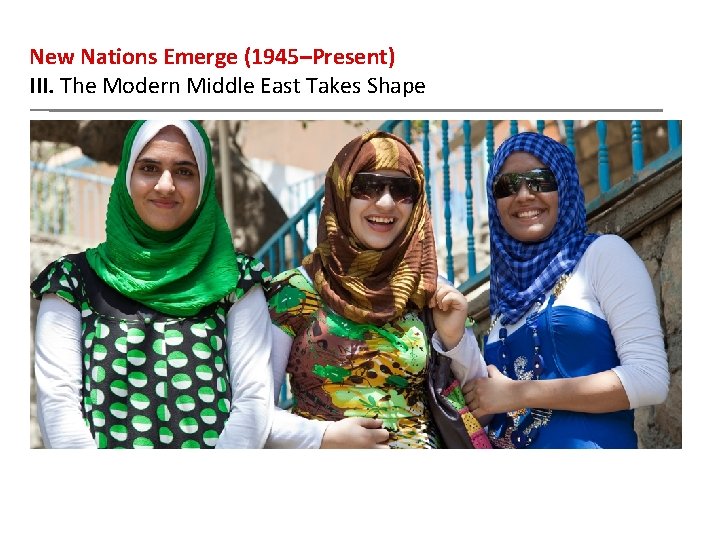
C. Importance of Oil & Islam and the Modern World 1. Oil-producing nations formed OPEC (Organization of Petroleum Exporting Countries) in 1960. Saudi Arabia, Iran, Iraq, Kuwait and many other ME nations are in it, along with Venezuela. They’ve caused global recessions controlling the supply of oil. Saudi Arabia practices Wahhabism, a strict form of Islam. 2. Many ME countries established western-style democracies and favored western culture. Many Muslims demanded change and wanted a return to Sharia law, laws based on the Quran. Some radical groups have formed, turning to violence to achieve their goals in their countries. 3. The status of women in this part of the world is complicated. Some women have abandoned the hejab and traditional Muslim dress for western clothing. Others have embraced it as a renewed dedication to their faith. However, in many ME nations, women are struggling to gain and keep their rights in the face of a very conservative culture.
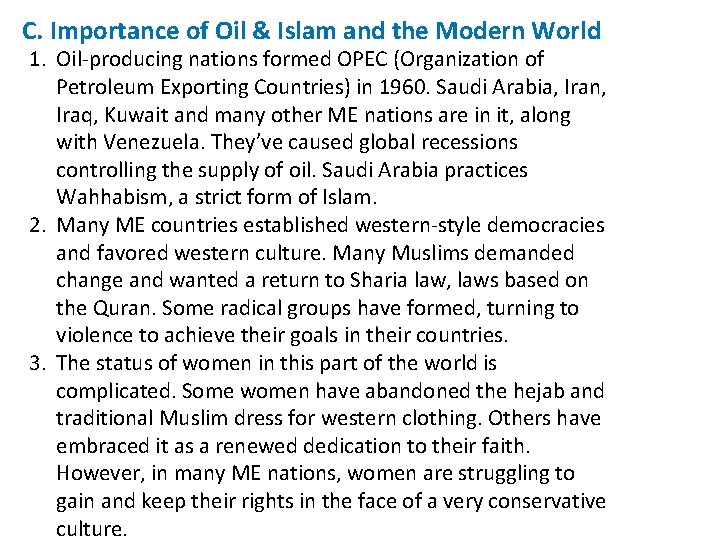
The Challenges of Diversity Christians make up a sizable minority in Lebanon, Syria, and Egypt. Here, women worship in a Syrian Orthodox church. In Lebanon, where 39 percent of the population is Christian, there are 12 different Christian sects.
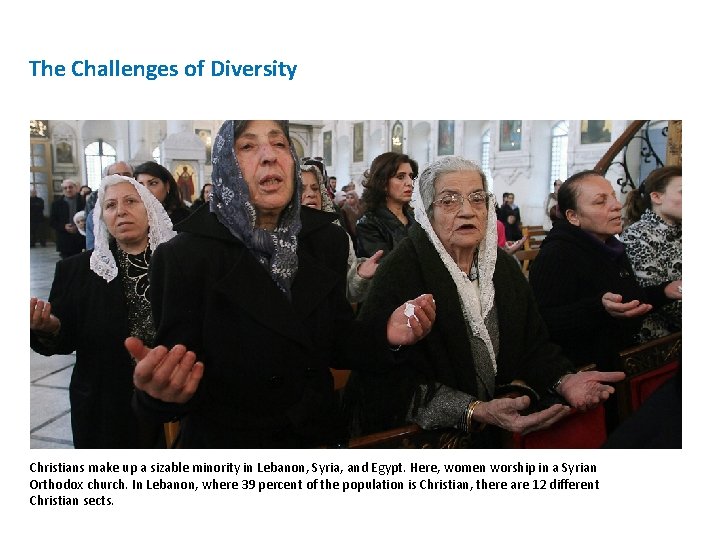
The Challenges of Diversity Analyze Maps This map shows the countries of the modern Middle East. Saudi Arabia, Kuwait, and Iran are three of the world’s largest oil-producing countries. Why might control of the Straits of Hormuz be important?
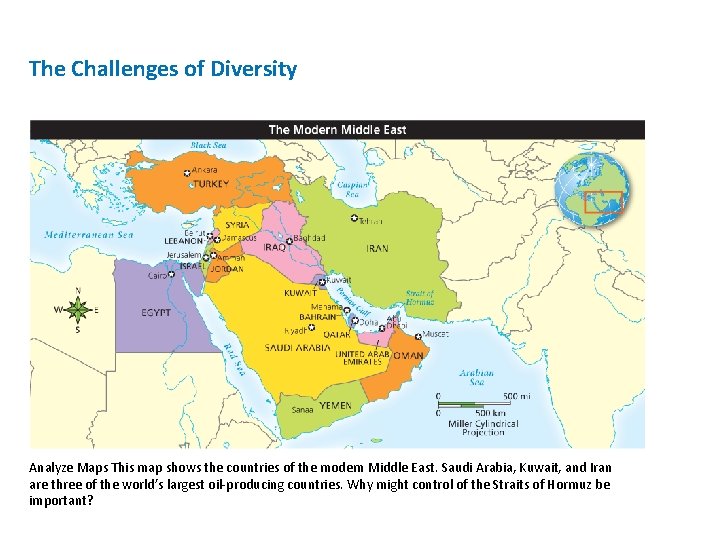
The Founding of Israeli flags fly in New York City to celebrate the birth of Israel, which became an independent state on May 14, 1948. Explain Why was an Arab state not established as well?
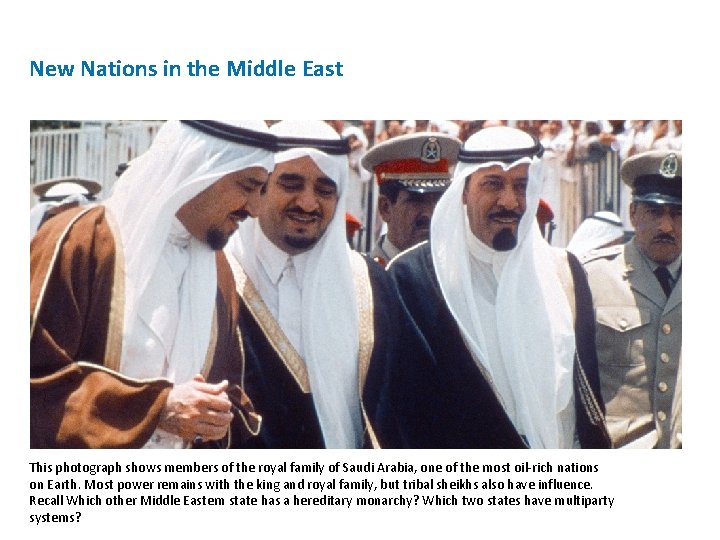
New Nations in the Middle East This photograph shows members of the royal family of Saudi Arabia, one of the most oil-rich nations on Earth. Most power remains with the king and royal family, but tribal sheikhs also have influence. Recall Which other Middle Eastern state has a hereditary monarchy? Which two states have multiparty systems?
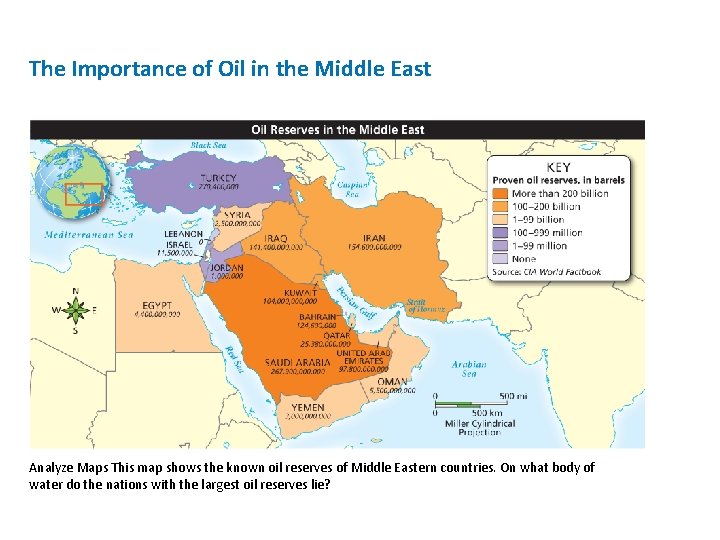
The Importance of Oil in the Middle East Analyze Maps This map shows the known oil reserves of Middle Eastern countries. On what body of water do the nations with the largest oil reserves lie?
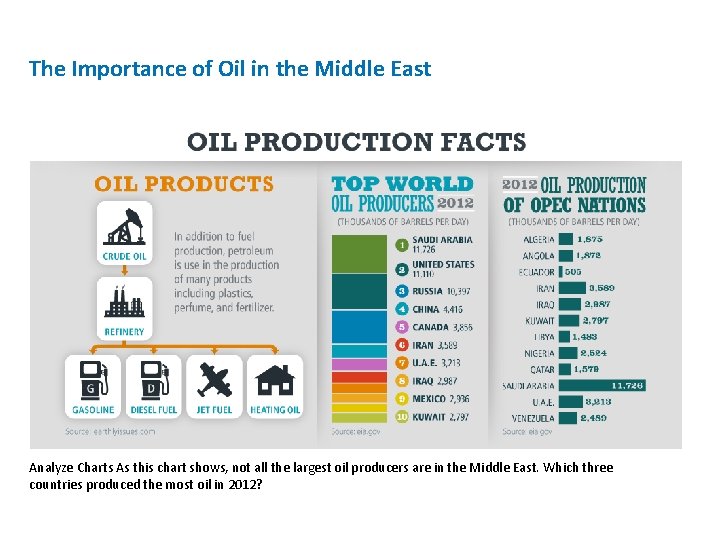
The Importance of Oil in the Middle East Analyze Charts As this chart shows, not all the largest oil producers are in the Middle East. Which three countries produced the most oil in 2012?
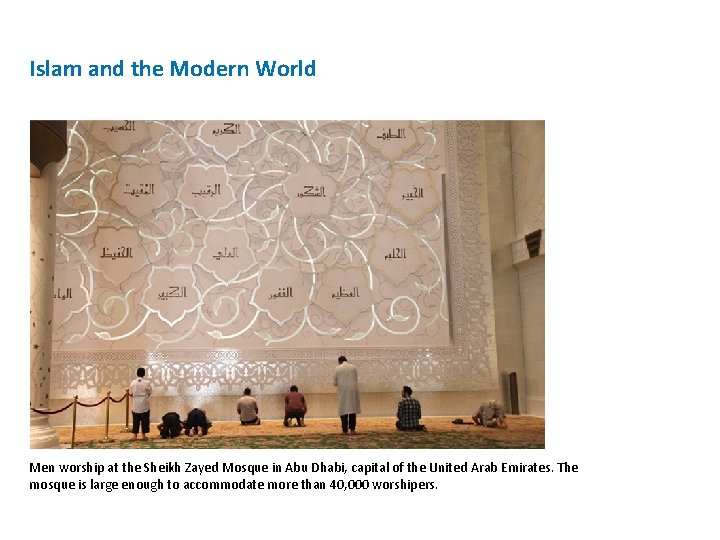
Islam and the Modern World Men worship at the Sheikh Zayed Mosque in Abu Dhabi, capital of the United Arab Emirates. The mosque is large enough to accommodate more than 40, 000 worshipers.