
New Nations After WWII WH Chapter 18 Review
- Slides: 14
New Nations After WWII WH Chapter 18 Review
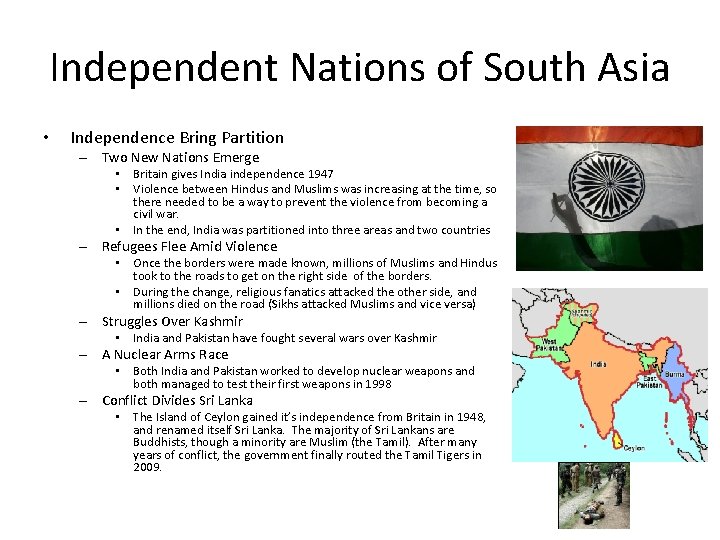
Independent Nations of South Asia • Independence Bring Partition – Two New Nations Emerge • Britain gives India independence 1947 • Violence between Hindus and Muslims was increasing at the time, so there needed to be a way to prevent the violence from becoming a civil war. • In the end, India was partitioned into three areas and two countries – Refugees Flee Amid Violence • Once the borders were made known, millions of Muslims and Hindus took to the roads to get on the right side of the borders. • During the change, religious fanatics attacked the other side, and millions died on the road (Sikhs attacked Muslims and vice versa) – Struggles Over Kashmir • India and Pakistan have fought several wars over Kashmir – A Nuclear Arms Race • Both India and Pakistan worked to develop nuclear weapons and both managed to test their first weapons in 1998 – Conflict Divides Sri Lanka • The Island of Ceylon gained it’s independence from Britain in 1948, and renamed itself Sri Lanka. The majority of Sri Lankans are Buddhists, though a minority are Muslim (the Tamil). After many years of conflict, the government finally routed the Tamil Tigers in 2009.
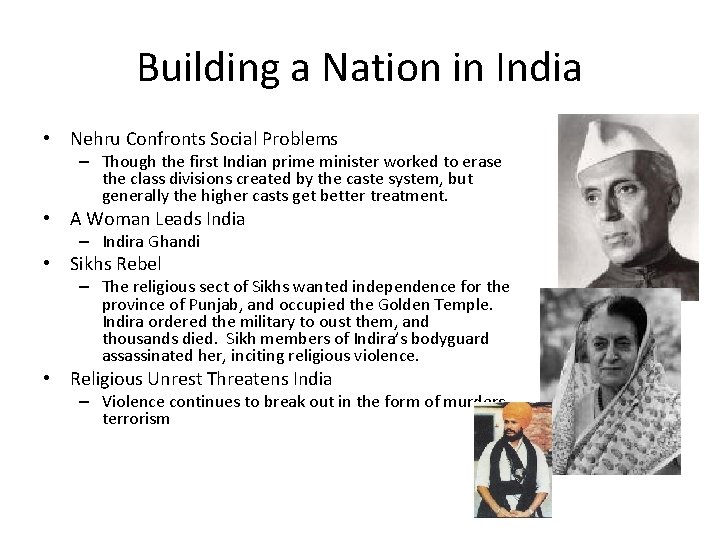
Building a Nation in India • Nehru Confronts Social Problems – Though the first Indian prime minister worked to erase the class divisions created by the caste system, but generally the higher casts get better treatment. • A Woman Leads India – Indira Ghandi • Sikhs Rebel – The religious sect of Sikhs wanted independence for the province of Punjab, and occupied the Golden Temple. Indira ordered the military to oust them, and thousands died. Sikh members of Indira’s bodyguard assassinated her, inciting religious violence. • Religious Unrest Threatens India – Violence continues to break out in the form of murders, terrorism
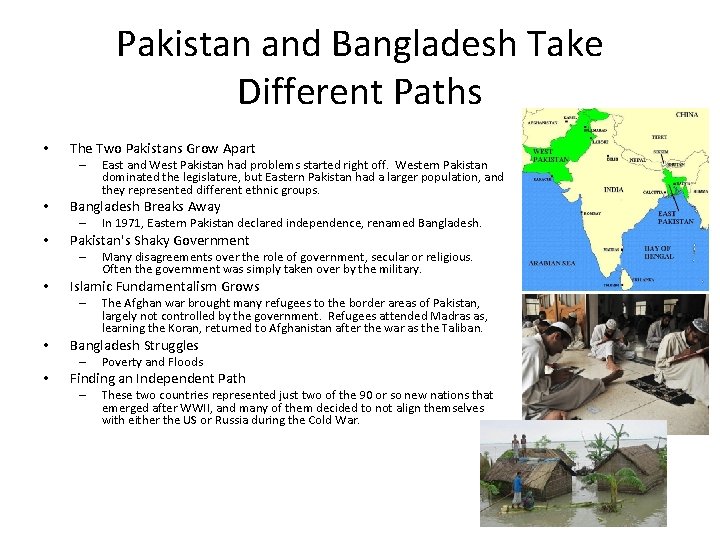
Pakistan and Bangladesh Take Different Paths • The Two Pakistans Grow Apart – • Bangladesh Breaks Away – • The Afghan war brought many refugees to the border areas of Pakistan, largely not controlled by the government. Refugees attended Madras as, learning the Koran, returned to Afghanistan after the war as the Taliban. Bangladesh Struggles – • Many disagreements over the role of government, secular or religious. Often the government was simply taken over by the military. Islamic Fundamentalism Grows – • In 1971, Eastern Pakistan declared independence, renamed Bangladesh. Pakistan's Shaky Government – • East and West Pakistan had problems started right off. Western Pakistan dominated the legislature, but Eastern Pakistan had a larger population, and they represented different ethnic groups. Poverty and Floods Finding an Independent Path – These two countries represented just two of the 90 or so new nations that emerged after WWII, and many of them decided to not align themselves with either the US or Russia during the Cold War.
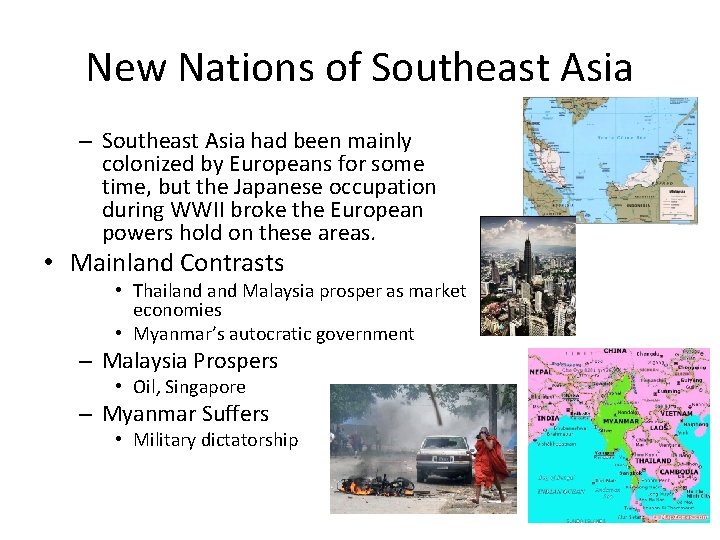
New Nations of Southeast Asia – Southeast Asia had been mainly colonized by Europeans for some time, but the Japanese occupation during WWII broke the European powers hold on these areas. • Mainland Contrasts • Thailand Malaysia prosper as market economies • Myanmar’s autocratic government – Malaysia Prospers • Oil, Singapore – Myanmar Suffers • Military dictatorship
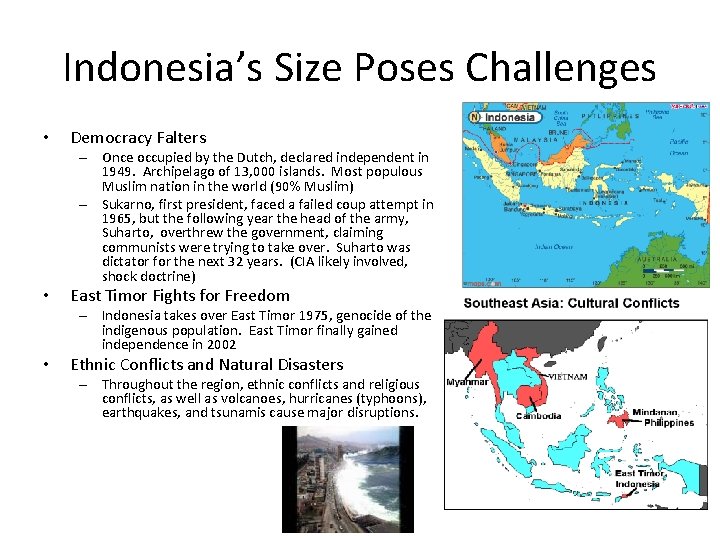
Indonesia’s Size Poses Challenges • Democracy Falters – Once occupied by the Dutch, declared independent in 1949. Archipelago of 13, 000 islands. Most populous Muslim nation in the world (90% Muslim) – Sukarno, first president, faced a failed coup attempt in 1965, but the following year the head of the army, Suharto, overthrew the government, claiming communists were trying to take over. Suharto was dictator for the next 32 years. (CIA likely involved, shock doctrine) • East Timor Fights for Freedom – Indonesia takes over East Timor 1975, genocide of the indigenous population. East Timor finally gained independence in 2002 • Ethnic Conflicts and Natural Disasters – Throughout the region, ethnic conflicts and religious conflicts, as well as volcanoes, hurricanes (typhoons), earthquakes, and tsunamis cause major disruptions.
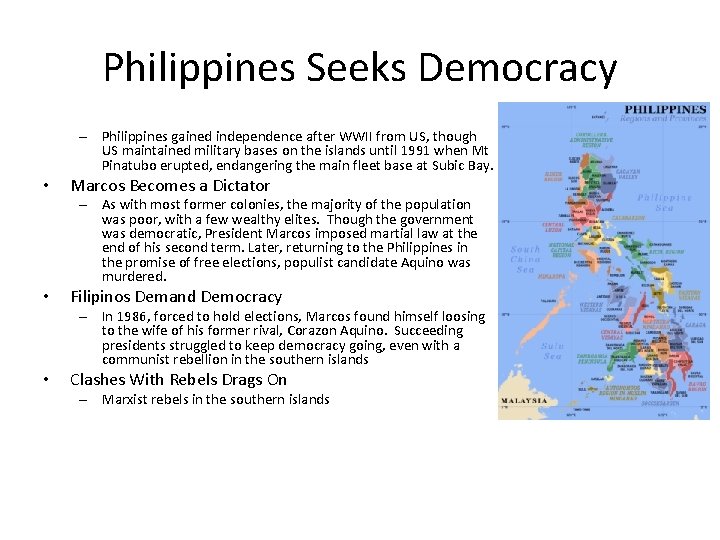
Philippines Seeks Democracy – Philippines gained independence after WWII from US, though US maintained military bases on the islands until 1991 when Mt Pinatubo erupted, endangering the main fleet base at Subic Bay. • Marcos Becomes a Dictator – As with most former colonies, the majority of the population was poor, with a few wealthy elites. Though the government was democratic, President Marcos imposed martial law at the end of his second term. Later, returning to the Philippines in the promise of free elections, populist candidate Aquino was murdered. • Filipinos Demand Democracy – In 1986, forced to hold elections, Marcos found himself loosing to the wife of his former rival, Corazon Aquino. Succeeding presidents struggled to keep democracy going, even with a communist rebellion in the southern islands • Clashes With Rebels Drags On – Marxist rebels in the southern islands
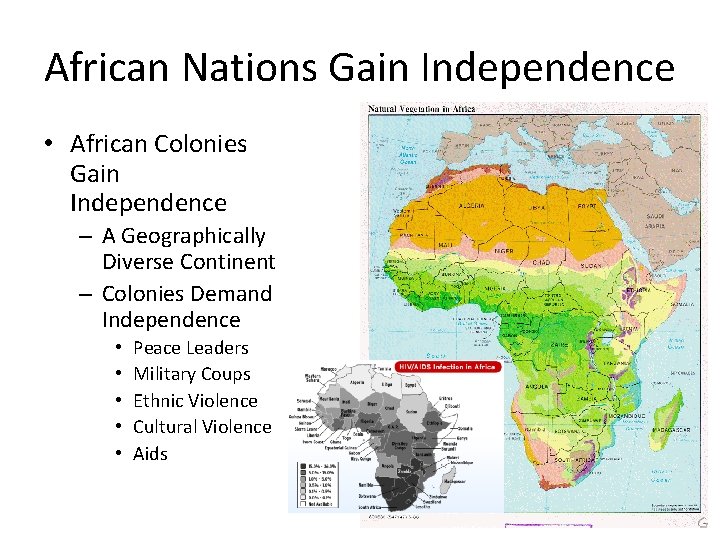
African Nations Gain Independence • African Colonies Gain Independence – A Geographically Diverse Continent – Colonies Demand Independence • • • Peace Leaders Military Coups Ethnic Violence Cultural Violence Aids
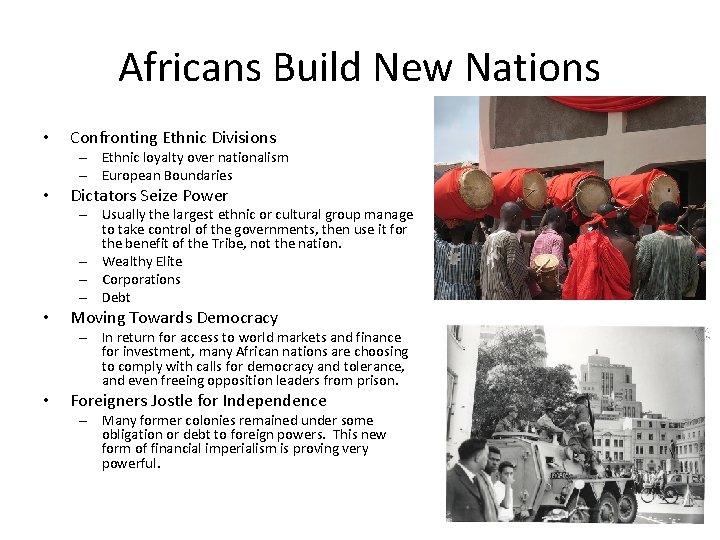
Africans Build New Nations • Confronting Ethnic Divisions – Ethnic loyalty over nationalism – European Boundaries • Dictators Seize Power – Usually the largest ethnic or cultural group manage to take control of the governments, then use it for the benefit of the Tribe, not the nation. – Wealthy Elite – Corporations – Debt • Moving Towards Democracy – In return for access to world markets and finance for investment, many African nations are choosing to comply with calls for democracy and tolerance, and even freeing opposition leaders from prison. • Foreigners Jostle for Independence – Many former colonies remained under some obligation or debt to foreign powers. This new form of financial imperialism is proving very powerful.
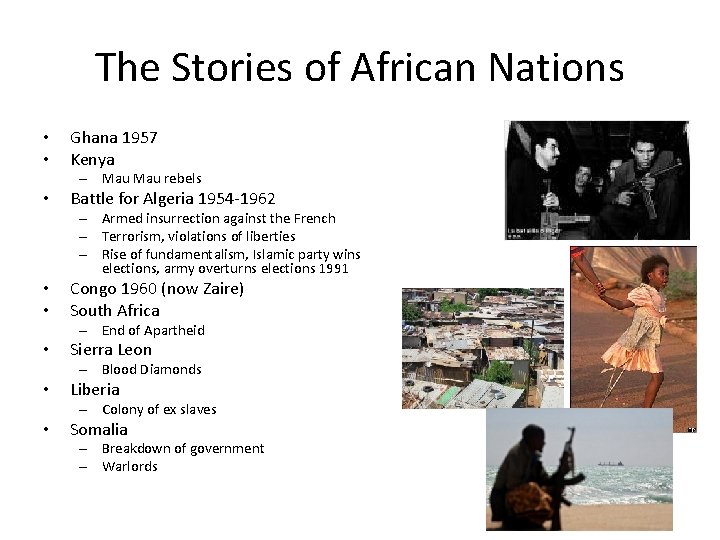
The Stories of African Nations • • Ghana 1957 Kenya – Mau rebels • Battle for Algeria 1954 -1962 – Armed insurrection against the French – Terrorism, violations of liberties – Rise of fundamentalism, Islamic party wins elections, army overturns elections 1991 • • Congo 1960 (now Zaire) South Africa – End of Apartheid • Sierra Leon – Blood Diamonds • Liberia – Colony of ex slaves • Somalia – Breakdown of government – Warlords
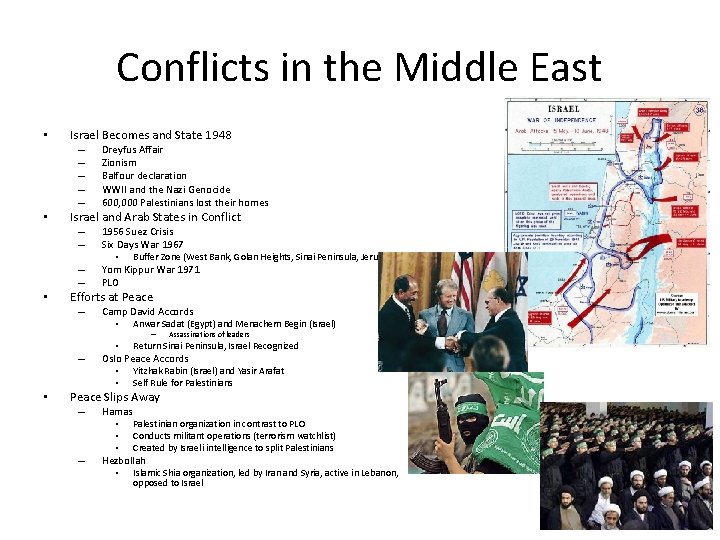
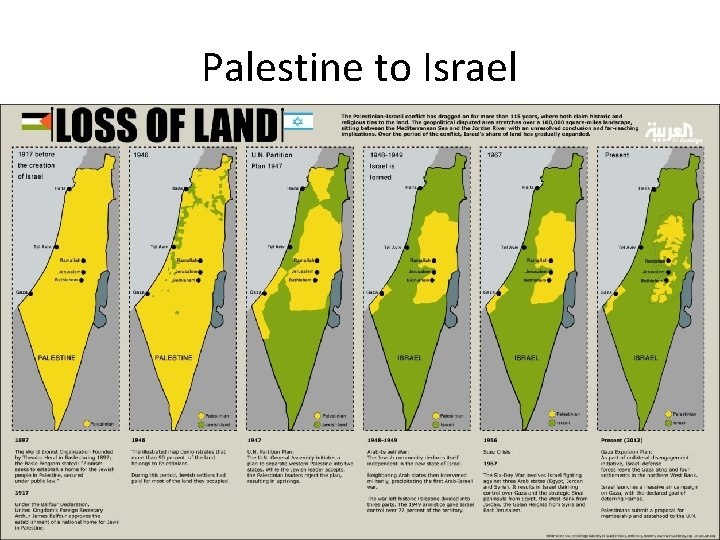
Conflicts in the Middle East • Israel Becomes and State 1948 – – – • Israel and Arab States in Conflict – – • Dreyfus Affair Zionism Balfour declaration WWII and the Nazi Genocide 600, 000 Palestinians lost their homes 1956 Suez Crisis Six Days War 1967 • Buffer Zone (West Bank, Golan Heights, Sinai Peninsula, Jerusalem Yom Kippur War 1971 PLO Efforts at Peace – Camp David Accords • Anwar Sadat (Egypt) and Menachem Begin (Israel) – – • Assassinations of leaders • Return Sinai Peninsula, Israel Recognized Oslo Peace Accords • Yitzhak Rabin (Israel) and Yasir Arafat • Self Rule for Palestinians Peace Slips Away – – Hamas • Palestinian organization in contrast to PLO • Conducts militant operations (terrorism watchlist) • Created by Israeli intelligence to split Palestinians Hezbollah • Islamic Shia organization, led by Iran and Syria, active in Lebanon, opposed to Israel
Palestine to Israel
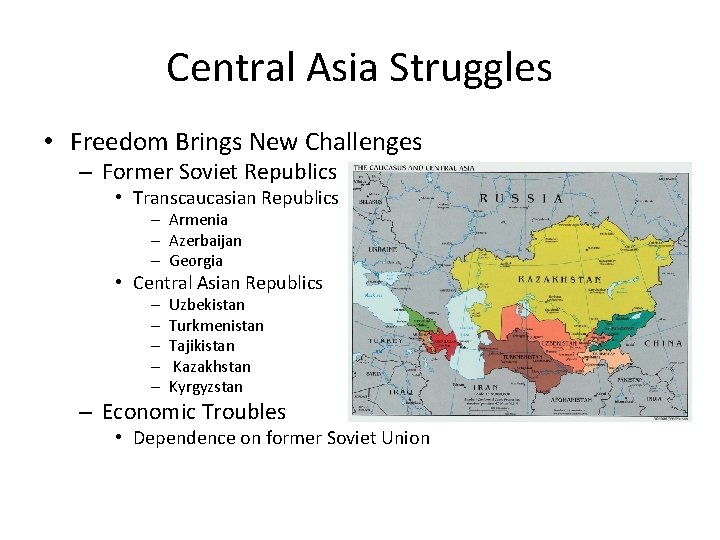
Central Asia Struggles • Freedom Brings New Challenges – Former Soviet Republics • Transcaucasian Republics – Armenia – Azerbaijan – Georgia • Central Asian Republics – – – Uzbekistan Turkmenistan Tajikistan Kazakhstan Kyrgyzstan – Economic Troubles • Dependence on former Soviet Union
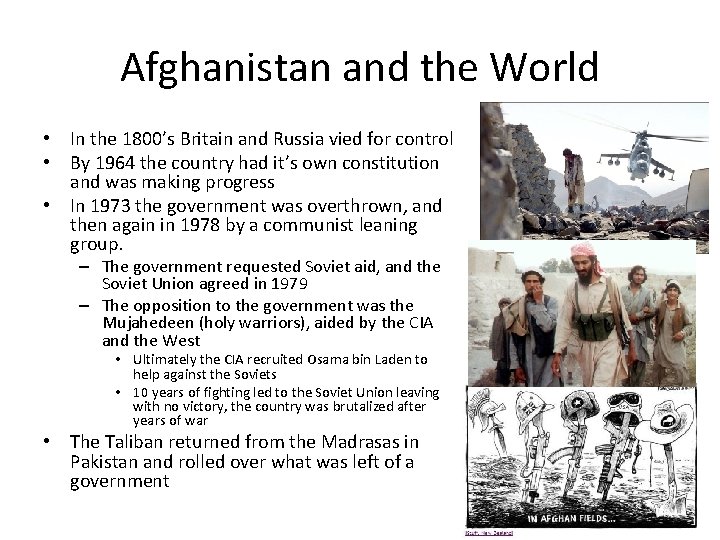
Afghanistan and the World • In the 1800’s Britain and Russia vied for control • By 1964 the country had it’s own constitution and was making progress • In 1973 the government was overthrown, and then again in 1978 by a communist leaning group. – The government requested Soviet aid, and the Soviet Union agreed in 1979 – The opposition to the government was the Mujahedeen (holy warriors), aided by the CIA and the West • Ultimately the CIA recruited Osama bin Laden to help against the Soviets • 10 years of fighting led to the Soviet Union leaving with no victory, the country was brutalized after years of war • The Taliban returned from the Madrasas in Pakistan and rolled over what was left of a government