
New National Curriculum Assessment Changes A Summary Guide
- Slides: 35
New National Curriculum & Assessment Changes A Summary Guide to the Changes and Expectations for 2015/16 Wednesday 24 th February 2016
New National Curriculum • All local authority schools are now required to follow a new national curriculum framework, as set out by the government. • In the last academic year, 2014 -15, children in Year 2 and Year 6 followed the framework of the previous curriculum, whilst other year groups moved to the new curriculum. • From September 2015, at primary level, this requirement applies to all years from Year 1 to Year 6. • From this academic year National Curriculum levels are no longer relevant and will not be used to assess children or inform parents at the end of Key next page
Statutory Coverage in KS 2 • Subjects are classed as ‘core’ and ‘foundation’. • Core Subjects: English, Mathematics & Science. • Foundation Subjects: Art and Design, Computing, Design and Technology, Languages*, Geography, History, Music, Physical Education (PE). • The curriculum must be ‘balanced and broadly based’. • This also includes Religious Education and PSHE (personal, social, health and economic education). • Key Stage 1: Year 1 & 2 (Age 5 -7) • Key Stage 2: Years 3 -6 (Age 7 -11) (sometimes divided into lower KS 2/Y 3 -4 and upper KS 2/Y 5 -6) next page
Key Changes • Change in the curriculum aims to raise standards – the new curriculum is intended to be more challenging, in particular in English and maths • English (language and literacy) and Maths (numeracy and mathematics) are essential skills within the curriculum. • An expectation is set out to develop confidence and skills in these specific areas as well as in a cross-curricular approach through other subjects • The content in general is slimmer, particularly in the foundation subjects. It focuses on essential core subject knowledge and skills. next page
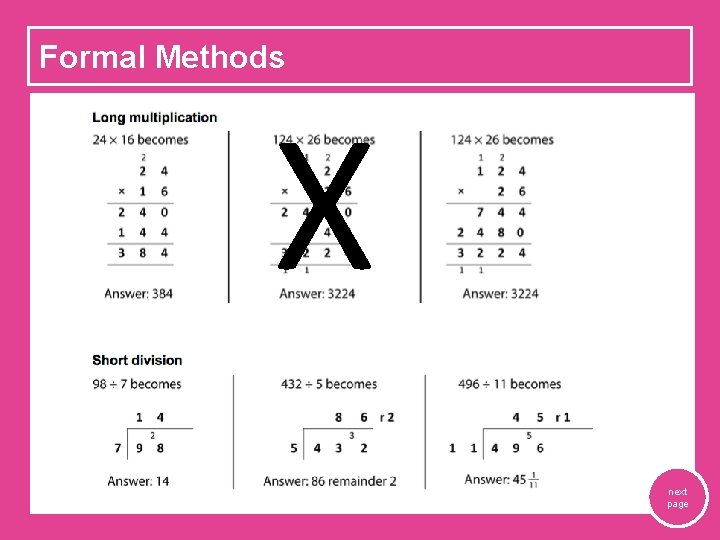
Key Changes • Literacy and numeracy now gone – English and maths are back! • In Maths there is a much greater emphasis on arithmetic and formal written methods of. Also more demanding content in fractions, decimals and percentages. • In English pupils will be expected to have stronger command of written and spoken word with greater demands made on grammatical knowledge. • ICT renamed ‘Computing’ and has more programming than using programs. • Science focuses on importance of scientific knowledge and language with an increased emphasis on core scientific concepts. • Language now statutory at KS 2. • In other curriculum areas content has been slimmed down to allow schools to adapt the curriculum to focus on essential knowledge needed in each year group. next page
Key Changes next page
Raising Expectations click to see all text • The following slides give some examples of the statutory expectations set out in the new national curriculum programmes of study. • These are just a summary of examples and not exhaustive lists. • The statements are taken directly from the government’s published national curriculum framework for all local authority maintained schools. • These are intended to give a flavour of the higher expectations now in place. All children will still need to work at an appropriate level for their individual needs. next page
English (Literacy) • English is divided and subdivided into: o Reading (Word Reading and Comprehension) o Writing (Transcription: spelling and handwriting; and Composition (articulating ideas and structuring them) Within this area, there is now a much greater emphasis on technical skills of grammar, vocabulary and punctuation. Click your chosen year group below: Year 1 Year 2 Year 3&4 Year 5&6 next page
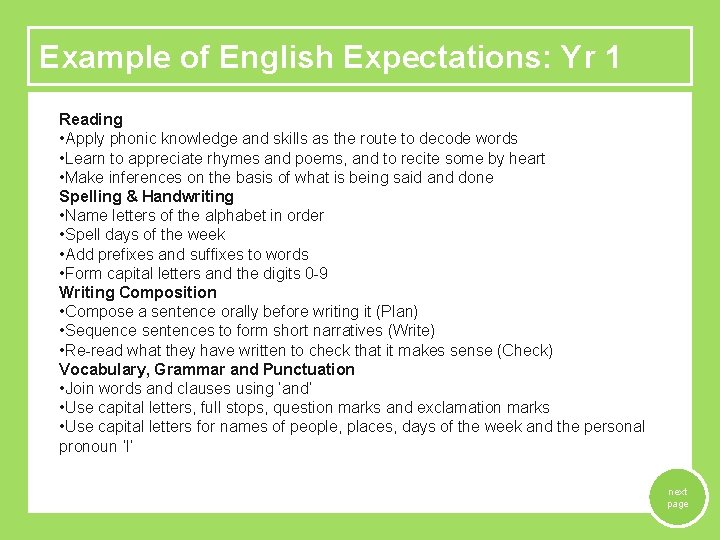
Example of English Expectations: Yr 1 Reading • Apply phonic knowledge and skills as the route to decode words • Learn to appreciate rhymes and poems, and to recite some by heart • Make inferences on the basis of what is being said and done Spelling & Handwriting • Name letters of the alphabet in order • Spell days of the week • Add prefixes and suffixes to words • Form capital letters and the digits 0 -9 Writing Composition • Compose a sentence orally before writing it (Plan) • Sequence sentences to form short narratives (Write) • Re-read what they have written to check that it makes sense (Check) Vocabulary, Grammar and Punctuation • Join words and clauses using ‘and’ • Use capital letters, full stops, question marks and exclamation marks • Use capital letters for names of people, places, days of the week and the personal pronoun ‘I’ next page
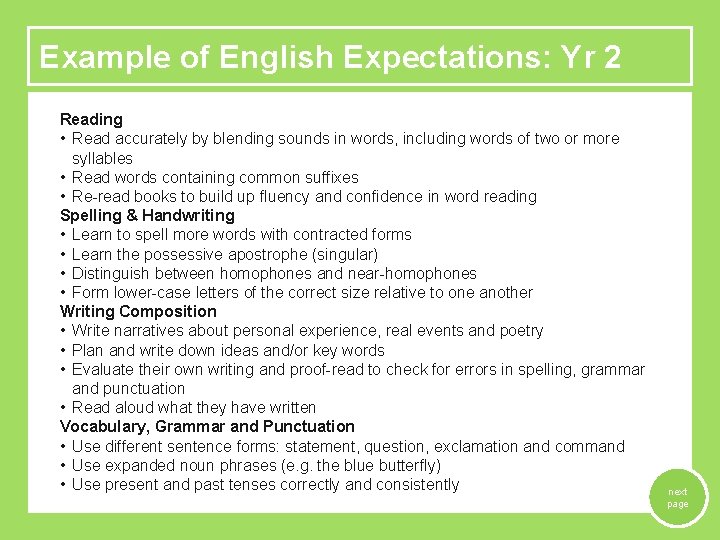
Example of English Expectations: Yr 2 Reading • Read accurately by blending sounds in words, including words of two or more syllables • Read words containing common suffixes • Re-read books to build up fluency and confidence in word reading Spelling & Handwriting • Learn to spell more words with contracted forms • Learn the possessive apostrophe (singular) • Distinguish between homophones and near-homophones • Form lower-case letters of the correct size relative to one another Writing Composition • Write narratives about personal experience, real events and poetry • Plan and write down ideas and/or key words • Evaluate their own writing and proof-read to check for errors in spelling, grammar and punctuation • Read aloud what they have written Vocabulary, Grammar and Punctuation • Use different sentence forms: statement, question, exclamation and command • Use expanded noun phrases (e. g. the blue butterfly) • Use present and past tenses correctly and consistently next page
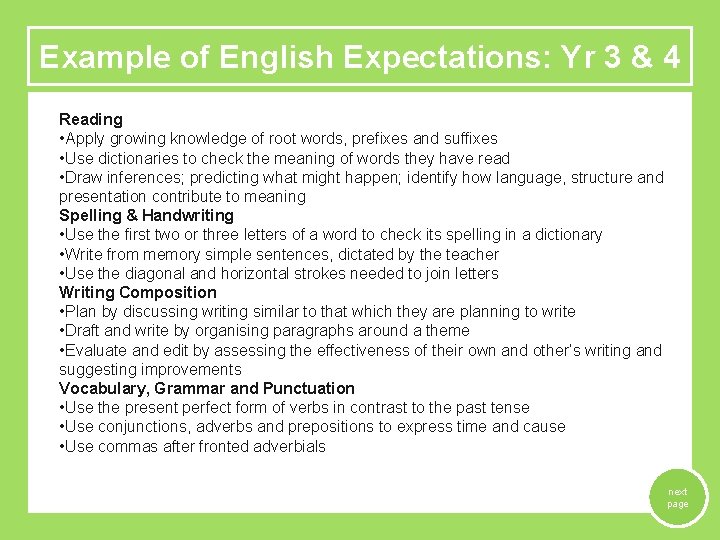
Example of English Expectations: Yr 3 & 4 Reading • Apply growing knowledge of root words, prefixes and suffixes • Use dictionaries to check the meaning of words they have read • Draw inferences; predicting what might happen; identify how language, structure and presentation contribute to meaning Spelling & Handwriting • Use the first two or three letters of a word to check its spelling in a dictionary • Write from memory simple sentences, dictated by the teacher • Use the diagonal and horizontal strokes needed to join letters Writing Composition • Plan by discussing writing similar to that which they are planning to write • Draft and write by organising paragraphs around a theme • Evaluate and edit by assessing the effectiveness of their own and other’s writing and suggesting improvements Vocabulary, Grammar and Punctuation • Use the present perfect form of verbs in contrast to the past tense • Use conjunctions, adverbs and prepositions to express time and cause • Use commas after fronted adverbials next page
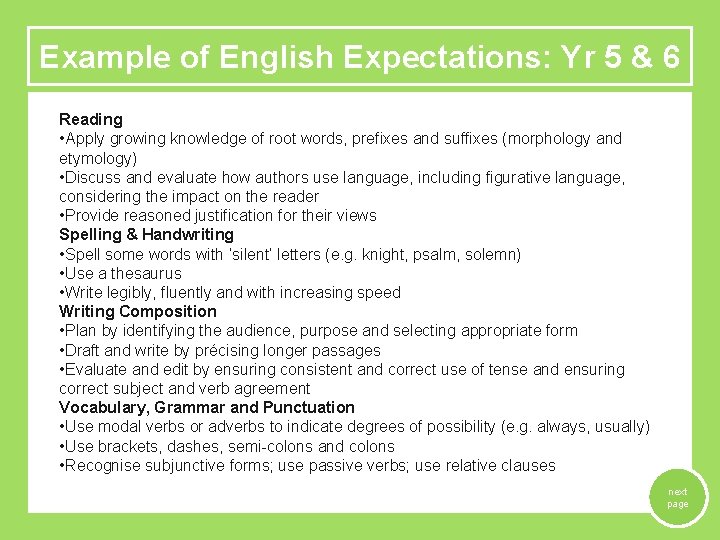
Example of English Expectations: Yr 5 & 6 Reading • Apply growing knowledge of root words, prefixes and suffixes (morphology and etymology) • Discuss and evaluate how authors use language, including figurative language, considering the impact on the reader • Provide reasoned justification for their views Spelling & Handwriting • Spell some words with ‘silent’ letters (e. g. knight, psalm, solemn) • Use a thesaurus • Write legibly, fluently and with increasing speed Writing Composition • Plan by identifying the audience, purpose and selecting appropriate form • Draft and write by précising longer passages • Evaluate and edit by ensuring consistent and correct use of tense and ensuring correct subject and verb agreement Vocabulary, Grammar and Punctuation • Use modal verbs or adverbs to indicate degrees of possibility (e. g. always, usually) • Use brackets, dashes, semi-colons and colons • Recognise subjunctive forms; use passive verbs; use relative clauses next page
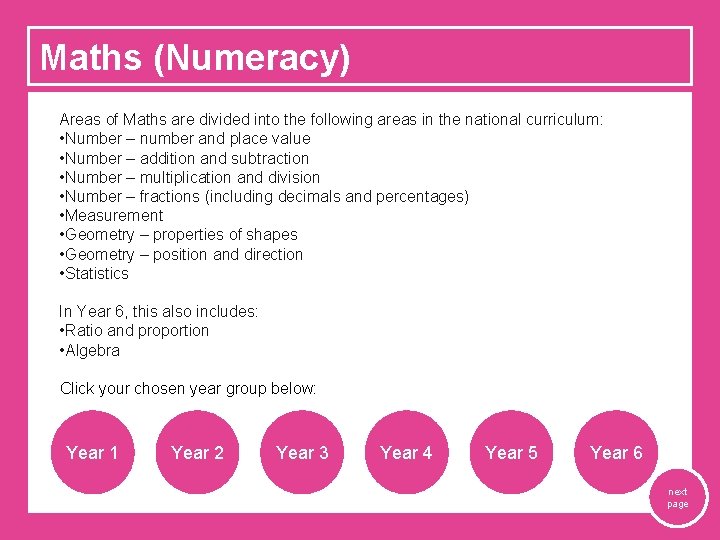
Maths (Numeracy) Areas of Maths are divided into the following areas in the national curriculum: • Number – number and place value • Number – addition and subtraction • Number – multiplication and division • Number – fractions (including decimals and percentages) • Measurement • Geometry – properties of shapes • Geometry – position and direction • Statistics In Year 6, this also includes: • Ratio and proportion • Algebra Click your chosen year group below: Year 1 Year 2 Year 3 Year 4 Year 5 Year 6 next page
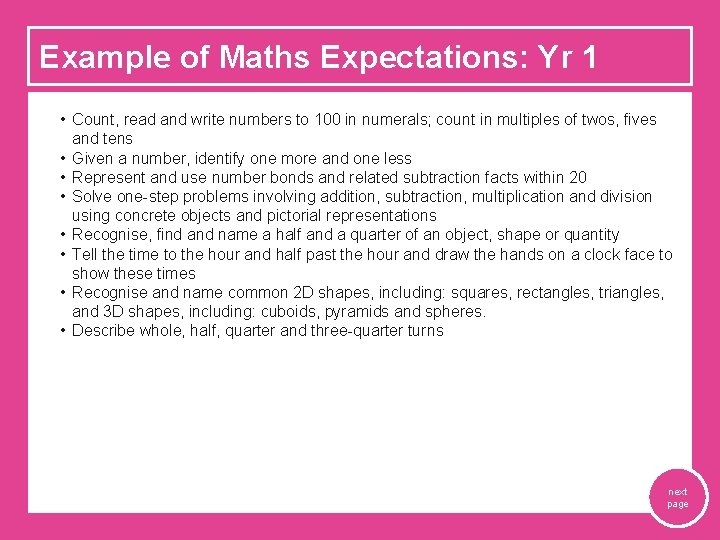
Example of Maths Expectations: Yr 1 • Count, read and write numbers to 100 in numerals; count in multiples of twos, fives and tens • Given a number, identify one more and one less • Represent and use number bonds and related subtraction facts within 20 • Solve one-step problems involving addition, subtraction, multiplication and division using concrete objects and pictorial representations • Recognise, find and name a half and a quarter of an object, shape or quantity • Tell the time to the hour and half past the hour and draw the hands on a clock face to show these times • Recognise and name common 2 D shapes, including: squares, rectangles, triangles, and 3 D shapes, including: cuboids, pyramids and spheres. • Describe whole, half, quarter and three-quarter turns next page
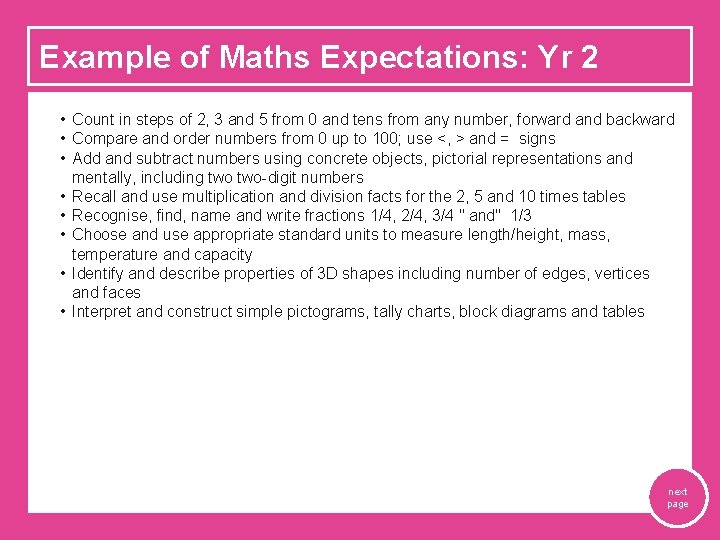
Example of Maths Expectations: Yr 2 • Count in steps of 2, 3 and 5 from 0 and tens from any number, forward and backward • Compare and order numbers from 0 up to 100; use <, > and = signs • Add and subtract numbers using concrete objects, pictorial representations and mentally, including two-digit numbers • Recall and use multiplication and division facts for the 2, 5 and 10 times tables • Recognise, find, name and write fractions 1/4, 2/4, 3/4 " and" 1/3 • Choose and use appropriate standard units to measure length/height, mass, temperature and capacity • Identify and describe properties of 3 D shapes including number of edges, vertices and faces • Interpret and construct simple pictograms, tally charts, block diagrams and tables next page
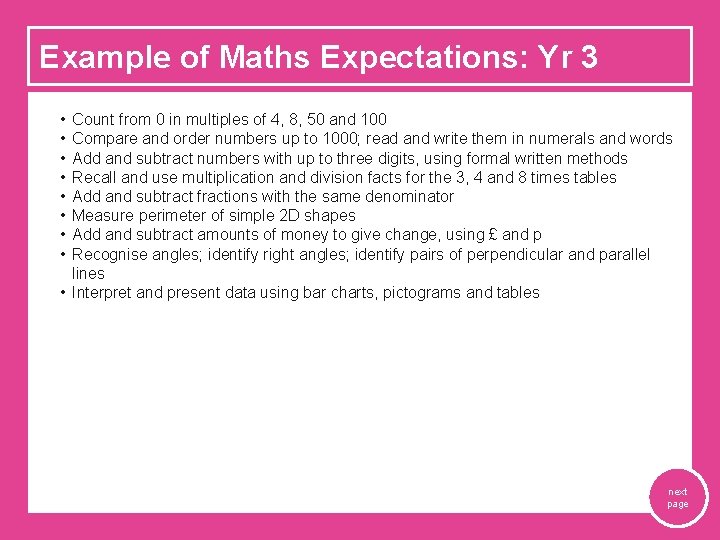
Example of Maths Expectations: Yr 3 • • Count from 0 in multiples of 4, 8, 50 and 100 Compare and order numbers up to 1000; read and write them in numerals and words Add and subtract numbers with up to three digits, using formal written methods Recall and use multiplication and division facts for the 3, 4 and 8 times tables Add and subtract fractions with the same denominator Measure perimeter of simple 2 D shapes Add and subtract amounts of money to give change, using £ and p Recognise angles; identify right angles; identify pairs of perpendicular and parallel lines • Interpret and present data using bar charts, pictograms and tables next page
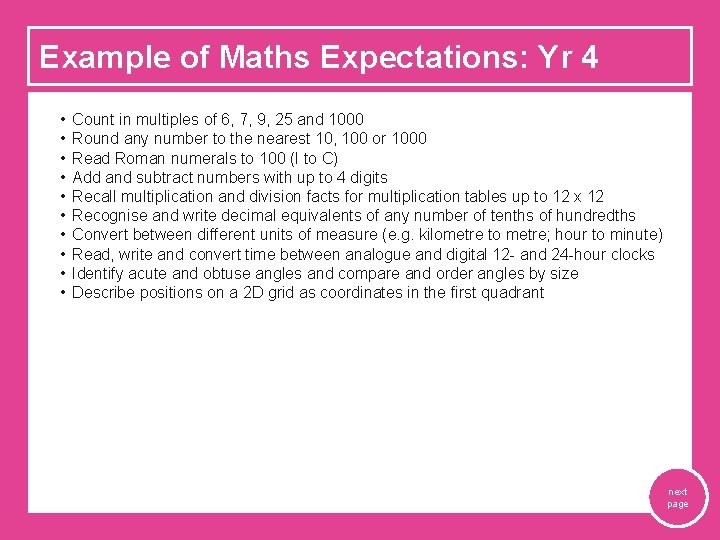
Example of Maths Expectations: Yr 4 • • • Count in multiples of 6, 7, 9, 25 and 1000 Round any number to the nearest 10, 100 or 1000 Read Roman numerals to 100 (I to C) Add and subtract numbers with up to 4 digits Recall multiplication and division facts for multiplication tables up to 12 x 12 Recognise and write decimal equivalents of any number of tenths of hundredths Convert between different units of measure (e. g. kilometre to metre; hour to minute) Read, write and convert time between analogue and digital 12 - and 24 -hour clocks Identify acute and obtuse angles and compare and order angles by size Describe positions on a 2 D grid as coordinates in the first quadrant next page
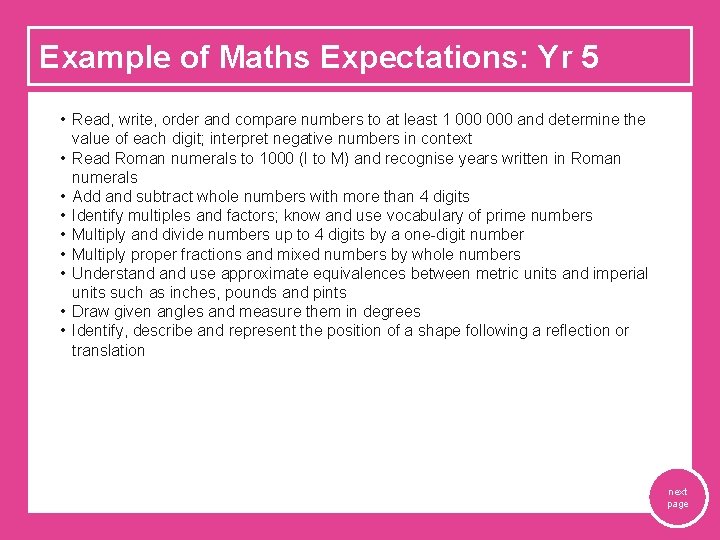
Example of Maths Expectations: Yr 5 • Read, write, order and compare numbers to at least 1 000 and determine the value of each digit; interpret negative numbers in context • Read Roman numerals to 1000 (I to M) and recognise years written in Roman numerals • Add and subtract whole numbers with more than 4 digits • Identify multiples and factors; know and use vocabulary of prime numbers • Multiply and divide numbers up to 4 digits by a one-digit number • Multiply proper fractions and mixed numbers by whole numbers • Understand use approximate equivalences between metric units and imperial units such as inches, pounds and pints • Draw given angles and measure them in degrees • Identify, describe and represent the position of a shape following a reflection or translation next page
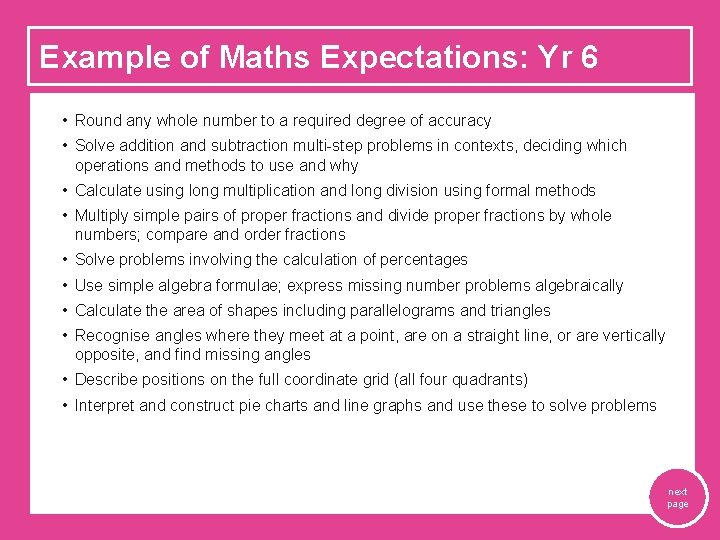
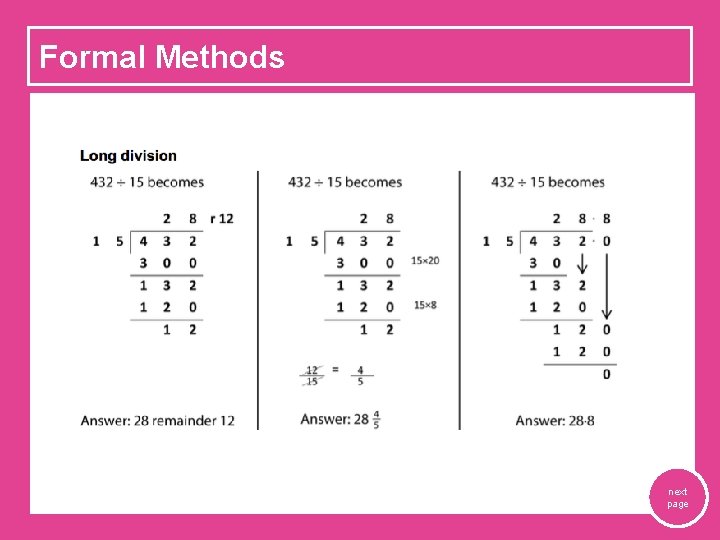
Example of Maths Expectations: Yr 6 • Round any whole number to a required degree of accuracy • Solve addition and subtraction multi-step problems in contexts, deciding which operations and methods to use and why • Calculate using long multiplication and long division using formal methods • Multiply simple pairs of proper fractions and divide proper fractions by whole numbers; compare and order fractions • Solve problems involving the calculation of percentages • Use simple algebra formulae; express missing number problems algebraically • Calculate the area of shapes including parallelograms and triangles • Recognise angles where they meet at a point, are on a straight line, or are vertically opposite, and find missing angles • Describe positions on the full coordinate grid (all four quadrants) • Interpret and construct pie charts and line graphs and use these to solve problems next page
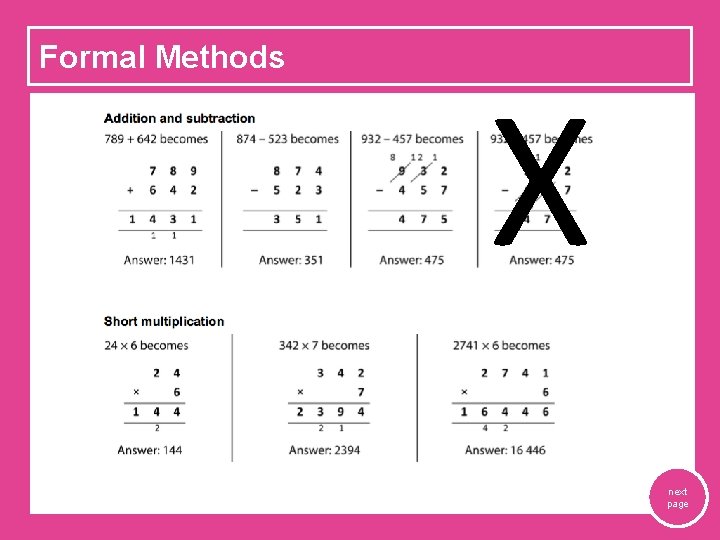
Formal Methods X next page
Formal Methods X next page
Formal Methods next page
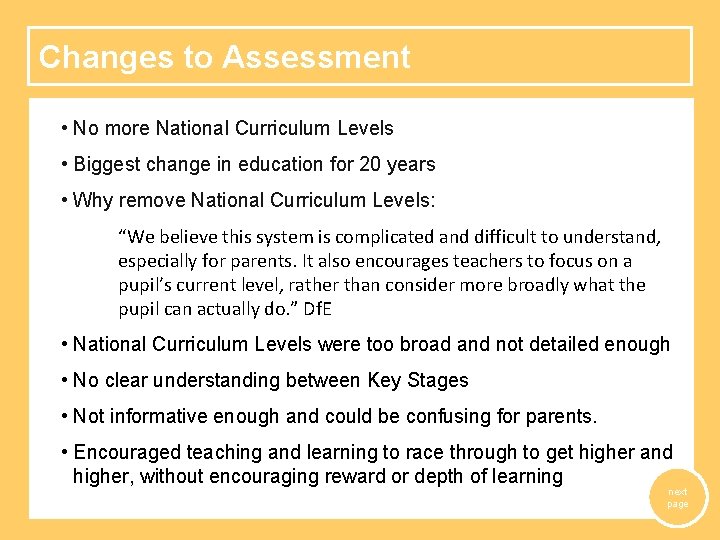
Changes to Assessment • No more National Curriculum Levels • Biggest change in education for 20 years • Why remove National Curriculum Levels: “We believe this system is complicated and difficult to understand, especially for parents. It also encourages teachers to focus on a pupil’s current level, rather than consider more broadly what the pupil can actually do. ” Df. E • National Curriculum Levels were too broad and not detailed enough • No clear understanding between Key Stages • Not informative enough and could be confusing for parents. • Encouraged teaching and learning to race through to get higher and higher, without encouraging reward or depth of learning next page
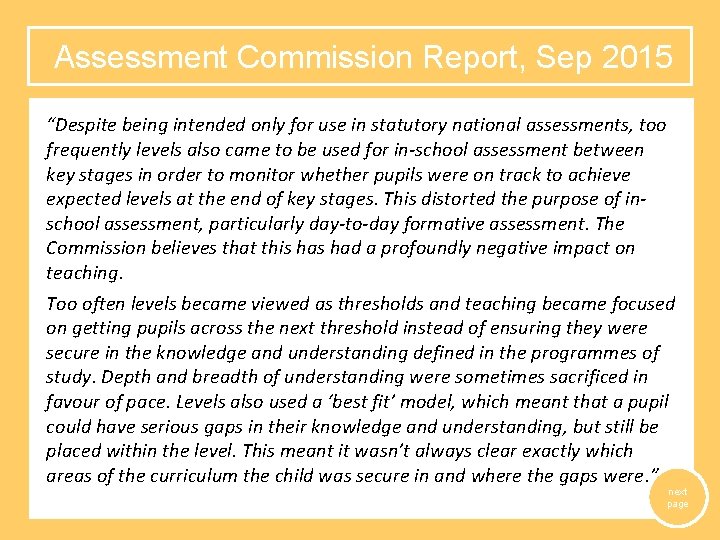
Assessment Commission Report, Sep 2015 “Despite being intended only for use in statutory national assessments, too frequently levels also came to be used for in-school assessment between key stages in order to monitor whether pupils were on track to achieve expected levels at the end of key stages. This distorted the purpose of inschool assessment, particularly day-to-day formative assessment. The Commission believes that this had a profoundly negative impact on teaching. Too often levels became viewed as thresholds and teaching became focused on getting pupils across the next threshold instead of ensuring they were secure in the knowledge and understanding defined in the programmes of study. Depth and breadth of understanding were sometimes sacrificed in favour of pace. Levels also used a ‘best fit’ model, which meant that a pupil could have serious gaps in their knowledge and understanding, but still be placed within the level. This meant it wasn’t always clear exactly which areas of the curriculum the child was secure in and where the gaps were. ” next page
Changes to Assessment • Schools now have freedom to develop own assessment systems • Assessment system needs to be clearly tied to intended purpose, in 3 ways: • Formative assessment: used by teachers on a day to day basis to tailor teaching to individual needs • In-school summative assessment: enables schools to evaluate how much a pupil has learned at the end of a teaching period • National summative assessment: used by the government to hold schools to account (ie Yr 2 & 6 SATs) • RMJS uses a variety of internal tests, some made in school, some purchased, to ensure its formative and summative assessment practice informs our teaching. next page
Reporting to parents • Year 6 – results of SATs. The results will now be a scaled score between about 70/80 and 120/130. (We do not know exactly what this will look like yet) • Years 3, 4 & 5. We will report on whether or not your child has met the expectations for English and maths for that year group. This will be in language like: • Working towards the Y 4 expectations • Has met the Y 4 expectations • Has exceeded the. Y 4 expectations. • Alternatively: • Has not achieved most of the Y 4 objectives • Achieves most Y 4 objectives but cannot apply learning • Meets the National Standard – achieves most of the Y 4 objectives • Achieves most Y 4 objectives with good application next • Achieves almost all Y 4 objectives with very good application page
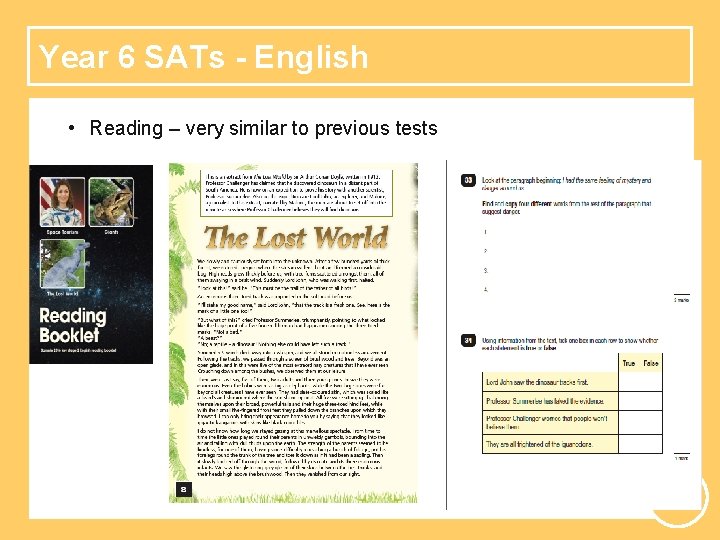
Year 6 SATs - English • Reading – very similar to previous tests next page
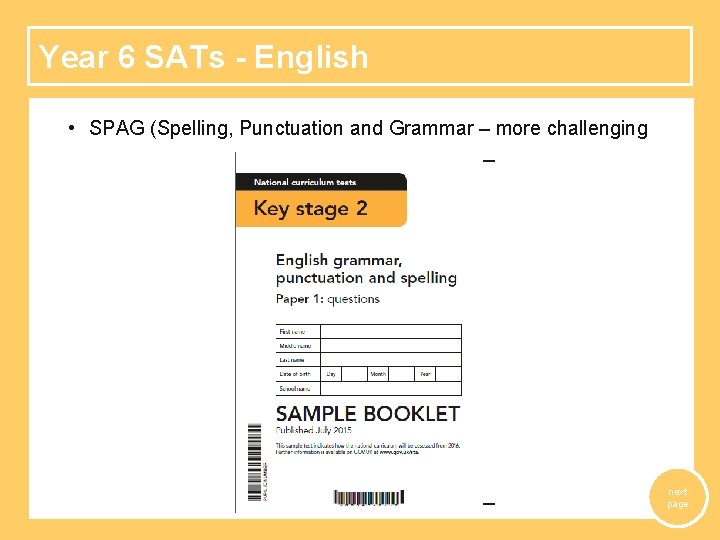
Year 6 SATs - English • SPAG (Spelling, Punctuation and Grammar – more challenging next page
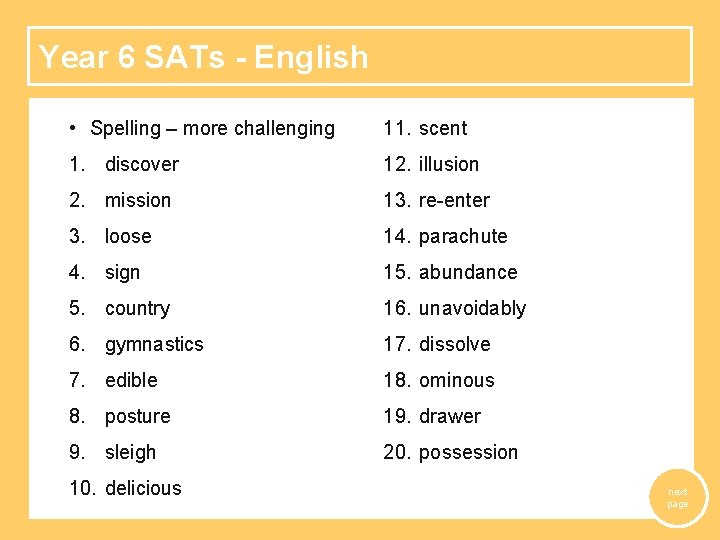
Year 6 SATs - English • Spelling – more challenging 11. scent 1. discover 12. illusion 2. mission 13. re-enter 3. loose 14. parachute 4. sign 15. abundance 5. country 16. unavoidably 6. gymnastics 17. dissolve 7. edible 18. ominous 8. posture 19. drawer 9. sleigh 20. possesion possession 10. delicious next page
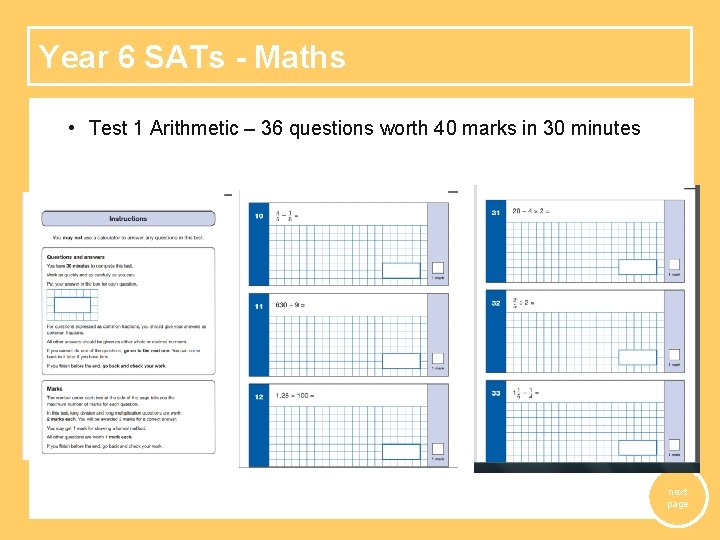
Year 6 SATs - Maths • Test 1 Arithmetic – 36 questions worth 40 marks in 30 minutes next page
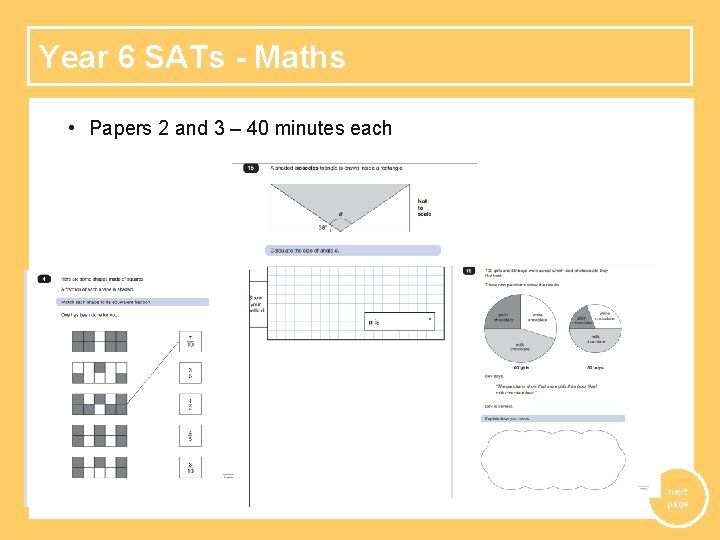
Year 6 SATs - Maths • Papers 2 and 3 – 40 minutes each next page
How to Help Your Child with Reading Listening to your child read can take many forms. First and foremost, focus developing an enjoyment and love of reading. • Enjoy stories together – reading stories to your child at KS 1 and KS 2 is equally as important as listening to your child read. • Read a little at a time but often, rather than rarely but for long periods of time! • Talk about the story before, during and afterwards – discuss the plot, the characters, their feelings and actions, how it makes you feel, predict what will happen and encourage your child to have their own opinions. • Look up definitions of words together – you could use a dictionary, the Internet or an app on a phone or tablet. • All reading is valuable – it doesn’t have to be just stories. Reading can involve anything from fiction and non-fiction, poetry, newspapers, magazines, football programmes, TV guides. • Visit the local library - it’s free! Early to bed! next page
How to Help Your Child with Writing • Practise and learn weekly spelling lists – make it fun! • Encourage opportunities for writing such as letters to family or friends, shopping lists, notes or reminders, stories or poems. • Write together – be a good role model for writing. • Encourage use of a dictionary to check spelling and a thesaurus to find synonyms and expand vocabulary • Allow your child to use a computer for word processing, which will allow for editing and correcting of errors without lots of crossing out. • Remember that good readers become good writers! Identify good writing features when reading (e. g. vocabulary, sentence structure, punctuation). • Show your appreciation: praise and encourage, even for small successes! Early to bed! next page
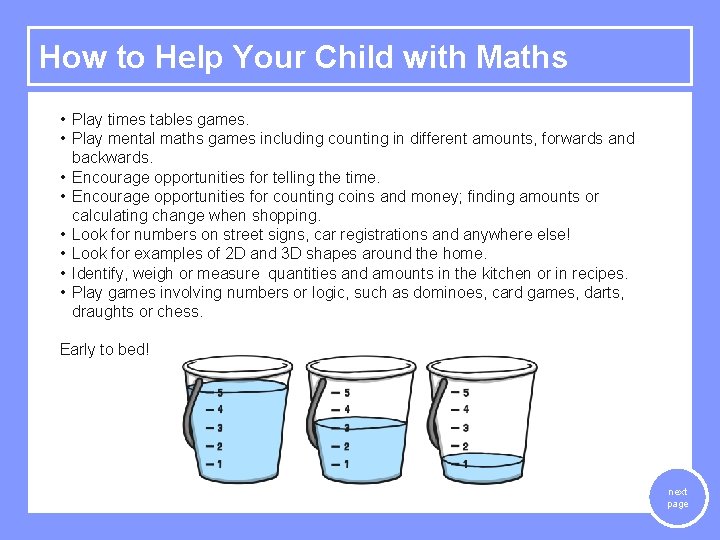
How to Help Your Child with Maths • Play times tables games. • Play mental maths games including counting in different amounts, forwards and backwards. • Encourage opportunities for telling the time. • Encourage opportunities for counting coins and money; finding amounts or calculating change when shopping. • Look for numbers on street signs, car registrations and anywhere else! • Look for examples of 2 D and 3 D shapes around the home. • Identify, weigh or measure quantities and amounts in the kitchen or in recipes. • Play games involving numbers or logic, such as dominoes, card games, darts, draughts or chess. Early to bed! next page
Further Information • School Website – Curriculum. You will find the following: ü Our Curriculum Policy ü Guide to the National Curriculum. This includes a detailed guide for each year group about the content to be taught in each subject. ü This presentation ü A Guide to the Year 6 SATs from our recent information meetings for year 6 parents/carers ü Detail about what we are teaching in each year group each term at RMJS • Df. E National Curriculum - full details from the official site can be found here.