
New model of service Key Learnings thus far

- Slides: 20
New model of service
Key Learnings thus far o o o Progressive Universalism model of service Embed evaluation into practice- Outcomes Framework As an organisation, define what we mean by ‘evidenced base’ Take a whole of organisational approach to theory of change in the development of our Practice Framework commonality in how our practitioners articulate our purpose and define how it is we make a difference. Elevate the place of clinical governance in the organisation © 2018
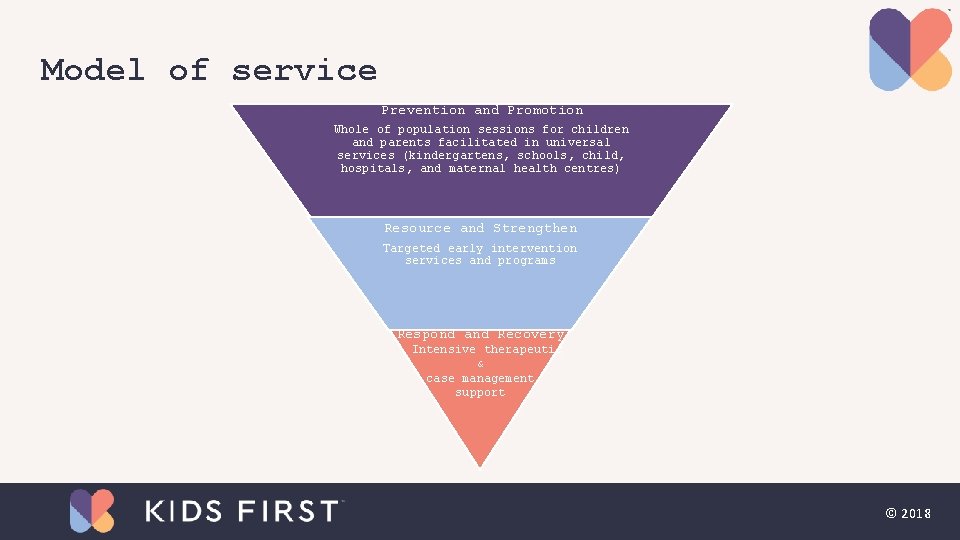
Model of service Prevention and Promotion Whole of population sessions for children and parents facilitated in universal services (kindergartens, schools, child, hospitals, and maternal health centres) Resource and Strengthen Targeted early intervention services and programs Respond and Recovery Intensive therapeutic & case management support © 2018
Change of Organisational Structure o o Locally based Prevents families from entering a stress pathway at critical transition points Integrated Practice Distinguishing clinical and operational governance © 2018
Clinical Intake Service The Centralised Clinical Intake Service supports two multi-disciplinary Geo Centers (HB & TT) to provide: o Clinically indicated, targeted interventions: brief, early and tertiary o Integrated care planning for children and their families o All families with a Brief Family Consultation Session at start of service o Tailored responses using evidence informed practice and programs © 2018
Brief Family Consultation Therapy Brief Family Consultation (BFC) Therapy is a timelimited, structured process for meeting with a client/family that is focussed on achieving realistic and negotiated goals. It is evidence based, client driven, family inclusive and strength oriented. © 2018
Brief Family Consultation When is it used? o As a process for engaging families o To provide goal focused brief interventions o To stabilise and contain families needing long term support o To get things moving again in a stuck or chronic situation o To help develop a thorough closing plan o To address almost any client issue © 2018
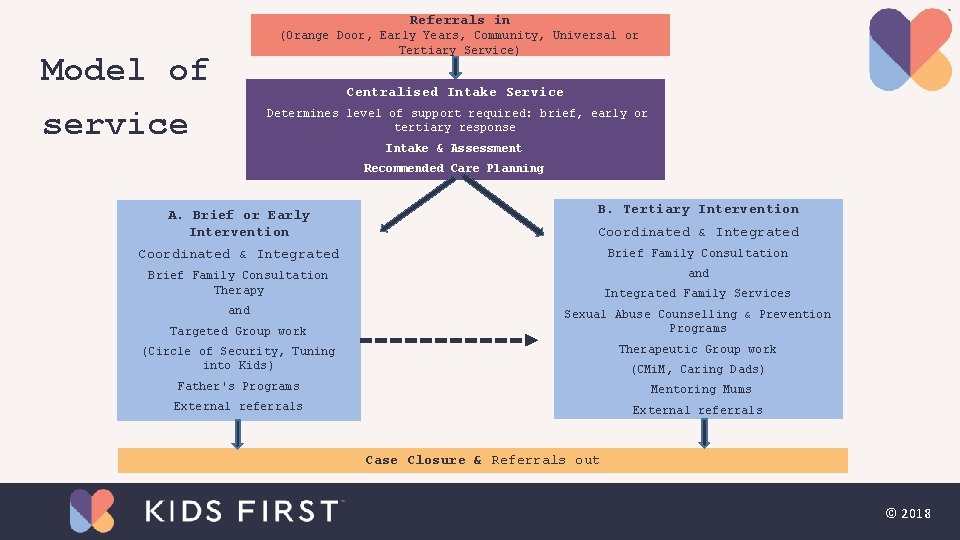
Referrals in (Orange Door, Early Years, Community, Universal or Tertiary Service) Model of Centralised Intake Service service Determines level of support required: brief, early or tertiary response Intake & Assessment Recommended Care Planning B. Tertiary Intervention A. Brief or Early Intervention Coordinated & Integrated Brief Family Consultation Therapy and Targeted Group work Integrated Family Services Sexual Abuse Counselling & Prevention Programs Therapeutic Group work (Circle of Security, Tuning into Kids) (CMi. M, Caring Dads) Father's Programs Mentoring Mums External referrals Case Closure & Referrals out © 2018
Theory of Change o An organisational theory or statement that creates a shared understanding, and coherent logic of the impact services hope to achieve. o The resulting theory of change is a roadmap for creating the change we seek and a reference point for how we practice, what we stand for, and how we measure our effectiveness going forward. © 2018
Investing in children and families has important impacts on the safety, health and wellbeing of our communities. We understand there can be significant intergenerational consequences of negative structural and family difficulties on society. Whilst we are not limited in our focus, our areas of expertise lie in the impact of family safety, including childhood abuse and neglect, and of complex needs such as mental health difficulties, on children and families. We are striving to address common risk factors and strengthen protective factors through a continuum of prevention and © 2018
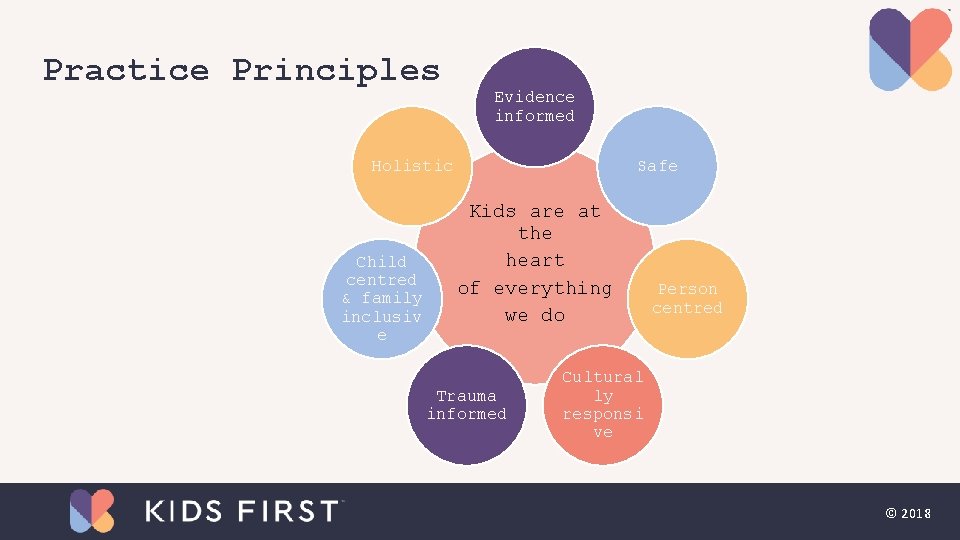
Practice Principles Evidence informed Holistic Child centred & family inclusiv e Safe Kids are at the heart of everything we do Trauma informed Person centred Cultural ly responsi ve © 2018
Feedback Informed Practice o Embedding client feedback and direction into the support process is an evidence-based, effective means of creating client-directed practice. o The use of client rating scales to provide feedback about client outcomes and therapeutic fit between client and practitioner at every session. © 2018
Evidenced Based Practice - Outcomes Framework o Outcomes Rating Scales and Session Rating Scales o Seeking and obtaining valid, reliable, and feasible feedback from consumers regarding therapeutic alliance and outcomes as much as doubles the effect size of interventions, cuts drop out rates by half and decreases risk of deterioration. o Miller (2011) impact of routinely monitoring and using outcome and alliance data from 13 RCTs involving over 12, 000 consumers. © 2018
Therapeutic Alliance 1. Agreement on goals 2. Agreement on the means and purpose of methods to be used 3. Agreement on the practitioner's role (how well they engage) 4. Accommodation client's preferences. © 2018
Evidenced Based Decision Making Processes o Best Available Research o Clinical Expertise o Client Values/ Context/Characteristics © 2018
Unpacking the Evidence in EBPs o What does Evidence Based mean to our organisation? o How do we want to define Evidenced Based? © 2018
Strategic Programming o Choosing EBPs o Implemtating o Choosing evaluation tools o Making sure our PRACTICE IS EVIDENCED BASED © 2018
Strategic Programming Kids First is in the process of choosing, developing and implementing evidenced based programs and practices that will: o Match our client and community's needs o Enhance the practice in our core programs o Align with our model of service and associated practice framework © 2018
Applying Evidenced Based Decision Making in how you choose programs for your Organisation 1. Best Available Research evidence 2. Experiential evidence 3. Contextual evidence © 2018
Future Practice and Service Developments o Implementation of evidenced based practice tools o Routine Monitoring and Evaluation o Systematic clinical review system o Development of competencies which feed into annual PDR o KPIs for practitioners based on our funding o Development of an Org Outcomes Framework © 2018