
NEW MEDICAID POLICIES AND PROCEDURES TRAINING FOR NURSING






















- Slides: 68
NEW MEDICAID POLICIES AND PROCEDURES TRAINING FOR NURSING FACILITIES Division of Eligibility Policy July 26, 2017 1
2 SECTION 1: IDENTITY VERIFICATION POLICY AND PROCEDURES Division of Eligibility Policy July 26, 2017
Discussion Points 3 Purpose of Identity Verification Hierarchy Electronic Data Sources Other Documentation of Identity Affidavit of Identity
Purpose 4 To streamline the identity verification process for individuals applying for Medicaid A photo ID is not required as part of the application submission ESA will leverage electronic data sources to verify an individual’s identity
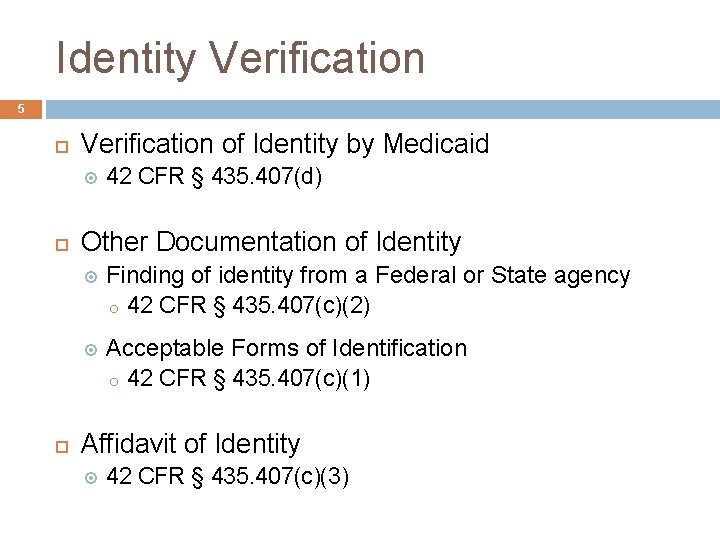
Identity Verification 5 Verification of Identity by Medicaid 42 CFR § 435. 407(d) Other Documentation of Identity Finding of identity from a Federal or State agency o 42 CFR § 435. 407(c)(2) Acceptable Forms of Identification o 42 CFR § 435. 407(c)(1) Affidavit of Identity 42 CFR § 435. 407(c)(3)
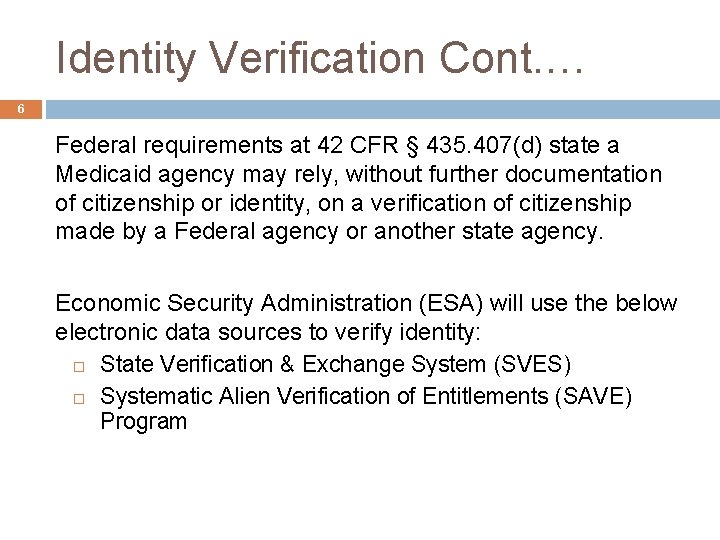
Identity Verification Cont. … 6 Federal requirements at 42 CFR § 435. 407(d) state a Medicaid agency may rely, without further documentation of citizenship or identity, on a verification of citizenship made by a Federal agency or another state agency. Economic Security Administration (ESA) will use the below electronic data sources to verify identity: State Verification & Exchange System (SVES) Systematic Alien Verification of Entitlements (SAVE) Program
Identity Verification Cont. 7 Other Documentation of Identity (42 CFR 435. 407(c)(2) ) The agency may accept as proof of identity a finding of identity from a Federal agency or another State agency, including but not limited to a public assistance, law enforcement, internal revenue or tax bureau, or corrections agency, if the agency has verified and certified the identity of the applicant.
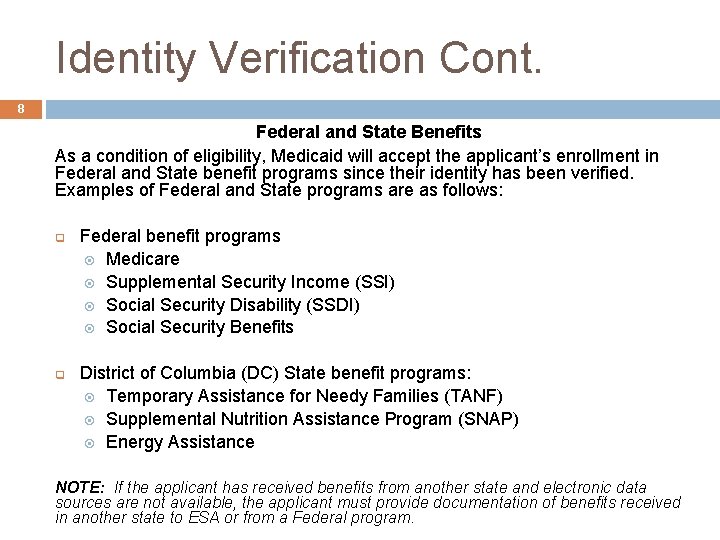
Identity Verification Cont. 8 Federal and State Benefits As a condition of eligibility, Medicaid will accept the applicant’s enrollment in Federal and State benefit programs since their identity has been verified. Examples of Federal and State programs are as follows: q q Federal benefit programs Medicare Supplemental Security Income (SSI) Social Security Disability (SSDI) Social Security Benefits District of Columbia (DC) State benefit programs: Temporary Assistance for Needy Families (TANF) Supplemental Nutrition Assistance Program (SNAP) Energy Assistance NOTE: If the applicant has received benefits from another state and electronic data sources are not available, the applicant must provide documentation of benefits received in another state to ESA or from a Federal program.
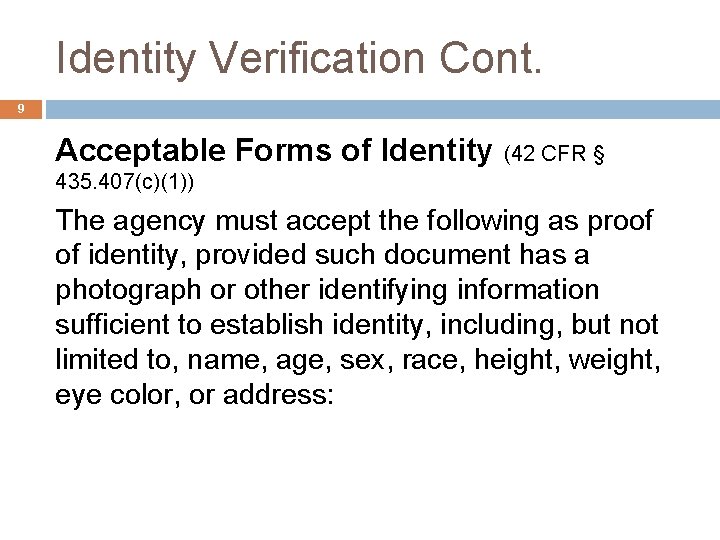
Identity Verification Cont. 9 Acceptable Forms of Identity (42 CFR § 435. 407(c)(1)) The agency must accept the following as proof of identity, provided such document has a photograph or other identifying information sufficient to establish identity, including, but not limited to, name, age, sex, race, height, weight, eye color, or address:
Identity Verification Cont. 10 ACCEPTABLE FORMS OF IDENTITY (cont. ) Identification containing Photograph or Other Sufficient Identifying Information Voter registration card Driver’s license issued by a State or Territory US military card or draft record Military dependent’s ID card For a child under 19 years old, a clinic, doctor, hospital, or school record including preschool or day care records. School ID card issued by the Federal, State, or local government US Coast Guard Merchant Mariner card A finding of identity from an Express Lane agency Two other documents containing consistent information that corroborates an applicant’s identity, including but not limited to: employer ID card, high school/equivalent and college diplomas, marriage certificates, divorce decrees, and property deeds or titles.
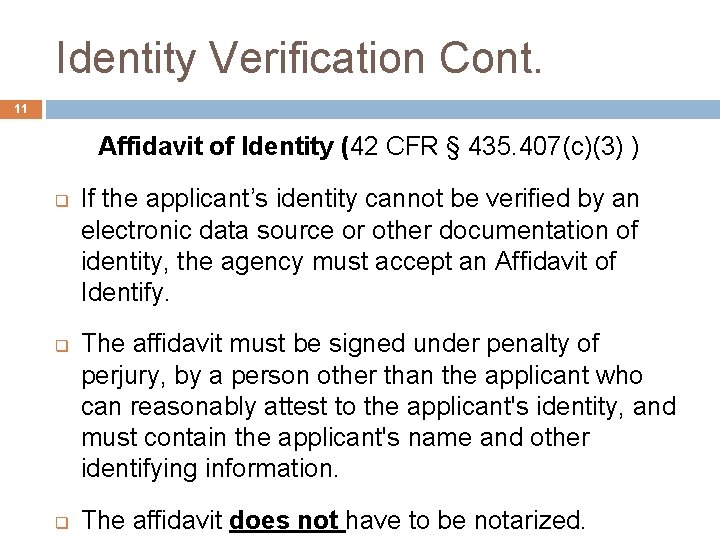
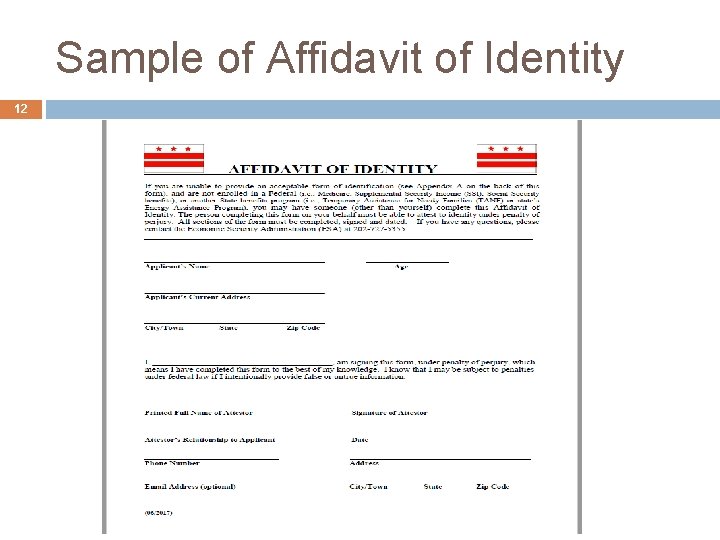
Identity Verification Cont. 11 Affidavit of Identity (42 CFR § 435. 407(c)(3) ) q q q If the applicant’s identity cannot be verified by an electronic data source or other documentation of identity, the agency must accept an Affidavit of Identify. The affidavit must be signed under penalty of perjury, by a person other than the applicant who can reasonably attest to the applicant's identity, and must contain the applicant's name and other identifying information. The affidavit does not have to be notarized.
Sample of Affidavit of Identity 12
13 SECTION 2: NEW MEDICAID APPLICATION SUBMISSION PROCESS Division of Eligibility Policy July 26, 2017
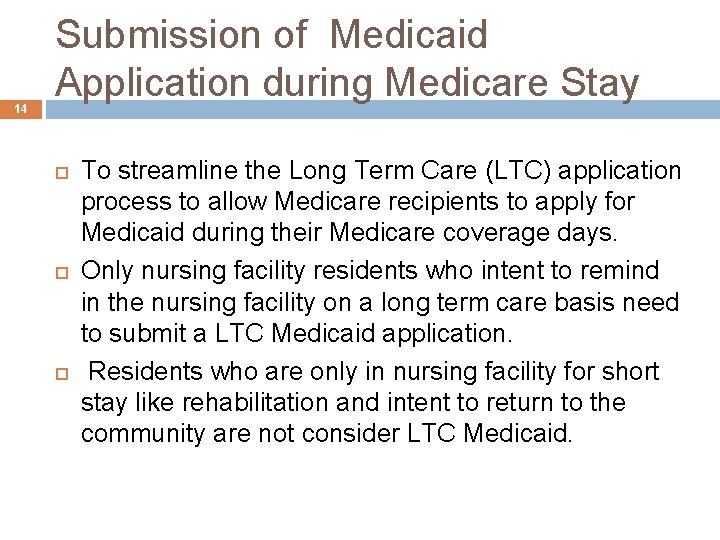
14 Submission of Medicaid Application during Medicare Stay To streamline the Long Term Care (LTC) application process to allow Medicare recipients to apply for Medicaid during their Medicare coverage days. Only nursing facility residents who intent to remind in the nursing facility on a long term care basis need to submit a LTC Medicaid application. Residents who are only in nursing facility for short stay like rehabilitation and intent to return to the community are not consider LTC Medicaid.
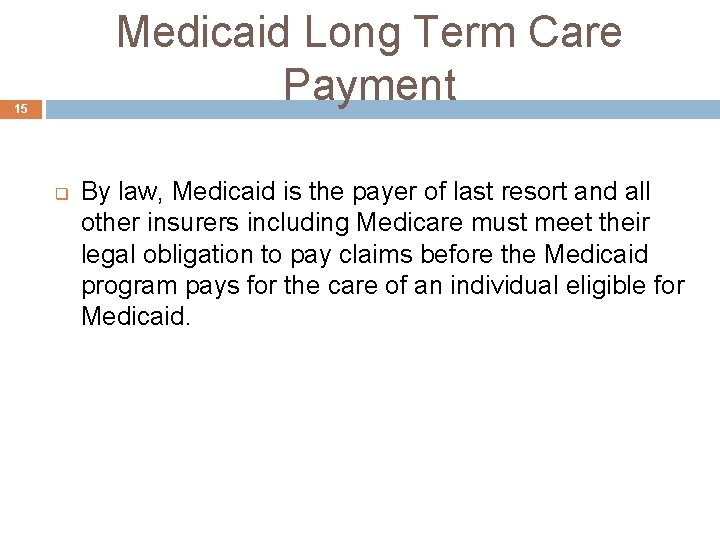
Medicaid Long Term Care Payment 15 q By law, Medicaid is the payer of last resort and all other insurers including Medicare must meet their legal obligation to pay claims before the Medicaid program pays for the care of an individual eligible for Medicaid.
Medicaid LTC Application Process for Individuals who are receiving Medicare Coverage 16 A Medicaid LTC application may be submitted to ESA during an individual’s Medicare pay days. In order for the application to be considered complete and registered in ACEDS ESA must receive: § § § The signed and completed Medicaid LTC application The Request for Action 1346 The current Level of Care Form
Medicaid LTC Application Process for Individuals who are receiving Medicare Coverage 17 The provider will indicate on the 1346 whether the applicant has Medicare coverage and when that coverage will end. Medicaid Long Term Care coverage will start when the individual meets all non-financial and financial eligibility criteria. If the applicant is not enrolled in Medicaid as a Qualified Medicare Beneficiary (QMB), the individual will be evaluated for QMB coverage as well. Patient pay responsibility begins the first day after the applicant’s Medicare coverage expires.
QMB 18 A QMB only application may be submitted through Quickbase. QMB only covers Medicare cost sharing. A Long Term Care Medicaid application, Request for Action, and a Level of Care must be submitted if the applicant wished to be considered for Medicaid Long Term Care.
19 Qualified Medicare Beneficiary (QMB) Income Limits Federal 1 Person Household Monthly Poverty Level (FPL) QMB 300% FPL $3, 015 *** QMB has no resource test 2 Person Household Monthly $4, 059
Request For Action Form 1346 20
Example 21 Jackie Mclean who is a Medicare beneficiary enters a nursing home on January 1, 2017. He applies for Medicaid on January 12, 2017 and determined eligible because he meets all non-financial and financial criteria for Medicaid LTC coverage. Swell Nursing Home submitted the required Request for Action which indicates Mr. Mclean has Medicare and his Medicare coverage days end on April 11, 2017. Jackie Mclean is determined eligible for Medicaid so ESA enrolls him into Medicaid on January 1, 2017 which is reflected on the 1346. ESA completes 1346 showing the initial month of patient pay effective April 12, 2017 through April 30, 2017. The Request for Action will also reflect the beneficiary’s patient pay effective May 1, 2017 and ongoing.
What if the Applicant has Excess Income 22 If ESA evaluates the application and determines the applicant has income in excess of 300% of SSI and has Medicare coverage, the individual should be placed on a six month spend-down. The spend-down begins the first day of the month of application and ends on the last day of the sixth month. Incurred medical expenses that will not be paid by any other party may be submitted to ESA to meet the spenddown In addition to other incurred medical expenses, ESA should use projected medical institution expenses when Medicaid become the primary payer through the end of the spend-down period to be considered an allowable expense to meet the spend-down and have Medicaid coverage.
Example 23 Paul Chambers who is a Medicare beneficiary enters a nursing home on January 1, 2017. He applies for Medicaid on January 12, 2017. His gross income from Social Security is $2, 642. 83. His countable income, $2, 642. 83 exceeds the 300% SSI income limit of $2, 205. The Request for Action form indicates that Mr. Chambers’ has Medicare and his Medicare covered days ends on April 11, 2017. Paul is placed on a six month spend-down effective January 1, 2017 through June 30, 2017. The spend-down is determined by subtracting the MNIL of $642. 83 from Paul’s countable income of $2, 642. 83. The difference of $2, 000 is multiplied by six to arrive at the spend-down amount of $12, 000 effective January 1, 2017 through June 30, 2017. Paul has no other medical expenses for which he is responsible which can be considered for spend-down. On April 12, 2017, ESA evaluates Paul’s projected medical expenses and enrolls him into Medicaid the first day of the month in which he meets eligibility April 1, 2017.
Example 24 Since Paul was not responsible for any medical institutional expenses from January 1, 2017 through April 11, 2017, ESA can only consider the projected medical institution costs that Paul is expected to incur from April 12, 2017 through June 30, 2017. ESA determines that the projected medical institution costs are $24, 000. Since that expense exceeds Paul’s spend-down amount, Paul will be enrolled in Medicaid April 1, 2017. Paul’s patient pay responsibility will become effective April 12, 2017 through June 30, 2017. Lastly, since Paul met his spend-down, ESA will process a second spend-down for July 1, 2017 through December 31, 2017. ESA should use Paul’s projected medical institution expenses to meet the second spend-down. ESA must complete a 1445 for the second spend-down.
Patient Pay 25 The patient pay responsibility for individuals who were previously covered by Medicare begins after the Medicare coverage days expire. A prorated patient pay determination will be required if the Medicare coverage days end on any day other than the last day of the month.
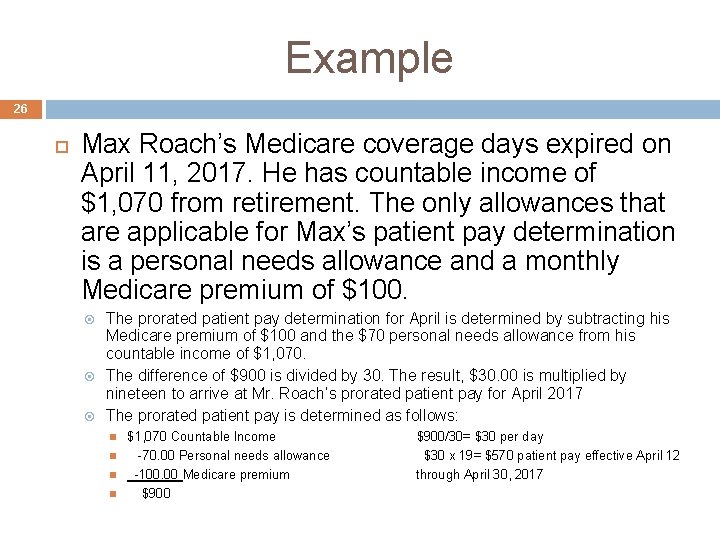
Example 26 Max Roach’s Medicare coverage days expired on April 11, 2017. He has countable income of $1, 070 from retirement. The only allowances that are applicable for Max’s patient pay determination is a personal needs allowance and a monthly Medicare premium of $100. The prorated patient pay determination for April is determined by subtracting his Medicare premium of $100 and the $70 personal needs allowance from his countable income of $1, 070. The difference of $900 is divided by 30. The result, $30. 00 is multiplied by nineteen to arrive at Mr. Roach’s prorated patient pay for April 2017 The prorated patient pay is determined as follows: $1, 070 Countable Income $900/30= $30 per day -70. 00 Personal needs allowance $30 x 19= $570 patient pay effective April 12 -100. 00 Medicare premium through April 30, 2017 $900
Example cont’d 27 Max Roach’s Medicare coverage days expired on April 11, 2017. He has countable income of $1, 070 from retirement. $1, 070 Countable Income -70. 00 Personal needs allowance -100. 00 Medicare premium $900. 00 Max Roach’s patient pay effective May 1, 2017 and ongoing
28 SECTION 3: NURSING FACILITY ANNUAL LEVEL OF CARE ATTESTATION FORM Division of Eligibility Policy July 26, 2017
Discussion Points 29 q Nursing Facility Annual Level of Care Attestation When to Use the Form How to Use the Form Where to Send the Form
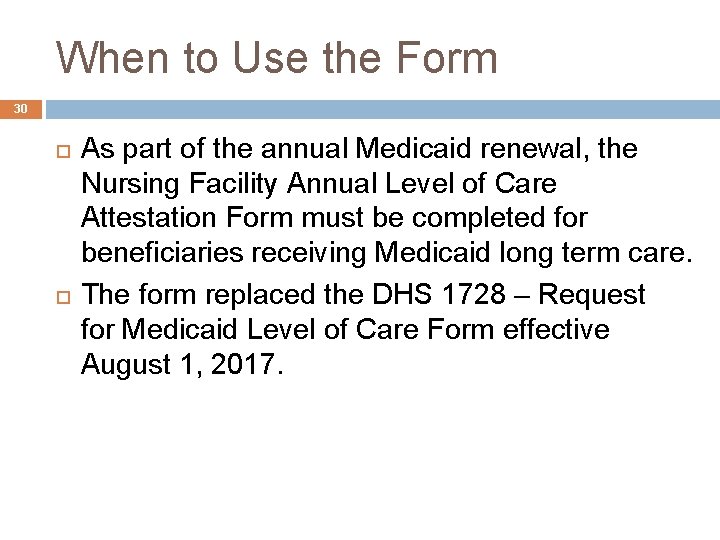
When to Use the Form 30 As part of the annual Medicaid renewal, the Nursing Facility Annual Level of Care Attestation Form must be completed for beneficiaries receiving Medicaid long term care. The form replaced the DHS 1728 – Request for Medicaid Level of Care Form effective August 1, 2017.
Who can complete the form? 31 Only the Nursing Facility Physician or Advance Practice Registered Nurse (APRN) is authorized to complete and sign the attestation form.
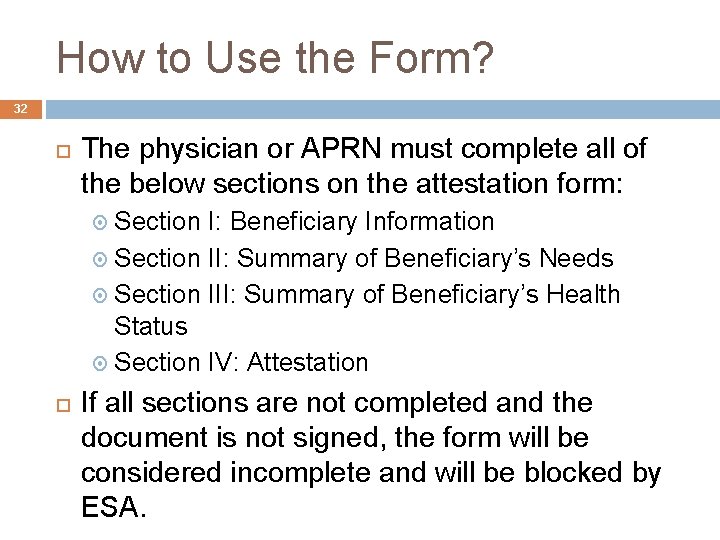
How to Use the Form? 32 The physician or APRN must complete all of the below sections on the attestation form: Section I: Beneficiary Information Section II: Summary of Beneficiary’s Needs Section III: Summary of Beneficiary’s Health Status Section IV: Attestation If all sections are not completed and the document is not signed, the form will be considered incomplete and will be blocked by ESA.
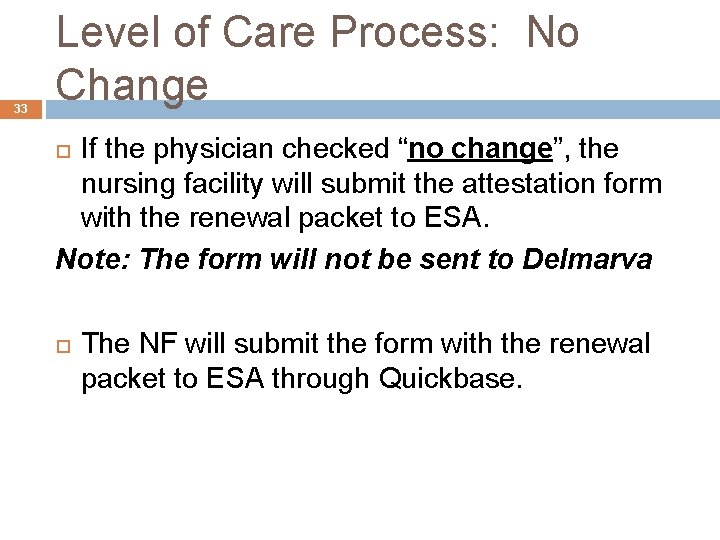
33 Level of Care Process: No Change If the physician checked “no change”, the nursing facility will submit the attestation form with the renewal packet to ESA. Note: The form will not be sent to Delmarva The NF will submit the form with the renewal packet to ESA through Quickbase.
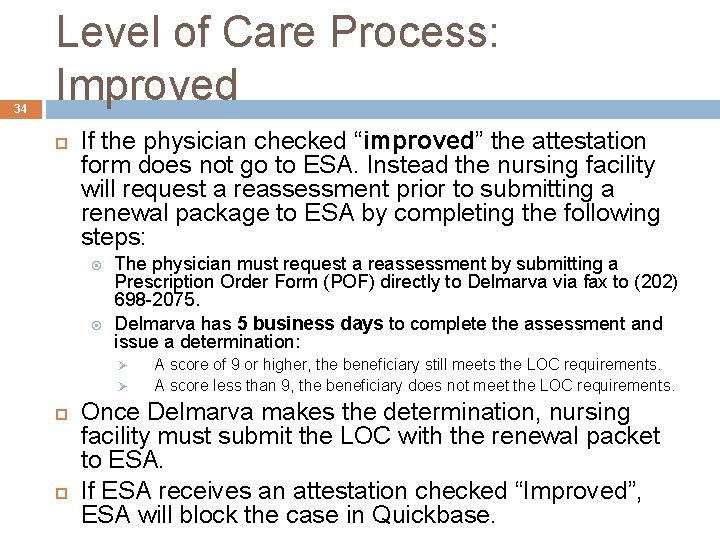
34 Level of Care Process: Improved If the physician checked “improved” the attestation form does not go to ESA. Instead the nursing facility will request a reassessment prior to submitting a renewal package to ESA by completing the following steps: The physician must request a reassessment by submitting a Prescription Order Form (POF) directly to Delmarva via fax to (202) 698 -2075. Delmarva has 5 business days to complete the assessment and issue a determination: Ø Ø A score of 9 or higher, the beneficiary still meets the LOC requirements. A score less than 9, the beneficiary does not meet the LOC requirements. Once Delmarva makes the determination, nursing facility must submit the LOC with the renewal packet to ESA. If ESA receives an attestation checked “Improved”, ESA will block the case in Quickbase.
35 NF Attestation of Level of Care Form
36 SECTION 4: OVERVIEW OF REQUEST FOR ACTION (DHS 1346 FORM) AND STATEMENT OF PATIENT PAYABILITY (DHS 1445 FORM) Division of Eligibility Policy July 26, 2017
Discussion Points 37 Purpose of the Form DHS 1346 (Rev. 06/17) DHS 1445 (Rev. 06/17) When to Use the Form How to Use the Form Where to Send the Form
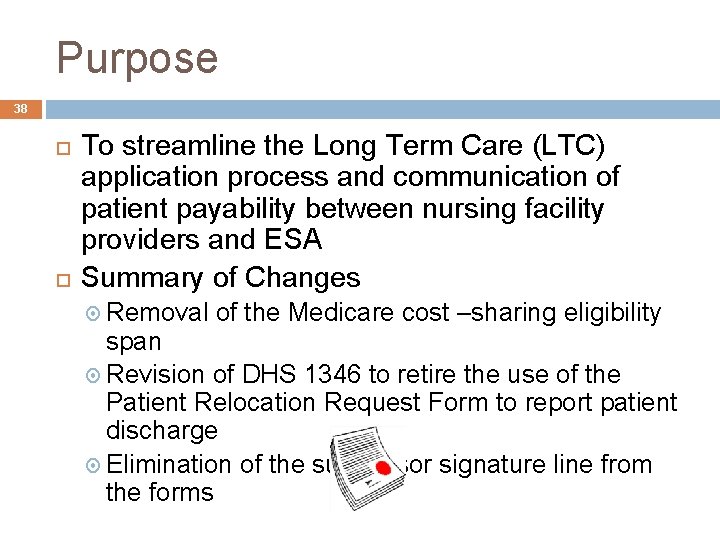
Purpose 38 To streamline the Long Term Care (LTC) application process and communication of patient payability between nursing facility providers and ESA Summary of Changes Removal of the Medicare cost –sharing eligibility span Revision of DHS 1346 to retire the use of the Patient Relocation Request Form to report patient discharge Elimination of the supervisor signature line from the forms
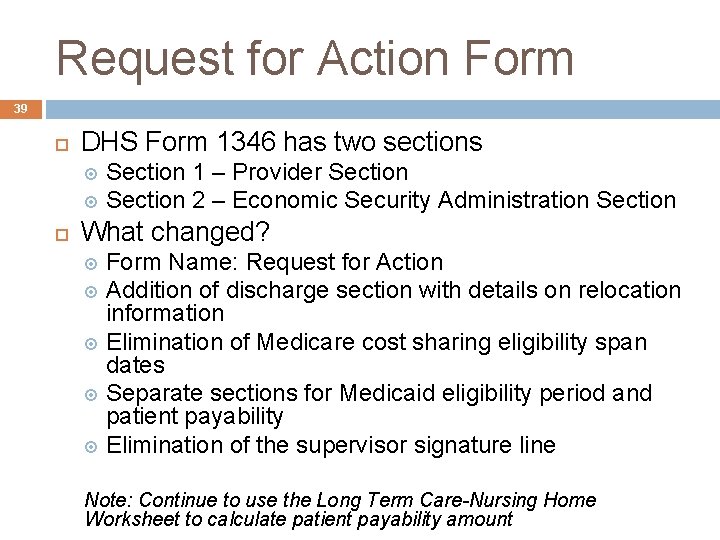
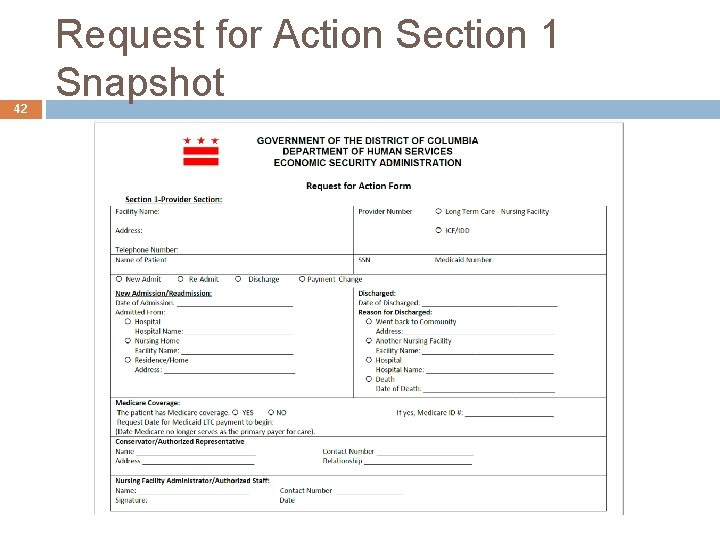
Request for Action Form 39 DHS Form 1346 has two sections Section 1 – Provider Section 2 – Economic Security Administration Section What changed? Form Name: Request for Action Addition of discharge section with details on relocation information Elimination of Medicare cost sharing eligibility span dates Separate sections for Medicaid eligibility period and patient payability Elimination of the supervisor signature line Note: Continue to use the Long Term Care-Nursing Home Worksheet to calculate patient payability amount
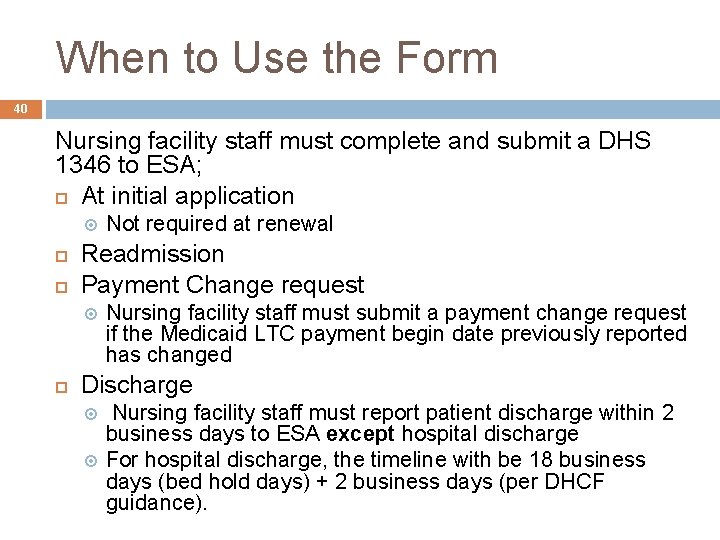
When to Use the Form 40 Nursing facility staff must complete and submit a DHS 1346 to ESA; At initial application Readmission Payment Change request Not required at renewal Nursing facility staff must submit a payment change request if the Medicaid LTC payment begin date previously reported has changed Discharge Nursing facility staff must report patient discharge within 2 business days to ESA except hospital discharge For hospital discharge, the timeline with be 18 business days (bed hold days) + 2 business days (per DHCF guidance).
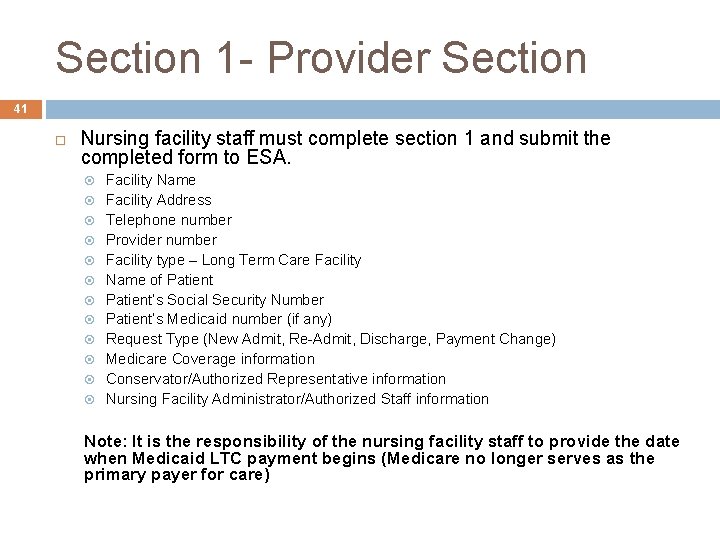
Section 1 - Provider Section 41 Nursing facility staff must complete section 1 and submit the completed form to ESA. Facility Name Facility Address Telephone number Provider number Facility type – Long Term Care Facility Name of Patient’s Social Security Number Patient’s Medicaid number (if any) Request Type (New Admit, Re-Admit, Discharge, Payment Change) Medicare Coverage information Conservator/Authorized Representative information Nursing Facility Administrator/Authorized Staff information Note: It is the responsibility of the nursing facility staff to provide the date when Medicaid LTC payment begins (Medicare no longer serves as the primary payer for care)
42 Request for Action Section 1 Snapshot
Section 2 - Economic Security Administration Section 43 ESA must inform the nursing facility provider of the patient’s Medicaid eligibility and patient payability by completing section 2 of the form Medicaid eligibility period Patient Payability Begin date End of certification date Initial month (if applicable, prorated amount) Monthly amount Authorized Social Service Representative (SSR) Once completed, ESA must forward a copy of the form as listed on the distribution section
44 Request for Action Section 2 Snapshot
45 Statement of Patient Payability Form DHS 1445: Statement of Patient Payability ESA uses DHS 1445 to communicate patient payability to nursing facility providers What changed? Minor changes Initial month and monthly amount sections consolidated into one (1) renewal month section Supervisor’s signature line eliminated
When to Use the Form 46 ESA must complete a DHS 1445 to communicate any changes on the patient payability amount at; Renewal /Recertification Payment Change Reconciliation Discharge Approval of second six month spend down budget period
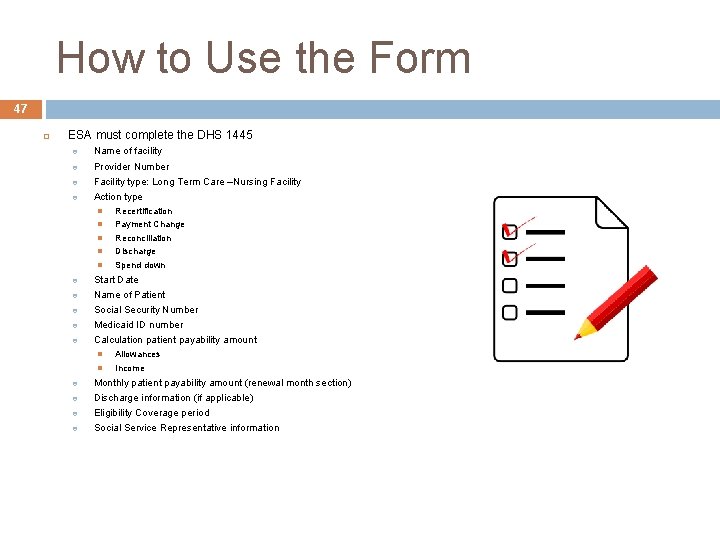
How to Use the Form 47 ESA must complete the DHS 1445 Name of facility Provider Number Facility type: Long Term Care –Nursing Facility Action type Recertification Payment Change Reconciliation Discharge Spend down Start Date Name of Patient Social Security Number Medicaid ID number Calculation patient payability amount Allowances Income Monthly patient payability amount (renewal month section) Discharge information (if applicable) Eligibility Coverage period Social Service Representative information
48 DHS Form 1445 (Rev. 06/17) Snapshot
Where to Send the Form 49 A copy of the completed DHS Form 1346 and DHS Form 1445 must be distributed as follows; Original to the facility/provider Copy to Fiscal Agent (Conduent) Copy to Conservator/Authorized representative Copy to the patient Copy to case record
50 SECTION 5: MEDICAID EVALUATION OF FINANCIAL INSTITUTION ACCOUNTS AND THE ASSET VERIFICATION SYSTEM Division of Eligibility Policy July 26, 2017
Discussion Points 51 Background Financial Institutions Types of Financial Institution Accounts What Has Changed? Resource Limits Evaluating the Money Held In Financial Institution Accounts How AVS Works Summary
Background- Asset Verification System 52 Federal regulations require all states to implement a program to verify an applicant/beneficiary’s money held in financial institutions. Groups with resource test include Aged, Blind, and Disabled category and LTC Medicaid
Financial Institutions 53 Medicaid considers monies held in financial institutions to be resources when determining eligibility. Financial institutions include: Banks Credit Unions
Types of Financial Institution Accounts 54 The following financial institution accounts are verified by the District’s Asset Verification System (AVS) and will be evaluated when determining eligibility for Medicaid: 1. 2. 3. 4. 5. Checking Accounts Savings Accounts Certificate of Deposit Accounts Money Market Accounts Christmas Club Accounts
What Has Changed? 55 q q q AVS is the primary source for ESA to verify financial institution accounts. If the bank account information is verified through AVS, the ESA worker does not need to send a checklist to verify account balances. If the applicant/beneficiary has a financial institution account, but it cannot be verified by AVS, the worker may need to send a checklist. AVS will send a response when a verification cannot be obtained.
Resource Limits 56 Household Single Person Married Couple Aged, Blind, Disabled Applicant/Beneficiary (Community Medicaid) $4, 000 $6, 000 Long Term Care Applicant/Beneficiary Either Institutionalized or in an Home and Community Based Services Waiver $4, 000 Not Applicable An individual who is applying for Medicaid Long Term Care Services is always a household of one
Evaluating the Money Held In Financial Institution Accounts 57 If the countable value of the individual’s money held in financial institution accounts plus the countable value of the individual’s other resources exceeds the applicable resource limit, the individual is ineligible for Medicaid.
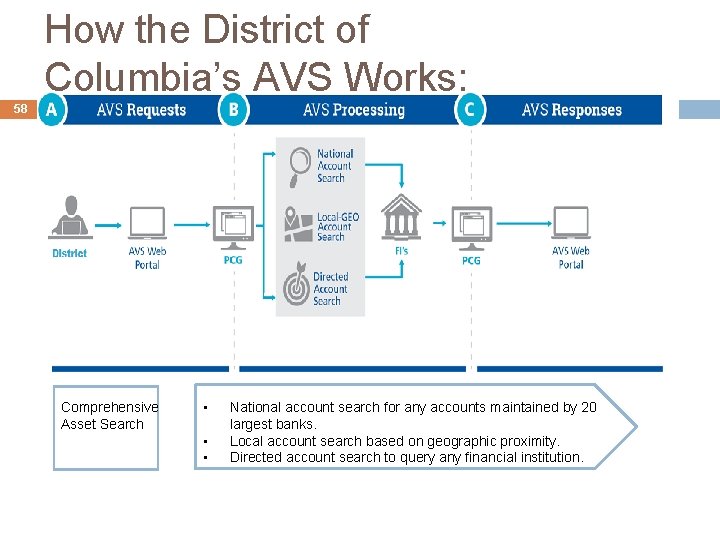
How the District of Columbia’s AVS Works: 58 Comprehensive Asset Search • • • National account search for any accounts maintained by 20 largest banks. Local account search based on geographic proximity. Directed account search to query any financial institution.
In Summary 59 AVS is ESA’s primary source for verifying the resource value of financial institution accounts for ABD and LTC Medicaid applicants/beneficiaries. This should make the application/renewal process more efficient by reducing the issuance of checklist from ESA.
60 SECTION 6: LONG TERM CARE MEDICAID SPENDDOWN CHANGES Division of Eligibility Policy July 26, 2017
Discussion Points 61 Purpose of the Spend-down Changes Background Summary of Changes The Result
62 Purpose- Spend-Down Budget Period Alignment The purpose of this process change is to eliminate renewal notices from being issued to Medicaid LTC Spend-down beneficiaries in the fourth month of spend-down.
Background 63 Medicaid Long Term Care Beneficiaries who became eligible for Medicaid through spenddown received renewal forms at the beginning of the 4 th month of their spend-down.
Summary of Changes 64 System changes have been implemented for new Medicaid beneficiaries to eliminate the issuance of renewal forms during the fourth month of the beneficiary’s spend-down budget period starting August 2017. This system change will be effective for enrolled Medicaid Long Term Care Spend-down beneficiaries (318/318 Q) effective November 1, 2017. Nursing facility staff are still encouraged to help Medicaid beneficiaries submit renewal information until the change is made in November 2017.
The Result 65 Beneficiaries will no longer receive renewal packets at the beginning of 4 th month of their spend-down period which will result in a more streamline process for ESA, the beneficiary, and the nursing facility.
Questions 66
Contact Information 67 Danielle Lewis-Wright Araceli Simbulan Associate Director Program Analyst Email: Danielle. Lewis@dc. gov Email: Araceli. Simbulan@dc. gov Anthony Proctor Natasha Moss Management Analyst Program Analyst Email: Anthony. Proctor 3@dc. gov Email: Natasha. Moss 2@dc. gov Gary Watts Management Analyst Email: Gary. Watts@dc. gov
68 Contact Information for Questions Regarding Medicaid Payment During Medicare Stay Days Ann (Bernie) Thomas Monique Willard, MHA Management Analyst Ann. thomas 4@dc. gov Monique. willard 2@dc. gov Suprenia Robinson Management Analyst Suprenia. robinson@dc. gov