
New Media Definition Information and communication technologies and



- Slides: 21
New Media Definition Information and communication technologies and their associated social contexts, and especially as infrastructures with three components: 1. Artefacts or devices used to communicate or convey information 2. The activities and practices in which people engage to communicate or share information, and 3. Social arrangements or organisational forms that develop around these devices and practices. Whereas production, text and audience are the core elements of mass media, Artefacts, practices and social arrangements are the core elements of new media. Media means, more than just the technologies of which the media are composed, also incorporate all of the activities, practices, and social arrangements associated with the media by both the producers and consumers of the media. Therefore, study of new media includes the technologies, their applications and their impacts. In his book Understanding New Media, Robert Logan uses the term ‘New Media’ with reference to “those digital media that are interactive, incorporate two-way communication and involve some form of computing”.
Some experts describe new media: ‘as the ability to combine text, audio, digital video, interactive multimedia, virtual reality, the Web, email, chat, a cell phone, a PDA, such as the Palm pilot or Black. Berry, computer applications, and any source of information accessed by a personal computer. Manovich describes new media ‘as new cultural forms which are native to computers or rely on computer for distribution: Web sites, humancomputer interface, vitual worlds, VR, multimedia, computer games, computer animation, digital video, special effects in cinema and net films, interactive computer installations. ’ Bolter and Grusin define new media in terms of ‘remediation’, as the defining characteristic of new digital media. The old media are passive mass media, whereas the new media are ‘individually accessed interactive media’. The new media permit a great more participation of its users who are no longer just passive recipients of information, but are active producers of content and information. • What is new about today’s new media is that they are digital, they are linked and cross-linked with each other, and the information they mediate is very easily processed, stored, transferred, retrieved , hyper-linked, and perhaps most radical of all , easily searched for and accessed. • New media holds out a possibility of on-demand access to content anytime, anywhere, on any digital device, as well as interactives user-feedback, creative participation and community formations around the media content.
Examples of New Media • Websites and blogs • Streaming audio and video • Chatrooms • E-mail • Online communities • Social media and sharing platforms • Mobile apps • Web advertising • DVD and CD-Rom media • Virtual reality environments • Internet telephony • Digital camera • Interactive TV etc.
• New media holds out a possibility of on-demand access to content anytime, anywhere, on any digital device, as well as interactives userfeedback, creative participation and community formations around the media content. • Most technologies described as new media are digital, often having characteristics of being manipulated, networkable, dense, compressible, and interactive. The basic elements of new media are: 1. Technological application, and 2. Information networks. The technologies of new media are: 1. Concerned with processing, exchange and storage 2. The new media are as much an institution of private as well as of public communication and are regulated (or not) accordingly. 3. Their operation is not typically professional or bureaucratically organised in the same degree as mass media.
Categories of new media (based on types of use, content, and context) • Interpersonal Communication Media Ø Telephone, and e-mail Ø Content is private and perishable and relationship established and reinforced may be more important than the information conveyed. • Interactive Play Media Computer based and video games, plus virtual reality devices • Information Search Media The Internet/www Collective Participatory Media Ø Specially the use of the internet for sharing and exchanging information, ideas, active computer mediated relationships. experience and developing
Types of New Media The following five types of new media illustrate the evolution of new media. Blogs Although blogs are an early form of new media, they are still relevant and share several characteristics of the most recent new media types. Information in blogs is easily accessed and searched for, and everything is typically organized naturally. For instance, blog posts are often nested under categories, and users can navigate posts by a specific category or tag or via a search. And like other forms of new media where content is posted - such as online newspapers and some social media platforms - entries often contain mixed media such as photos and video to go along with the text. Blogs can also be interactive, despite some variance. Virtual Reality Virtual reality technologies simulate an environment along with the user’s physical presence and sensory experience. Commonly, the user experiences virtual reality through a special headset or on a computer screen. Seemingly limitless applications for virtual reality exist. In virtual reality, users can cycle through the Himalayas, consider purchasing real estate that hasn’t been built yet, see a 360 -degree film or train as a sniper. All virtual reality delivers a highly interactive, immersive experience that places the user in a lifelike or fictional environment.
• Social Media • Social media centers on creating, sharing, and exchanging information, ideas, and content in online networks and communities. Highly interactive, social media is a form of new media that relies heavily on the participation of users to provide value. • Online Newspapers Online newspapers are considered new media for many of the same reasons as blogs. Online newspapers blend multiple types of media and are easily accessed and searched. Users can also interact with some online newspapers via a comment feature. • Digital Games Digital games are a part of everyday media culture and a unique type of new media. “Digital games and game worlds open up cultural spaces themselves, and, unlike other new media and virtual environments, these spaces are framed as ‘playful’ from the outset, ” Johannes
What keeps the new media new? • Two modes of social shaping of technologies which keeps ‘new media’ new: • Recombination (through convergence and divergence): - Continuous hybridization of both existing technologies and innovations in interconnected technical and institutional networks. - Continuous renewal of new media technologies - Continuous adoption and use in unanticipated ways - Reinvented, reconfigured, sabotaged, adapted, hacked, ignored - Continuous introduction of new features, even is they merge, elaborate, and extend existing functions
• Networking : - Point-to-point networks (a broad , multiplex interconnection in which many points or nodes, persons, groups, machines, connection of information organisation) are the building blocks of contemporary technical and social organisation - Links among nodes are created or abandoned on an as-needed basis - Any node can be a sender or receiver of message or both. - Networks depart from the hierarchical one-way distribution configuration typically associated with mass media - The one-to-many frame of mass communication are reconfigured as one-to-one and many-to-many modes of communication - Mediated communication is recombinant, networked, ubiquitous and interactive - Open up new, more active modes of engagement with media Examples: playing computer games, surfing the web, searching data bases, writing and responding to e-mail, visiting a chatroom, shopping online, blogging, mobbing, texting, Ming, spoofing etc
Characteristics of new media According to Livingstone (1999: 65): What may be new about the internet is the combination of interactivity with those features which were innovative for mass communication-the unlimited large volume of content, the scope of audience reach, the global nature of communication. Everret Rogers identifies three crucial features of the new technologies in terms of • Their interactivity • Their, individualized, de-massified nature, and • The asynchronous nature of the new communication systems (Rice, 1999).
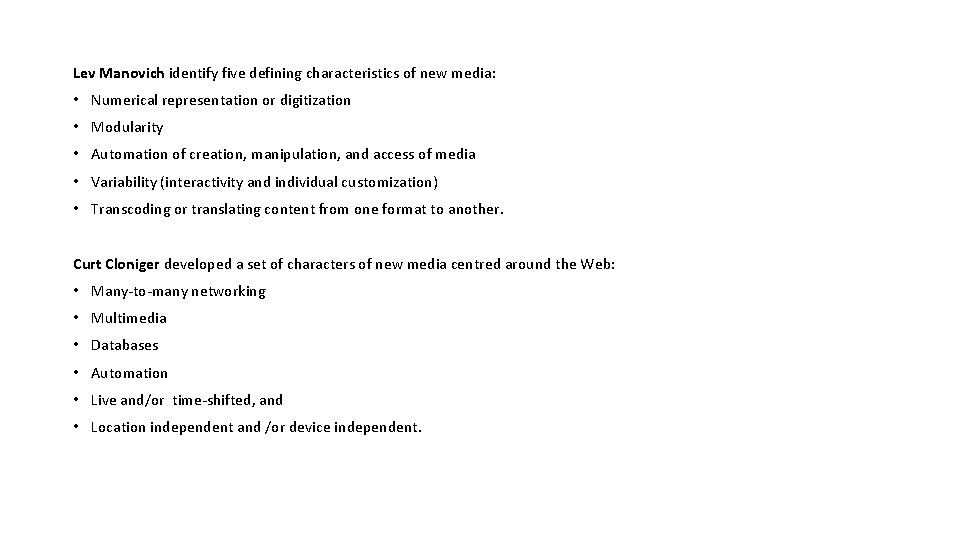
Lev Manovich identify five defining characteristics of new media: • Numerical representation or digitization • Modularity • Automation of creation, manipulation, and access of media • Variability (interactivity and individual customization) • Transcoding or translating content from one format to another. Curt Cloniger developed a set of characters of new media centred around the Web: • Many-to-many networking • Multimedia • Databases • Automation • Live and/or time-shifted, and • Location independent and /or device independent.
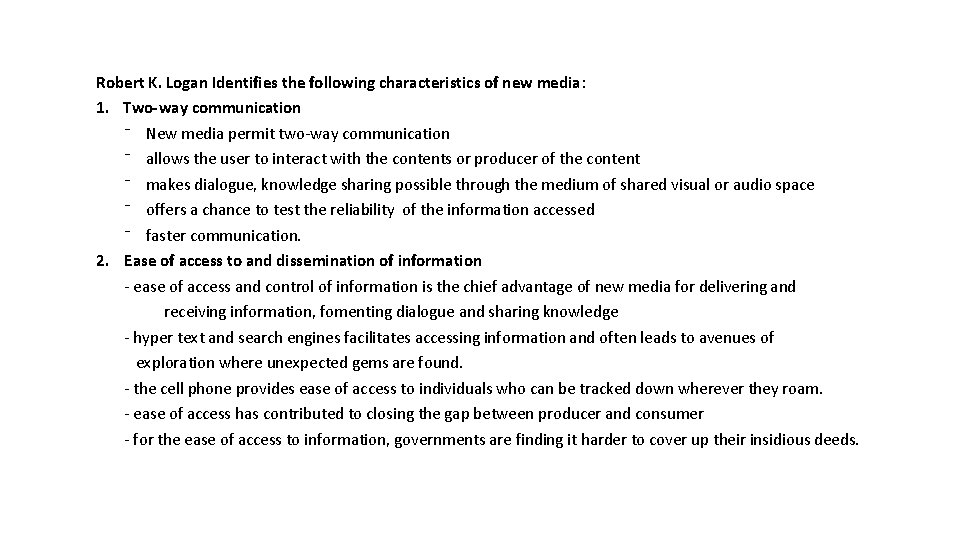
Robert K. Logan Identifies the following characteristics of new media: 1. Two-way communication ⁻ New media permit two-way communication ⁻ allows the user to interact with the contents or producer of the content ⁻ makes dialogue, knowledge sharing possible through the medium of shared visual or audio space ⁻ offers a chance to test the reliability of the information accessed ⁻ faster communication. 2. Ease of access to and dissemination of information - ease of access and control of information is the chief advantage of new media for delivering and receiving information, fomenting dialogue and sharing knowledge - hyper text and search engines facilitates accessing information and often leads to avenues of exploration where unexpected gems are found. - the cell phone provides ease of access to individuals who can be tracked down wherever they roam. - ease of access has contributed to closing the gap between producer and consumer - for the ease of access to information, governments are finding it harder to cover up their insidious deeds.
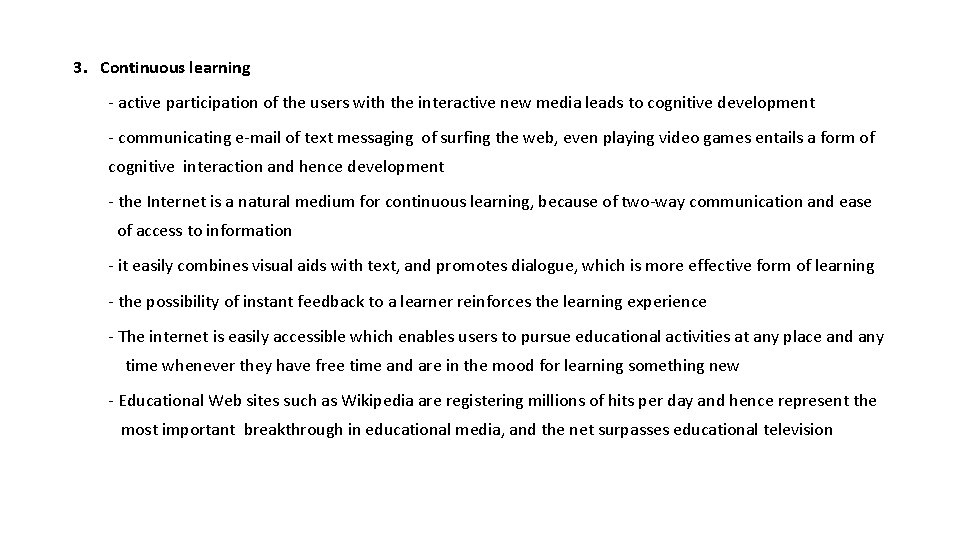
3. Continuous learning - active participation of the users with the interactive new media leads to cognitive development - communicating e-mail of text messaging of surfing the web, even playing video games entails a form of cognitive interaction and hence development - the Internet is a natural medium for continuous learning, because of two-way communication and ease of access to information - it easily combines visual aids with text, and promotes dialogue, which is more effective form of learning - the possibility of instant feedback to a learner reinforces the learning experience - The internet is easily accessible which enables users to pursue educational activities at any place and any time whenever they have free time and are in the mood for learning something new - Educational Web sites such as Wikipedia are registering millions of hits per day and hence represent the most important breakthrough in educational media, and the net surpasses educational television
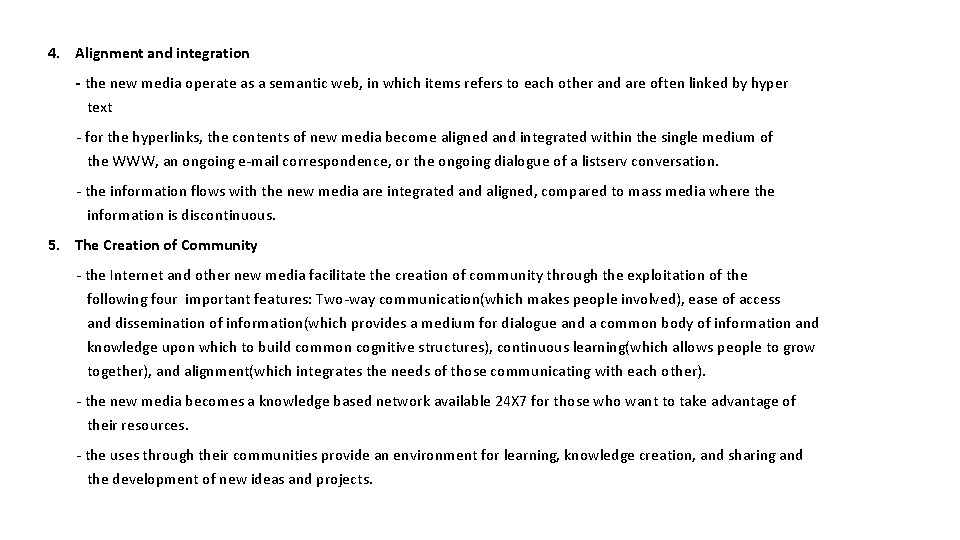
4. Alignment and integration - the new media operate as a semantic web, in which items refers to each other and are often linked by hyper text - for the hyperlinks, the contents of new media become aligned and integrated within the single medium of the WWW, an ongoing e-mail correspondence, or the ongoing dialogue of a listserv conversation. - the information flows with the new media are integrated and aligned, compared to mass media where the information is discontinuous. 5. The Creation of Community - the Internet and other new media facilitate the creation of community through the exploitation of the following four important features: Two-way communication(which makes people involved), ease of access and dissemination of information(which provides a medium for dialogue and a common body of information and knowledge upon which to build common cognitive structures), continuous learning(which allows people to grow together), and alignment(which integrates the needs of those communicating with each other). - the new media becomes a knowledge based network available 24 X 7 for those who want to take advantage of their resources. - the uses through their communities provide an environment for learning, knowledge creation, and sharing and the development of new ideas and projects.
6. Portability and time flexibility - a unique feature of new media , particularly devices such as the computer notebook, Wi. Fi, the cellphone, the MP 3 player, and the PDA are their portability, which translates into ubiquitious computing. - The receiver and even the producer of information can be anywhere because of the portability of these devices and can interact at any time it is convenient for them. - Portability provides freedom over space and time. 7. Convergence of many media - new media comes with the ability to combine different media in one device. For example, cell phone that takes and transmits photos, provides text messaging, serves as an internet port, and so forth. -The WWW is another example of convergent media that integrated text, audio, video, and graphics and allows for conferencing, chatting, video phoning, and online versions of selling, buying, auctioning, banking, searching, researching, learning, attending seminars and trade shows, and gaming etc. 8. Interoperability - Interoperable means able to operate in conjunction or the ability of products and systems to work together to accomplish a common task - New media are interoperable in the technical sense, but, as such they also promote social, political, and organisational interoperability, which is one of their strong points and is the reason for thie widespread adoption. - It is the digital nature of new media that makes for their interoperability and hence convergence by allowing different new media to talk to each other. Example, the cell phone and the Internet.
9. Aggregation of content and crowd sourcing - New media such as the Internet, the WWW, and search engines beside convergence of different media, also aggregate content - The ease of access to digital information through new media, enables new media to collect content from different sources - Computers are aggregators in the sense that they allow easy storage and access to information files, so one tends to collect all of one’s output on a computer plus the output of others that one finds convenient to have easy access to. - The aggregation of content has led to a large number of commercially successful web-based businesses. Yahoo and AOL aggregate and organise information freely available on the Web. 10. Variety Choice, and the Long Tail - digital new media technologies facilitate duplication of content with easiness and without degradation of the quality of the media. This feature is driving a revolution in terms of duplication and transmission of media content whether they are text, audio, video of their combination. Because duplication and reproduction, and disply on new media platforms incur very little cost, material for which there is very little demand can still be reproduced and made available by the operators of a website and still turn a profit. This leads to availability of variety and presents choice before the consumers. - Chris Anderson(Wired, Oct. 2004) has identified phenomenon and has given it the name “The Long Tail”(Logan, 2010: 64)
11. Reintegration of producer and consumer -before the industrial age there was no division of labour - industrlization disintegrated the producer and the consumers - computing again reversed the trend leading to reintegration of the producer and consumer, they are collectively referred to as prosumers. 12. Social collectivity and cooperation - by offering new opportunities for interaction and collaboration, the new media has amplified the old media’s effort for creating collective action and cooperation in unprecedented global level. - what may be unique is, in most cases, the cooperation takes place among individuals who have never met each other(cyber space) - one of the first to identify cyber cooperation was Howard Rheingold(2002)in his book “Smart Mobs: The Next Social Revolution). “Smart mobs emerge when communication and computing technologies amplify human talent for cooperation and collective action of both beneficial and destructive kinds”. - New Media Creates what Tim O’Reilly(2004) terms an “architecture of participation”; - Alvin Toffler in the Third Wave(1980) identified the emergence of participatory structures and producer/consumers of “prosumers”
- The Internet, WWW, blogs, podcasts, and the cell phones are examples of new media that give rise to collectivity because they combine both communication and computing functions. - The collective forms of cooperation that new media makes possible can be: collective interests, collective judgements, collective resources, and collective projects. - A number of websites allow people sharing common interest to identify each other and where possible to meet up and share experiences and/ or organise offline joint activities. 13. Remix Culture - Wikipedia defines remix as “an alternative mix of a song using the technique of audio editing. . ” - In its extended form, “Remix” refers to the contemporary practice of creating new cultural artefacts by remixing prior cultural elements to create something new. A web application that combines data from more than one source into an integrated experience. - William Gibson(2005) claims that “Remix” is the very nature of the digital media. It , of course, is the most visible face of the Internet culture. The PEW Internet and American life project 2007 has found that 17 % Internet users take material from the Net and remix it for their own artistic creation. - although remix has always been an aspect of human culture, the phenomenon takes on more significance in the digital age because of the ease with which a creator of a new cultural artefact can “steal” already existing works. Music, text, and images are easily transferred from one digital device to another because of the Internet, which allows this phenomenon to take place on a global scale.
14. Transition from products to services - Emergence of new media represents a transition from products to services. - Instead of a product, such as a music or software CD –Rom being shrink wrapped in a box , the same functionality is being offered as a service through cyber space. - The form of software distribution has the advantage that the updating of software becomes a continuous process.
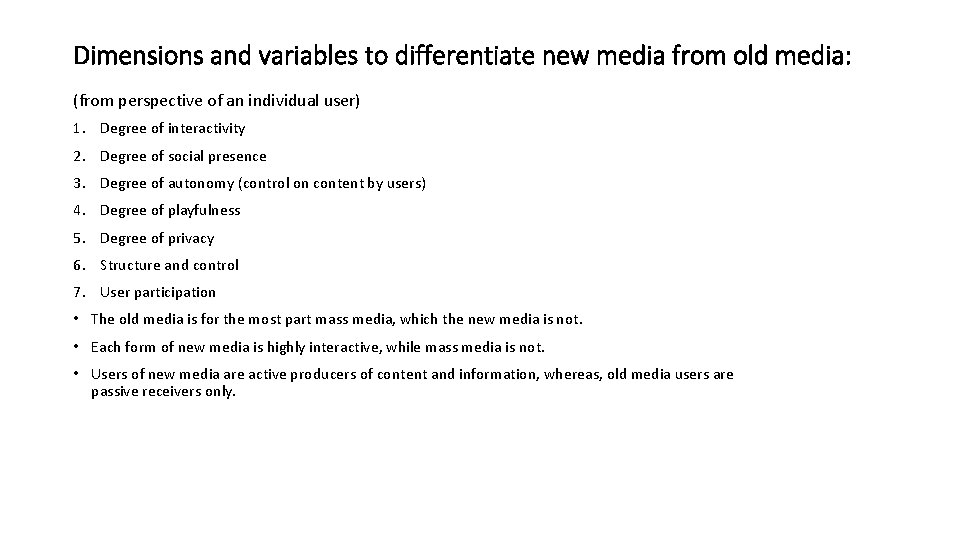
Dimensions and variables to differentiate new media from old media: (from perspective of an individual user) 1. Degree of interactivity 2. Degree of social presence 3. Degree of autonomy (control on content by users) 4. Degree of playfulness 5. Degree of privacy 6. Structure and control 7. User participation • The old media is for the most part mass media, which the new media is not. • Each form of new media is highly interactive, while mass media is not. • Users of new media are active producers of content and information, whereas, old media users are passive receivers only.
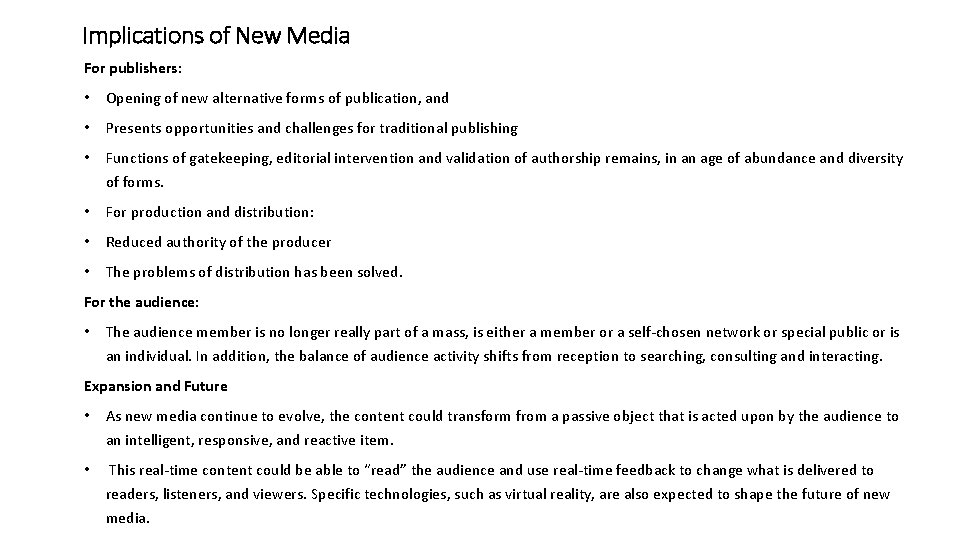
Implications of New Media For publishers: • Opening of new alternative forms of publication, and • Presents opportunities and challenges for traditional publishing • Functions of gatekeeping, editorial intervention and validation of authorship remains, in an age of abundance and diversity of forms. • For production and distribution: • Reduced authority of the producer • The problems of distribution has been solved. For the audience: • The audience member is no longer really part of a mass, is either a member or a self-chosen network or special public or is an individual. In addition, the balance of audience activity shifts from reception to searching, consulting and interacting. Expansion and Future • As new media continue to evolve, the content could transform from a passive object that is acted upon by the audience to an intelligent, responsive, and reactive item. • This real-time content could be able to “read” the audience and use real-time feedback to change what is delivered to readers, listeners, and viewers. Specific technologies, such as virtual reality, are also expected to shape the future of new media.