
New Measurement of the Electron Magnetic Moment and
- Slides: 74
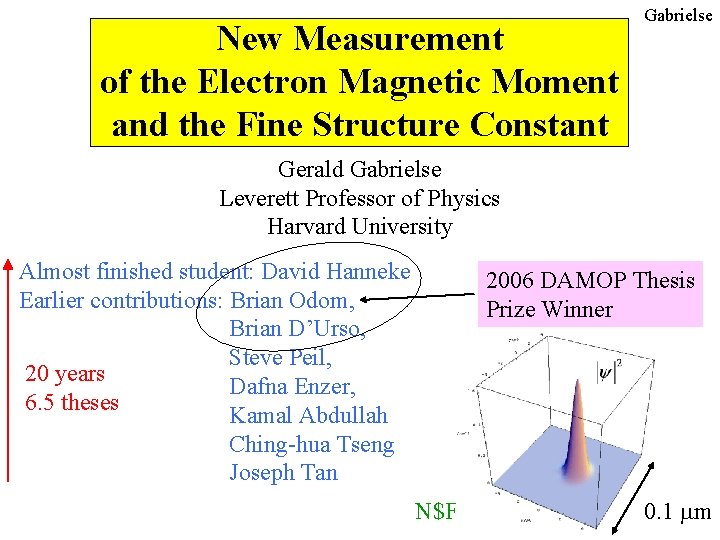
New Measurement of the Electron Magnetic Moment and the Fine Structure Constant Gabrielse Gerald Gabrielse Leverett Professor of Physics Harvard University Almost finished student: David Hanneke Earlier contributions: Brian Odom, Brian D’Urso, Steve Peil, 20 years Dafna Enzer, 6. 5 theses Kamal Abdullah Ching-hua Tseng Joseph Tan 2006 DAMOP Thesis Prize Winner N$F 0. 1 mm
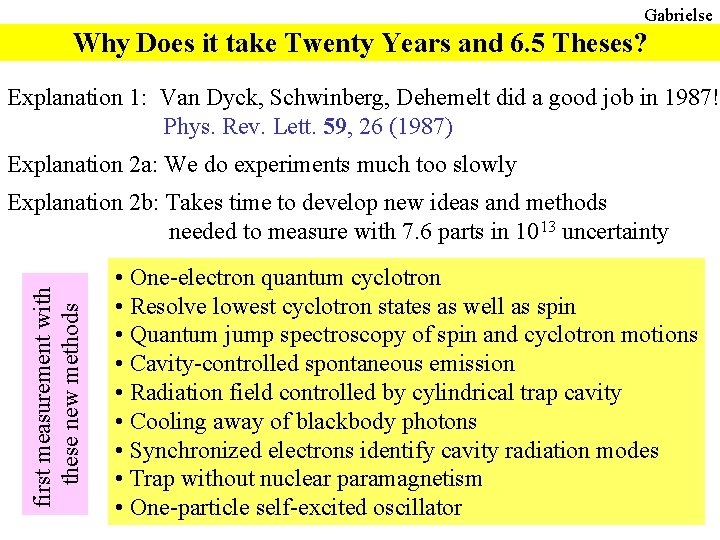
Gabrielse Why Does it take Twenty Years and 6. 5 Theses? Explanation 1: Van Dyck, Schwinberg, Dehemelt did a good job in 1987! Phys. Rev. Lett. 59, 26 (1987) Explanation 2 a: We do experiments much too slowly first measurement with these new methods Explanation 2 b: Takes time to develop new ideas and methods needed to measure with 7. 6 parts in 1013 uncertainty • One-electron quantum cyclotron • Resolve lowest cyclotron states as well as spin • Quantum jump spectroscopy of spin and cyclotron motions • Cavity-controlled spontaneous emission • Radiation field controlled by cylindrical trap cavity • Cooling away of blackbody photons • Synchronized electrons identify cavity radiation modes • Trap without nuclear paramagnetism • One-particle self-excited oscillator
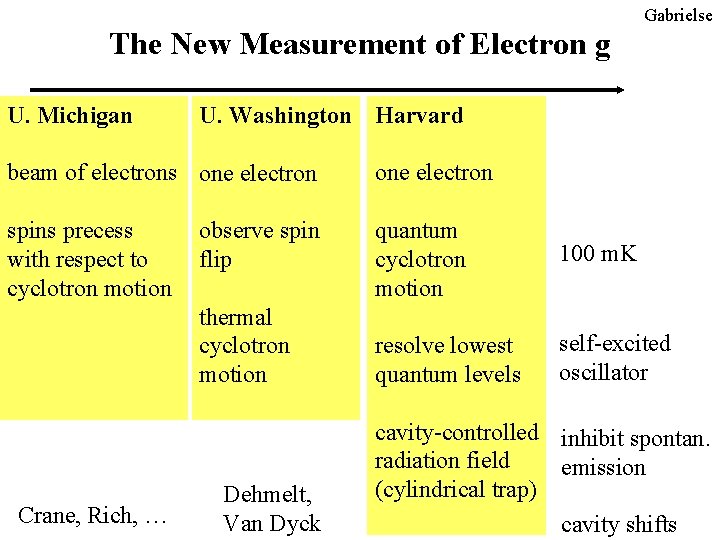
Gabrielse The New Measurement of Electron g U. Michigan U. Washington Harvard beam of electrons one electron spins precess with respect to cyclotron motion quantum cyclotron motion 100 m. K resolve lowest quantum levels self-excited oscillator observe spin flip thermal cyclotron motion Crane, Rich, … Dehmelt, Van Dyck cavity-controlled inhibit spontan. radiation field emission (cylindrical trap) cavity shifts
Gabrielse Magnetic Moments, Motivation and Results
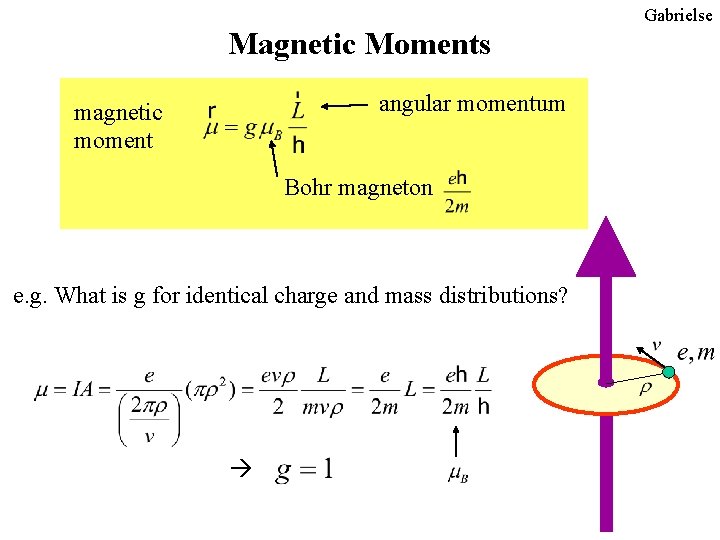
Gabrielse Magnetic Moments angular momentum magnetic moment Bohr magneton e. g. What is g for identical charge and mass distributions?
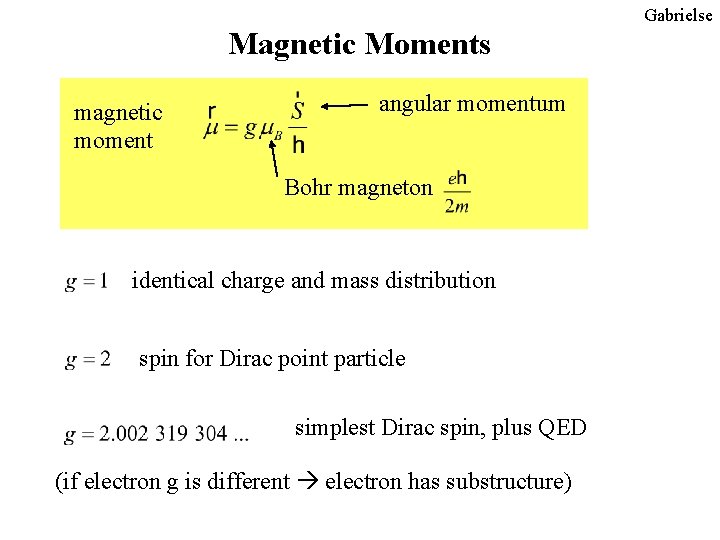
Gabrielse Magnetic Moments magnetic moment angular momentum Bohr magneton identical charge and mass distribution spin for Dirac point particle simplest Dirac spin, plus QED (if electron g is different electron has substructure)
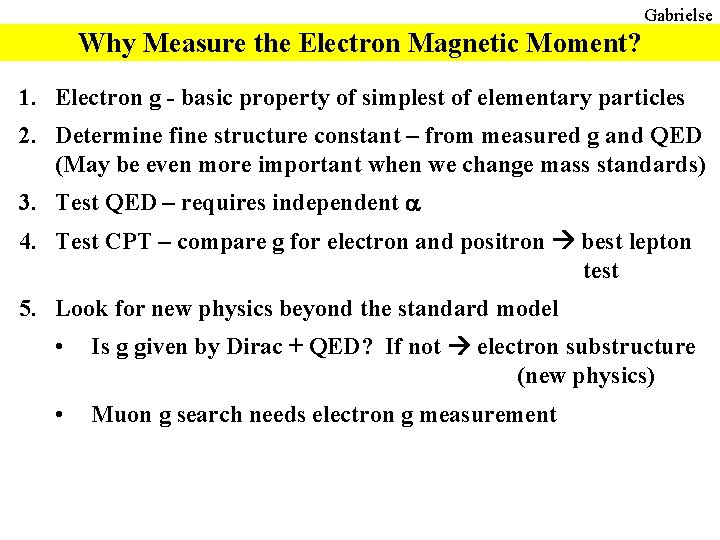
Gabrielse Why Measure the Electron Magnetic Moment? 1. Electron g - basic property of simplest of elementary particles 2. Determine fine structure constant – from measured g and QED (May be even more important when we change mass standards) 3. Test QED – requires independent a 4. Test CPT – compare g for electron and positron best lepton test 5. Look for new physics beyond the standard model • Is g given by Dirac + QED? If not electron substructure (new physics) • Muon g search needs electron g measurement
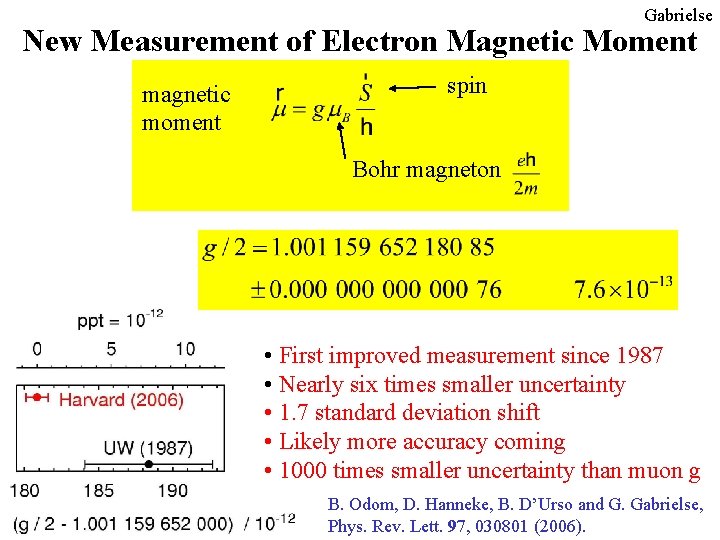
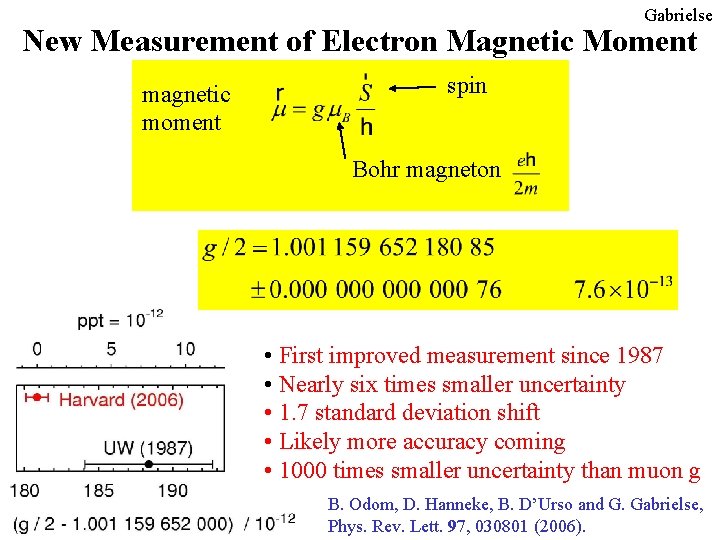
Gabrielse New Measurement of Electron Magnetic Moment magnetic moment spin Bohr magneton • First improved measurement since 1987 • Nearly six times smaller uncertainty • 1. 7 standard deviation shift • Likely more accuracy coming • 1000 times smaller uncertainty than muon g B. Odom, D. Hanneke, B. D’Urso and G. Gabrielse, Phys. Rev. Lett. 97, 030801 (2006).
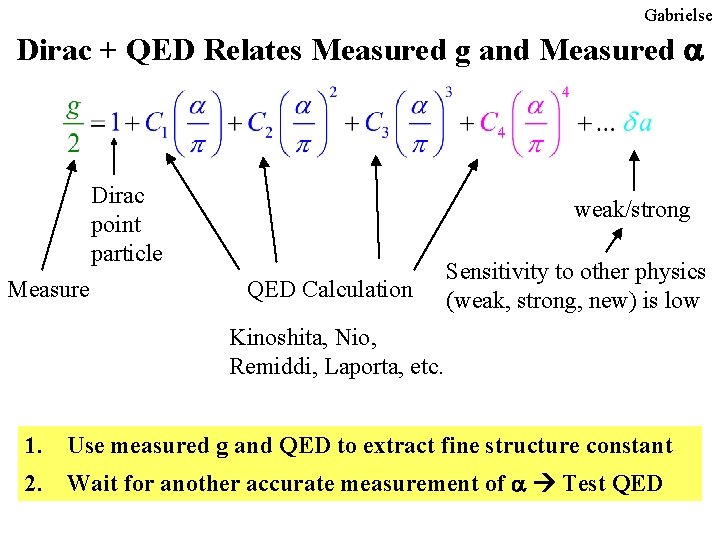
Gabrielse Dirac + QED Relates Measured g and Measured a Dirac point particle Measure weak/strong QED Calculation Sensitivity to other physics (weak, strong, new) is low Kinoshita, Nio, Remiddi, Laporta, etc. 1. Use measured g and QED to extract fine structure constant 2. Wait for another accurate measurement of a Test QED
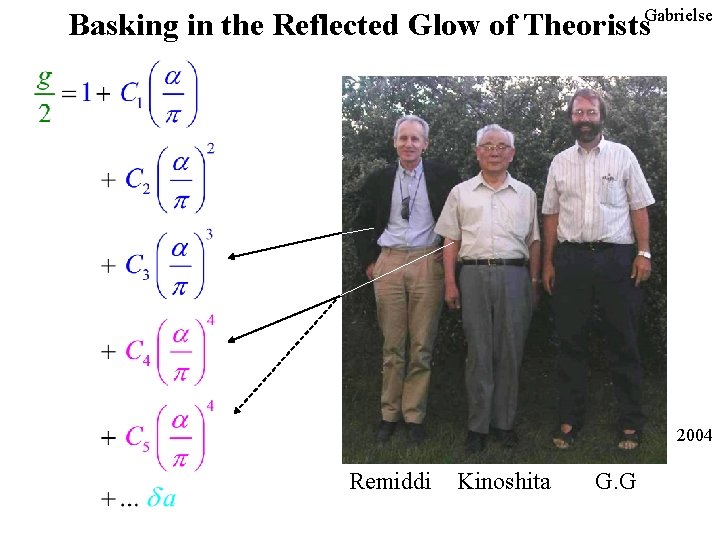
Basking in the Reflected Glow of Theorists. Gabrielse 2004 Remiddi Kinoshita G. G
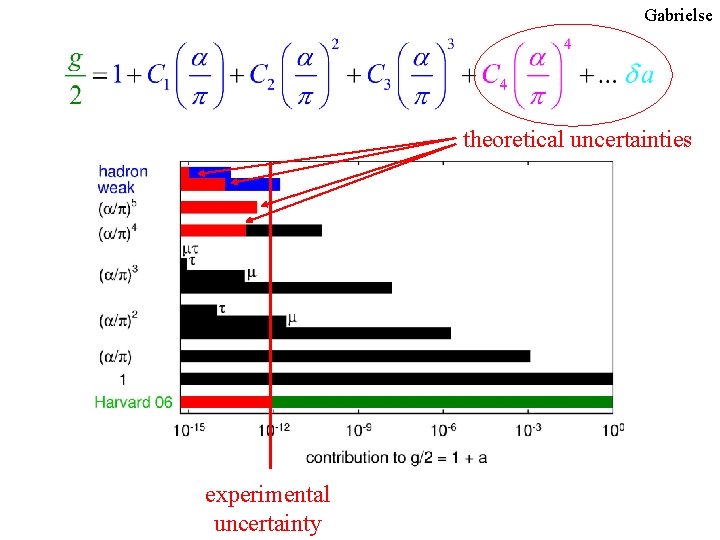
Gabrielse theoretical uncertainties experimental uncertainty
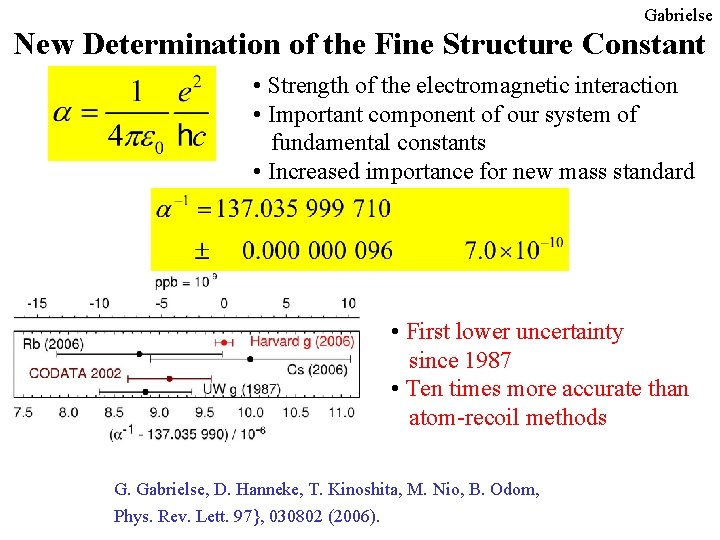
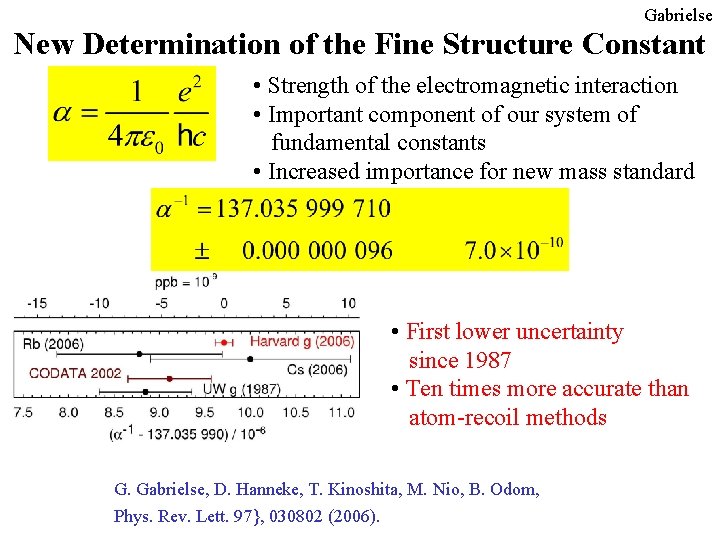
Gabrielse New Determination of the Fine Structure Constant • Strength of the electromagnetic interaction • Important component of our system of fundamental constants • Increased importance for new mass standard • First lower uncertainty since 1987 • Ten times more accurate than atom-recoil methods G. Gabrielse, D. Hanneke, T. Kinoshita, M. Nio, B. Odom, Phys. Rev. Lett. 97}, 030802 (2006).
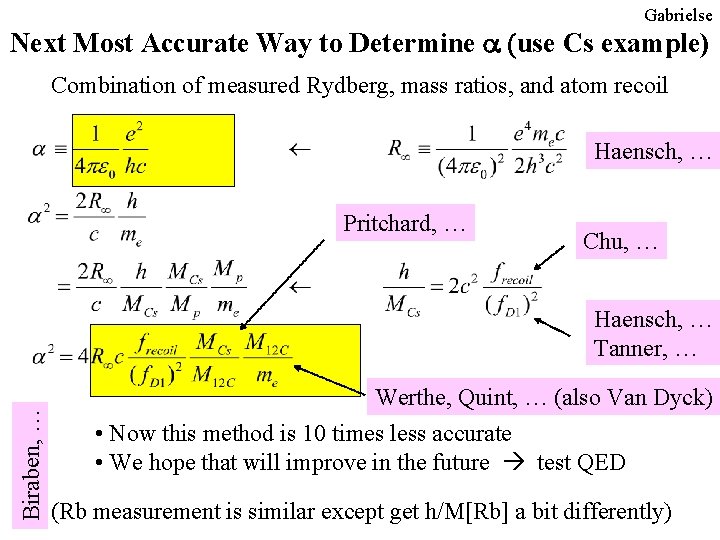
Gabrielse Next Most Accurate Way to Determine a (use Cs example) Combination of measured Rydberg, mass ratios, and atom recoil Haensch, … Pritchard, … Chu, … Biraben, … Haensch, … Tanner, … Werthe, Quint, … (also Van Dyck) • Now this method is 10 times less accurate • We hope that will improve in the future test QED (Rb measurement is similar except get h/M[Rb] a bit differently)
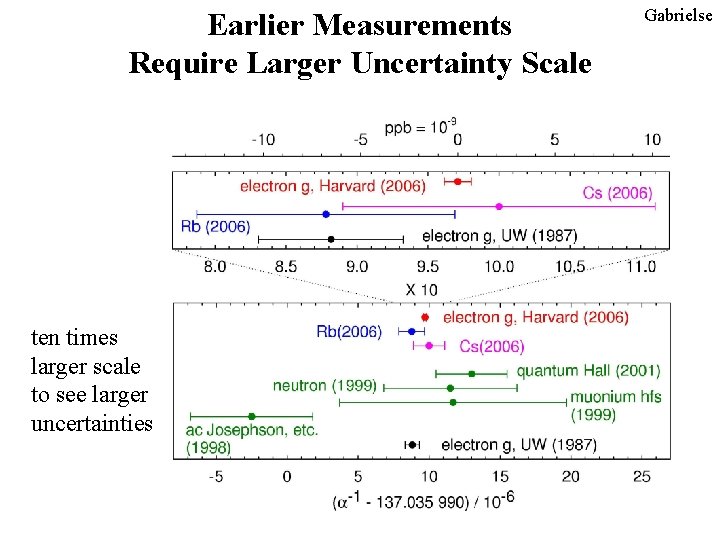
Earlier Measurements Require Larger Uncertainty Scale ten times larger scale to see larger uncertainties Gabrielse
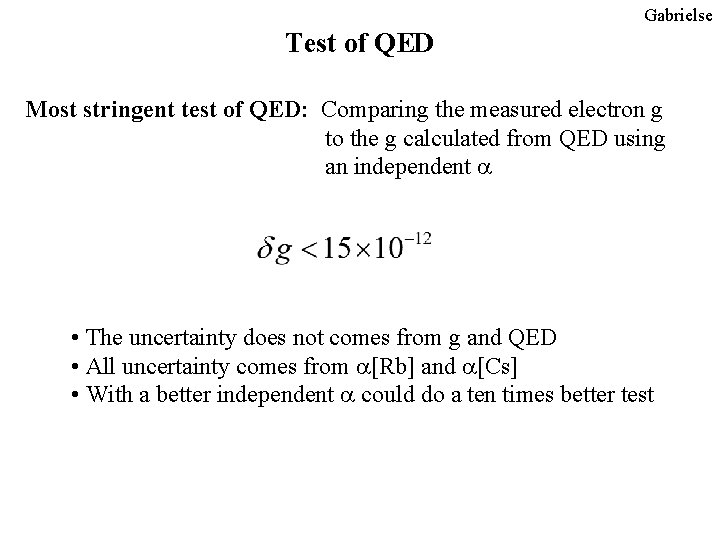
Gabrielse Test of QED Most stringent test of QED: Comparing the measured electron g to the g calculated from QED using an independent a • The uncertainty does not comes from g and QED • All uncertainty comes from a[Rb] and a[Cs] • With a better independent a could do a ten times better test
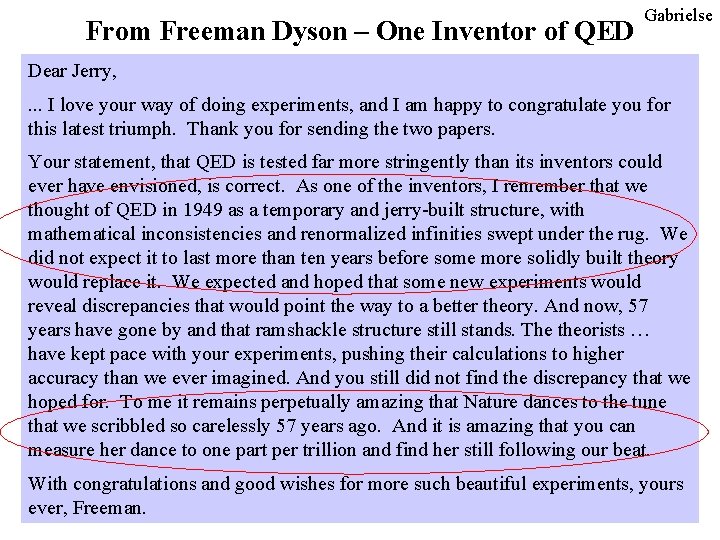
From Freeman Dyson – One Inventor of QED Gabrielse Dear Jerry, . . . I love your way of doing experiments, and I am happy to congratulate you for this latest triumph. Thank you for sending the two papers. Your statement, that QED is tested far more stringently than its inventors could ever have envisioned, is correct. As one of the inventors, I remember that we thought of QED in 1949 as a temporary and jerry-built structure, with mathematical inconsistencies and renormalized infinities swept under the rug. We did not expect it to last more than ten years before some more solidly built theory would replace it. We expected and hoped that some new experiments would reveal discrepancies that would point the way to a better theory. And now, 57 years have gone by and that ramshackle structure still stands. The theorists … have kept pace with your experiments, pushing their calculations to higher accuracy than we ever imagined. And you still did not find the discrepancy that we hoped for. To me it remains perpetually amazing that Nature dances to the tune that we scribbled so carelessly 57 years ago. And it is amazing that you can measure her dance to one part per trillion and find her still following our beat. With congratulations and good wishes for more such beautiful experiments, yours ever, Freeman.
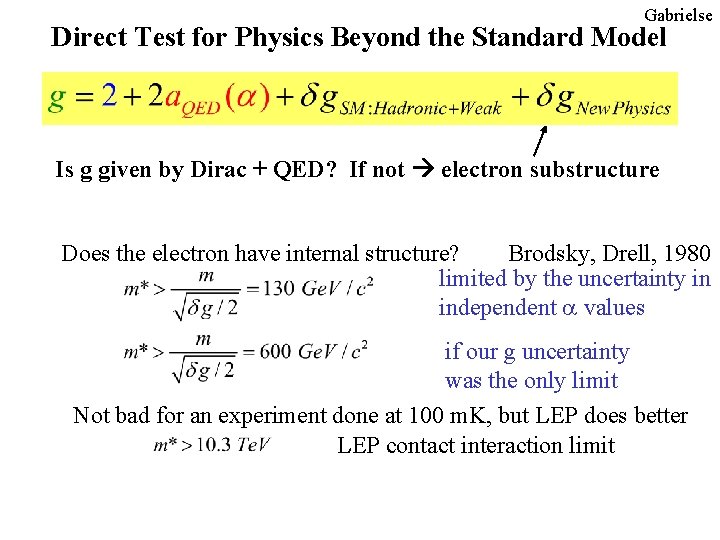
Gabrielse Direct Test for Physics Beyond the Standard Model Is g given by Dirac + QED? If not electron substructure Does the electron have internal structure? Brodsky, Drell, 1980 limited by the uncertainty in independent a values if our g uncertainty was the only limit Not bad for an experiment done at 100 m. K, but LEP does better LEP contact interaction limit
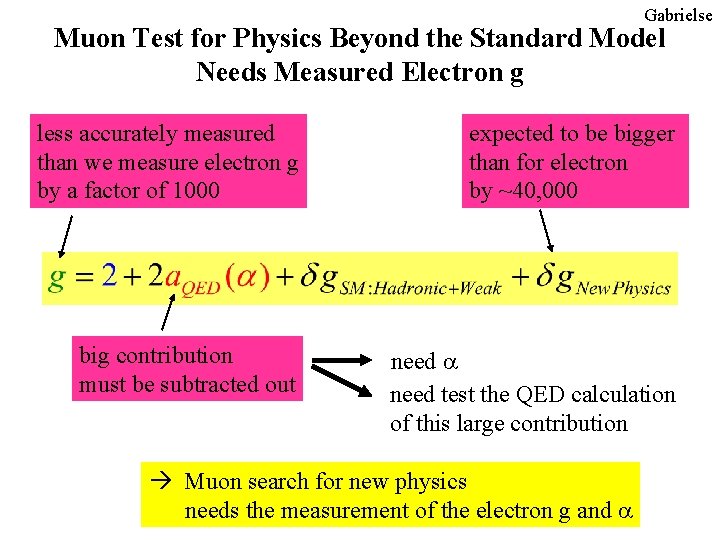
Gabrielse Muon Test for Physics Beyond the Standard Model Needs Measured Electron g less accurately measured than we measure electron g by a factor of 1000 expected to be bigger than for electron by ~40, 000 big contribution must be subtracted out need a need test the QED calculation of this large contribution Muon search for new physics needs the measurement of the electron g and a
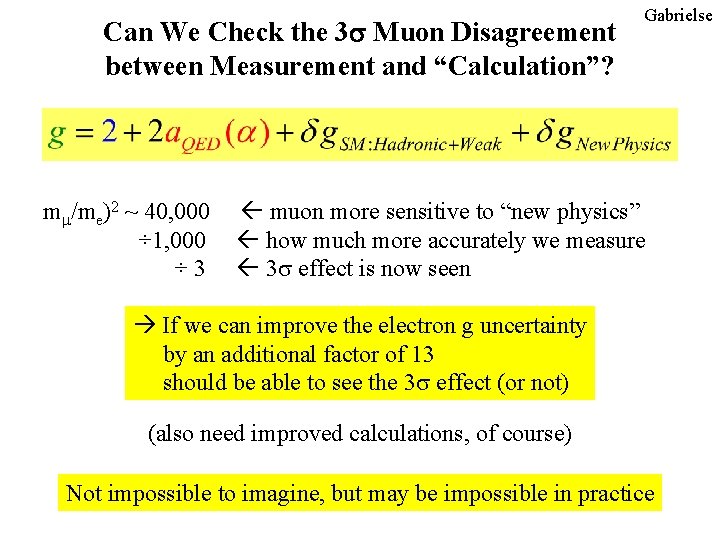
Can We Check the 3 s Muon Disagreement between Measurement and “Calculation”? Gabrielse mm/me)2 ~ 40, 000 muon more sensitive to “new physics” ÷ 1, 000 how much more accurately we measure ÷ 3 3 s effect is now seen If we can improve the electron g uncertainty by an additional factor of 13 should be able to see the 3 s effect (or not) (also need improved calculations, of course) Not impossible to imagine, but may be impossible in practice
Gabrielse How Does One Measure the Electron g to 7. 6 parts in 1013?
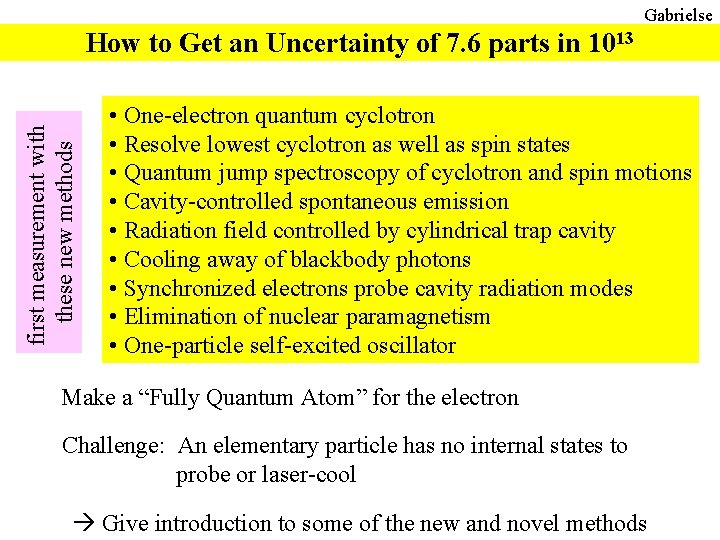
Gabrielse first measurement with these new methods How to Get an Uncertainty of 7. 6 parts in 1013 • One-electron quantum cyclotron • Resolve lowest cyclotron as well as spin states • Quantum jump spectroscopy of cyclotron and spin motions • Cavity-controlled spontaneous emission • Radiation field controlled by cylindrical trap cavity • Cooling away of blackbody photons • Synchronized electrons probe cavity radiation modes • Elimination of nuclear paramagnetism • One-particle self-excited oscillator Make a “Fully Quantum Atom” for the electron Challenge: An elementary particle has no internal states to probe or laser-cool Give introduction to some of the new and novel methods
Gabrielse Basic Idea of the Measurement Quantum jump spectroscopy of lowest cyclotron and spin levels of an electron in a magnetic field
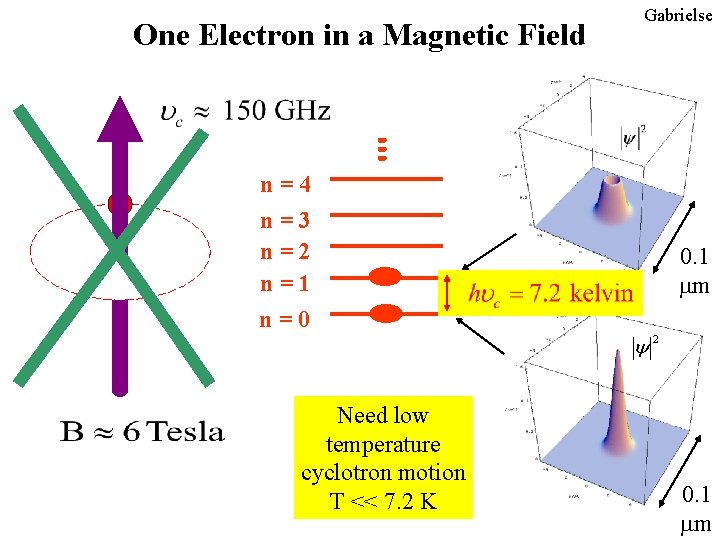
One Electron in a Magnetic Field Gabrielse n=4 n=3 n=2 n=1 n=0 0. 1 mm y Need low temperature cyclotron motion T << 7. 2 K 2 0. 1 mm
First Penning Trap Below 4 K 70 m. K Need low temperature cyclotron motion T << 7. 2 K Gabrielse
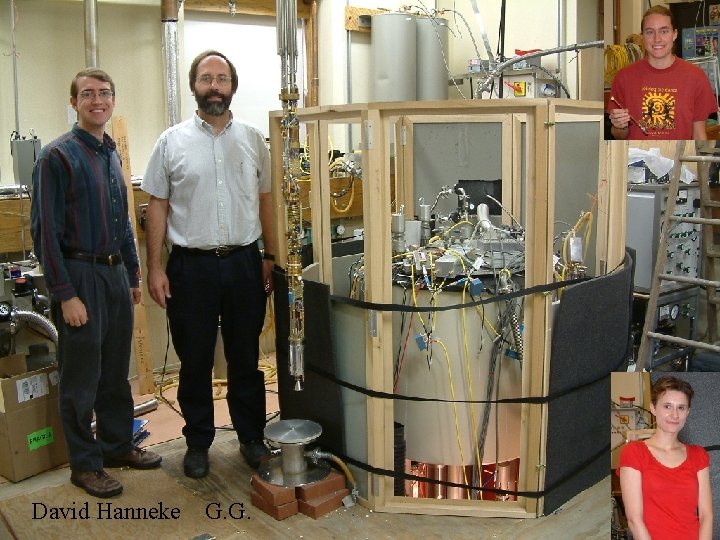
Gabrielse David Hanneke G. G.
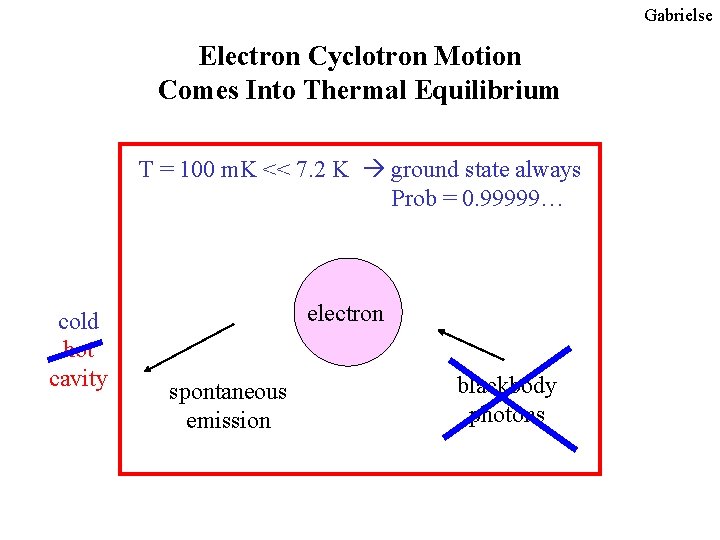
Gabrielse Electron Cyclotron Motion Comes Into Thermal Equilibrium T = 100 m. K << 7. 2 K ground state always Prob = 0. 99999… cold hot cavity electron spontaneous emission blackbody photons
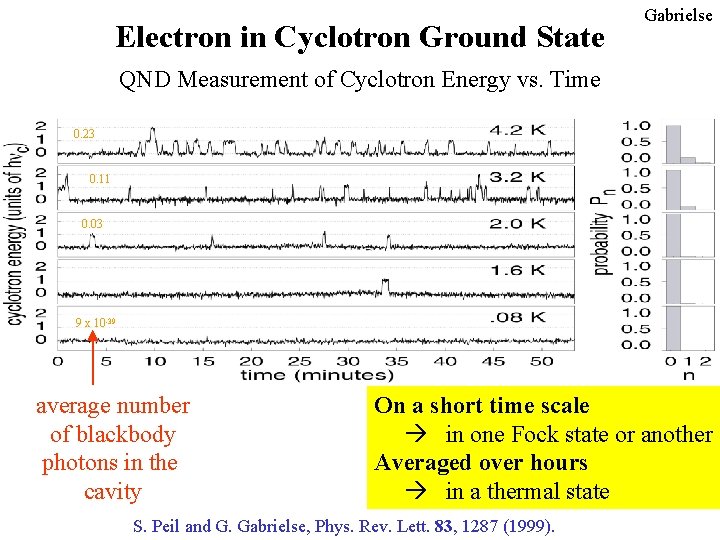
Electron in Cyclotron Ground State Gabrielse QND Measurement of Cyclotron Energy vs. Time 0. 23 0. 11 0. 03 9 x 10 -39 average number of blackbody photons in the cavity On a short time scale in one Fock state or another Averaged over hours in a thermal state S. Peil and G. Gabrielse, Phys. Rev. Lett. 83, 1287 (1999).
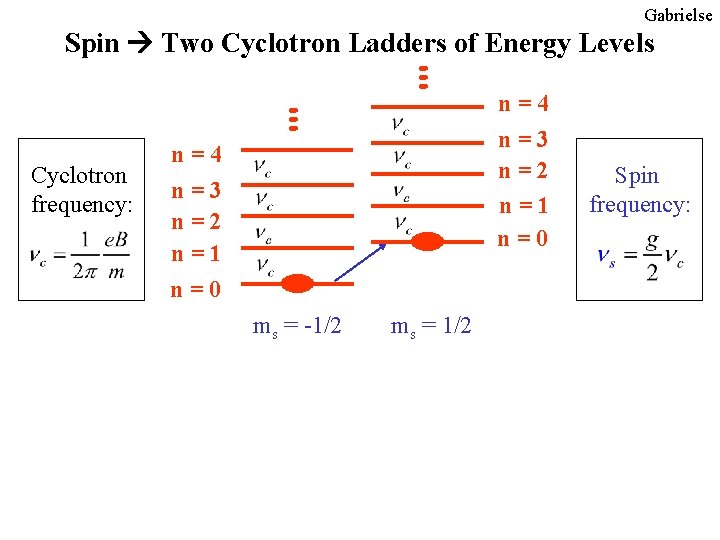
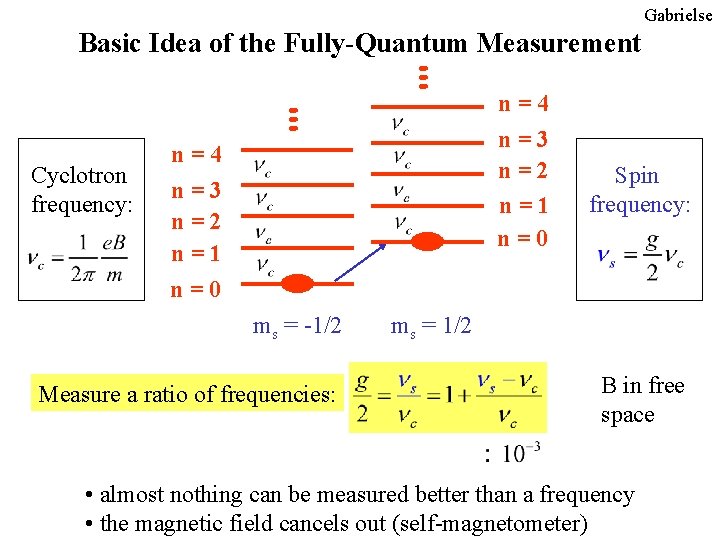
Gabrielse Spin Two Cyclotron Ladders of Energy Levels Cyclotron frequency: n=4 n=3 n=2 n=1 n=0 ms = -1/2 ms = 1/2 Spin frequency:
Gabrielse Basic Idea of the Fully-Quantum Measurement Cyclotron frequency: n=4 n=3 n=2 n=1 n=0 n=4 n=3 n=2 n=1 Spin frequency: n=0 ms = -1/2 Measure a ratio of frequencies: ms = 1/2 B in free space • almost nothing can be measured better than a frequency • the magnetic field cancels out (self-magnetometer)
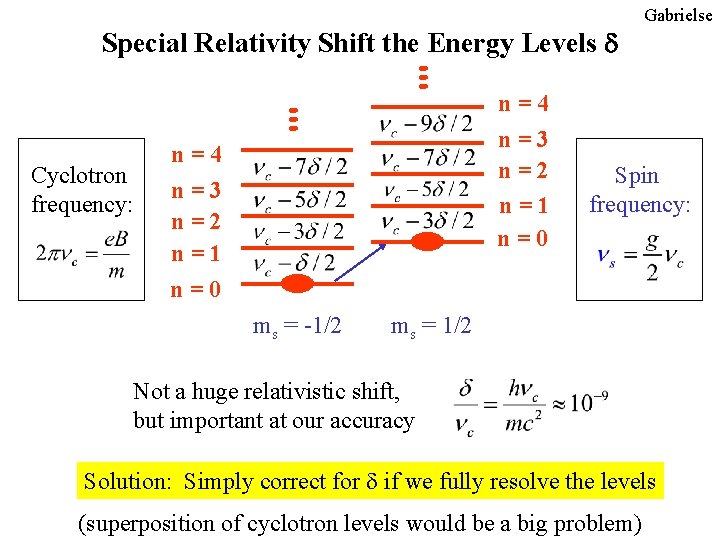
Special Relativity Shift the Energy Levels d Cyclotron frequency: n=4 n=3 n=2 n=1 n=0 n=4 n=3 n=2 n=1 Gabrielse Spin frequency: n=0 ms = -1/2 ms = 1/2 Not a huge relativistic shift, but important at our accuracy Solution: Simply correct for d if we fully resolve the levels (superposition of cyclotron levels would be a big problem)
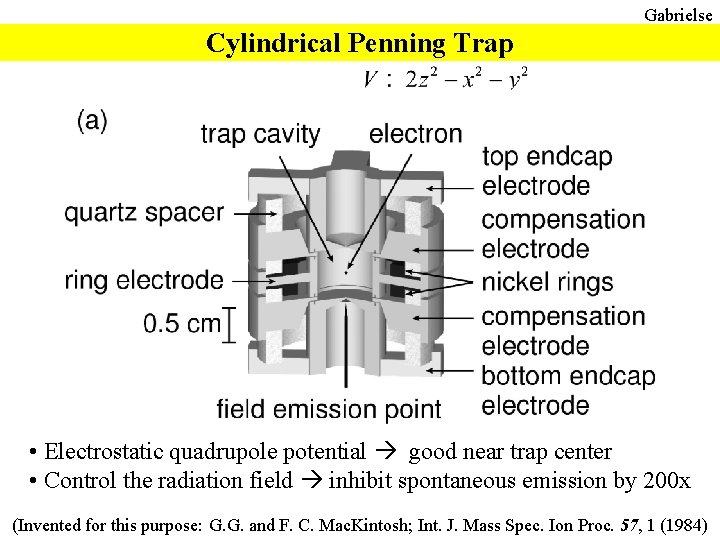
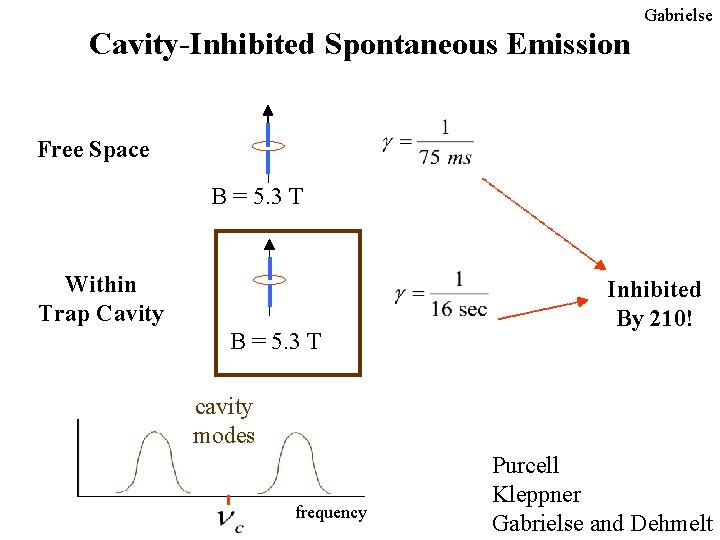
Gabrielse Cylindrical Penning Trap • Electrostatic quadrupole potential good near trap center • Control the radiation field inhibit spontaneous emission by 200 x (Invented for this purpose: G. G. and F. C. Mac. Kintosh; Int. J. Mass Spec. Ion Proc. 57, 1 (1984)
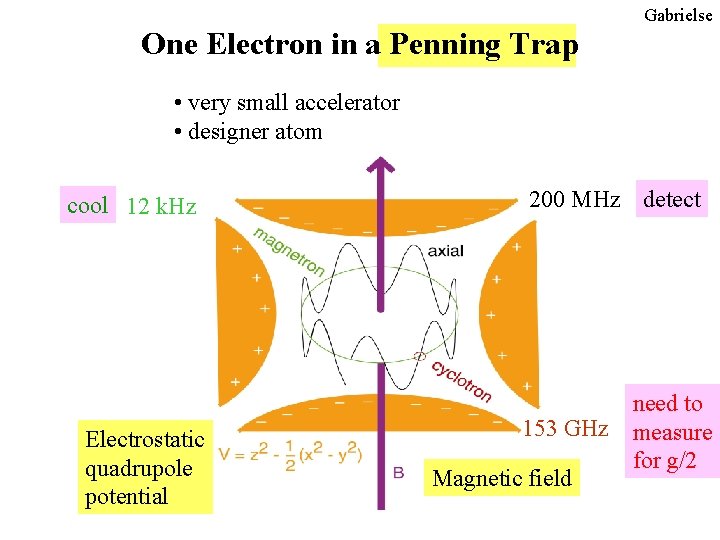
Gabrielse One Electron in a Penning Trap • very small accelerator • designer atom cool 12 k. Hz Electrostatic quadrupole potential 200 MHz detect need to 153 GHz measure for g/2 Magnetic field
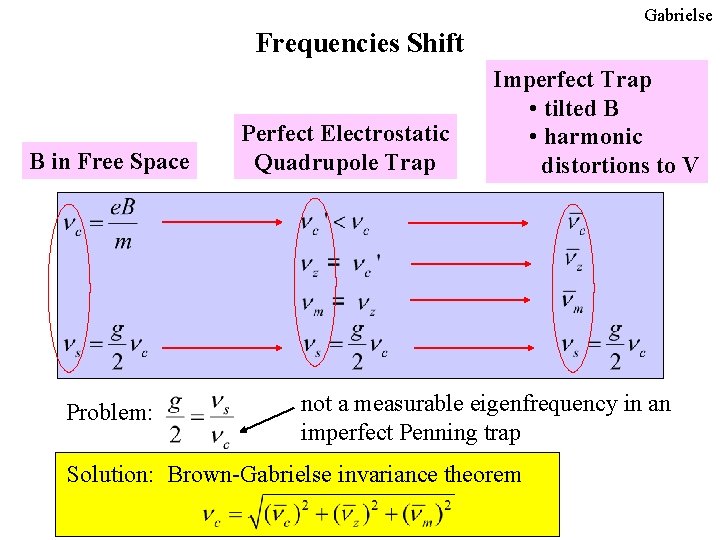
Gabrielse Frequencies Shift B in Free Space Problem: Perfect Electrostatic Quadrupole Trap Imperfect Trap • tilted B • harmonic distortions to V not a measurable eigenfrequency in an imperfect Penning trap Solution: Brown-Gabrielse invariance theorem
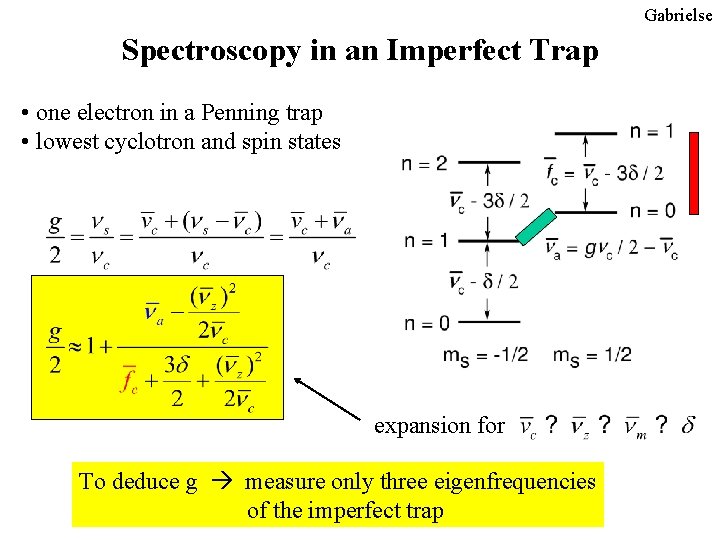
Gabrielse Spectroscopy in an Imperfect Trap • one electron in a Penning trap • lowest cyclotron and spin states expansion for To deduce g measure only three eigenfrequencies of the imperfect trap
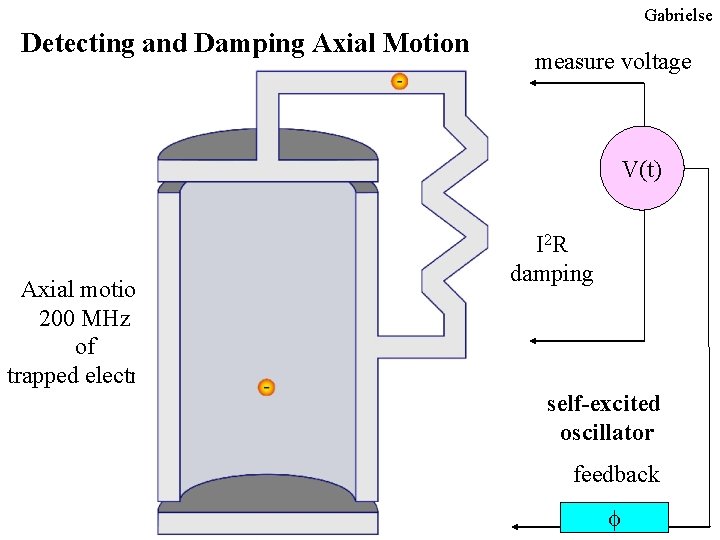
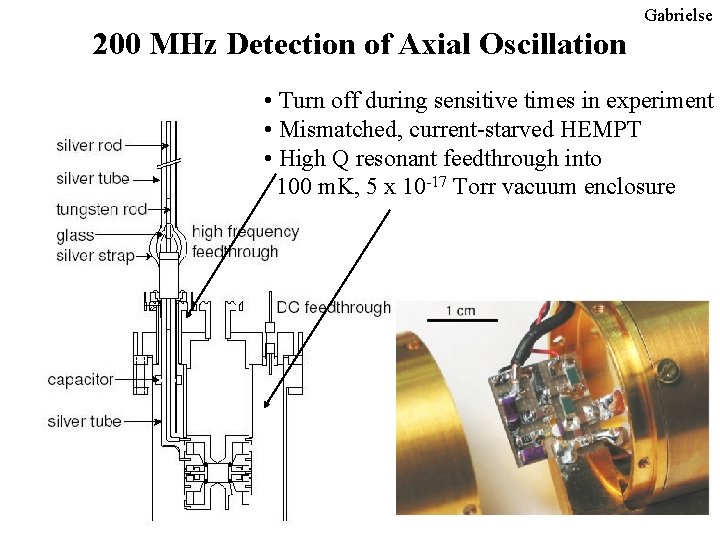
Gabrielse Detecting and Damping Axial Motion measure voltage V(t) Axial motion 200 MHz of trapped electron I 2 R damping self-excited oscillator feedback f
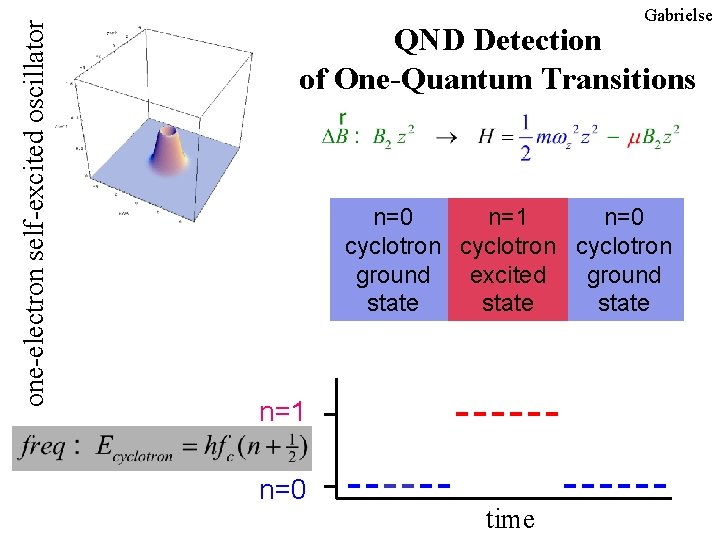
one-electron self-excited oscillator Gabrielse QND Detection of One-Quantum Transitions n=0 n=1 n=0 cyclotron ground excited ground state n=1 n=0 time
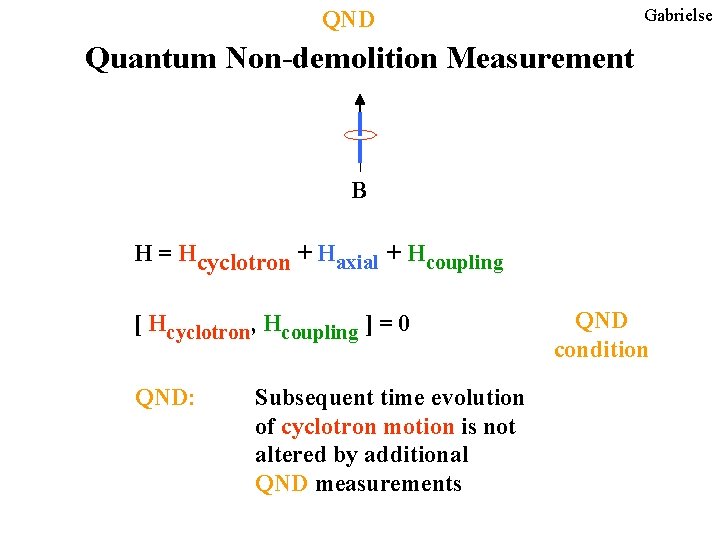
Gabrielse QND Quantum Non-demolition Measurement B H = Hcyclotron + Haxial + Hcoupling [ Hcyclotron, Hcoupling ] = 0 QND: Subsequent time evolution of cyclotron motion is not altered by additional QND measurements QND condition
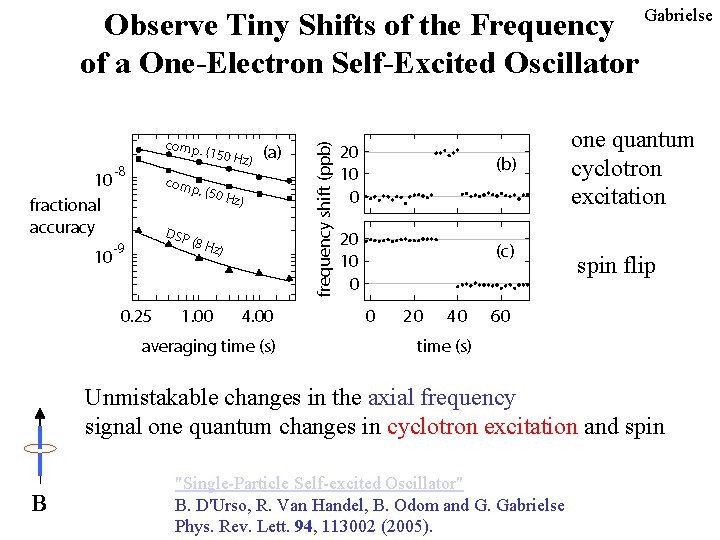
Observe Tiny Shifts of the Frequency Gabrielse of a One-Electron Self-Excited Oscillator one quantum cyclotron excitation spin flip Unmistakable changes in the axial frequency signal one quantum changes in cyclotron excitation and spin B "Single-Particle Self-excited Oscillator" B. D'Urso, R. Van Handel, B. Odom and G. Gabrielse Phys. Rev. Lett. 94, 113002 (2005).
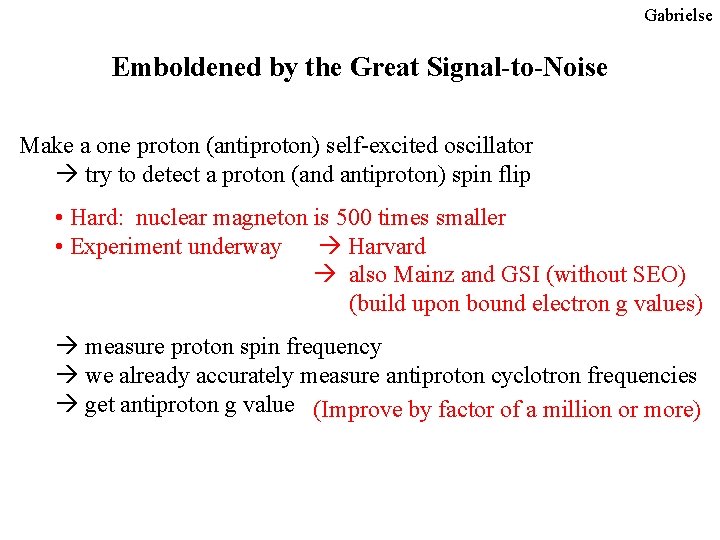
Gabrielse Emboldened by the Great Signal-to-Noise Make a one proton (antiproton) self-excited oscillator try to detect a proton (and antiproton) spin flip • Hard: nuclear magneton is 500 times smaller • Experiment underway Harvard also Mainz and GSI (without SEO) (build upon bound electron g values) measure proton spin frequency we already accurately measure antiproton cyclotron frequencies get antiproton g value (Improve by factor of a million or more)
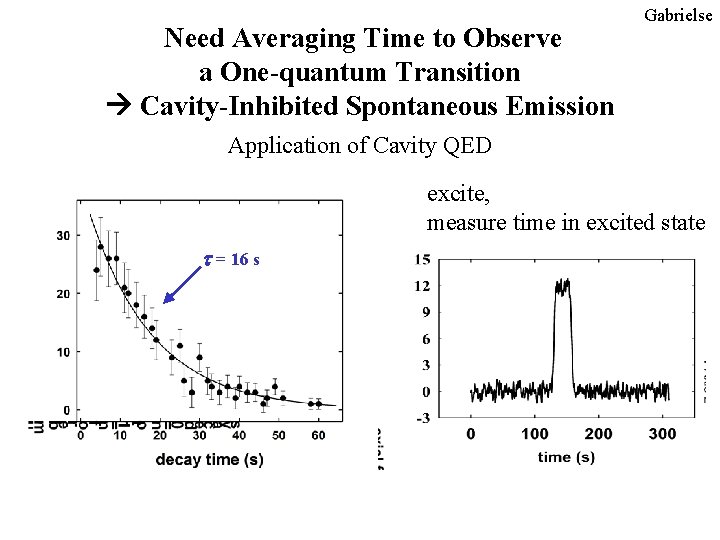
Need Averaging Time to Observe a One-quantum Transition Cavity-Inhibited Spontaneous Emission Gabrielse Application of Cavity QED excite, measure time in excited state t = 16 s
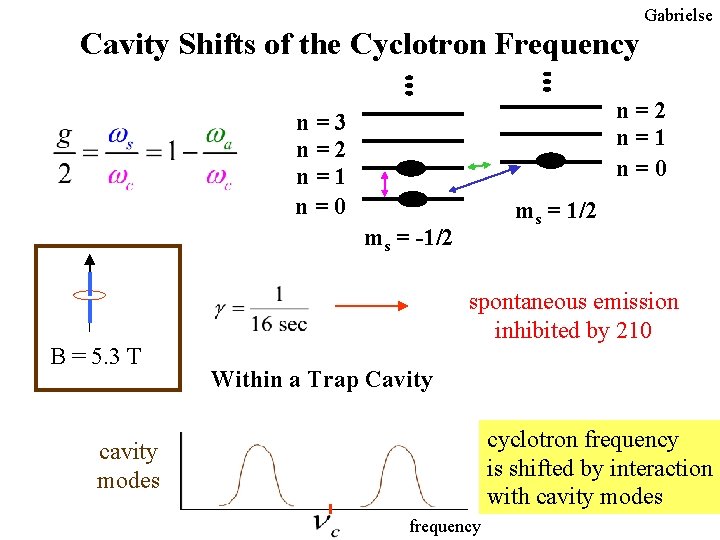
Gabrielse Cavity-Inhibited Spontaneous Emission Free Space B = 5. 3 T Within Trap Cavity B = 5. 3 T Inhibited By 210! cavity modes frequency Purcell Kleppner Gabrielse and Dehmelt
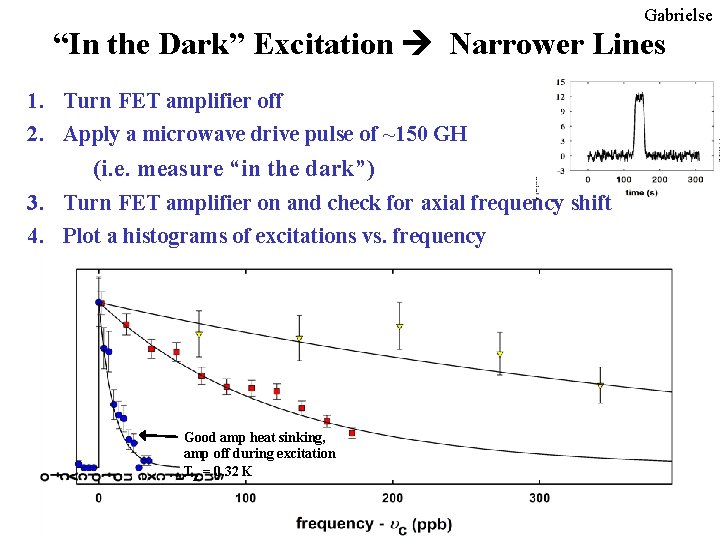
Gabrielse “In the Dark” Excitation Narrower Lines 1. Turn FET amplifier off 2. Apply a microwave drive pulse of ~150 GH (i. e. measure “in the dark”) 3. Turn FET amplifier on and check for axial frequency shift 4. Plot a histograms of excitations vs. frequency Good amp heat sinking, amp off during excitation Tz = 0. 32 K
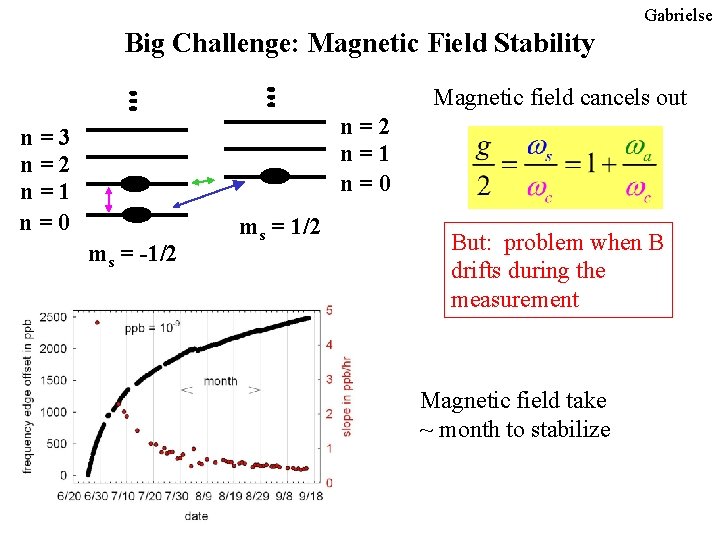
Gabrielse Big Challenge: Magnetic Field Stability Magnetic field cancels out n=2 n=1 n=0 n=3 n=2 n=1 n=0 ms = -1/2 ms = 1/2 But: problem when B drifts during the measurement Magnetic field take ~ month to stabilize
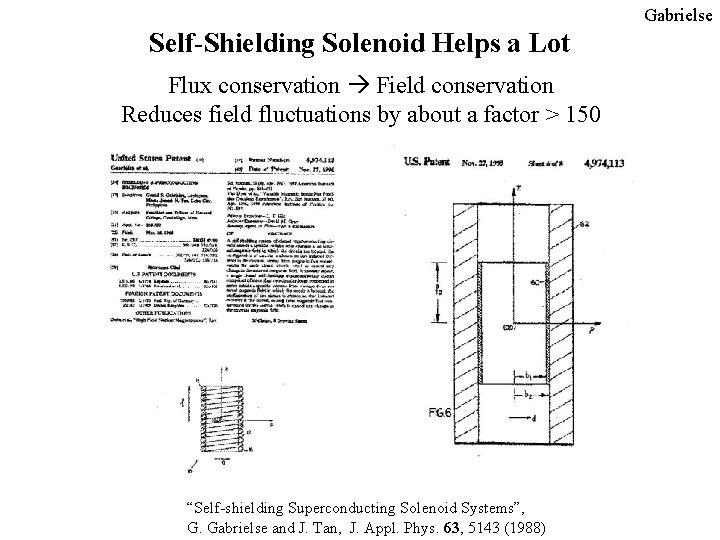
Gabrielse Self-Shielding Solenoid Helps a Lot Flux conservation Field conservation Reduces field fluctuations by about a factor > 150 “Self-shielding Superconducting Solenoid Systems”, G. Gabrielse and J. Tan, J. Appl. Phys. 63, 5143 (1988)
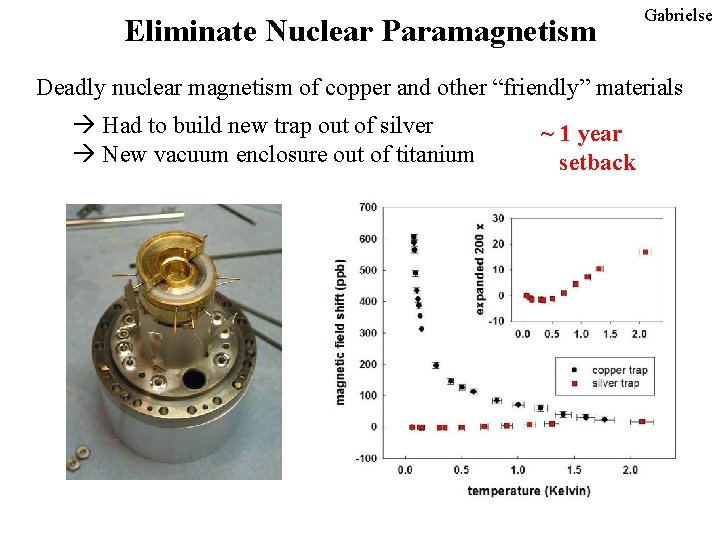
Eliminate Nuclear Paramagnetism Gabrielse Deadly nuclear magnetism of copper and other “friendly” materials Had to build new trap out of silver New vacuum enclosure out of titanium ~ 1 year setback
Gabrielse
Gabrielse
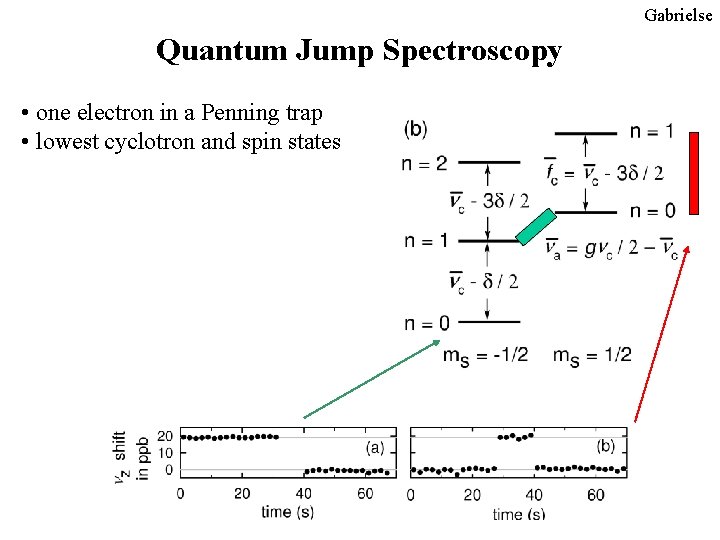
Gabrielse Quantum Jump Spectroscopy • one electron in a Penning trap • lowest cyclotron and spin states
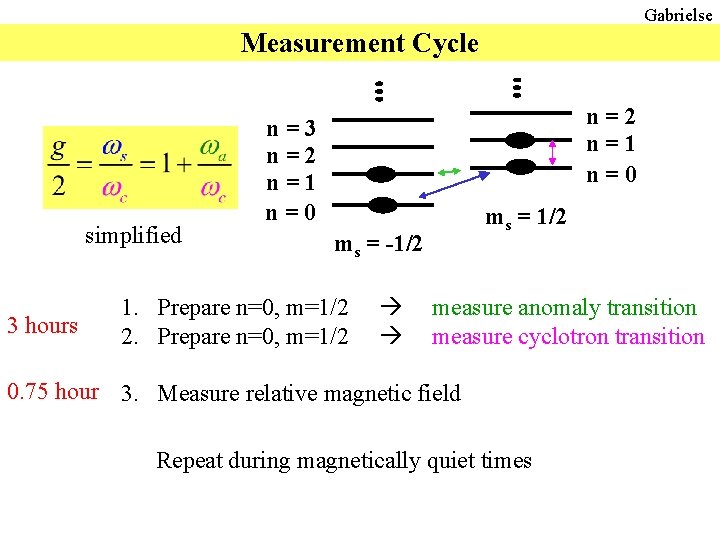
Gabrielse Measurement Cycle simplified 3 hours n=2 n=1 n=0 n=3 n=2 n=1 n=0 ms = -1/2 ms = 1/2 1. Prepare n=0, m=1/2 measure anomaly transition 2. Prepare n=0, m=1/2 measure cyclotron transition 0. 75 hour 3. Measure relative magnetic field Repeat during magnetically quiet times
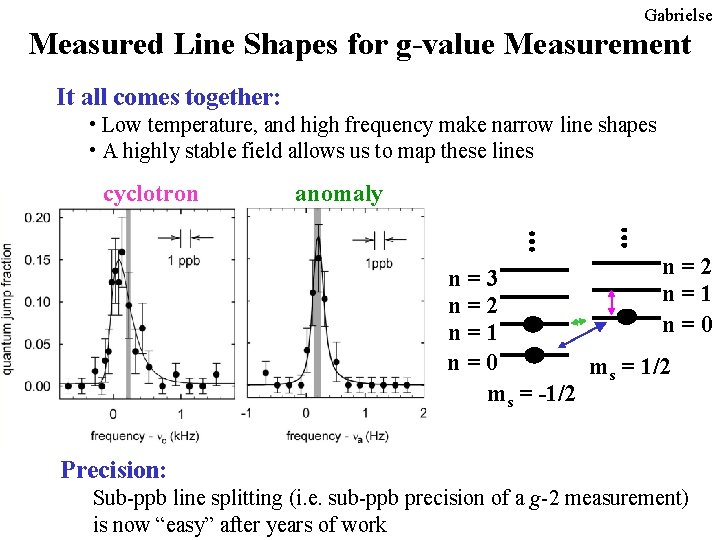
Gabrielse Measured Line Shapes for g-value Measurement It all comes together: • Low temperature, and high frequency make narrow line shapes • A highly stable field allows us to map these lines cyclotron anomaly n=2 n=3 n=1 n=2 n=0 n=1 n=0 ms = 1/2 ms = -1/2 Precision: Sub-ppb line splitting (i. e. sub-ppb precision of a g-2 measurement) is now “easy” after years of work
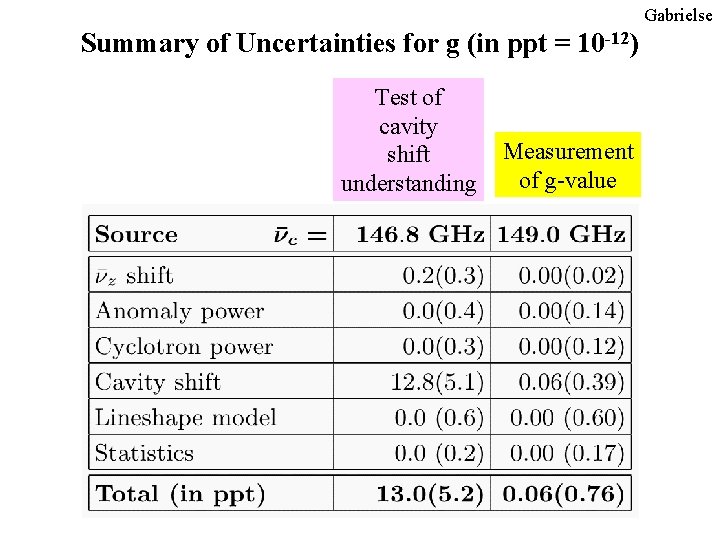
Gabrielse Cavity Shifts of the Cyclotron Frequency n=2 n=1 n=0 n=3 n=2 n=1 n=0 ms = 1/2 ms = -1/2 spontaneous emission inhibited by 210 B = 5. 3 T Within a Trap Cavity cyclotron frequency is shifted by interaction with cavity modes frequency
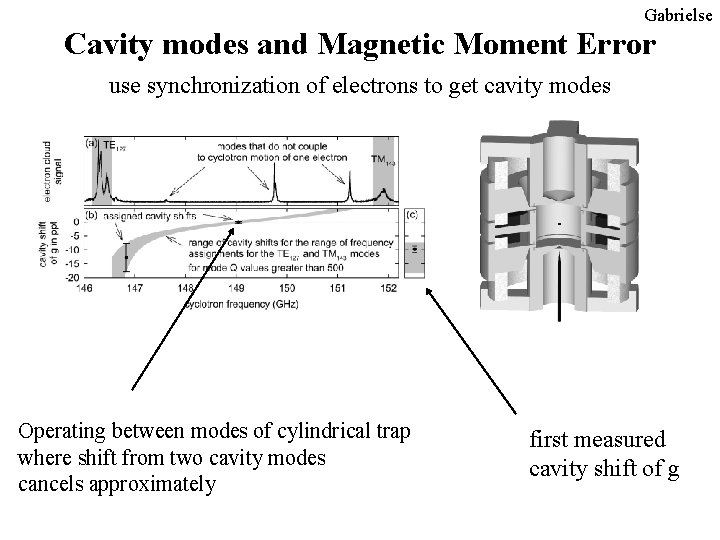
Gabrielse Cavity modes and Magnetic Moment Error use synchronization of electrons to get cavity modes Operating between modes of cylindrical trap where shift from two cavity modes cancels approximately first measured cavity shift of g
Gabrielse Summary of Uncertainties for g (in ppt = 10 -12) Test of cavity shift understanding Measurement of g-value
Gabrielse
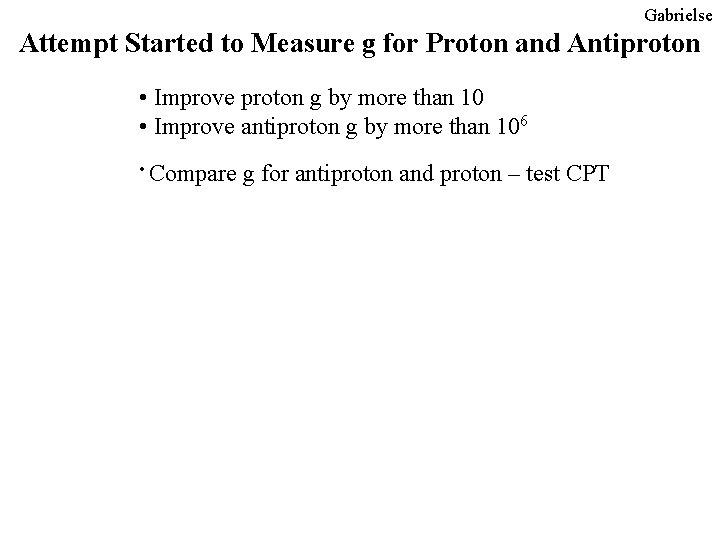
Gabrielse Attempt Started to Measure g for Proton and Antiproton • Improve proton g by more than 10 • Improve antiproton g by more than 106 • Compare g for antiproton and proton – test CPT
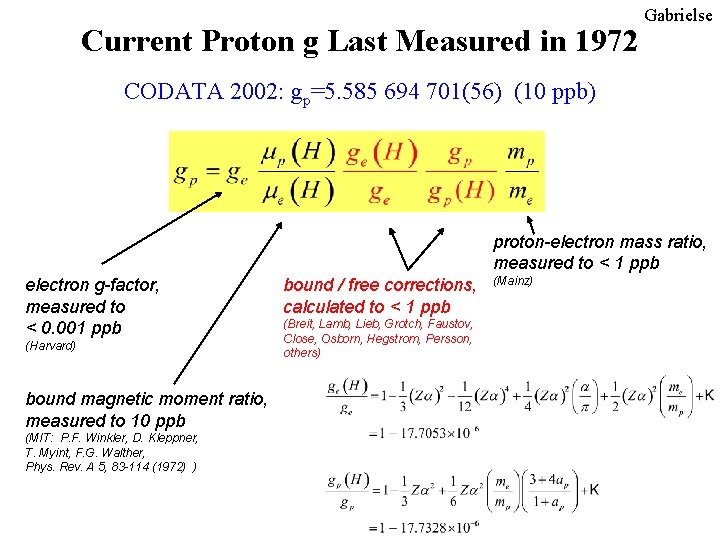
Current Proton g Last Measured in 1972 Gabrielse CODATA 2002: gp=5. 585 694 701(56) (10 ppb) proton-electron mass ratio, measured to < 1 ppb electron g-factor, measured to < 0. 001 ppb (Harvard) bound magnetic moment ratio, measured to 10 ppb (MIT: P. F. Winkler, D. Kleppner, T. Myint, F. G. Walther, Phys. Rev. A 5, 83 -114 (1972) ) bound / free corrections, calculated to < 1 ppb (Breit, Lamb, Lieb, Grotch, Faustov, Close, Osborn, Hegstrom, Persson, others) (Mainz)
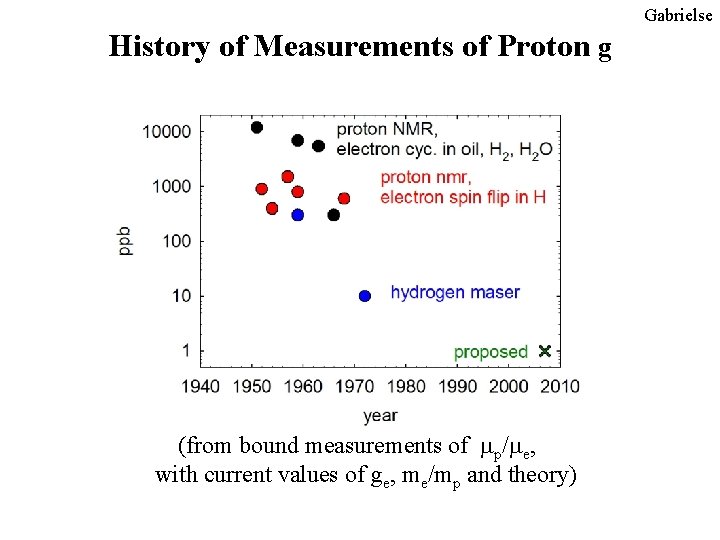
Gabrielse History of Measurements of Proton g (from bound measurements of mp/me, with current values of ge, me/mp and theory)
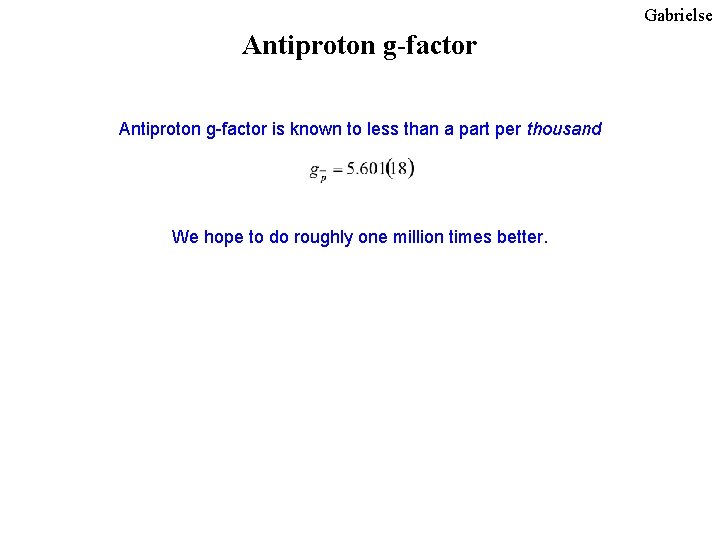
Gabrielse Antiproton g-factor is known to less than a part per thousand We hope to do roughly one million times better.
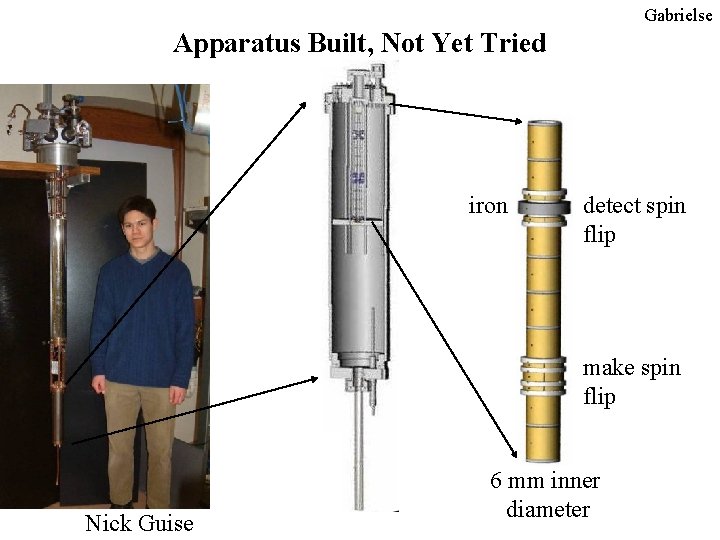
Gabrielse Apparatus Built, Not Yet Tried iron detect spin flip make spin flip Nick Guise 6 mm inner diameter
Gabrielse Summary and Conclusion
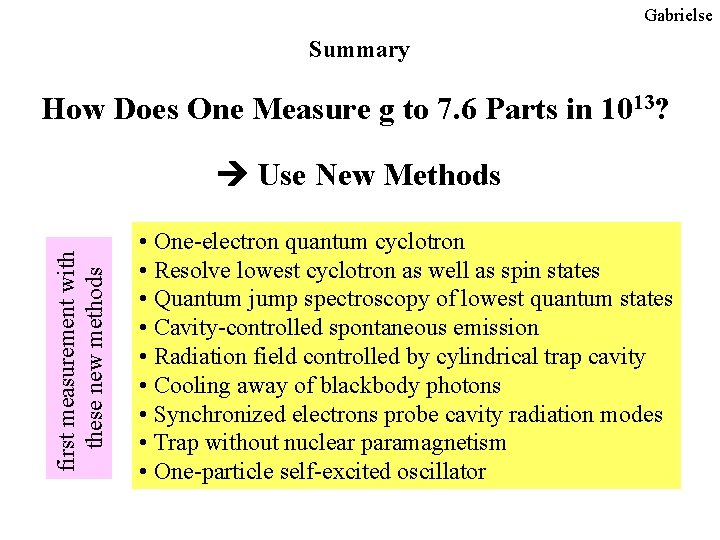
Gabrielse Summary How Does One Measure g to 7. 6 Parts in 1013? first measurement with these new methods Use New Methods • One-electron quantum cyclotron • Resolve lowest cyclotron as well as spin states • Quantum jump spectroscopy of lowest quantum states • Cavity-controlled spontaneous emission • Radiation field controlled by cylindrical trap cavity • Cooling away of blackbody photons • Synchronized electrons probe cavity radiation modes • Trap without nuclear paramagnetism • One-particle self-excited oscillator
Gabrielse New Measurement of Electron Magnetic Moment magnetic moment spin Bohr magneton • First improved measurement since 1987 • Nearly six times smaller uncertainty • 1. 7 standard deviation shift • Likely more accuracy coming • 1000 times smaller uncertainty than muon g B. Odom, D. Hanneke, B. D’Urso and G. Gabrielse, Phys. Rev. Lett. 97, 030801 (2006).
Gabrielse New Determination of the Fine Structure Constant • Strength of the electromagnetic interaction • Important component of our system of fundamental constants • Increased importance for new mass standard • First lower uncertainty since 1987 • Ten times more accurate than atom-recoil methods G. Gabrielse, D. Hanneke, T. Kinoshita, M. Nio, B. Odom, Phys. Rev. Lett. 97}, 030802 (2006).
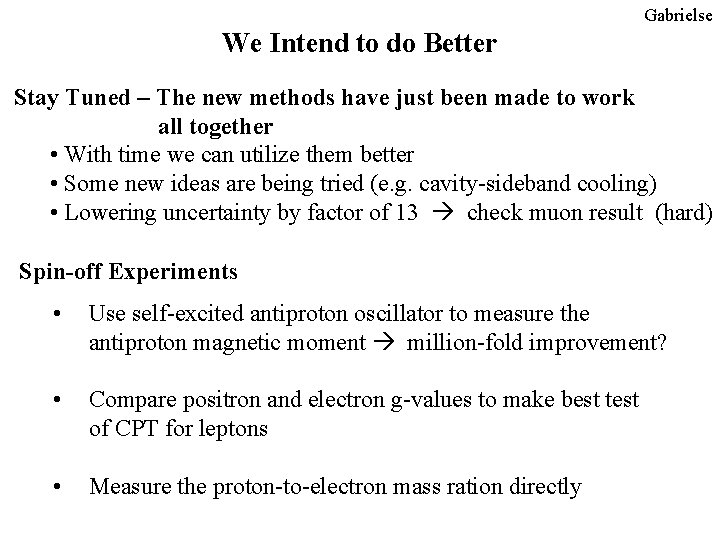
Gabrielse We Intend to do Better Stay Tuned – The new methods have just been made to work all together • With time we can utilize them better • Some new ideas are being tried (e. g. cavity-sideband cooling) • Lowering uncertainty by factor of 13 check muon result (hard) Spin-off Experiments • Use self-excited antiproton oscillator to measure the antiproton magnetic moment million-fold improvement? • Compare positron and electron g-values to make best test of CPT for leptons • Measure the proton-to-electron mass ration directly
Gabrielse
Gabrielse
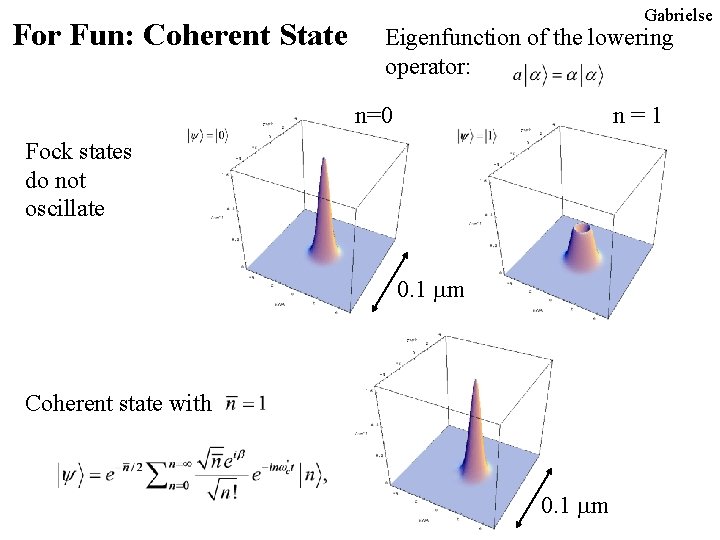
For Fun: Coherent State Gabrielse Eigenfunction of the lowering operator: n=0 n = 1 Fock states do not oscillate 0. 1 mm Coherent state with 0. 1 mm
Gabrielse 200 MHz Detection of Axial Oscillation • Turn off during sensitive times in experiment • Mismatched, current-starved HEMPT • High Q resonant feedthrough into 100 m. K, 5 x 10 -17 Torr vacuum enclosure
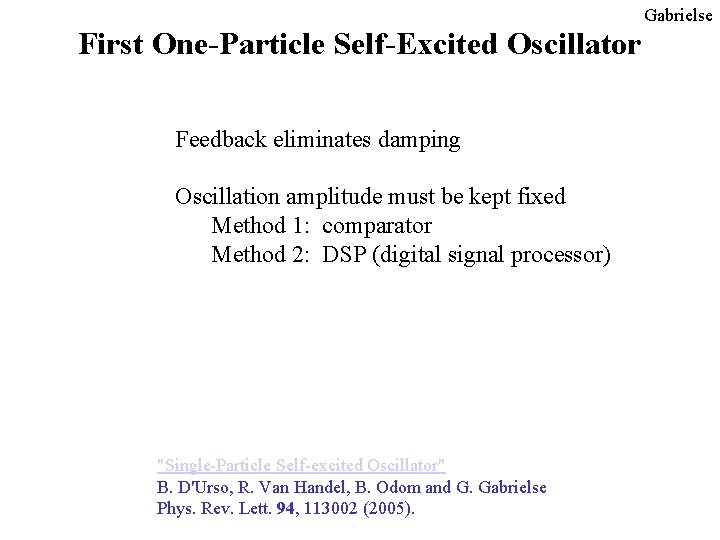
Gabrielse First One-Particle Self-Excited Oscillator Feedback eliminates damping Oscillation amplitude must be kept fixed Method 1: comparator Method 2: DSP (digital signal processor) "Single-Particle Self-excited Oscillator" B. D'Urso, R. Van Handel, B. Odom and G. Gabrielse Phys. Rev. Lett. 94, 113002 (2005).
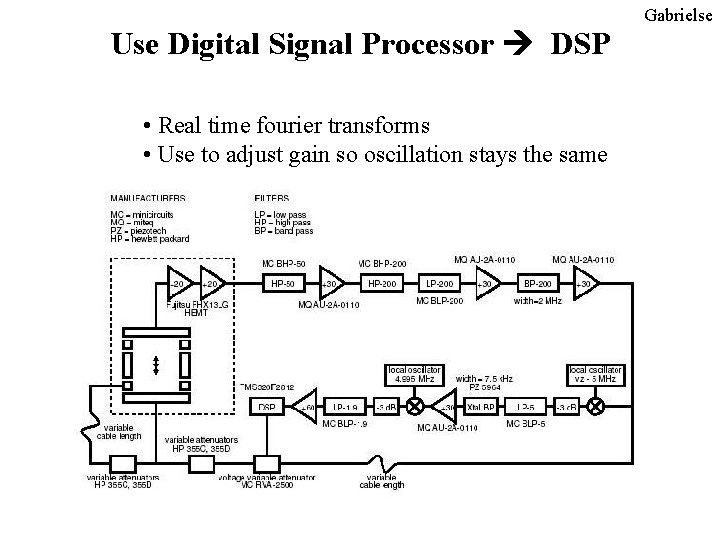
Gabrielse Use Digital Signal Processor DSP • Real time fourier transforms • Use to adjust gain so oscillation stays the same
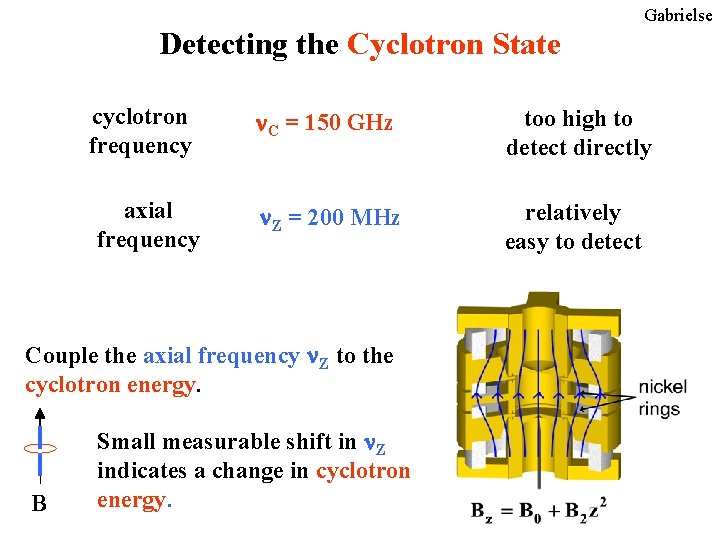
Gabrielse Detecting the Cyclotron State cyclotron frequency axial frequency n. C = 150 GHz too high to detect directly n. Z = 200 MHz relatively easy to detect Couple the axial frequency n. Z to the cyclotron energy. B Small measurable shift in n. Z indicates a change in cyclotron energy.
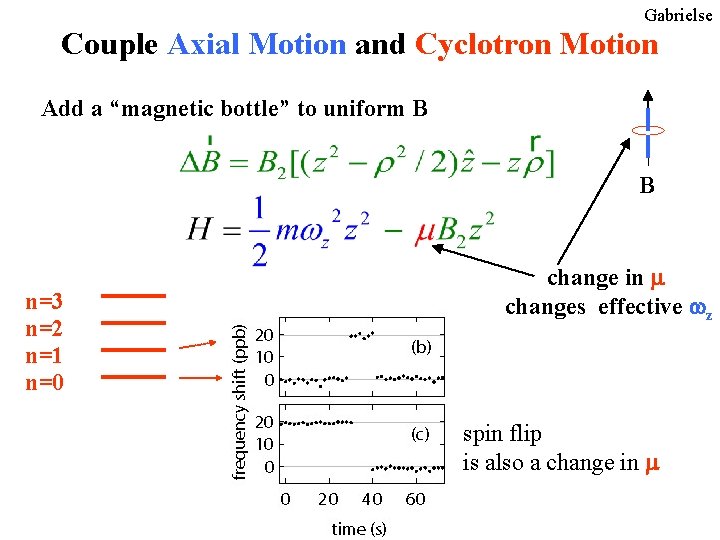
Gabrielse Couple Axial Motion and Cyclotron Motion Add a “magnetic bottle” to uniform B B n=3 n=2 n=1 n=0 change in m changes effective wz spin flip is also a change in m
Gabrielse
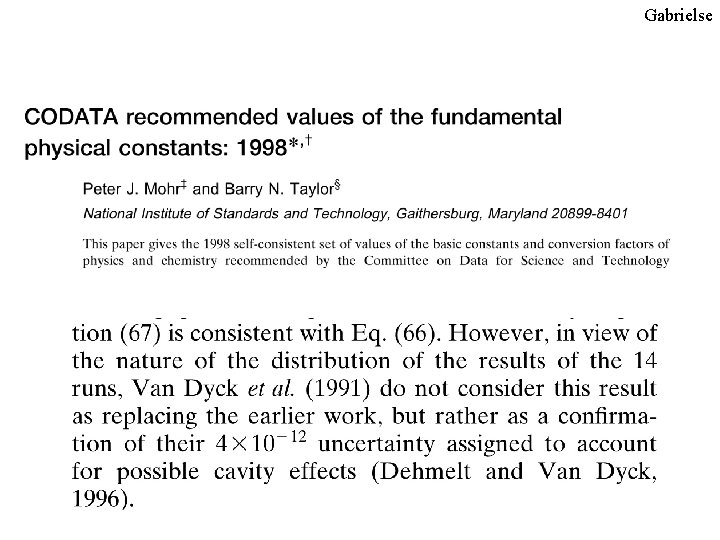
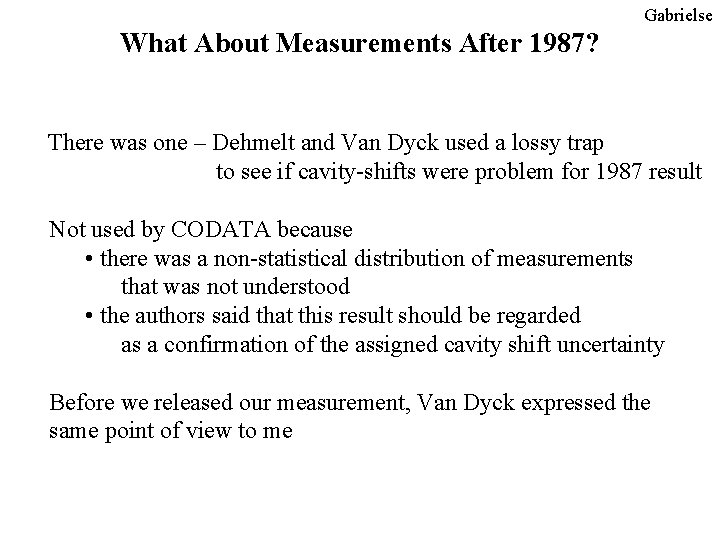
Gabrielse What About Measurements After 1987? There was one – Dehmelt and Van Dyck used a lossy trap to see if cavity-shifts were problem for 1987 result Not used by CODATA because • there was a non-statistical distribution of measurements that was not understood • the authors said that this result should be regarded as a confirmation of the assigned cavity shift uncertainty Before we released our measurement, Van Dyck expressed the same point of view to me