
New Materials for Semiconductor Radiation Detectors P J

- Slides: 48
New Materials for Semiconductor Radiation Detectors P. J. Sellin Centre for Nuclear and Radiation Physics Department of Physics University of Surrey Guildford, UK Paul Sellin, Centre for Nuclear and Radiation Physics
Introduction A review of recent developments in semiconductor detector materials and technology for X-ray and gamma imaging: r Commercially available or near-market materials: Ÿ status of Cd. Zn. Te/Cd. Te Ÿ summary of best spectroscopic results from other materials Ÿ INTEGRAL/SWIFT – imaging detectors in space r New developments in large-area thick film materials: Ÿ polycrystalline and epitaxial Cd. Zn. Te/Cd. Te thick films Ÿ Heavy element (Z 80) thick films (Hg, Tl, Pb, Bi) r Future materials – latest results from promising new detector materials: Ÿ synthetic single-crystal diamond Ÿ boron-based semiconductors for neutron detection r Conclusion Paul Sellin, Centre for Nuclear and Radiation Physics
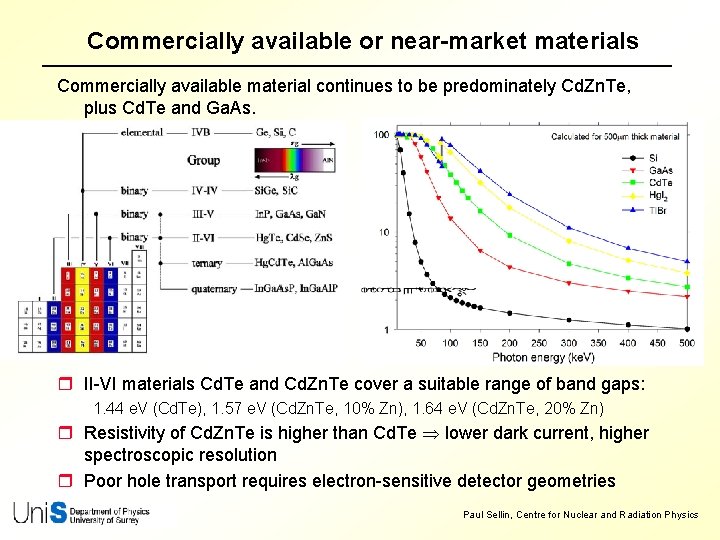
Commercially available or near-market materials Commercially available material continues to be predominately Cd. Zn. Te, plus Cd. Te and Ga. As. r II-VI materials Cd. Te and Cd. Zn. Te cover a suitable range of band gaps: 1. 44 e. V (Cd. Te), 1. 57 e. V (Cd. Zn. Te, 10% Zn), 1. 64 e. V (Cd. Zn. Te, 20% Zn) r Resistivity of Cd. Zn. Te is higher than Cd. Te lower dark current, higher spectroscopic resolution r Poor hole transport requires electron-sensitive detector geometries Paul Sellin, Centre for Nuclear and Radiation Physics
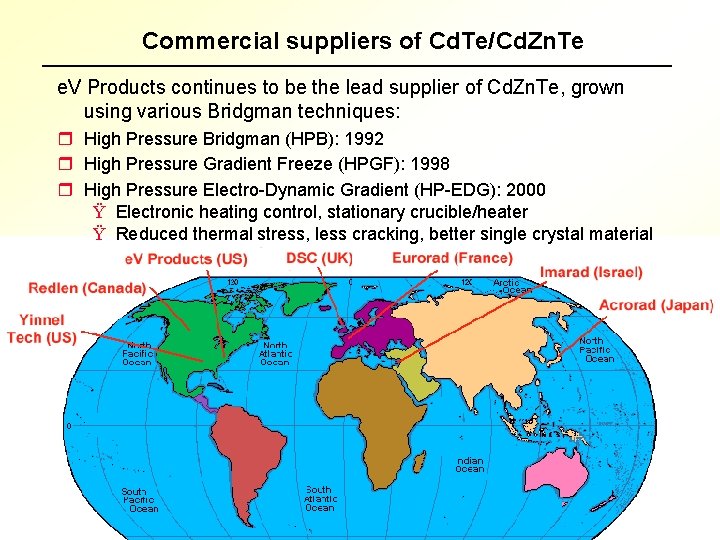
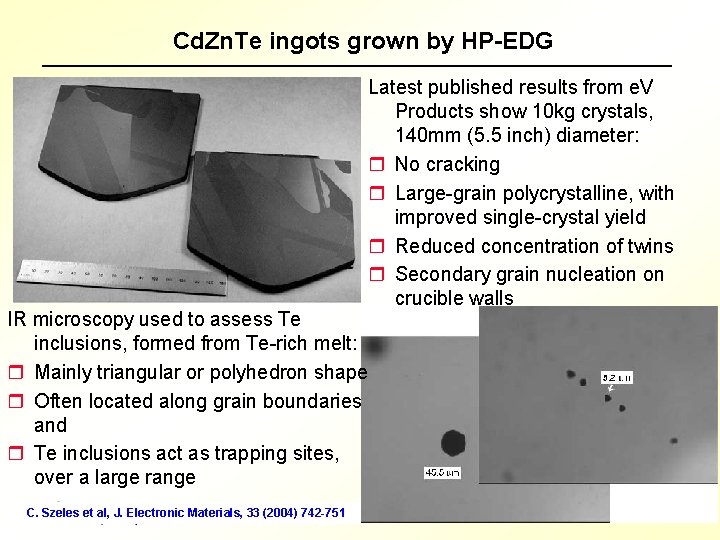
Commercial suppliers of Cd. Te/Cd. Zn. Te e. V Products continues to be the lead supplier of Cd. Zn. Te, grown using various Bridgman techniques: r High Pressure Bridgman (HPB): 1992 r High Pressure Gradient Freeze (HPGF): 1998 r High Pressure Electro-Dynamic Gradient (HP-EDG): 2000 Ÿ Electronic heating control, stationary crucible/heater Ÿ Reduced thermal stress, less cracking, better single crystal material Paul Sellin, Centre for Nuclear and Radiation Physics
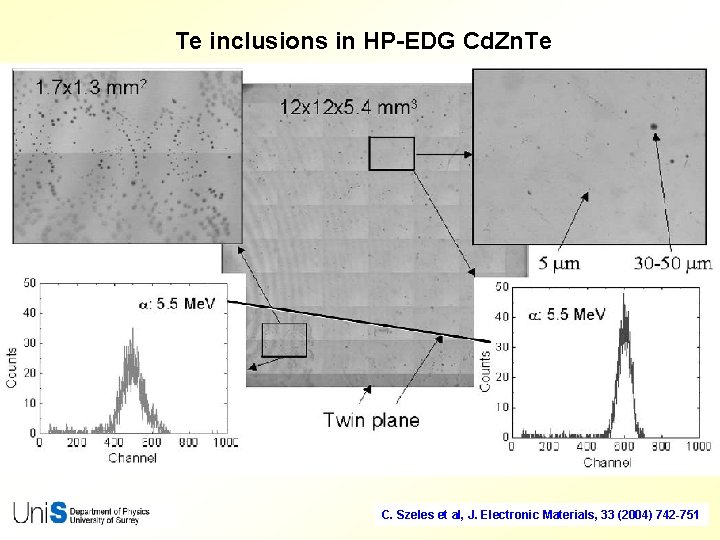
Cd. Zn. Te ingots grown by HP-EDG Latest published results from e. V Products show 10 kg crystals, 140 mm (5. 5 inch) diameter: r No cracking r Large-grain polycrystalline, with improved single-crystal yield r Reduced concentration of twins r Secondary grain nucleation on crucible walls IR microscopy used to assess Te inclusions, formed from Te-rich melt: r Mainly triangular or polyhedron shape r Often located along grain boundaries and r Te inclusions act as trapping sites, over a large range C. Szeles et al, J. Electronic Materials, 33 (2004) 742 -751 Paul Sellin, Centre for Nuclear and Radiation Physics
Te inclusions in HP-EDG Cd. Zn. Te Sellin, Centre. Materials, for Nuclear and Radiation Physics C. Szeles et al, Paul J. Electronic 33 (2004) 742 -751
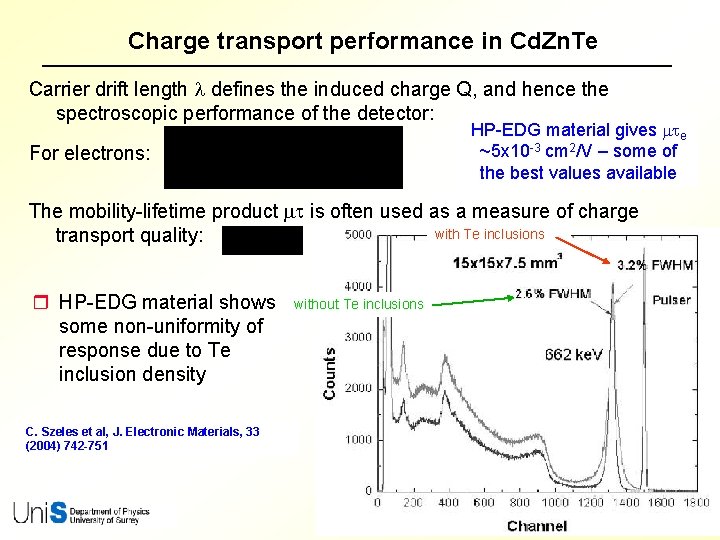
Charge transport performance in Cd. Zn. Te Carrier drift length l defines the induced charge Q, and hence the spectroscopic performance of the detector: HP-EDG material gives mte ~5 x 10 -3 cm 2/V – some of the best values available For electrons: The mobility-lifetime product mt is often used as a measure of charge with Te inclusions transport quality: r HP-EDG material shows some non-uniformity of response due to Te inclusion density without Te inclusions C. Szeles et al, J. Electronic Materials, 33 (2004) 742 -751 Paul Sellin, Centre for Nuclear and Radiation Physics
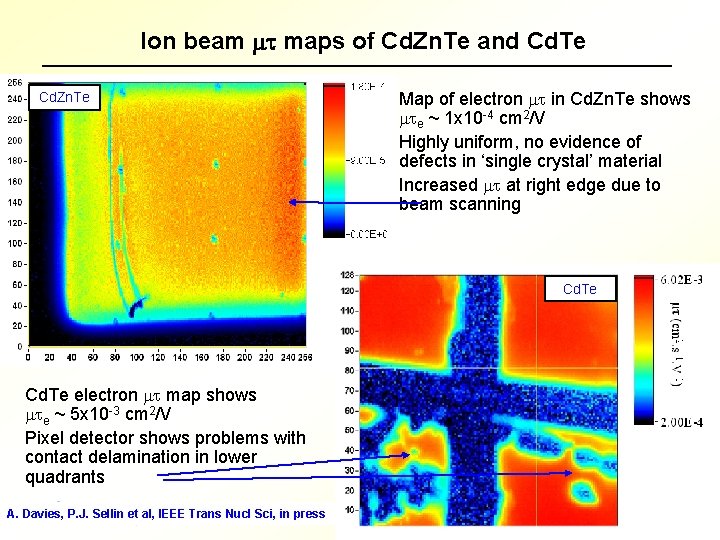
Ion beam mt maps of Cd. Zn. Te and Cd. Te Cd. Zn. Te Map of electron mt in Cd. Zn. Te shows mte ~ 1 x 10 -4 cm 2/V Highly uniform, no evidence of defects in ‘single crystal’ material Increased mt at right edge due to beam scanning Cd. Te electron mt map shows mte ~ 5 x 10 -3 cm 2/V Pixel detector shows problems with contact delamination in lower quadrants A. Davies, P. J. Sellin et al, IEEE Trans Nucl Sci, in press Paul Sellin, Centre for Nuclear and Radiation Physics
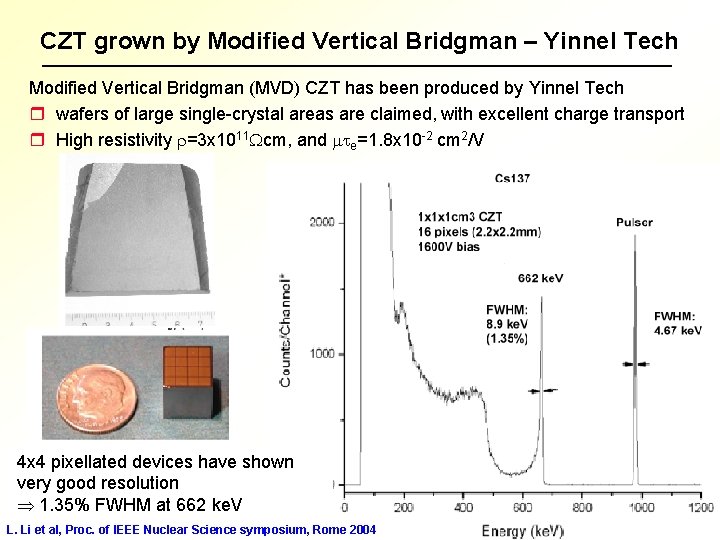
CZT grown by Modified Vertical Bridgman – Yinnel Tech Modified Vertical Bridgman (MVD) CZT has been produced by Yinnel Tech r wafers of large single-crystal areas are claimed, with excellent charge transport r High resistivity r=3 x 10¹¹ Wcm, and mte=1. 8 x 10 -2 cm 2/V 4 x 4 pixellated devices have shown very good resolution 1. 35% FWHM at 662 ke. V L. Li et al, Proc. of IEEE Nuclear Science symposium, Rome 2004 Paul Sellin, Centre for Nuclear and Radiation Physics
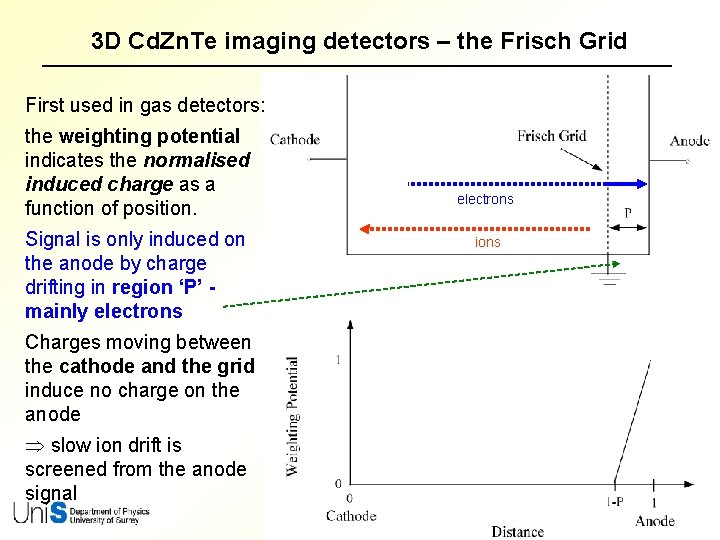
3 D Cd. Zn. Te imaging detectors – the Frisch Grid First used in gas detectors: the weighting potential indicates the normalised induced charge as a function of position. Signal is only induced on the anode by charge drifting in region ‘P’ mainly electrons ions Charges moving between the cathode and the grid induce no charge on the anode slow ion drift is screened from the anode signal Paul Sellin, Centre for Nuclear and Radiation Physics
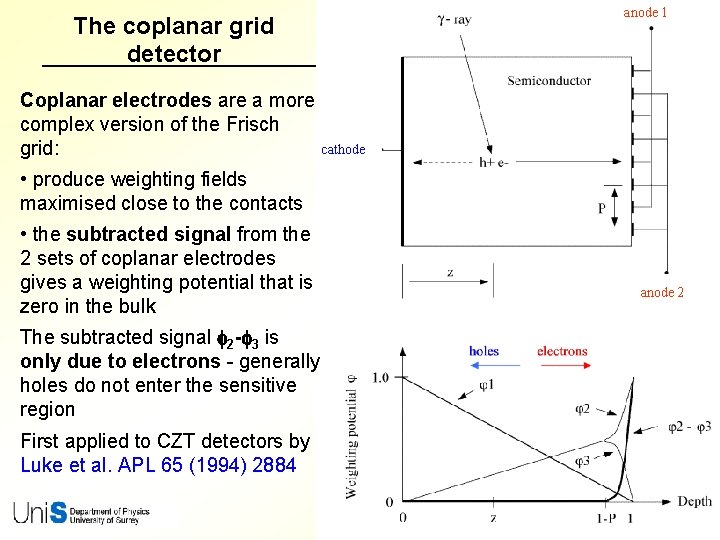
anode 1 The coplanar grid detector Coplanar electrodes are a more complex version of the Frisch grid: cathode • produce weighting fields maximised close to the contacts • the subtracted signal from the 2 sets of coplanar electrodes gives a weighting potential that is zero in the bulk anode 2 The subtracted signal f 2 -f 3 is only due to electrons - generally holes do not enter the sensitive region First applied to CZT detectors by Luke et al. APL 65 (1994) 2884 Paul Sellin, Centre for Nuclear and Radiation Physics
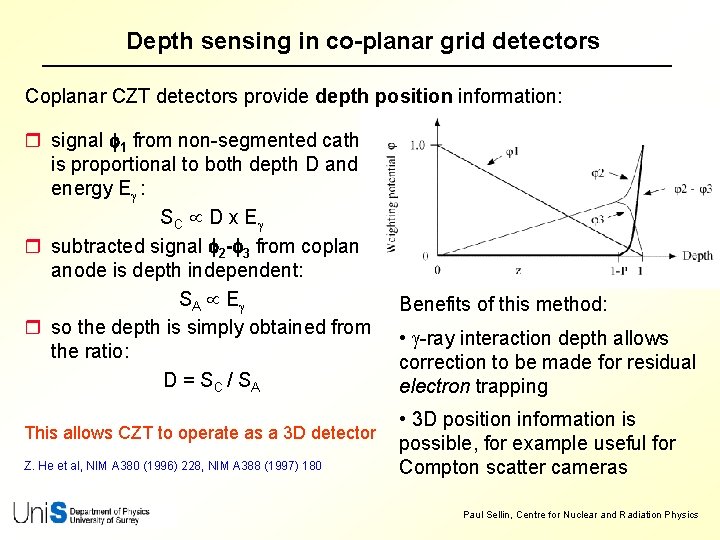
Depth sensing in co-planar grid detectors Coplanar CZT detectors provide depth position information: r signal f 1 from non-segmented cathode is proportional to both depth D and energy E : SC D x E r subtracted signal f 2 -f 3 from coplanar anode is depth independent: SA E Benefits of this method: r so the depth is simply obtained from • -ray interaction depth allows the ratio: correction to be made for residual D = S C / SA electron trapping This allows CZT to operate as a 3 D detector Z. He et al, NIM A 380 (1996) 228, NIM A 388 (1997) 180 • 3 D position information is possible, for example useful for Compton scatter cameras Paul Sellin, Centre for Nuclear and Radiation Physics
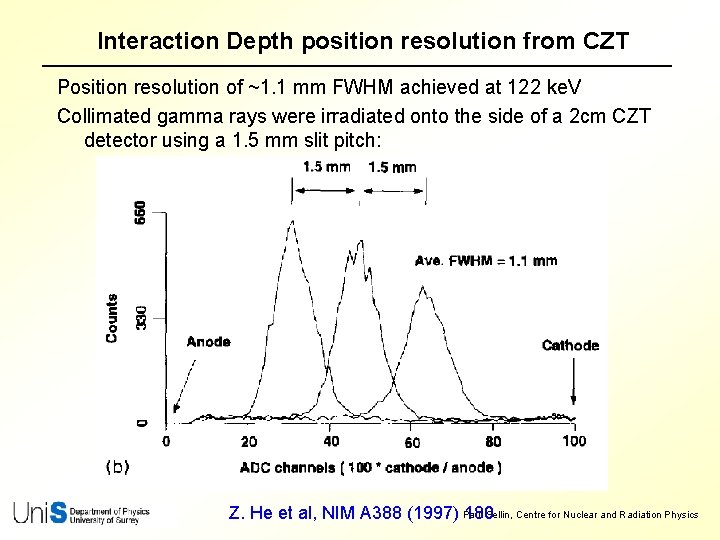
Interaction Depth position resolution from CZT Position resolution of ~1. 1 mm FWHM achieved at 122 ke. V Collimated gamma rays were irradiated onto the side of a 2 cm CZT detector using a 1. 5 mm slit pitch: Z. He et al, NIM A 388 (1997) Paul 180 Sellin, Centre for Nuclear and Radiation Physics
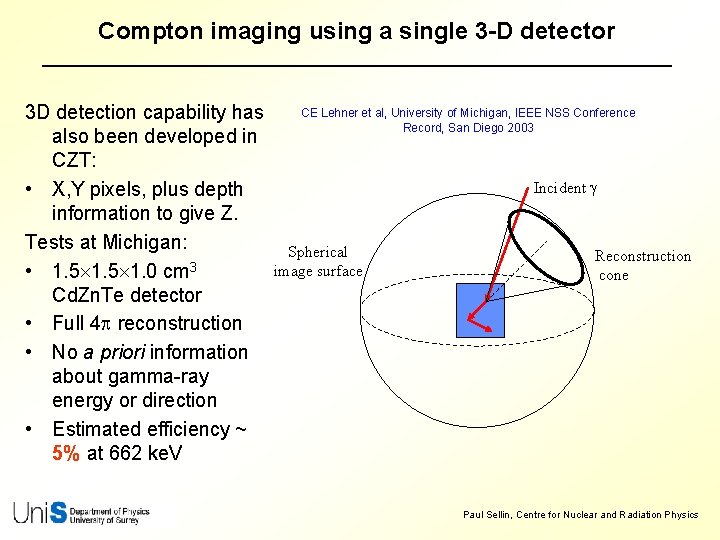
Compton imaging using a single 3 -D detector 3 D detection capability has also been developed in CZT: • X, Y pixels, plus depth information to give Z. Tests at Michigan: • 1. 5 1. 0 cm 3 Cd. Zn. Te detector • Full 4 p reconstruction • No a priori information about gamma-ray energy or direction • Estimated efficiency ~ 5% at 662 ke. V CE Lehner et al, University of Michigan, IEEE NSS Conference Record, San Diego 2003 Incident Spherical image surface Reconstruction cone Paul Sellin, Centre for Nuclear and Radiation Physics
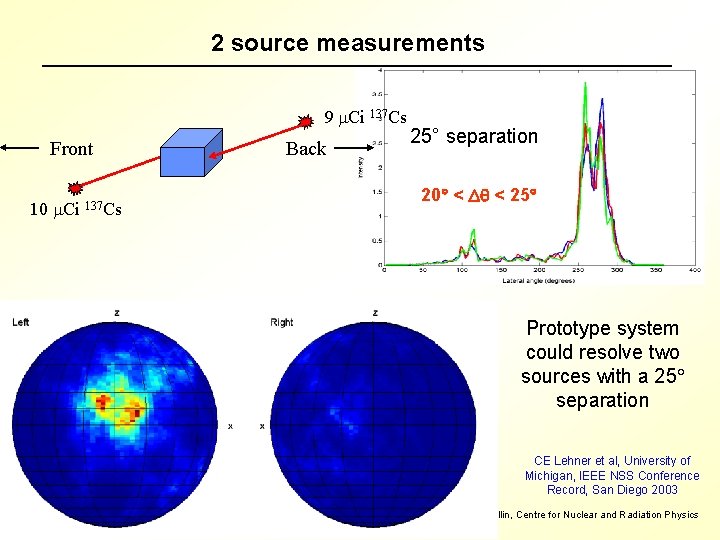
2 source measurements 9 m. Ci 137 Cs Front 10 m. Ci 137 Cs Back 25° separation 20 < < 25 Prototype system could resolve two sources with a 25 separation CE Lehner et al, University of Michigan, IEEE NSS Conference Record, San Diego 2003 Paul Sellin, Centre for Nuclear and Radiation Physics
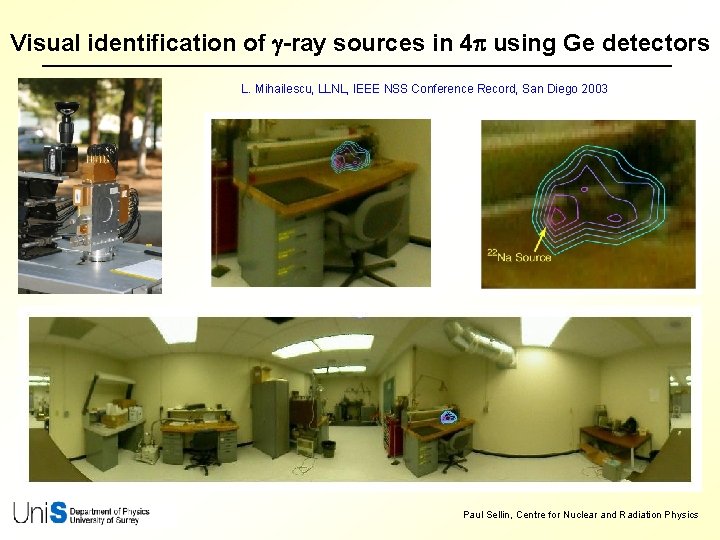
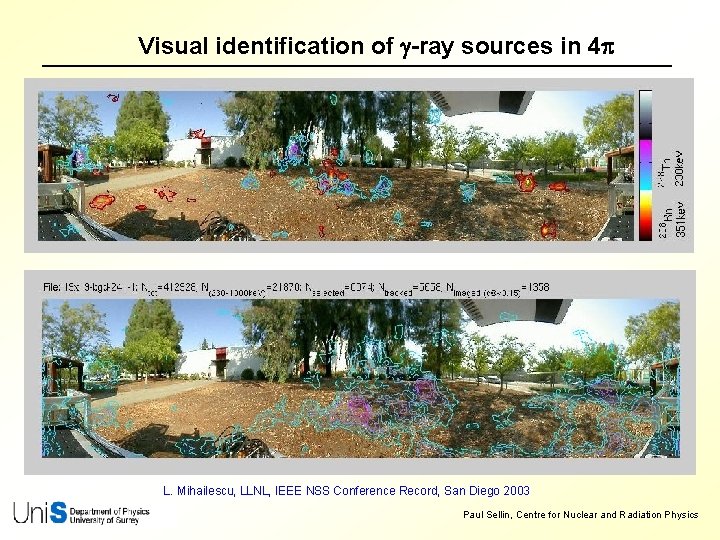
Visual identification of g-ray sources in 4 p using Ge detectors L. Mihailescu, LLNL, IEEE NSS Conference Record, San Diego 2003 Paul Sellin, Centre for Nuclear and Radiation Physics
Visual identification of g-ray sources in 4 p L. Mihailescu, LLNL, IEEE NSS Conference Record, San Diego 2003 Paul Sellin, Centre for Nuclear and Radiation Physics
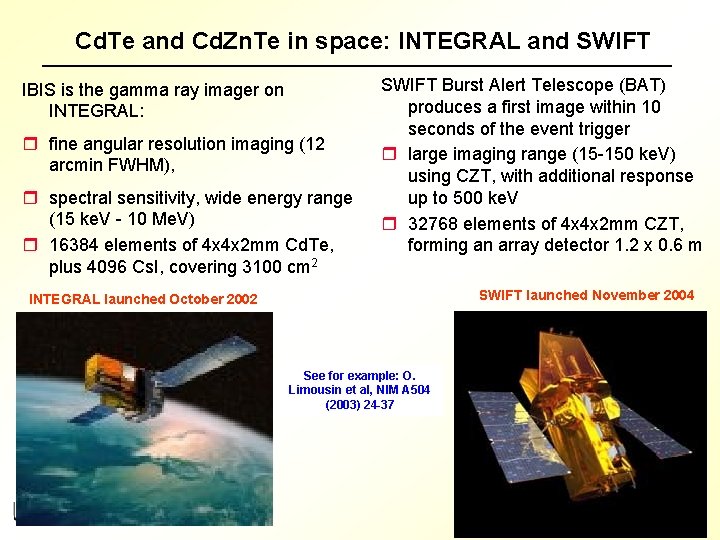
Cd. Te and Cd. Zn. Te in space: INTEGRAL and SWIFT IBIS is the gamma ray imager on INTEGRAL: r fine angular resolution imaging (12 arcmin FWHM), r spectral sensitivity, wide energy range (15 ke. V - 10 Me. V) r 16384 elements of 4 x 4 x 2 mm Cd. Te, plus 4096 Cs. I, covering 3100 cm 2 SWIFT Burst Alert Telescope (BAT) produces a first image within 10 seconds of the event trigger r large imaging range (15 -150 ke. V) using CZT, with additional response up to 500 ke. V r 32768 elements of 4 x 4 x 2 mm CZT, forming an array detector 1. 2 x 0. 6 m SWIFT launched November 2004 INTEGRAL launched October 2002 See for example: O. Limousin et al, NIM A 504 (2003) 24 -37 Paul Sellin, Centre for Nuclear and Radiation Physics
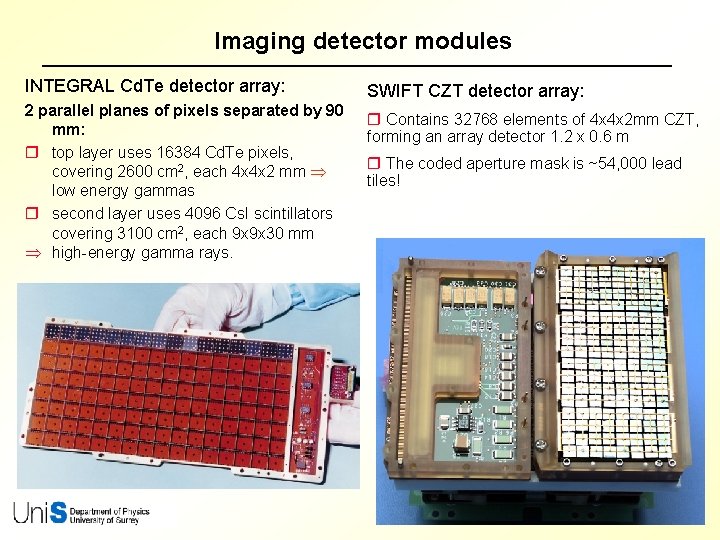
Imaging detector modules INTEGRAL Cd. Te detector array: 2 parallel planes of pixels separated by 90 mm: r top layer uses 16384 Cd. Te pixels, covering 2600 cm 2, each 4 x 4 x 2 mm low energy gammas r second layer uses 4096 Cs. I scintillators covering 3100 cm 2, each 9 x 9 x 30 mm high-energy gamma rays. SWIFT CZT detector array: r Contains 32768 elements of 4 x 4 x 2 mm CZT, forming an array detector 1. 2 x 0. 6 m r The coded aperture mask is ~54, 000 lead tiles! Paul Sellin, Centre for Nuclear and Radiation Physics
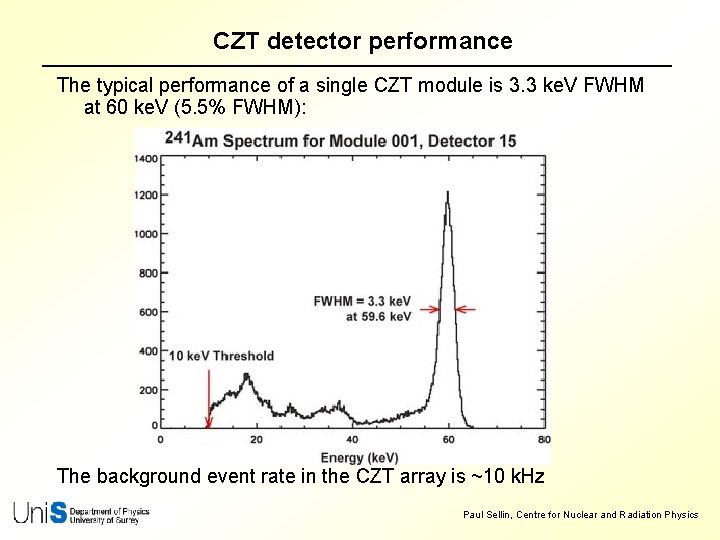
CZT detector performance The typical performance of a single CZT module is 3. 3 ke. V FWHM at 60 ke. V (5. 5% FWHM): The background event rate in the CZT array is ~10 k. Hz Paul Sellin, Centre for Nuclear and Radiation Physics
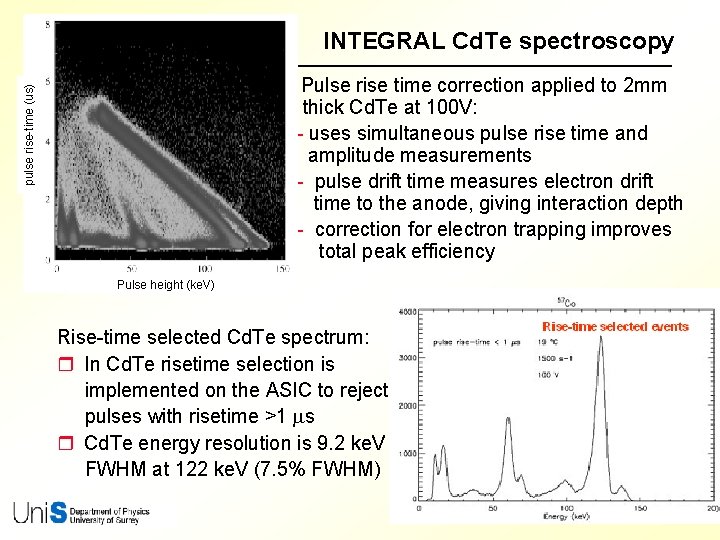
INTEGRAL Cd. Te spectroscopy pulse rise-time (us) Pulse rise time correction applied to 2 mm thick Cd. Te at 100 V: - uses simultaneous pulse rise time and amplitude measurements - pulse drift time measures electron drift time to the anode, giving interaction depth - correction for electron trapping improves total peak efficiency Pulse height (ke. V) Rise-time selected Cd. Te spectrum: r In Cd. Te risetime selection is implemented on the ASIC to reject pulses with risetime >1 ms r Cd. Te energy resolution is 9. 2 ke. V FWHM at 122 ke. V (7. 5% FWHM) Paul Sellin, Centre for Nuclear and Radiation Physics
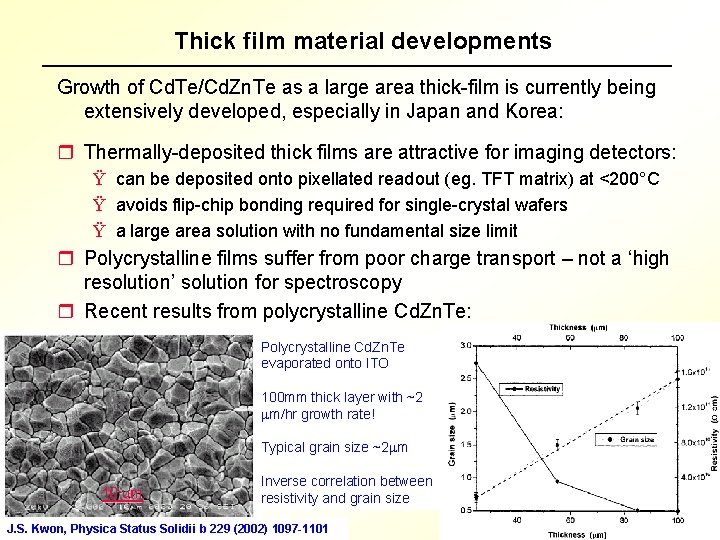
Thick film material developments Growth of Cd. Te/Cd. Zn. Te as a large area thick-film is currently being extensively developed, especially in Japan and Korea: r Thermally-deposited thick films are attractive for imaging detectors: Ÿ can be deposited onto pixellated readout (eg. TFT matrix) at <200°C Ÿ avoids flip-chip bonding required for single-crystal wafers Ÿ a large area solution with no fundamental size limit r Polycrystalline films suffer from poor charge transport – not a ‘high resolution’ solution for spectroscopy r Recent results from polycrystalline Cd. Zn. Te: Polycrystalline Cd. Zn. Te evaporated onto ITO 100 mm thick layer with ~2 mm/hr growth rate! Typical grain size ~2 mm Inverse correlation between resistivity and grain size Paul Sellin, Centre for Nuclear and Radiation Physics J. S. Kwon, Physica Status Solidii b 229 (2002) 1097 -1101
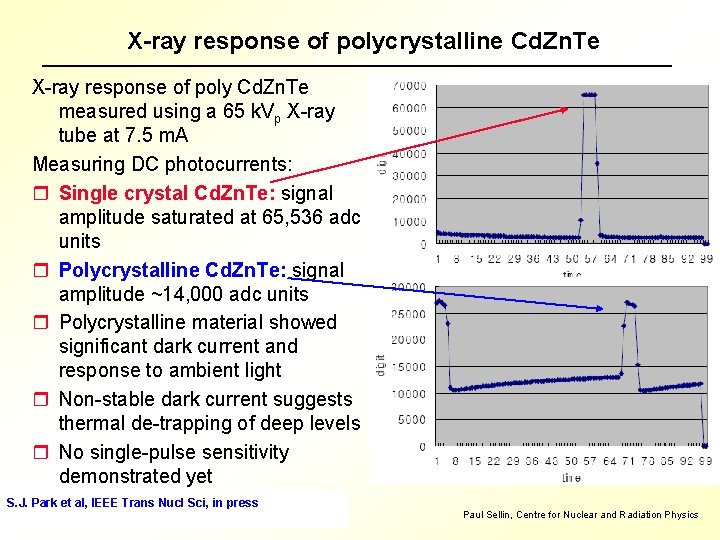
X-ray response of polycrystalline Cd. Zn. Te X-ray response of poly Cd. Zn. Te measured using a 65 k. Vp X-ray tube at 7. 5 m. A Measuring DC photocurrents: r Single crystal Cd. Zn. Te: signal amplitude saturated at 65, 536 adc units r Polycrystalline Cd. Zn. Te: signal amplitude ~14, 000 adc units r Polycrystalline material showed significant dark current and response to ambient light r Non-stable dark current suggests thermal de-trapping of deep levels r No single-pulse sensitivity demonstrated yet S. J. Park et al, IEEE Trans Nucl Sci, in press Paul Sellin, Centre for Nuclear and Radiation Physics
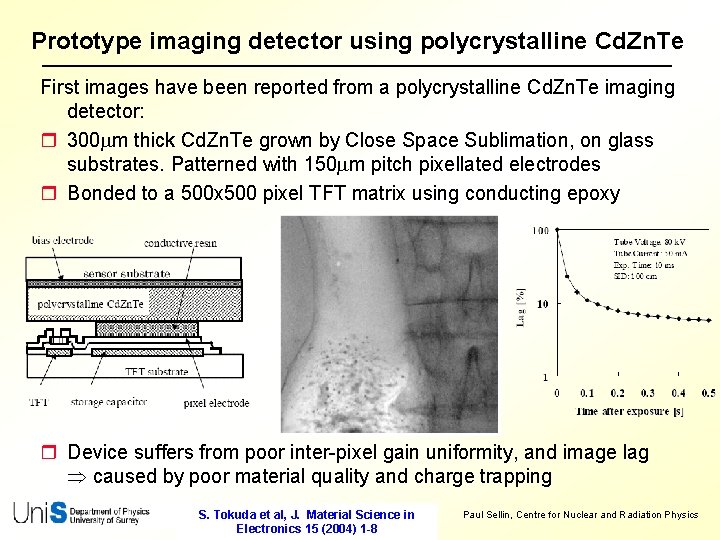
Prototype imaging detector using polycrystalline Cd. Zn. Te First images have been reported from a polycrystalline Cd. Zn. Te imaging detector: r 300 mm thick Cd. Zn. Te grown by Close Space Sublimation, on glass substrates. Patterned with 150 mm pitch pixellated electrodes r Bonded to a 500 x 500 pixel TFT matrix using conducting epoxy r Device suffers from poor inter-pixel gain uniformity, and image lag caused by poor material quality and charge trapping S. Tokuda et al, J. Material Science in Electronics 15 (2004) 1 -8 Paul Sellin, Centre for Nuclear and Radiation Physics
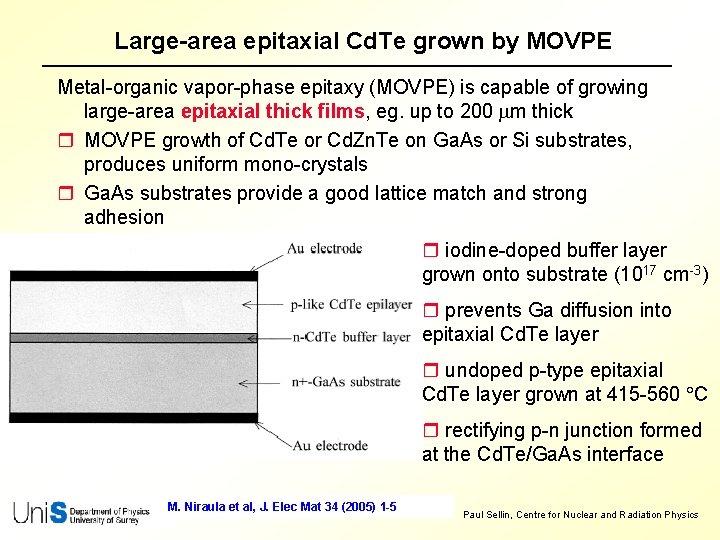
Large-area epitaxial Cd. Te grown by MOVPE Metal-organic vapor-phase epitaxy (MOVPE) is capable of growing large-area epitaxial thick films, eg. up to 200 mm thick r MOVPE growth of Cd. Te or Cd. Zn. Te on Ga. As or Si substrates, produces uniform mono-crystals r Ga. As substrates provide a good lattice match and strong adhesion r iodine-doped buffer layer grown onto substrate (1017 cm-3) r prevents Ga diffusion into epitaxial Cd. Te layer r undoped p-type epitaxial Cd. Te layer grown at 415 -560 C r rectifying p-n junction formed at the Cd. Te/Ga. As interface M. Niraula et al, J. Elec Mat 34 (2005) 1 -5 Paul Sellin, Centre for Nuclear and Radiation Physics
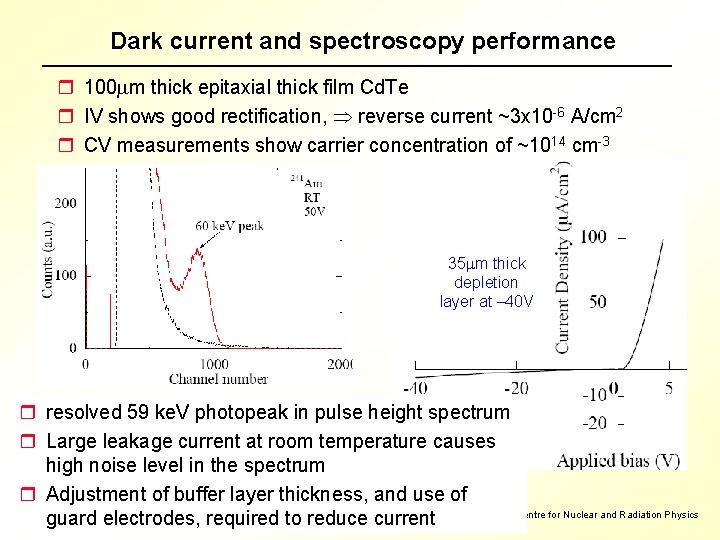
Dark current and spectroscopy performance r 100 mm thick epitaxial thick film Cd. Te r IV shows good rectification, reverse current ~3 x 10 -6 A/cm 2 r CV measurements show carrier concentration of ~1014 cm-3 35 mm thick depletion layer at – 40 V r resolved 59 ke. V photopeak in pulse height spectrum r Large leakage current at room temperature causes high noise level in the spectrum r Adjustment of buffer layer thickness, and use of guard electrodes, required to reduce current Paul Sellin, Centre for Nuclear and Radiation Physics
High-Z polycrystalline materials (Hg, Tl, Pb, Bi) Polycrystalline thick film high-Z (Z 80) materials have been extensively studied for X-ray imaging applications: The iodide and bromide families have many suitable candidates: r Detailed studies of Hg. I 2 and PBI 2 have been carried out r Hg. I 2 shows superior dark current and charge transport properties r Promising results from Tl. Br, also as single crystal material Paul Sellin, Centre for Nuclear and Radiation Physics
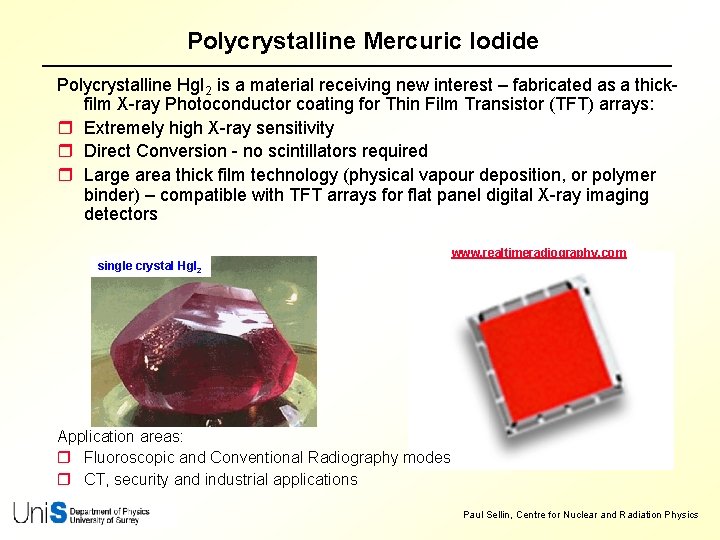
Polycrystalline Mercuric Iodide Polycrystalline Hg. I 2 is a material receiving new interest – fabricated as a thickfilm X-ray Photoconductor coating for Thin Film Transistor (TFT) arrays: r Extremely high X-ray sensitivity r Direct Conversion - no scintillators required r Large area thick film technology (physical vapour deposition, or polymer binder) – compatible with TFT arrays for flat panel digital X-ray imaging detectors www. realtimeradiography. com single crystal Hg. I 2 Application areas: r Fluoroscopic and Conventional Radiography modes r CT, security and industrial applications Paul Sellin, Centre for Nuclear and Radiation Physics
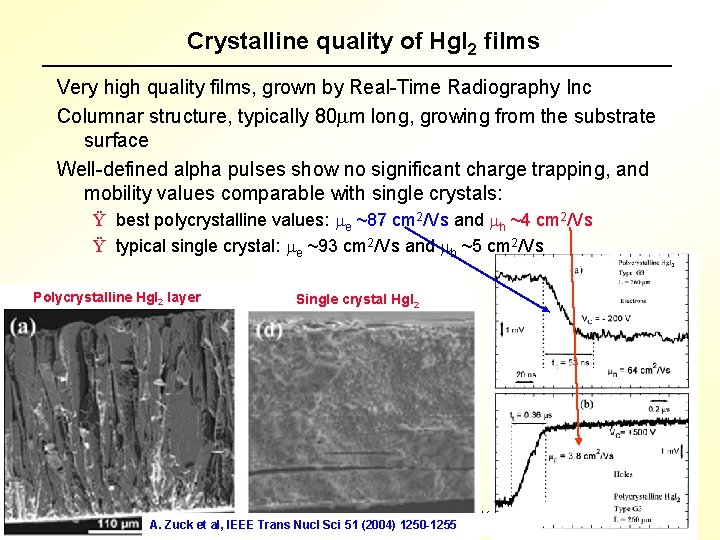
Crystalline quality of Hg. I 2 films Very high quality films, grown by Real-Time Radiography Inc Columnar structure, typically 80 mm long, growing from the substrate surface Well-defined alpha pulses show no significant charge trapping, and mobility values comparable with single crystals: Ÿ best polycrystalline values: me ~87 cm 2/Vs and mh ~4 cm 2/Vs Ÿ typical single crystal: me ~93 cm 2/Vs and mh ~5 cm 2/Vs Polycrystalline Hg. I 2 layer Single crystal Hg. I 2 A. Zuck et al, IEEE Trans Nucl Sci 51 (2004) 1250 -1255 Paul Sellin, Centre for Nuclear and Radiation Physics
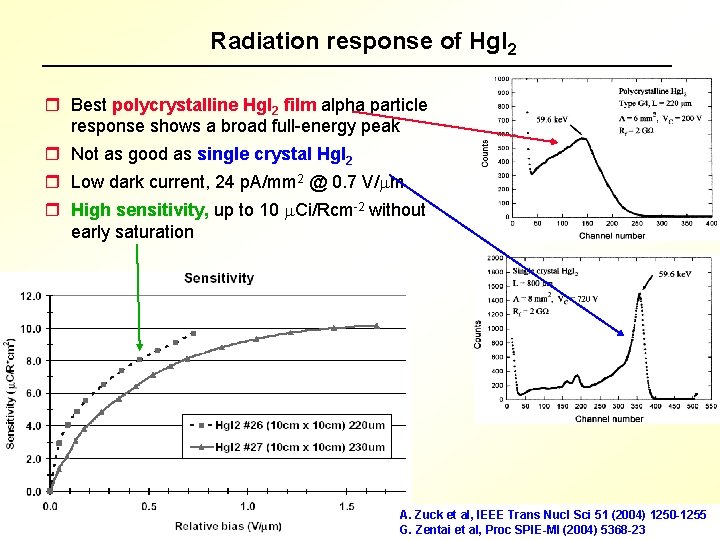
Radiation response of Hg. I 2 r Best polycrystalline Hg. I 2 film alpha particle response shows a broad full-energy peak r Not as good as single crystal Hg. I 2 r Low dark current, 24 p. A/mm 2 @ 0. 7 V/mm r High sensitivity, up to 10 m. Ci/Rcm-2 without early saturation Paul Sellin, Trans Centre. Nucl for Nuclear and(2004) Radiation Physics A. Zuck et al, IEEE Sci 51 1250 -1255 G. Zentai et al, Proc SPIE-MI (2004) 5368 -23
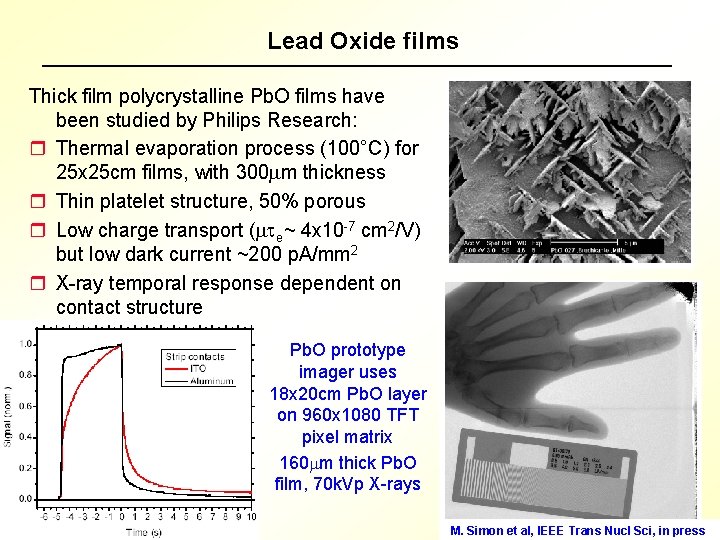
Lead Oxide films Thick film polycrystalline Pb. O films have been studied by Philips Research: r Thermal evaporation process (100°C) for 25 x 25 cm films, with 300 mm thickness r Thin platelet structure, 50% porous r Low charge transport (mte~ 4 x 10 -7 cm 2/V) but low dark current ~200 p. A/mm 2 r X-ray temporal response dependent on contact structure Pb. O prototype imager uses 18 x 20 cm Pb. O layer on 960 x 1080 TFT pixel matrix 160 mm thick Pb. O film, 70 k. Vp X-rays Paul Sellin, Centre for Nuclear and Radiation Physics M. Simon et al, IEEE Trans Nucl Sci, in press
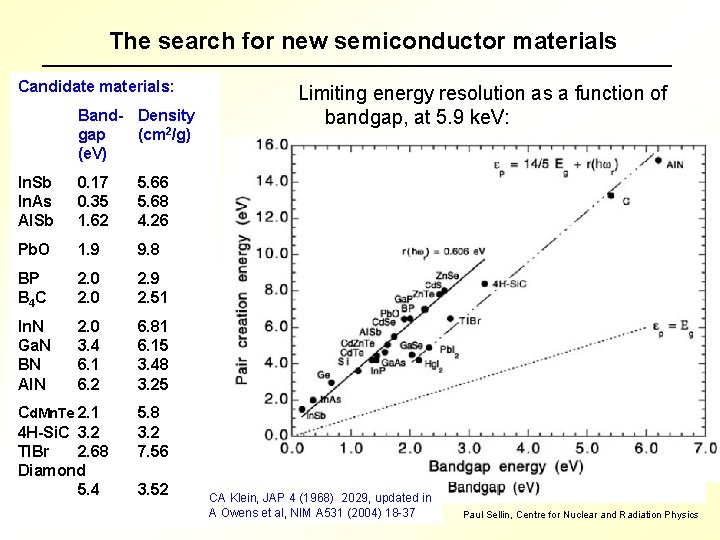
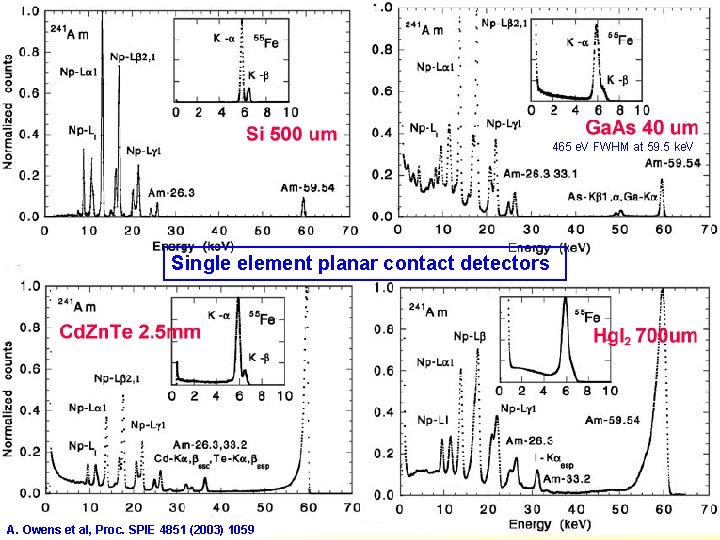
The search for new semiconductor materials Candidate materials: Band- Density gap (cm 2/g) (e. V) In. Sb In. As Al. Sb 0. 17 0. 35 1. 62 5. 66 5. 68 4. 26 Pb. O 1. 9 9. 8 BP B 4 C 2. 0 2. 9 2. 51 In. N Ga. N BN Al. N 2. 0 3. 4 6. 1 6. 2 6. 81 6. 15 3. 48 3. 25 Cd. Mn. Te 2. 1 4 H-Si. C 3. 2 Tl. Br 2. 68 Diamond 5. 4 Limiting energy resolution as a function of bandgap, at 5. 9 ke. V: 5. 8 3. 2 7. 56 3. 52 CA Klein, JAP 4 (1968) 2029, updated in A Owens et al, NIM A 531 (2004) 18 -37 Paul Sellin, Centre for Nuclear and Radiation Physics
Spectroscopy from ESTEC 465 e. V FWHM at 59. 5 ke. V Single element planar contact detectors Paul Sellin, Centre for Nuclear and Radiation Physics A. Owens et al, Proc. SPIE 4851 (2003) 1059
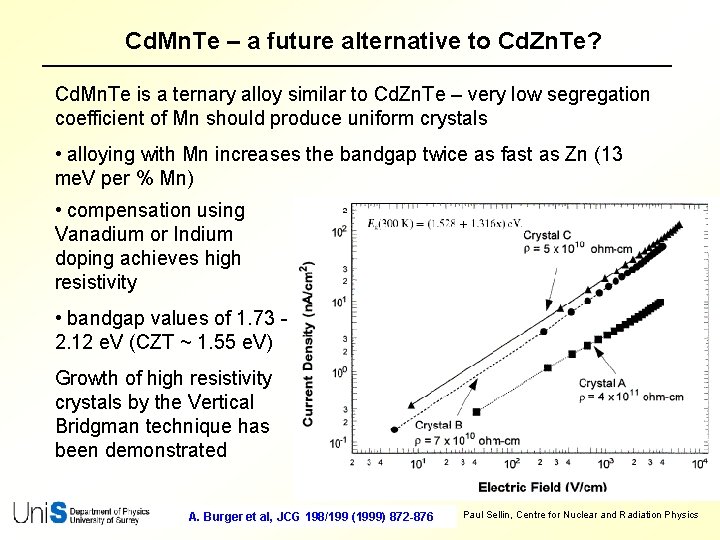
Cd. Mn. Te – a future alternative to Cd. Zn. Te? Cd. Mn. Te is a ternary alloy similar to Cd. Zn. Te – very low segregation coefficient of Mn should produce uniform crystals • alloying with Mn increases the bandgap twice as fast as Zn (13 me. V per % Mn) • compensation using Vanadium or Indium doping achieves high resistivity • bandgap values of 1. 73 2. 12 e. V (CZT ~ 1. 55 e. V) Growth of high resistivity crystals by the Vertical Bridgman technique has been demonstrated A. Burger et al, JCG 198/199 (1999) 872 -876 Paul Sellin, Centre for Nuclear and Radiation Physics
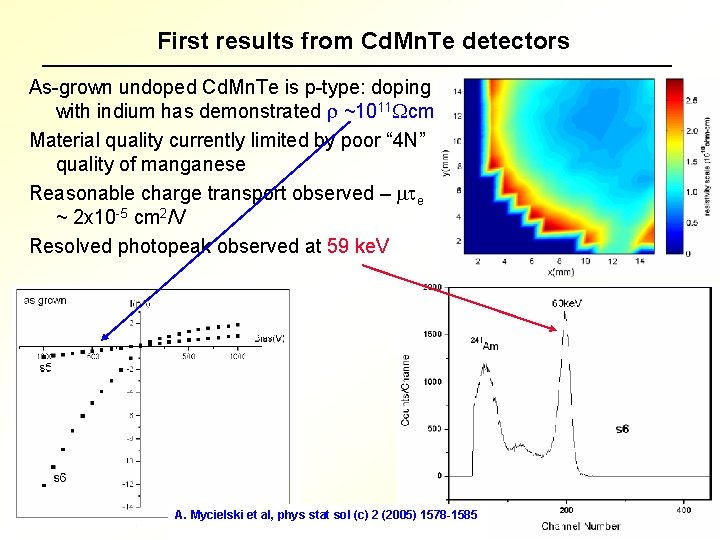
First results from Cd. Mn. Te detectors As-grown undoped Cd. Mn. Te is p-type: doping with indium has demonstrated r ~1011 Wcm Material quality currently limited by poor “ 4 N” quality of manganese Reasonable charge transport observed – mte ~ 2 x 10 -5 cm 2/V Resolved photopeak observed at 59 ke. V Paul Sellin, Centre for Nuclear and Radiation Physics A. Mycielski et al, phys stat sol (c) 2 (2005) 1578 -1585
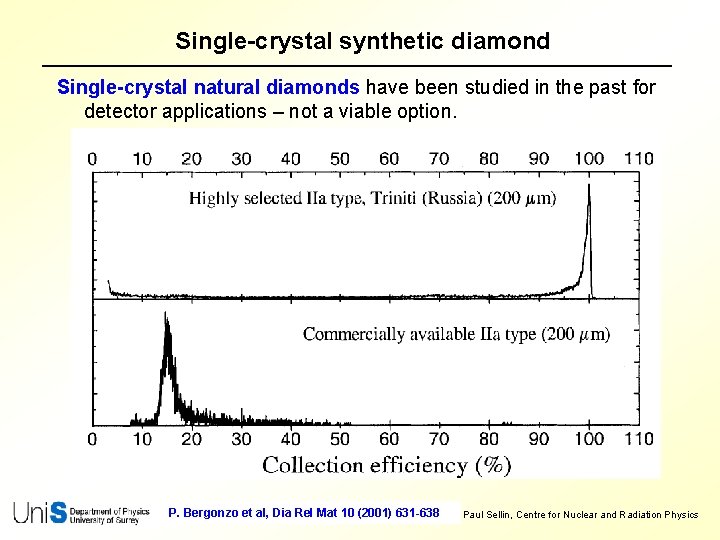
Single-crystal synthetic diamond Single-crystal natural diamonds have been studied in the past for detector applications – not a viable option. P. Bergonzo et al, Dia Rel Mat 10 (2001) 631 -638 Paul Sellin, Centre for Nuclear and Radiation Physics
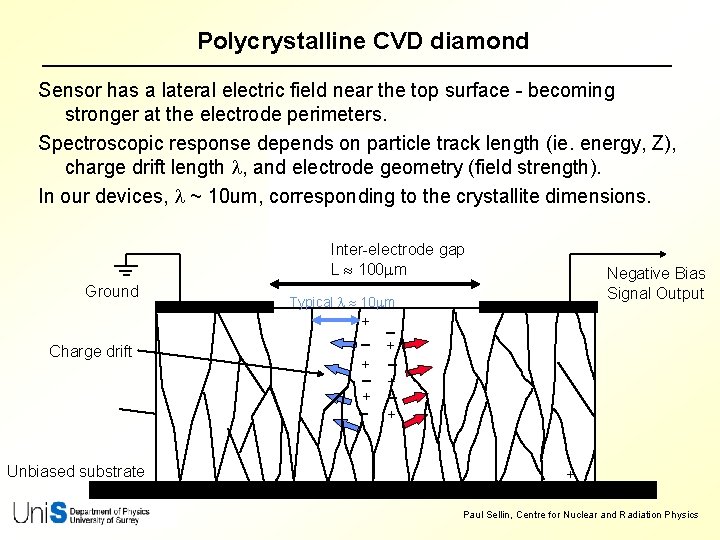
Polycrystalline CVD diamond Sensor has a lateral electric field near the top surface - becoming stronger at the electrode perimeters. Spectroscopic response depends on particle track length (ie. energy, Z), charge drift length l, and electrode geometry (field strength). H In our devices, l ~ 10 um, corresponding. He toorthe crystallite dimensions. Inter-electrode gap L 100 mm Ground Charge drift Unbiased substrate Negative Bias Signal Output Typical l 10 mm + _ _ + + Paul Sellin, Centre for Nuclear and Radiation Physics
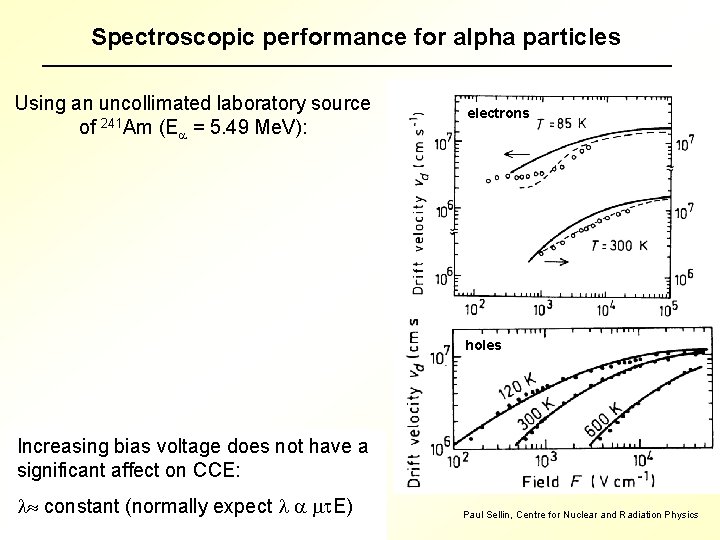
Spectroscopic performance for alpha particles Using an uncollimated laboratory source of 241 Am (E = 5. 49 Me. V): electrons holes Increasing bias voltage does not have a significant affect on CCE: l constant (normally expect l mt. E) Paul Sellin, Centre for Nuclear and Radiation Physics
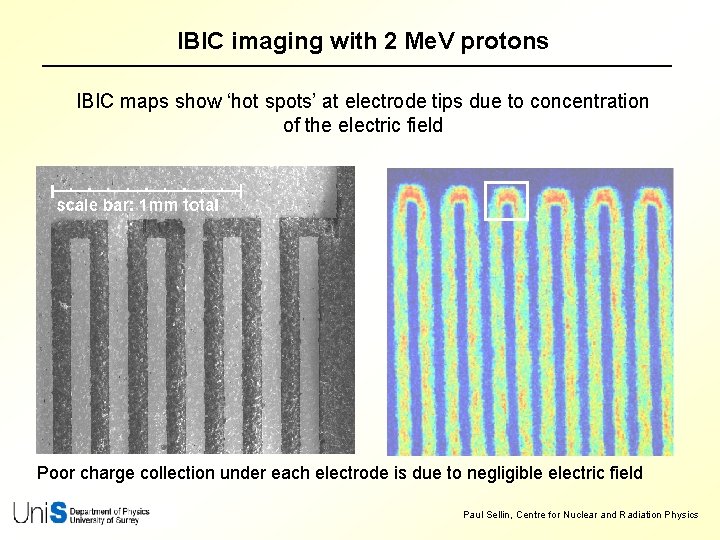
IBIC imaging with 2 Me. V protons IBIC maps show ‘hot spots’ at electrode tips due to concentration of the electric field Poor charge collection under each electrode is due to negligible electric field Paul Sellin, Centre for Nuclear and Radiation Physics
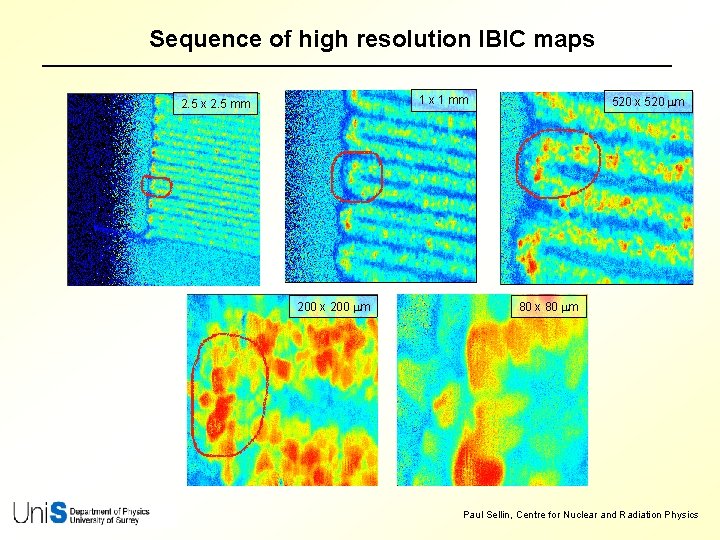
Sequence of high resolution IBIC maps 1 x 1 mm 2. 5 x 2. 5 mm 200 x 200 mm 520 x 520 mm 80 x 80 mm Paul Sellin, Centre for Nuclear and Radiation Physics
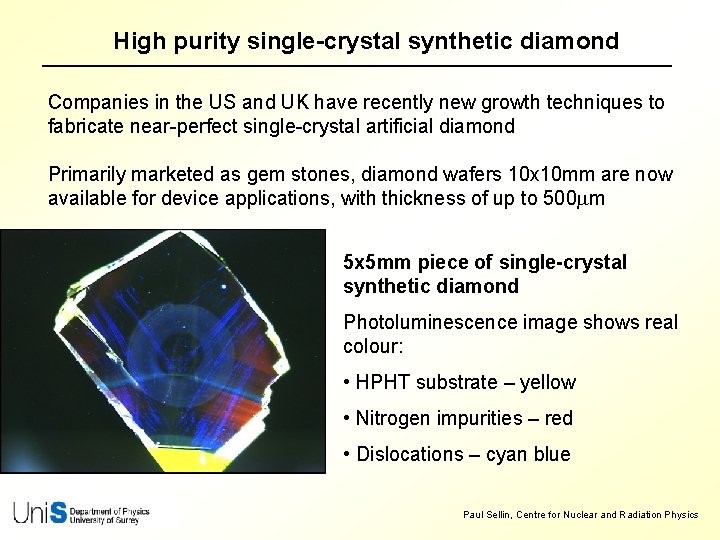
High purity single-crystal synthetic diamond Companies in the US and UK have recently new growth techniques to fabricate near-perfect single-crystal artificial diamond Primarily marketed as gem stones, diamond wafers 10 x 10 mm are now available for device applications, with thickness of up to 500 mm 5 x 5 mm piece of single-crystal synthetic diamond Photoluminescence image shows real colour: • HPHT substrate – yellow • Nitrogen impurities – red • Dislocations – cyan blue Paul Sellin, Centre for Nuclear and Radiation Physics
Single-crystal CVD diamond detectors Specialist applications of diamond detectors: r as tissue-equivalent rad-hard detectors, eg megavoltage therapy beams r detectors for very high temperature, high radiation environments True single-crystal material removes charge trapping associated with grain boundaries: r 100% CCE demonstrated from alpha particles r High mobility fast signals r Radiation hardness tests are in progress Paul Sellin, Centre for Nuclear and Radiation Physics
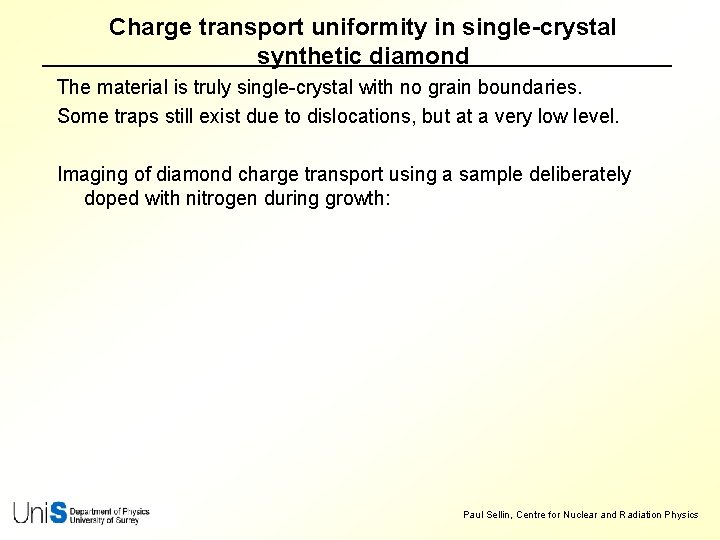
Charge transport uniformity in single-crystal synthetic diamond The material is truly single-crystal with no grain boundaries. Some traps still exist due to dislocations, but at a very low level. Imaging of diamond charge transport using a sample deliberately doped with nitrogen during growth: Paul Sellin, Centre for Nuclear and Radiation Physics
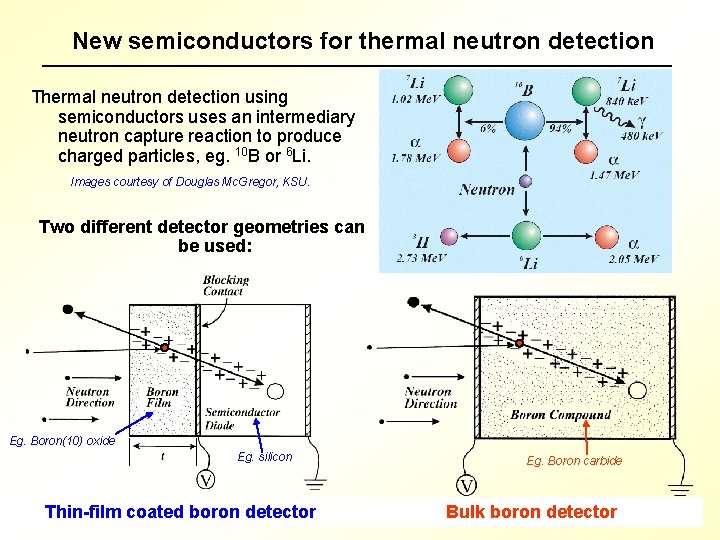
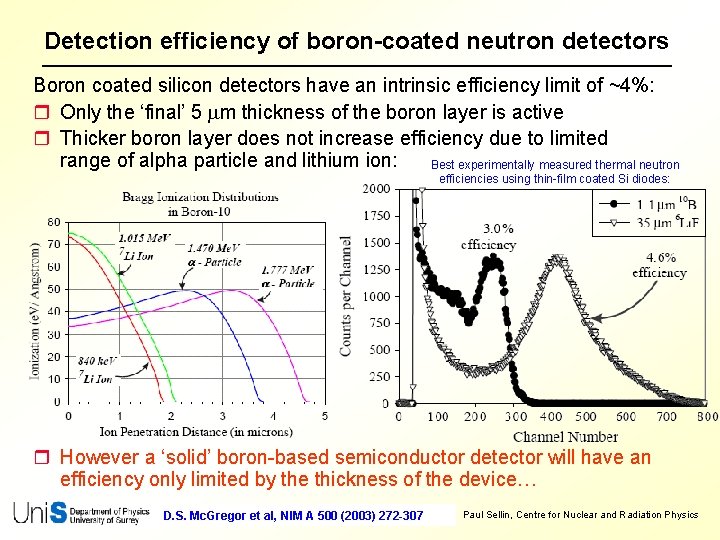
New semiconductors for thermal neutron detection Thermal neutron detection using semiconductors uses an intermediary neutron capture reaction to produce charged particles, eg. 10 B or 6 Li. Images courtesy of Douglas Mc. Gregor, KSU. Two different detector geometries can be used: Eg. Boron(10) oxide Eg. silicon Thin-film coated boron detector Eg. Boron carbide Paul Sellin, Centredetector for Nuclear and Radiation Physics Bulk boron
Detection efficiency of boron-coated neutron detectors Boron coated silicon detectors have an intrinsic efficiency limit of ~4%: r Only the ‘final’ 5 mm thickness of the boron layer is active r Thicker boron layer does not increase efficiency due to limited range of alpha particle and lithium ion: Best experimentally measured thermal neutron efficiencies using thin-film coated Si diodes: r However a ‘solid’ boron-based semiconductor detector will have an efficiency only limited by the thickness of the device… D. S. Mc. Gregor et al, NIM A 500 (2003) 272 -307 Paul Sellin, Centre for Nuclear and Radiation Physics
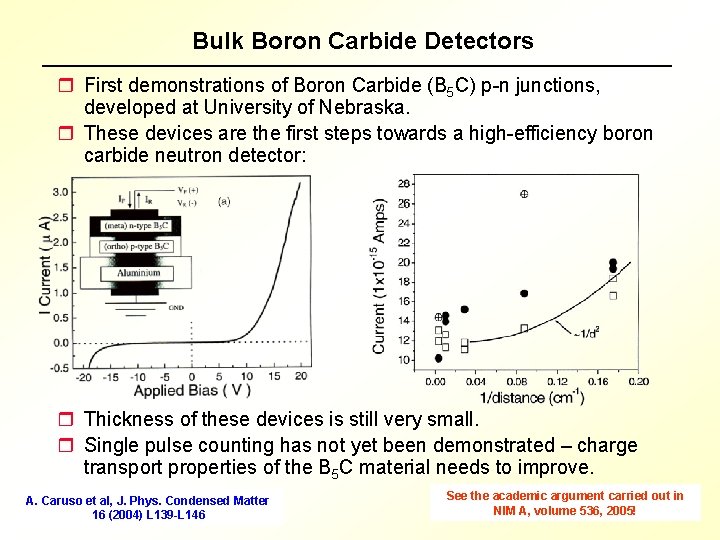
Bulk Boron Carbide Detectors r First demonstrations of Boron Carbide (B 5 C) p-n junctions, developed at University of Nebraska. r These devices are the first steps towards a high-efficiency boron carbide neutron detector: r Thickness of these devices is still very small. r Single pulse counting has not yet been demonstrated – charge transport properties of the B 5 C material needs to improve. A. Caruso et al, J. Phys. Condensed Matter 16 (2004) L 139 -L 146 See the academic argument carried out in NIMCentre A, volume 536, and 2005! Paul Sellin, for Nuclear Radiation Physics
Conclusions r The demand for high-Z semiconductor radiation imaging detectors continues to develop, with potential applications in medical, synchrotron, space and security imaging r Cd. Zn. Te continues to dominate the commercial supply of high-Z materials, with new suppliers of detector-grade material slowly becoming available r There is a steady improvement in Cd. Zn. Te material uniformity, single-crystal volume, and spectroscopic performance, with mte approaching 10 -2 cm 2/Vs r There is significant R&D activity in thick film materials, compatible with largearea imaging devices: Ÿ Polycrystalline and epitaxial Cd. Te/Cd. Zn. Te thick films Ÿ Various Z 80 compounds, with excellent imaging performance demonstrated by Hg. I 2 r Amongst the various new materials, synthetic single-crystal diamond has many promising uses for dosimetry and radiation-hard detectors r Boron-based semiconductors are poised to produce new advances in neutron detection Paul Sellin, Centre for Nuclear and Radiation Physics
Paul Sellin, Centre for Nuclear and Radiation Physics