
New Magnet Technology for high field Lucio Rossi
- Slides: 23
New Magnet Technology (for high field) Lucio Rossi CERN INFN - CNS 1 future strategy Elba 22 May 2014
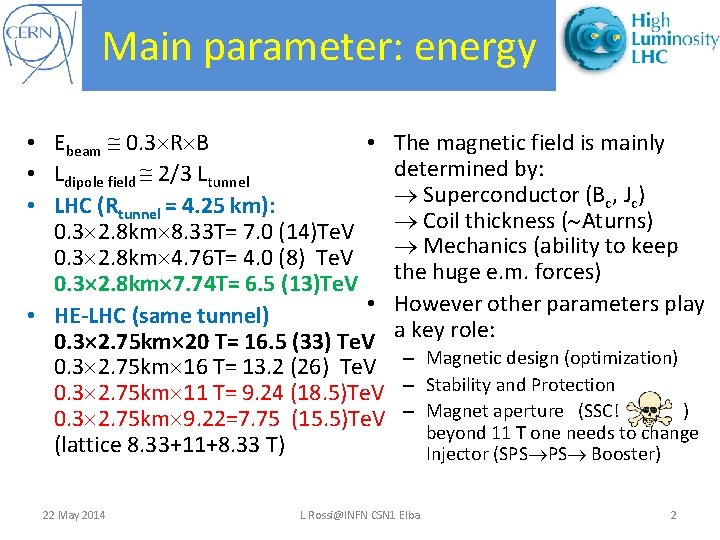
Main parameter: energy • Ebeam 0. 3 R B • • Ldipole field 2/3 Ltunnel • LHC (Rtunnel = 4. 25 km): 0. 3 2. 8 km 8. 33 T= 7. 0 (14)Te. V 0. 3 2. 8 km 4. 76 T= 4. 0 (8) Te. V 0. 3 2. 8 km 7. 74 T= 6. 5 (13)Te. V • • HE-LHC (same tunnel) 0. 3 2. 75 km 20 T= 16. 5 (33) Te. V 0. 3 2. 75 km 16 T= 13. 2 (26) Te. V 0. 3 2. 75 km 11 T= 9. 24 (18. 5)Te. V 0. 3 2. 75 km 9. 22=7. 75 (15. 5)Te. V (lattice 8. 33+11+8. 33 T) 22 May 2014 The magnetic field is mainly determined by: Superconductor (Bc, Jc) Coil thickness ( Aturns) Mechanics (ability to keep the huge e. m. forces) However other parameters play a key role: – Magnetic design (optimization) – Stability and Protection – Magnet aperture (SSC! ) beyond 11 T one needs to change Injector (SPS PS Booster) L. Rossi@INFN CSN 1 Elba 2
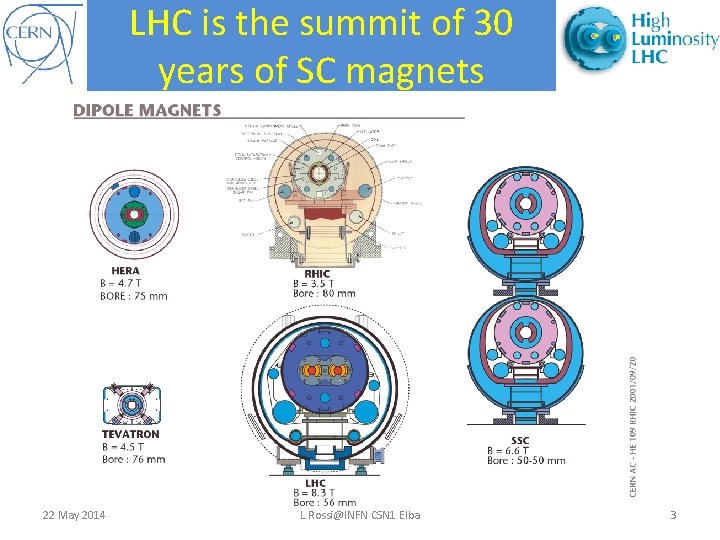
LHC is the summit of 30 years of SC magnets 22 May 2014 L. Rossi@INFN CSN 1 Elba 3
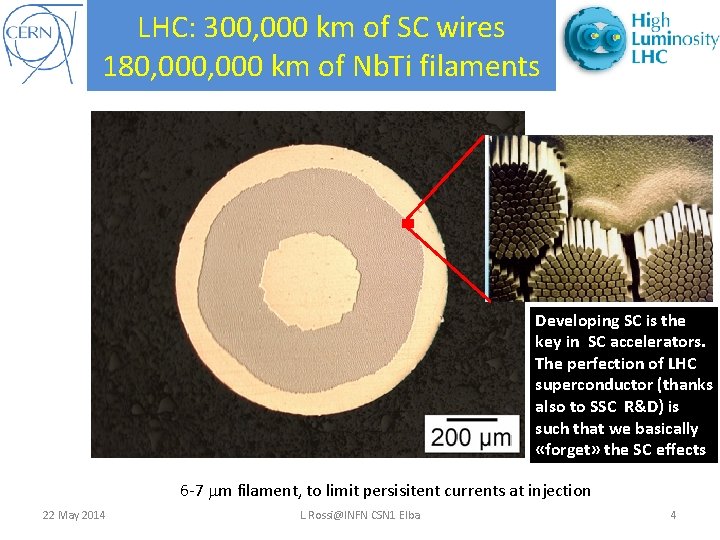
LHC: 300, 000 km of SC wires 180, 000 km of Nb. Ti filaments Developing SC is the key in SC accelerators. The perfection of LHC superconductor (thanks also to SSC R&D) is such that we basically «forget» the SC effects 6 -7 m filament, to limit persisitent currents at injection 22 May 2014 L. Rossi@INFN CSN 1 Elba 4
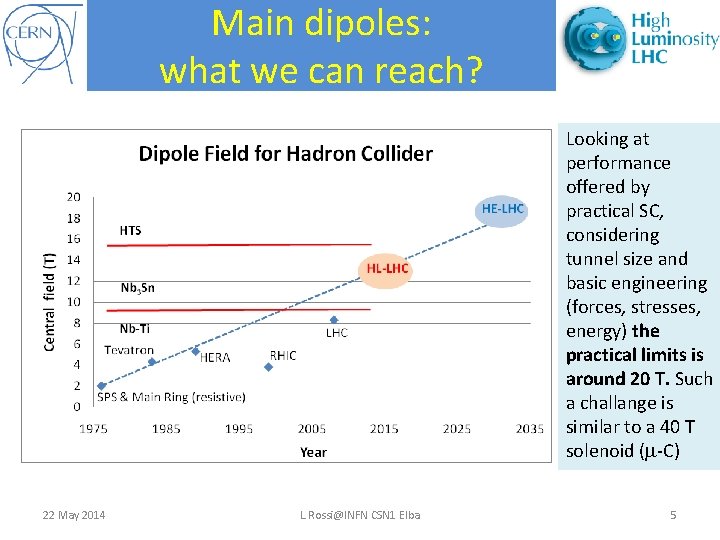
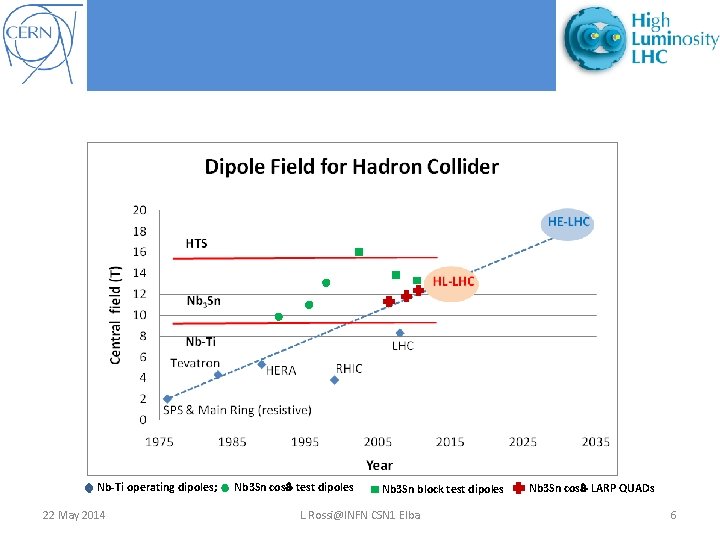
Main dipoles: what we can reach? Looking at performance offered by practical SC, considering tunnel size and basic engineering (forces, stresses, energy) the practical limits is around 20 T. Such a challange is similar to a 40 T solenoid ( -C) 22 May 2014 L. Rossi@INFN CSN 1 Elba 5
Nb-Ti operating dipoles; 22 May 2014 Nb 3 Sn cos test dipoles Nb 3 Sn block test dipoles L. Rossi@INFN CSN 1 Elba Nb 3 Sn cos LARP QUADs 6
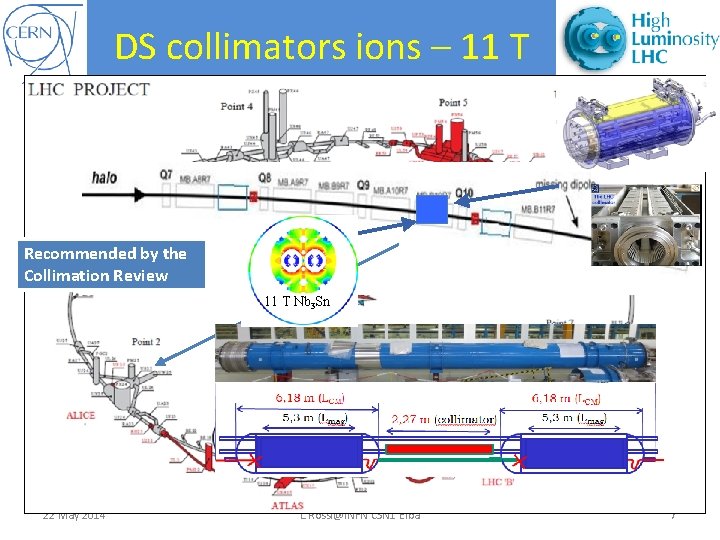
DS collimators ions – 11 T Recommended by the Collimation Review 11 T Nb 3 Sn 22 May 2014 L. Rossi@INFN CSN 1 Elba 7
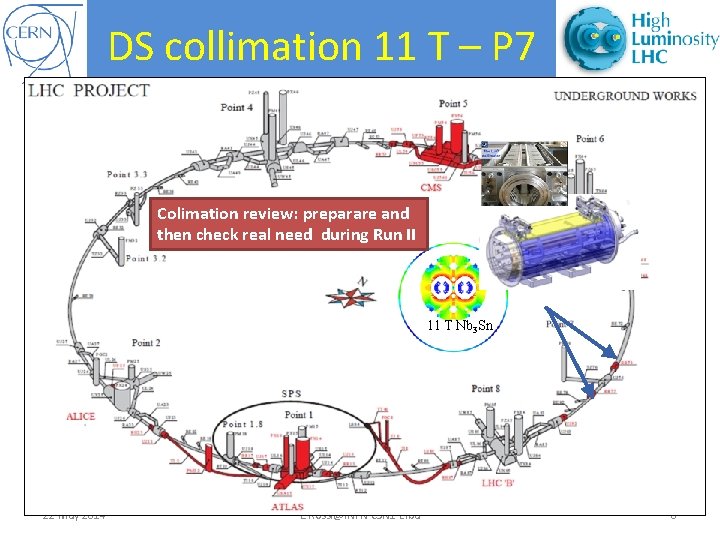
DS collimation 11 T – P 7 Colimation review: preparare and then check real need during Run II 11 T Nb 3 Sn 22 May 2014 L. Rossi@INFN CSN 1 Elba 8
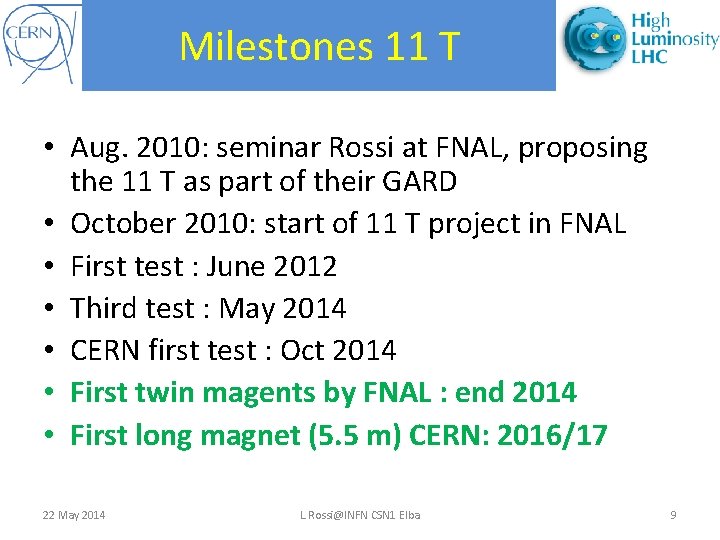
Milestones 11 T • Aug. 2010: seminar Rossi at FNAL, proposing the 11 T as part of their GARD • October 2010: start of 11 T project in FNAL • First test : June 2012 • Third test : May 2014 • CERN first test : Oct 2014 • First twin magents by FNAL : end 2014 • First long magnet (5. 5 m) CERN: 2016/17 22 May 2014 L. Rossi@INFN CSN 1 Elba 9
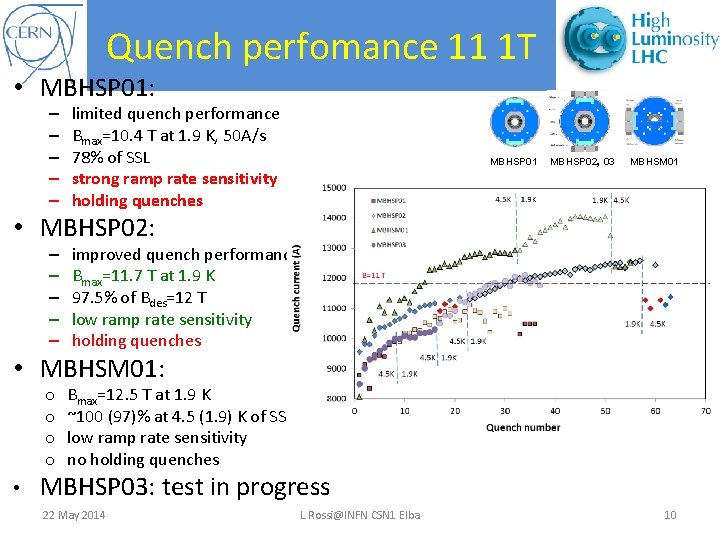
Quench perfomance 11 1 T • MBHSP 01: – – – limited quench performance Bmax=10. 4 T at 1. 9 K, 50 A/s 78% of SSL strong ramp rate sensitivity holding quenches MBHSP 01 MBHSP 02, 03 MBHSM 01 • MBHSP 02: – – – improved quench performance Bmax=11. 7 T at 1. 9 K 97. 5% of Bdes=12 T low ramp rate sensitivity holding quenches • MBHSM 01: o o • Bmax=12. 5 T at 1. 9 K ~100 (97)% at 4. 5 (1. 9) K of SSL low ramp rate sensitivity no holding quenches MBHSP 03: test in progress 22 May 2014 L. Rossi@INFN CSN 1 Elba 10
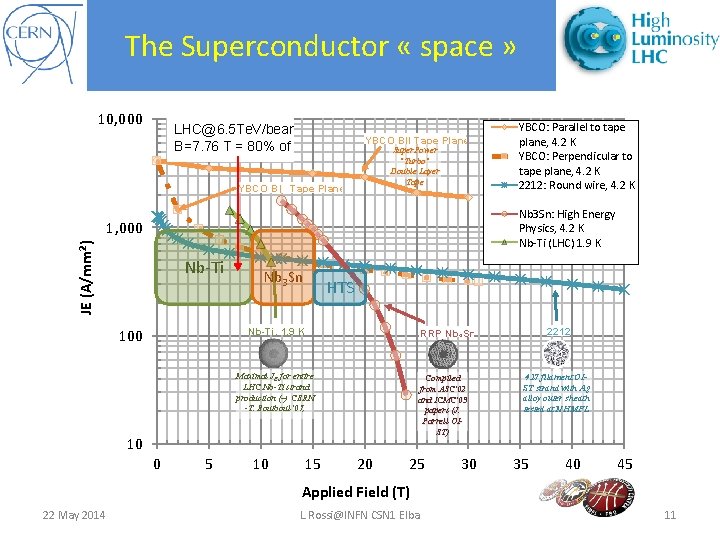
The Superconductor « space » 10, 000 LHC@6. 5 Te. V/beam B=7. 76 T = 80% of Ic YBCO B|| Tape Plane Super. Power "Turbo" Double Layer Tape YBCO B|_ Tape Plane YBCO: Parallel to tape plane, 4. 2 K YBCO: Perpendicular to tape plane, 4. 2 K 2212: Round wire, 4. 2 K Nb 3 Sn: High Energy Physics, 4. 2 K Nb-Ti (LHC) 1. 9 K JE (A/mm²) 1, 000 Nb-Ti Nb 3 Sn HTS Nb-Ti, 1. 9 K 100 Maximal JE for entire LHC Nb Ti strand production (–) CERN T. Boutboul '07, Compiled from ASC'02 and ICMC'03 papers (J. Parrell OI ST) 10 0 5 10 15 2212 RRP Nb 3 Sn 20 25 30 427 filament OIST strand with Ag alloy outer sheath tested at NHMFL 35 40 45 Applied Field (T) 22 May 2014 L. Rossi@INFN CSN 1 Elba 11
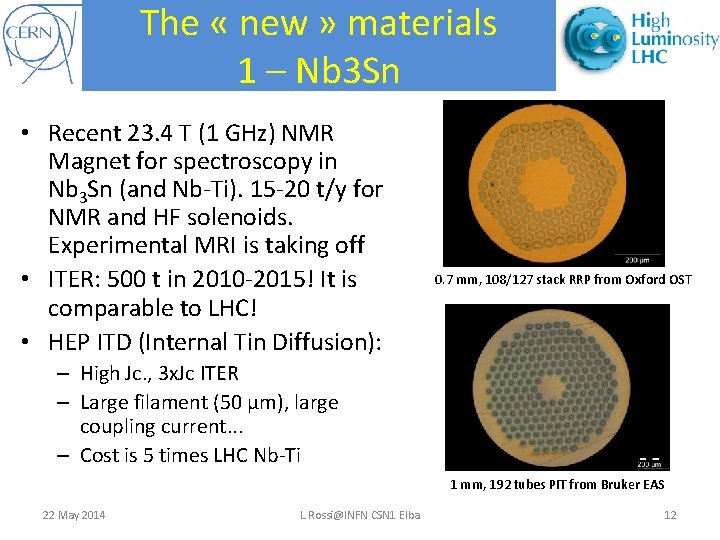
The « new » materials 1 – Nb 3 Sn • Recent 23. 4 T (1 GHz) NMR Magnet for spectroscopy in Nb 3 Sn (and Nb-Ti). 15 -20 t/y for NMR and HF solenoids. Experimental MRI is taking off • ITER: 500 t in 2010 -2015! It is comparable to LHC! • HEP ITD (Internal Tin Diffusion): 0. 7 mm, 108/127 stack RRP from Oxford OST – High Jc. , 3 x. Jc ITER – Large filament (50 µm), large coupling current. . . – Cost is 5 times LHC Nb-Ti 1 mm, 192 tubes PIT from Bruker EAS 22 May 2014 L. Rossi@INFN CSN 1 Elba 12
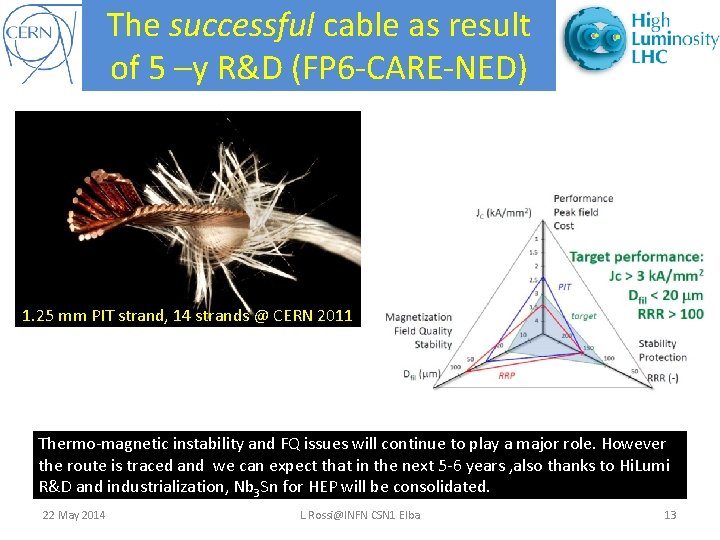
The successful cable as result of 5 –y R&D (FP 6 -CARE-NED) 1. 25 mm PIT strand, 14 strands @ CERN 2011 Thermo-magnetic instability and FQ issues will continue to play a major role. However the route is traced and we can expect that in the next 5 -6 years , also thanks to Hi. Lumi R&D and industrialization, Nb 3 Sn for HEP will be consolidated. 22 May 2014 L. Rossi@INFN CSN 1 Elba 13
CERN Program • Nb 3 Sn • Hi. Lumi: consolidate cable by 2014 and magnet desing – perfomance at 11 -13 T by 2016 • Hilumi magnets has high quality only at collision • FCC: launch conductor R&D now for new generation • Design 15 -16 T dipole (small aperture) now, first model by 2018? 22 May 2014 HTS Started basic R&D (Eucard 2) Explore the parameter space Demonstrate technical feasibility (the equivalent of LARP program for Nb 3 Sn) by 2018 • Cost reduction program (2020) • Design and test accelerator magnets by 2020 -2025 • HTS will be needed for HE-LHC or FCC at least in some regions of the accelerator. Boost 2025% in energy. • • L. Rossi@INFN CSN 1 Elba 14
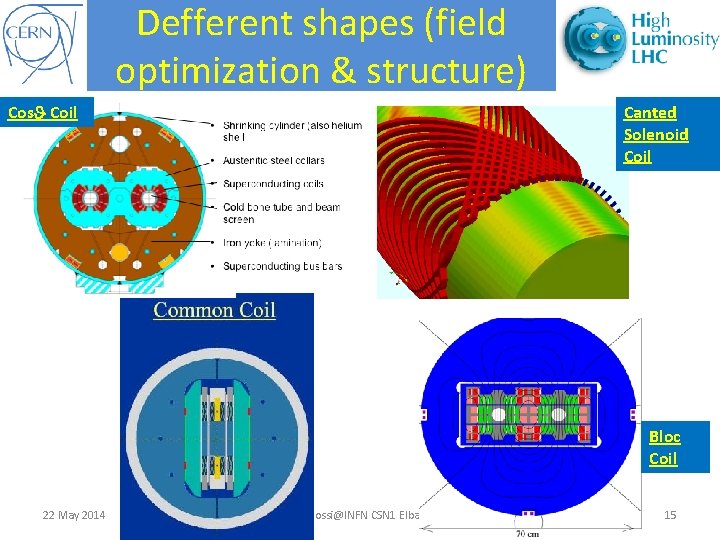
Defferent shapes (field optimization & structure) Cos Coil Canted Solenoid Coil Bloc Coil 22 May 2014 L. Rossi@INFN CSN 1 Elba 15
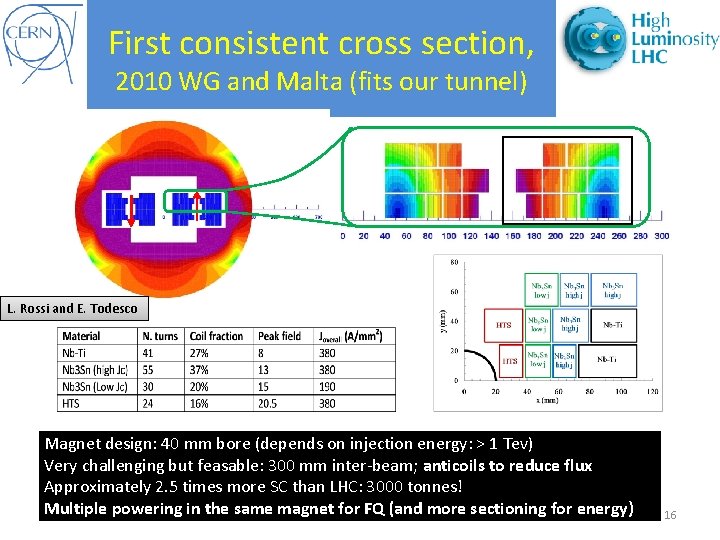
First consistent cross section, 2010 WG and Malta (fits our tunnel) L. Rossi and E. Todesco Magnet design: 40 mm bore (depends on injection energy: > 1 Tev) Very challenging but feasable: 300 mm inter-beam; anticoils to reduce flux Approximately 2. 5 times more SC than LHC: 3000 tonnes! Multiple powering in the same magnet for FQ (and more sectioning for energy) 22 May 2014 L. Rossi@INFN CSN 1 Elba 16
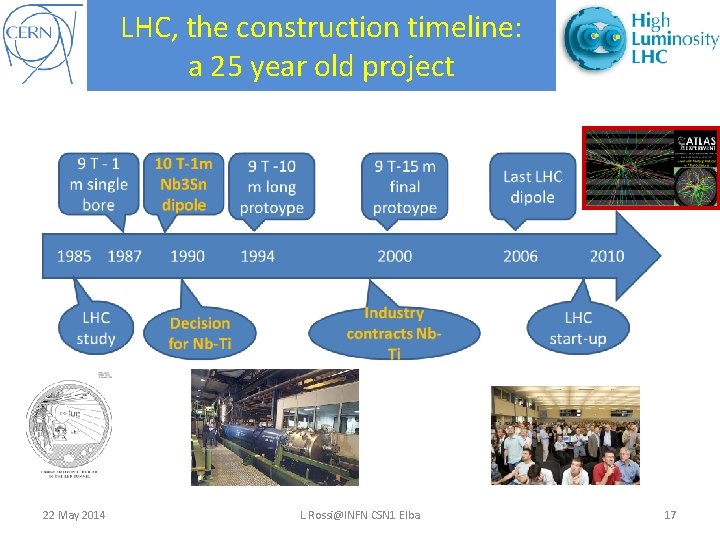
LHC, the construction timeline: a 25 year old project 22 May 2014 L. Rossi@INFN CSN 1 Elba 17
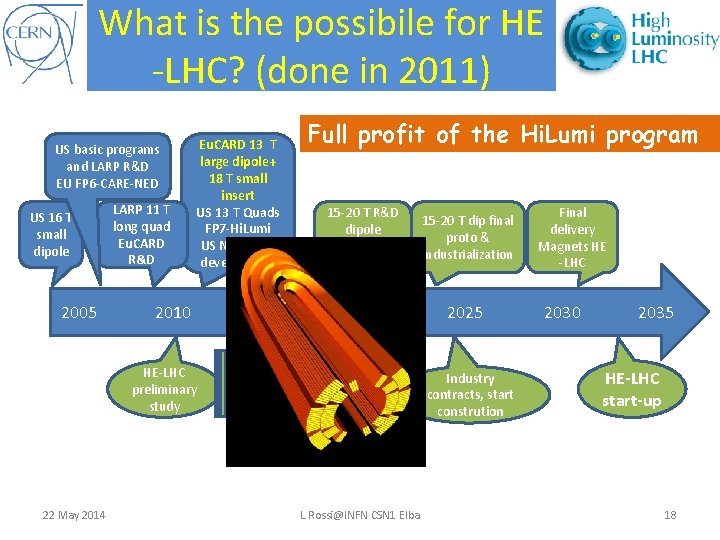
What is the possibile for HE -LHC? (done in 2011) US basic programs and LARP R&D EU FP 6 -CARE-NED US 16 T small dipole LARP 11 T long quad Eu. CARD R&D Eu. CARD 13 T large dipole+ 18 T small insert US 13 T Quads FP 7 -Hi. Lumi US Nb. Sn-HTS development Full profit of the Hi. Lumi program 15 -20 T R&D dipole models and prototypes 15 -20 T dip final proto & Industrialization Final delivery Magnets HE -LHC 2005 2010 2015 2020 2025 2030 2035 HE-LHC preliminary study 22 May 2014 Eu. CARD 2 full bore dipole HTS for HE-LHC: yes. or. no L. Rossi@INFN CSN 1 Elba Industry contracts, start constrution HE-LHC start-up 18
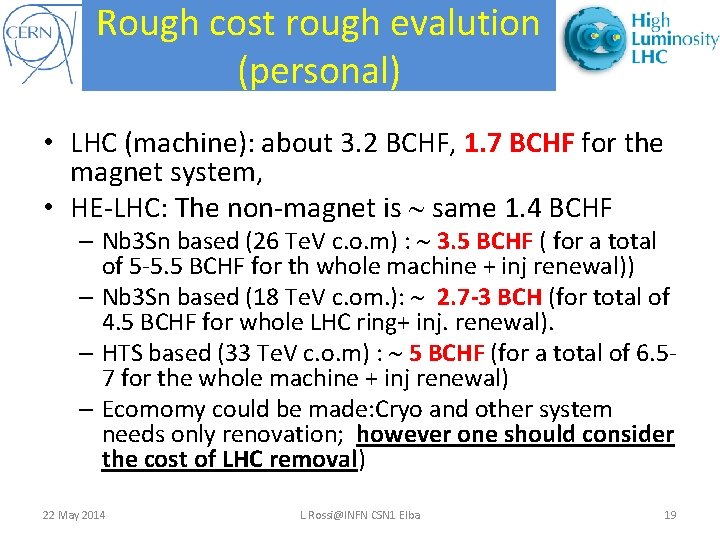
Rough cost rough evalution (personal) • LHC (machine): about 3. 2 BCHF, 1. 7 BCHF for the magnet system, • HE-LHC: The non-magnet is same 1. 4 BCHF – Nb 3 Sn based (26 Te. V c. o. m) : 3. 5 BCHF ( for a total of 5 -5. 5 BCHF for th whole machine + inj renewal)) – Nb 3 Sn based (18 Te. V c. om. ): 2. 7 -3 BCH (for total of 4. 5 BCHF for whole LHC ring+ inj. renewal). – HTS based (33 Te. V c. o. m) : 5 BCHF (for a total of 6. 57 for the whole machine + inj renewal) – Ecomomy could be made: Cryo and other system needs only renovation; however one should consider the cost of LHC removal) 22 May 2014 L. Rossi@INFN CSN 1 Elba 19
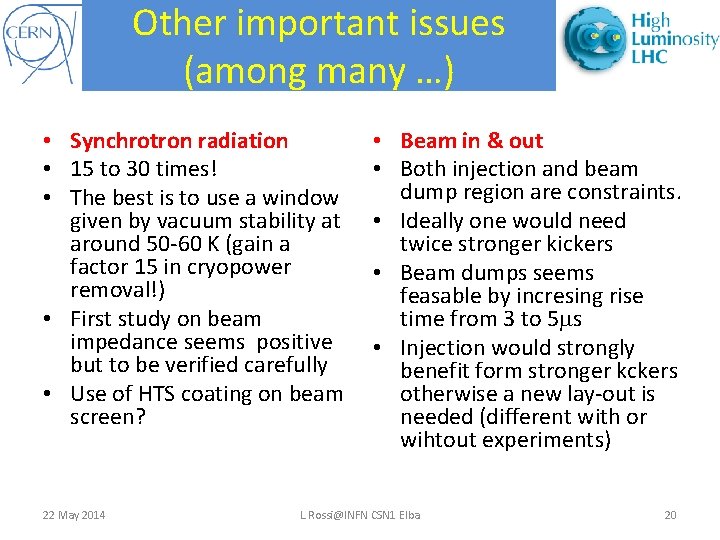
Other important issues (among many …) • Synchrotron radiation • 15 to 30 times! • The best is to use a window given by vacuum stability at around 50 -60 K (gain a factor 15 in cryopower removal!) • First study on beam impedance seems positive but to be verified carefully • Use of HTS coating on beam screen? 22 May 2014 • Beam in & out • Both injection and beam dump region are constraints. • Ideally one would need twice stronger kickers • Beam dumps seems feasable by incresing rise time from 3 to 5 s • Injection would strongly benefit form stronger kckers otherwise a new lay-out is needed (different with or wihtout experiments) L. Rossi@INFN CSN 1 Elba 20
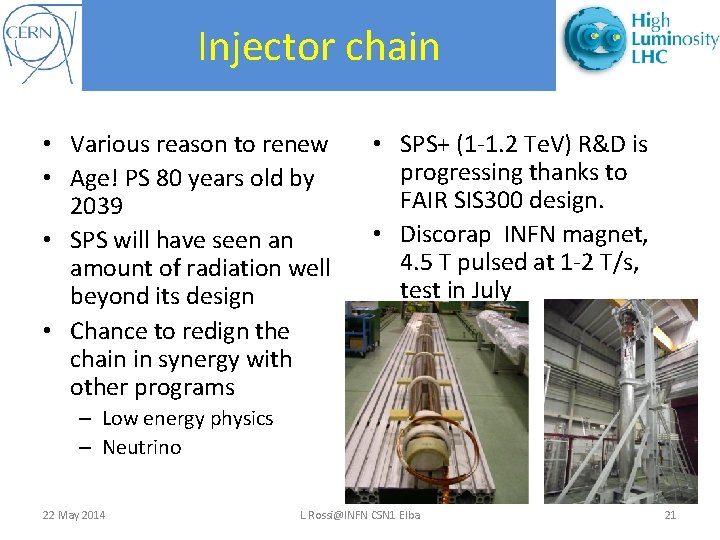
Injector chain • Various reason to renew • Age! PS 80 years old by 2039 • SPS will have seen an amount of radiation well beyond its design • Chance to redign the chain in synergy with other programs • SPS+ (1 -1. 2 Te. V) R&D is progressing thanks to FAIR SIS 300 design. • Discorap INFN magnet, 4. 5 T pulsed at 1 -2 T/s, test in July – Low energy physics – Neutrino 22 May 2014 L. Rossi@INFN CSN 1 Elba 21
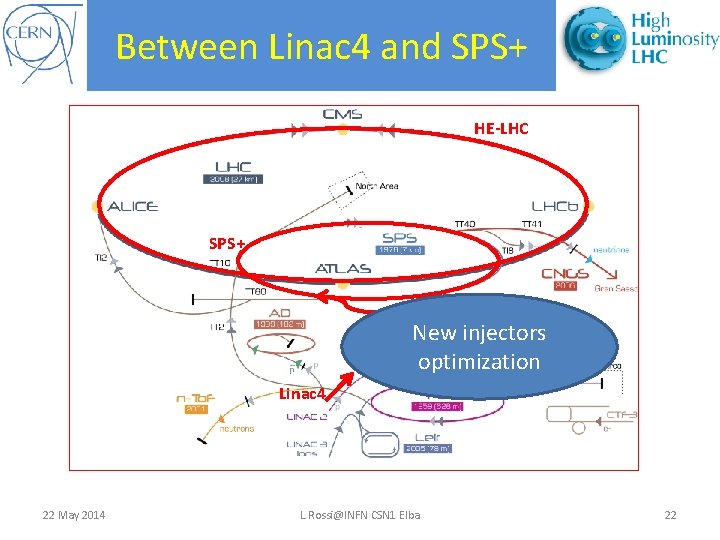
Between Linac 4 and SPS+ HE-LHC SPS+ New injectors optimization Linac 4 22 May 2014 L. Rossi@INFN CSN 1 Elba 22
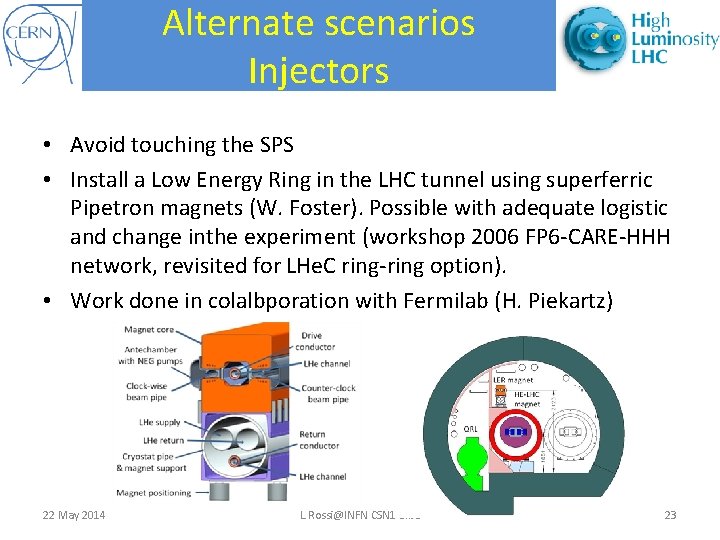
Alternate scenarios Injectors • Avoid touching the SPS • Install a Low Energy Ring in the LHC tunnel using superferric Pipetron magnets (W. Foster). Possible with adequate logistic and change inthe experiment (workshop 2006 FP 6 -CARE-HHH network, revisited for LHe. C ring-ring option). • Work done in colalbporation with Fermilab (H. Piekartz) 22 May 2014 L. Rossi@INFN CSN 1 Elba 23