
New Irregular Sampling Coding Method for Transmitting Images

- Slides: 18
New Irregular Sampling Coding Method for Transmitting Images Progressively Hung, K. -L. and Chang, C. -C. , IEE Image and Signal Processing, vol. 150, no. 1, Feb 2003, pp. 44 -50 Advisor :Chang, Chin-Chen Reporter: Lee, Jiau-Yun Date : 2003/5/6
Outline n n n Introduction Previous Works Proposed Method Experimental Result Conclusions
Introduction n PIT(Progressive Image Transmission) techniques are used to send an image through many stages. The receiver is given only a few bits to achieve a rough. Image quality is refined gradually.
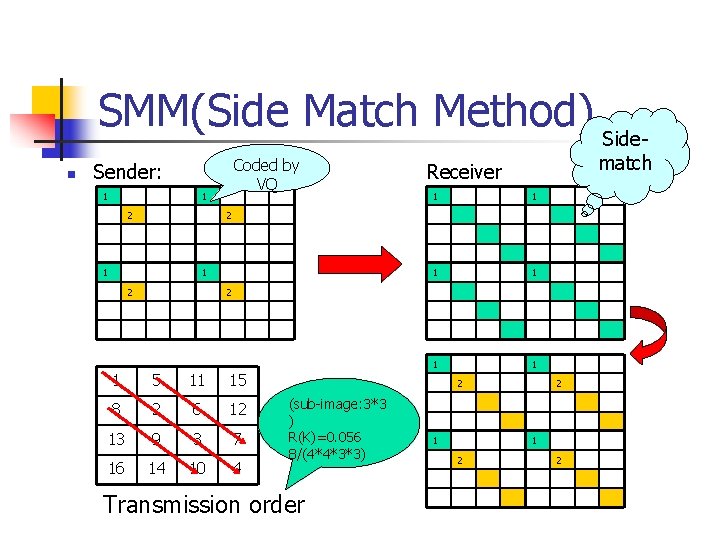
SMM(Side Match Method) Siden Coded by VQ Sender: 1 1 2 match Receiver 1 1 1 2 2 1 5 11 15 8 2 6 12 13 9 3 7 16 14 10 4 2 (sub-image: 3*3 ) R(K)=0. 056 8/(4*4*3*3) Transmission order 1 2 2
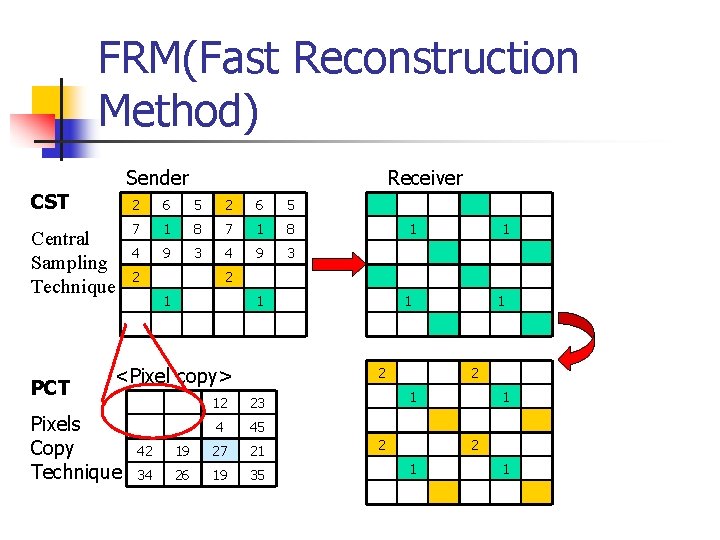
FRM(Fast Reconstruction Method) Sender CST Central Sampling Technique PCT Receiver 2 6 5 7 1 8 4 9 3 2 1 1 <Pixel copy> Pixels Copy Technique 1 1 2 12 23 4 45 42 19 27 21 34 26 19 35 1 2 1 2 1 1
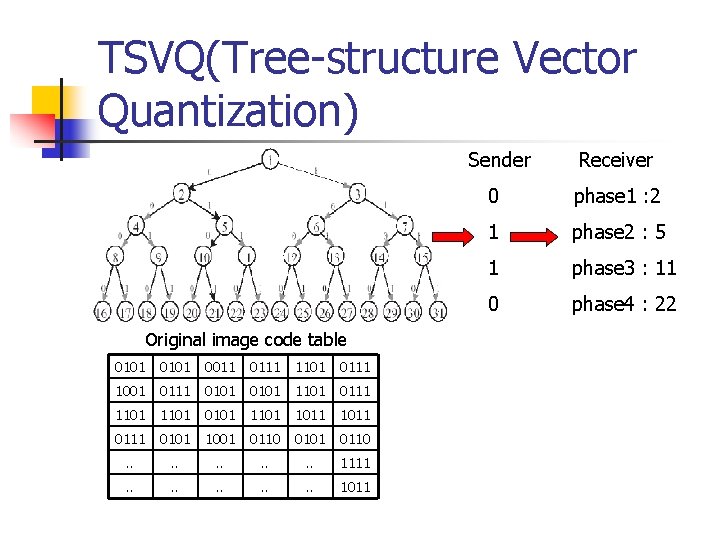
TSVQ(Tree-structure Vector Quantization) Sender Original image code table 0101 0011 0111 1101 0111 1001 0111 0101 1101 0111 1101 0101 1011 0101 1001 0110 0101 0110 . . 1111 . . 1011 Receiver 0 phase 1 : 2 1 phase 2 : 5 1 phase 3 : 11 0 phase 4 : 22
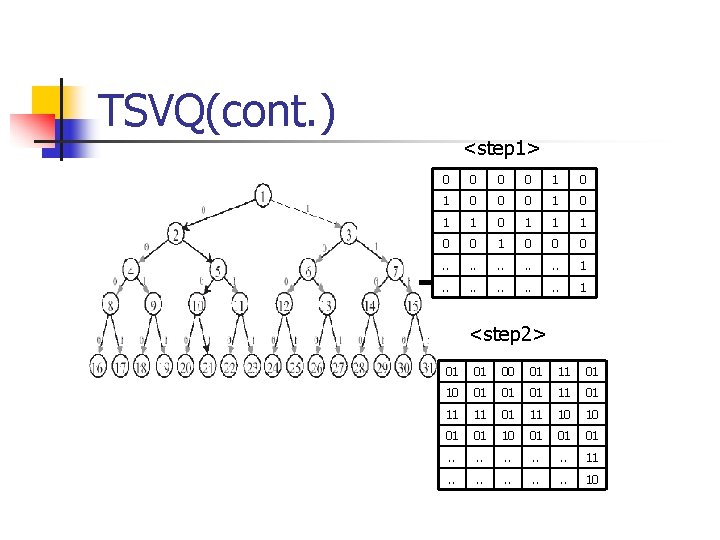
TSVQ(cont. ) <step 1> 0 0 1 0 0 0 1 1 1 0 0 0 . . 1 <step 2> 01 01 00 01 11 01 10 01 01 01 11 11 01 11 10 10 01 01 01 . . 10
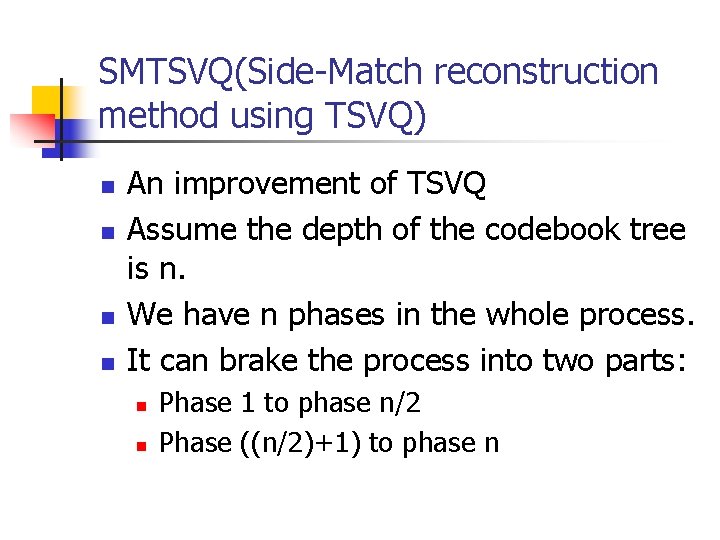
SMTSVQ(Side-Match reconstruction method using TSVQ) n n An improvement of TSVQ Assume the depth of the codebook tree is n. We have n phases in the whole process. It can brake the process into two parts: n n Phase 1 to phase n/2 Phase ((n/2)+1) to phase n
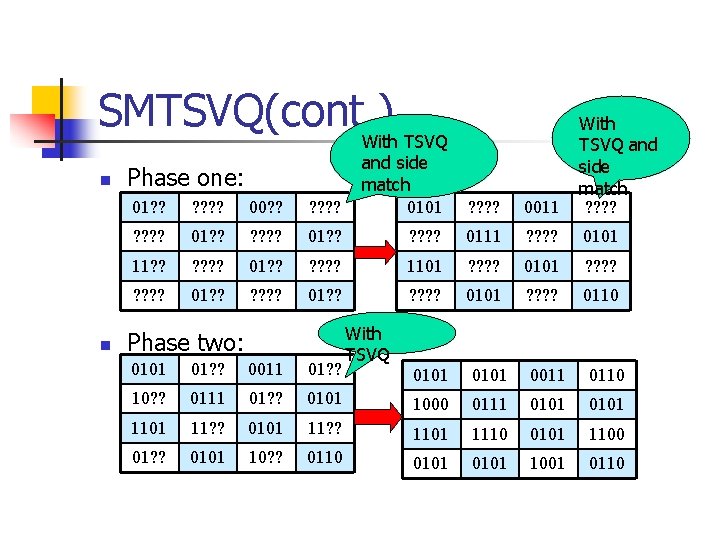
SMTSVQ(cont. ) With TSVQ n n ? ? 0011 With TSVQ and side match ? ? 01? ? 00? ? and side match 0101 ? ? ? ? 01? ? 0111 ? ? 0101 11? ? 01? ? 1101 ? ? 0101 ? ? ? ? 01? ? ? ? 0101 ? ? 0110 Phase one: Phase two: 0101 01? ? 0011 01? ? 10? ? 0111 01? ? 1101 11? ? 0101 With TSVQ 0101 0011 0110 0101 1000 0111 0101 11? ? 1101 1110 0101 1100 10? ? 0110 0101 1001 0110
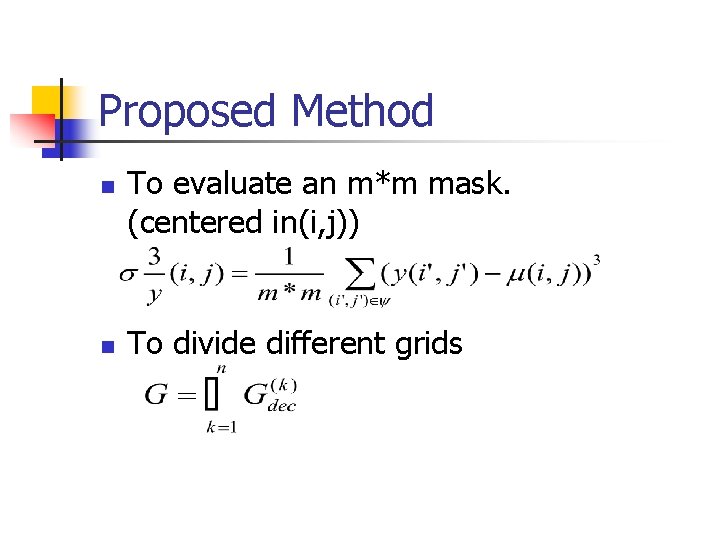
Proposed Method n n To evaluate an m*m mask. (centered in(i, j)) To divide different grids
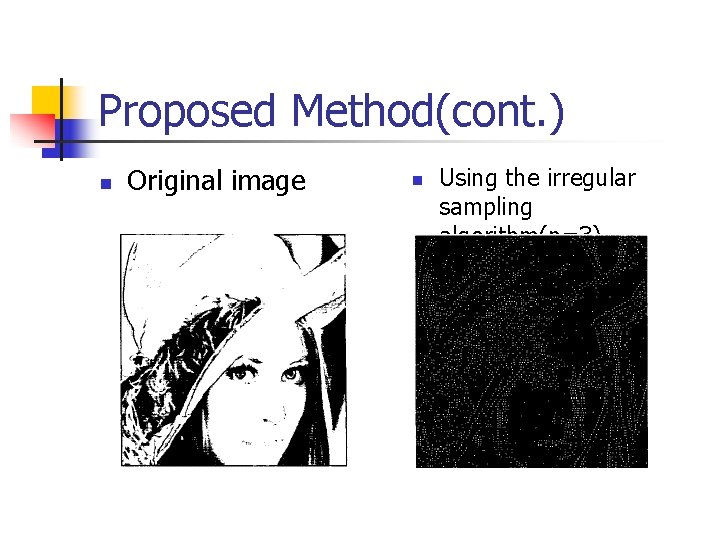
Proposed Method(cont. ) n Original image n Using the irregular sampling algorithm(n=3)
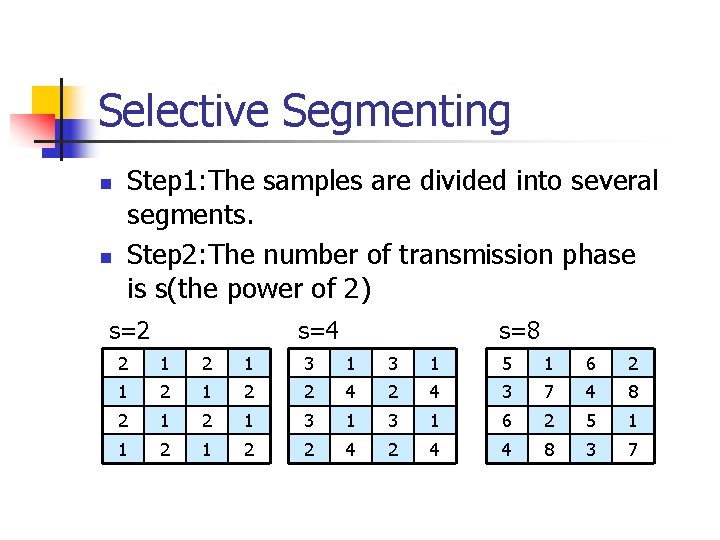
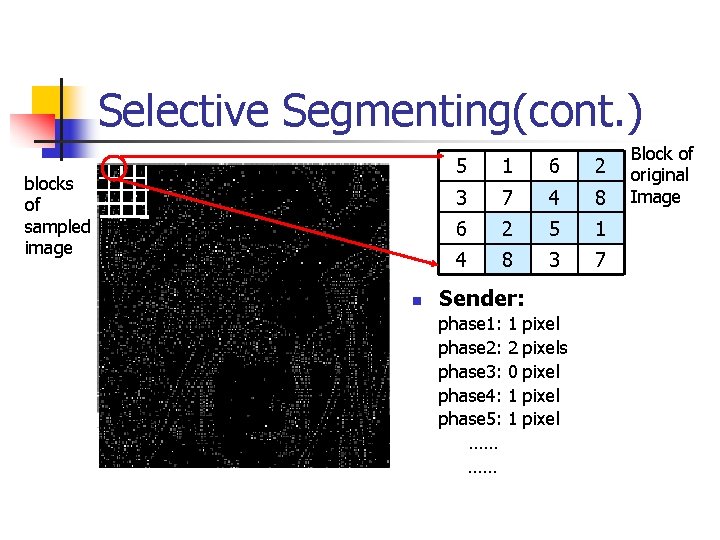
Selective Segmenting n n Step 1: The samples are divided into several segments. Step 2: The number of transmission phase is s(the power of 2) s=2 s=4 s=8 2 1 3 1 5 1 6 2 1 2 2 4 3 7 4 8 2 1 3 1 6 2 5 1 1 2 2 4 4 8 3 7
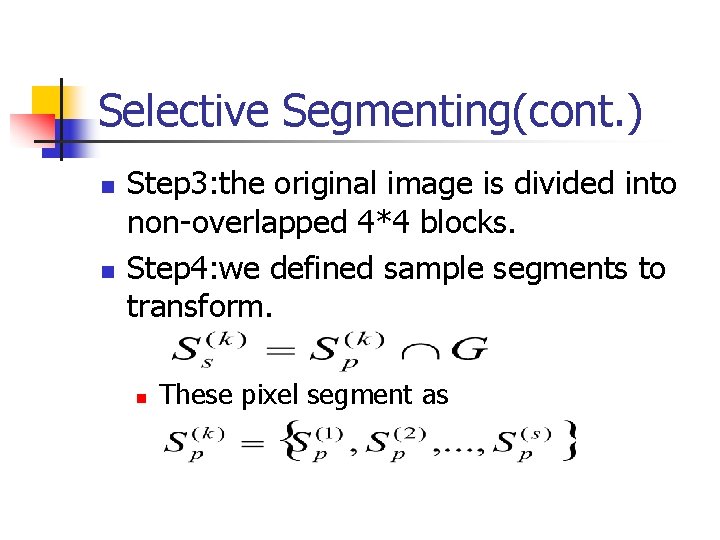
Selective Segmenting(cont. ) n n Step 3: the original image is divided into non-overlapped 4*4 blocks. Step 4: we defined sample segments to transform. n These pixel segment as
Selective Segmenting(cont. ) blocks of sampled image n 5 1 6 2 3 7 4 8 6 2 5 1 4 8 3 7 Sender: phase 1: phase 2: phase 3: phase 4: phase 5: …… …… 1 2 0 1 1 pixels pixel Block of original Image
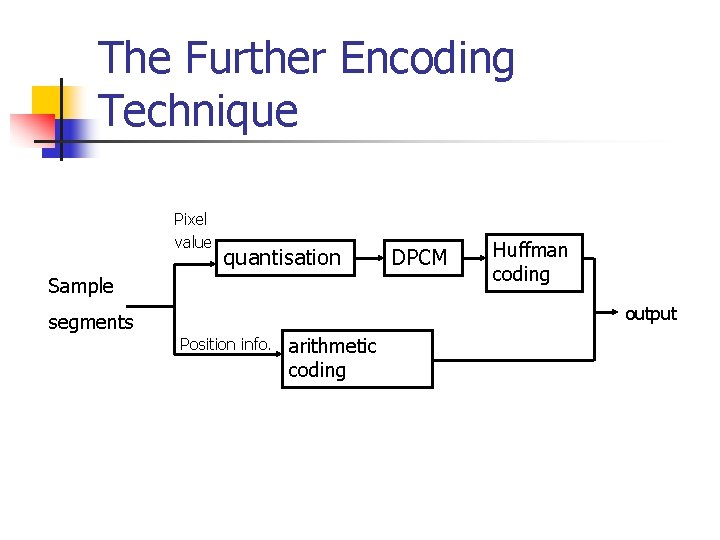
The Further Encoding Technique Pixel value quantisation Sample segments DPCM Huffman coding output Position info. arithmetic coding
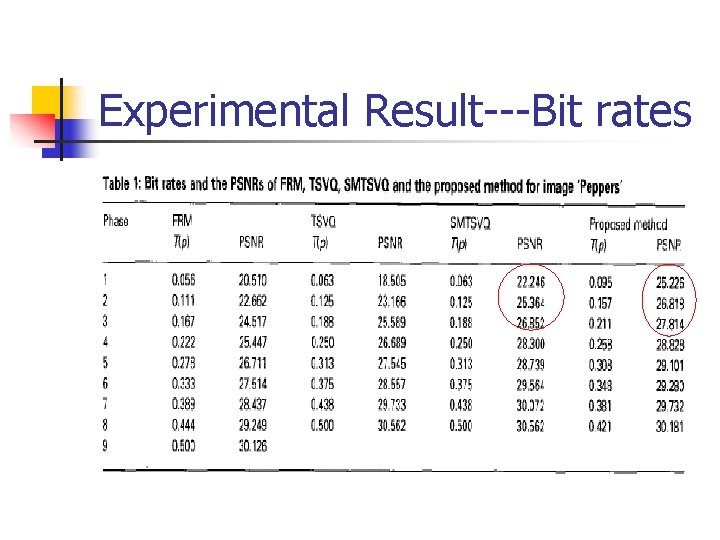
Experimental Result---Bit rates
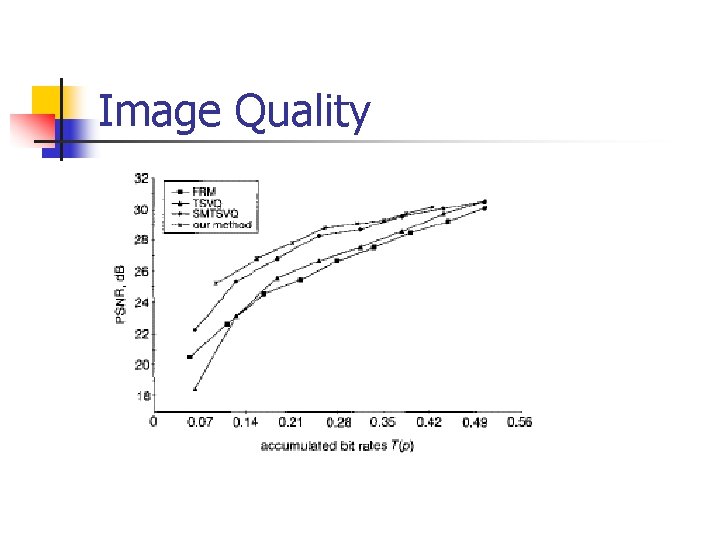
Image Quality
Conclusions n n By our experimental results, the image quality is better than FRM, TSVQ and SMTSVQ. the higher bit rate requirement will be reduced by increasing the number of transmission phases.